Linux Spur viewer, version 5.0.9.329906, dated November 17, 2017 and promoted to release status 29 November – offered pending a Linux version of the Alex Ivy viewer code.
Obsolete platform viewer, version 3.7.28.300847, May 8, 2015 – provided for users on Windows XP and OS X versions below 10.7.
In Brief
Teleport Fail Issues: following the last Server User Group meeting on Tuesday May 14th, there was a test of a teleport fix Simon Linden had been working on, and a further test was carried out following this week’s meeting, with Simon Linden commenting:
Last week’s test was really helpful – it showed that one problem seemed to be fixed, but exposed another one that I hope is fixed this week. If it goes well, that new teleport code may go out onto RC channels next week.
Teleport Attachment Issues: this is a separate issue to that being investigated by Simon Linden, and which is more related to . there’s no current update on the work being put into fixing this, but as Simon observed in the meeting:
As far as I know, the problems with attachments tend to be with crossings and not teleports … while much of the code is the same, there’s usually a fundamental difference in crossings because you’re already connected to that region before you go there, whereas with teleports you are not … which was part of the big disconnect issue we had before.
Script Processing Issues: as reported in my week #18 SUG summary, there have been numerous reports of script run time issues, with some reporting that problems only started occurring following the roll-back on April 18th, 2019. BUG-226851 outlines some of the problems. The Lab are looking into this, but at present there are no updates on the problem.
Since it opened, Bellisseria, the new Linden Homes continent, has started to develop into a thriving community of those not only interested in having a home there, but also in developing a community spirit. To assist with this, the Lab incorporated a number of social areas throughout the continent, such as the pool area in Gaim, which serves both the coastal houses and house boats in the area, and – most recently, it terms of this article – the Squishy Pickle bar in the houseboat regions added in May 2019.
However, residents have also added their own, creating the first public rez zones in the continent on their own properties and their own social spaces, such a pubs. where people can gather. As such, I thought I’d take a little road trip around the continent, using some of these locations as way points.
The beach-side pool at Gaim, the starting-point for my little drive
My starting point was the pool area at Gaim, selected simply because it is the closest public social area to my houseboat. From here, I took the coastal road north, heading up to Normandale, a region with several public spaces within walking distance of the local houses, including a picnic area looking out towards the Coral Waters airstrip off the coast. From here, and before reaching New Bigby, with its extensive west-facing beach, I turned inland.
The route led me past one of numerous show homes scattered across the continent. Like many such house, this one, by Apple Fall is open for people to come in and get ideas for interior décor for their homes. Sadly I couldn’t stop as I’d risk seeing my car go poof, so I continued east, passing through Greenbow, then taking a short run through the still-to-be-named SSPE228 with a brief turn north into Rockham and then east once more to Fourze.
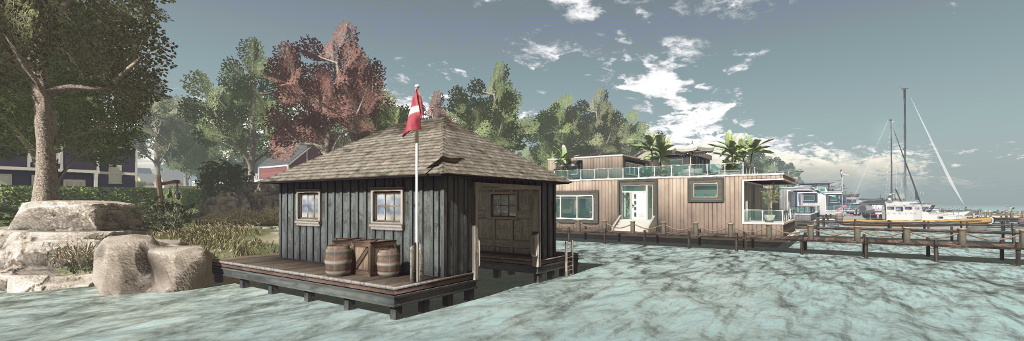
This took me past a riverside seating area before turning north along the coast, past one of the many little boathouses that are open to the public (as which I thought might be earmarks to become rezzing zones at some point); this one, pictured in the banner of this articles, looks out over one of the lighthouses that do have rezzing areas. Continuing north took me through Kiva and on to Maple Cross, with its hilltop garden area (which perhaps could use a little smoothing in some of the terraforming).
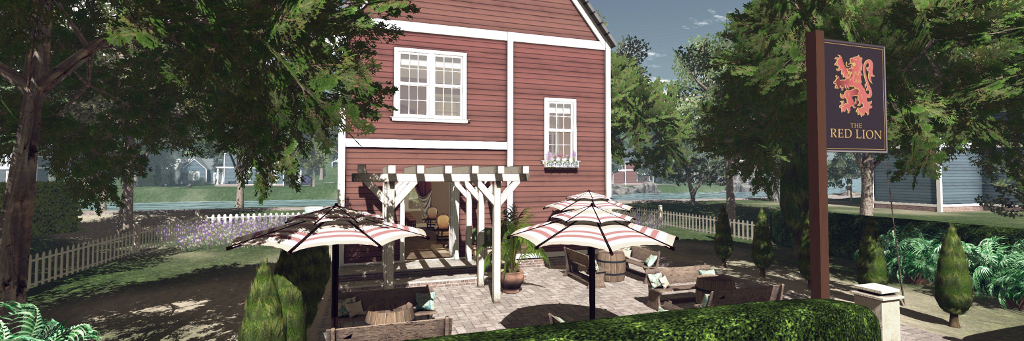
One of my primary destinations for this trip was Buitenwijk, and the Red Lion pub. Now, I’ll be honest, whenever I hear or read the words traditional English pub, I tend to shiver, as so often the words don’t tend to measure up to what we in the UK might regard as a “pub”. However, the Red Lion’s owner, Matty (Matty Luminos), is also from the UK, and the Red Lion does indeed offer the look and feel of a modern boutique-style pub, where a selection of beers, ales, wines and more might be pleasantly imbibed either indoors or out in the garden. With its riverside location.
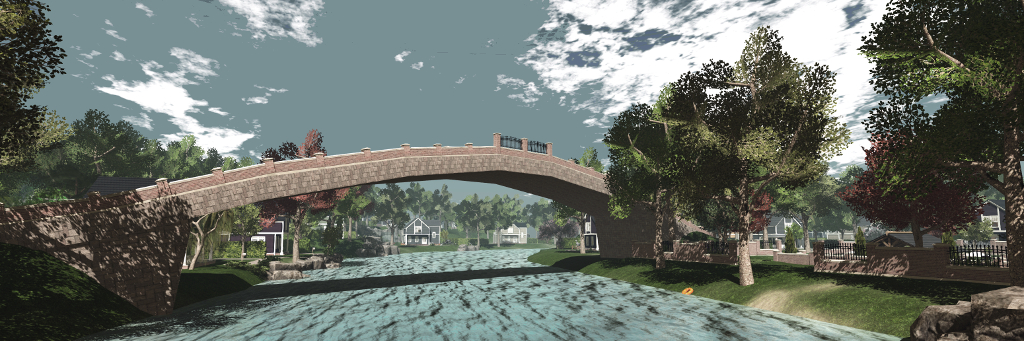
While the Red Lion offers open rezzing, calling-up a car in the garden would be rude, so instead, I resumed my travels via my trusty Roadrunner scooter, by Ape Piaggio (see A Second Life Roadrunner for more). Riding this, I again headed north, passing the impressive arc of the Capitol Springs Bridge, before continuing on through the houses to the rez point at what is currently called SPPE133. At this point, I cheekily swapped my scooter for my MD900 helo (which I quickly shoved onto the grass alongside the road after sitting in it!), and took to the skies for a quick flight back to my houseboat.
I’ve seen Bellisseria being referred to by some bloggers as a “ghetto”. I’m not sure where that perception comes from – outside of perhaps not having visited. Yes, the styles of homes are (for the present) somewhat limited (four variations of house and four variations of houseboat). But as any trip along the roads or waterways of Bellisseria or flights across the continent demonstrate, there is already sufficient variety of house style, coupled with people’s approaches to decorating their homes and gardens – including the various “extension” and “party packs” for interior / exterior supplements – to make Bellisseria a diverse and pleasant environment, entirely undeserving of the epithet.
For my part, I’m becoming increasingly persuaded by the attractions of Bellisseria and the growing community spirit within it – hence why I’ll be writing for The Bellisserian, the continent’s new resident-run newspaper. I plan to spend more time travelling through Bellisseria and, from time-to-time writing about places of interest within the continent like the Red Lion and the various Linden / Mole defined public spaces. In this, I would perhaps like the Lab to make the land-based rez points more obvious – it’s great having Yasmin’s HUD (see Finding rez zones in Bellisseria – Yasmin’s free HUD for more) – but having the rez points marked by a sign like those found on other mainland continents with road routes, would be handy – and could be done at the humble cost of 1 LI apiece.
In the meantime, my thanks to Gingir Ghoststar for her note card of points of interest and to the folks of the Bellisseria Citizen’s Group for pointing out additional public places they’ve discovered.
Logos representative only and should not be seen as an endorsement / preference / recommendation
Updates for the week ending Sunday, May 19th
This summary is generally published every Monday, and is a list of SL viewer / client releases (official and TPV) made during the previous week. When reading it, please note:
It is based on my Current Viewer Releases Page, a list of all Second Life viewers and clients that are in popular use (and of which I am aware), and which are recognised as adhering to the TPV Policy. This page includes comprehensive links to download pages, blog notes, release notes, etc., as well as links to any / all reviews of specific viewers / clients made within this blog.
By its nature, this summary presented here will always be in arrears, please refer to the Current Viewer Release Page for more up-to-date information.
Note that for purposes of length, TPV test viewers, preview / beta viewers / nightly builds are generally not recorded in these summaries.
Lumiya is currently unavailable through Google Play – see my article and update here. However, it remains available to new users (or can be re-purchased if urgent) via SlideMe.
La Maison d’Aneli, curated by Aneli Abeyante, is hosting another intriguing exhibition of 2D and 3D art. With its opening having taken place on May 15th, the exhibition features Giovanna Cerise, Delalune Ella, McGrafite, Vroum Short, Tshirtkikill Straaf and Mathilde Vhargon.
For her 3D installation, Giovanna Cerise uses a quote from Italian writer and poet, Alda Merini, One lies on the back of the world and feels. It is the final line from Merini’s poem I like the verb “to feel”, one of a series of reflections on words, and the theme of the poem – that of feelings – is the core reflection of the elements of Giovanna’s installation.
These start with a sculpture of a woman lying on her back bearing, appropriately enough, Ci si sdraia sulla schiena del mondo (“one lies on the back of the world”). Around this are pieces with titles intended to evoke emotional states: Waiting, Transcendence, Solitude, Eros. All of these are placed within a series of monochrome geometric forms that echo some of Giovanna’s previous installations and is something of a motif of her work.
Also on the same level of the gallery as Giovanna’s installation is a selection of Mathilde Vhargon’s digital paintings that mix an abstract approach with geometric pieces, most of which are created more-or-less as a stream of consciousness approach, rather that any “premeditated” approach, as Mathilde herself notes:
My paintings suggest themselves to me a little at a time without conscious planning. I often use small sections of them as materials to develop into new paintings … I love strong colours and flowing abstract forms. You will often find ambiguous suggestions that lead the viewer to imagine various possibilities and interpretations.
Sharing the same level of the gallery is another stunning selection of drawings by McGrafite, also known as Marisa Camelo, MC.
A physical world artist focusing on pencil-based drawings, I was first introduced to her work at the end of 2018 (see The art of MC Grafite in Second Life), when I noted there is only one word that can be used to describe it: striking; the selection of art presented at La Maison d’Aneli fully reinforces this fact.
Beautifully produced, with marvellously clean lines and presentation, these are drawing rich with life and vitality and – in the case of a couple at least – a hint of menace. Such is the beauty of McGraphite’s drawing I admit to being an admirer of her work since that first introduction in December 2018.
Beautifully produced, with marvellously clean lines and presentation, these are drawing rich with life and vitality and – in the case of a couple at least – a hint of menace. Such is the beauty of McGraphite’s drawing I admit to being an admirer of her work since that first introduction in December 2018.
On the upper level of the gallery is an exhibition of art and photography by Lune (Delalune Ella). Again split between the main floor and the galleried mezzanine, the lower part of the exhibition features seven pieces of Lune’s digital art. These have a spiritual element to them, which is perhaps most noticeable in the pieces that include mandala-like rosette forms. Rich in vibrant colours, these are modern pieces that quickly captivate and engage.
Above them, Lune presents 13 photographs that appear to reflect some of Lune’s travels around the world, and within which a love of water is evident. Again, these are evocative pieces, expressive in their tone and presentation.
Across the hall are twelve pieces by yogib33r (Tshirtkikill Straaf). These are perhaps the most unusual pieces of art I’ve recently come across in Second Life, reproductions of yogib33r’s physical world art. Pen and ink (I believe), these are whimsical pieces that completely defy description, but have a unique charm and attraction about them that allows them to stand as pieces of modern art.
Rounding-out this ensemble exhibition is Mirrors a 3D installation by Vroum Short of Vegetal Planet fame. When visiting, it is essential you have the Advanced Lighting Model (ALM) enabled in your viewer (Preferences > Graphics > make sure Advanced Lighting Model is checked – you do not need to turn on shadows as well), and to set your viewer’s time of day to midnight.
As the name suggests, this is an installation – split between two levels – representing mirrors and reflective surfaces. The installation comprises a series of halls with mirror-like rooms containing static and animated pieces, some of which are designed to physically mirror one another. Created through the use of projectors, these are visually stunning effects – providing you have ALM enabled, as noted above. For those who are interested, the installation includes teleports to Vroum’s Vegetal Planet art region.
An artist’s impression of an unpiloted commercial lander leaving a scaled-back LOP-G for a descent to the surface of the Moon ahead of a 2024 human return to the lunar surface.Credit: NASA
On May 13th, 2019, NASA announced that the Trump Administration had requested a US $1.6 billion bump to the space agency’s 2020 budget, to assist it in its efforts to return humans to the Moon by 2024. If approved, the increase will be used by NASA as a “down payment” – or more correctly seed money – that will in particular be put towards studies and projects related to the development of a human-rated lunar lander.
Given just how much needs to be done, US $1.6 billion really isn’t that much; in 2019, NASA was allocated US $4.5 billion of a US $19.2 billion to put towards its lunar efforts, most of which was used in the development of the initial Space Launch System (SLS) rocket and the ongoing work in developing the Orion Multi-Purpose Crew Capsule, with small amounts being allocated to studies such as the Lunar Orbital Platform-Gateway (LOP-G) station, and development of a new generation of lunar-capable space suits.
But these capabilities are just a part of the infrastructure NASA needs to build if it really is to achieve a human return to the Moon by 2024. This includes the LOP-G itself, the need to carry out more extensive robotic exploration of the lunar south pole, the selected location for the landing, the development, testing and deployment of these robot missions, the development of the technologies NASA have touted as being required for a long-term human presence on the Moon (not all of which will be required in the initial phases of the return, admittedly). And, of course, there is the need to develop and test the lunar lander itself.
The Lockheed Martin Orion MPCV Ground Test Article (GTA), a version of the vehicle constructed specifically for testing under simulated conditions to demonstrate the environmental integrity and operational capability of the craft. Credit: NASA / Lockheed Martin
The announcement was used by NASA to springboard a series of new PR videos to help promote their lunar aspirations, including one narrated by William “James T. Kirk” Shatner – are upbeat whilst being light on details. Even so they are useful watching for those wanting to have the agency’s aims painted in the broadest of brush strokes.
Part of this PR drive included the confirmation of the lunar programme’s official title: Artemis. The daughter of Zeus and Leto, Artemis was the Greek goddess of the hunt, the wilderness, wild animals, and chastity, the patron and protector of young girls, and was worshipped as one of the primary goddesses of childbirth and midwifery.
However, in this instance, the most important aspect of Artemis’ legend is that she was regarded as the goddess of the Moon – and the twin sister to Apollo. As such, the name is clearly intended as a way to indirectly echo the can do attitude that marked the Apollo era.
NASA’s plans to send humans to the Moon by 2028 had three parts that could be launched, in part, by commercial rockets, and which used a fully operational LOP-G. If the White House target date of 2024 is to be met, these plans must be vastly accelerated – and NASA budget will require a committed year-on-year increase from the US government. Credit: NASA
With one billion of the additional budget request being specifically for use in lunar lander development, on May 17th, NASA confirmed that it has selected 11 companies to begin studies and initial prototype development of portions of human landers intended for use in the 2024 (and beyond) missions.
Some US $45.5 million has been set aside by NASA in support of all 11 companies, each of which is expected to make its own contribution – up to 20% of the total cost of their study / prototype programme to the development work. The awards are part of NASA’s Next Space Technologies for Exploration Partnerships (NextSTEP) programme, a series of broad agency announcements that support public-private partnerships to develop technologies needed for NASA’s exploration plans.
The 11 companies selected comprise Aerojet Rocketdyne, Blue Origin, Boeing, Dynetics, Lockheed Martin, Masten Space Systems, Maxar Technologies, Northrop Grumman Innovation Systems, OrbitBeyond, Sierra Nevada Corporation and SpaceX.
Given Lockheed Martin have been working on their own proposals for a lunar lander for some time (see Space Sunday: Moon, Mars, and abort systems), and Blue Origin recently unveiled their own lander, Blue Moon (see Space Sunday: a Blue Moon, water worlds and moving house), their inclusion in the list is unsurprising. Neither is the inclusion of the likes of SpaceX, Boeing, Sierra Nevada Corporation and Northrop Grumman. What is perhaps surprising is the inclusion of start-ups like OrbitBeyond (founded in 2018), which was initially granted a Commercial Lunar Payload Services (CLPS) contract by NASA, allowing it to bid on delivering science and technology payloads to the Moon, rather than being involved in the development of human-rated lander vehicles.
Blue Origin, who recently revealed a full-scale model of their Blue Moon lunar lander, are one of 11 companies selected by NASA to carry out initial work into a human-rated Moon lander. Credit: Blue Origin
The awards require companies to pay at least 20 percent of the overall cost of each study or prototype project, with the work to be completed in six months. To allow the companies to start work immediately, the participating companies are allowed to start work while the contract terms are still being negotiated.
However, it’s not all good news. The 2020 federal budget has yet to be passed by Congress, and on May 16th, the House Appropriations Committee released an updated 2020 federal budget proposal of their own. This includes an additional US $1.3 billion in spending for NASA – but almost none of it is earmarked for NASA’s exploration programmes, which encompass a return to the Moon. Instead, under the House proposal, that programme is effectively cut by US $618 million.
It’s now just over a month since I snagged my Linden Home houseboat shortly after the new Linden Homes continent was officially launched (see: Lab launches new Linden Homes). I initially settled on the Windlass houseboat design to turn into a second home (see Making a (Linden) houseboat a home), but this week, because I like fiddling with things, I decided to try out some of the other designs, starting with the Barnacle.
This is the only design in the initial batch of houseboats that has an actually room upstairs, giving it an interesting differentiator to the other three designs, and gives it a little extra floor space. This makes it an excellent choice for developing a cosy home design, hence my interest in it.
An element from Blush Bravin’s Party Pack for the Barnacle makes a great wall divider when creating a cosy lounge area, thw warmth increased by the Lab’s sunflower interior wall colour.
Another aspect in my decision to play the the Barnacle was Blush Bravin’s Party Boat add-on. This is one of a number of kits Blush has produced specifically for the new Linden Homes, all of which are available via her SL Marketplace store, and on the strength of the Barnacle kit, I’d say they are well worth the minimal investment of L$250.
For the Barnacle, the kit includes a range of items: internal room dividers, décor highlights, and external elements, such as a trellis for the upper deck and a porch for the front door, and a small room (bathroom?) that tucks into one side of the main floor. Everything is supplied in a rezzing system (which admittedly can require careful placement to avoid fiddling with bits post-deploy).
A snug living room
A HUD is also supplied for applying textures, although this didn’t want to work for me, so I relied on manual texturing. This wasn’t a problem as for my purposes, I only really required the room dividers and the brick wall panel from the main deck interior. One of these, with ceiling-height wooden slats, I combined with a humble prim to make a room divider to split the lower deck in two, giving me a lounge area and kitchen / dining space. The brick panel and smaller divider, became a breakfast bar for the kitchen.
I don’t usually go in for kitchens in SL houses (we don’t actually eat in SL after all), but there are some nice low LI mesh kitchen sets available, and I wanted to give the houseboat a homely feel so I picked up a nice kitchen and additional elements from [DDD] ~ Dysfunctionality: the Cozy County Kitchen wine rack, Christine fireplace, Heph’s Kitchen Counter, and Captain’s Lanterns, which together with my existing items from Cory Edo’s Trompe Loeil and a few other pieces from assorted sources allowed me to create the kind of look I wanted.
I don’t usually go in for kitchens and bit, but these houseboats call for them at times
Given there are four variations available with each house type which can be swapped with a simple set of clicks, swapping between them has already proven popular. Providing the fixtures and fittings used are both Copy and Modify, a rezzing tool such as Builder’s Buddy or those available on the Marketplace, makes the storing and placement of interiors for each style of house an additional breeze when swapping back and forth.
Just set your décor and layout items (piers, garden furnishings, etc.), use the rezzing system to record and store the pieces, make sure you also record the position of the rezzer (I use the Description field in the Edit floater), and – providing you don’t move to another parcel – you can swap between house styles and interiors in less than 5 minutes.
There’s even room for one of my beloved pianos – my Culprit Sonata Baby Grand. The small step between the two living spaces is to help break things up a little
The above is probably a case of preaching to the converted for some, but is does make swapping between house designs and layouts and lot more fun – and obviously, there’s no reason why you can’t have multiple layouts for any given house / houseboat type.
Now, if you’ll excuse me, I might go and have a play with the Wallower houseboat 🙂 .






 Inara Pey: Living in a Modemworld