Space Sunday: of tweets, space stations and helicopters

NASA has linked the Moon with Mars for decades, but only really emphasised the former whilst only talking vaguely about the latter. This lunar “bias” might have been the reason for a confusing tweet by President Trump on June 7th, 2019. Credit: NASA

In December 2017, President Trump signed Space Policy Directive (SPD)-1, directing NASA to focus on returning human to the Moon. More recently this has seen the White House to direct NASA to achieve this return by 2024, and not 2028, the US space agency’s target year. We’ve also seen the programme gain a name – Project Artemis (Artemis being the sister of Apollo in Greek mythology) and the White House and Congress getting into something of a tussle over NASA’s 2020 budget: the former wants to add US $1.6 billion to NASA’s budget specifically for the lunar effort, the latter wants to give NASA an extra US $1.3 billion for programmes other than a return to the Moon.

However, tussles over budget increases aside (and even if it were granted, US $1.6 billion is merely a splash of the level of financing NASA realistically needs to reach the Moon by 2024), the US space agency has at least had a goal to aim for, until President Trump appeared to rock the boat on June 7th, when he issued a tweet that appeared to suggest NASA shouldn’t be aiming for a return to the Moon, but should be focused on Mars.

Donald Trump’s June 7th tweet concerning NASA’s human space flight goals

The tweet drew a huge amount of backlash from people trying to claim that Trump regards the Moon as “part of Mars”. However, those doing so are somewhat misguided. Anyone with any understanding of NASA’s plans / desires over the last 30 years with regards to Mars know that the Moon has been indelibly linked to that effort; it’s been pretty much the view that the one (Mars) cannot be achieved without the other (a return to the Moon).

The cornerstone of this claim has always been that the Moon can be used as a testing ground for technologies that might assist us in the exploration / settlement of Mars.

The Moon provides an opportunity to test new tools, instruments and equipment that could be used on Mars, including human habitats, life support systems.

– NASA website

But how accurate is this assertion? “Not very” is a not unfair summation. Mars is a very different destination to the Moon. Just landing there requires substantially different capabilities to those required for landing on the Moon.

For example, Mars has an atmosphere and the Moon does not. This can be both an advantage (it can be used to help slow an incoming vehicle down on its way to the surface) and a disadvantage (lander vehicles must be capable of withstanding entry into that atmosphere and making use of it during descent, which adds significant complexity to them). Similarly, the technology needed to get off of Mars is different: more powerful motors are required to counter the greater gravity (twice that of the Moon), these in turn require more fuel, which makes the ascent vehicle more complex – which could also feed back into the decent vehicle as well, if a paired system, such as proposed for use with the Moon, is to be used.

That Mars has an atmosphere means that very different technical approaches must be taken for landing there compared to landing on the Moon. Credit: The Mars Society

Similarly, how local resources on the Moon and Mars might be used differ substantially. With the Moon, it is proposed water ice in the southern polar regions is leveraged as a means of producing oxygen, water and fuel stocks. This could also be done on Mars – but there is a far more accessible resource on Mars for this: its carbon-dioxide rich atmosphere.

Using a 19th century technique called the Sabatier Reaction, water, oxygen and methane can literally be produced out of the Martian air. The oxygen and methane can be used a fuel stocks, while the air and water have obvious life-support options.

The Sabatier reaction: (1) hydrogen feedstock carried to Mars is combined with the carbon-dioxide atmosphere to produce methane (CH4), used as propellant, and water (H2O). (2) Te water is split into hydrogen, which is fed back to to help support the first reaction, and oxygen, also used as a propellant. (3) A related reaction takes the CO2 atmosphere and splits it into “waste” carbon, returned to the atmosphere and oxygen, which can be used as propellant or to supplement air supplies.

Tests carried out by the Mars Society – and verified in a 2003 joint NASA / ESA study – show that an automated lander vehicle carrying just 6 tonnes of hydrogen to the surface of Mars could produce 112 tonnes of methane / oxygen fuel by the time a human crew arrives 18 months later – enough to power their ascent vehicle back to Mars orbit or – depending on the mission architecture used – even all the way back to Earth orbit.

And when it comes to things like life support systems and radiation shielding – do we actually need the Moon to test these for an eventual Mars mission? Actually no. In terms of life support systems, we already have the infrastructure in place for testing them, just 400km from the surface of Earth; we call it the International Space Station. And when it comes to testing technologies to protect against radiation – even GCRs (galactic cosmic rays) – this can be done through other, and potentially less costly, means.

Which is not to say that we shouldn’t be going to the Moon; the potential science returns are as significant as those in going to Mars. However, it’s not unfair to say that for the last 30 years, the constant linking of the Moon and Mars has resulted in NASA being unable to achieve either.

Thus, Trump’s tweet shouldn’t be seen as any kind of belief on his part that the Moon is anyway “a part” of Mars, but rather a reflection (or possibly parroting) of the frustration some space advocates feel in the way NASA constantly links the two, with the emphasis perhaps too closely focused on the Moon, rather than looking at the potential and inspiration humans face in going to Mars.

However, where Trump’s tweet is potentially harmful is in the confusion it might cause. Trump’s spur-of-the-moment tweets have an unfortunate habit of becoming “policy”. As such, it was hard to know if the June 7th tweet was simply parroting something heard, or whether it was signalling a genuine change in direction for US space policy. As such, some, such as the Planetary Society, more correctly sought not to belittle the Moon “a part” of Mars element of Trump’s tweet, but to request a clarification of anticipated goals.

The Planetary Society’s response to Trump’s Tweet, highlighting the real concerns, not “he doesn’t know the Moon from Mars” nonsense

This clarification appeared to come at the National Space Society’s International Space Development Conference in Washington DC on June 8th. At that event, Scott Pace, Executive Secretary of the National Space Council, indirectly referenced Trump’s tweet, stating that while efforts to return humans to the lunar surface by 2024 were ongoing, NASA and the administration should devote more attention to long-term aspirations of human Mars missions.

The president’s comments was a criticism not of going back to the moon but rather not paying more attention to that long-term goal.  We’re head down, working on the immediate execution of this [and] I don’t think we always do a good job speaking to the larger vision that this is part of. What he [Trump] is doing is stepping back and expressing, I think, a very understandable impatience with how long all of that takes, and sometimes we miss the bigger picture.

– Scott Pace, Executive Secretary, the National Space Council

Continue reading “Space Sunday: of tweets, space stations and helicopters”
Cars, boys and animals, and words on the Moon

Seanchai Library

It’s time to highlight another week of storytelling in Voice by the staff and volunteers at the Seanchai Library. As always, all times SLT, and events are held at the Library’s home at Holly Kai Park, unless otherwise indicated.

Sunday, June 9th, 18:30 Chitty Chitty Bang Bang

Caledonia continues Ian Flemming’s classic children’s tale Chitty-Chitty-Bang-Bang: the Magical Car from the Golden Horseshoe.

Monday, June 10th 19:00: Incident at Hawk’s Hill

Gyro Muggins reads naturalist and historian Allan W. Eckert’s popular novel.

In 1870, Manitoba became the fifth province of the (then) three-year-old Canadian Confederation. Over the previous 18 months, it had seen strife and rebellion, but for William MacDonald, his wife, Esther, and their family, the lands around what would eventually become the city of Winnipeg, are ideal for farming, and so they have settled and built Hawk’s Hill.

The open spaces are perfect for the MacDonald’s four children – or should have been; while the three elder children thrived, the youngest, six-year-old Ben, became increasingly introverted.

Small for his age, Ben was reserved and prefers being with animals, learning to imitate the sounds of many, and well as copying their movements and actions. In return, the local animals seem to respond well to him – although members of his family and the other locals consider him odd.

But then came the day when Ben, in seeking new animals to mimic, wandered further than was usual, venturing into unfamiliar territory – only to become hopelessly lost. When a storm breaks, he has no option but to hide in a badger hole – an occupied badger hole. And thus begins a relationship spanning several months between young boy and a female badger, to the benefit and comfort of both.

Tuesday, June 11th 19:00: Crenshaw

In her first novel after winning the Newbery Medal, Katherine Applegate delivers an unforgettable and magical story about family, friendship, and resilience.

Jackson’s parents are in serious financial trouble; their stressful circumstances are taking a toll on Jackson. Mum and dad remain cheerful and upbeat, putting on a happy face for their kids, but Jackson is not fooled. He knows times are bad and, whether he likes it or not, Crenshaw the giant cat is here to help him through the worst of it.

Crenshaw is not only very large, he’s both outspoken and imaginary. He has come back into Jackson’s life to help him. But is an imaginary feline enough to save Jackson and his family from losing everything?

Author Katherine Applegate proves in unexpected ways that friends matter, whether real or imaginary.

With Caledonia Skytower.

Wednesday, June 12th 19:00: TBA

Check the Seanchai Library website for update.

Thursday, June 13th 19:00: Howling at the Moon

Stories and Poetry of a Lunar Nature with Caledonia at A Midsummer Night’s Dream at LEA 2.

Touring Jilin in Second Life

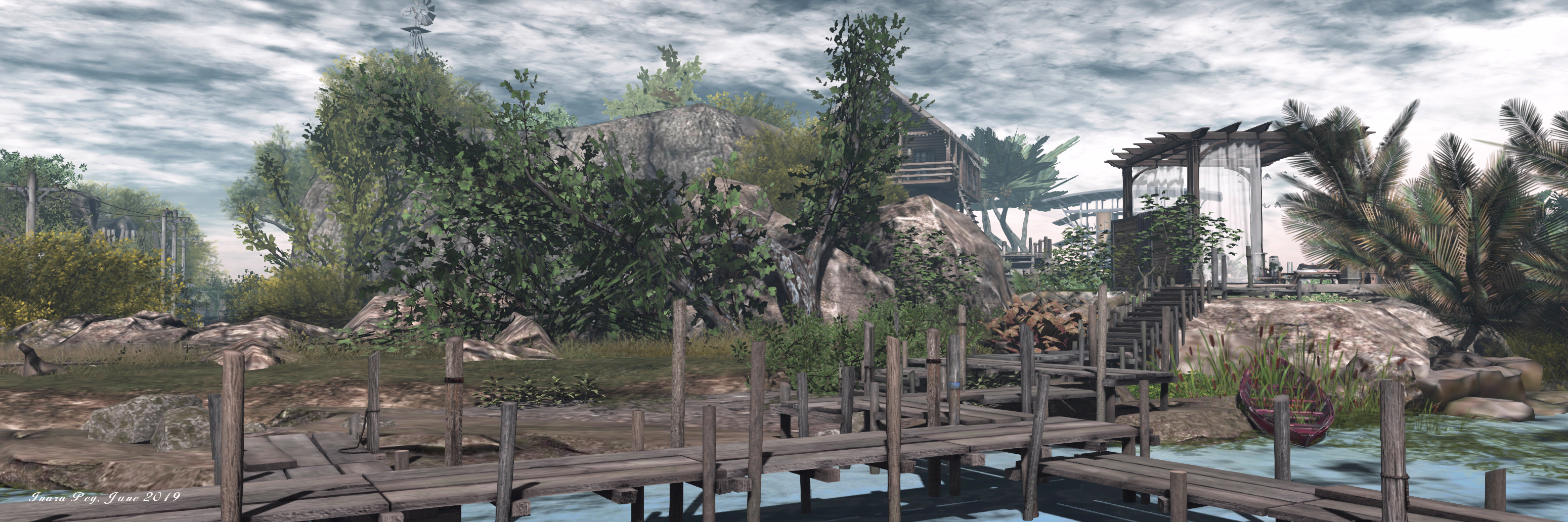
Jilin Estates; Inara Pey, June 2019, on FlickrJilin Estates, June 2019 – click any image for full size

Jilin is the name of one of the provinces of north-east China that borders North Korea, whilst also sharing a border with Russia. It is a region rich in minerals (a total of 136) including gas, coal, iron, nickel, molybdenum, graphite, gypsum, gold and silver, and has China’s largest reserves of shale oil. As well as this, it is the garden of traditional Chinese medicine resources, with approximately 27,000 kinds of wild plants and 9,000 kinds of medicinal herbs.

A rugged place, with four major mountain ranges, Jilin is a richly diverse place. It also lends its name to a new, visually stunning residential Full region within Second Life operating under the title Jilin Estates. It’s a place that offers a considered balance between private rental properties and public spaces that are open to visitors to explore – a group joining fee of L$250 additionally gives visitors rezzing rights, if they desire.

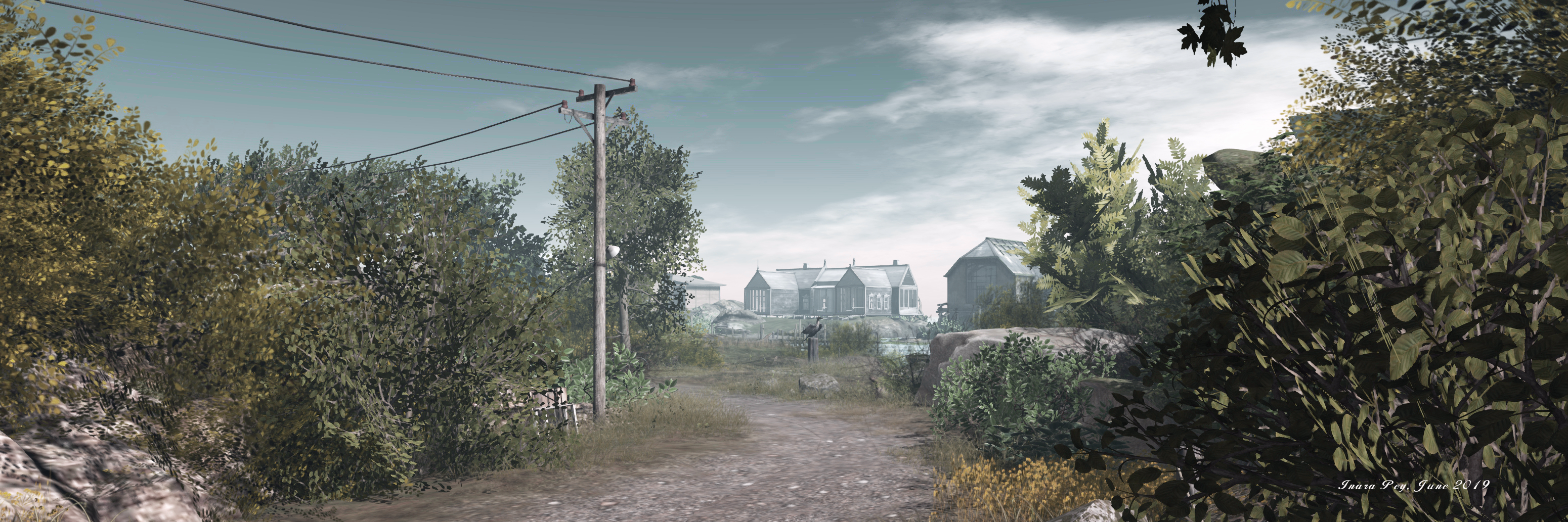
Jilin Estates; Inara Pey, June 2019, on FlickrJilin Estates, June 2019

The work of Li Zhu (JamaicasianBaby) and Jin Zhu (KidDreamz), the region offers, in the words of the website, “pre-landscaped private residential and community residential spaces, where tenants can enjoy scenic views from all angles of their respective homes.”

The majority of the residential spaces are places around the outside of the region, each to its own island space offering views out over the ocean. In addition there are three “community cabins” offering smaller rental space, but which are more integrated with the public / community areas of the region. What is interesting about the rentals is the eclectic mix of houses that are supplied; there is no central theme, instead the houses ranging from a Tuscan villa through to converted industrial units going by way of wooden homes in what might be considered “traditional” looks and far more modern units of wood or cement construction.

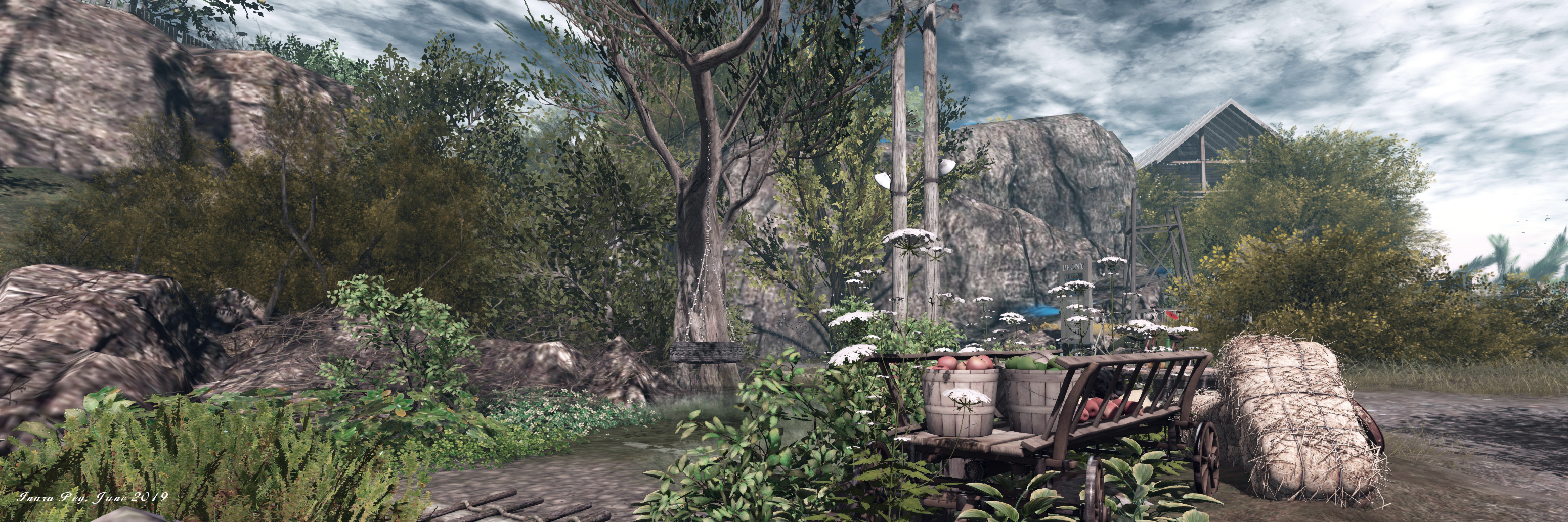
Jilin Estates; Inara Pey, June 2019, on FlickrJilin Estates, June 2019

All of this makes for an interesting layout and visually appealing appearance those seeking a new Second Life home within a private estate might find appealing. The various style of home also make for an interesting and varied backdrop for photography. However, it is the public spaces that potentially offer greater interest to those who enjoy exploring second Life.

These occupy the large central land mass of the region, together with a couple of the outlying islands. With two large tables of rock rising from low-lying cinder-tracked roads and a rocky coastline, the primary landmass is rich in detail and finely laid out with much to discover and photograph. The landing point sits in the shadow of one of the rocky plateaus, a little garden / picnic space looking east to where the some of the private homes straddle their various islands.

Jilin Estates; Inara Pey, June 2019, on FlickrJilin Estates, June 2019

A track winds through the area, bordering the landing point as it does so. This connects to the trails leading up to the cliff-top tables, and to the other points of interest: the garage and “secret garden”, the old docks, a bridge spanning the water to one of the “community cabins” and the walled garden of a second “community cabin”.

A third rental place sits at the top of one of the rock plateaus, while the second plateau is home to one of the region’s public events spaces: a space for music and dancing. Reached via a winding rocky path, this rises above the community “games cabin” and open-air theatre space to the north. These are linked one to another via wooden platforms, one of which offers a public seating area, and via a rope bridge that spans a narrow channel of water to the region’s beach lounge and dining space.

Jilin Estates; Inara Pey, June 2019, on FlickrJilin Estates, June 2019

The latter is an impressive structure that sits astride a rocky waterway than tumbles to the sea channel, and which has an infinity pool fronting its ocean view. These public spots are the focus of special events within the region – DJ party nights up on the high plateau, movie nights at the cosy theatre and karaoke at the games cabin. In addition, the public spaces are available for hire with private events – contact the owners through the website for details.

Whether or not you’re looking for somewhere different to live in Second Life, or are looking for somewhere new to explore and photograph as part of your SL travels, Jilin Estates is an eye-catching, photogenic and enjoyable place in which to send time and explore (and there is more to discover than I’ve directly mentioned here: take the Games Mountain and the secret fishing spot for example). One that is as richly diverse as its Chinese namesake.

Jilin Estates; Inara Pey, June 2019, on FlickrJilin Estates, June 2019

Our thanks to Miro Collas for the tip-off and SLurl.

SLurl Details


Athazagoraphobia, Evolution and a touch of colour at Vibes Gallery

Vibes Gallery: Store’s Helendale – Athazagoraphobia

I confess that Vibes Gallery, curated (I believe) by Eviana Robbiani, is a place that I’d not come across until I received an invite from Storie’s Helendale (GlitterPrincess Destiny) to attend her latest exhibition there – one of three that can be experienced within the somewhat grunge-like gallery setting that offers an appeal of its own.

Storie’s often tends to take the more unusual / thought provoking as the theme for her exhibitions, and this – although brief in some respects – is no different. Entitled Athazagoraphobia, it takes its title from what is perhaps one of the least talked about human phobias: fear of being forgotten or of forgetting others.  It is often associated with the families / loved ones of Alzheimer’s/dementia patients, who fear their loved ones will forget them eventually, but can be encountered elsewhere, and in the form of a fear of being forgotten by those we love after we have passed.

Vibes Gallery: Store’s Helendale – Athazagoraphobia

In this, athazagoraphobia has a role to play in our digital lives. What happens if we leave SL, will those we have known be remembered? How long will our work / activities here help hold us in the minds of others? Even if our work remains, will it help people to recall us, as the people responsible for that work? What happens if someone we know decides to leave Second Life? will they continue to think of us, to recall our friendship, our company? Will we live on in their thoughts?

Through words and images, this appears to be the element of athazagoraphobia Storie’s explores in this small, but evocative exhibition. In it, she uses images to offer the suggestion of fading memories and words to question how we might be recalled, to bring in the focus the desire to be remembered, to be more than a fading memory or the name assigned to an image or object. It’s a dark subject – emphasised by Storie’s request that a dark windlight setting is used when visiting – but it is also one hauntingly brought to life through her images.

Vibes Gallery: Lexia Kohime – Evolution

I retained the same windlight setting – Phototools No Light, although Midnight will also work – to view Evolution, an exhibition by Lexia Kohime. In difference to many avatar study exhibitions, the focus of this exhibition is the male portrait: close-in head studies present in a range of finishes: colour, monochrome and sepia finishes, these are fascinating pieces, each rich with its own life, a capturing and framing of the nature of the subjects.

The exceptions to the pieces sit to one end of the gallery space, where a smaller selection of female avatar head studies can be found. I confess that, as engaging as the male studies are, I found several of these to be more coptivating. Not because they are of female avatars (I have no bias either way when it comes to avatar studies), but because I found four of them to be rich in the kind of narrative I love to discover within images.

Vibes Gallery: Lexia Kohime – Evolution

The final exhibition – which commenced in mid-May 2019, and so might not have much longer to run – is an ensemble selection featuring Aurora Donner, Zoota Manota, Petra Messioptra, Meilo Minotaur, Marina Munter, Armand Parks, Erika Xaron, Patrick of Ireland and Rodnoc.

Again entirely focused on avatars, perhaps the best way to describe the theme of this selection is “colour”; each piece contains a colour palette and / or tone that immediately draws the visitor into it.

Vibes Gallery: ensemble exhibition

With three engaging exhibitions offering a richness of art and avatar studies for May / June, I look forward to returning to Vibes Gallery to witness future exhibitions.

SLurl Details

RFL 2019: are you ready for the Weekend?

RFL of SL 2019: Relay Weekend

The Relay For Life of Second Life Relay Weekend for 2019 is upon us, and will feature everything one would expect from the event – walks, celebrations, remembrances, the luminaria ceremony, interviews, music, dance, and more, all in aid of the American Cancer Society in its efforts to eradicate cancer.

I’ve been fortunate enough to have a couple of sneak peeks around the regions that make up this year’s walk, together with the activities regions, and to say they are extraordinary would be an understatement. Spanning 36 regions, including the core American Cancer Society region, the Second Life RFL Relay Weekend promises to be spectacular.

RFL of SL 2019: recall RFL mega events, such as the SciFi Con

Activities will kick off at 10:00 SLT on Saturday, June 8th, and will feature 24 hours of themed laps, activities and entertainment. The weekend will wrap up 24 hours later, on Sunday, June 9th at 10:00 SLT. Featured events between those two times include:

Saturday, July 16th 2016

  • 10:00 SLT Opening Ceremony:  the weekend formally begins at the Ceremony Stage.
  • 11:00 SLT Celebrate: The first lap of Relay weekend begins with the celebrate ceremony.  A Survivor/Caregiver honour walk
  • 21:00 SLT Remember – The Luminaria Ceremony:  a solemn reflection with readings and inspirational music as the regions are darkened in remembrance of those and their loved ones who have lost their battles to cancer or are still battling it; all are invited to participate.  Please walk the track in silence

Sunday, July 17th 2016:

  • 06:00 SLT Fight Back: Collect your Fight Back Kits and Fight Back Flags available at the Relay Information Stations along the track, and pledge to save a life: your own, a friends, a family member, or someone you don’t even know yet
  • 10:00 SLT Closing Ceremony: a closing tribute to al that RFL of SL has accomplished at the Ceremony Stage.
RFL of SL 2019: witness art – with pieces like this, by Cica Ghost and Bryn Oh

Track Themed Laps

From 11:00 SLT on Saturday, June 8th through until 09:00 SLT on Sunday June 9th, relayers will be able to join in laps around the relay track that winds through all of the event regions will commence, each with its own focus / theme. The times mean that no matter where you are, if you believe in supporting efforts to reduce  / eliminate cancer in all its forms, there is likely a slot when you can spend time walking the track. You don’t have to go a whole hour – just hit the start line, walk – and make a donation!

All times below are SLT.

Saturday, June 8th
Sunday, June 9th
11:00: Survivor/Caregiver Lap sponsored by the Relay Rockers 00:00: Midnight Masquerade!
12:30: Teams Lap sponsored by Together We Are Mighty 01:00 Wear the Rainbow
14:00: Purple Hour 02:00: Demos!
15:00: Halloween Hour sponsored by River Park Club 03:00: Girl / Boy Next Door (library outfits)
16:00: All Aboard! Uniforms (conductors, pilots, flight attendants, ship captains, etc.) 04:00: Beachwear
17:00: All Aboard! 15th Anniversary Lap (wear any Relay shirt from year’s past) sponsored by the Relay Rockers 05:00: Crazy Hats
18:00: Animals, Prehistoric, Dinosaurs sponsored by Harmony of Hope – In loving memory of Kate 06:00: Fight Back Lap
19:00 Walk your pet / Shoulder pets 07:00: Pajama Party!
20:00: Formal Wear 08:00: Mother Earth sponsored by Harmony of Hope
21:00: Luminaria Ceremony 09:00: Black and White
22:00: Fantasy / Magical 10:00: Closing Ceremony & Victory Lap
23:00: Game of Thrones

Entertainment

Music will be provided throughout the weekend by the following DJs (all times SLT):

Saturday, June 8th:  09:00 Trader Whiplash; 11:00 Nuala Maracas; 12:30 Gem Sunkiller; 14:00 Fizban Underwood; 15:00 Anni Braveheart; 16:30 Tazzie Tuque; 18:00 BenVee; 19:30 Tril MacLeod; 22:00 Fuzzball Ortega

Sunday, June 9th: 00:00 Lia Vipera BrightFlame; 01:00 Madonna; 02:30 Elrik Merlin; 04:00 Luke Flywalker; 06:00 FIGHT BACK LAP with Nuala Maracas; 07:00 Madelyn Majestic; 08:30- 10:00 Trader Whiplash; 11:00 Nuala Maraca.

You can catch all the music both at the event or anywhere on the grid or on-line, by tuning into T1 Radio – including coverage of the ceremonies.

RFL of SL 2019: Relay Weekend

Where To Start

If you’re new to RFL of SL weekends, probably the best place to start is the ACS Welcome Area, or you can opt to drop in directly at main stage at RFL Unity. And don’t forget to visit the RFL Museum, and recall RFL events of the past!

So, are you ready to Relay?

Related Links

Sansar Product Meetings week #23: Avatar 2.0 and a little Q and A

The Sansar World Oceans Day Charity Event: Virtual Beach Clean Up – help Linden Lab (with additional support from the Roddenberry Foundation) raise money for EarthEcho International. Find out more on the Sansar World Oceans Day event page.

The majority of the following notes were taken from my recording of the Sansar Product Meeting held on Thursday, June 7th, which was largely a general user Q&A and feedback session. The official video of the meeting is embedded at the end of this article for reference.

R33 Updates

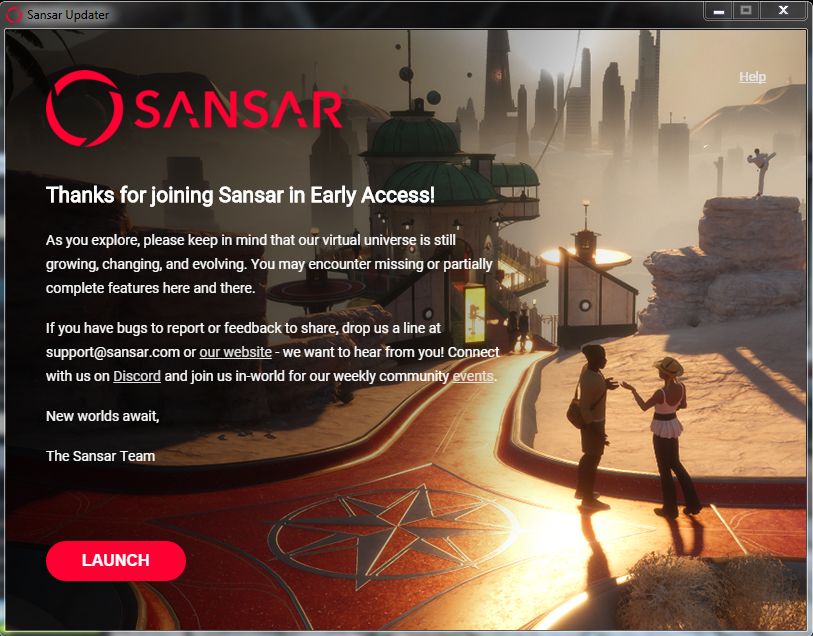
The Early Access pop-up, displayed when installing the client / a client update

There have been a couple of updates to the R33 Give more, Get More Sansar update. These have focused on bug fixes, and were released on May 31st (release notes) and June 5th (release notes).

One of these updates appears to also have changed the client updates process – although this may have been done a while ago, and I’m only now seeing it; I’ve not been that active on Sansar recently.

On installing a client update (and presumably when installing it for the first time) and new pop-up in displayed once installation is complete.

As can be seen on the right, this confirms that Sansar is still in “Early Access” (which may well also be a reference to the Steam Early access programme, and so the pop-up may only appear to Sansar users coming to it via Steam or who have linked their Sansar account to Steam). It warns user that things are in a state of flux, and also provides links to the Sansar website and the Sansar Discord channel.

A Launch button at the bottom of the pop-up will launch the client proper, allowing a user to log-in to Sansar (either manually or automatically if they have Remember Me checked in the client log-in screen).

Avatar 2.0

  • Avatar 2.0 represents a substantial update to Sansar and is currently one of the primary focuses for the Sansar team. It will include:
    • An updated avatar skeleton.
    • Bone deformation (e.g. allowing the avatar’s face to be directly selected and shaped / contoured as the user wants).
      • For this initial release, the deformation system will only work with the Sansar base avatar.
      • As resources become available, it is hoped to expand this to custom avatars in later releases.
    • Volumetric morphs (e.g. using sliders built-in to the base mesh to make adjustments).
    • Support for uploading and using custom skins for the base avatar.
    • The ability to use the base avatar to create custom avatars directly, which can then be sold through the Sansar Store (although this functionality will not be in the initial Avatar 2.0 release).
      • This will hopefully include the ability to create avatar shapes (a-la Second Life), rather than having to create entire avatars.
  • Avatar 2.0 reference files for use by creators are in development.
    • The current plan is to make these files available to creators approximately a month before the actual Avatar 2.0 deployment.
    • This early release of the reference files will be supported by the Sansar avatar development team, who will be available to test avatars and clothing built / rigged to the new avatar format and test them internally at the Lab and provide feedback, as creators will not be able to test directly until the new avatar system has been deployed.
    • It is anticipated that this process will work in a similar manner to the way in which Sansar fashion support with Marvelous Designer was deployed at the end of 2017; the difference her being the files will be available to all creators wishing to experiment with them, rather than just a selected few.
    • Note: the recent updates to the avatar reference files that have been distributed to so creators for testing purposes are not avatar 2.0; they are updates to the current avatar intended to reduce issues found with blend files, together with a general clean-up of the files.
    • It is anticipated that additional updates to the reference files will see the inclusion of textures. However, decimation for these reference files will remain a user task, although the plan is to include decimation support in the avatar 2.0. reference files.
  • Avatar 2.0 will not initially support different  / custom bone structures, although support for this may be added in the future.
  • To help with the introduction of Avatar 2.0:
    • The Lab has been working on Marvelous Designer scaling and translation, which may be deployed in week #24 (commencing Monday, June 10th). This will allow MD clothing to be more easily scaled / rotated / translated, hopefully making it easier to update to fit the new avatar skeleton (and other shapes).
    • Emotes are being re-targeted, so they should continue to work with the new avatar.
    • Similarly, a re-mapping capability for attachments is being looked at, primarily aimed at allowing attachments to be moved between attach points, but which may also ease some of the transition to the new skeleton.
  • It is currently not clear what will happen with the current avatar skeleton when Avatar 2.0 is ready for release.
    • The Lab view trying to support both skeletons as being “difficult”, and they may opt to only support avatar 2.0 going forward.
    • This calls into question content breakage for all of the current custom avatars (and rigged items) associated with the current avatar skeleton.
    • It was intimated during the meeting that those who have purchased custom avatars using the current avatar may receive some form of refund / stipend from the Lab in lieu of no longer being able to use those avatars.
    • It was also indicated that some form of update system will be made available to creators to allow them to make updates to items they’ve made specific to the current avatar to work with Avatar 2.0, and distribute them to customer who have purchased the previous version.
  • Given the extent of the changes with Avatar 2.0 and the fact that some decisions are still in flux, it has been suggested that in the weeks / months leading up to the release:
    • A portion of each Product Meeting is allocated to discussing Avatar 2.0, particularly where the Lab has reached a decision.
    • A Product Meeting ahead of the actual deployment (when it is ready to roll) is devoted to Avatar 2.0.
  • A goal with the updates is to (at some point) open up the materials editor for the avatar both pre- and post-upload, so maps can be altered / updated for both the base and custom avatars.

Look Book

  • Currently, Look Book cannot be searched. For those with a sizeable avatar inventory.
  • This can make finding a specific item painful it is:
    • Either a lot of scrolling through clothing or accessories within Look Book to find the required item(s),
    • Or, if a search function is to be used, going to the Store, searching there, clicking the Wear It Now button (which applies to already purchased items as well) to return to look Book and seeing it worn.
  • The Lab is working on adding more functionality to Look Book, but right now, the focus is on Avatar 2.0 (see above), and so it will be a while before anything for Look Book is deployed.

General Inventory Capabilities

Inventory in Sansar essentially comes in two forms: Avatar inventory (clothing, hair, accessories) that can be obtained through the Sansar Store and which is available via the Look Book. Object style inventory – scripts, building, sounds, media, plants, rocks, lights, etc., which can also be uploaded and obtained through the Sansar Store but which are available only through the Edit Mode inventory.

  • LL have been discussing making the latter more user friendly through the introduction of folders.
  • There has also been some discussion of providing an “experience” style of inventory, such that an avatar can obtain / carry / select items they wish to use directly within an experience.
  • Currently no information is available on how either approach may work or when they might be ready for deployment.

The “Three Pillars” of Sansar

In the discussion, Landon McDowell, the Lab’s Chief Product Officer, defined the primary “three pillars” for Sansar as a platform as being:

  • Content creation – including provided a set of well-round tools / support for tools for both avatar and world creation.
  • Socialisation – making sure people can interact with one another, make friends, hold social events.
  • Gaming  / exploration – quests, mini-games, people exploring experiences and discovering what has been put into them.

So if someone wants to come into Sansar and do something under one (or more) of these umbrellas, the Lab wants to be able to support them.

In Brief

  • Local persistence: something the Lab wants to offer, but not currently being worked on.
  • Questing system:
    • Further Lab-built questions will be forthcoming.
    • The quest system itself is being enhanced and improved, but is not yet user-friendly enough to be opened to experience creators.
    • The plan remains to make the question system available once it is robust and friendly enough to be used by experience creators. It is liable to be several more months before it is available on a platform use.
    • The system will most likely include a scripting API.
  • Particle system: this is something the Lab want to do this, but the focus at the moment is on performance, and will remain so for another “couple of months”, so development of any particle system is deferred until at least this work has been completed.