HippiMagic Art Studio and Gallery has relocated, and now occupies a part of a Full region. While the latter is still being developed by Sophie72 Congrejo, the gallery’s curator and the region holder, the art exhibitions have re-opened, with August seeing something of a change-up with the art on display.
Within the garden area of the gallery are displays by Anibrm Jung, featuring a mix of her Second Life and Real Life photography mounted on the wall of the gallery building. This is one the most diverse selections of Ani’s art that I’ve seen in an exhibition like this, featuring as it does her always stunning physical world macro photography, and a range of styles an finishes to her SL art that are truly engaging.
Also in the garden as a corner display of physical world photography by Phenix Wonder. This is actually my first exposure to Phee’s work, and again, her use of the macro lens in some of the pieces is superb; just take Sun Pattern and Thistle as two examples (seen below, left). Just nine pieces are offered here, but they are enough to captivate the eye – and to leave me hoping to see more of her work in the future.
The gallery building continues to exhibit the work of Wintergeist, another artist I admire, together with Sophie’s own images as well, both of which I wrote about back in June 2019 (see Art with a touch of HippiMagic in Second Life).
Outside in the square is the Woodstock Art Contest. This features images by MikeMazrok, Kalyca McCallen, Jeri Rahja, Doris Johnsky, FreeDom Voix, Dido Haas, Edwige Monroe and Fluer Heartsdale.
As the name suggests, this is a contest with a focus on the 1960s and Woodstock, with the images reflecting the hippy counter-culture epitomised by Woodstock. The winners for the contest will be announced on Sunday, August 18th, with a party featuring live singer StayAwayJoe from 12:00 noon, SLT.
There was no deployment to the SLS (Main) channel on Tuesday, August 13th.
On Wednesday, August 14th the RC channel should be updated as follows:
BlueSteel and LeTigre should be updated to server maintenance update 19#19.08.07.529856, containing internal updates which should see improvements to the percentage of scripts running per CPU cycle (particularly for Full regions) and reduce the portion of a cycle given over to idle scripts.
Magnum should be updated to server maintenance update 19#19.08.06.529800, containing internal fixes.
SL Viewer
The Love Me Render viewer, version 6.2.3.527758, formerly the Rainbow RC viewer dated June 5th, was promoted to de facto release status at the start of the week.
The rest of the official viewer pipelines remain as follows at the time of writing:
Bakes on Mesh RC viewer, version 6.3.0.529185, July 11th.
Project viewers:
360 Snapshot project viewer, version 6.2.4.529111, July 16th.
Legacy Profiles viewer, version 6.2.3.527749, June 5. Covers the re-integration of Viewer Profiles.
Linux Spur viewer, version 5.0.9.329906, promoted to release status 29th November 2017 – offered pending a Linux version of the Alex Ivy viewer code.
Obsolete platform viewer, version 3.7.28.300847, May 8th, 2015 – provided for users on Windows XP and OS X versions below 10.7.
In Brief
Scripts
Script usage is still seen as possible cause of contention (e.g. because one parcel owner is consuming all script resources within a region). A means has been suggested for changing (see BUG-225391), but the Lab see the issue as complex and so wanted to get improvements such as those being initially deployed to the BueSteel and LeTigre RC channels issued first before potentially digging more deeply into the question of script usage and allocation.
How clear a picture does the Full private region Top Scripts give for script usage in a region? Obviously, it can help, but as Mazidox Linden noted: “I do something similar all the time. It doesn’t give you the fine grained details you’d imagine for our set-up however. For that I use other (mostly internal) tools/techniques.”
It’s been suggested that script information could be extended to parcel level. This is something the Lab has indicated it is musing doing – but no firm plans to implement any changes if the Lab go in that direction have been indicated. It is also a complicated issue, as Simon Linden summarised:
So how would you treat someone with 1/4 of a region and a club [and] 50 avatars come to see a popular performer, and the other 3/4 are empty at the time? Give [the club] all the script time? Or leave 75% for the … other land?
Region Memory Bloat
As a reminder: a region can suffer significant memory bloat during repeated terraforming. Simply put, this is the result of the navmesh (part of the region’s physics) being reformed during the terraforming. This can have numerous impacts: overall performance can be affected, as can rezzing objects. Nominally, if a Full region’s memory allocation hits approx 900 Mb, or a homestead 230 Mb, it will shut down rezzing (if the underpinning simulator gets within ~90% of its memory limit (256MB for a Homestead & 1024MB for a full region) it will disallow rezzing).
So, if you are running a region that starts reporting issues with rezzing and have been terraforming, consider a restart (or requesting a restart from support).
Alternate Reality, August 2019 – click any image for full size
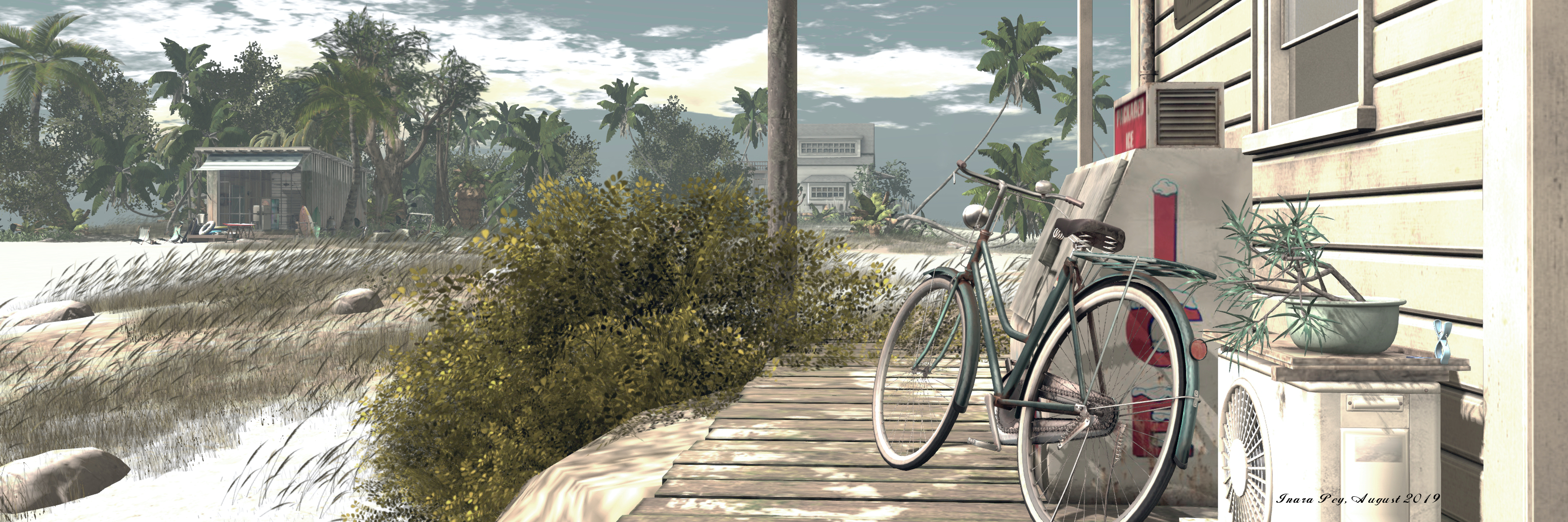
Designed by SimoneFiore on behalf of region holder ThisIsMyAltsAlt, Alternate Reality is a homestead region open to the public on the basis of joining the local group (no fee required).
Offering a simple, low-lying island, it is a place with plenty of space, most of which is open to the public, with the exception of the house located towards the north-west of the region, sitting within a private parcel clearly denoted by ban lines should you get too close.
Alternate Reality, August 2019
Predominantly sandy, Alternate Reality is home to scattered clumps of grass, all of varying sizes, which break through the surrounding sand like islands poking up above the surface of an ocean.
These little islands of green sit under the shade of trees that grow above them, tress that largely suggest that this is place located within temperate, rather than tropical climbs – although there are a few palm trees and other suggestion that perhaps we’re not that far from the warmer tropics.
Alternate Reality, August 2019
Within this setting are numerous opportunities for photography (as group access is required, rezzing of props is also possible) and some fun activities – including a see-saw, beach volleyball and swings. There are also multiples places to sit and relax. These can be found along the beach in shaded little hideaways. Or, for those who prefer, there is a bar, with indoor and outdoor seating, again offering opportunities for photographs while the deck across the sand from the bar is a DJ’s set-up, suggestive of music events.
This is an easy location to tour, requiring little in the way of description, offering a quiet getaway that demonstrates that when it comes to landscaping, sometimes, less really is more. So, this being the case, and unusually for me, I’ll leave you with a couple of back-to-back photos.
Alternate Reality, August 2019Alternate Reality, August 2019
Logos representative only and should not be seen as an endorsement / preference / recommendation
Updates for the week ending Sunday, August 11th
This summary is generally published every Monday, and is a list of SL viewer / client releases (official and TPV) made during the previous week. When reading it, please note:
It is based on my Current Viewer Releases Page, a list of all Second Life viewers and clients that are in popular use (and of which I am aware), and which are recognised as adhering to the TPV Policy. This page includes comprehensive links to download pages, blog notes, release notes, etc., as well as links to any / all reviews of specific viewers / clients made within this blog.
By its nature, this summary presented here will always be in arrears, please refer to the Current Viewer Release Page for more up-to-date information.
Note that for purposes of length, TPV test viewers, preview / beta viewers / nightly builds are generally not recorded in these summaries.
Official LL Viewers
Current Release version 6.2.3.527758, formerly the Rainbow RC viewer dated June 5, promoted June 18 – No change.
Artful Expressions Gallery curated by Sorcha Tyles, has (another) new home, and with it, a new exhibition.
Veritas (“truth”) is a selection of images by Anu Papp split into two groups of fives images apiece in the gallery’s two exhibition wings. Avatar studies all, the majority appear to be a mix of self-portraits and images that feature Anu’s SL partner Ferdinand, with around three photos of friends rounding out the mix.
Each of the images has its own sense of mood and presence, which can be added to by hovering the mouse over each in turn to see the title displayed. In this, I found the title of the exhibit somewhat intriguing. While each of the images offers its own narrative (and insight into mood, the possible creative intent), etc., there is little that intrinsically link the images back to the ideal of truth.
This actually offers a possible conundrum, as it leaves those so minded (like myself) to ponder over title and subject. Is the title a reference to the truth that however hard we try to insist “SL is SL and RL is RL and never the twain shall meet”, we actually cannot avoid imbuing our avatars with some (or all) of the traits and foibles of our personalities? Is it the truth that our avatars present the means for each of us to express our inner self to the world more openly and as we would like to be seen by others?
Determining what truth is being referred to can have darker shades, such as the idea is there in truth no beauty? For truth is harsh to almost everyone; it forces us to accept our flaws and snap out of our grand illusions – and our avatars are perhaps one of our grandest illusions. So beautiful they may be – but do that reflect truth? But what then of the individual titles of the pieces presented? Do they fall into place with the idea that in truth, our digital presence is mere illusion, or do they push back against it, revealing that other truth referenced above: that they actually reveal who we are, more so that all of the masks we might otherwise wear in life?
Not that this exhibition demands we engage in such an internal debate. The images are captivating in and of themselves – and I admit to becoming very drawn to the two period pieces offered. Both are marvellously presented, and the case of Les Nobles in particular, I once again saw the greatest truth Second Life offers to us: that no matter who or where we are in life, SL gives our imaginations wings.
June 2011: a pristine assembled MSL Curiosity rover sits within its assembly clean room at NASA’s Jet Propulsion Laboratory prior to being stowed and mounted within its delivery system in preparation for its December 2011 launch to Mars. Credit: NASA/JPL
Seven years ago on August 6th, 2012 at 05:17 UTC, NASA’s Mars Science Laboratory rover Curiosity arrived in Gale Crater on Mars. I’ve covered the progress of the mission throughout (just follow my MSL / Curiosity tag), and those articles in fact gave birth to this Space Sunday column; but it’s been a while since I’ve last updated on things.
Since its arrival on Mars, Curiosity has driven a total of 21 km (13 mi) from its landing point to the base of the crater’s central mound, Aeolis Mons, and has ascended 368 metres (1,207 ft) up the side of the mound, which NASA informally call “Mount Sharp” to its current location.
How Curiosity Reached Mars, (1) cruise stage – provided power and data collection during flight from Earth to Mars; (2) aeroshell protecting rover and skycrane during journey and during entry into the Martian atmosphere, with parachute system (6); (3) the skycrane used to winch the rover down to the ground whilst hovering a few metres in the air; (4) the rover in its stowed configuration; (5) the heat shield that protected the vehicle during its entry into the Martian atmosphere. Credit: NASA/JPL
Along the way, Curiosity has revealed a lot about Mars – including confirmation that Gale Crater has been host to multiple bodies of water during its early life, and that the conditions were suitable for microbial life to have potentially arisen on the planet.
Nor did the rover have to wait to make the discovery: it did so literally within weeks of its hair-raising arrival when it had barely started on its journey and was exploring an ancient riverbed on the floor of Gale Crater (dubbed “Yellowknife Bay”), when analysis of samples gathered revealed all the essential ingredients which – if mixed with water (that once flowed through the riverbed) – might have given life a kick-start and to have been enough to possibly sustain it during the warmer, wet periods of Mars’ early history.
As well as this, Curiosity has revealed much about the ancient conditions on Mars, has found hematite (which requires the presence of water to form), done much to reveal atmospheric processes at work on the planet, and helped track Martian weather and climate processes.
There have been a few causes for concern along the way. Early on in the mission it was revealed that the rover’s six aluminium wheels had suffered more wear and tear than had been anticipated, prompting some changes to the rover’s route as it approached “Mount Sharp”.
Most particularly, the rover’s drill mechanism has had its share of issues, some of which have required changes to how the drill is operated.
However, none of this has really impacted on the rover’s mission – in fact, Curiosity has recently obtained its 22nd drill sample from Mars, as it examines a region the mission team call the “Clay Unit”, one of several closely packed areas with strong differentiators scientists want to examine. Clay forms in the presence of water, and the area has sufficient enough clay deposits to be detected from orbit, and Curiosity has recovered samples with the highest amounts of clay minerals found to date by the mission.
This area is one of the reasons we came to Gale Crater. We’ve been studying orbiter images of this area for 10 years, and we’re finally able to take a look up close.
– Kristen Bennett, U.S. Geological Survey and co-lead for Curiosity’s clay-unit campaign
A panoramic view of “Teal Ridge” in the “Clay Unit” showing sharp differentiations in rock and surface material that suggest the evolution of a lake-like environment. June 18, 2019, the 2,440th Martian day, or sol, of the mission. Credit NASA/JPL
Quite why this particular area is so rich in clay deposits is unclear, but the area is home to complex geologic features, such as “Teal Ridge” and “Strathdon,” a rock made of dozens of sediment layers that have hardened into a brittle, wavy heap. Unlike the thin, flat layers associated with lake sediments Curiosity has studied, these wavy layers in these features suggest a more dynamic environment. Wind, flowing water or both could have shaped this area.
Both “Teal Ridge” and “Strathdon” represent changes in the landscape suggestive of the evolution of the ancient lake environment. This is further exemplified by the area above the “Clay Unit”, and towards which Curiosity is slowly making its way. It’s an area rich is sulphate deposits, indicative that it was drying up or becoming more acidic in ancient times whilst the lower slopes were still rich in water.
The Clay and Sulphate bearing regions on “Mount Sharp” and the proposed path Curiosity is following through them. Credit: NASA/JPL
Cutting down slope through the “Sulphate Unit” is the Gediz Vallis and Ridge, which appears to have been form by water running down “Mount Sharp” at some period after both the Clay Unit and Sulphate Units before spreading into the “Greenheugh Pediment”. This points to the area having seen some considerable changes as a result of climate changes on Mars.
We’re seeing an evolution in the ancient lake environment recorded in these rocks. It wasn’t just a static lake. It’s helping us move from a simplistic view of Mars going from wet to dry. Instead of a linear process, the history of water was more complicated. It’s finally being able to read the paragraphs in a book — a dense book, with pages torn out, but a fascinating tale to piece together.
– Valerie Fox, Division of Geological and Planetary Sciences, Caltech
Curiosity is powered by a radioisotope thermoelectric generator (RTG) that uses a core of plutonium-238. The heat given off by the decay of the isotope is converted into electric voltage by thermocouples and stored within two lithium-ion batteries that directly power the rover’s systems. This ensures the rover obtains constant power during all seasons and through the day and night, with waste heat is also passed through the vehicle’s interior to keep systems and instruments at their operating temperature and without the need for additional electric heating systems.
However, over time, the amount of electrical voltage the RTG can generate decreases. Overall, Curiosity’s RTG is expected to provide sufficient power (100+ Watts) to run all of the rover’s systems for 14 years – so 2019 marks the half-way point. Which is not to say that Curiosity only has seven more years of operations. Rather, it means that in around 7 years power generation is going to fall below the 100 watts mark, and it may become necessary for rationing power between systems on the rover, reducing some of its capacity.
The mission included the first stage of a privately-funded initiative to transfer living DNA to the Moon – a kind of “Noah’s Ark Mark II”, providing a repository from which plants and animals could be regenerated to repopulate the Earth should a catastrophe akin to a flood of biblical proportions overtake the planet. In particular for this first phases of the project, a 30-million-page archive of human history viewable under microscopes, as well as human DNA were carried by the lander in a DVD-like “Lunar Library” – which also includes tardigrades.
The tardigrade. Credit: 3DStock/Shutterstock
Science fiction fans might recognise this name from the television series Star Trek: Discovery. However, far from being the stuff of sci-fi shows and stories, tardigrades are very real (if a lot, lot smaller than their Star Trek “breathren”) and also exceptionally hardy.
Known colloquially as water bears or moss piglets, tardigrades are a phylum of water-dwelling eight-legged segmented micro-animals that can be found almost anywhere on Earth, from the tops of mountains to the bottoms of the oceans, from the tropical stew of rain forests to the frozen wastes of the polar regions. They can survive extremes of temperature and pressure (both high and low), air deprivation, radiation, dehydration, and starvation and exposure to outer space.
The tardigrades were stored dehydrated tardigrade – which puts them into a state of suspended animation – and “encased in an epoxy of Artificial Amber”. In this state, they could in theory be revived if exposed to heat and moisture. But even without these, the tardigrade could survive for years on the Moon – specimens have been recovered after being in a dehydrated state for decades. Such is the design of the unit in which they are stored, those responsible for the project believe it “highly likely” it survived Beresheet’s impact on the surface of the Moon.
Sadly, it is unlikely we’ll ever get to know if this is the case; the crash point for the Israeli lander puts in it in an area of the Moon’s south polar region far removed from any planned destinations for NASA’s Artemis missions, making recovery very unlikely.
Steam Powered Satellites and Autonomous Exploration
Am August press release from NASA reveals the agency has completed tests of what is effectively the world’s first steam-propelled satellite in Earth’s orbit. Admittedly, it not a particularly big vehicle being tested – it is small enough to compete with a box of tissues – but the test is an important step in examining technologies for future automated space exploration.
The test took place on June 21st, 2019, and was part of a coordinated manoeuvre between two CubeSats operating in low-Earth orbit, carried out as part of NASA’s Optical Communications and Sensor Demonstration (OCSD) mission.
The steam-propelled CubeSat in an artist’s impression. Credit: NASA
The two tiny vehicles were orbiting the Earth around 9 km (5.8 mi) apart when they automatically established a radio communications cross-link with one another. One then ordered the other to fire its thruster and close the gap between them. Rather than using a traditional hypergolic propellant or inert gas, both of the CubeSats carry small tanks of water which can be heated to produce steam that is ejected through an engine nozzle to generate propulsion.
This demonstration is important on two counts. The first is that it shows the potential for a series of small satellite drones to command one another to carry out assorted operations entirely independently of control from Earth. Such a group of drones could work cooperatively on a mission – say a survey of the asteroid belt or the icy moons of Jupiter. They could operate in unison, commanding one another, or under the autonomous control of a “mother ship” that could have facilities for storing (and returning) samples to Earth.
The second is that, in using water as a means of propulsion, these vehicles could in theory be easily fuelled and refuelled with water – water which might in turn be obtained from the frozen bodies these craft are exploring.
Demonstrations such as this will help advance technologies that will allow for greater and more extended use of small spacecraft in and beyond Earth-orbit. It is exciting to think about the possibilities enabled with respect to deep space, autonomously organizing swarms of small spacecraft.
– Roger Hunter, programme manager,
NASA Small Spacecraft Technology Programme
Perseid Meteor Shower
Every July / August, the Earth passes through a haze of stellar debris left by Comet 109P/Swift-Tuttle. The result is of this passage is the Perseid meteor shower (called this because they appear to originate from the constellation of Perseus), is one of the brightest meteor displays one can see in the northern hemisphere. The shower tends to last around a month, from July 17th (ish) through to August 24th.
Observing the Perseids in 2019
This year, the peak period for activity should be August 12th and 13th, when between 60 and 100 meteors an hour might be visible streaking across the night sky. In Europe, the best time to see them is after midnight, while America gets it a little easier and earlier. To check time in your location try timeanddate.com, which should give local observation times.
Unfortunately, the moon will be very close to full on the night of the peak, and this will affect the visibility of the fainter meteors. Of course, you’ll also need to be somewhere that’s dark enough to see the night sky without it being blotted too heavily by surrounding Earthly light pollution.
To help people observe the peak period, there are a number of planned livestreams on the web – including the two below.







 Inara Pey: Living in a Modemworld