2019 SL User Groups 9/1: Simulator User Group

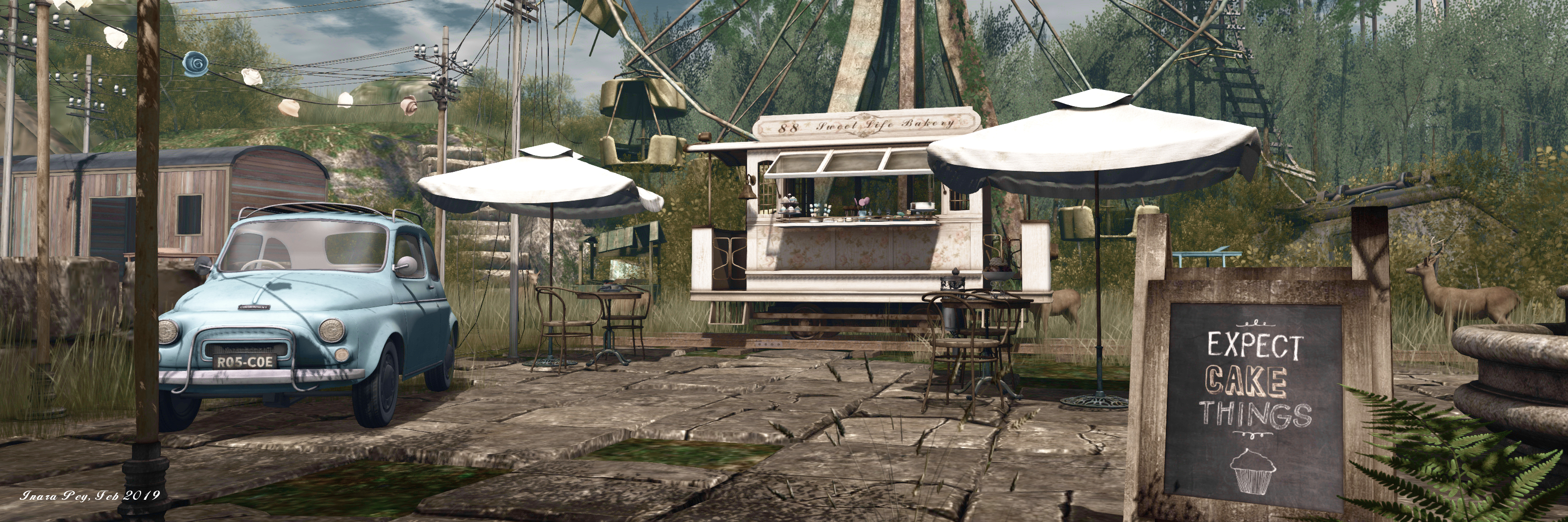
Endless; Inara Pey, January 2019, on FlickrEndlessblog post

Server Deployments

Please refer to the server deployment thread for the latest news.

  • There was no deployment to the SLS (Main) channel on Tuesday, February 26th, leaving it on server maintenance package 19#19.01.25.523656. As regions on the channel were restarted in week #8, there was no restart this week.
    • The planned deployment was cancelled due to a list minute issue being found, and also led to the planned RC deployment(s) being postponed.
  • No deployments are planned for Wednesday, February 27th, 2019, leaving the RCs on the following simulator versions:
    • BlueSteel and LeTigre: server maintenance package 19#19.02.16.524516 EEP).
    • Magnum: server maintenance package 19#19.02.16.524515, comprising further internal fixes.
    • Simon indicated at the SUG meeting that regions on the RC channels might be restarted, although this is unclear, as the channels have not hit the 14-day restart barrier.

SL Viewer

There have been two recent RC viewer updates:

  • On Tuesday, February 26th, the BugSplat RC viewer updated to version 6.1.0.524670.
  • On Friday, February 22nd, the Estate Access Management (EAM) RC viewer updated to version 6.1.0.524240.

The rest of the viewer pipeline remains as follows:

  • Current Release version 6.0.1.522263, dated December 5th, promoted December 13th. Formerly the Spotykach Maintenance RC viewer – No Change.
  • Release channel cohorts (please see my notes on manually installing RC viewer versions if you wish to install any release candidate(s) yourself):
    • BugSplat RC viewer, version 6.1.0.524348, February 13th. This viewer is functionally identical to the current release viewer, but uses BugSplat for crash reporting, rather than the Lab’s own Breakpad based crash reporting tools.
    • Love Me Render RC viewer, version 6.0.2.523177, January 16th.
  • Project viewers:
  • Linux Spur viewer, version 5.0.9.329906, dated November 17th, 2017 and promoted to release status 29th November – offered pending a Linux version of the Alex Ivy viewer code.
  • Obsolete platform viewer, version 3.7.28.300847, May 8th, 2015 – provided for users on Windows XP and OS X versions below 10.7.

Inventory UDP Messaging Deprecation

The planned deployment to Magnum (cancelled for this week) should include the updated simulator code that removes all asset fetching UDP messaging from the simulator code. Once deployed, this will mean anyone using really old viewers that do not have HTTP asset fetching on regions running on the Magnum RC channel will no longer be able to obtain responses to asset requests – and this will increase as the code is deployed to the remaining channels.

It’s not clear yet if the two “legacy” viewers currently offered by the Lab (the Linux Spur viewer and Obsolete Platform viewer) will remain available after the update has been fully deployed, as both will be unable to fetch assets.  Those wishing to test older versions of viewers against the updated simulator code can do so on Mesh Sandbox 3 on Aditi.

The Question of Script Load

The core of the SUG meeting revolved around the question of scripts and simulator loads. The discussion started with a request to make scripts run % data accessible to SLS, so scripters might coder periodic, intensive scripts hold off loops of execution if they can see a region is busy.

This spun out to a discussion of making information on scripts (as seen at the region level via Top Scripts) available at parcel level. However, a concern here is the risk of unnecessary drama: if X on parcel Y can see top scripts across the region, and sees A’s scripts on another parcel gobbling script time, it could lead to an assumption (right or wrong) it is the scripts that are responsible for all issues X is experiencing, resulting in potential local drama.

Another idea put forward is to make script use tied to parcel size (as is the case with land capacity / impact) in an effort to make script usage fairer within a region (see BUG-225391). While potentially good in theory, such a “fair use” approach has some potential issues:

  • Script usage isn’t balanced by parcel within a region. It is possible to have multiple parcels using little or no script time, and one using more than its “fair share”. Currently, this means things can balance out within a region, but with a capped script use, the “high use” parcel could be penalised when there is no need. As Oz Linden noted, “We could do that, but suppose we did. In many places people would see a big script performance drop even though the region had lots of idle time.”
  • Scripts are the only thing that can impact local performance: Physics Time, for example, can be over-used and impact performance, leaving very little script time per frame.
  • There is a difference between in-world scripts and attached scripts, so there is a question of how would the latter be accounted for? Making them part of the parcel allowance isn’t necessarily fair, as the parcel owner has no direct control over others without something of a draconian approach (depending on parcel size) – upping the potential for drama / upset.

Simon Linden also pointed out that there is pretty significant overhead moving between the scripts versus running actual bytecode (that is figuring out what to run against actually running it), so monitoring everything could add more of an overhead than actually letting scripts run – although there have been discussions on how to improve this. But, he also cautioned that adding further checks would have to be a “real clear win”.

There are some reports that the percentage scripts run seems to be falling across Mainland, without a noticeable increase in script count, which if true, would indicate something is going wrong. But as pointed out at the meeting, without data, it is hard to tell what is going on. Is a slow-down a case of having too much useful stuff going on for the available resources, or is it a case of someone going compute-bound in their script, lagging a region.

This is likely to be a discussion that will continue.

Mainland land holders will soon be able to auction their land

Update, March 26th: user-to-user auctions are now live.

Update: Well, an Oopsie from me. Seems the user-to-user Mainland auctions aren’t *quite* live, but still in a testing phase. As such, this article has been revised.

In July 2018, Linden Lab overhauled the Mainland auction system – see Second Life land auctions get a face-lift and the official blog post A Face lift for Auctions.

The “new” auction system leverages Second Life Place Pages as the medium for presenting land for auction and for placing bids, together with a new “cover page” listing available parcels up for auction. which can be found at https://places.secondlife.com/auctions. At the time the system launched, it was restricted to land being auctioned by Linden Lab, with the promise (at that time) that Mainland land holders would be able to start adding their own parcels “soon”.

“Soon” took a step closer to becoming an reality on Tuesday, February 26th, when a new Knowledge Base article appeared, entitled Creating Your Own Auctions. It is designed to walk Mainland land holders through how to set a parcel for auction. According to Alexa Linden, who contacted me on the matter, the system is still in testing, but will likely be ready t go in the very near future.

The Knowledge Base article outlines a number of requirements for those wishing to auction their Mainland parcels:

  • The parcel must be owned by an individual resident; group owned parcels cannot be auctioned.
  • Auctions can only be created by the parcel owner, and the owner must have a verified email address.
  • Parcels for auction must be set for auction via their associated Place Page.
  • There is a 15% commission payable to Linden Lab on all successfully concluded auctions.
  • When you create the auction, the ownership of the parcel is transferred to a temporary holding account named AuctionServices Linden.
    • You will no longer be listed as the owner and will not be able to edit, cut, sell, or change the parcel in any way once you create the auction.
    • If you cancel the auction, or if the auction completes without any bids, then the ownership of the parcel returns to you.
    • Note: it is not clear what happens to any payable tier during this time, but I presume it remains payable until such time as the auction concludes.
Mainland auctions for user-to-user auctions are now very close to being launched

If you are not familiar with Place Pages, you can find out about them via my Place Pages tutorial. This will be updated to include the relevant information on setting a parcel for auction in the near future, once the service has been confirmed as being “live”. In the meantime, additional details on Mainland auctions can be found in the Second Life Knowledge base as follows:

Again, and for clarity, do please remember, the auction system is for Mainland only. Private regions or parcels cannot be offered through it.

Melusina’s Empty Spaces in Second Life

DiXmiX Gallery: Empty Spaces

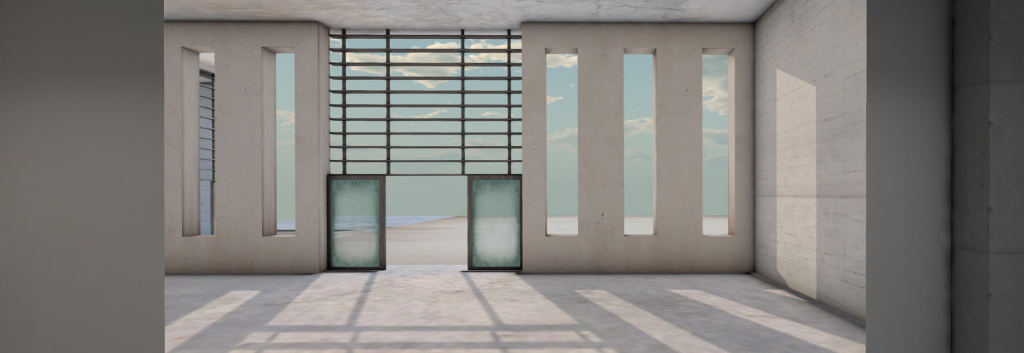
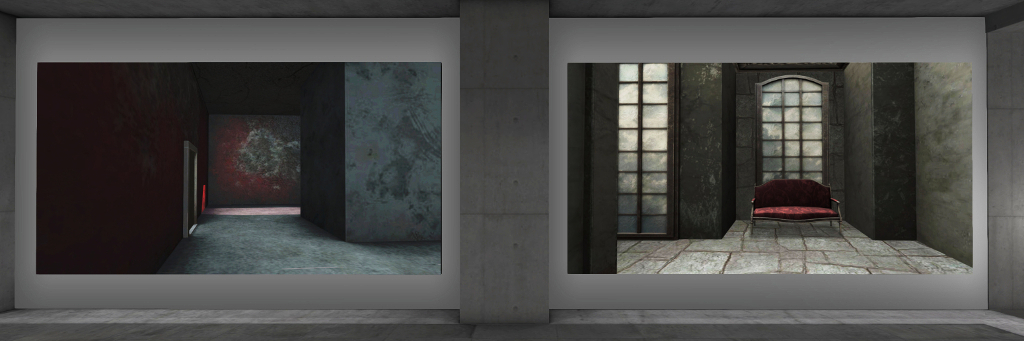
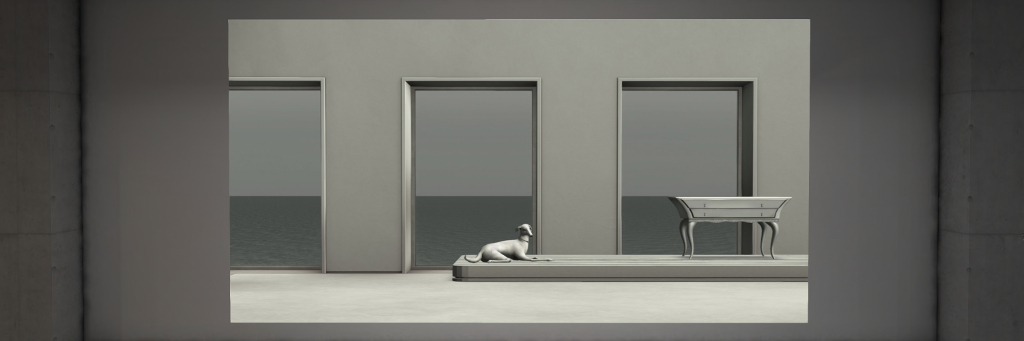
Melusina Parkin makes a return to DiXmiX Gallery about a year to the date after her latest exhibition there (see Melusina’s Minimalism in Second Life), to present Empty Spaces, this time in the gallery’s Black exhibition hall.

Melusina’s work is often a fine blend of detail, space and minimalism, all carefully combined and crafted to present images that are elegant in their unique focus and rich in narrative and feeling. This is perfectly reflected in the twelve images presented in this collection which – if I might be so bold as to suggest – carry with them something of a thematic link to her previous exhibition at DiXmiX, Less is More (see link above), and perhaps more particularly to her June 2017 exhibition, Absences (see Melusina’s Absences in Second Life).

DiXmiX Gallery: Empty Spaces

As with that latter exhibition, Empty Spaces presents images that are perhaps notable for what is absent; rooms and hallways that are devoid of furnishing and décor – or, where furniture is present, it is noticeably absent signs of use; there is no-one seated on the couch or chair while the dresser appears unattended and the pool strangely sans water.

But where Absences offered a single point of focus within a room or setting – a chair, a coat hanger suspended from a hook, a ruffled bed – Empty Spaces in many respects takes a step back; while some images do offer sight of a couch or chair, a rag hanging from a hook,  most offer a much broader view; the focus is far more on the room, the space the image represents, than the object or item within it.

DiXmiX Gallery: Empty Spaces

Windows and doors, for example appear in many of the images – even those featuring a specific object – halls and open views can be seen, as at times, are hints of other spaces just out of our sight. Thus, the narrative many of these places is broader than that of Absences. What lies behind the closed door, is there something awaiting discovery around the corner of a hallway our in the spaces that lie between us and a distance doorway, hidden from our view by intervening walls? What might lie at the bottom of the empty swimming pool or beyond the opaque glass of windows, where shadows can only give hints – and perhaps deceive.

These are images that again allow us to become playwrights; we can write the stories they hint at; but so to is there the sense of something more within them. Are we looking at images that reflect the lives of others, vignettes of their times and presence-in-absence? Or are we in fact looking at spaces in which the echoes of our own times and actions might still be heard?

DiXmiX Gallery: Empty Spaces

And this is what I continue to love and admire in Melusina’s art; through it she offers both and theme and idea that is – by the nature of her having taken the image – her own, but leaves the story behind it entirely down to us to define and tell. Thus, her exhibitions are always engaging and thought-provoking delights.

SLurl Details

A further day at Sol Farm in Second Life

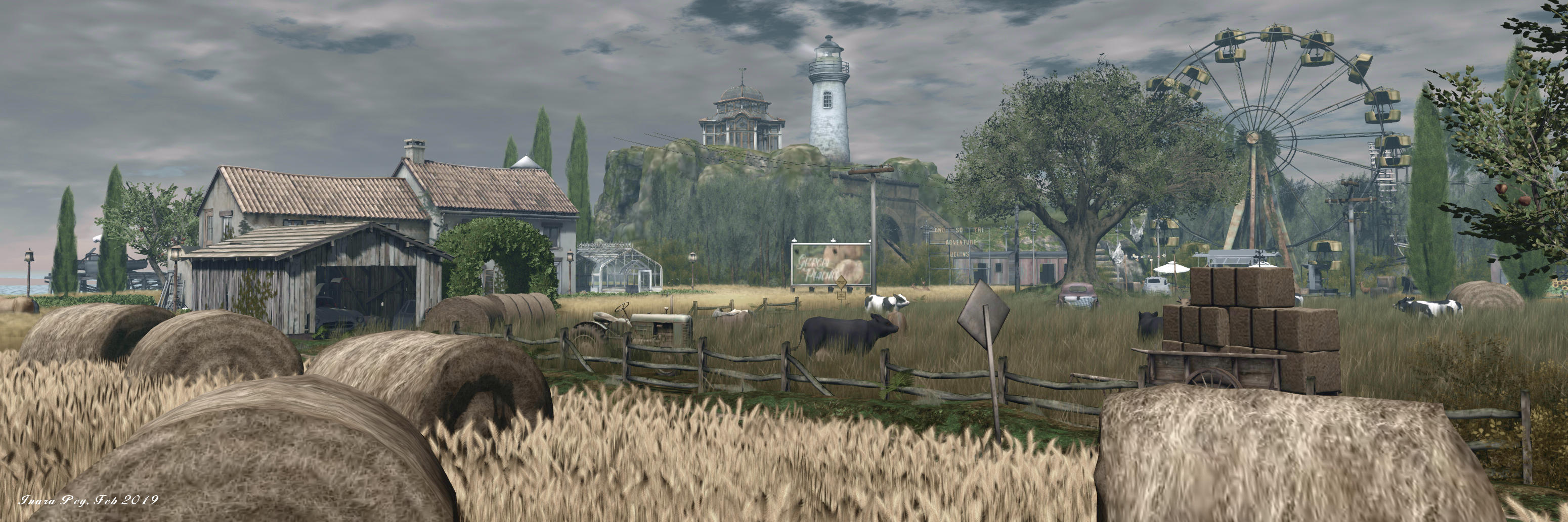
Sol Farm; Inara Pey, February 2019, on FlickrSol Farm – click any image for full size

In looking back through my notes on regions visited in these pages, I came across Sol Farm, a place we first visited just over two years ago (see A Day at Sol Farm in Second Life) but had failed to return to in the intervening time. So I suggested to Caitlyn we hop over and take a look at what may have changed over the past 25 months.

During our first visit to this Full region, designed by Show Masala that utilises the additional 10K Land Capacity option available to private regions, I noted it to be:

A largely rural setting, centred around Sol Farm, complete with thatched farmhouse, fields of crops and livestock, outbuildings, and many of the mechanical accoutrements of a working farm. However, there is much more here than may at first be apparent.

Sol Farm; Inara Pey, February 2019, on FlickrSol Farm

This is still very much the case. In fact, on first arrival, I wondered if anything had changed since our original visit or if the region had settled into one of those wonderful places that, rather than offering new looks to entice visits and exploration, instead preserve its original look and feel, making it an attractive and familiar place to re-visit,  where memories can be re-awoken be familiar sights.

For example, the thatched farmhouse with its fields are still there, sun-ripened crops looking ready for harvesting. Also still in evidence is the Mediterranean villa to the south of the farm, complete with its suggestion that it is perhaps a holiday home; while off to the west from the landing point the familiar Ferris wheel of an old fun fair breaks the horizon, as does the rocky knob topped by a lighthouse and pavilion.

Sol Farm; Inara Pey, February 2019, on FlickrSol Farm

But first looks can be a little deceiving: Sol Farm has changed over the intervening time. Thus, for those both new to the region or those who have perhaps visited it in the past but have not returned of late, it makes for an engaging and in places a quirky visit, with much to occupy the eye and camera.

The quirkiness can immediately be evidenced when using the SLurl given in this article. When looking west from the landing point in provides, it is hard to miss the blue whale serenely and slowly circling through the air over the farm, a small wild garden apparently growing on its back (and on in which you can ride for an aerial view of the region). But it is not the only twist to this setting.

Sol Farm; Inara Pey, February 2019, on FlickrSol Farm

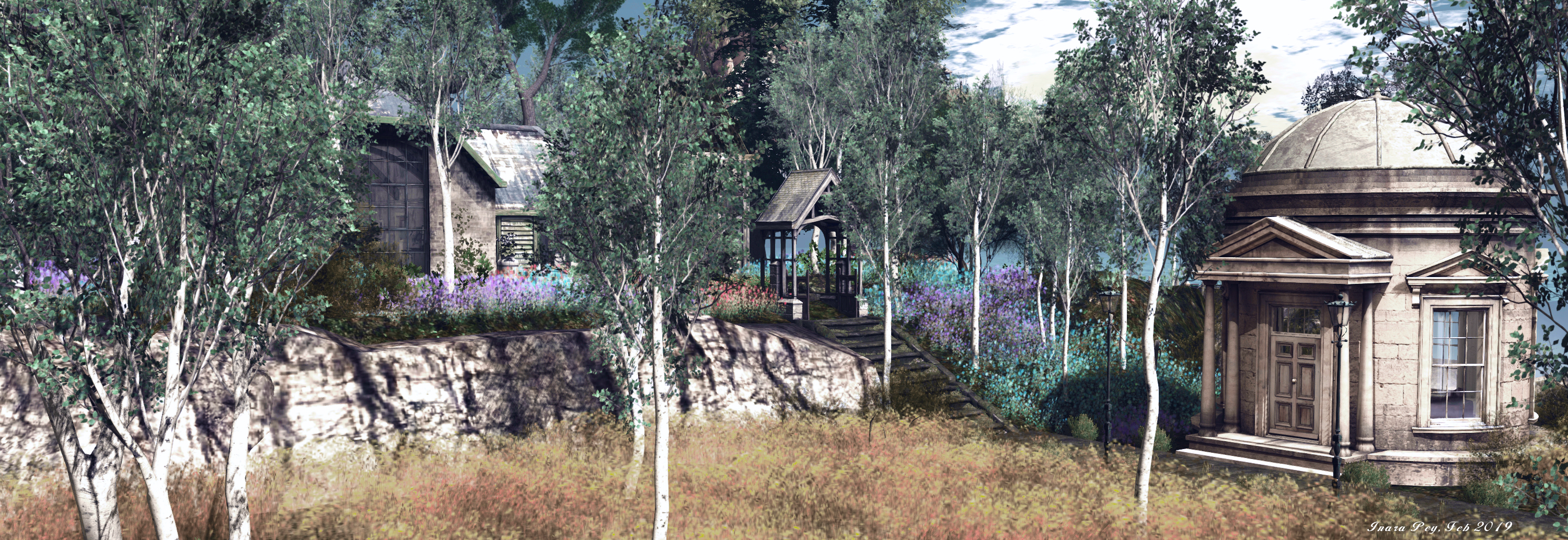
It is also to the west that I spotted another change from our last visit. What had once been a large house occupying its own island connected to the rest of the region via a wooden board walk, is now a headland where another crop is ripening and which ends in a rocky promontory, where sits the most eclectic little group of houses, both on the ground and up in the trees, a little wind turbine supplying them with power.

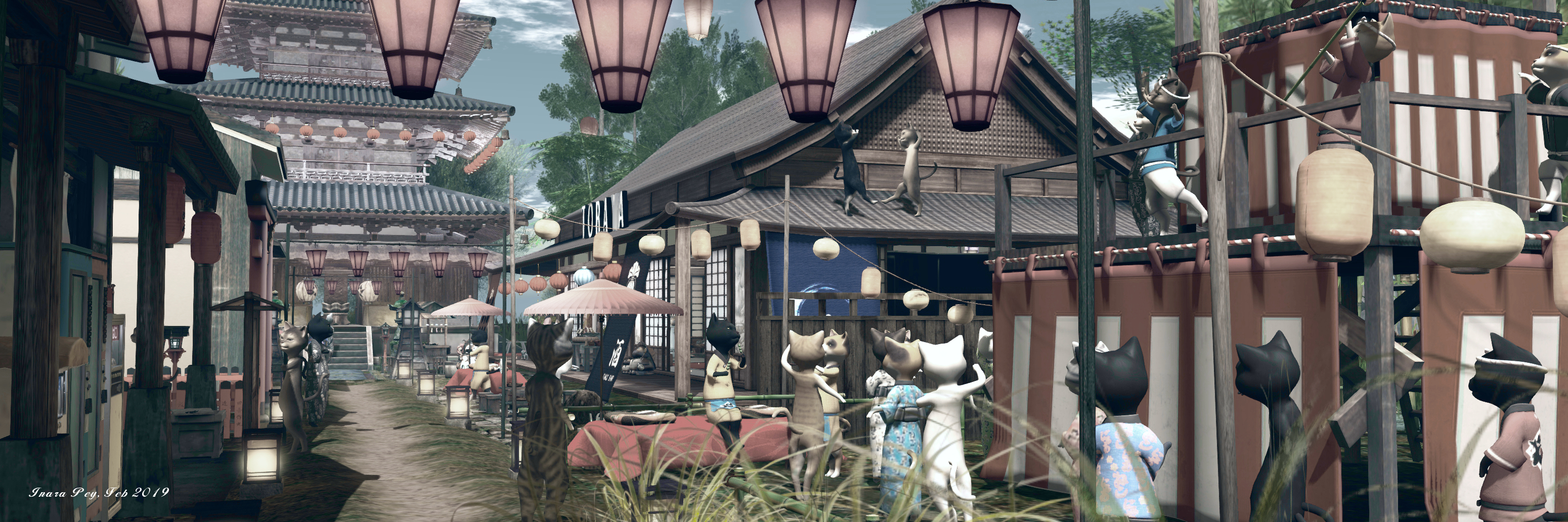
During our January 2017 visit, I noted in passing the presence of a little Japanese village occupying the west side of the region, but somewhat separated from it by a rocky curtain wall. This is still present and open to visitors (just follow the track around the island to the east and under the Torii gate sheltering beneath a rocky arch, or take the north side beach eastwards until you come to it). However, it now offers another odd little quirk, being the home to a host of cats. And not just any cats; these all stand upright as they go about their business, a large part of which appears to involve some kind of festival.

Sol Farm; Inara Pey, February 2019, on FlickrSol Farm

There are many elements that bring this setting together as a landscape painting made real. The first, perhaps are the rutted tracks that run through the region. These link the various points of interest – the farm, the villa, the broken old fun fair, the Mediterranean farm alongside it and the north-western headland – into a cohesive whole, giving the feeling you’re really travelling through a place. Another is the use of farm animals, sheep, horses, cattle, that neatly help stitch the central farm and the western lands together. Then there is the rich sound scape that perfectly enfolds everything.

Stay within the region long enough, and you’ll discover another somewhat unique element to it: the weather. Every so often a small tornado will pass through, bringing with it a squall of rain, the wind tossing bits and pieces of rubbish into the air which fall back to Earth in the storm’s wake before vanishing along with the storm itself.

Sol Farm; Inara Pey, February 2019, on FlickrSol Farm

Beautifully conceived from farm to beaches to houses and village, richly detailed and presented, Sol Farm remains a photogenic joy to visit.

SLurl Details

  • Sol Farm (Story of Infinite, rated: Moderate)

Love Made in SL 2: Lily and Charles

Logo by Marianne McCann, courtesy of Linden Lab

It seems the UK is a popular place when it comes to people in Second Life finding love that brings them together in the physical world as well as the digital! For the second part of the new mini-series Love Made in SL, the camera turns to Lily Swidlehurst from the UK and CharlesDe Beaumont from Germany.

Released on Monday, February 25th (does the mark the series as being fortnightly in releases?), this is another short video which tells – in the participant’s own words – how their relationship blossomed on both side of the screen.

It’s a story that piqued my curiosity, as Lily and Charles are both Second Life mentors. Together with Aullere Ocello and her SL partner, Notfragile Gausman, they run the Helping Haven Community Gateway, which has been the subject of an article in this blog (see Community Gateways in Second Life: Helping Haven).

This link to mentoring is also reflected in part of the video being sent in Ahern, which also reflects the fact that Lily and Charles actually met at a welcome centre. However, this also perhaps reveals something that tended to be true of Second Life at one time (although I have no idea if it is still the case): that the friendships made during our earliest exposure to Second Life can actually be the most enduring over time.

And in an age where all the emphasis on digital interactions and the “need” to have all the widgets offered by VR  – facial expression, etc – in order to make communication and interaction “real”, Charles points out that actually, quite a lot can be revealed simply through text.

If you get to know someone over several months just typing … then in the end, the personality is becoming very clear.

– CharlesDe Beaumont

Simply put, while it is so often maligned in this the so-called VR age, and disparagingly dismissed as “getting in the way”, the keyboard is actually a magnificent tool for communication, honesty and openness. Perhaps because – like our avatars – it removes us by one step from those with whom we’re communicating, offering an opportunity for consideration and the freedom to offer feelings and emotions that might otherwise remain hidden due to things like embarrassment.

Lily and Charles: sharing their experience through Love Made in SL

As with Teal and Wolfie in the first part of this series (see Love Made in SL: a new video mini-series), the relationship between Charles and lily grew to a point where, after 11 months, Charles took the plunge and moved from Germany to the UK. Around six months later, they were setting up home together.

Also like the first segment in the series, the story is simply and beautifully told, making further commentary here somewhat superfluous. So why not watch the video below, and keep an eye out for the next in this series in a couple of weeks time?

Love Made in SL can be found on the Second Life You Tube channel.

2019 viewer release summaries week #8

Logos representative only and should not be seen as an endorsement / preference / recommendation

Updates for the week ending Sunday, February 24th

This summary is generally published every Monday, and is a list of SL viewer / client releases (official and TPV) made during the previous week. When reading it, please note:

  • It is based on my Current Viewer Releases Page, a list of all Second Life viewers and clients that are in popular use (and of which I am aware), and which are recognised as adhering to the TPV Policy. This page includes comprehensive links to download pages, blog notes, release notes, etc., as well as links to any / all reviews of specific viewers / clients made within this blog.
  • By its nature, this summary presented here will always be in arrears, please refer to the Current Viewer Release Page for more up-to-date information.
  • Note that for purposes of length, TPV test viewers, preview / beta viewers / nightly builds are generally not recorded in these summaries.

Official LL Viewers

  • Current Release version 6.0.1.522263, dated December 5th, promoted December 13th. Formerly the Spotykach Maintenance RC viewer – No change.
  • Release channel cohorts:
    • Estate Access Management (EAM) RC viewer updated to version 6.1.0.524240 on February 22nd.
  • Project viewers:
    • Environmental Enhancement Project (EEP) viewer updated to version 6.0.2.524476 on February 19th.

LL Viewer Resources

Third-party Viewers

V5/V6-style

V1-style

Mobile / Other Clients

  • No Updates.

Additional TPV Resources

Related Links