
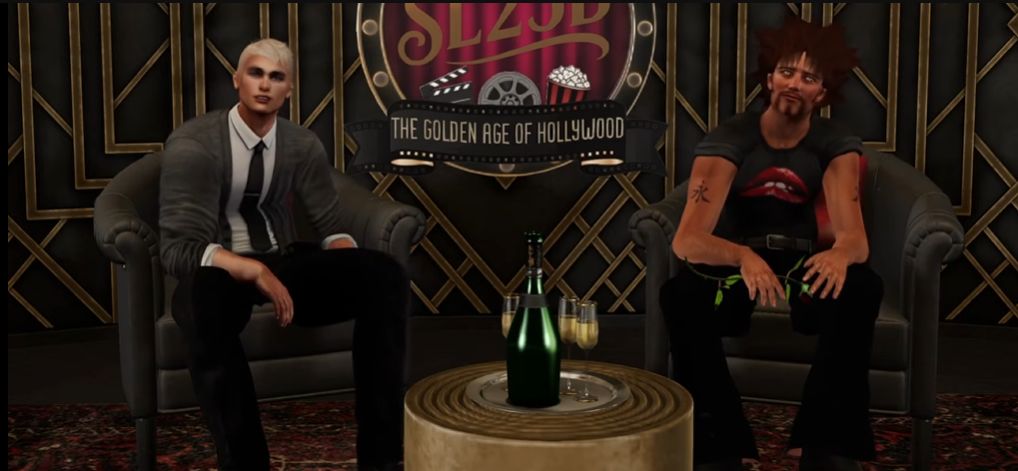
| On Monday, June 22nd 2026, Linden Lab held the first of the SL23B Meet the Lindens events, featuring Second Life and company founder, Philip Rosedale, in conversation with Brett Linden. The session was live and featured a mix of pre-submitted questions, and those asked during the session. | Table of Contents |
Notes:
- This is a summary (not a full transcript) of the majority of topics discussed at the session, and the official video of the session is embedded at the end of this article, not a full transcript.
- Timestamps are provided to the relative points within the video where specific topics are discussed, allowing readers who prefer to listen to the comments directly to be able to do so.
- The session did not address a lot of technical / product-related questions, due to the fact that these would likely be addressed by the representatives of the relevant teams attending other SL23B Meet the Lindens sessions.
- Some of the questions addressed were answered only in part or somewhat differently to how they were phrased. Where this is the case, the bullet points obviously reflect the answers given.
Pre-Submitted Questions
On Second Life
[2:38-5:00] When you first imagined Second Life, what was the most important thing you hoped people would do there; and what have residents done that has surprised you the most?
- As first imagined, Second Life was more of an artificial life simulator than it was a virtual world.
- It was going to have a much more complex / stripped set of physics laws and a lot of emergent behaviour within it, up to and including the evolution of artificial life-forms in addition to having a human presence within the world.
- In this respect, the original vision might be seen as somewhat closer to Minecraft, where there are rules to be negotiated, with “all of the magic” coming out of human interactions with those rules.
- However, in development, SL became far more focused on a combination of the ability of the individual to be artistically and creatively expressive together with the development of avatars.
- At the time Second Life was developing, the concept of the avatar was largely undetermined.
- In the very early days, there weren’t human avatars, but little spaceship-like creations with “a Cylon-like eye”, and “a giant eyeball”.
[5:02-6:57] Looking back after more than 20 years, which of your beliefs about virtual worlds turned out to be right and which turned out to be completely wrong?
- This has multiple possible answers, so the focus will be on just one.
- As SL started to take off with mass media coverage [around 2006], his belief was that everyone in the world would use an avatar “at least a little” (e.g. people would not fly from coast to coat for business meetings, but would all meet as avatars).
- In this respect he believed that Second Life will be more like the Internet has become [supporting on-line meetings and presentations, etc.] in that respect.
- It turned out that while most people were not willing to use avatars even for work, a much smaller portion of people would be willing to use avatars as a primary means of personal expression.
- Feels that the use of avatars remains one of the mysteries and challenges about Second Life and virtual worlds in general.
[6:58-9:26] You’ve often described SL as a place which gives people “freedom”. Why do you think freedom remains a powerful ingredient in virtual worlds when many modern platforms are moving towards more controlled experiences?
- It is interesting to look back and note that too much freedom can be overwhelming. Just standing in-world for the first time with an empty space before you and all of SL’s creation / building tools and options at your disposal can be both powerful and overwhelming, and people opt out of it.
- However, if there is too little freedom, such as the limited means by which to give personal expression in a video game, then people also opt out of it.
- The ideal balance is obviously somewhere in the middle of these extremes, even if Second Life is biased towards too much freedom.
[9:27-12:01] If you were inventing SL for the first time in 2026, what would you build differently, and what would you keep the same?
- Again, multiple possible answers, but will focus on two things: in-world building and the avatar.
- In-world building:
- The ability to build something in front of someone or work collaboratively on building something is “electrifying”, and the ability to both edit the world at the same time as using it is “critical”. As such, would “double-down” on this.
- The decision to fully implement mesh support was a practical decision because creators wanted the detail and additional abilities inherent in creating mesh models.
- In this, while it might have been something of a “trade-off”, allowing the import of model build “off-line” was absolutely the right decision at the time. However, in today’s world if SL was just starting, he would insist on having the necessary mesh toolsets in-world, with no off-line creation.
- The avatar:
- If SL were just starting in 2026, he would look to have the avatars “made of [/by?] the same stuff as prims”.
- Feels that something was missed in having the avatar toolset separate and distinct from the content creation tools (“building model”), and so would want to re-examine that.
- Was never his intention to have such a division between world-building and avatar building – hence the use of Primitars in LindenWorld.
- [Note that you can obtain a “modern” take on the Pirmitar for free on the Marketplace.]
- In 2026, it should be possible to build avatars using the same materials and capabilities as used in building the world.
- In general for content creation if building SL in 2026, would also look at capabilities such as 3D Gaussian splatting, again for both world-building activities and avatar-building.
[12:01-14:07] What do you think makes a virtual world feel truly “alive”? Is it the technology, the economy, the creators, the social connections, or is it something else entirely?
- To him, the two things that made Second Life “real” in the early days were:
- It had a sufficient set of live building tools to enable people to be genuinely and personally expressive.
- There was an economy which allowed people to share / trade / help each other [e.g. those who found in-world building difficult / confusing could still purchase houses, etc., and share in the world].
- In addition to the above, to ensure the world can continue, there needs to be a real density of diverse people using it – a lesson he feels other virtual worlds that have come along have failed to grasp.
Virtual worlds with no people in them are not really virtual worlds. It’s all about the world being a space between us.
– Philip Rosedale
[14:12-17:45] What has Second Life taught you about human nature which you don’t think you could have learned in any other way?
- Feels that one of the things he has been privileged with throughout his long association with Second Life is what it has taught him about human nature.
- One of these lessons is that SL demonstrates people want to help one another far more than they want to fight or compete.
- Much of the physical world is predicated on competition with others rather than cooperation; SL shows that people would much rather cooperate and help one another.
- Example: early in SL history, he heard someone was “giving away” land, leading to concerns of a scam / ponzi scheme. But investigations revealed they were buying parcels and giving them to people at no charge to take over and use [and presumably pay tier on], just to help them get started in SL.
- SL has also demonstrated it can take away physical danger from people by offering them a place they can share and participate which does not have the means to inflict physical violence on them.
[17:49:20:46] What lessons from SL do you wish today’s social media platforms had learned?
- Simple answer: ads are evil; micro transactions are a lot better.
- One of the questions for the early Internet corporate users was how to pay for it. Two schools of thinking emerged: to either just place ads on everything; or to figure out how to charge very small amounts of money for things.
- Obviously, the former won, but Second life is perhaps the richest exploration of the potential of the latter, and has proven it to be a better and most honest direction to take.
- Acknowledges that this is a simplistic view, given what micro transactions actually cover and the form they take, but very much believes having a direct economy is much better.
- Second Life also initially [before the advent of the Basic account] also provided an income [stipend] as well as an economy.
- This approach has proven its value in terms of how little personal information LL gathers on its users, allowing them to remain relatively anonymous; something which is increasing important in the “surveillance economy” of ad-based revenue generation.
[20:56-23:14] SL pioneered the creator economy long before the term existed. What do you think modern creator platforms still get wrong?
- One thing modern platforms get wrong is that their fees are not low enough, particularly on transactions.
- SL has a variety of different fees for a variety of different things, but:
- There remain no fees for in-world purchases of goods and services from others.
- Where fees are charged for things like Marketplace transactions, they remain single-digit percentages.
- By contrast, many other platforms with “creator economies” have revenue splits between themselves and the creators in high double-digit percentages [and other charge “commission fees” in the double-digit realm – e.g. at least 15% on creator sales].
[23:40-25:38] What creator-made experience in Second Life left the strongest impression on you?
- Cubey Terra’s [now defunct, sadly] Abbot’s Aerodrome with its skydiving experience.
- AM Radio’s The Far Away – which is still in Second Life and curated by Ziki Questi.
- Robbie Dingo’s Watch the World video [which remains one of my all-time favourite SL videos, and has been featured in these pages].
[33:16-34:03] What aspect of Second Life are you most proud of, regardless of business success or technology?
- The positive impact on people.
- Feels this is truer today than previously given the way technology is doing so much to damage human relationships.
[36:56-37:20] If you could instantly grant every resident one new ability tomorrow, what would it be? [Answered in fun.]
On Technology, the Future and AI
[25:52-28:23] Do you think AI-generated characters will eventually become meaningful members of on-line communities or will human-created communities always remain fundamentally different?
- Believes the answer is yes, AI-generated character will become meaningful members of on-line communities, but not the AI systems that currently exist.
- The current AI systems are neither “alive” nor as compelling as prospective friends and neighbours in a virtual environment when compared to humans.
- Developing more compelling AI systems is part of the work being carried out at the California Institute of Machine Consciousness, where he both spends some of his time working and fulfilling an oversight role as treasurer and board director.
- CIMC’s work is focused on the development the development of neural networks which learn and “grow-up” via direct interactions with humans, rather than depending on large language models (LLMs) as with the current crop of AI systems. They will hopefully have deeper and more compelling “personalities”.
- See also: Awakening the Angels by Philip Rosedale.
[28:32-33:14] What technological breakthrough do you think will most dramatically improve virtual worlds today?
- Believes the ability to convey non-verbal cues when communicating in virtual world is one of the most vital components in making them more broadly compelling.
- The biggest thing missing is emotional non-verbal communication; body language, expression, eye movement, etc., which can communicate far more than words, and help us to determine whether a personal can be trusted or not.
- Obviously, those in SL have learned to operate and interact without these non-verbal cues, but it is a skill to be learned over time and not having such cues is a tremendous impediment for platform growth.
- Believe that the ability for convenient body, expression and emotion tracking is coming, and that AI can help with the detection of all three.
- SL obviously has avatars that can be expressive, all that is lacking is the ability for them to directly convey the expression, emotion, etc., of the people using them.
- Does not believe technologies used by the likes of VR Chat and similar do not do a good enough job in this respect.
- Couches the idea as the “spouse test”: if body language, etc., could be accurately transmitted by a person’s avatar, could that person’s spouse recognise them purely on the basis of the avatar’s movement and expression and without voice or similar?
[34:22-36:45] What problem are you most interested in solving today, which you weren’t interested in 20 years ago?
- Is working on Fair Share [via his In Reality Lab based out of the Linden Lab office complex], a project to investigate how the design of Second Life’s currency systems might be used to create better forms of physical world local community currencies they are able to produce, based on mutual trust (rather than artificial scarcity) and funded by a simple transaction tax.
- In this, has a similar conviction with the idea as he did with Second Life 20+ years ago (in this case, people will “stop using dollars” in favour of local currencies).
- Emphasised this is not a Bitcoin, Etherium or other high-end crypto currency.
Questions from the Audience
[37:49-41:23] do you think that virtual worlds still have an under-developed role to play in serious adult learning? Are the blockers technological, institutional or cultural.
- Absolutely virtual worlds have an underdeveloped role to play in adult learning .
- The learning process is complicated, relying much more on interpersonal interactions – meeting friends outside of the classroom, chatting, sitting together, etc., than had at one time been thought.
- When done correctly, virtual worlds like Second Life can present the whole campus experience – from moving to classes to meeting people, thus enhancing the learning process..
- The challenge, however, goes back to the lack of non-verbal communications already mentioned. In this case, how people are responding to a lesson, who is looking where or at whom, etc., which remains a blocker to many learning experiences.
- As such, sees the major blocker to widespread use of virtual worlds for learning as being more technological than not; and alongside the current lack of non-verbal communications, also sees things like voice, video and screen sharing having to work at high fidelity as intrinsic to the virtual learning process as well.
[44:06-46:48] Can you address the future of Second Life, where you believe it’s headed? For example, user growth and retention. How much future proofing is really possible?
- Believes that the development of non-verbal communications is key to the platform as a whole, as it will help people feel far more comfortable around the use of avatars.
- Believe small steps can be taken in attracting new users, such as the work in improving the overall marketing of the platform, which is starting to bear fruit.
- Recognises that there is a degree of challenge in both meeting the needs of established users and attracting new users to the platform; particularly when many have known SL as their virtual home for up to 20 years. These challenges can result in trade-offs.
- Is personally comfortable if the platform doesn’t grow as fast as it might otherwise, and with the trade-offs the company has made in keeping its users engaged and in attracting new users. As such, he doesn’t have a given answer as to the one thing that might make it suddenly grow “explosively”.
[46:54-48:39] As a lover of SL history, are the builds like those mentioned being preserved?
|
Side Note: The Second Life Region Preservation Society (SLRPS)Established by Patch Linden does maintain a number of historically significant region builds, including:
However, the status of SLRPS is unknown following the May 2026 reorganisation at Linden Lab. |
- Another issue is that of copyright [when someone removes a region from SL, if it is entirely their own work, they may not want it preserved].
- Certain regions / builds of historical interest might not actually work correctly if available now.
- Some environment were historic builds could be preserved via a rezzing system might be possible, but again would require space, engineering support, etc.
[48:32-50:16] During the “boom” period (2006-2008) dozens of companies joined Second Life, and there was an expectation of company meetings and workshops occurring in-world. This didn’t materialize. Do you have regrets on that, or are you happy with how things have actually turned out?
- Is less a big business person and more of a community content and community, so is happy with how it turned out.
- Again believes the lack of non-verbal communications tracking makes it hard for SL to be a viable business / marketing tool.
- Also doesn’t think it makes particular sense for really big consumer brands to come to SL as a marketplace (e.g. because of geographic issues compared to the global nature of SL’s user base), so is happy with the way things are.
[50:19-52:49] Could SL develop programmes in theatre, art, sports, leadership, and other areas that allow the moles, creators, and the community to participation? Could these be a kind of scholarship to help defray costs for those developing programmes and events?
- The Positive side of supporting the arts say separate from supporting commercial activates is that it provides the opportunity to uh grow art in the world. So at a high-level, funding for the arts makes a lot of sense.
- However, such a top-down curated approach can become difficult for LL to manage [e.g. claims of FICs, favouritism, etc.]. Further, such an approach can lead to people focusing more on predicting “what the powers want” than on producing the art they wish to produce.
- As such, he is OK with the Lab not being too closely involved in the support of such endeavours and would prefer the baseline experience to open for people to offer what they’d like others to experience.
- [Note: this is why LL provide the regions for the Second Life Endowment for the Arts, but not involve itself in select the art and installations displayed within the SLEA regions.]
[53:01-55:06] What are some things we can do to help keep this place around even if we don’t have money?
- Personally on-boarding people into Second Life and helping them get started (or “adopting a noob”), then providing LL really specific actionable feedback on what exactly happened and what in particular could be done to directly improve the new user’s experience.
- What is not really required in opinions on things like Welcome Hubs, etc., as these are generally highly subject and when taken together, often run contrary to one another. Plus, many ideas that get suggested have been tried in the past and tended not to work.
[55:10-56:18] What fiction are you reading?
- Most recent has been reading The Philosophy of Ted Chang and prior to that Project Hail Mary (before seeing the film).
- Does not really listen to audio books. Much prefers the idea that physical books and turning the pages is far more memorable.
[56:25-58:55] Will Second Life ever bring back the Cornfield?
- For those unfamiliar with the Cornfield, it was the punitive region to which people exhibiting bad behaviour would be sent and would have to log-in there and remain there for a certain amount of time.
- It was literally a cornfield with televisions strewn across it giving out public information messages.
- Believes it is one of the reasons SL is so positive, as it demonstrated there were consequences to bad behaviour – although some might argue there are not enough consequences for bad behaviours.
- Thinks that people understanding that their membership in their community and the norms that they should follow are very much a product of everyone’s involvement in the platform is part of the magic of Second Life.
- Would like to see LL make incremental changes that further enable local communities in SL better restrict, control, normalise their own behaviours and memberships, rather than it being managed top-down.
[59:53-1:01:55] Any thoughts about ways the community’s collective expertise might be leveraged for the betterment of Second Life?
- Is open to ideas on this. If people have specific ideas (rather than generalities / subjective observations), they can be e-mailed to him.
- Would also appreciate suggestions on how to actually bring together such a broad-based coalition and then manage it in a format where actionable ideas which can be carried out by a relatively small team might be brought forward. So those with ideas on how to select and organise such a group, examples of processes by which they might work, etc., would also be welcome.
- Also noted that he’s personally had a lot of conversations around ideas and suggestions from “old hands”, but the solutions, the engineering costs, etc., have tended to be complicated.
End of Session.
SL23B Meet the Lindens Summaries
- Product Team (Grumpity and Keira Linden)
- Engineering Team
- Marketing and Growth (Brett and Fausto Linden)
- Second Life Studios


Great write-up, thank you!!
LikeLike
TY! And you’re very welcome!
LikeLike