
| On Wednesday, June 24th 2026, Linden Lab held the third of the SL23B Meet the Lindens events, featuring members of the Product team.
Notes:
|
Table of Contents |
- Not all subjects are in chronological order compared to the video. I have attempted to group them by subject / responder. So for example, some audience questions on things like the viewer are placed within the related section of the text, but are given their own timestamp for reference.
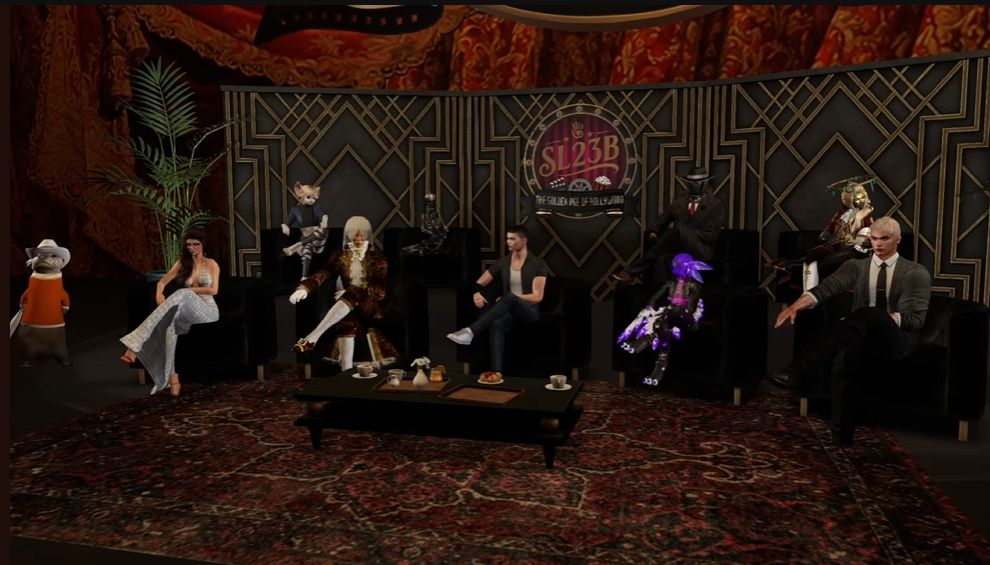
Participants

PBR, Graphics, Performance
PBR Roll-out and Optimisations
[6:06-8:02] Since the introduction of PBR, some users have reported performance issues, whilst others have raised concerns about accessibility (e.g. photosensitivity and epilepsy triggers due to reflective surfaces, etc.). Looking back on the roll out, what lessons have the engineering team learned, and what improvements can residents expect in future PBR optimisations?
Geenz Linden:
- Lessons: most important one would be getting people testing sooner and getting a larger cohort of people testing. A lot of the problems with PBR stemmed from this.
- This is actually one of the bigger challenges faced by viewer updates and new features in general, both in identifying the right time for testing and the right people to help test them.
- Improvements: LL is continuing to improve performance with PBR and is always looking at um new issues that people are reporting, from things like the skies not looking quite right on legacy content through to some of the accessibility concerns mentioned.
- PBR is here to stay, so the improvements will continue.
Viewer Performance
[8:08-9:35] Many residents are running modern gaming hardware, but still experience performance problems that may seem out of proportion compared to contemporary games. What are the biggest technical bottlenecks that limit Second Life’s performance today and what progress can residents realistically expect over the next few years?
Geenz Linden:
- Probably some of the biggest bottlenecks are going to be multi-threading. A lot of modern computers have a lot of processor cores allowing them to do a lot of things at once. The viewer hasn’t really caught up with hasn’t really caught up with that yet, and doing so would definitely help with overall viewer performance.
- Also going to inevitably hit a ceiling with how much performance can be squeezed out of [the now deprecated in most cases] OpenGL. So discussions are going on about how to migrate to something faster and more performant across a range of hardware.
Graphic APIs and Improvements, and “Future Proofing” SL
[18:56-21:10] With PBR increasing the rendering demands and modern technologies like DLSS and FSR becoming increasingly important is there a long-term plan to move beyond OpenGL towards modern graphics APIs (e.g. Vulkan DirectX12, WebGPU). If so, what challenges make that transition difficult?
Geenz Linden:
- There is active discussion around how to go through and move away from OpenGL. Second Life is “a beast of a platform” to try and render; there’s a lot of content density in every single frame the viewer tries to draw. So Vulkan, etc., isn’t exactly a turnkey silver bullet sort of solution.
- Also need to be able to meet our current performance or better. This is also not as straightforward as just flip a switch and you’re on the new thing that’s magically faster. A lot of work goes into some of these newer pipelines to be able to get to that point.
- At the same time, there is making sure that the general look and feel of SL is maintained. SL has 23 years worth of content. So care has to be taken not to break things as much as possible when changing the rendering engine.
- There is also the wide range of hardware used to access SL. This can mean just because an API is supported across different hardware, it doesn’t mean it’s supported the same way across that hardware.
- All of this requires consideration and testing of options to make sure nothing is being broken along the way.
- [53:52-54:36] LL very well aware of where the industry is going with broader OpenGL support, plus the current version used in SL doesn’t have much performance headroom left. So, preliminary steps are being taken to make a move easier.
- Those interested are encouraged to attend the Open-Source User Group [summaries here].
[21:25-23:08 ] From an engineering perspective, how much of Second Life can realistically be modernised while also preserving compatibility with the platform that has evolved for more than two decades?
Geenz Linden:
- When adding more modern rendering features, as noted, care has to be taken to avoid things like content breakage; people want to see things in SL the way the saw them on first joining the platform.
- This isn’t always possible so care must be taken when it comes down to updating the platform: to add / update, or replace?
- For example, the 2011-2012 work to add the original Materials (Blinn-Phong) to SL was purely an additive feature which didn’t disrupt existing feature sets; things looked about the same.
- EEP and Bento are other examples of things that added to SL rather than replacing or modifying existing features which also worked.
Region Crossings
[9:38-12:29] Vehicle users, role players, and explorers have long struggled with inconsistent region crossings. How difficult is this problem from an engineering standpoint? Are there any meaningful improvements on the horizon?

Monty Linden:
- On the technical load, has described this as a bug finding problem. Teleports and region crossings – and to an extent logging- in – touch almost every system, both in the viewer and server-side, involving something on the order of 100,000 lines of code get involved in the entire process.
- Given the complexity of the process, it is probably plagued by something on the order of several hundred bugs, some small, some innocuous, some unreachable, and a few of them extremely significant. Some exist architecturally; some are protocol definition problems and reliability problems.
- LL is very aware of the issues of teleporting and region crossings, and has significant projects in development to address some of the problems. So people will start seeing small incremental changes to fix the big ones, get the reliability better, a reduction in viewer disconnects, etc.
- This won’t be an overnight thing, and at times LL will ask for feedback, as this is a process that relies on people reporting specific and interesting problems that they are encountering; the team need to see a bigger spread of the bad experiences people are having. So please file bug reports.
WebRTC and Voice Updates
[12:32-16:14] What have been the biggest challenges with the new voice system and what improvements are currently being worked on?

Roxie Linden:
- Biggest challenges: the variety of audio devices and operating systems used in SL, not of all which can be tested in all combinations. So, if people are experiencing issues with Voice, please file a bug report.
- Voice is also a significant system with a lot of moving parts; a lot of servers, the simulators, the various viewers (and their release cycles in picking up code and fixes), etc., and orchestrating them all is a complex task when dealing with the size of something like SL, hence the slow and steady development and deployment.
- Issues: region crossing disconnects can still occur with peer-to-peer Voice communications. There are probably other issues, so again, bug reports are requested.
- However, WebRTC is entirely in-house rather than being supplied by a third-party, which means fixes can be implemented faster.
Technical Initiatives
Current Projects
[16:30-18:41] What are the most impactful technical projects that are currently underway that could significantly improve the Second Life experience?

Jerome Linden:
- Due to SL being around for a long time, a lot of the work being carried out is maintenance focused, but the work is not solely There are a number of big projects in progress. These include:
- WebRTC, as mentioned above, and which could include voice-to-text transcription, and this is being experimented with and a project with it could start very soon.
- Lua scripting: this is another major project which should hopefully ship in 2026. It is currently available in some regions for testing. A benefit with Lua is that it is a known language so creators from outside SL should be more comfortable with it then Mono or LSL.
- There is SL Mobile, which is continuing to develop and allow the sharing of experiences between devices.
- These are the big projects which will be / become visible over the next 6-12 months, with others in the pipe.
- There are also smaller project in progress – optimising graphics quality and performance. There is also work going on with the viewer UI.
Linux Support and Scripting Support
[26:19-26:40] Is there any possibility of an official Linux viewer returning in the future or will Linux support continue to rely primarily on third-party viewers?
Geenz Linden:
- Linux support will be returning, and will debut with the release of the Lua scripting viewer.
[26:53-28:23] Can you share any updates on the Lua scripting project status, timeline, and the long-term vision for modernizing scripting within Second Life?

Rider Linden:
- Not going to commit to a timeline, but as mentioned, it’s actually looking really good for Lua to be deployed later in 2026.
- Those who are interested, Lua is discussed at the Simulator User Group held every other Tuesday [meeting summaries here].v These meeting offer a lot of feedback that is helping to shape Lua.
[28:33-30:14] What is LL’s long-term vision for improving creator tools, documentation, education, and collaboration opportunities for builders and scripters?
Rider Linden:
- The Lua viewer will have quite a number of uh of improvements: tighter integration with external editors for easier coding, for example.
- There is also a VS code plug-in which has some fairly tight integration with SL, helping to keep function definitions up to date, etc.
- There is the in-development Getting Started with Scripting Portal with information on how to get started in scripting if you’re not a scripter.
Inventory and Content Organisation Improvements
[30:47-32:03] Many of Second Life’s core systems, things like inventory management, profiles, landmarks, and content organisation have changed very little over the years. Are there plans to modernise these and make them easier to manage?
Jerome Linden:
- Short answer: no plans yet, but it is heavily discussed.
- A focus right now is to make entering Second Life easier and a more pleasant experience. Part of this making systems like inventory more accessible, easier to use and more modern. So there are discussions, but currently, there is not an exact plan in place.
- Will say that he is expecting changes and modernisation around the system in the next 6 to 24 months.
We have a question about modifiable content transparency. Would it be possible to provide clear information about what parts of a purchase product are actually modifiable so that residents can make more informed purchase decisions before buying?
[32:09-33:20] Would it be possible to provide clear information about what parts of a purchase product are actually modifiable so that residents can make more informed purchase decisions before buying?
Jerome Linden:
- By transparency here, is reading people want to know what they’re buying before they buy it.
- In terms of the specifics of clarifying what can be edited, etc., in-world, there are currently no plans.
- In terms of the Marketplace, there are plans being discussed with the Product Team, but these are not ready for discussion. The short answer is that LL wants to make the Marketplace experience and buying experience better and easier, which also goes back to the new user experience and making it easier for them to engage in the economy.
Simulator and Server Infrastructure
[33:30-35:39] When will users see noticeable reductions in lag? What areas of server infrastructure are currently receiving the most engineering attention?
Monty Linden:
- Lag comes in three varieties: the user’s side [their hardware, Internet connection], network [the routing from the user’s Internet connection to the AWS servers used by LL] and server side [what is going on within the simulator / server that can cause lag]. Can only really talk about server-side and network.
- Unlike the viewer, server-side frame rates don’t have as direct a correlation to the experience.
- There has been work to improve a number of areas within the server-side over the past few years, such as “fairness”: when one avatar would undertake something like entering a region, for example, the simulator would focus on them as a priority and impact the experience of everyone already in the region. Nowadays, the person entering the region suffers a little more in terms of delay, but those in the region suffer less.
- More of this kind of work is being done so over time the server will get better.
Security: Phishing Attacks and User Protection
Hacked accounts and fraudulent Marketplace links continue to circulate through groups and chat channels. What tools or engineering solutions are being developed to help residents identify, report and avoid these scams more effectively?

Soft Linden:
- Phishing has always been an issue in Second Life, but attackers have recently adapting their tactics. Historically, resident reports have always been the most important factor in helping us identify campaigns and respond to them.
- This is not ideal as completing the Abuse Report is manually intensive. So for links, the ability to right-click a suspect link and auto-generate a report has been prototyped and might be deployed.
- It is hoped that such an approach will increase the number of reports on phishing attempts and allow LL to respond far more quickly.
- LL has also prototyped some changes that’ll give a clear signals when someone is about to visit a site that doesn’t match their personal browsing habits. This will be something that’s tracked locally in the viewer so as not to compromise people’s privacy or alter whatever browser privacy protection they might have in place.
- There is other work that’s intentionally less visible and aren’t for discussion as revealing them could offer bad actors a way around them.
- Overall, LL is aware these problems have increased and the goal is to make scams harder to succeed whilst making reporting easier, and finding ways to more effectively respond when uh campaigns do appear.
Some residents have suggested tighter restrictions around external links uh within the viewer to reduce fishing and social engineering attacks. So the question is how does Linden Lab evaluate the balance between security and usability in this area?
Soft Linden:
- There is always a trade-off. You don’t want the Wild West where everybody is left to judge everywhere alone; but you also don’t want to create a completely locked down experience that kind of breaks Second Life for everyday use.
- The overall goal has to be to avoid making all of you personally responsible for every risk, although this is not always fully possible, but it’s the right place to start.
- So when evaluating changes around security controls generally, LL starts with the questions is this actually making safer behaviour the easier behaviour? Are we making attacks less effective? Are we improving our own ability to respond when attacks do happen? Are we avoiding changes that make Second Life harder to use in ways that are going to frustrate you and drive you toward unsafe workarounds?
- Second Life has an incredibly complex surface. So there is not one universal rule for every context. So the approach is to add friction where the risk is higher and improve signals when something looks a little weird, and improve reporting response.
Additional Technical Topics
AI Use and Long-Term Vision
[23:25-25:20] Beyond generative AI, are there opportunities to use AI technologies to improve asset optimisation, performance, content creation workflows or other engineering challenges within Second Life?
Jerome Linden:
- To be clear, because AI is used for many things, LL has no plans to use generative AI to create content or anything like that for Second Life.
- AI tools are used within various workflows where appropriate – security challenges, code audits, team workflows, customer support workflows, etc.
- For features that would be a little bit more uh resident facing, AI would only be used where it makes sense. For example, it is hard to optimise assets using AI, because assets are all user-designed, and people do a lot of things with their content.
- But there are areas of optimisation where AI can be used, such as helping to monitor the Marketplace and make sure the listing are tagged correctly and in the right category and perhaps analyse if there are things that should be unlisted from the Marketplace.
- AI will also assist with the Voice-to-text transcription already mentioned.
- So, no plans to use AI generated content in-world, but a considered use of AI tools where appropriate.
[42:15-45:19] It is becoming increasingly difficult to distinguish authentic products from misleading Marketplace listings using AI generated images. What steps is LL considering to improve transparency, trust and discoverability on marketplace?

Juniper Linden:
- The Marketplace Team is very aware of this, although it is also a Product question as well and Engineering.
- It has come up through feedback reports at through the Web User Group meetings [summaries here].
- The real question is: yes there are AI-generated images and things like that, but what is the limit of what we consider AI in terms of assisting things? So LL is moving slowly on this so as to fully consider what controls, etc., are implemented.
- Companies have rolled-out AI moderation in a way that can be really aggressive and demeaning, such as mis-flagging AI-generated content, which would potentially upset SL content creators.
- If there is an opt-in process, how do creators know the level of AI use requires self-reporting?
- So there isn’t currently a single answer, because it is something LL is trying to figure out as the AI ecosystem changes and people experiment with it more. However, it is being monitored, and thought is going into how AI generated tools might help with some content moderation [as noted by Jerome], but full-on content moderation, this needs careful consideration.
General Marketplace Usability / Moderation
[45:33-47:36] Residents have expressed concerns about Marketplace usability (e.g. mis-labelled demos, listing moderation issues, vague rejection messages). Are there plans to improve the Marketplace experience for both shoppers and creators? For example, when are drop-down sizes coming or rollover images, etc., to make the MP resemble a more modern marketplace website.
Juniper Linden:
- There is currently a clean-up on listings [de-listing items with no sales over 2 years and where the creator has not logged-in to SL for some time]; together with work to modernise the MP.
- Given the age of the application, a lot of this work is from the ground-up, requiring a lot of internal work to break things down to be more manageable and easier for LL’s internal tooling.
- The hope is to revamp the MP as much as possible, but things are quiet right now as the foundational work gets underway in order to start tackling more of the technical debt within Marketplace.
- Once this work is done, then things like better error messaging and more persistence on jobs and retries can be put into place.
Creating a “Second Life 2.0”
[25:29-26:15] With Unity and Unreal moving towards interoperability in the coming years, has LL ever considered the idea of archiving the current Second Life and creating a new modern successor?
Jerome Linden:
- Short answer: No. There are no plans to do this.
- The issue is not really engineering but business: it will be very difficult to ask the entire resident population to switch ecosystems. And if you don’t then you have the complexity of trying to support two ecosystems [which LL has tried with SL and Sansar].
OpenSimulator Interoperability
[35:49-36:57] Is there any possibility of renewed interoperability or collaboration with OpenSimulator or have those platforms diverge just too far technically to make that practical?
Jerome Linden:
- There are no plans to engage with OpenSimulator.
- Whilst LL is very engaged with the open source community with the viewer, any involvement with OpenSimulator would require opening-up the Second Life simulator code base, which is not something LL plans to do.
- Keep the simulator code base private helps a lot in term of possible attacks and things like that.
Second Life 2-3 Years Hence
[47:43-49:15] If we were to look ahead five years, what do you think will be the most noticeable engineering improvements that residents will experience in Second Life?
Jerome Linden:
- Five years is a long time; better to answer in the 2-3 year time frame.
- As noted, currently the focus is on make SL more accessible to new users and grow the platform.
- This involves modernising the platform, as already mentioned: inventory improvements, marketplace improvements; there’s also Lua coming out, Voice-to-text transcription, plus avatar customisation.
- Believes that in the next two to three years there will be a lot of features and updates emerging. This will also provide opportunities to potentially rewrite some of the software that has been aging for 20 years.
Magic Wand Time
[49:18-52:55]If you could wave a magic wand and solve one longstanding technical challenge in Second Life tomorrow, what would it be and why?
- Leviathan Linden: I would vote for region crossings.
- Geenz Linden: content interoperability; the ability to bring content from other places into Second Life.
- Roxie Linden: communications – Voice-to-text; translation; text-to-speech; improving the ways in which people can communicate with one another.
- Rider Linden: would have said teleporting, but will go with more scripting improvements and capabilities.
- Soft Linden: less latency when it comes to playing games in-world, and form people around the world using SL.
- Monty Linden: more collaborative building opportunities; it’s one of the things that makes SL unique, and while necessary, some changes to SL have diminished it.
SL Mobile

[1:01:16-1:01:45] What is the status of SL Mobile?
Radix Linden:
- SL Mobile is still considered beta and is definitely a work in progress.
- There are a lot of changes coming down the pipe still and things are going to change in significant ways. But no specific promises; just more to come!
[Side note: see also this section of the Product Team Meet the Lindens session.]
Audience Questions
[54:48-55:22] Is there any work on a fix for memory leaks inside Second Life?
- Geenz: There is work reduce the memory footprint that the viewer takes due to the volume of content it has to process in real time. But it is a complex problem.
[55:32-56:08] Is there an official recommendation or just any insights you could offer people looking at trying to get the best laptop for SL?
- Geenz: Lots of VRAM will help you, together with a powerful CPU. SL doesn’t necessarily eat a ton of your GPU, but it will eat a lot of RAM and it does need a good CPU.[See Also: SL System Requirements.]
[56:43-57:20] How come that after rolling restarts on the Mainland, content can be lost and not be retrieved?
- Leviathan: There are some known ways that a region being taken down would fail to save its sim state; these may cause the majority of the cases of lost content. There are some fixes for these issues in the current simulator release.
[57:25-58:13] Could someone provide an update on using game controllers with the viewer?
- Leviathan: The game control project was started a couple of years ago with an original focus on exposing game control inputs to in-world scripts. Currently, the focus is on just making the viewer work with a game controller so that you can move around and configure your game controllers to do what you want. It’s a work in progress.
[58:16-59:09] Is PBR Bakes on Mesh going to be available soon?
- Geenz: short answer: it would be nice to add it. Longer answer: there are some steps which have to be completed first. There is an upcoming viewer, the Graphic Care Package viewer, lays some foundational work to get that going, e.g. the upcoming uh PBR specular extension support.
[59:25-1:00:34] Are there any plans to modernize the chat experience more broadly?
- Jerome Linden: There is no specific plan around chat right now outside of making IM chat histories persist across platforms. There are the already-mentioned chat related projects (transcription, etc.), but no plan to improve specific areas of chat, but like every feature, we’re trying to modernize it and make it easier to use.
[1:01:55-1:02:41] I have a question about the alpha glitch when multiple objects with alpha textures on them are on screen and behind and in front of each other. Is there any attempt still being made to permanently fix this?
- Geenz: LL is aware of various different solutions to tackle this issue, but a lot of these solutions would end up costing performance people who are on lower-end hardware. Graphic APIs like Metal and Vulkan would also definitely help out with this a lot – so updating the rendering API would probably have to be the first tasks to complete before trying to attack this in earnest.
[1:02:59-1:03:43] Do older accounts that never log in anymore that have a lot of things in their inventory, do they contribute to the bulk of information the servers have to hold on to, which may negatively affect how well they run? What impact does that have?
Jerome: Does not think the impact is major, right? We are talking of us storing data in some databases. So it’s not a main contributor to performance issues. >> Great. Thank you.
End of session.
SL23B Meet the Lindens Summaries
- Philip Rosedale
- Product Team (Grumpity and Keira Linden)
- Marketing and Growth (Brett and Fausto Linden)
- Second Life Studios


