The Third Eye, curated by Jaz (Jessamine2108), opened its September 2020 exhibition on the 29th August, once again offering a double header of art featuring Lynn (Titaniclynn Ayres) and pieces by Jaz herself.
Lynn is a Second Life photographer whose work tends to centre on landscape photography, but also can encompass art and avatar studies. For Photos by Lynn she offers 18 pieces in both colour and black and white that are taken from her extensive portfolio of landscape images, and which incorporate some of Second Life’s popular public destinations.
Third Eye – Lynn
The colour images, encompassing places such as Boulder, Jambo, A Taste of Africa, Cherishville, Venesha – all of which are well known to seasoned Second Life travellers – offer unique views of their subject that are rendered in rich colours. In some, this post-processing suggests a painting-like finish, in others they provide a sense of warmth and lightness. All, however, do full service to their subjects.
Similarly, Lynn’s black and white pieces encompass SL’s more popular destinations of recent times and are all equally evocative – if not more so, given the way black-and-white images tend to draw out the secrets of their subjects. In this – and while I enjoyed Lynn’s colour works immensely, I found the black-and-white pieces like Waiting.., Tralala’s Diner and Elvion, to contain a particular vitality.
Third Eye – Jaz
For her exhibition, Jaz offers Navarasa a visual journey through emotions in Indian dance. The Navarasa is a dance form that represents the nine rasas, or emotions that an individual might display according to their situation. These are: Śṛṅgāraḥ (romance, love, attractiveness) Hāsyam (laughter, mirth, comedy), Raudram (anger, fury), Kāruṇyam (compassion, mercy), Bībhatsam (disgust, aversion), Bhayānakam (horror, terror), Veeram (heroism) and Adbhutam (wonder, amazement).
Each of these emotions is portrayed in a pair of images: the uppermost a scene captured from within Second Life, the lower a photograph over which has been set the dance step representative of the rasa itself. It’s an engaging, evocative display, dance figures and background photos (including in places the use of colour wash) capture the emotional mood, whilst the accompanying image from Second Life provides an expressive narrative for the emotion.
Light of the Desert, August 2020 – click any image for full size
Back in May, I wrote about Camila Runo’s homestead region design, A Taste of Africa (see A voyage to Africa in Second Life). Since that time, Camila has redressed the region so whilst it remains rooted in Africa, its foundation lay further to the north and perhaps east than that iteration, as the new title – *NOUR* – Light of the Desert – indicates.
As with the previous iteration of the region, this is a richly evocative setting, incorporating multiple aspects of what might be called – for those of us in the west, at least – “traditional desert settings”.
Light of the Desert, August 2020
There’s a domed palace on a rocky plateau, complete with a small garden house with with the most valuable commodity to be found within desert dunes: free-flowing eater. Then there is a Bedouin camp site sitting at the edge of an oasis (or a wadi, depending on your preference). In between these sits a waterside village, crowned by a luxurious bath house, although the dhows sitting on the river suggest this is more of a working village than a resort.
From the landing point, located in the south-west corner, it is possible to visit all of these locations in turn, the region being neatly laid out in such a way so as to suggest a walk through a desert, one surrounded by high dunes (although these are admittedly off-region, so the intervening water does spoil the effect a little), passing from one oasis of life to the next. A path running down from the landing point points to the route to be taken, with the first stop that of the high palace. sitting on its plateau, commanding a view across the rest of the region.
Light of the Desert, August 2020
Topped by yellow-painted domes and reached via a stone stairway that sits just within the walls of the village and that leads the way past the lower-lying garden house, the palace has thick walls to help keep the heat out, a tall fountain splashing water within its main hall. Lavish curtains and drapes separate the side rooms from the hall, and latticed windows allow whatever breeze might pass to enter the building, while the upper level offers an ornate bath and chaise lounge on which to recline.
Down below, beyond the garden house with its fountains, water, grass and flowers, sits the village. Flat-topped houses and a souk built of mudstone surround an open market of tented stalls. It is bracketed by water to one side, where wharves for dhows sit, and a long ruler of a wall on the other, clearly designed to keep as much of the wind-blown sand out of the village as possible. Standing as a place of local commerce, the village is dominated, as noted earlier, by the squat bulk of a great bathhouse, within which sits a large square pool and plenty of opportunities to relax.
Light of the Desert
A single gateway sits within the long village wall, parallel lines of rounded stones marching out into the desert beyond. These wind around and between rippled dunes, showing the way to the oasis / wadi. Whether you follow them past the old desert fort or simply set out over the banked dunes to reach the greenery that lies beyond them is up to you, but once you’ve passed through the ring of palm trees you’ll find a spacious Bedouin camp set out around a body of water unusually – for a desert – fed by a rocky peak from which water tumbles in multiple falls.
Throughout all of this are many details that add depth to the region. There are a lot of places both within the grander buildings and in the large tents to sit, with more outside around camp fires or shaded by the likes of blankets draped over simple wooden frames. Dromedary camels add to the felling of the north African / Arbian setting, whilst a rich (if a little intrusive in places) sound scape brings life to the village with the noise of people going about their daily business filling the air. Adding their own conversation to the mix are the camels, given as they are to the occasional grunt and snort as they wander.
Light of the Desert, August 2020
Following on from A Taste of Africa, Camila’s latest build continues in the same vein of offering an immersive, engaging setting, one particularly rip for avatar photography, although the region offers more than this for those willing to dress the part and / or explore it from end to end. All-in-all, an excellent build and engaging visit.
With EEP, it is now possible to have reflective floors at the parcel level that everyone can see, and contained within the parcel
Within Second Life there have been numerous ways to produce reflective floors within buildings – the most popular being to build a near-duplicate of what is in a room / building and inverting it “below” a textured, semi-transparent floor, allowing the duplicate to act as a reflection.
It’s a clever means of achieving the idea of reflections in polished floors, and has the advantage of being relatively “efficient” performance-wise (if a little hard on land impact, depending on the degree to which a person goes with the “reflected” items under the floor), as it means re-use of loaded textures and avoids rendering avatar reflections and mirroring movement. Although that said, the fact that the technique doesn’t show avatar reflections can spoil the effect.
Nitroglobus Roof Gallery provides an excellent demonstration of using a duplicate build to create the illusion of a reflective floor (although note the lack of any avatar shadow)
As has long been known, Linden Water can also be used as a means of producing reflective floorsthat can reflect avatars as well as objects. However, under Windlight, it has tended to suffer from a couple of observable weaknesses: if applied at the region level, it meant all water viewed from the region with produce the mirror effect – which could be a problem when outdoors (e.g. a mirror-flat surrounding sea); while to use it at parcel level meant using a viewer that accepted viewer-side parcel Windlight support – so anyone not using such a viewer would see a building / room with “flooded” floors.
EPP, with its simulator support for for parcel-level environment settings, means that is now possible to use Linden Water to create reflective floor effects within ground-level building that can more easily been seen by anyone entering the building, regardless of the viewer they are using. There are some pre-requisites involved, both it terms of creating the effect and viewing it, but even so, it is relatively easy to implement for anyone who wishes to do so.
Those prerequisites are:
As the approach uses Linden Water, it can only bee used at ground level (and on ground-level rooms of such buildings).
Some skill with terraforming is required, in particular:
Lowering / levelling land – this is important as the “reflective” floors must be at water level.
Ability to sub-divide land into parcel – this is particularly important if there is Linden Water is visible from outside the building with reflective floors, as you’ll be making changes to how Linden Water appears.
For parcels, you’ll need to have permission to set the environment at parcel level – if you do not own the region, and parcel level EEP support has been disabled via the region level controls, you will have to discuss the matter with the region holder / owner.
Those visiting the building must have Preferences → Graphics → Water Reflections set to All Avatars and Objects or Everything in order to see the water reflecting everything, including avatars.
The approach works best with your own builds, but can be used with pre-fab builds if they are modifiable, and can have floors modifed / replaced.
1 Prepare Your Land and Building
The first thing you need to do, is determine the shape of the floor space you wish to has as a reflective space and prepare the part of your land where it is to go.
Make a simple prim template of the shape of the room / building.
Place the template on your land where the room is to be positioned.
Keep in mind that depending on your location, you may want to sub-divide your land (if you have the necessary permission) so you can see natural-looking Linden Water when outside your house.
Use the terrafrorming tools in the Build / Edit floater to carefully lower the land under the template to expose the Linden Water.
Note that the “reflective floor” will, when the work is finished, need to sit just below the level of Linden Water. This means you may have to set it lower than the floors in other rooms on the ground floor of the building, or have the building itself surrounded by a mesh / prim surround to blend it with the ground level.
When you’re set, position the building and if necessary sub-divide your parcel.
Edit the building and:
Sset each of the floors you wish to be reflective to around 80% transparent – note that you may have to experiment with this setting, depending on the floor texture you use.
Apply a suitable texture for the reflective floor(s) (e.g. a wood texture for a polished wooden floor, or a marble effect for a public building).
2. Set the Water Environment
As noted above, you’ll need a suitable normal map to replace the one used for Linden Water.
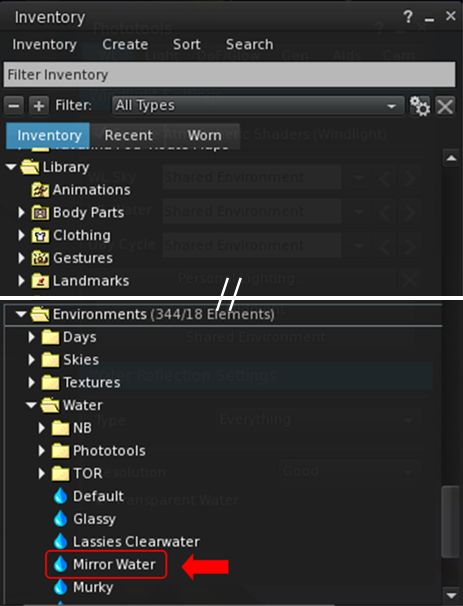
The easiest way to do this is to use the Mirror Water environment asset that is included in the viewer under Library → Environments → Water.
You will need to copy this asset from its default Library location to your inventory (e.g. to the Settings folder – or a sub-folder within Settings, if you organise your EEP assets in sub-folders).
You can use the Mirror Water environment asset to help create your reflective floor. Make sure you copy it (e.g. via drag-and-drop) to your Settings folder
With the Mirror Water environment asset copied to your inventory, double-click on it to edit it. This will open the Fixed Environment – Water panel.
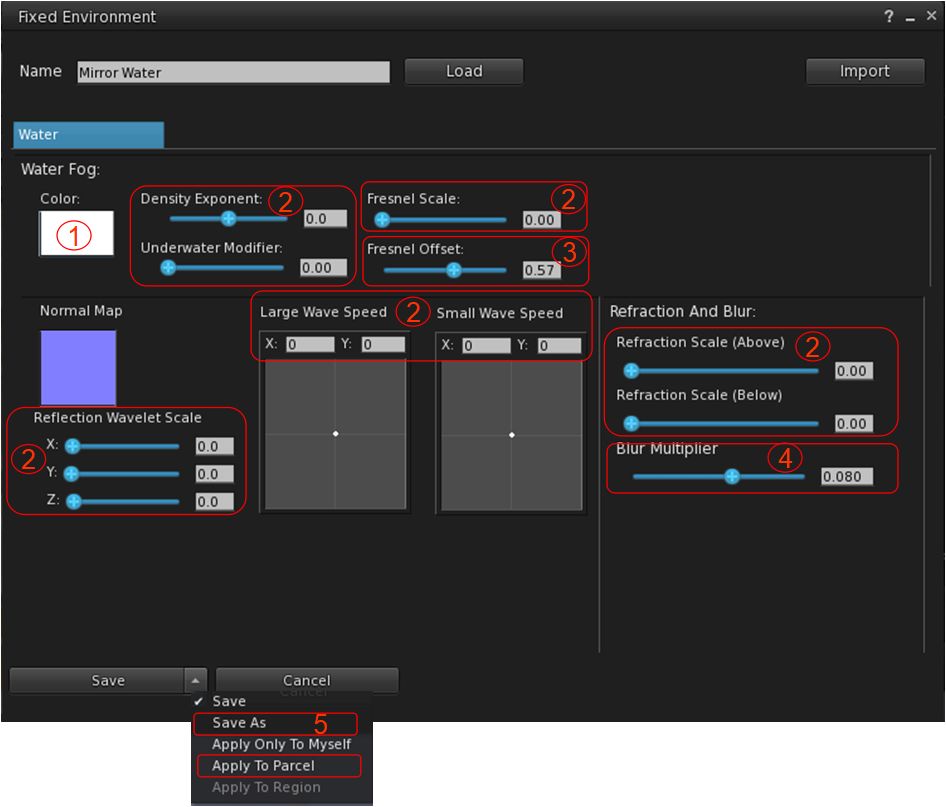
Within the panel, make the following changes (see the image below for reference):
Set the water fog colour to white (note that depending on things like ambient lighting, the floor texture you use, etc., you may need to adjust this towards a more grey colour).
Set all of the following to 0.0:
Fog Density Exponent and Underwater Multiplier.
Fresnel Scale.
X, Y, Z Reflection Wavelet Scale.
Large and Small Wave Speed.
Refraction Scale (Above) and (Below).
Set Fresnel Offset to 0.50 (note that depending on things like ambient lighting, the floor texture you use, etc., you may want to adjust this up or down).
Set Blur Multiplier to 0.80 (note that depending on things like ambient lighting, the floor texture you use, etc., you may want to adjust this up or down).
From the Save / Apply Drop-down, select Save As and save your updated environment asset under a new name (e.g. “Reflective Floor”).
Adjusting the water settings for a reflective floor effect
Once saved, Select Apply to Parcel from the Save / Apply drop down to apply the environment to the parcel.
3. See How It Looks / Fine Tuning
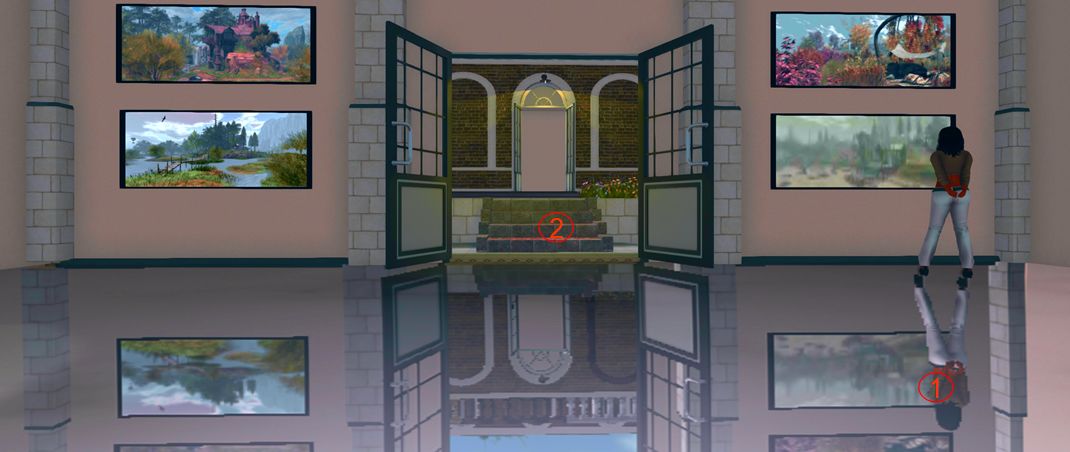
You should now have a nicely reflective floor to your building, as shown below.
The finished product again, as per the banner image, note the avatar reflection and well as the reflections of in-world objects (1), and also the use of steps to access the low-set floor of the gallery from the outside “ground level” (2)
What’s more, if the building is sitting within its own parcel, when you leave the building, any visible Linden Water should look like natural water / waves (although if you cam into the building or glimpse the “reflective floor” from outside of the parcel, it might look a trifle odd until you actually enter the parcel).
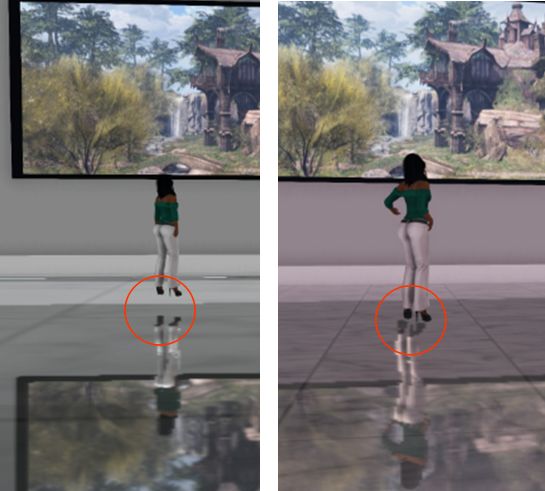
You might find that some additional “fine tuning” of the build is required to achieve a perfect result. If you’ve placed your floor a little above the level of Linden Water, for example, you may find your avatar “floats” over its reflection (below left), or if the floor is set a little too far below the level of Linden Water, the avatar and reflection may appear to “merge” at feet / ankles. But errors can be corrected with careful adjustment of your floor either down or up.
You may have to adjust the floor level relative to the Linden Water level to prevent avatar reflections giving the impression avatars are floating above the floor (l) – or standing with feet embedded in it – and actually standing on the floor (r).
Conclusion
There are still some limitations on the effectiveness of this approach: as noted above, it can only be used for ground-level interiors, and the effect does require visitors to have their graphics preferences set to reflect avatars in Linden Water. However, once set-up, it can add a certain edge to places like stores and galleries.
I’m not sure how much of a performance hit would occur in viewers trying to render a lot of avatars and their moving reflections in a ballroom or other dance venue, so these might require greater consideration. But if you do want to have a different ground-level flooring for your building, and you can meet the prerequisites noted above, it might well be worth giving it a go.
I’ve always enjoyed Luis Lockjaw’s region builds, particularly his Templemore designs from Hesperia through to Lutz City, going by way of Elysium City, so an opportunity to visit his latest Templemore design – Templemore Cove – carried with it a certain anticipation.
Past Templemore builds have had something of a fantastical feel to them, one rooted in reality, but with a twist of fantasy that has made them attractive to the eye whilst tickling the the imagination. For this iteration, things are a little more straightforward: the presentation of a shoreline town clearly in a tropical / sub-tropical location, rich in palm trees and surrounded by off-shore islands sitting is water that – going by the trawlers docked to one side of the region – rich in fish.
Templemore Cove, August 2020
The town itself could be anywhere, but has a distinctively central / southern American feel to it, so much so that by turn, the setting suggests it might be somewhere in Florida, at others perhaps somewhere like Cuba or another large Caribbean island, or perhaps somewhere like Panama or San Salvador.
Florida is particularly evoked by the luxury yachts and powerboats to the east, the pools and neon Motel signs. Cuba and South American townships are suggested by the sun-faded gay colours of buildings, be they apartment houses or places of business, together with – in places at least – the age of some of the types of vehicle to be found. Swimming pools are much in evidence, whilst the town is built along a grid pattern that is again suggestive of somewhere in the United States, as do the broad board walks. And whilst most of the buildings are shells, it doesn’t prevent visitors appreciating their attractiveness.
The Templemore builds have always had an association with music, and that is very much the case here, with stages to the south and east, whilst the north-side beach offers a chance to escape and relax.
Templemore Cove, August 2020
It is clear that throughout, considerable care has been put into this design – as is always been the case with Luis’ region builds. However, it would be remiss of me if I didn’t point out that this detail comes at a cost: this is a full region with the private region land capacity bonus – and this has been used to the maximum in terms of the amount of mesh and texturing (and if not in terms of physical capacity), all of which can place a significant load on a view that is running with shadows enabled, a higher draw distance, etc.
As an example of this, whilst taking photos with shadows set and a draw distance of 190 metres, I found my fps bouncing fairly heavily between single-digits and mid-teens with under half-a-dozen avatars in the region, some times dropping as low as 4-4.2 fps, which made moving uncomfortable. Things were marginally better with shadows off, but it’s possible those on older systems may well find Templemore Cove heavy going.
Templemore Cove, August 2020
Nevertheless, Templemore Cove has an attractiveness that is worth seeing, particularly if you do enjoy taking photos of Second Life locations.
I first visited Love & Love Art Gallery, curated by Lylaya Love (lylaya), back in June 2020. Since then, it has relocated, and earlier in August, two new exhibitions opened, featuring the work of Kerupa Flow and Norton Lykin respectively.
Kerupa Flow presents another series of her truly remarkable tablet-and-pen creations, the majority of which are monochrome in nature. There is a richness of diversity present in these pieces, suggestive of multiple roots for Kerupa’s work. To take just a handful: When it Rain, for example has an ink wash style about it, whilst Hug and Curious Walker hint at pen-and-ink drawings whilst Lurking Now is surreal in nature and the landscape of Indelible Night carries an abstracted element within it.
Love & Love Gallery: Kerupa Flow
I admit to finding Kerupa’s work quite fascinating since first encountering it in 2015; her work is always rich in the narrative it contains, and all of the pieces offered here carry that same strength and depth – perhaps most notably her 3D piece, I’ll be sure to find you.
Across the hall, Norton’s work tends towards the striking, with bold, strong colours, and this exhibition is no exception. Twelve pieces of a somewhat abstract nature with a twist of futurism are presented here, offering reflections on love, life, art and the cosmos.
Love & Love: Norton Lykin
Several of the pieces reflect the art of others – Mario2 Helstein and Giovanna Cerise, as re-imagined through Norton’s eyes. These are particularly striking, while Sunrise with Shadows and Red Moon present unique views of the most recognisable occupiers of our solar system (outside of Earth).
When visiting, be sure to take the teleport mat to the gallery’s lower floor where, at the time of my visit, Patrick Moya’s iconic art was still on display, nicely balanced by a display by Oblomov (Jos Bookmite) I reviewed back in June 2020.
At the start of August 2020, we made the move to Second Norway (see Farewell, Isla Pey, hello, Isla Caitinara). Since then we’ve been settling in, and as I noted a few days ago, I’ve been playing with a scene rezzing system so that we can have a choice of homes on our island (see: House changing with a scene rezzer in Second Life – and we’re up to three designs now 🙂 ).
However, what surprised me about our move was the feedback (comments on this blog and via IM) from people under the misapprehension that the April / May change in ownership of the estate had somehow resulted it in being “broken up” and replaced by “cookie cutter islands”. In fact, while there have been changes to the estate, much of the original Second Norway remains – and as a frequent visitor-turned-resident, I can also say that none of its spirit has been lost.
In this, I hope this small selection of photos helps to illustrate that point.
The central regions in the estate still have their road and rail system – the latter having (I understand) been ungraded. For water access, this roads mean that the familiar drawbridges are still present
Of course, the airport is still there – as can be seen in the banner image for this piece. So to – contrary to rumour – the road and rail system, as shown above.
The estate also has a good mix of residential and commercial spaces – Motor Loon’s famous MLCC brand is still present for example. On the south side of the estate, AustinLiam has taken this a stage further – an entire group of regions set out as a village, offering his houses and commercial units and other buildings in a contiguous setting with roads, waterfront areas, moorings, and more.
AustinLiam’s regions on the south side of Second Norway
Of course, there are the outer islands – which in the future may well expand, depending on demand, but the Vanity Bonito’s team have also put in new infrastructure that offers opportunities that may not have been so readily available previously: such as the Eidet Event Centre sitting on is own wooded island.
The Eidet Event Centre, Second Norway
Residents within the estate have also sought to offer places of interest as well – camp sites, vacation centres, air fields (although the latter seem to mostly lack rez zones) – all of which add to the estate’s appeal.
Another look at Austin Liam’s commercial regions
With a balanced approach to building codes and themes, as well as offering tenants terraforming rights on their islands, Second Norway is a good mix of the “old” – the central regions with their roadways, rail lines, airport and bridges – and the “new”, with the updated island designs, allowing it to both retain its character whilst offering newcomers a good mix of opportunities.
So if you’ve not paid Second Norway since the changes, now’s the time to hop in your boat or ‘plane, pull up the map and take a look!




 Inara Pey: Living in a Modemworld