Space Sunday: China’s ambitions, Dawn’s success and Kepler’s return

China's space station, as it should look in 2022 (credit: China Manned Space Engineering)
China’s space station, as it should look in 2022 (credit: China Manned Space Engineering)

China has confirmed a series of ambitious new goals for its growing space endeavours, starting with the launch later this year of a new orbital facility, and progressing through 2018 with the launch of the core module for a large-scale space station, and which includes further mission to the Moon and to Mars.

The first orbital facility launched by China, Tiangong-1 (“Heavenly Palace-1”), was launched in 2011. Referred to as a “space station”, the unit was more a demonstration test-bed for orbital rendezvous and docking capabilities. While it was visited by two crews in 2012 and 2013, neither stayed longer than 14 days, and sinc 2013,  Tiangong-1 has operated autonomously, although it has suffered a series of telemetry failures in that time.

A model of Tiangong-2, which will be 14.4 metres (47 ft) in length, 4.2 metres (14 ft) in diameter and mass 20 tonnes, seen docked with a crewed Shenzhou ("Divine Craft") orbital vehicle on the left (Credit: unknown originating source)
A model of Tiangong-2, which will be 14.4 metres (47 ft) in length, 4.2 metres (14 ft) in diameter and mass 20 tonnes – almost 3 times the mass of the Tiangong-1 unit, seen docked with a crewed Shenzhou (“Divine Craft”) orbital vehicle on the left (Credit: unknown originating source)

Tiangong-2 will be launched later in 2016, and is designed to build on the experiences gained with the original facility, helping to pave the way for China’s first “genuine” space station. In particular, Tiangong-2 will provide an experiments bay, improved living facilities for longer-during stays, and allow China to verify key technologies such as propellant refuelling while in orbit, and undertake fully automated docking activities using uncrewed vehicles, when the nation’s first automated resupply vehicle, Tianzhou-1 (“Heavenly Vessel-1”) docks with the facility in 2017.

Tiangong-2 will be followed, in 2018 by the launch of the larger Tianhe-1 (“Sky River-1”) unit, which will form the core module for China’s first dedicated space station. Over the four years from 2018, this will grow with the addition of up to three other pressurised modules,  together with a docked “Hubble-class” space telescope. It be supported and maintained by automated re-supply mission from Earth using the Tianzhou, and provide living and working space for up to 6 crew,

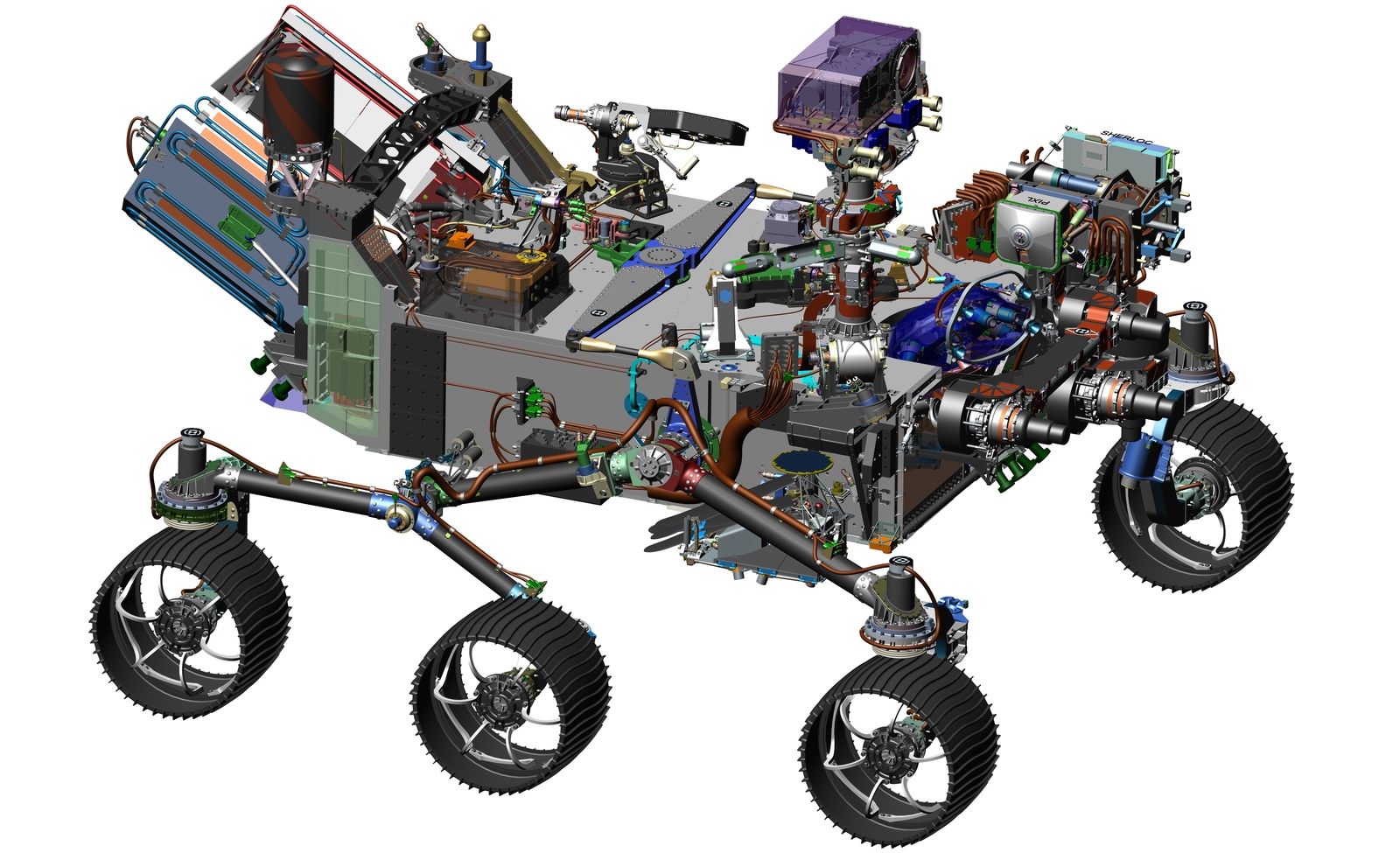
A prototype model of the propsed Mars rover China plans to launch in 2020 as part of a 3-phase mission involved an orbiter / carrier vehicle, a static lander and the rover (credit:
A prototype model of the proposed Mars rover China plans to launch in 2020 as part of a 3-phase mission involved an orbiter / carrier vehicle, a static lander and the rover (credit: China National Space Administration)

Nor does it end there. At the end of March, I wrote about China’s aggressive approach to Mars exploration.

As a part of the series of announcements made by the Chinese authorities in the run-up to their first national Space Day on April 24th, 2016 – being the anniversary of the launch of China’s first satellite, Dongfanghong-1 (‘The East is Red’) – it was confirmed that the planned orbiter / rover mission to the red planet will be launched in 2020.

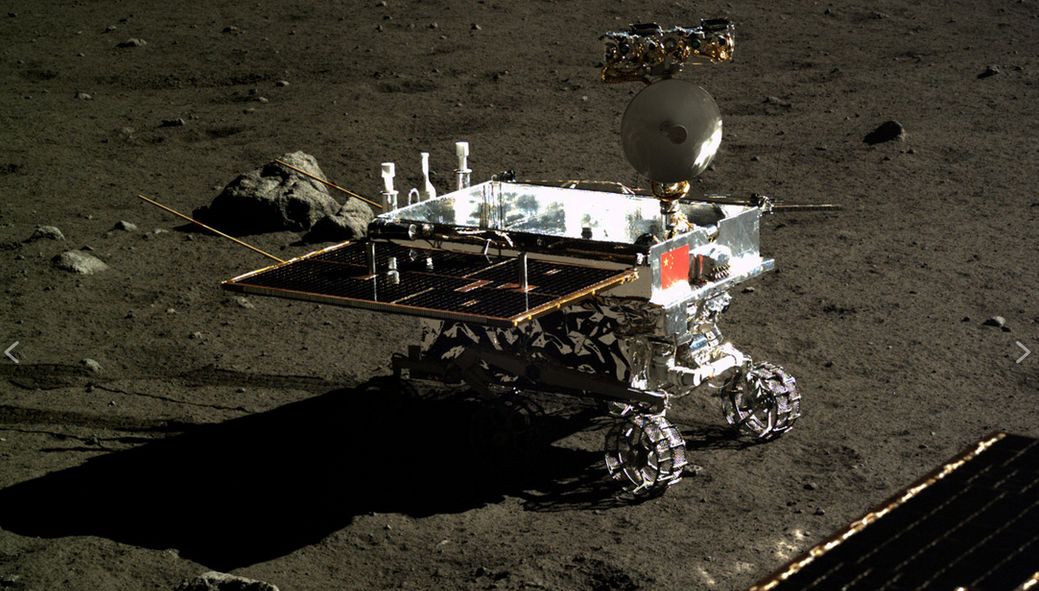
The rover element of the mission will build on experience gained during the deployment and operation of the Yutu vehicle on the Moon in 2013, and will be used to investigate the planet’s soil, atmosphere, environment, and look for traces of water.

As part of the preparations for this mission – although it is also a mission in its own right – China plans to land the its Chang’e-4 (“Moon Goddess”) probe, on the far side of the Moon in 2017, an operation which will be carried out fully autonomously of Earthside intervention.

To ensure all this happens, China is developing two new launch vehicle – the Long March 5 and the Long March 7. The Long March 5 will form the backbone of China’s space activities, offering a family of 6 launch vehicle variants, the largest of which will be capable of placing up to 25 tonnes in low Earth orbit (LEO), 14 tonnes in geosynchronous transfer orbit (GTO) for missions to the Moon, Mars or elsewhere, putting it in the same class of launch vehicles as America’s Atlas V and Delta IV launchers, and the commercial SpaceX Falcon 9 launcher.

Using non-toxic and pollution-free propellant, the 60-metre-long vehicle has a core diameter of 5 metres, and will be equipped with four strap-on booster 3.5 metres in diameter, Long March 5 is the first of China’s launch vehicles to specifically designed for both cargo / satellite launches and crewed mission launches.  The maiden flight of the vehicle is expected to be the Chang’e-4 mission to the far side of the Moon.

China's Long March 5 (l) and Long March 7 (r) next generation launch vehicles
China’s Long March 5 (l) and Long March 7 (r) next generation launch vehicles (credit: Sina Weibo)

The Long March 7 vehicle will be slightly smaller, capable of lifting 13.5 tonnes to LEO, although this will be enhanced over time to allow the vehicle to lift up to 20 tonnes to LEO. It will form the launch vehicle for the  Tianzhou resupply missions to Tiangong-2 and Tianhe-1, and over time will be uprated to crewed launch vehicle status. It is slightly smaller than the Long March 5, with a height of 53 metres, a core diameter of 3.35 metres, and used 4 2.25 metre diameter liquid-fuelled strap-on boosters. The first launch of a Long March 7 vehicle is expected later in 2016, when it lifts Tianzhou-1 for a rendezvous with Tiangong-2.

Continue reading “Space Sunday: China’s ambitions, Dawn’s success and Kepler’s return”

Space Sunday: BEAM and Kepler, Europa and comets

Euorpa's icy, mineral-stained surface as imaged by NASA's Galileo mission - see bwlow (credit: NASA / JPL)
Euorpa’s icy, mineral-stained surface as imaged by NASA’s Galileo mission – see below (credit: NASA / JPL)

In my last Space Sunday article, I covered the arrival of the BEAM inflatable module at the International Space Station, and the concerns for NASA’s Kepler “planet hunter” space observatory. As there’s been further news on both of these, I thought I’d start this Space Sunday with a quick round-up on them, starting with Kepler.

The Kepler observatory, located some 121 million kilometres (75 million miles) “behind” Earth as both orbit the Sun, has been engaged in a 7-year mission to try to locate planets – particularly possible Earth-type planets – orbiting other stars. As I reported last time around, despite one major setback which called a halt to the observatory’s primary mission in 2012, Kepler has been a remarkably successful mission, catalogue some 4,000 potential planets orbiting other suns, with over 1,000 subsequently confirmed as planets.

However, on April 7th, Kepler reported to mission managers that it has entered Emergency Mode – a status indicating a critical problem has occurred, causing the observatory to shut down all science operations and other systems, and was utilising its supplies of valuable propellant to maintain its orientation so it could communicate with Earth, rather than using its electric reaction wheels, powered by sunlight.

Keler 425b - the first Earth-like planet to be found orbiting within its sun's habitable zone
Keler 425b – the first Earth-like planet to be found orbiting within its sun’s habitable zone (credit: NASA)

Over the next several days, mission engineers were able to upload instructions to Kepler so that it could position itself in a “point rest state” where communications could be maintained without eating into further propellant reserves. Following this, a long, slow data download commenced, which allowed engineers to fully understand the extent of the problem – but not the cause. However, this has been enough for a path to recovery to be determined.

Kpler: being nursed back to health from 121 million km away
Kpler: being nursed back to health from 121 million km away (credit: NASA)

Since April 12th, commands have been sent to the observatory instructing it to bring it non-critical systems back on-line one at a time, monitoring responses as it did so. With each system successfully restored, Kepler has been gradually coming to life whilst eliminating potential causes of the original problem. There is still a way to go, but mission managers are now reasonably confident Kepler can be restored to a fully operational status.

“The recovery started slowly and carefully, as we initially merely tried to understand the situation and recover the systems least likely to have been the cause,” said Kepler programme manager Charlie Sobeck on April 14th. “Over the last day and a half, we’ve begun to turn the corner, by powering on more suspect components. With just one more to go, I expect that we will soon be on the home stretch and picking up speed towards returning to normal science operations.”

Meanwhile, BEAM – the Bigelow Expandable Activity Module – an inflatable prototype habitat module which arrived at the International Space Station on April 10th – was extracted from its ferry vehicle, the uncrewed Dragon resupply vehicle, on Saturday April 16th, and successfully secured against the airlock node of one of the station’s modules.

the extraction and relocation were undertaken remotely, using the space station’s robot arm commanded from Earth to lift the BEAM unit, still in its compact “flight” configuration just 2.4 metres (8ft) in length and 2.1 metres (7ft) diameter, from the unpressurised section of the Dragon cargo vehicle and then position it against the US Tranquillity Module of the space station, where it was secured by astronauts Tim Kopra and Jeff Williams.

Space station commander Tim Kopra took this photograph of the BEAM unit, in its compact state, being moved towards the Tranquillity module by the station's robot arm, ready for it to be secured against one of the station's airlocks
Space station commander Tim Kopra took this photograph of the BEAM unit, in its compact state, being moved towards the Tranquillity module (seen on the left, directly under the robot arm) by the station’s robot arm, ready for it to be secured against one of the station’s airlocks (credit: NASA / Tim Kopra)

The module is not due to be inflated until early May, when it will increase in size to some 4m x 3.5m (13ft x 10.5ft) and provide some 16 cubic metres (565 cubic ft) of working space. It will be equipped with monitoring equipment  to investigate how well it protects against solar radiation, space debris and contamination over a 12-18 month period. During this time, ISS crew members will enter the unit 3 or 4 times a year to collect deployment dynamics sensor data, perform microbial surface sampling, conduct periodic change-out of the radiation area monitors, and inspect the general condition of the module.

BEAM-animation
Animation showing the manoeuvre to position BEAM against the Tranquillity module

Continue reading “Space Sunday: BEAM and Kepler, Europa and comets”

Space Sunday: Of Odysseys, rockets, inflatables and exoplanets

Mars Odyssey: 15 years since launch and still going strong

Fifteen years ago, on April 7th, 2001, NASA launched their Odyssey mission to Mars. Since then, this orbital vehicle, whilst often overlooking in favour of its younger companions, Mars Express from Europe and NASA’s Mars Reconnaissance Orbiter, has done much to revolutionise our understanding of Mars.

Named for 2001: A Space Odyssey, the seminal science-fiction novel by Arthur C. Clarke, Odyssey arrived in orbit around Mars in October 2001. In doing so, not only did it overcome the failures of the 1999 Mars Climate Orbiter and Mars Polar Lander missions, it almost immediately scored its own major success: one suite of instruments found evidence for water ice close to the surface in large areas of Mars – as significant finding which has since gone on to shape much of our thinking about what lies within the Martian crust.

In 2010, Odyssey provided the highest-resolution (at that time) global map of Mars, stitched together from 21,000 images returned by the Thermal Emission Imaging System (THEMIS). Prior to that, in 2008 Odyssey spotted evidence of salt deposits across about 200 places in the south of Mars. NASA considers these areas to be signs of where abundant water used to sit. Scientists theorized the deposits could come from groundwater, which evaporated and left deposits of mineral behind. While in 2007, Odyssey imaged what appeared to be massive cave mouths on the surface of Mars.

THEMIS confirmed the openings – each between 100 to 250 meters (328 to 820 feet) across – were either vertical shafts running into the Martian crust or possibly openings leading to cavernous spaces beneath the surface. Dubbed the “seven Sisters” the openings were discovered on the flank of Arsia Mons, one of the gigantic Tharsis volcanoes, prompting speculation that they might be the collapsed roofs of lava tunnels within the volcano’s slopes.

A 2007 THEMIS image from Mars Odyssey showing entrances to possible Martian caves, dubbed the "seven sisters." Clockwise from upper-left: Dena, Chloe, Wendy, Annie, Abbey, Nikki and Jeanne. Arrows signify direction of solar illumination (I) and direction of North (N) - Credit: GE Cushing, TN Titus, JJ Wynne, USGS, USGS, Northern Arizona University, and PR Christensen of Arizona State University
A 2007 THEMIS image from Mars Odyssey showing entrances to possible Martian caves, dubbed the “seven sisters.” Clockwise from upper-left: Dena, Chloe, Wendy, Annie, Abbey, Nikki and Jeanne. Arrows signify direction of solar illumination (I) and direction of North (N) – Credit: GE Cushing, TN Titus, JJ Wynne, USGS, USGS, Northern Arizona University, and PR Christensen of Arizona State University

The vehicle has also operated in concert with the Mars Reconnaissance Orbiter in support of surface missions, including both the Curiosity and Opportunity rovers. As well as acting as a communications relay for such missions, Odyssey has been able to add context to the rovers’ work by providing thermal and other images which have helped science teams better understand the environments in which the rovers are operating. Nor does it end there. Odyssey has also been a careful observer of the Martian weather.

As each year on Mars lasts around 26 months, Odyssey has observed the planet through more than six Martian years. These observations have revealed some seasonal patterns that repeat each year and other seasonal events, such as large dust storms, which differ significantly from year to year.

A 2001 false colour map of Mars made from data gathered by Odyssey's gamma ray spectrometer reveals the widespread distribution of hydrogen-enriched soil on Mars (in blue), the result of sub-surface ice deposits
A 2001 false colour map of Mars made from data gathered by Odyssey’s gamma ray spectrometer reveals the widespread distribution of hydrogen-enriched soil on Mars (in blue), the result of sub-surface ice deposits

In just this past year, Odyssey’s orbit has put the spacecraft in position to observe Mars in early morning light. Previously, the spacecraft flew over ground that was either in afternoon lighting or pre-dawn darkness. The new orbit enables studies of morning clouds and fogs and comparison of ground temperatures in the morning to temperatures of the same sites in the afternoon and pre-dawn, again helping to increase our understanding of the various atmospheric mechanisms operating on the planet.

With 15 years under its belt, Odyssey continued to work hard around Mars and shows no sign of stopping. So, happy anniversary, Odyssey!

On Land and Sea

Hard on the heels of Blue Origin’s third successful launch and recovery of their sub-orbital New Shephard capsule and propulsion module during a test flight, Elon Musk’s SpaceX has achieved what had been eluding them:  launching a Falcon 9 rocket with a payload bound for the International Space Station and then landing the first stage of the rocket on a platform at sea.

The success comes after four prior attempted to land the first stage of the booster at sea – part of SpaceX’s efforts to develop a semi-reusable system to reduce overall launch costs – all ended with the booster crashing into the floating landing platform, or toppling over post touch-down.

The Falcon 9 1.1 furst stage of CRS-8 stands tall on the the drone ship following its landing on April 8th, 2016
The Falcon 9 1.1 furst stage of CRS-8 stands tall on the drone ship Of Course I Still Love You, following its landing on April 8th, 2016 (credit: SpaceX)

The April 8th launch, officially titled CRS-8, lifted-off from Cape Canaveral Air Force Station, Florida, at 8:53 GMT. After separating from the second stage of the rocket, which carrying the Dragon cargo craft up to orbit, the first stage of the booster performed a series of three burns  to slow it down and boost it back towards the landing platform – referred to as an autonomous drone ship – that was keeping station downrange of the launch site. Eight and a half minutes after the launch, the first stage made a vertical descent over the platform, re-firing its main engines to slow itself as the landing legs deployed from along the side of the rocket’s body, and it eased into a gentle touch-down.

After the landing, crew boarded the platform to weld the rocket’s landing pads to the deck as a precaution against it toppling over while the platform was being towed back to port. Current plans call for the platform to undergo examination and testing at Kennedy Space Centre to ensure no structural damage occurred during the landing, before it is refurbished for a further at-sea landing, possibly in June 2016. The Falcon booster stage will  also undergo post-flight examination prior to being refurbished for a future launch.

Continue reading “Space Sunday: Of Odysseys, rockets, inflatables and exoplanets”

Space Sunday: of rockets, rovers and impacts

Blue Origin's New Shephard lifts-off on Saturday, April 2nd on a successful sub-orbital test flight which saw both capsule and propulsion module successfully recovered
Blue Origin’s New Shephard lifts-off on Saturday, April 2nd on a successful sub-orbital test flight which saw both capsule and propulsion module successfully recovered

Blue Origin, established by  Amazon founder Jeff Bezos, scored a three-for-three with launches and landings of their sub-orbital New Shephard launch vehicle.

Intended to offer passengers the opportunity to experience the microgravity of space, New Shephard is a two stage vehicle comprising the capsule unit which will eventually carry  6 people to the each of space, and a rocket stage simply called the “propulsion module”. Both are designed to be fully re-usable in order to reduce the overall cost of launch operations.

The Blue Origin propulsion module just a couple of seconds from touch down on April 2nd, 2016 (image: Blue Origins)

Having first flown on November 23rd, 2015, when the capsule unit reached an altitude of 100.5 km (63 mi) before parachuting back to a soft landing and the propulsion module made a powered descent and landing, the April 2nd, 2016, marked the third successful flight for both capsule and propulsion module, the latter now having been used for all three successful flights in November 2015, January 2016 and April 2016.

During the flight, the capsule – which was carrying a small science payload – reached a maximum altitude of 103.4 km (64.4 mi) before making a return to Earth under its parachutes, while the propulsion module steered its way back to the launch site to make a powered landing.

Nor was this a run-of-the-mill return for the propulsion module, as a the ascent / descent engine was re-lit at a much higher altitude that is expected during operational flights, at around 1,107 metres (3,600 ft), in a manoeuvre designed to further test the engine’s reliability and the wear and tear it might suffer during a flight. Understanding both of these factors will help Blue Origin better identify the overall costs involved in refurbishing rocket and engines between flights.

The New Shephard capsule, whilst primarily intended to fly people on sub-orbital flights, can also be used for science research, as demonstrated in this flight, which saw the capsule carry the Box of Rocks experiment from the Southwest Research Institute, designed to explore how rocky debris settles in microgravity, and the University of Central Florida’s Collisions into Dust experiment, which aims to better understand how large bodies interacted with dust in the early Solar System.

The New Shephard capsule being recovered following its parachute landing (image: Blue Origin)

While Blue Origin appear to be slightly ahead of SpaceX in terms of launching and recovering their rockets, it’s important to remember that the current New Shephard vehicle and the SpaceX Falcon 1.1 are very different beasts. Not only is the latter some 3 times bigger than New Shepard, the first stage of the vehicle flies much higher and faster than the Blue Origin vehicle, both of which make returning the first stage of the booster to a landing site to make a safe touchdown far more of a technical challenge.

That said, the sub-orbital capabilities of New Shephard are only one phase of Blue Origin’s plans. With the vehicle expected to commence crewed test flights in 2017 and offer sub-orbital tourist flights from 2018, the company plan to gradually uprate the vehicle to a point were it will also be able to undertake orbital launches and still be recovered.

Walking with Rovers

NASA is continuing to ramp public interest in Mars, with a new public outreach programme set to begin in summer 2016.

Destination: Mars builds on the ongoing cooperative work between the space agency and Microsoft in developing applications and opportunities for the Miscrosoft HoloLens system. As I’ve previously reported, NASA is already using the HoloLen aboard the International Space Station, and have also developed a means for members of the Curiosity science team put themselves “on” Mars using the HoloLens and data / images returned by the rover.

It is in the latter capacity that Destination: Mars is designed to work, offering the public, using the mixed reality capabilities of the HoloLens to “visit” Mars.

Apollo 11 Lunar Module Pilot and second man on the Moon, Edwin "Buzz" Aldrin, acts as a virtual host for Destination: Mars
Apollo 11 Lunar Module Pilot and second man on the Moon, Edwin “Buzz” Aldrin, acts as a virtual host for Destination: Mars

Continue reading “Space Sunday: of rockets, rovers and impacts”

Space Sunday: of ice and salts, aurorae, and mountains

A true colour image returned by the Dawn space probe of one of the bright "spots" in Occator crater on Ceres, revealing what might be a cryo-volcano
A true colour image returned by the Dawn space probe of one of the bright “spots” in Occator crater on Ceres, revealing what might be a cryovolcano (credit:NASA / JPL-Caltech / UCLA / MPS / DLR / IDA / PSI)

The science team behind the joint NASA / ESA Dawn mission has released the most stunning high-resolution images yet seen of Ceres, one of the solar system’s three “protoplanets” located in the asteroid belt between the orbits of Mars and Jupiter.

The Dawn spacecraft has been mapping Ceres for also a year, operating at its lowest altitude above the tiny world since December 2015. During the course of the year, the images and data it has returned have, alongside information sent to us about Pluto and Charon by the New Horizons mission, caused planetary scientists to start seriously reconsidering all they thought they understood about minor planetary bodies in the solar system.

However, one thing everyone has been waiting for has been to see high-resolution images of Occator crater and the strange bright spots within it which have been the cause of so much interest and speculation, ever since they were first imaged by the Hubble Space Telescope.

A false-colour image showing the main peak in Occator crater with the small bright spots off to the right
A false-colour image showing the main peak in Occator crater with the small bright spots off to the right (credit:NASA / JPL-Caltech / UCLA / MPS / DLR / IDA / PSI)

While the vehicle may have commenced its most detailed mapping orbit of Ceres in December, due to the complexities of Dawn’s orbit around the tiny world, it was not until relatively recently that it was able to overfly the 92 km (57 mi) diameter Occator and capture images of what lay within it, and these images were released on March 22nd, as a part of a science briefing given at the 7th annual Lunar and Planetary Science Conference in Texas.

Taken from an altitude of just 385 kilometres (240 miles) above the crater, the images reveal a huge dome-like structure with a dimpled top forming the brightest of the “spots” in Occator. It looks for all the world like a volcano, prompting speculation that it might be what is called a “cryovolcano”. The theory here being that Ceres may contain significant quantities of volatiles (ices), which are gently heated by the dwarf planet’s interior, causing them to erupt through the surface layer, the deposits they leave behind slowly building up the volcano-like dome.

A false colour elliptical map of Ceres showing that Occator (just right of centre) is not the only bright spot on the tiny planetoid others, mostly associated with young (around 70-150 million years old) craters
A false colour elliptical map of Ceres showing that Occator (just right of centre) is not the only bright spot on the tiny planetoid others, mostly associated with young (around 70-150 million years old) craters (credit:NASA / JPL-Caltech / UCLA / MPS / DLR / IDA / PSI)

However, this is not he only theory on what might be happening. Spectral observations show that the light patches found in Occator and elsewhere are consistent with a magnesium sulphate called hexahydrite, which resembles Epsom salts here on Earth. Thus, an alternative theory is that impacts in places like Occator expose the salt-rich ices trapped in the crust to the vacuum of space. This causes the ice to sublimate (vaporise), leaving the salt behind.

Commenting on the two the two theories, Ralf Jaumann, planetary scientist and Dawn co-investigator at the German Aerospace Center (DLR) said, “Before Dawn began its intensive observations of Ceres last year, Occator Crater looked to be one large bright area. Now, with the latest close views, we can see complex features that provide new mysteries to investigate. The intricate geometry of the crater interior suggests geologic activity in the recent past, but we will need to complete detailed geologic mapping of the crater in order to test hypotheses for its formation.”

In the interim, NASA has released a new video summarising Dawn’s investigations of Ceres.

Cygnus Rendezvous with ISS

March 22nd saw the latest Orbital ATK Cygnus resupply vehicle lifted-off from Space Launch Complex 41 on Cape Canaveral Air Force Station, Florida in a spectacular night-time launch beneath a full Moon.

The automated vehicle, carrying 3.5 tonnes of supplies and equipment up to the International Space Station, made a flawless ascent into the Florida sky, the clear weather and moonlight offer some extraordinary opportunities for photographers, as shown in the image below, taken by Alex Polimeni for Spaceflight Now.

Long exposure photograph shows the trail of the Atlas V launch vehicle as it carries the Cygnus OA6 vehicle "Rick Husband" into orbit on March 22nd, 2016. In the foreground is the world famous Vehicle Assembly Building (VAB) at NASA’s Kennedy Space Centre (credit: Alex Polimeni / Spaceflight Now)
Long exposure photograph shows the trail of the Atlas V launch vehicle as it carries the Cygnus OA6 vehicle “Rick Husband” into orbit on March 22nd, 2016. In the foreground is the world-famous Vehicle Assembly Building (VAB) at NASA’s Kennedy Space Centre (credit: Alex Polimeni / Spaceflight Now)

Continue reading “Space Sunday: of ice and salts, aurorae, and mountains”

Space Sunday: From Pluto’s ocean to Mercury’s darkness

Water ice had been identified by the RALPH instrument suite on New Horizons, now it seems Pluto may have a liquid ocean beneath its surface
Water ice had been identified by the Ralph instrument suite on New Horizons (shown on blue), now it seems Pluto may have a liquid ocean beneath its surface (Credit: NASA/JHUAPL/SwRI)

It may be so far away that the Sun appears to be a particularly bright star it is sky, but it now seems that Pluto has a liquid ocean just beneath its icy surface, just as might have once been the case with its companion, Charon, billions of years ago.

Since passing through the Pluto-Charon system in July 2015, NASA’s New Horizons space craft has been returning the data it gathered at a steady rate, focusing initially on the high-resolution images collected during the probes high-speed run by the two tiny worlds (both smaller than the Moon). These images have revealed Pluto and Charon to be remarkably complex little worlds, with glacial flows, rotated ice blocks, volcano-like mounds and other features rivalling the geology found on much larger, warmer planets like Mars.

“What we see really has exceeded all of our collective expectations and imagination,” said William McKinnon, a planetary scientist at Washington University, Missouri, and one of those working on the project. “We think on the insides of these bodies were very cold ammonia rich oceans,” said McKinnon, noting that ammonia is a “fantastic antifreeze” that can lower the freezing point of water by 100 C.

A close-up of the canyons on Charon, Pluto's big moon, taken by New Horizons during its close approach to the Pluto system last July. Multiple views taken by New Horizons as it passed by Charon allow stereo measurements of topography, shown in the color-coded version of the image. The scale bar indicates relative elevation. Credits: NASA/JHUAPL/SwRI
A close-up of the canyons on Charon, taken by New Horizons during its close approach to the Pluto system last July, reveal how the surface was “cracked open” as the subsurface ocean froze-out and expanded (credit: NASA/JPL / John Hopkins University Applied Physics Laboratory  / SwRI)

Data from New Horizons indicate that Charon’s ocean probably froze solid around 2 billion years ago, expanding as it did so, cracking open the outer shell of the world. This freezing-out was likely due to Charon being too small to remain geologically active, its internal processes quickly slowing down as it cooled. Pluto, however, being larger, shows every sign of still being active and with a warm interior, so its subsurface ocean probably still exists, marking it as another in a handful of the solar system’s smaller bodies which are home to sub-surface oceans.

“We now have half a dozen worlds, like Enceladus (a moon orbiting Saturn), Europa and Ganymede (moons of Jupiter), and now Pluto, that seem to have oceans in their interiors,” New Horizons’ lead scientist Alan Stern said when discussing the potential and significance of Pluto’s ocean.

Fumeroles (hydrothermal vents) support exotic life on Earth's seabed
Fumeroles (hydrothermal vents) support exotic life on Earth’s seabed

We know that life is remarkably tenacious and is extraordinary for surviving in unlikely places. All that is required is heat, a source of energy and water. On Earth, for example, volcanic fumeroles on the deep ocean floor can become havens for exotic life in places where sunlight never reaches.

This has led to speculation that places like Europa, which generates a lot of internal heat due to gravitational flexing thanks to the presence of Jupiter and the other large Galilean satellites, may well have similar, mineral-rich fumeroles on its ocean floor which may be havens for life exotic, basic forms of life. Could Pluto have the same?

“All we can say is that we think that Pluto has an ocean and we think that this ocean has survived to the present day. It’s the kind of ocean that is deep inside the interior of Pluto, in total darkness,” McKinnon stated.

“But, it would lie between a floating water ice shell and the rocky interior, so it would be in contact with rock. There would be a modest amount of heat leaking out. You certainly couldn’t rule it out, but anything about life on Pluto is simply speculation.”

Whether or not any basic life has managed to develop deep under Pluto’s icy crust is something we may never discover. However, that a liquid ocean does appear to exist beneath the planet’s icy shell is nevertheless intriguing. That water is present on Pluto has already been confirmed by the Ralph instrument suite aboard New Horizons. However, further evidence of its existence was revealed in February with the publication of images of “floating” hills of water ice on the nitrogen ice “sea” of Sputnik Planum”.

These hills are thought to be fragments which have broken away from the uplands surrounding “Sputnik Planum”. They exist in chains multiple kilometres in length or are grouped together, standing in stark contrast to the relatively flat expanse of the icy plain on which they sit.

Because water ice is less dense than nitrogen-dominated ice, scientists believe these water ice hills are like icebergs in Earth’s Arctic Ocean. In particular, the “chains” of hills have formed along the flow paths of the glaciers, while in the more “cellular” terrain of central “Sputnik Planum”, they become subject to the convective motions of the nitrogen ice, and are pushed to the edges of the cells, where the hills form clusters or groups. One of the largest of these, located towards the north of “Sputnik Planum” and measuring some 60km x 35km (37 mi x 22 mi) has been dubbed “Challenger Colles” in memory of the crew of the lost space shuttle Challenger.

The floating water ice hills of Pluto, slowly drifting over the nitrogen ice of "Sputnik Planum"
The floating water ice hills of Pluto, slowly drifting over the nitrogen ice of “Sputnik Planum” (Credit: NASA/JPL / John Hopkins University Applied Physics Laboratory  / SwRI)

Continue reading “Space Sunday: From Pluto’s ocean to Mercury’s darkness”