Since we first ventured into space, there have been a number of images returned to us with show both the beauty and the fragility of the place we call home – the Earth, with perhaps two of the most iconic being Earthrise and The Blue Marble.
Earthrise was taken by William Anders aboard Apollo 8 on December 24th, 1968 as he, mission Commander Frank Borman and colleague Jim Lovell became the first men to travel around the Moon and back to Earth. While there has been some dispute over the years as to who took the image, Borman and Lovell both having grabbed the camera on which the original was taken to capture shots of their own, it remains perhaps one of the most famous images of modern history.
1990 – “Earthrise” (click to enlarge)
In 1972 came The Blue Marble, an image captured from Apollo 17 on December 17th, 1972 from a distance of 45,000 kilometres (28,000 miles). While the term has been subsequently applied by NASA to a wide range of images of Earth returned from orbiting satellites, the original Apollo 17 photograph remains the most famous.
1972: The Blue Marble (click to enlarge)
On December 6th, 2012, NASA released three composite high-definition pictures of images captured by the Suomi NPP meteorological satellite using its VIIRS (Visible Infrared Imaging Radiometer Suite) instrument. Part of a series of images captured by the satellite which reveal the Earth at night in stunning detail, the three images are “whole Earth” pictures showing views from over Africa, the Americas and Australia and Asia.
All three are amazing views of the planet, but I have to confess that of them all, it is the picture showing Africa and Europe which is for me the most stunning. Not because I’m from the UK, which can just be seen in the image, but because the picture says so much about our place on Earth. Just look at the lights of our cities spread across Europe, and the seemingly tiny sprinkling of lights around Africa.
2012: The Black Marble (click to enlarge) – via the BBC
All of these images deserve to become as iconic as Earthrise, The Blue Marble and other famous images such as 1990’s Pale Blue Dot, taken from a distance of 6 billion kilometres (3.7 billion miles) by the Voyager 1 spacecraft revealing the Earth as a tiny pinpoint of reflected sunlight hanging in space.
Together, all of these images remind us that in all the vastness of space, we only have one place to call home. It belongs to us all, and we’re all responsible for it. Let’s make sure we take care of it.
On Monday 3rd December, NASA provided an update on the Mars Science Laboratory’s (MSL) most recent findings in analysing soil samples gathered from the “Rocknest” region of Gale Crater on Mars.
As reported last time, the findings had been the subject of intense media speculation for almost two weeks after radio reporter Joe Palca over-egged relatively innocent comments made by MSL’s Principal Investigator John Grotzinger concerning the initial soil analysis results received from the SAm Analysis at Mars suite of instruments while the reporter was setting-up and testing his recording equipment for an interview on November 20th. In his subsequent broadcast, Palca was unable to resist couching Grotzinger’s comments in terms of something “earth-shaking” having been found.
Had Curiosity found evidence of organics in just its first soil sample? Had Curiosity found evidence of past life on Mars? Had Curiosity found life on Mars? The questions and speculation seemed to grow with each passing day. Not even a firm, but low-key statement put out by NASA on the 26th November stopped the speculation growing, forcing them to issue a very strongly worded press release on the matter on November 29th and use Curiosity’s “Twitter personality” team to underline the fact that no organics had been found in a series of tweets the same day.
MSL Principal Investigator John Grotzinger
The rumour-mill had been fuelled in part by the fact that NASA planned to give an update on the first four months of the MSL mission at the fall meeting of the American Geophysical Union (AGU), with some believing the space agency would only do so if they had something “major” to announce about the mission. The fact that NASA has regularly attended AGU meetings in the past to provide updates on missions – including Curiosity’s predecessors, the Mars Exploration Rovers, seemed to escape people’s notice…
And the Findings Are….
An update was given at the AGU on Monday December 3rd, with NASA summarising them in a press briefing for those unable to attend the live meeting. While the results are not “earth-shaking”, they are nevertheless interesting.
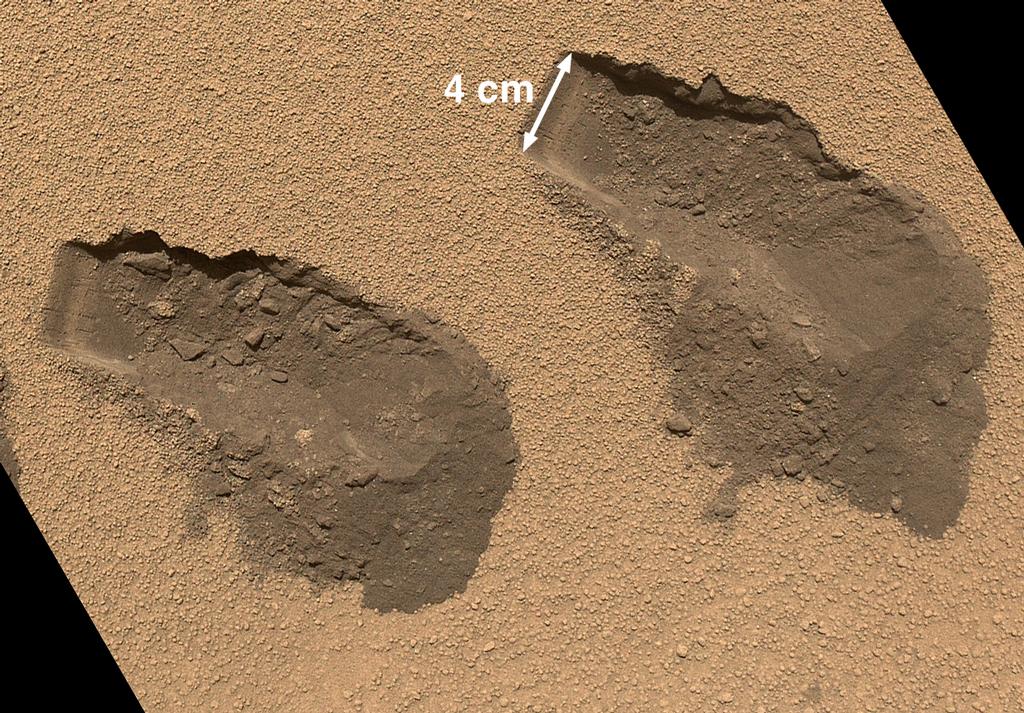
A Mars Hand Lens Imager (MAHLI) image of the third (left) and fourth (right) trenches made by Curiosity’s 4 cm-wide scoop. Acquired on Sol 84 (Oct. 31, 2012) the image shows details of the properties of the “Rocknest” sand dune. The upper surface is covered by crust of coarse sand grains approx. 0.5 to 1.5 mm, mantled with fine dust, giving it a light brown/red colour. The crust is about 0.5 cm thick and beneath it is finer, darker sand. The left end of each trough wall shows alternating light and dark bands, indicating that the sand inside the drift is not completely uniform. This might be due to different amounts of infiltrated dust, chemical alteration or deposition of sands of slightly different colour.
Please use the page numbers below to continue reading this article
It’s been a curious week or so where Curiosity is concerned, primarily because of speculation over exactly what SAM may – or may not – have found. In my last update, I covered recent activities with MSL, including the fact that a soil sample had, after weeks of preparation, been delivered to the SAM (Sample Analysis at Mars) suite of instruments. Since then, the media has been agog with rumours that something “earth-shaking” may have been discovered.
But before I get to that, a quick catch-up on activities since my last report.
On the 16th November, the rover’s 100th Sol on Mars, Curiosity finally made a move from the small sand dune it had been studying in an area dubbed Rocknest. It didn’t actually initially go very far – just 1.9 metres (6.2 feet), but it was enough for the rover to be able to deploy its robot arm in what was called a “touch and go” examination of an interesting rock, initially dubbed “Rocknest 3”, using the Alpha Particle X-Ray Spectrometer (APXS) in two 10-minute examinations of the rock in order to gain readings of data about its chemical elements. The rock had previously been the subject of examination by Curiosity when on Sol 57 (October 3rd) the ChemCam laser system and telescope were used to gather initial data.
An image of “Rocknest 3” captures by the micro-imager camera of ChemCam and showing the laser hit points created during initial analysis of the rock. In all some 15,000 laser pulses were directed at the rock, which was some 3.7 metres (12 feet) from the laser system. This image and the associated data wer subsequently downlinked to Earth using Europe’s Mars Express orbiter in order to demonstrate the ability to use that vehicle as a back-up communications relay should Mars Odyssey or the Mars Reconnaissance Orbiter be unavailable.
Afterwards, the arm was stowed and Curiosity travelled a further 25 metres (83 feet) eastward to a further target called “Point Lake”, which overlooks a lower-lying area leading into the area dubbed Glenelg.
“We have done touches before, and we’ve done goes before, but this is our first ‘touch-and-go’ on the same day,” said Curiosity Mission Manager Michael Watkins of NASA’s Jet Propulsion Laboratory, Pasadena, Calif. “It is a good sign that the rover team is getting comfortable with more complex operational planning, which will serve us well in the weeks ahead.”
Prior to departing Rocknest, Curiosity took a set of panoramic images of the area ahead of it, including “Point Lake”, where work will commence in finding a suitable target for the rover’s drill mechanism on the robot arm’s turret for the very first time.
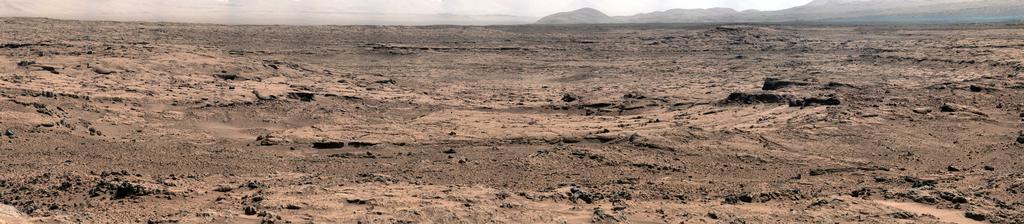
This panorama is a mosaic of images taken by the Mast Camera (Mastcam) on the NASA Mars rover Curiosity while the rover was working at a site called “Rocknest” in October and November 2012. The centre of the scene, looking eastward, includes the “Point Lake” area, where the rover spent the Thanksgiving period capturing further images for analysis in preparation for the final leg of the journey to Glenelg.
Please use the page number below to continue reading this article
The recent focus on the NASA / JPL Mars Science Laboratory mission has been on Curiosity’s soil sampling activities in the region of Gale Crater scientists have called “Rocknest”. However, this is not all that the rover has been up to. Through the sample gathering operations, two other instruments have been hard at work, measuring and monitoring the environmental conditions around the rover. These are the The Radiation Assessment Detector (RAD) and the Rover Environmental Monitoring Systems (REMS) – each of which has been working away day and night since Curiosity first arrived on Mars.
RAD is particularly focused on the amount of radiation, both from the sun (solar radiation) and in the form of cosmic rays, reaching the surface of Mars. While Mars has an atmosphere, it is extremely thin and tenuous in comparison to that of Earth – at ground level it is about as dense as Earth’s atmosphere at an altitude of several miles. The Martian atmosphere is primarily carbon dioxide and it does not have any ozone layer. This, coupled with the lack of a strong magnetic field means that the surface of Mars is subjected to far higher levels of both solar and cosmic radiation than are experienced on Earth.
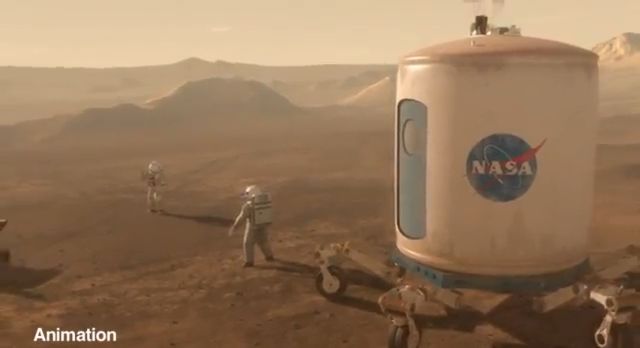
However, even though the atmosphere around Mars is tenuous, it is still enough to have an effect on incoming radiation, and RAD is designed to measure the levels of radiation common to the surface of Mars and, working with REMS, help give further insight into the processes which go into altering that radiation as it passes through the atmosphere. Both of these studies will in turn help scientists understand the impact incoming radiation is having on the local environment and increase out understanding of surface conditions on Mars in preparation for human missions there in the future.
Curiosity: increasing our understanding of the Martian surface environment for future human missions
REMS is the rover’s meteorological station, comprising instruments mounted both on the body of the rover and on the forward mast. It is responsible for monitoring wind, pressure, humidity and temperature, and is being used to establish a track record of atmospheric conditions and changes experienced by Curiosity. Despite the wind measurement instrument on the rover’s mast being damaged during the landing phase of the mission – mostly likely due to a stone being thrown up by the Descent Stage engines and striking the instrument – REMS has been returning huge amounts of data about the Martian atmosphere, helping scientists develop a clearer understanding of the complex mechanics at work in the Martian atmosphere.
As mentioned about, the Martian atmosphere is largely carbon dioxide and very tenuous. Both of these points factor into large seasonal variances in the Martian atmosphere. Due to the tenuous nature of the atmosphere, temperatures are extremely low. During the colder winter months, these low temperatures cause a significant amount of the atmosphere to “freeze out” into the polar ice caps (most notably the southern polar cap, which is predominantly carbon dioxide ice). In the southern hemisphere, the warmer temperatures, while still low by Earth terms, are enough for much of this carbon dioxide to sublimate into the atmosphere with the result that season changes can cause the Martian atmosphere to shrink / grow by some 30% through the course of a year.
These thermal processes also operate on a day/night cycle, and also affect the radiation signature being recorded by Curiosity’s RAD instrument. Essentially, what is happening is this: during daylight hours, the atmosphere heats up rapidly and expands, causing the atmosphere to “bulge out”. Convection currents cause the atmosphere to flow outwards from this bulge to equalise the pressure either side of it. This leaves the atmosphere below the bulge at a lower pressure than the air on the night side of the planet. As the day passes and the sun sets, the atmosphere cools and the bulge contracts increasing the surface air pressure beneath it.
The daily thermal cycle on Mars: by day, as the planet rotates, the atmosphere warms and expands. Air flows out from the heated “bulge” in order to equalise the pressure with the atmosphere around it, with the result that while the bulge causes a “thicker” atmosphere, it is one that is less dense and at a lower pressure than the air on the “night side” of the planet
Overall, this daily fluctuation can amount to a 10% variation in air pressure over the day / night cycle as measured by REMS. Taken alongside the RAD measurements, this has revealed an interesting correlation with the amount of radiation being measured around the rover. As the air temperature increases through the day and the atmosphere expands to lower the local air pressure, so to does the amount of radiation being measured by RAD increase. Then, as the temperature drops during the evening into night, so to does the atmospheric density and pressure increase – and surface level radiation doses fall, with between a 3% and 5% variation in radiation levels being recorded by REMS during a single day / night period.
A 5-Sol chart showing the relationship between radiation and air pressure during the day / night cycle. As the air is warmed during each day, so the air pressure drops (blue) and the amount of radiation being recorded (red) increases. As night draws is, so the blue line increases, indicating an increase in atmospheric pressure – and radiation levels drop
Please use the page numbers below to continue reading this article
Curiosity is coming to the end of its time at Rocknest, the sandy area in Gale Crater where it has been sifting and examining soil samples and carrying out other experiments over the course of the last few weeks. Glenelg still remains the intended target for the rover, prior to it starting an exploration to the near-central mound in the crater NASA refer to as “Mount Sharp”.
Since my last update on 31st October, Curiosity has been using the Sample Analysis at Mars (SAM) instrument suite to examine the atmosphere in Gale Crate in greater detail. SAM is a remarkably flexible and complex set of instruments, able to analyse air and soil samples a number of ways.
Earlier in the mission, SAM was used to obtain an initial sampling of Martian air “inhaled” at Bradbury Landing. This was subjected to initial analysis by the instrument’s mass spectrometer. Over the last few days, Curiosity has used SAM to further sample the Martian Air, subjecting it to more detailed analysis using a Turnable Laser Spectrometer (TLS).
The TLS shoots laser beams into a measurement chamber which can be filled with Mars air. By measuring the absorption of light at specific wavelengths, the tool can measure concentrations of methane, carbon dioxide and water vapor in the Martian atmosphere and different isotopes of those gases.
This picture shows a lab demonstration of the measurement chamber inside the Tunable Laser Spectrometer, an instrument that is part of the Sample Analysis at Mars investigation on NASA’s Curiosity rover. This demonstration uses visible lasers – rather than the infrared ones on the actual spectrometer – to show how the lasers bounce between the mirrors in the measurement chamber. (Click to enlarge)
Methane is of particular interest to scientists as, while it can be produced by either biological or non-biological processes, it is regarded as a simple precursor chemical for life. SAM represents the most sensitive tool yet deployed on or around Mars which might be capable of detecting methane in the atmosphere. However, the task isn’t easy, as it is probable that if the gas does exist at all within the Martian air, it is liable to do so only in very light traces. Certainly, none wer found in the initial sample analysed by Curiosity’s TLS, as SAM TLS lead Chris Webster of NASA’s Jet Propulsion Laboratory (JPL) confirmed in a press conference I dialled-in to last week.
“Methane is clearly not an abundant gas at the Gale Crater site, if it is there at all. At this point in the mission we’re just excited to be searching for it,” he said. “While we determine upper limits on low values, atmospheric variability in the Martian atmosphere could yet hold surprises for us.”
Please use the page numbers below to continue reading this article
The initial results from Curiosity’s first examination of soil samples (or more correctly, regolith samples), analysed by the Chemistry and Minerology instrument (CheMin) have been returned to Earth for evaluation.
CheMin took samples of the surface material gathered by the rover’s scoop and pre-processed (filtered for compositional size) using CHIMRA, which forms a part of the turret-mounted suite of instruments and systems on the rover’s robot arm, and subjected them to X-ray diffraction, which is regarded as the “gold standard” for understanding the mineral composition of soil and rock samples on Earth. CheMin marks the very first time such an analytical capability has been possible on the surface of another planet in the solar system.
The identification of minerals in rocks and soil is crucial for the mission’s goal to assess past environmental conditions. Each mineral records the conditions under which it formed. The chemical composition of a rock provides only ambiguous mineralogical information, as in the textbook example of the minerals diamond and graphite, which have the same chemical composition, but strikingly different structures and properties.
A graphic showing the first analysis of a Martian soil sample by Curiosity’s CheMin instrument. The sample was scooped on Sol 69 (October 15th 2012) and delivered to CheMin on Sol 71. By directing an X-ray beam at a sample and recording how X-rays are scattered by the sample at an atomic level, CheMin can definitively identify and quantify minerals on Mars for the first time. Each mineral has a unique pattern of rings, or “fingerprint,” revealing its presence. The colours in the graphic represent the intensity of the X-rays, with red being the most intense
Because of the ambiguity in chemical analysis, which has to date revealed remarkably uniform results from regions which are geographically very diverse over the surface of the planet, understanding the actual minerology of Martian soil has always been a mixture of scientific study laced with educated inferences, so CheMin is a major game-changer.
“We had many previous inferences and discussions about the mineralogy of Martian soil,” said David Blake of NASA Ames Research Center in Moffett Field, California, the Principal Investigator (PI) for CheMin. “Our quantitative results provide refined, and in some cases, new identifications of the minerals in this first X-ray diffraction analysis on Mars.”
Prior to MSL’s arrival on Mars, it had been long theorised that much of the surface material may well be of volcanic origin, particularly given the ample evidence of the planet having had an extremely active volcanic past.


 On Monday 3rd December, NASA provided an update on the Mars Science Laboratory’s (MSL) most recent findings in analysing soil samples gathered from the “Rocknest” region of Gale Crater on Mars.