When discussing Mars exploration, it is easy to forget that NASA, the US space agency is far from alone. Both Europe and India are currently operating vehicles in orbit around Mars, while in 2004, the European Space Agency became only the third agency in the world to attempt a landing on Mars, when the British built Beagle 2 mission separated from its Mars Express parent craft but unfortunately failed to safely arrive on the surface of Mars.
Mars Express has gone on to be one of the most successful Mars orbital mission on record, carrying out a range of duties similar to those of NASA’s Mars Reconnaissance Orbiter (MRO), which it preceded to Mars by some two years. Now approaching the end of its 12th year in operation around the planet, Mars Express continues to return a wealth of data to Earth and also functions as a back-up communications relay for the two NASA rovers currently operating on the surface of the Red Planet.
An artist’s impression of Beagle 2 on Mars (image: European Space Agency)
Quite what happened to Beagle 2 remained unknown until early in 2015. It had been thought the tiny lander, just 1 metre (39 inches) in diameter but packing a huge amount of science capabilities into it, had been lost as a result of burning up in Mars’ tenuous atmosphere or as a result of its parachute landing system or air bags failing. However, as I reported in January 2015, images captured by NASA’s MRO revealed Beagle 2 had landed quite safely, but one of its solar panels failed to deploy, preventing the craft from communicating with Mars Express and Earth.
In 2018, ESA, working in conjunction with the Russian Federal Space Agency, Roscosmos, plan to overcome Beagle 2’s failure to gather science from the surface of Mars with a rover vehicle called ExoMars Rover, part of an ambitious 2-phase mission itself entitled “ExoMars”, and which commences in 2016.
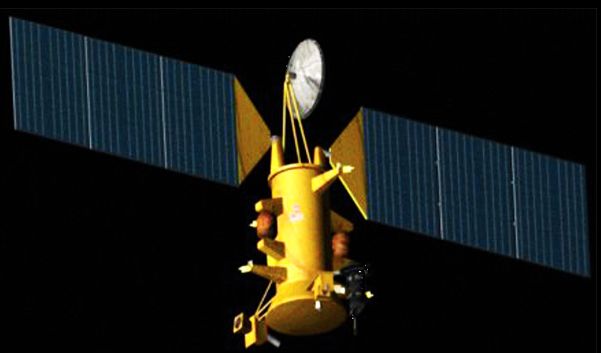
ESA’s ExoMars TGO: due for launch in March 2016, part of a 2-phase mission to search for direct evidence of life, past or present, on Mars. In this artist’s impression, the capsule-like Schiaparelli has already been detached from the circular base of the vehicle (image: European Space Agency)
The first part of the mission will commence in March 216 with the launch of the ExoMars Trace Gas Orbiter (TGO), a telecommunications relay orbiter and atmospheric gas analyser mission. This will arrive in orbit around Mars in December 2016 and will proceed to map the sources of methane on Mars, as well as analyse and study other trace gases. Methane is of particular interest to scientists its likely origin is either present-day microbial life existing somewhere under the surface of the planet, or the result of geological activity. Confirmation that either is the cause would be of significant scientific benefit.
Whilst in operation in Mars obit, TGO will deploy Schiaparelli, an Entry, Descent and Landing Demonstrator Module (EDLM). This is intended to test some of the key technologies needed to safety see a rover-carrying lander onto the surface of Mars, such as the ability to control touchdown orientation and velocity. Most uniquely, the landing will take place during the Martian dust storm season, presenting scientist with the opportunity to characterise a dust-loaded atmosphere during entry and descent, and to conduct surface measurements associated with a dust-rich environment.
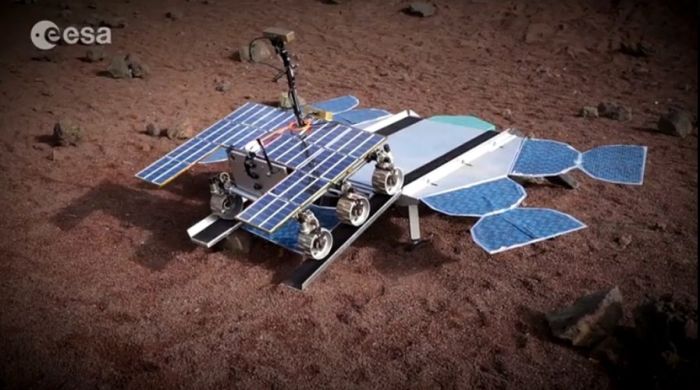
The Advanced Prototype ExoMars Rover undergoing remote deployment testing in 2015 (image: European Space Agency)
The 2018 ExoMars Rover mission, although yet to be finalised, is primarily designed to find evidence of microbial life, past or present, under the Martian surface. It is provisionally scheduled for launch in May 2018, although this may be delayed until August 2020, around the time NASA Mars 2020 rover mission is due to fly.
The ExoMars vehicle is somewhat larger than NASA’s solar-powered Opportunity rover, but at some 207 kg (456 lb), is about one-third the mass of Curiosity and the Mars 2020 rover. A unique aspect to ExoMars Rover is that it will carry a drilling system aboard which, for the first time, will allow samples to be obtained from almost 2 metres (6.5 ft) below the surface of Mars. The rover is expected to operate for around 6-7 months, but could remain operational for much longer. During that time, it should cover a distance of around 4 km (2.5 mi), after landing in early 2019.
The four proposed landing sites for ExoMars Rover. The colours on the map represent the relative elevations of surface features on Mars. White / Red refer to the highest elevation, such as the Tharsis Bulge and the great volcanoes to the north-west, and blue the low-lying regions, such as the far northern latitudes and the great impact basin of Hellas in the south-east, which likely caused the Tharsis Bulge upwelling
In September I reported on images captured by the New Horizons space probe of the night side of Pluto, backlit by the distant Sun. In a follow-up to those images, the New Horizons team has released stunning high-resolution images captured by the probe shortly after passing the point of closest approach to Pluto on July 14th, 2015.
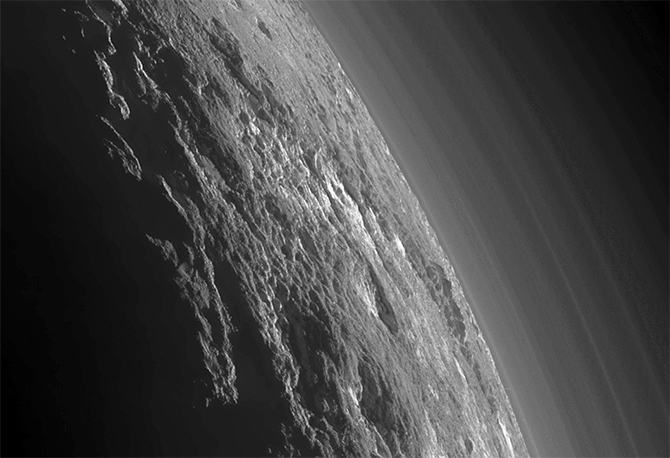
The images were captured from a distance of just 18,000 km (11,000 miles) from Pluto using the Multi-spectral Visible Imaging Camera (MVIC), part of New Horizon’s Ralph suite of instruments, which were pieced together to form a magnificent view of Pluto with a resolution of some 700 metres per pixel.
The mosaic of images shows the rich complexity of both Pluto’s surface features and its atmosphere, the enhanced images clearly bringing the bands of haze in the latter into sharp relief.
An enhanced image of Pluto’s night side, composed of images captured by the MVIC instrument on New Horizons on July 14th, 2015. As Pluto is “tipped over” on its axis by 120 degrees, the planet’s north pole is to the right and south pole to the left (image: NASA/JPL / JHUAPL / SwRI)
The clearest detail of Pluto’s surface can be seen to the right, which because the planet’s axis is tilted by 120-degrees, is the north polar region. The sheer ruggedness of the terrain can be seen here, some of the pitted hills almost looking like clouds above a distant landscape. However, the left side, and the south pole isn’t entirely without interest: caught by the glow of sunlight refracted by Pluto’s tenuous atmosphere, the rugged nature of the little world’s chaotic surface can also be seen.
Subject to enhancement, a portion of the images capturing the northern regions of Pluto reveal even more detail, particularly within the complex layering of Pluto’s atmosphere, where the enhancements reveal it to be made up of around a dozen layers, far more than had been thought during New Horizon’s final approach to Pluto in late June. These layers are made up of tholins, soot-like organic compounds created as a result of ultraviolet radiation from the sun interacting with the upper layers of Pluto’s atmosphere. These particles, undergoing some chemical changes as they drift back down through the various layers, eventually precipitate down onto Pluto’s surface, staining it red.
An enhanced image of Pluto north polar region revealing an incredibly complex surface of hills and valleys, ice features and high mountains, while above can be seen an enhanced view of the complex atmospheric banding (image: NASA/JPL / JHUAPL / SwRI)
Cassini’s Enceladus Encounter
Cassini, NASA’s deep space probe exploring Saturn and his retinue of moons as a part of the Cassini-Huygens mission, is approaching the end of its 20-year mission. Launched in 1997, and following a 7-years transit to Saturn, Cassini has been studying the system in great detail, and delivered a tiny European lander vehicle, Huygens, to the surface of Titan, the largest moon in the solar system, and one with its own rich atmosphere, and standing bodies of liquid on its surface.
With fuel reserves set to expire in late 2017, Cassini will be ordered to fly into Saturn’s own dense atmosphere before it does so, where it will burn-up. In the meantime, however, the vehicle continues to return a marvellous wealth of data about the Saturn system, including several studies of another of the giant planet’s remarkable moons, Enceladus.
Enceladus revealed: captured on October 28th, this image reveals the icy beauty of the moon as Cassini closes for its penultimate, and closest, approach (image: NASA/JPL / Space Science Institute)
Like Jupiter’s moon Europa, Enceladus is a domain of ice, under which likely sits an ocean of liquid water. Shortly after arriving in orbit around Saturn, Cassini made the first of numerous flybys of the little Moon, which is just 500 km (310 mi) across, and detected the presence of a very thin atmosphere primarily made up of water vapour. In particular, the craft observed geysers erupting from the south pole, spewing water vapour, ice particles and other material into space, some of which likely contributes to Saturn’s “E” ring.
At the end of October 2015, Cassini made its penultimate flyby of Enceladus, passing over the Moon at an altitude of just 48 km (30 mi) and at a speed of some 30,000 kph (19,000 mph), diving through another of the geyser plumes in the process to measure the composition of gas and ice particles launched from the underground ocean.
A stunning images taken by Cassini following the October flyby reveals a crescent Enceladus floating above Saturn’s magnificent rings (image: NASA/JPL / Space Science Institute)
In particular, the Cassini science team will be analysing the data returned by Cassini following the flyby to see if the sensors found any evidence of molecular hydrogen in the plumes. Doing so would help verify suspected hydrothermal activity is taking place on the floor of Enceladus’ ice-shrouded ocean which could give rise to hot environments rich in mineral and chemical deposits suitable for the development of microbial life, just as deep-ocean thermal vents here on Earth provide life-sustaining environments.
Cassini will make one more return to Enceladus on December 19th, but will pass further from the little Moon as its orbit gradually swings it around Saturn for a further and final set of encounters with giant Titan, before finally moving inwards to pass between Saturn and its rings for the first time to study Saturn’s atmosphere in detail as the mission draws to a close in 2017.
Dawn Descends Over Ceres
On October 23rd, the NASA / ESA joint mission to explore two of the solar system’s three “protoplanets” located in the asteroid belt between the orbits of Mars and Jupiter, commenced manoeuvres to lower itself to is final orbit around Ceres.
The Dawn spacecraft, which arrived at Ceres in March 2015, after a 2.5 year transit flight from Vesta, its first destination, fired its ion engine to start reducing its orbit from 1,450 kilometres (915 miles) to just 380 km (235 mi), a manoeuvre which should see the vehicle spiral gently downwards to arrive in its new orbit in mid-December. At that time, Dawn will commence a final mapping and data-gathering mission, providing images with a resolution of 35 metres (120 ft) per pixel.
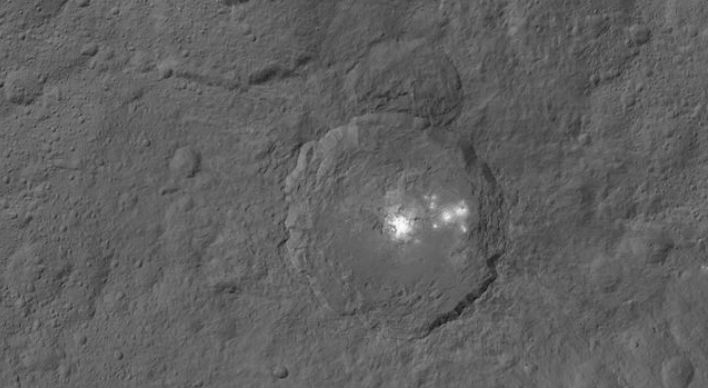
Occator crater and its bright spots images from directly overhead and a distance of 1,450 km (915 miles) by the Dawn space vehicle (image: NASA / JPL / DLR)
It is hoped that this final science orbit will offer definitive data on precisely what is giving rise to a series of odd bright spots within the crater Occator on Ceres, and which appear to be related to what seems to be a small and very localised trace atmosphere within the crater. Current thinking is the bright markings are salt or ice water deposits which are being out-gassed from Ceres’ interior.
Britain’s Spaceplane Gets £80 million Investment
SABRE is the name of a radical “air-breathing” hybrid engine which has been in development by a small British company called Reaction Engines Limited (REL) since the late 1990s. The aim is to reduce the amount of on-board oxidiser required in the rocket combustion process by allowing the engine to draw on the air around it during the initial ascent through the denser part of the Earth’s atmosphere, much like a regular jet engine uses the air around it. Only when the air becomes too thin to support combustion does the rocket engine switch over to its on-board supplies of liquid oxygen to burn with its liquid hydrogen fuel.
Ultimately, REL hope to use the SABRE engine in a single stage to orbit (SSTO) vehicle called Skylon, a fully reusable space launch vehicle, capable of operating from and to a conventional runway just like an aeroplane, and carrying up to tonnes into low Earth orbit. However, the SABRE engine potentially has a wide range of applications, including a purely “air-breathing” variant (called Scimitar) which could be used to power aircraft within Earth’s atmosphere at speeds close to five times that of sound.
REL propose using the SABRE engine in their Skylon spaceplane capable of lifting up to 15 tonnes (cargo or 24 passengers) into orbit. however, the engine has many potential uses, hence the interest from BASE Systems and the UK government (image: REL)
On Monday, November 2nd, REL announced that BAE Systems Ltd is to invest some £20.6 million (US $31.8 million) in REL in return for a 20% stake in the company, while the UK government has awarded a further £60 million (US $92.8 million). Together with recent funding from the EU, REL has now raised some £95 million (US $146.6 million) to further develop SABRE.
Skulls in the Sky
Halloween 2015 brought with it a creepy-looking visitor which looked down on Earth as many across the world took to marking All Hallows Eve on Saturday, October 31st.
The visitor in question was asteroid 2015 TB145, a lump of rock around 600 metres (1,968 feet) across. Tumbling through space, it passed by the Earth at a distance of roughly 480,000 km (300,000 miles) – slightly further from us than the orbit of the Moon, at a speed of some 126,000 kph (78,293 mph).
Such Earth-passing asteroids are not rare, although this one was only identified on October 10th, 2015. It well be the last close passage to Earth by a very large asteroid until 2027, and its size offered scientists a unique opportunity to image it using radar.
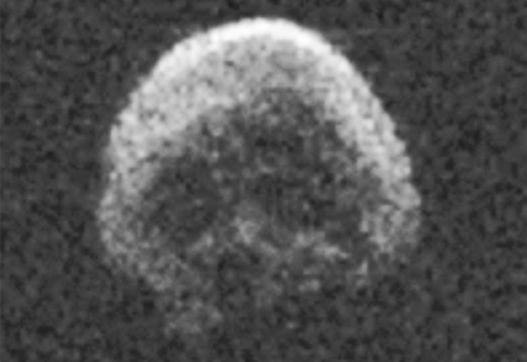
Asteroid 2015 TB145 in an eerily skull-like image captured by the Arecibo Observatory on Friday, October 30th, 2015.
On Friday, October 30th, the The Arecibo Observatory in Puerto Rico used radar mapping to capture an image of the asteroid in which it looks like a gigantic skull. It was all an optical illusion of course, the combined result of the radio reflections from the asteroid giving rise to the grey shaded image and the effect of pareidolia, in which the human brain perceives shapes and patterns that aren’t really there; as the asteroid tumbled through space, the similarities to a human skull were quickly lost as the radar reflections changed.
Nevertheless, it was fittingly spooky for Halloween!
Discover Gale Crater
I’ve written extensively about NASA’s Curiosity rover and its explorations within Gale Crater on Mars since its arrival there in August 2012. Now NASA and the Los Angeles Times have combined to provide a virtual reality exploration of Gale Crater, which examines some of the principal features to be found there, traces the rover’s route from crater floor and up the flank of “Mount Sharp” and which allows visitors to fly over the crater or take a guided tour using simple keyboard controls.
Attendance is free, but for those wishing to donate to the supporting this and future conferences, there are a number of options to do so, ranging from $10.00 USD through to $200.00 USD, all of which offer various benefits to purchasers. For the full range of ticket options and their respective benefits, and to book your place at the conference, please visit the conference ticket page.
The 2015 conference will be a one day affair, taking place on Saturday, December 5th. Nevertheless, it will present a full programme of dynamic short presentations and panels that spotlight the best of the OpenSimulator platform and community that will take place virtually on the conference grid.
In addition, the organisers are inviting the OpenSimulator Community to host community and social events, scheduled for dates leading up to the conference in the days leading up to the conference and immediately following its closing on Saturday, December 5th at 17:00 PST, and again on Sunday, December 6th.
If you wish to give a presentation or talk at the conference, please register your interest via the Call for Proposals page, but note that all proposals must be received no later that 11:59 PST on Saturday, October 31st.
The OpenSimulator Community Conference is an annual conference that focuses on the developer and user community creating the OpenSimulator software. The conference is a joint production by Core Developers of OpenSimulator and AvaCon, Inc., a 501(c)(3) non-profit organization dedicated to promoting the growth, enhancement, and development of the metaverse, virtual worlds, augmented reality, and 3D immersive and virtual spaces. The conference features a day of presentations, panels, keynote sessions, and social events across diverse sectors of the OpenSimulator user base.
Astrophotographer Mia Stålnacke caught this aurora display over Kiruna, Sweden, in March 2015
The Sun is the only star we can directly observe in detail. As such, it has been the subject of study for a long time, significantly so since the birth of the space age. As such, you’d think we know pretty much all there is to know about it; but the fact is that the Sun still has many mysteries – and surprises – of its own awaiting understanding and discovery.
One of these mysteries has been strange particle emissions rich in helium-3. These don’t form part of the more familiar coronal mass ejections (CMEs), which can have an elevated impact on Earth magnetosphere giving rising to more energetic aurorae, or with collimated X-ray flares. The cause of these helium-3 rich outbursts has until now been hard to trace because in order to be detected by the Advanced Composition Explorer (ACE) craft which is designed to study such energetic particles, they have to originate very close to the Sun’s limb, making any associated events hard to observe.
A look at the Sun’s right limb on January 26, 2010. Within the marked red square, a large-scale blast wave travels through the Sun’s atmosphere. These images were obtained with the help of NASA’s STEREO A probe and show the Sun’s atmosphere in extreme ultraviolet light.
However, on October 13th, two teams of scientists working independently of one another, but using the same data and images gathered from NASA’s STEREO solar observation vehicle and the Earth-orbiting ACE platform, announced they had pin-pointed the cause of the outbursts. They are the result of huge explosions occurring in the Sun’s atmosphere, which in turn create gigantic atmospheric shock waves in the Sun’s atmosphere which can extend over half a billion kilometres (300,000 miles) and advance at speeds of 300 km (190 mi) per second. It is believed the sheer speed of the shock waves from these explosions is sufficient to accelerate the helium-3 (itself produced as a part of the overall fusion process in the Sun’s core), into a stream of particles thrown off into space.
While it has been confirmed the initial explosions are not related to CMEs or sunspots or other known solar phenomena, the precise reason for the explosions themselves has yet to be determined.
Charon Revealed
Images and data returned by the New Horizons space vehicle at the start of October have provided more details about Pluto’s companion, Charon, revealing it to be an even more fascinating world than had been anticipated.
Charon as revealed in the highest resolution images yet returned of that tiny world by New Horizons (image: NASA/JPL / JHUAPL / SwRI)
The images, captured in black and white by the probe’s LORRI camera, have been combined with images and data gathered by the RALPH suite of instruments to present a beautiful full-colour image of almost all of one face of Charon, as seen by New Horizons as it swept through its closest approach to both Charon and Pluto on July 14th, 2015.
Some 1,214 kilometres (753 miles) in diameter, Charon is about half the size of Pluto, and was only discovered in 1978. Quite how it formed has been the subject of much debate. Prior to New Horizons’ visit, the most popular theory was that Charon coalesced from the debris of a collision between Pluto and another Kuiper belt object. However, New Horizons has so far failed to return any images of Pluto that hint at such a collision, and the make-up of the two worlds is less similar than might be expected were one the offshoot of the other. So the theory gaining ground now is that both bodies were already formed when they fell into orbit around one another.
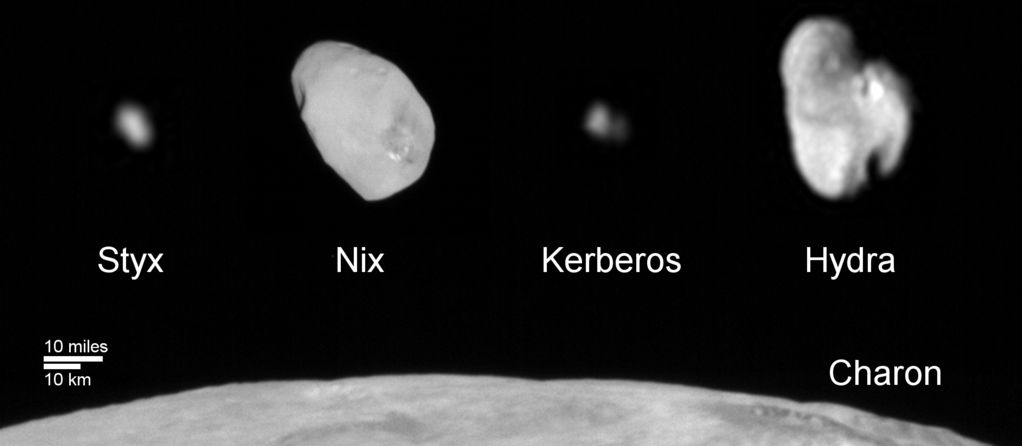
A comparison of the Moons of Pluto as images by New Horizons, and their relative size
The latest images of Charon reveal a striking world, every bit as varied as Pluto, and marked by a massive series of fractures across its midriff, suggesting a massive upheaval in Charon’s past which split open its crust. The southern hemisphere also has a more youthful appearance than the region north of the fracture, suggesting that widespread resurfacing took place following the event, and that cryovolcanism (ice volcanoes) may today be contributing to maintaining the relatively smooth appearance of Charon’s southern regions. So like Pluto, Charon may still be an active world.
Romy Abovitz talks Magic Leap at WSJD Live (image courtesy of Engagdet)
Magic Leap, the augmented reality company established by enigmatic entrepreneur Rony Abovitz, and which gained over US $500 million from the likes of Google in 2014 (see my article from October 2014), revealed a little more about its product during a WSJD Live interview recently.
As reported by Nicole Lee for Engadget, Abovitz and Chief Content Officer Rio Caraeff talked in general terms about the system which has caused no small amount of excitement among those who have actually seen it in action. People such as Google’s CEO Sundar Pichai, who sits on the Magic Leap board and was one of the driving forces behind Google’s lion’s share of the half-billion funding mentioned above, and who shares a place on the board with Qualcomm’s executive chairman, Paul Jacobs, another investor from that round of funding.
The technology has also wowed leading lights from the entertainment industry such as Weta Workshop’s co-founder Richard Taylor (one of the first to invest in Magic Leap), and Thomas Tull, CEO of Legendary Entertainment (aka Legendary Pictures). For those outside, however, Magic Leap has perhaps come over as a riddle bordering on smoke and mirrors.
The Magic Leap website splash screen (no pun intended)
Talking at the WSJD event, Abovitz indicated Magic Leap won’t be tied to a particular platform or OS, but will be entirely self-contained and with a dedicated OS. He also indicates that in difference to those dismissing AR on the grounds that “no-one likes to wear glasses for long”, the form factor for the unit will be something people won’t fight shy of wearing. He also states it will allow them to maintain a normal relationship with others when in use – a little dig, no doubt, at the first generation of cumbersome and isolating VR headsets about to hit the market.
Alongside of the interview, Magic Leap also released a new video which they state is filmed entirely through Magic Leap technology and with no special effects or compositing.
Quite how the system works, however, is still a mystery. No headsets are shown in any of the company’s promotional material, and much is made of the use of a “Dynamic Digitized Lightfield Signal” (which we can call “Digital Lightfield™”). In speaking at WSJD, Abovitz and Caraeff both skirted specifics, with the former only saying, “We treat human biology as our centre point; everyone already has a head-mounted display. It’s your head!”
This suggests the company is perhaps pursuing direct retinal projection, possibly in some form of headset unit that is less intrusive than the kind of units suggestive in the patent filings the company has made in the past. And if this sounds like science-fiction, remember Abovitz made his money developing medical technology, and the company has apparently devoted considerable effort into researching the relationship between the photonic light field and the way the brain functions.
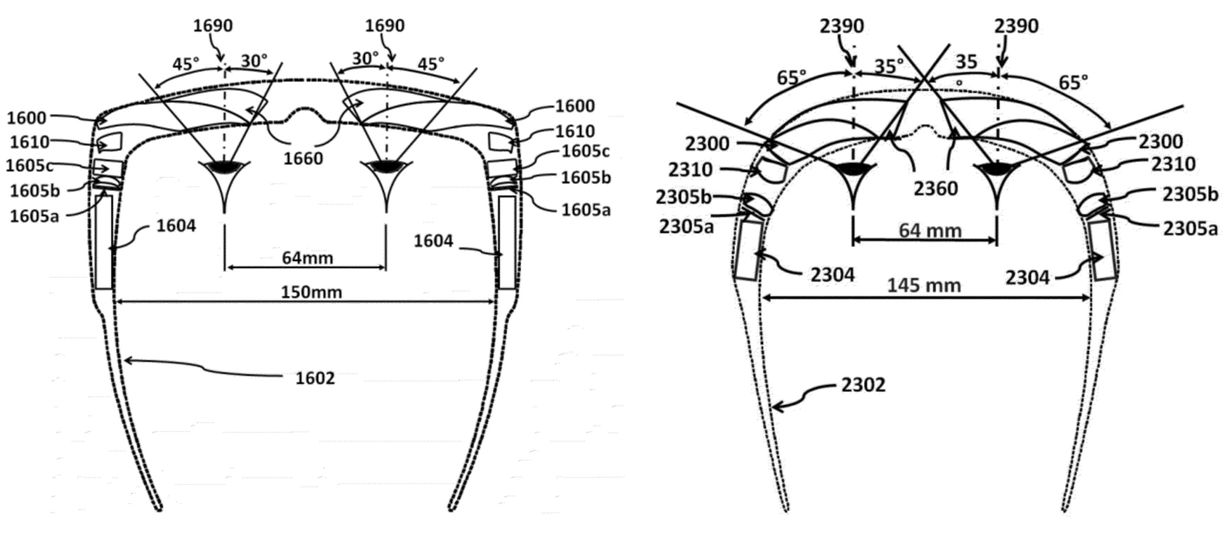
Patent WO 2014043196 A1, filed for Magic Leap by Chunyu Gao for augmented reality headsets styled in both “regular glasses” and “wrap-around” form factors, suggesting some form of headset will be a necessary part of the system – click for full size
So what is the purpose of all this? Caraeff indicated the ultimate am is for Magic Leap to provide broad-based platform for visual computing. “Anything that you can do on your smartphone, on your computer; you’ll be able to do on Magic Leap,” he said, then added, “Where the world is your screen.”
“We believe the future of computing should be natural,” Abovitz stated. “With Magic Leap, your brain doesn’t distinguish what’s real and what’s Magic Leap, because as far as your brain’s concerned, it is real.”
I admit to being far more persuaded that AR will generate a greater mass market presence than VR. Despite the negative memes about people not liking glasses and Google’s misplaced Glass product, AR would appear to be far more inclusive in its use than VR, and have the same potential reach into many of the markets being hailed as VR’s territory: business, medical, education, healthcare and entertainment.
Whether Magic Leap will actually pave the way in this regard as units start to roll off the company’s new production line in Florida at some point in the future, is open to debate. I do, however, admit to being more intrigued by the potential of AR systems like it and CastAR than I am with the first generation of VR headsets we’re about to see.
Additional material on the WSJD Live event via The Verge.
The Curiosity rover team have released a further study showing that ancient Mars was capable of storing water in lakes over an extended period of time, and that this water was a principal component in the creation of “Mount Sharp”, the mound at the centre of Gale Crater, currently being investigated by the NASA rover.
This forms the latest in a series of reports on the subject of water on Mars and in Gale Crater to be published by the Curiosity science team, and comes almost a year after I wrote about studies released by the team which detailed how “Mount Sharp” – more formally known as Aeolis Mons – was most likely formed by sediments laid down by successive wet period in Mars’ ancient past.
“Observations from the rover suggest that a series of long-lived streams and lakes existed at some point between about 3.8 to 3.3 billion years ago, delivering sediment that slowly built up the lower layers of Mount Sharp,” said Ashwin Vasavada, Mars Science Laboratory project scientist, discussing the new report.
In December 2014, NASA issued a report on how “Mount Sharp” was likely formed. On the left, the repeated depositing of alluvial and wind-blown matter (light brown) around a series of central lakes which formed in Gale Crater, where material was deposited by water and more heavily compressed due the weight of successive lakes (dark brown). On the right, once the water had fully receded / vanished from the crater, wind action took hold, eroding the original alluvial / windblown deposits around the “dry” perimeter of the crater more rapidly than the densely compacted mudstone layers of the successive lake beds, thus forming “Mount Sharp”
However, until Curiosity actually started studying “Mount Sharp” in detail, the accuracy of the earlier studies couldn’t be completely verified. The latest results from the rover indicate that these wetter scenarios were correct for the lower portions of Mount Sharp, and that the filling of at least the bottom layers of the mountain occurred over a period of less than 500 million years, mostly as a result of material deposited by ancient rivers and lakes.
The new report also comes on top of confirmation that the recurring slope lineae (RSL) features seen on Mars from orbit are most likely the result of outflows of water which are occurring today. together they are reshaping some of the thinking around water on Mars – and what might have happened to it.
“What we thought we knew about water on Mars is constantly being put to the test,” said Michael Meyer, lead scientist for NASA’s Mars Exploration Programme. “It’s clear that the Mars of billions of years ago more closely resembled Earth than it does today. Our challenge is to figure out how this more clement Mars was even possible, and what happened to that wetter Mars.”
Curiosity has found plenty of evidence for water on the floor of Gale Crater, which likely took the form of one or more lakes during the wetter parts of Mars’ history, before becoming rivers and streams later. Strata at the foot of “mount Sharp” (shown above) strongly suggested water played a significant part in forming the mound, and the evidence for this being the case has continued to be revealed as the rover climbs the lower slopes
Currently, images of the flanks of the mound returned by the rover and from orbit suggest water-transported sedimentary deposition may have extended at least 150 to 200 metres (500 to 650 feet) above the crater floor, and possibly as high as 800 metres (approx 1/2 a mile). This both indicates that there was at least one standing body of water in the crater and further confirms that “Mount Sharp” was a direct result of sediments deposited by this water. Or at least, the lower slopes were; there is currently little evidence for the sedimentary strata extending about the 800 metre mark, however. This has led to speculation that wind-blown deposits are responsible for the upper reaches of the mound.
Taken together, the recent findings concerning Mars and its water suggest that the planet’s history is far more complex than had been thought. “We have tended to think of Mars as being simple,” John Grotzinger, the former project scientist for the Curiosity mission said of the latest findings.
“We once thought of the Earth as being simple too,” he continued. “But the more you look into it, questions come up because you’re beginning to fathom the real complexity of what we see on Mars. This is a good time to go back to re-evaluate all our assumptions. Something is missing somewhere.”
Pluto’s Water
The blue haze of Pluto’s atmosphere: released on October 8th, this true colour image taken after the New Horizons spacecraft had completed its closest approach to the dwarf planet shows Pluto’s night side ringed by the blue haze of its thin atmosphere, as illuminated by the distant Sun, far away on the other side of the little world
The latest images and data to be received on Earth from NASA’s New Horizons space vehicle reveal Pluto’s atmosphere to be a rich blue in colour, and confirm that water ice exists on theplanet.
“Who would have expected a blue sky in the Kuiper Belt? It’s gorgeous,” said Alan Stern, New Horizons principal investigator as the striking image shown above was released as part of the latest batch of pictures and data to be received from the space craft and undergo processing and initial analysis.
The blue colour indicates that the haze within Pluto’s atmosphere is made up of a lot very fine of particulate matter, which scatters blue light from the Sun more easily than other colours, due to blue having a shorter wavelength (which is also the reason the sky we see here on Earth also appears blue, because that wavelength is easily scattered by the tiny particles making up our atmosphere).
In Pluto’s case, it’s thought that the particles in the atmosphere are largely tholins, created by ultraviolet radiation from the Sun breaking down the methane and nitrogen in Pluto’s upper atmosphere, allowing their molecules to gradually recombine into the more complex tholins, which draft down through the atmosphere, undergoing further changes, before eventually reaching the surface of the planet, giving it a distinctive reddish colour.
Instruments forming the Ralph suite aboard New Horizons have identified regions of exposed water ice on Pluto which occur in regions which have corresponding deposits of tholins. Quite what the relationship is between the two is unclear. The water ice deposits are shown in blue on the inset image simply for convenience, and not because that’s how they appear on Pluto
The discovery of water ice on Pluto has taken scientists by surprise. Not so much because it is there, but because it appears to be somehow related to areas of heavy tholin deposits. Confirmation of the presence of water ice came from data returned by the Ralph instrument suite aboard New Horizons, but just how widespread it might be isn’t clear, as it seems that it might be masked elsewhere by other surface material.