Space Sunday: of Pluto, Mars and crowdfunding space outreach

new-horizonNASA and the Applied Physics Laboratory (APL) at John Hopkins University kept their promise a little earlier than expected.

With the resumption of image and data transmissions from New Horizons, at the start of September, they had indicated that Fridays would henceforth, and for the course of the next 12 months, be known as Pluto Friday, the day on which the latest raw images from the mission to that distant tiny world and its companions would be released.

However, the first set of images came a little sooner than advertised: on Thursday, September 10th, and they continue to show two tiny worlds which continue to astound and have planetary scientists rethinking much about their understanding of dwarf planets.

“Pluto is showing us a diversity of landforms and complexity of process that rival anything we’ve seen in the solar system,” New Horizons’ principal investigator Alan Stern, from the Southwest Research Institute in Colorado, said in a statement. “If an artist had painted this Pluto before our flyby, I probably would have called it over the top — but that’s what is actually there.”

Charon, Pluto's largest companion, as seen by New Horizons on July 14th, 2015, from a distance of some 464,000 kilometres (290,000 miles), revealing a rich and diverse range of surface features
Charon, Pluto’s largest companion, as seen by New Horizons on July 14th, 2015, from a distance of some 464,000 kilometres (290,000 miles), revealing a rich and diverse range of surface features (image: NASA / JHU / APL / SWU) – click any image for the full-size version

The images render details as small as 400 metres / 440 yards per pixel on the surface of Pluto, and reveal features that have scientists agog with excitement; so much so that at a NASA press conference, the images were summarised thus, “it’s complicated!”

In them, we can see a rich complexity of features: nitrogen ice flows which have apparently oozed (and might still be slowly oozing) out of mountain ranges and across broad plains; mountain ranges which are themselves reminiscent of chaotic regions on Mars and Jupiter’s Europa; complex valley systems which might have been carved by the action of material flowing across the planet; and even – perhaps most curiously of all –  what seem to be wind-blown fields of dunes.

A synthetic perspective view of Pluto, based on the latest high-res received from New Horizons presents a view of Pluto from around 1,800 km (1,100 mi) above Pluto’s equatorial area. Towards the bottom of the image is the cratered and dark region dubbed "Cthulhu Regio", and above it, the bright "heart" of Pluto, showing the icy plains of "Sputnik Planum". The images used to create this view were captured from a distance of 80,000 km (50,000 mi) from Pluto
A synthetic perspective view of Pluto, based on the latest high-res received from New Horizons presents a view of Pluto from around 1,800 km (1,100 mi) above Pluto’s equatorial area. Towards the bottom of the image is the cratered and dark region dubbed “Cthulhu Regio”, and above it, the bright “heart” of Pluto, the “Tombaugh Regio”, with the icy plains of “Sputnik Planum” prominent. The images used to create this view were captured from a distance of 80,000 km (50,000 mi) from Pluto (images: NASA / JHU / APL / SWU) – click any image for the full-size version

What is also particularly striking about these images of Pluto is the way that they reveal some of the oldest  (geologically speaking) regions yet seen on the planet sitting right alongside what are the youngest locations on the planet, adding further emphasis to the idea that Pluto has been, and might still be, an active world.

But what about those dunes mentioned above? If they are indeed what the images released on September 10th suggest, Pluto has once again served up a surprise.

“Seeing dunes on Pluto, if that is what they are would be completely wild!” William McKinnon from the mission’s Geology, Geophysics and Imaging (GGI) team, said, “because Pluto’s atmosphere today is so thin. So either Pluto had a thicker atmosphere in the past, or some process we haven’t figured out is at work. It’s a head-scratcher!”

The dunes of Pluto? This image, representing a portion of Pluto's surface some 350 km (220 mi) across, shows some of the planet's older, chaotic terrain at the bottom, and an enigmatic field of dark, aligned ridges that resemble dunes which have caused planetary scientists to feel their eyebrows further vanishing under hair lines. The image was captured from a distance of 80,000 km (50,000 mi) from Pluto.
The dunes of Pluto? This image, representing a portion of Pluto’s surface some 350 km (220 mi) across, shows some of the planet’s older, chaotic terrain at the bottom, and an enigmatic field of dark, aligned ridges that resemble dunes toward the top. The image was captured from a distance of 80,000 km (50,000 mi) from Pluto (images: NASA / JHU / APL / SWU)

More is also being discovered about Pluto’s atmosphere, which is also proving to be a lot more complex than had originally been thought, having many more layers within its thin haze than had been thought. However, these layers of haze have allowed the science team to glimpse surface features which might otherwise have remained unseen as sunlight caught by the haze over the terminator – the divide between the day and night sides of the planet – cast a soft glow over part of Pluto’s night side. When enhanced through careful processing, this glow could be used to reveal what lay below.

Continue reading “Space Sunday: of Pluto, Mars and crowdfunding space outreach”

Space Sunday: Pluto calls, Mars mystifies, Starliner prepares

new-horizonIt’s been a little quiet on the new images front where the New Horizons mission is concerned. The spacecraft, which performed the first ever flyby of Pluto and Charon in July, gathered a wealth of data, around 95% of which has remained aboard the spacecraft awaiting transmission back to Earth.

There have been a number of reasons this has been the case. First off, for the period following the close encounter, New Horizons continued to gather data and images of the Pluto-Charon system. Such is the design of the vehicle that while doing this, it couldn’t actually transmit information back to Earth. Also, once the data had been gathered it required sorting and prioritising ready for transmission back to Earth, and this again took time to do.

However, on Saturday, September 5th, New Horizons oriented itself to make contact with the Deep Space Network (DSN) operated by NASA for what was the start of a year-long “intensive” download of the 10 gigabits of data gathered by the craft, starting with information the science team regard as the highest priority data sets.

The reason the transfer will take so long is not only because the enormous distance between New Horizons and Earth, which takes radio signals moving at the speed of light over 4.5 hours to cross (a time which is slowly increasing), but also because the rate at which the data can be transmitted is limited.

Currently, the nuclear “battery” powering New Horizons can only produce around 2-10 watts of electrical power, which has to keep all of the various electrical systems warm and running. So to conserve power, the vehicle only transmits data at between 2-4 kbps. To put that in perspective, it would take you about 2 hours to download a single photo from your cellphone to your computer at those speeds.

NASA Deep Space Network facility near Canberra, Australia
NASA Deep Space Network (DSN)  is a set of three communications facilities operated by NASA in Spain, Australia (shown above) and California. They are tasked with maintaining communications with NASA’s deep space and planetary missions. Located roughly 120-degrees apart around the Earth, the three facilities can between them maintain a constant radio observation on any spacecraft under their command as the Earth rotates.

Discussing the start of the extended data download from New Horizons, Alan Stern, the mission’s Principal Investigator, said, “this is what we came for – these images, spectra and other data types that are going to help us understand the origin and the evolution of the Pluto system for the first time.”

He continued, “and what’s coming is not just the remaining 95 percent of the data that’s still aboard the spacecraft – it’s the best datasets, the highest-resolution images and spectra, the most important atmospheric datasets, and more. It’s a treasure trove.”

To mark the receipt of data and images, NASA / JPL and John Hopkins’ APL have designated Friday as Pluto Friday, when they’ll be publishing that latest images, unprocessed, received from the spacecraft the previous week. The images will be available on the LORRI image catalogue, operated by JHU / APL, starting on Friday, September 11th, 2015.

In the meantime, here’s an animated video from NASA, showing the Pluto flyby, just to whet appetites.

Mars’ Atmosphere: Where did It Go?

One of the many mysteries of Mars is what happened to its atmosphere. All of the evidence gathered over the years about the Red Planet is that it once had an atmosphere dense enough to support free-flowing liquid water, and that potentially as much of 20% of the planet’s surface may have been submerged.

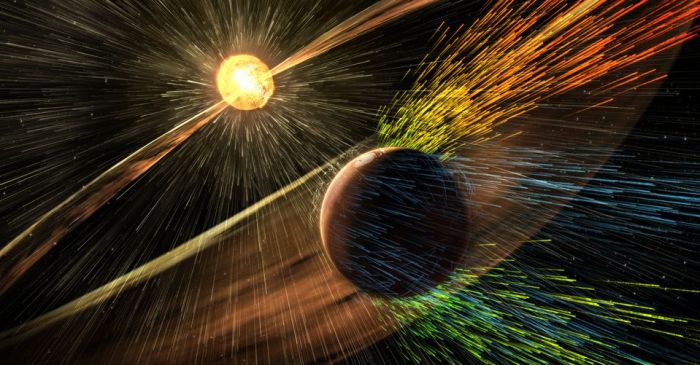
So what happened? There are a number of theories. One of these is that over time, the action of the solar wind, combined with Mars’ relatively weak gravity, effectively “scooped” much of the atmosphere away into space.   Measurements of heavy and light carbon ratios in the present day atmosphere lend considerable weight to this theory.

An artist's impression of what a wet Mars may have looked like, based on the ratio of deuterium contained within the Martian polar caps
An artist’s impression of what a wet Mars may have looked like, based on the ratio of deuterium contained within the Martian polar caps

Another idea is that carbon dioxide, the major constituent of Mars’ atmosphere may have been “sequestered” – that is, “pulled” out of the atmosphere to be stored in rocks and subsurface deposits by various chemical reactions, forming carbonate minerals in the process.

This theory was given its own boost when a region of Mars called Nili Fossae, approximately as big as the US state of Arizona, was found to have huge deposits of carbonates (more recently this region has been of interest to scientists due to the discovery of impact glass, helping to mark the region as a candidate target for the Mars 2020 rover mission).

Continue reading “Space Sunday: Pluto calls, Mars mystifies, Starliner prepares”

Sinewave.space: a further contender for virtual spaces

The above video has been gaining attention since first appearing on You Tube at the end of August. It’s advance promotion for a new virtual worlds platform called Sinewave.space, built using the Unity 3D engine, and which may be opening its doors to initial users in December 2015.

The company behind Sinewave.space is Sine Wave Entertainment, a name which may be familiar to many Second Life users, given it is also the company behind the highly successful Sine Wave animations brand in-world.

Spearheading the work is Sine Wave’s CEO, Adam Frisby, a man who has considerable experience with virtual world platforms, having been one of the founders of the OpenSimulator project. In Second Life he is probably better known as Adam Zaius, the man behind such ventures as Azure Islands and the DeepThink virtual worlds development agency, which operated in both Second Life and OpenSim.

Adam Frisby is perhaps more recognisable to many in SL as Adam Zaius

Nor are Sine Wave Entertainment new to the virtual worlds market. They’ve built and operated a number of virtual world spaces themselves, and they’ve produced virtual world spaces on behalf of clients, with all of their products created using the Unity 3D engine.

Perhaps the largest of their own environments is Wet.fm, a music-focused virtual environment claiming some 400,000 “live audience members”, 120 artists and some 600 music events held to date.

Chief among client-oriented spaces the company have developed is Flybar, a “multiplayer social game and on-line cinema for [the] globally distributed Spanish language soap opera Cuéntame cómo pasó“, and  which claims 1.2 million unique visitors since  2012, together with the Gojiyo virtual world / platform The latter was originally developed for India’s Godrej Industries and boasts 1.7 million registered users. It also appears to have what might be called associated games or spin-offs, such as Jiyopets.

Sine Wave are responsible for the India-based virtual world, GoJiyo, for Godrei Industries, and which boasted 1.7 million registered users

Reading the available information about sinewave.space, it’s interesting to note the similarities in approach between it and Project Sansar. For example, both platforms are intended to be white label environments in which creators can build their own branded spaces, and then promote  / market them directly to their potential audience, complete with sign-up portal, etc., without that audience necessarily being aware that the space they are entering is part of a platform providing many such spaces / experiences.

Further, both companies indicate the spaces within each platform could potentially be of unlimited size (Sine Wave indicate bandwidth, and Linden Lab the physics simulator, as being the only practical limitations to “land size”);  both platforms will offer a mix of “in-built” tools as well as support for a broad range of 3rd party tools for content creation – although Sine Wave would appear to be significantly further down the road in this. Sine Wave and Linden Lab also appear to be steering a similar course in terms of offering central user account management, virtual goods marketing, etc., which can be used across multiple environments running on their platforms.

Among their tool chain - which includes an advanced animation / gesture system - is the "humanoid resizer", intended to allow mesh clothing sized for "poular avatar skeletons" to be automatically resized to fit the primary Sinewave.space avatar skeleton
Sine Wave are offering a content creation tool chain which includes an advanced animation / gesture system and, as illustrated above, a “humanoid resizer” tool, designed to allow mesh clothing sized for “popular avatar skeletons” to be automatically resized to fit the primary Sinewave.space avatar skeleton

Which should not be taken to mean I think the two are in any way connected – I don’t. Rather, I find it interesting that two companies, each with their own approach to building and running immersive 3D spaces, have arrived at a similar conceptual approach as to how to build a platform aimed at being flexible enough in design and implementation to appeal to a wide cross-section of potential use-cases, without necessarily tying creators / clients / partners – or indeed, users – to a single branded environment.

Obviously, there are differences as well. For example, Sine Wave have indicated that among the worlds running on Sinewave.space will be a number of their own spaces – such as the aforementioned wet.fm, which is due for a re-launch under the sinewave.space banner in the near future – with the Sine Wave portfolio listing a number (all?) of such spaces which might be candidates for inclusion.

Sine Wave also produce Convvirt, a business-oriented space built on Unity 3D. Whether it is to form a part of the overall sinewave.space "federation" of virtual worlds is unclear, but it is listed as a part of the also listed under the Sinewave.space portfolio, so one assumes so
Sine Wave also produce Convvirt, a business-oriented space built on Unity 3D. Whether it is to form a part of the overall Sinewave.space “federation” of virtual worlds is unclear, but it is listed as a part of the also listed under the Sine Wave portfolio bearing the Sinewave.space brand, so one assumes so

Sine Wave also have the advantage of building on an engine – Unity 3D – with which they have many years of experience of both operating and using to build virtual spaces, rather than starting entirely from scratch. Lessons learned from past efforts can be put directly to use. They are also well-versed in the tools an capabilities contained within the engine without having to go through an internal learning curve as a part of the development process, and they have experience in combining the tools within the engine with their own tools – motion capture, animation, etc. – to present creators with an integrated tool chain.

As it is, and as noted earlier, Sine Wave are seeking content creators – region designers, clothing designers, animators and gesture designers, vehicle builders, and more – and in doing so, they’re offering those signing-up a 70/30 (in the creator’s favour) revenue split on all content sold within the platform’s worlds when they are opened to users. Those interested should follow the above link to find out more.

It’ll be interesting to see how sinewave.space develops over the coming months, both independently as with Project Sansar as a possible frame of reference (and even vice-versa), and I hope to be able to provide updates on progress through these pages.

Note; this article was largely drafted prior to show #84 of the Drax Files Radio Hour podcast, in which Drax talks to Adam Frisby about Sinewave.space. You can hear the conversation starting at the 34:30 mark, with an introduction by Drax.

Space Sunday: of selfies, sprites, and black holes

CuriosityCuriosity, NASA’s Mars Science Laboratory rover has departed “Marias Pass”, a geological contact zone between different rock types on the slopes of “Mount Sharp”, some of which yielded unexpectedly high silica and hydrogen content.

As noted in a recent space update in these pages, silica  is primarily of interest to scientists, because high levels of it within rocks could indicate ideal conditions for preserving ancient organic material, if present. However, as also previously noted, it may also indicate that Mars may have had a continental crust similar to that found on Earth, potentially signifying the geological history of the two worlds was closer than previously understood. Hydrogen is of interest to scientists as it indicates water bound to minerals in the ground, further pointing to Gale Crater having once been flooded, and “Mount Sharp” itself the result of ancient water-borne sediments being laid down over repeated wet periods in the planet’s ancient past.

Curiosity actually departed “Marias Pass” on August 12th, after spending a number of weeks examining the area, including a successful drilling and sample-gathering operation at a rock dubbed “Buckskin”, where the rover also paused to take a “selfie”, which NASA released on August 19th. It is now continuing its steady climb up the slopes of “Mount Sharp.”

A low-angle self-portrait produced from multiple images captured by the Mars Hand Lens Imager (MAHLI) camera mounted on the "turret" at the end of the rover's robot arm. The images were taken on August 5th, as the rover was parked at the "Buckskin" rock formation from which it gathered drill samples
A low-angle self-portrait produced from multiple images captured by the Mars Hand Lens Imager (MAHLI) camera mounted on the “turret” at the end of the rover’s robot arm. The images were taken on August 5th, as the rover was parked at the “Buckskin” rock formation from which it gathered drill samples

As it does so, initial analysis of the first of the samples gathered from “Buckskin” is under-way. It is hoped with will help explain why the “Marias Pass” area seems to have far higher deposits of hydrogen bound in its rocks than have previously been recorded during the rover’s travels. This data has been supplied by the Dynamic Albedo of Neutrons (DAN) instrument on Curiosity, which almost continuously scans the ground over which the rover is passing to gain a chemical signature of what lies beneath it.

“The ground about 1 metre beneath the rover in this area holds three or four times as much water as the ground anywhere else Curiosity has driven during its three years on Mars,” said DAN Principal Investigator Igor Mitrofanov of Space Research Institute, Moscow, when discussing the “Marias Pass” DAN findings. Quite why this should be isn’t fully understood – hence the interest in what the drill samples undergoing analysis might reveal.

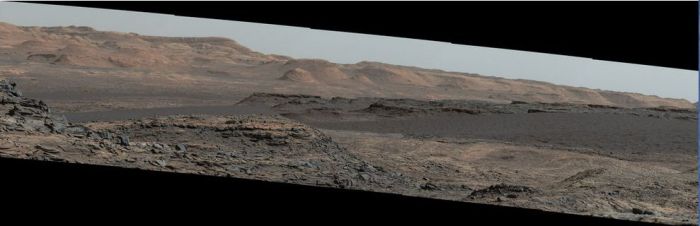
A stunning vista: the slopes of "Mount Sharp" as seen by Curiosity as it commenced the upward drive away from "Marias Pass". Captured by the rover's Mastcam systems, the image shows an intriguing landscape, with the gravel and sand ripples typical of much of the terrain over which the rover has passed in the foreground. In the middle distance sit outcrops of smooth, dust-covered bedrock, above which sit sandstone ridges. On the horizon sit rounded buttes, rich in sulfate minerals, suggesting a change in the availability of water when they formed - click image for the full size version
A stunning vista: the slopes of “Mount Sharp” as seen by Curiosity as it commenced the upward drive away from “Marias Pass”. Captured by the rover’s Mastcam systems, the image shows an intriguing landscape, with the gravel and sand ripples typical of much of the terrain over which the rover has passed in the foreground. In the middle distance sit outcrops of smooth, dust-covered bedrock, above which sit sandstone ridges. On the horizon sit rounded buttes, rich in sulfate minerals, suggesting a change in the availability of water when they formed – click image for the full size version

The drilling operation itself marked the first time use of the system since a series of transient short circuits occurred in the hammer / vibration mechanism in February 2015. While no clear-cut cause for the shorts was identified, new fault protection routines were uploaded to the rover in the hope that should similar shorts occur in the future, they will not threaten any of Curiosity’s systems.

A Flight over Mars

With all the attention Curiosity gets, it is sometimes easy to forget there are other vehicles in operation on and around Mars which are also returning incredible images and amounts of data as well – and were doing so long before Curiosity arrived.

One of these is Europe’s Mars Express, the capabilities of which come close to matching those of NASA’s Mars Reconnaissance Orbiter. Mars Express has been in operation around Mars for over a decade, and in that time has collected an incredible amount of data.

At the start of August, ESA released a video made of high resolution images captured by the orbiter of the Atlantis Choas region of Mars. This is an area about 170 kilometres long and 145 wide (roughly 106 x 91 miles) comprising multiple terrain types and impact craters, thought to be the eroded remnants of a once continuous ancient plateau. While the vertical elevations and depressions have been exaggerated (a process which helps scientists to better understand surface features when imaged at different angles from orbit), the video does much to reveal the “magnificent desolation” that is the beauty of Mars.

Continue reading “Space Sunday: of selfies, sprites, and black holes”

CastAR announce US $15 million funding

The CastAR banner
The castAR website banner

CastAR, formerly Technical Illusions, the company behind the augmented reality castAR headset with a VR capability and which I’ve been covering in this blog, has announced the completion of a US $15 million round of funding.

Former Valve employees  Jeri Ellsworth and Rick Johnson founded the company in 2013 after being let go by Valve – and given the blessings of Gabe Newell, Valve’s founder and Managing Director, to take the IP used within castAR with them.

Since then, they’ve been developing the headset with the aim of producing a low-cost, self-contained AR system initially aimed at games and entertainment, but with a wide range of other potential applications – including VR, through the addition of a clip-on that allows for wide field-of-view VR experiences.

The Development Kit / Kickstarter version of the CastAR headset
The Development Kit / Kickstarter version of the castAR headset (image via Engadget)

The early stages of the company’s work was largely funded by a Kickstarter campaign in late 2013 which raised just over US $1 million. This provided sufficient capital to get the company running, albeit on the small scale, and in October 2014, they were able to start shipping the first of the Developer / Kickstarter backer kits whilst also relocating from Seattle, Washington, to Mountain View, California, a move overseen by the newly hired CEO, David Henkel-Wallace.

However, fulfilling the obligations of the Kickstarter campaign has been difficult – so far the company has only been able to produce and ship around 1/3 of the pledged headsets. The Series A round of funding, which has been chiefly backed by Playground Global, co-founded by Andy Rubin of Android Inc. fame, will enable the company to take on staff, complete its Kickstarter obligations and lay the foundations for the future.

The news of the investment round was announced to Kickstarter backers in a personal note from Jeri and Rick, which reaffirms their commitment to their original supporters, reading in part:

What does this mean for Kickstarter? Delivery! We remain committed, as we always have, to giving our Kickstarter backers a high quality product and experience. Of course with only nine people and an ambitious engineering plan, it clearly has taken us longer than we had planned, but among other things, this investment will make sure we complete the Kickstarter in the next several months.

We recognise every day that we would not be where we are at without the support of you, our backers. You believed in us when we put together a video showing a product of 90% hot glue, some friends using it, and some crude software. That support reassured us that we weren’t crazy, and it helped send investors the message that there is significant excitement for castAR.

The conceptualised castAR production headset and VR clip-on system (image: Technical Illusions)
The conceptualised castAR production headset and VR clip-on system (image: CastAR)

The slightly ungainly – at least in its development form – headset uses projectors mounted on it to bounce light of a retro-reflective surface in an effect Ellsworth came across by accident, setting her with the initial idea for the system. The light from the projectors is delivered back to the wearer’s eyes through active-shutter glasses which also track the user’s position, allowing the projection to be updated in real-time.

Projections seen when wearing the headset appear as holographic elements directly in front of the user’s field of vision, which can then be manipulated via a “wand” hand controller.  Because the retro-reflective material bounces light back to its origin, multiple users can use the same surface simultaneously without experiencing any interference from other headset, allowing multiple headsets to be used in the same physical space for game play or other activities.

A key aim of the headset is to be affordable, ease-to-use system which users of all ages can immediate grasp conceptually and use with ease.

“When we say a consumer product, we mean a consumer price point,”  Henkel-Wallce told GamesIndustry.biz when discussing the funding announcement. “The Oculus headset is only a few hundred dollars but then you need a $1000 PC to run your games. That’s not a consumer product, that’s not something you’re giving to your kids.

Making CastAR fun, affordable and self-contained is key to the unit's success
Daivd Henkel-Wallace: Making CastAR fun, affordable and self-contained seen as key to the unit’s success

“Our vision is that Christmas day Grandma has bought these for the kids, they tear open the paper, they open the box, they’re eight and ten years old, they put down the game board and within a minute they’re playing. That’s where we want to get to.”

It was this approach which attracted Playground Global’s interest, with Rubin stating, “I was really intrigued by [their] approach to tackling the problem of how to drive mainstream adoption of AR. They’re the only company I found to be simplifying the utility and application of augmented and virtual reality technology into a fun, accessible, and portable system that will wow kids and adults alike.”

The company’s change in name was also announced alongside of the funding news, and is seen as a natural step for the fledgling company, as Rick Johnson explained when writing to Kickstarter backers:

One observation we’ve made along the way is that people kept calling us “castAR” as a company name. We used the financing as an excuse to change our official company name to castAR.

The Series a funding round comes on top of an undisclosed seed round of funding for the company. Together these demonstrate that castAR is a viable investment concern, opening the door to additional round of investment in the future, if / when needed. As Henkel-Wallace informed Gamesindustry.biz, “This money really marks an inflection point from being just a raw start-up to actually allowing us to become a really fully functioning company.”

Congrats to Jeri, Rick, David and the team.

Sources

High Fidelity: into the solar system and STEM grant recipients

HF-logoI’m rather into space and astronomy – that much should be obvious from my Space Sunday reports, and coverage of mission like the Curiosity rover, astronomical events like the transit of Venus and so on.

So when High Fidelity posted news on the 2015 summer intern project, and the words “solar system” featured in it, my attention was grabbed. The post opens:

Hello! I’m Bridget, and I’ve been interning at High Fidelity this summer, working to build some JavaScript content in HF. As a math and computer science major, I had the opportunity to hone my programming skill set, learning from Hifi’s superb team of software engineers and design-minded innovators.

So here’s the culmination of my work this summer: a virtual orbital physics simulation that provides an immersive, interactive look at our solar system.

Bridget's solar system model correctly simulates the movement of planetary bodies around a stellar object , utilsing both Newton's and Kepler's laws, thus producing a dynamic teaching model for orbital mechanics and gravity
Bridget’s solar system model correctly simulates the movement of planetary bodies around a stellar object , utilising both Newton’s and Kepler’s laws, thus producing a dynamic teaching model for orbital mechanics and gravity – with a potential application for teaching aspect of physical cosmology

The goal of Bridget’s project is to demonstrate what can be built using JavaScript (and some C++), with a particular emphasis on building educational content in High Fidelity, and by using the solar system, she has come up with a highly innovative approach to teaching orbital mechanics – and more besides.

Essentially, she has created a model of the solar system which uses “real” gravitational physics to simulate the motion of the planets around the Sun. The planets themselves occupy orbits scaled relative to Earth, and fixed reference values are used for the orbital period, large and small body masses, and gravity. Then, a little Newtonian physics is thrown into the mix, together with a sprinkling of Kepler’s Laws of planetary motion. Thus, the scripting ensures that the planets maintain a stable orbit, while updates correct mimic each planet’s orbital trajectory around the Sun.

This generates a model that is interesting enough in itself, if somewhat simplified in nature, as Bridget notes, whilst also pointing to its potential for further use:

While the simulation exploits a somewhat simplified model, namely neglecting the elliptical nature of the planets’ orbits, it can easily be modified to account for additional factors such as the n-body problem.

In other words, there is the potential here to both refine the model in terms of orbital mechanics and planetary motion as a part of the teaching / learning process, and perhaps even dip a toe into physical cosmology.

the simulation
the simulation includes a UI which allows users to perform a number of tasks, including playing a little game and being able to zoom into the planets.

Bridget also notes:

Another fun aspect of the project was implementing UI to create possibilities for exploration and experimentation within the simulation. A panel with icons lets you:

  • Pause the simulation and show labels above each planet revealing its name and current speed
  • Zoom in on each planet
  • Play a “Satellite Game” (think Lunar Lander, but with a satellite around the earth), where you attempt to fling a satellite into stable orbit
  • Adjust gravity and/or the “reference” period, and see what happens!

Bridget’s work marks the second time a summer intern has reported on working at High Fidelity during the summer hiatus. In 2014, Chris Collins chatted to the (then) 17-year-old Paloma Palmer, a high School student also honing her coding skills. She focused on coding voxels to respond directly to volume inputs over a microphone in real-time. You can see her discussion with Chris on the HiFi YouTube channel.

Staying with education, and following on from my coverage of High Fidelity’s STEM VR challenge, Ryan Kampf announced the first of the grant recipients on Friday, August 14th.

The VR challenge invited educators, be they individuals or groups, to take up the STEM VR Challenge, to submit proposals for educational content in High Fidelity which meets the criteria set-out in the Challenge website, namely that the content is:

  • HMD (e.g. Oculus Rift) featured
  • High school age appropriate
  • STEM focused
  • Social (can be experienced by >3 people together).

On offer were up to three grants of US $5,000 each for recipients to further develop their ideas.

In his  announcement Ryan indicated that two recipients for grants had been selected from submissions: the TCaRs VR Challenge and Planet Drop VR.

Both use game mechanics, with TCaRs (Teaching Coding – a Racing simulation) enabling users get to interact with and customise their racing cars using JavaScript, while Planet Drop places players into an alien planet environment which they must explore through “cooperative asymmetrical gaming”. Each has highly specialised information, based on their chosen STEM field and provided to them via a game HUD, and the aim is for them to work together, sharing the information they receive as quickly and effectively as possible to allow the team to solve challenges and advance through a story arc of increasingly impressive accomplishments.

Conceptual illustration of the "Mech Pods" the players in Planet Drop will use to explore their alien environment
Conceptual illustration of the “Mech Pods” the players in Planet Drop will use to explore their alien environment

Congratulations to Bridget on her summer intern project (the script is available for those wishing to use it), and to the STEM VR challenge recipients.