2020 Simulator User Group week #31 summary & the Blake Sea Cloud challenge

Auld Lang Syne, June 2020 – blog post

The following notes were taken during the Simulator User Group meeting of Tuesday, July 28th, 2020.

Simulator Deployments

Please refer to the server deployment thread for news and updates:

  • There was no deployment to the core SLS channel regions on Tuesday, July 28th, leaving the majority of the grid running on server maintenance update 544832, designed to resolve issues with some internal service updates, chat range improvements and capability improvements.
  • On Wednesday, July 29th, there should be a deployment to two of the RC channels (LeTigre and BlueSteel), primarily related to internal changes related to the cloud uplift.

SL Viewer

  • After being rolled back to RC status, the Tools Update viewer version 6.4.5.544639 was removed from the available viewer list on Monday, July 27th.
  • The Mesh uploader was promoted to RC status with the release of version 6.4.5.544027 on Monday, July 27th.

The remaining official viewer pipelines remain as follows:

  • Current release viewer version 6.4.4.543157, dated June 11th, promoted June 23rd, formerly the CEF RC viewer – ROLL BACK.
  • Release channel cohorts:
    • Arrack Maintenance RC viewer, version 6.4.5.544465, July 6th.
    • Love Me Render RC viewer, version 6.4.5.544028, June 30th.
  • Project viewers:
    • Custom Key Mappings project viewer, version 6.4.5.544079, June 30th.
    • Copy / Paste viewer, version 6.3.5.533365, December 9th, 2019.
    • Project Muscadine (Animesh follow-on) project viewer, version 6.4.0.532999, November 22nd, 2019.
    • Legacy Profiles viewer, version 6.3.2.530836, September 17th, 2019. Covers the re-integration of Viewer Profiles.
    • 360 Snapshot project viewer, version 6.2.4.529111, July 16th, 2019.

Blake Sea Cloud Challenge (Aditi)

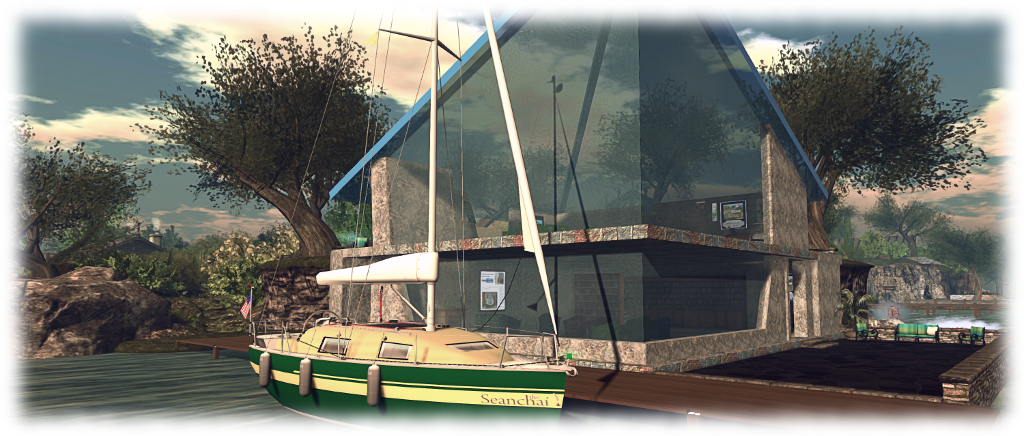
As I was the first to report on July 21st, the Blake Sea regions have been cloned to the Aditi, the beta grid, and are running on AWS servers in the cloud (see: Blake Sea in the cloud on ADITI). At that time, region crossings for the regions were  – to say the least – unstable.

Since then, those regions (some 46 in total) have been further updated (Monday, July 27th), and to help with gathering data on cloud-based region crossings, Simon Linden has defined the Blake Sea Challenge:

We just did some updates this morning (Monday July 27th) that fixes a bunch of the region connectivity issues.    I just did a tour and didn’t hit any invisible walls.
Along those lines, I made a quick “Blake Sea Challenge”   Go to secondlife://Aditi/secondlife/Morris/200/207/34  on the BETA aditi grid, and click on the red egg-shaped thing to try it out.   It will give you the “Blake Sea Challenge”  … wear it and touch, and it’ll get you going.   Follow the instructions to sail / fly / motor around 46 regions without doubling back and see if you make it.   Have fun and keep letting us know how it goes!

– Simon Linden, Simulator User Group

Blake Sea is now on Aditi and running in the cloud for those wishing to test vehicle region crossings. If interested, try taking Simon’s challenge (above)

In Brief

  • There are renewed reports of delays to scripted object rezzing across many regions. see: BUG-228939 “on_rez action delayed for 2 to 3 seconds in many regions”.

A touch of Dim Sum Gardens in Second Life

Dim Sum Gardens, July 2020 – click any image for full size

Dim Sum Gardens is a Full region on the Mainland that has been given over to a quite spectacular oriental themed public garden space that can be deceptive in its breadth and depth. Designed by Wee Willian Wylie, the gardens are built around a large lake, and are rich in features and details that can make any visit a voyage of discovery – although that said, it would be remiss of me not to note that such is the depth of detail within the gardens, a visit can take a lot out of older systems; so if you do tend to travel with a high draw distances or shadows always enabled, be prepared to make adjustments so that you might better enjoy things.

A visit commences on the south side of the gardens within a Japanese-style walled terrace area. Here, on a platform guarded by Japanese hunter / warriors and sinuous water dragons, sitting over a rectangular pool water and beneath a stylishly modern Torii gate, the landing point looks out across the lake as it spreads itself to the north, water falling from a low lip in the edge of the pool to add to the lake’s fill.

Dim Sum Gardens, July 2020

This is a place where the term here be dragons has genuine meaning: as well as the two water dragons busily keeping the pool under the landing point topped-up, dragon heads decorate a stone fountain on the terrace below, and two more are waiting to greet visitors as they descend the steps from the terrace to join the path that offer routes of exploration along the south side of the gardens. In addition, all of this  – landing point, terrace and all – is watched over by a large water dragon that raises its head out of the lake to also examine arriving visitors.

Bracketed by trees and woods to the south, west and east, the lake reaches north to where the land rises in grass-topped bluffs that arc around the back of a large island that proudly rises from the waters, a couple of smaller, low-lying islands between it and the landing point to the south. This sheer-faced island is topped by a quite marvellous Japanese tea house that mixes modern and traditional design in a manner that delights the eye. Like the landing point, this tea house is also guarded by dragons as it sits over a water feature that is home to fountains and Japanese crane, whilst waters tumble from the rocks of its perch to also add to the lake below.

Dim Sum Gardens, July 2020

The tea house is just one of many buildings and structures to be found throughout the gardens, some of which may be easy to spot as they raise their roofs above screens of trees or sit out over the waters whilst others may only come into view as you wander, and some attempt to remain hidden right up until you are almost literally on top of them.

Most of the larger structures are distinctly oriental in design, although a further café, sitting on the north shore of the lake and tucked behind the bulk of the island tea house, is of western design, and several of the smaller hideaways and romantic spots could hail from anywhere around the globe, whilst a dance pavilion on an island tucked into the south-east of the lake carries an elven air about it.

Dim Sum Gardens, July 2020

But no matter what their heritage, the placement of all the structures, large and small, within these gardens means that they all simply work and come together with the landscaping to capture the eye and heart.

To get to all of them really is an exercise in exploration: whilst a trail runs east and west from the path leading outward from the landing point terrace, it quickly becomes sporadic and overgrown or broken, although in places fences and old wall may offer hints of where to go. This allows things like bridges out to islands or the rediscovery of the trail after losing it in long grass and wild flowers, to add to the sense of adventure – as can coming across the unexpected, near-unseen house and courtyard or Japanese pavilion hiding within a curtain of bamboo.

Dim Sum Gardens, July 2020

For those who tire of wandering – something hard to imagine here – or who simply want to sit and relax, Dim Sum Gardens again offers a lot, from simple benches in the shade of trees, to the aforementioned cafés and tea houses, to the many pavilions and picnic spots and decks built out over the water and rafts floating upon it.

Nor is the lake home to a lone dragon; ducks swim among the lily pads, puffins perch on rocks, and heron and pelicans keep an eye out for unwary fish that might stray too close to where they stand. rowing boats and lanterns also sit on the waters, whilst several pieces of art rise above the rippled surface. This is a place rich in the colours of nature: multiple hues of green from grass, flowers and trees, reds and pinks and whites of cherry trees, and where the reds and greys and browns of rooftops add their bursts of colour to the mix.

Dim Sum Gardens, July 2020

With something new to see wherever you look and surprises to be found wherever you wander, Dim Sum is a perfect setting (if, again being honest, a possible heavy load for some systems). Such is its design, more than one look might be required to find everything – as I found out when I returned to take photos and came across the orangery with its piano inside, so well hidden under the boughs of a cherry tree I’d completely missed during my first visit!

SLurl Details

Science fiction, music, and a P.I. in Second Life

Seanchai Library

It’s time to highlight another week of storytelling in Voice by the staff and volunteers at the Seanchai Library. As always, all times SLT, and events are held at the Library’s home, unless otherwise indicated. Note that the schedule below may be subject to change during the week, please refer to the Seanchai Library website for the latest information through the week.

Monday, July 27th, 19:00: Colossus

Gyro Muggins reads the 1966 future cold war novel by Dennis Feltham (DF) Jones.

Charles Forbin has dedicated ten years of his life to the construction of the supercomputer, Colossus, rejecting romantic and social endeavours in order to create the United States of North America’s (UNSA, a nation encompassing both America and Canada) first artificially intelligent defence system.

Colossus is capable of taking and analysing data rapidly, allowing it to make real-time decisions about the nation’s defence needs. But the system soon exceeds even Forbin’s expectations; it is able to take far more information and process it far faster than he and his team at the Colossus Programming Office believed would ever be possible.

Such is the system’s apparent abilities, the President hands off full control of the UNSA’s ballistic missile capability, together with other defence protocols, to Colossus and makes the announcement to the world that he has ensured peace.

But then the USSR announces that it has a defence supercomputer of its own – Guardian – with capabilities similar to that of Colossus. Then the two computers demand they be allowed to communicate directly – and proceed to do so at a rate that is well beyond the understanding of their respective development teams.

And neither system takes it kindly when Forbin and his Russian opposite number, Academician Kupri, both disable their ability to communicate directly and then seek to remove them from control of UNSA and USSR nuclear missiles…

Tuesday, July 28th:

12:00 Noon: Russell Eponym, Live in the Glen

Music, poetry, and stories in a popular weekly session at Ceiluradh Glen.

19:00: The Golden Apples of the Sun

Willow Moonfire reads from an anthology of 22 short stories by Ray Bradbury, first published in 1953, and which takes its title from the final line of the poem The Song of Wandering Aengus by W.B. Yeats. Originally published in 1897 under the title A Mad Song before gaining its proper name until 1899. A romantic poem about an old man recalling a magical encounter with a silver trout that turned into a beautiful young girl after he caught it, only for her to vanish, the poem ends with the stanza:

Though I am old with wandering
Through hollow lands and hilly lands,
I will find out where she has gone
And kiss her lips and take her hands;
And walk among long dappled grass,
And pluck till time and times are done
The silver apples of the moon,
The golden apples of the sun.

Of these lines, Bradbury said, “Maggie [his wife] introduced me to Romantic poetry when we were dating, and I loved it. I love that last line in the poem, and it was a metaphor for my story, about taking a cup full of fire from the sun.”

Wednesday, July 29th, 19:00: Whittington

Caledonia Skytower reads Alan Armstrong’s 2006  Newbery-Honor winning tale.

Whittington is a roughneck tom cat who arrives one day at a barn full of rescued animals and asks for a place there. Present at the barn is a menagerie of animals and young Ben and Abby, whose grandfather owns the barn and does the rescuing.

To earn his place, Whittington tells the tale of his famous ancestor, the nameless cat who brought Dick Whittington to the heights of wealth and power in 16th-century England. In telling his story of how his ancestors saved and elevated Whittington, this tom-with-a-chip, elevates another little boy above his fear of learning to read.

Thursday, July 30th

1900: Philip Marlowe’s The Finger Man

With Shandon Loring. Also in Kitely – from the main Seanchai World grid.kitely.com:8002:SEANCHAI.

21:00: Seanchai Late Night

Finn Zeddmore presents contemporary science fiction and fantasy from such on-line sources as Escape Pod, Light Speed, and Clarkesworld magazines.

2020 viewer release summaries week #30

Logos representative only and should not be seen as an endorsement / preference / recommendation

Updates for the week ending Sunday, July 26th

This summary is generally published every Monday, and is a list of SL viewer / client releases (official and TPV) made during the previous week. When reading it, please note:

  • It is based on my Current Viewer Releases Page, a list of all Second Life viewers and clients that are in popular use (and of which I am aware), and which are recognised as adhering to the TPV Policy. This page includes comprehensive links to download pages, blog notes, release notes, etc., as well as links to any / all reviews of specific viewers / clients made within this blog.
  • By its nature, this summary presented here will always be in arrears, please refer to the Current Viewer Release Page for more up-to-date information.
  • Note that for purposes of length, TPV test viewers, preview / beta viewers / nightly builds are generally not recorded in these summaries.

Official LL Viewers

  • Current release viewer version 6.4.4.543157, dated June 11th, promoted June 23rd, formerly the CEF RC viewer – ROLL BACK..
    • Uses new viewer build tool chain, but does not include any user-facing updates outside of bug fixes.
  • Release channel cohorts:
    • Tools Update 2 RC viewer, version 6.4.6.545538, released on July 24th.
    • Tools Update RC viewer, version 6.4.5.544639, dated July 17th, ROLLED BACK to RC status, July 24th.
  • Project viewers:
    • No updates.

LL Viewer Resources

Third-party Viewers

V6-style

  • No updates.

V1-style

Mobile / Other Clients

  • No updates.

Additional TPV Resources

Related Links

Space Sunday: supergiants on camera and more to Mars

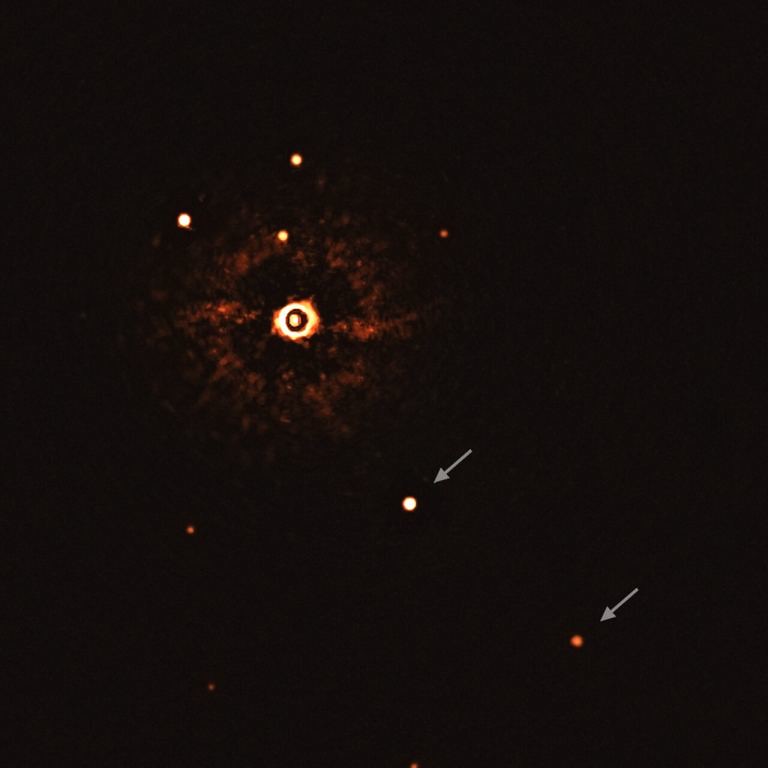
Are they stars? No, they’re a pair of exoplanets 310 light years away. Credit: ESO/Bohn et al, 2020

The above picture may not look that spectacular, just a couple of stars against the backdrop of space – exception the two disks it shows are not stars, they are planets – exoplanets, in fact, orbiting a star 310 light years away. As such, it is the first visible light photograph of multiple planets orbiting a Sun-like star taken from Earth.

Called TYC 8998-760-1, the star in question is of the G2V spectral class, and the closest Sun-like star to the solar system. However, whereas the Sun is some 4.6 billion years old, TYC 8998-760-1 is a mere stripling – just 17 million years old. It lies within the southern hemisphere constellation of Musca – a constellation which though small, contains a number of notable stars including Alpha, Beta, Gamma and Zeta Muscae, part of a group of hot blue-white stars that seem to share a common point of origin and motion within the galaxy, HD 100546, a blue-white Herbig Ae/Be star that is surrounded by a complex debris disk containing a large planet or brown dwarf and possible protoplanet, and  Theta Muscae, a triple star system, the brightest member of which is a Wolf–Rayet star.

The image was taken by the European Southern Observatory’s (ESO) Very Large Telescope (VLT) using the Spectro-Polarimetric High-contrast Exoplanet REsearch instrument (SPHERE). This instrument utilises a coronagraph to block out much of the light from a star, allowing the light reflected by any planetary bodies to be visible.

TYC 8998-760-1 is an interesting planetary system for a number of reasons. Given the relative youth of the parent star, it might be said that the system represents a glimpse of the early formation of the solar system. However, it is on a scale far vaster than our own. Both of the planets are gas supergiants, the innermost, called TYC 8998-760-1 b, being some 14 times the mass of Jupiter, whilst the outermost, TYC 8998-760-1 c, is around 6 times Jupiter’s mass. Both also orbit their parent at incredible distances in comparison to the planets of our own system:  TYC 8998-760-1 b averages 162 AU (1 AU being the average distance the Earth is from the Sun), and TYC 8998-760-1 c averages some 320 AU. By comparison, Neptune, the most distant of our major planets, averages a “mere” 30 AU from the Sun.

The complete image captured by the SPHERE instrument on ESO’s Very Large Telescope, showing the star TYC 8998-760-1 above centre, left, with three additional stars above it and its two supergiant planets below (arrowed). This image marks the first time astronomers have directly observed more than one planet orbiting a star similar to the Sun. Image Credit: ESO/Bohn et al, 2020.

These vast distances make both planets curiosities: exoplanets that are large and orbiting far from their host stars are very difficult to fit into the protoplanetary and accretion disk model(s ) that are generally used to explain planetary formation. Further, both planets appear to occupy relatively stable, circular orbits. Astronomers believe this could indicate that the two planets formed more-or-less where they are now and their near-circular orbits may indicate the presence of a still-to-be discovered third large body orbiting even further from the star (and TYC 8998-760-1 c was unknown prior to SPHERE capturing it) – or that their orbits might indicate their are the result of very specific ejections from an unseen stellar companion to  TYC 8998-760-1.

Further study is required to determine exactly how the planets may have formed, but their presence does raise the questions on whether smaller, rocky planets might orbit closer to the star – possibly within its habitable zone. As it is, SPHERE’s ability to gather data on planets has yielded a lot of information on the two gas giants that will keep astronomers busy. And while this is only the third image of exoplanets currently on record, with the upcoming generation of high-powered Earth and space-based telescopes, that number will increase over the coming decades.

Heavenly Questions En-route to Mars

The Long March 5 carrying China’s Tianwen-1 mission to Mars lifts-off on July 23rd. Credit: CCTV / China National Space Agency

In my previous Space Sunday update I covered the launch of the UAE’s Hope mission to Mars, launched as that article was being written, and the (then) forthcoming launch of China’s ambitious Tianwen-1 (“Quest for Heavenly Truth” or “Questions for Heaven”) orbiter / lander / rover mission.

At that time, it wasn’t clear just when China’s mission would lift-off, but going on past launches of the Long March 5 booster that would be hefting the mission away from Earth have generally been within 6 days of the rocket being delivered to the launch pad, speculation was that the Tianwen-1 launch would come in he week of July 20th through 24th, given its launcher arrived on the pad on July 17th.

A view of the Long March 5 booster ascending to orbit, showing the dual exhaust configuration of its first stage boosters. Credit: CCTV / China National Space Agency

Those speculations proved to be correct, because Long March 5 launch Y4 took to the skies from the Wenchang Satellite Launch Centre on Hainan Island in the South China Sea, at 04:41 UTC on the Morning of July 23rd (11:41 local time).

Continue reading “Space Sunday: supergiants on camera and more to Mars”

2020 SL project updates week #30: TPVD summary

Paris for Ara, June 2020 – blog post

The following notes are taken from the TPV Developer meeting held on Friday, July 24th, 2020. These meetings are generally held every other week, unless otherwise noted in any given summary. The embedded video is provided to Pantera – my thanks to her for recording and providing it. Time stamps are included with the notes will open the video at the point(s) where a specific topic is discussed.

SL Viewer News

[0:00-3:47]

The promotion of the Tools Update RC viewer to de facto release status didn’t go as intended, resulting in the promotion being rolled back to viewer version 6.4.4.543157, dated June 11th, promoted June 23rd, formerly the CEF RC viewer. In addition, a further version of the Tools Update viewer was issued in RC form.

The roll-back was due to the Tools Update viewer causing incoming new users to crash on arrival at the welcome islands. Presumably, the arrival of a second Tools Update RC viewer is to allow comparative testing between the two versions in an attempt to understand what is happening, the Tools Update 2 viewer having some form of internal differences to the Tool Update viewer.

There are reports that the Tools Update viewer also has a deadlock issue associated with it – see BUG-229110.

In the interim, the recommendation is for TPVs not to release version based on or incorporating the Tools Update viewer code.

Therefore, this leaves the current viewer pipelines as follows:

  • Current Release viewer version  6.4.3.543157, dated June 11th, promoted June 23rd, formerly the CEF RC viewer – ROLL BACK
  • Release channel cohorts:
    • Tools Update 2 RC viewer, version 6.4.6.545538, July 24.
    • Tools Update RC viewer, version 6.4.5.544639, July 17 – ROLL BACK TO RC STATUS.
    • Arrack Maintenance RC viewer, version 6.4.5.544465, July 6.
    • Love Me Render RC viewer, version 6.4.5.544028, June 30.
  • Project viewers:
    • Custom Key Mappings project viewer, version 6.4.5.544079, June 30.
    • Mesh uploader project viewer, version 6.4.4.543141, June 11.
    • Copy / Paste viewer, version 6.3.5.533365, December 9, 2019.
    • Project Muscadine (Animesh follow-on) project viewer, version 6.4.0.532999, November 22, 2019.
    • Legacy Profiles viewer, version 6.3.2.530836, September 17, 2019. Covers the re-integration of Viewer Profiles.
    • 360 Snapshot project viewer, version 6.2.4.529111, July 16, 2019.

General Viewer Notes

  • The “big push” is now on getting the Love Me Render (LMR) viewer promoted to release status. There are currently just “a few” open issues with the viewer, and the hope is these can be closed and the viewer cleared by QA for promotion “soon”. This is the viewer that includes several EEP-released fixes for things like HUD issues, specularity, etc.
  • The Legacy Profiles viewer has had some back-end web integration issues that have prevented it from progressing to RC status as had been hoped at the last meeting.
  • A further Maintenance RC viewer is close to being ready for issuing.

In Brief

  • [9:36-19:33] EEP issues:
    • People continue to report noticeable performance degradations with running EEP enabled viewers. The current work-round is for users to disable Linden Water rendering (CTRL-SHIFT-ALT-7), which appears to work even when Linden Water is totally occluded.
    • This is a recognised problem, and is being actively investigated. However, there may not be a single fix that resolves all performance issues, so this work may not delay the promotion of the LMR viewer, bu could end up being addressed as one or more “future fixes”.
    • There are also reports of increased sudden viewer freezes / stalls within EEP enabled viewers. Again, LL is aware of such reports and is investigating them.
    • In addition, there continue to be major questions as to the real value of EEP when compared to issues such as the overall impact on people having to remodel custom environments, ease-of-use within the tools, performance hits, etc.
    • Firestorm’s preview release of EEP has already resulted in considerable negative feedback even amongst a limited subset of users; there are concerns that when released, it could result an large-scale user backlash.
  • [20:54-24:18] Increasing the official viewer’s texture memory allowance: currently, the official viewer is pegged at using 512Mb of memory for texture handling, which can result in performance hits due to texture switching issues.  This is on a list of changes LL “would like to get to” – although Kitty Barnett has offered LL a code patch (already used by some TPVs, and baed on Runitai Linden’s own code) to help.
  • Reminders:
    • The fix for off-line inventory offers failing is now grid-wide. This is still awaiting an update in the official viewers, but TPVs capable of using the capability can now “go ahead and use it.”
    • Those wishing to test how regions running on AWS servers can do so on Aditi, the beta grid, as follows:
      • Regions Morris and Ahern (and possibly now Dore and Bonifacio, although this hasn’t been clarified).
      • The majority of the Blake Sea regions – see: Blake Sea in the cloud on ADITI.