Space Sunday: Perseverance departs, Endeavour returns

The moment of ignition as the Atlas V booster lifts-off from SLC-41 at Canaveral Air Force Station, Florida, Thursday, July 30th, 20020. Credit: NASA TV

At precisely 11:50 UTC (7:50am EDT) an Atlas 5 rocket thundered into near-perfect skies over Cape Canaveral Air Force Station in Florida, carrying aloft NASA’s Mars 2020 on the first stage of its 7-month trip to the red planet.

The launch marked the last of the “big three” missions to launch during the 2020 opportunity, following on the heels of China’s Tianwen-1 orbiter / lander / rover mission and the UAE’s Hope orbiter mission. Carrying the Perseverance rover and Ingenuity helicopter drone, Mars 2020 is the most scientifically complex of the three missions, and potentially set to be the longest running of all three: providing it doesn’t fall foul of any major issues, Perseverance (Or “Percy” as some have dubbed it) could be operational on Mars for 12-14 years, thanks to its nuclear power supply.

A pictorial history of NASA’s successful Mars missions from Mariner to MSL / Curiosity, together with Mars 2020 and the proposed sample return and orbital ice mapper missions. Credit: NASA

In the days leading up to departure, there had been concerns the attempt might have to be postponed thanks to the approaching Tropical Storm Isaias, but on the morning of the launch, conditions couldn’t have been better. There was, however, some pre-launch excitement on the other side of the United States, where the Jet Propulsion Laboratory in (JPL) – mission control for the mission once en route to Mars, was lightly shaken by a local 2.9 magnitude earthquake just 30 minutes prior to lift-off.

Just under 2 minutes after launch, the Atlas V dispatched its four strap-on boosters, allowing the core stage to continue towrds low earth orbit. Less then 2 minutes later, with the vehicle at an altitude of 392 km, the payload fairings were jettisoned, exposing the payload to space. The Centaur upper stage then commenced its “chill down” phase, readying its motor for operation once the Atlas core stage had detached.

BECO and separation: a camera mounted on the Centaur upper stage captures the Atlas V core stage as it falls away following separation and ignition of the EL-10 engine. Credit: NASA TV

BECO – Booster Engine Cut-Off – came 4 minutes and 20 seconds after launch, the core stage separating to allow the Centaur commence its work with and initial engine burn to further raise the vehicle’s orbit around Earth before the RL-10 motor was shut down and the reaction control system (RCS) was fired a number of times to set the stage and the payload rotating along their longitudinal axis, a move designed to ensure the payload would be spin-stabilised during its cruise to Mars.

This part of the journey started some 90 minutes after launch, on the “night” side of Earth relative to JPL. As this point, the RL-10 re-ignited, pushing the Centaur and its payload into a Trans-Mars Injection (TMI) orbit around the Sun before the two separated. As there was no “live” video of the separation, mission managers had to wait for NASA’s Tracking and Data Relay Satellites (TDRS) and Deep Space Network (DSN) on the ground to acquire a direct signal from the payload and its cruise “bus” to confirm they were safely on their way.

The Mars 2020 rover Perseverance. Credit: NASA

This TMI engine burn ensured Mars 2020 would cross the orbit of Mars, but it would do so before the planet reached the same point in space. This was because had both been on a course to intercept Mars, the Centaur booster would crash into the planet, potentially contaminating it. Instead, Mars 2020 will make two mid-course engine burns from the motors on its cruise “bus”, shifting its trajectory onto that will intercept the planet, leaving the Centaur to fly harmless by.

As well as searching for signs of ancient microbial life and advancing NASA’s quest to explore the past habitability, Mars 2020 will also form the first half of a sample return mission – as I’ve previously noted, it is equipped to leave up to 23 sealed sample containers on the surface of the planet, at least one of which may be retrieved by a future NASA/ ESA sample return mission, although such a mission has yet to be formally approved by either agency. In addition, Perseverance carries with it experiments geared towards learning more in preparation for the future human exploration of Mars.

Mars 2020 is heading for the 49km diameter Jezero Crater on the edge of Isidis Basin in the Martian Hemisphere. The crater has evidence for it once being a wet environment, including a broad inflow delta where water once flowed into the crater from the Syrtis Major uplands that is the landing site for Mars 2020. Credit: NASA

The first of these forms a part of the SHERLOC (Scanning Habitable Environments with Raman & Luminescence for Organics & Chemicals) instrumentation. Primarily designed to seek organic compounds on Mars, SHERLOC also contains five small pieces of material that might be potentially used in the outer layers of a future Marts spacesuit. These will be monitored to see how well they deal with possible corrosion by Martian dust and atmosphere under the effects of solar radiation. As a part of its duties, the Mars Environmental Dynamics Analyser (MEDA) will also study the nature of Martian dust so engineers can make better decisions about materials to be used in spacesuits and surface equipment.

Then there is MOXIE – the Mars Oxygen ISRU Experiment – designed to produce oxygen out of the carbon dioxide that makes up 96% of the Martian atmosphere.

Mars Direct (1996): proposed using 6 tonnes of hydrogen carried to Mars by an uncrewed Earth Return Vehicle (ERV) to generate 112 tonnes of oxygen and methane using the 19th century Sabatier reaction. These could then be used propel the ERV (and crew) back to Earth at the end of a mission, while the generate could continue to produce oxygen and methane during the crew’s 700-day stay on Mars after they have arrived 2 years after the ERV. Credit: Orange Dot Productions / Mars Society UK

The idea has its roots in the 1996 Mars Direct mission profile developed by Robert Zubrin and David Baker. They recognised that the biggest encumbrance to a mission to Mars was the amount of fuel required to both get a crew to Mars and then bring them back to Earth. To reduce this, they proposed using the Martian atmosphere to produce both oxygen and methane that could be used to fuel the vehicle a crew would use to return to Earth – massively reducing the mass of a mission. The same technique could also be used to provide a human crew with additional oxygen supplies and fuel for surface vehicles once they get to Mars.

MOXIE is a more modest idea, designed to produce just oxygen from the Martian atmosphere. It’s a proof-of-concept designed to produce 22g of oxygen (O2) per hour with >99.6% purity continuously for around 1230 hours. If successful, it could pave the way for a much large nuclear-powered unit to be delivered to Mars that could be used to produce a large volume of stored oxygen that could be used to produce the atmosphere for a human outpost on Mars and as the oxidiser for powering Earth return vehicles. As with the Mars Direct proposal, the system could be extended to also produce Methane fuel.

The MOXIE experiment aboard Perseverance aims to produce oxygen from the Martian atmosphere. Credit: NASA

Mars 2020 is now en route to Mars in the “cruise” phase of the mission, during which it will study interplanetary space. The next tense moment for the mission comes on February 18th, 2021, when the craft arrive at Mars, and Perseverance and Ingenuity enter the “seven minutes of terror” of the Entry, Descent and Landing (EDL) phase, which should culminate in both being safely delivered to Jezero Crater on the surface of Mars.

A Dragon Comes Home

Sunday, August 2nd, 2020 saw the Crew Dragon Demo-2 mission make its return to Earth. Launched to the International Space Station (ISS) on May 30th, 2020 (see: Space Sunday: how to fly your Dragon) carrying NASA astronauts Bob Behnken and Doug Hurley, the mission was intended to confirm the SpaceX crew dragon vehicle is ready to commence regular crew-carrying flights too and from the space station.

Since then, the vehicle has been docked at the ISS, allowing Hurley and Behnken work as a part of the Expedition 63 crew rotation. In particular, Behnken carried out four EVA space walks alongside of Expedition 63 commander Chris Cassidy, marking them as the third and forth US astronauts after Michael Lopez-Alegria and Peggy Whitson to have completed 10 EVAs during their careers.

Saturday, august 1st, 2020: Crew Dragon Demo-2 backs away from the ISS at the start of a 19-hour journey home. With the nose cap open, the forward docking hatch is visible, with the four black dots of the Draco motors that would later perform the critical de-orbit burn visible around it. Credit: NASA TV

Undocking came at 23:35 UTC (19:35 EDT) on  August 1st, 2020, 19 hours ahead of the planned splashdown, although concerns about Tropical Storm Isaias initially meant that the undocking might have been delayed to avoid rough weather and seas in the Gulf of Mexico south of Pensacola, Florida.

Following departure from the ISS the Dragon vehicle, comprising the capsule Endeavour and its service module (called the “trunk” by SpaceX) that provides long-duration power, life support and primary propulsion, raised itself up and over the ISS to allow it to “drop behind” the space station in their relative orbits prior to dropping down into a lower orbit. This formed the first of several flight manoeuvres that placed the vehicle in the correct orbit before the crew took a meal and had a sleep period.

Endeavour’s main parachutes open as it makes its return to Earth on August, 2nd, 2020. Credit: SpaceX

Final preparations for the re-entry and splashdown commenced just shy of an hour before the vehicle started its descent into Earth’s atmosphere on August 2nd, with the unclamping of the “claw” mating capsule to trunk and relaying power, fluids and atmosphere from one to the other, allowing the capsule to separate from the trunk, which was left to burn-up in the upper atmosphere. Flying free, the capsule then flipped itself over to point its nose in the direction of flight once more. This facilitated the opening of the nose cap to expose the four forward-facing Draco engines.

The latter were then used in a 11-minute de-orbit burn that placed the vehicle on a path of descent into the denser layers of the Earth’s atmosphere. Immediately following this, and still under automated control, Endeavour re-oriented itself to put its heat shield pointing into the direction of travel as the nose cone cover closed and latched. This started a 20-minute descent phase through the upper atmosphere unless Endeavour reached a point where plasma generated by the increasing friction against the atmosphere reached a maximum, blacking out all communications for a 6-minute period.

The moment of Splashdown. “Thank you for flying SpaceX!”. Credit: SpaceX

By the time the blackout ended, Endeavour had reduced its velocity from some 28,000 km/h to just 640 km/h, slowing the capsule to a point where its two drogue chutes could be deployed, stabilising the vehicle in its descent and allowing the four main ‘chutes to be deployed. These slowed the capsule during its final couple of kilometres of descent to just 25.6 km/h, allowing it to splash down precisely on target off the coast of Pensacola.

SpaceX recovery teams using fast motor boats were quickly on the scene and proceeded to carry out checks on the vehicle and the air around it to ensure it was not venting toxic gases while others chased down a recovered the main and drogue parachutes. Check-out operations on the capsule, which is designed to float upright on the water, was somewhat impeded by idiots trying to get close to it in their own power boats, but the support crew were able to rig Endeavour with a recovery harness as the main recovery ship, the Go Navigator, approached in readiness to lift the capsule aboard.

Hoisting the Endeavour aboard Go Navigator as the fast support boats keep onlookers in their own boats at bay. Credit: SpaceX

This was achieved using the a-frame hoist at the stern of the ship, which lifted Endeavour out of the water and onto a special “nest”, a platform that could move the capsule to the crew egress area, an operation completed less than 30 minutes after splashdown.  – in less than 30 minutes after splashdown. Opening the vehicle’s hatch, however was delayed as a result of small traces of potentially toxic Nitrogen Tetroxide fuel vapours from the engine burns remaining in the service space of the capsule where things like the propellant tanks, etc., reside. To avoid risk, this area needed to be purged before the astronauts could exit the vehicle.

This meant it was a further 30 minutes after splashdown that Bob Behnken, the mission pilot,  and mission commander Doug Hurley could be lifted from the the capsule and transferred to the ship’s medical area, where NASA flight surgeons carried out a post-flight medical. After this, both men were given time to adjust back to Earth’s gravity, take a show, get into more relaxed clothing than their pressure suits. They then transferred to a helicopter that rendezvoused with Go Navigator to fly them to Pensacola Naval Air Station and onward transfer to Ellington Field Joint Reserve base and the Johnson Space Flight Centre to be reunited with their families.

NASA astronaut Bob Behnken gives a thumbs-up to the video camera after being helped out of Endeavour. Credit: SpaceX

Endeavour, meanwhile, will be taken back to SpaceX facilities where it will be refurbished and  prepared for the second operational Crew Dragon flight, following NASA’s change of mind and allow SpaceX to re-use their capsules for multiple crewed flights to the ISS. In the meantime, the first operational flight of Crew Dragon is set to fly NASA astronauts Shannon Walker, Michael Hopkins and Victor Glover, together with Japanese astronaut Soichi Noguchi to the ISS in September 2020.

Farewell, Isla Pey, hello, Isla Caitinara

Isla Caitinara, August 2020

I recently mentioned that things have been a little hectic (both in the physical world and SL) such that my blogging frequency has been a little down this last week-ish.

One of the reasons for the slow-down as the decision to say farewell to Isla Pey after some 6 years of using it as an in-world home. Six years is a long time in SL, and while moving elsewhere hadn’t actually been something we’d mulled over in depth, circumstances aligned in such a way that an opportunity to relocate to somewhere slightly larger with the same LI and at a lower cost came up that combined with other changes so as to make a move advantageous.

Isla Ciatinara, August 2020

While living at Isla Pey had been fun – access to Blake Sea, sitting on the very edge of the grid, and so on., there were some disadvantages, and while these didn’t weigh heavily on the decision to move, they have been overcome by making it. In particular, the increased space means the house, gardens and grounds to be properly integrated without feeling cramped and being split into what was effectively three separate parts: north island and gardens, house, and south island, due to the shape of the parcel.

The new location, sitting in a corner of the renewed Second Norway estate – which I’ve had the pleasure of being completely revitalised by Vanity and her team – offers the same benefits as Isla Pey, while allowing house and gardens to be more properly integrated in a parcel that – like all those in Second Norway are offered with (optional) landscaping – a stream, a rocky backdrop in one corners, etc.

Isla Caitinara, August 2020

This supplied landscaping presented the opportunity to take the “skytower” house design we’ve been using, and move it more it overland and without having to put the various landscaping elements in beforehand. the cliffs also mean that the house – raised as it is above the ground – is also somewhat screened from view so as not to overpower the neighbours.

Positioning the house in a corner like this, a stream bubbling below it, means I could spread the main garden with its pond and zen elements, together with the old chapel ruins, out on the land directly below and in front of it, giving that sense of integration between house and grounds, whiles allowing the pond to be enlarged, and is now nicely overlooked by the infinity pool at the front of the house.

Isla Caitinara, August 2020

Of course the vehicle rezzing system came along in the move as well, so we can still easily change which boats aircraft as available for us without having to devote a huge amount of LI to keeping them rezzed or the annoyance of pulling the from inventory. If you haven’t read about using such systems, why not check out Adding a little vehicle space with a rezzing system.

Doubtless I’ll be making minor tweaks for a while, but for now it is – farewell Isla Pey, hello Isla Caitinara!

Keely’s Swan is Second Life

Swan, July 2020 – click any image for full size

I’m totally up to my ears in a variety of things at the moment, which has had something of an impact on my ability to blog with the usual frequency. Hopefully, I’ll be all caught up over the next couple of days, but I didn’t want to mission the opportunity to write a few words about Swan, the Homestead region held by Keely Mistwood as her personal space, but which she has opened to the public to visit.

The landscaping for the region is by Tab Tatham, whose design work is always worth seeing as she has an considered eye for creating natural environments – as can instantly be seen with Swan.

Swan, July 2020

The region is largely given over to a mountainous off-sim surround that joins with the island to present a low-lying tongue of land extending out into the waters of a bay, several other peaked islands rising from the waters to suggest a coastal archipelago, while the the trees of the lowlands suggest this is somewhere in the northern latitudes.

Rocky in nature and split by a stream that issues from one of the landscape’s rocky faces, the landscape is rich in fir and oak and climbs back to a high table close to the mountain backdrop, a finger of rock connecting the two, a screen of trees helping to curtain the join between region landscape and surround.

Swan, July 2020

This high bluff has prevented the sea complete separating the headland from the mountain, and thus turning it into an island. To one side is a channel that has eaten its way between headland and mountains; on the other is a sheltered arc of beach reached by wooden steps that descend from the flat top of the rock and watched over by a wooden deck.

The top of the plateau is largely given over to Keely’s house, which like the rest of the region, is open to the public. It has a delightfully bohemian feel to it, the indoor spaces open and breezy, seamlessly with the decks around it, and a cool looking rocky pool alongside in place of a more traditional swimming pool.

Swan, July 2020

Packed with detail, the house looks down on a further curved bay, this one with shingle rather than sand, this one arcing to another, lower table of rock, home to a more traditional swimming pool. It can be reached via the wooden steps leading up to the house from the landing point or via one of two zip lines.

The second zip line descends to the north-east and the tip of the headline, where an old cabin, now converted into a hidden summer house – although be warned that the trip down the line will take you through the local fir trees, so you could end up getting a few slaps from the boughs!

Swan, July 2020

Between the cabin / summer house and the landing point, the land is again rich in detail beneath the canopy of trees. Here might be found an open-air theatre, old terraces, open walks, decks and more, all making for a richly photogenic setting – although you’ll need you own pose HUD for avatar photography, as Keely hasn’t opened rezzing the region to avoid littering.

Superbly made, packed with opportunities to wander and / or relax (including the little island off-shore, although you’ll have to fly to it), Swan is a perfect destination for the SL traveller. I’m not sure if Keely intends to keep it open to visitors or if it may be a limited time opportunity to make a visit;  so if you’re interested, hopping over sooner rather than later might be the way to avoid disappointment.

Swan, July 2020

SLurl Details

  • Swan (rated: Moderate)

Gen Con in Second Life: let the games begin!

The Indiana Convention Centre reproduced in Second Life as a part of the VRazeTheBar Gen Con Experience

Thursday, July 30th saw the opening of the VRazeTheBar Gen Con Experience presented by VRazeTheBar, a four-day in-world event packed with activities being run as a part of Gen Con Online 2020 – and there is still time for Second Life gamers interested in table-top, computer, role-play and other games to sign-up and join in.

I’ve previously covered Gen Con and the VRazeTheBar Gen Con Experience in these pages, starting with Coming to Second Life: Gen Con “the best four days in gaming”, but in brief:

  • Gen Con is the largest tabletop-game convention in North America, by both attendance and number of events. In 2019, almost 70,000 people attended the event, held annually in Indianapolis, Indiana.
  • Due to the SARS-CoV-2 pandemic, Gen Con has moved its activities on-line for 2020 across a range of platforms.
  • So that attendees can enjoy some of the same atmosphere of gathering together, attending social events, participating in games, etc., solution provider VRazeTheBar, with the support of Linden Lab, has created a 4-region, multi-level event environment within Second Life: the VRazeTheBar Gen Con Experience.
Discover the history of Gen Con in the Gen Con Museum within VRazeTheBar Gen Con Experience
Gen Con is a very special experience, that’s what keeps people coming back. It was important for us to recreate, as much as possible, the magic that happens when 70,000 gamers take over down-town Indianapolis every year. So, we have built some of their favourite haunts, including Union Station, around the Convention Centre as a starting point that Gen Con veterans will immediately recognize. From there we take off and have created completely new virtual worlds where the imagination can soar.

– VRazeTheBar Cofounder and Creative Director Alesia Clardy (AlesiaPM in Second Life)

A table-top game within the Science Fiction gaming zone of VRazeTheBar Gen Con Experience
In VRazeTheBar’s virtual Gen Con experience, users will find many of the details that fans love: food trucks and the traditional Saturday night dance as well as a free official Gen Con virtual t-shirt. But more than anything else, it’s really about the games. The game masters have embraced the virtual platform to make some awesomely rich, detailed environments for interactive game play.

VRazeTheBar Gen Con Experience Press Release

The event kicked-off at 09:00 SLT on Thursday, July 30th, and will run through until Sunday, August 2nd – the same dates as Gen Con Online 2020, allowing Gen Con regulars to attend events both in-world and those Gen Con is hosting on other on-line platforms. The opening event featured Patch Linden, Linden Lab’s Vice President of Product Operations as a special guest to not Linden Lab’s assistance in making the event possible.

The activities planned for Gen Con in Second Life as are as varied as those found at the convention in the physical world, and to help attendees feel more at home, part of the event space features a recreation of down-town Indianapolis, where the Indiana Convention Centre, the focal point for Gen Con in the physical world, has been recreated, together with the Union Station, used for social gathering – as it will be in-world, and locations such as Georgia Street, with its lines of food wagons and street restaurants frequented by attendees.

Patch Linden And RCArchitect (VRazeTheBar’s Ron Clifton) at the opening event

The four levels for the event are:

  • Ground level: presentation area and historical.
  • 500m: modern / present day down-town Indianapolis.
  • 1000m: apocalyptic level – the ruins of down-town Indianapolis for Zombie hunting.
  • 1500m: game play environments.
We are hosting a large variety of table-top games and we also are offering periods where people can roam around on their own or with friends, to explore on foot, horseback, or flying. We even have virtual dragon rides. In addition, we will also have some live presentations and panel discussions with industry gaming experts.

– VRazeTheBar Cofounder and Creative Director Alesia Clardy (AlesiaPM in Second Life)

A full list of in-world activities can be found on the event website. In addition, for those registered for Gen Can who cannot get in-world, events at the VRazeTheBar Gen Con Experience will be live streamed courtesy of event partner isiLive.

As I’ve previously noted in covering VRazeTheBar Gen Con Experience (see Gen Con: sneaking a peek in Second Life) gaming activities will taken place across a 4-region group of settings located at 1,500m above ground level and feature a mix of table-top, role-play and other gaming activities.

If you’d like to join Gen Con in Second Life – and there is still room in a number of the events – registration is free. You’ll need to do so via the official Gen Con website. As I noted in my Sneak Peek article, access to the game areas will be controlled to prevent them becoming overloaded, but otherwise attendees are free to wander, sign-up for activities and even organise their own on-the-fly games.

Gen Con Online is very much an experiment for Gen Con – as shifting to on-line mediums is proving to be for a lot of events around the world. However, for VRazeTheBar Gen Con Experience it is something more: a proof of concept that virtual world spaces can be used as a part of a physical world event’s activities. As a proof-of-concept, there have been a couple of minor hiccups – sadly, Gen Con exhibitors have been unable to join the in-world event this year, but otherwise everything is ready to receive attendees.

It was important for us to have a stable reliable on-line platform to create this virtual Gen Con experience. This year is basically a small-scale proof-of-concept experience, but the Linden Lab infrastructure we have chosen will allow us to scale up quickly as demand unfolds.

– VRazeTheBar Cofounder and Solution Architect, Ron Clifton

Georgia Street and the Convention Centre in-world

To find out more about about VRazeTheBar Gen Con Experience and Gen Con Online, please follow the links below. And when you get in-world, don’t forget to accept the event experience and receive / obtain the teleport HUD for direct access to the various in-world regions (there are also bicycle, horse and dragon ride rezzers available on the different levels (bikes on down town level, horses on the gaming level, dragons awaiting discovery!). You can also find out more by visiting the links below – including the in-world public Welcome Centre for the event.

Related Links and SLurl Information

Painting the Summer in Second Life

Hoot Suite Gallery: Mareea Farrasco

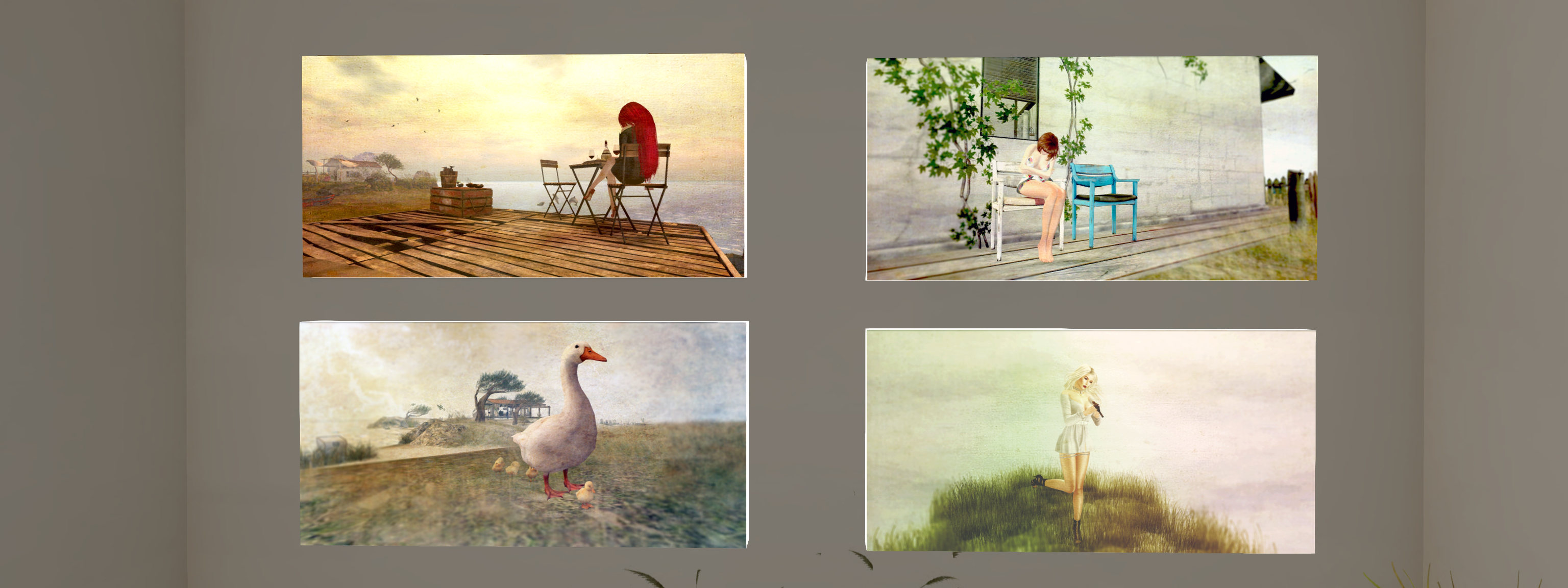
Now open at the Hoot Suite Gallery, the boutique gallery in Bellisseria curated by Owl Dragonash, is an exhibition that reminds us that while getting out and about to enjoy the beauty of summer may not be easy because of a certain pandemic, better times will return for all of us to have the freedom to visit our favourite corner of a beach or wander through grassy meadows.

Painting the Summer is a charming exhibition of gently post-processed images by Mareea Farrasco that carries us away to that summer beach and those summer grasslands, and to coastal walks and more. views out over rolling surf to sail boats lying off the coast and geese waddling over course grass. Often framing her avatar in relaxed poses.

Hoot Suite Gallery: Mareea Farrasco

These are elegant images in their presentation and in the lightness of touch with post-processing tools, while Owl’s Hoot Suite offers the perfect cosy venue for their presentation. The exhibition will run through until August 23rd, 2020.

SLurl Details

Firestorm 6.4.5 Beta: EEP and Camera Presets

On Tuesday, July 28th, 2020, Firestorm released a beta version of their viewer – 6.4.5.60799 – that provides support for the Lab’s Environment Enhancement Project (EEP), and which includes a number of other Lab-specific updates to the viewer, such as the Camera Presets capability.

There are a number of points of note to make about this viewer, which may influence people’s choice on whether or not to try / adopt it:

Table of Contents

  • While it contains the EEP updates, the following should be kept in mind:
    • There are a number of known issues with EEP, several of which currently have fixes contained within the Lab’s Love Me Render RC viewer (version 6.4.5.544028, dated June 30th, at the time of writing), and which is being prepared to be promoted to de facto release, possibly in the next 2-3 weeks.
    • There is a known performance hit related to EEP, for which an interim (and unsatisfactory) fix can be to disable Linden Water rendering (CTRL-ALT-SHIFT-7), even if Linden Water is occluding in your view. The underpinning causes of this issue are still being investigated.
  • Given its beta nature, this version of the viewer has not passed Firestorm’s QA cycle, nor are there formal release notes, although general notes on this version can be found here.

Because of the above, the following is not a full overview of the release; I will provide one once this version of the viewer reaches a formal release status. Instead, this article is designed to provide a general overview of the core visible changes in Firestorm 6.4.5: those of the EEP integration and particularly how it has been integrated with Firestorm’s Phototools floater, and those of the Camera Presets, which differ slightly to their implementation in the official viewer.

Installation

As this is a beta release:

  • There is no need to do a clean install.
  • By default, it will be installed into a different folder to the release version of Firestorm you have installed.
  • If you encounter issues with Firestorm 6.4.5, it is important you preserve your log files before starting any session using the release version of the viewer, and make sure you zip and attach them to any Jira you file.

Linden Lab Derived Updates Overview

Firestorm 6.4.5 incorporates updates from the following Linden Lab viewer releases:

  • Second Life Release Viewer version 6.4.4.543157, the Chrome Embedded Framework (CEF) Update 2020 – provides better support for media playback options win the viewer, including the ability to live stream into Second Life.
  • Second Life Release Viewer version 6.4.3.542964, the FMOD Studio viewer, dated May 29th, 2020 – updates the viewer audio playback support to use FMOD Studio.
  • Second Life Release Viewer version 6.4.2.541639, the Camera Presets viewer, dated May 11th, 2020 – see Camera Presets, below, for more.
  • Second Life Release Viewer version 6.4.1.540593, the Zirbenz Maintanence viewer, dated April 27th, 2020.
  • Second Life Release Viewer version 6.4.0.540188, the Environment Enhancement Project (EEP) viewer, dated April 17th, 2020 – see below for more.

Camera Presets

Camera Presets provides the ability for users to create one more more custom camera presets to define where and how the viewer camera is placed relative to your avatar, More than one set of presets can be created and saved, so that you can, for example have a camera position for general exploring, another suitable for combat games, another for building, etc., all of which can easily be accessed and used at any time via the Camera Presets drop-down.

Firestorm’s Camera Presets Options – note that depending on the viewer skin you are using, the Camera floater (middle left, above) many have a slightly different layout to that shown

For a general introduction to Camera Presets, please refer to: Tutorial: Viewer Camera Presets. However, when doing so, please note that:

  • The Firestorm Camera Floater is laid out differently to the official viewer, being more compact, as show in the image below.
  • If you wish to manually set a camera position using the camera controls (orbit / tilt and slide left/right / up/down), you must open the Camera Position floater via the Position… button,  and then save adjustments from that floater, as adjustments cannot be saved directly from the Camera floater, as is the case with the official viewer.

Environment Enhancement Project (EEP)

There’s unlikely to be many people who have not heard of the environment Enhancement Project (EEP). But in short:

  • Replaces the use of Windlight .XML files to control the water and sky environments seen in Second Life.
  • Environment settings are saved within environment assets that you can keep in your inventory and / or share with others.
  • Environments can be applied to a region or to a parcel (subject to region permissions) and / or to your avatar (thus allowing those travelling in vehicles to maintain a consistent environment across multiple region crossings).
  • Allows up to four different, independently controlled sky layers.
  • Allows the Sun, Moon and Cloud textures to be replaced with custom textures uploaded to the viewer.
  • Provides an extended day cycle of up to 168 hours, thus allowing a 7-day, 24-hour day / night cycle to be defined, for example.
  • Provides a Personal Lighting floater that allows you to make viewer-side adjustments to the local environment for the purposes of photography.
  • Provides new LSL functions to allow scripts to interact with parcel environments and that can be used with experiences.

EEP Resources

EEP is a large and complex overhaul of environment settings for Second Life, and there are numerous resources available for it. As the Firestorm implementation is more-or-less as per the official viewer, I offer the following links to resources:

EEP and Phototools

One of the popular elements within Firestorm is the Phototools floater. The Windlight (WL) tab, opened by default when accessing Phototools, has been revised for EEP, as shown in the image below.

The pre-EEP Phototools WL tab (l) and the EEP version (r). (1) The Drop-downs now select Day, Sky and Water settings from the Library → Environments folder; (2) Personal Settings button – opens the Personal Settings floater, allowing you to adjust the environment as seen in your viewer. This button essential replaces the Edit Sky Preset and Edit Water Preset buttons in the “old” Phototools WL tab; (3) cancels any changes made through the Personal Settings floater; (4) Pause Clouds – does what it says on the label; (5) Shared Environment – causes the viewer to use the local parcel / region environment.

Additional EEP Notes

  • There are around 200+ EEP environment settings to be found in the Library → Environments folder. These have been provided to Linden Lab by Whirly Fizzle of the Firestorm team.
  • As noted in the image above, these can be accessed via the WL tab in Phototools and via the drop-downs in Quick Prefs.
  • If you want to edit these any of the environment settings in the Environments folder, you must first copy them to a folder in your inventory (e.g. your Settings folder, or a sub-folder within it).
  • As per my tutorial, you can import the windlight settings you have on your local drive and convert them to EEP settings – see Importing Windlight Settings as EEP Assets.

For OpenSim

For OpenSim users, there are 3 key points:

  • The viewer incorporates Windlight ↔ EEP interoperability, allowing EEP viewer users to visit legacy Windlight regions.
  • The viewer supports the new OpenSim 0.9.2 with EEP, code-named “Ugly Sky.”
  • There is now a fast-entry grid feature on the login screen; simply enter a URI to add a new grid.

In addition, the last Firestorm OpenSim Release had a bug that caused crashes when rezzing items. This bug was responsible for 70% of all reported FS OpenSim crashes on the 6.3.9 version, and it has been fixed.

General Observations

Given Firestorm 6.4.5.60799 is a beta release and not a fully polished formal release, it may not be suitable for all users at this point in time – and this should be kept in mind when considering it. Should you decide to do so, again please remember:

  • Firestorm 6.4.5 can be installed alongside any current release of Firestorm, so you can swap between them.
  • Firestorm 6.4.5 has not been fully QA’d, so if you do encounter reproducible issues, please ensure you raise a bug report on the Firestorm JIRA.
  • With respect to EEP in particular:
    • Please take time to read the known issues in the beta release notes and, for EEP, those on the EEP viewer release notes from Linden Lab).
    • There are a number of EEP fixes forthcoming in the Love Me Render viewer (e.g:  fixes for EEP specularity issue – BUG-228781 and BUG-228581, and for BUG-225784 “BUG-225446 regression – HUDs are again affected by environment setting”). It may also include additional fixes.
    • Linden Lab is still working on issues such as BUG-229079 “[EEP] Density multiplier does not allow full range of settings to be saved/loaded” and BUG-229031 “[EEP] Water has a large performance hit on EEP”.
  • There are known performance (FPS) issues with EEP / this version of Firestorm.
  • This version of Firestorm will likely go through a number of iterations prior to reaching formal release status.

Related Links