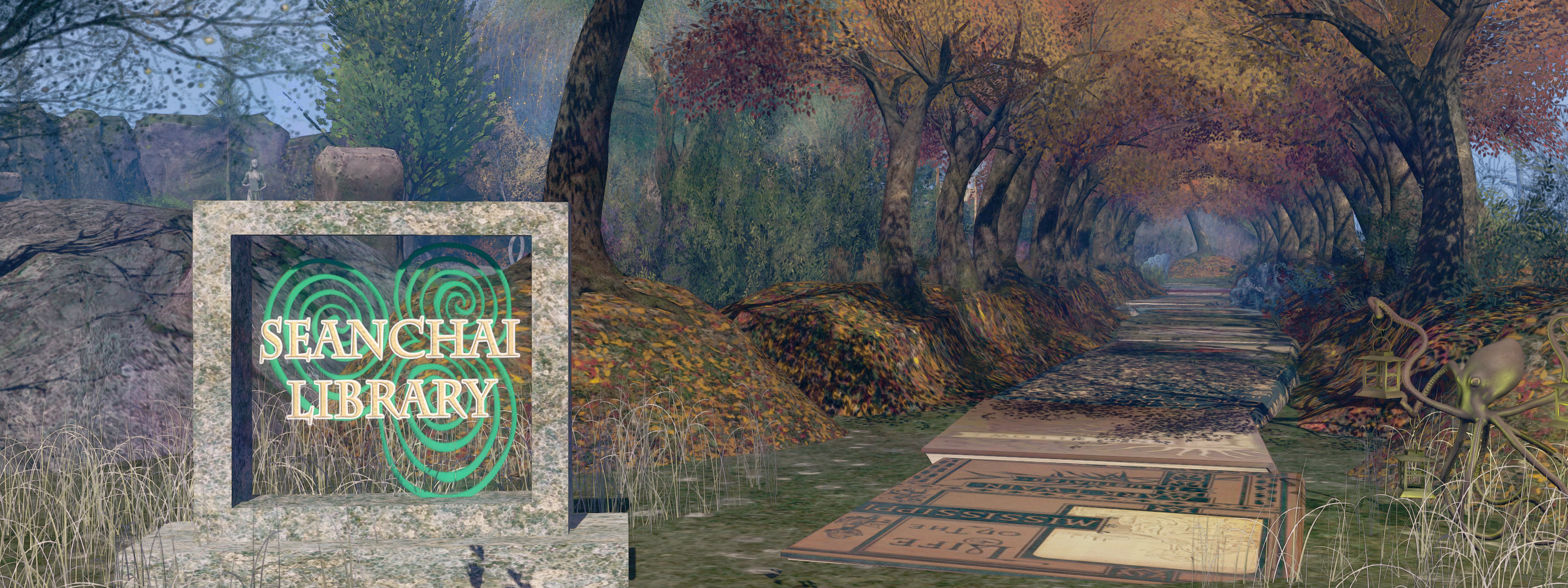
It’s time to highlight another week of storytelling in Voice by the staff and volunteers at the Seanchai Library. As always, all times SLT, and events are held at the Library’s home in Nowhereville, unless otherwise indicated. Note that the schedule below may be subject to change during the week, please refer to the Seanchai Library website for the latest information through the week.
Monday, January 11th, 19:00: The Dark Bright Water
Gyro Muggins reads Patricia Wrightson’s second novel charting the life of Wirrun of the Inlanders.
First encountered in The Ice Is Coming, when Wirrun set out on a quest to overcome the rise of the ancient enemy of Australia, the ice-bearded Ninya, the young janitor now has a reputation as a Hero among the Inlanders (Wrightson’s fantasy view of the Australian Aboriginals). It’s not a title he appreciates; he would much rather just get back to his janitorial work.
But the spirits of the land are restless: Yunggamurra, a river spirit is lost, so uses her siren-like powers of song to draw to herself those who might might take her home. Her singing come to Wirrun’s ears, and those of an elderly aboriginal emissary, and he realises he must journey to the very heartlands of Australia to better understand what he is feeling.
This he does, with the old emissary and his friend Ularra. Once there, he discovers that a storm is indeed rising within the domain of the spirits, and he is uniquely placed to both find Yunggamurra and prevent the coming storm. And so his new adventure begins.
19:00: Written in History: Letters that Changed the World
WRITTEN IN HISTORY celebrates the great letters of world history, creative culture and personal life. Acclaimed historian Simon Sebag Montefiore selects over one hundred letters from ancient times to the twenty-first century: some are noble and inspiring, some despicable and unsettling; some are exquisite works of literature, others brutal, coarse and frankly outrageous; many are erotic, others heartbreaking.
The writers vary from Elizabeth I, Rameses the Great and Leonard Cohen to Emmeline Pankhurst, Mandela, Stalin, Michelangelo, Suleiman the Magnificent and unknown people in extraordinary circumstances – from love letters to calls for liberation, declarations of war to reflections on death. In the colourful, accessible style of a master storyteller, Montefiore shows why these letters are essential reading: how they enlighten our past, enrich the way we live now – and illuminate tomorrow.
Join Caledonia Skytower as she reads selections from this remarkable book.
Wednesday, January 13th 19:00: In Walt We Trust
More from Craig Johnson’s Sheriff Longmire Series with Kayden Oconnell.
Thursday, January 14th
19:00: Monsters and Myths
The Pig’s Ploughman – Part 2, Shandon Loring presents another mythic adventure from the works of Bernard Evslin. Also in Kitely! Find teleport from the main Seanchai World grid.kitely.com:8002:SEANCHAI.
21:00: Seanchai Late Night
Finn Zeddmore presents contemporary sci-fi-fantasy from such on-line sources as Escape Pod, Light Speed, and Clarkesworld magazines.
Logos representative only and should not be seen as an endorsement / preference / recommendation
Updates for the week ending Sunday, January 10th
This summary is generally published every Monday, and is a list of SL viewer / client releases (official and TPV) made during the previous week. When reading it, please note:
It is based on my Current Viewer Releases Page, a list of all Second Life viewers and clients that are in popular use (and of which I am aware), and which are recognised as adhering to the TPV Policy. This page includes comprehensive links to download pages, blog notes, release notes, etc., as well as links to any / all reviews of specific viewers / clients made within this blog.
By its nature, this summary presented here will always be in arrears, please refer to the Current Viewer Release Page for more up-to-date information.
Note that for purposes of length, TPV test viewers, preview / beta viewers / nightly builds are generally not recorded in these summaries.
Official LL Viewers
Current release viewer version 6.4.11.551711, formerly Cachaça Maintenance RC viewer promoted on November 12th – No Change.
Release channel cohorts:
Project Jelly viewer (Jellydoll updates), updated to version 6.4.12.553798 on January 7th, 2021.
Custom Key Mappings project viewer, updated to version 6.4.12.553437, on January 7, 2021..
Project viewers:
Love Me Render (LMR) 5 project viewer, version 6.4.12.553511, issued on January 7th, 2021.
A stunning image of Starship SN9 standing on the Boca Chica launch platform framed by a low Sun. Credit: Mary “BocaChicaGal”
In December 2020, and following the not-quite-successful flight of Starship prototype SN8, SpaceX suffered what might have been a further setback in their flight test plans for the Starship vehicle, when prototype SN9 toppled sideways whilst in the stacking facility at the company’s Boca Chica, Texas, construction and flight test centre (see: Space Sunday: the flight of SN8 and a round-up).
However, the vehicle was quickly righted and following examination, work commenced on repairing / replacing the damaged elements (notably one of the forward aerodynamic surfaces). This work proceeded at a surprising pace; so much so that on December 22nd, 2020, it was delivered to he Starship launch platform.
Since then work has continued at the same rapid pace, such that within the two weeks since its arrival on the stand, SN9 has completed the majority of its pre-flight checks that took around 2 months to complete for SN8. These included initial fuel tank pressurisation tests using inert liquid nitrogen (to test the tanks and structure for leaks), partial and fuel test fuelling operations, vent system tests, testing of the reaction Control system (RCS) thrusters that help maintain the vehicle’s orientation in the atmosphere and will provide manoeuvring capabilities in space, and even a full static fire test of the vehicle’s three Raptor engines, which took place on January 6th.
SN9 static fire engine test. Credit: Mary “BocaChicaGal”
Two tests were skipped in the process – but this is seen as not so much because the company is trying to make up for any “lost time”, but rather the result of growing confidence in the process of taking a prototype vehicle from fabrication to test flight. However, while the engine firing was successful, it was somewhat shorter than those for SN8 – the Raptors fired for less than 2 seconds – so it is not clear whether or not an issue was encountered, forcing a premature shut-down. If this is the case, then it might be that further static fire tests may be announced ahead of any flight; if the brief firing was intentional, then it is possible a flight test could come within the next week or so.
As it is, the exact date of any actual flight test for SN9 – which will seek to repeat the 12.5 km altitude reached by SN8, but hopefully follow it with a successful landing – hasn’t been confirmed. However, to avoid a repeat of the SN8 crash, SpaceX CEO Elon Musk confirmed that the Methane header tank – a smaller tank designed to feed fuel to the Raptor motors during the landing sequence – for SN9 and at least some of the prototypes that follow it will be “pressed” with helium (this is, helium will be forced into the tank in order to force the methane out and to the engines) in order to avoid any pressurisation issues. However, it is not clear if this will be the permanent solution to the problem, or an interim update to allow test flights to continue whilst SpaceX develop a more permanent solution to the problem.
A diagram showing Starship and Super Heavy prototype development. On the left, SN9 is complete, and awaiting its flight. SN10 is awaiting Raptor motor installation and the attachment of its aft flaps, and SN11 has yet to have its upper sections installed and is awaiting its tail flaps and motors. All of the major hull elements of SN12 have been fabricated but have yet to be assembled. The diagram also show the assembly of SN15, which is will in advance of SN13 and SN14, while to the right is the status (as of January 9th) of the first Super Heavy prototype. Credit Brendan Lewis
At the same time as pre-flight tests have been continuing with Starship SN9, work has been continuing with a number of further prototypes. SN10 very close to completion, with just engines and aft aerodynamic flaps to be mounted, and SN11 will be receiving its upper sections in the coming week. Further down the chain, SN15 is also progressing, as is SN16. These will likely be the first two prototypes fully fitted with the thermal protection system used to safeguard the vehicle’s hull during atmospheric entry. This doesn’t necessarily mean either will make an orbital flight – SpaceX will doubtless want to text how the entire thermal system holds up under atmospheric flight prior to committing to an orbital attempt.
However, work currently appears to be on hold for vehicles SN13 and SN14, and SN12 has yet to be stacked. Whether these vehicles will be completed remains to be seen: Musk has previously indicated that the SN15 vehicle and beyond will include “significant upgrades” compared to earlier vehicles, so it is possible SpaceX may opt to skip from SN11 to SN15 in the flight test programme.
An image demonstrating the relative size of SpaceX vehicles and the shuttle. Left: the Crew Dragon – capable of flying up to 7 into LEO; right: a starship vehicle with a shuttle orbiter alongside. The orbiter could carry up to 7 into LEO with up to 28 tonnes of cargo. Starship can carry up to 100 people + cargo or up to 100 tonnes (cargo variant) to LEO. A Tesla 4×4 and human are included for scale. Credit: Dale Rutherford
Puerto Rico Governor Supports Rebuilding Arecibo
The outgoing governor of Puerto Rico, Wanda Vázquez Garced, signed an executive order on December 28th, 2020 backing the rebuilding of the 305-m diameter Arecibo radio telescope that collapsed in November 2020 (see: Space Sunday: returns and a collapse).
The order states that US $8 million is to be “assigned and allocated” for removing the debris of the collapsed telescope and “remedial environmental” work be completed at the site. It further states that the Puerto Rico government wishes to see the development of a telescope with a larger effective aperture, wider field of view and a more powerful radar transmitter to replace the original, thus providing the nucleus of “a world class science and education facility”.
Arecibo as it was: visible is the main dish with the central receiving platform suspended over it via the three towers. Credit: NASA
However, things are not as clear cut as this. For one thing, the construction of a new telescope is liable to cost more than ten times the funding stated in the order. It’s also not clear where the $8 million will come from; the order only suggests it could be provided through “state, federal and private sources (including public-private partnerships and state-federal partnerships)”.
More particularly, Arecibo is not under the funding auspices of the Puerto Rican government, but rather that of the National Science Foundation (NSF), which it turn is funded directly by the US government. Thus far, the NSF has not committed to any rebuilding / replacement at the site, nor have any funds been allocated by Congress in the 2021 federal budget – although the NSF has been directed to prepare a study / report on the telescope’s collapse, the clean-up operation and to determine whether a replacement / comparable facility should be established at the sit, together with the associated costs for doing so.
After the fall: the telescope after the collapse of the receiving platform (the wreckage of which can be see to the right of the disk. Also clearly visible is the scar where the collapsing platform and cables tore through the disk. Credit: NASA
NSF has a very well-defined process for funding and constructing large-scale infrastructure, including telescopes. It’s a multi-year process that involves congressional appropriations and the assessment and needs of the scientific community. So, it’s very early for us to comment on the replacement.
– Ralph Gaume, director of NSF’s Division of Astronomical Sciences
Hermes Kondor is a photographer and artist I’ve come to greatly admire since first witnessing his work in 2020. Whether presenting his photography from the physical world or his digital art, Hermes has a remarkable range of artistic expression that always engages the eye and the brain. Given this, his Kondor Art Centre with its multiple art spaces, always makes for a worthwhile visit – as I noted in The art of Hermes Kondor in Second Life.
On January 7th, 2021, Hermes opened his latest exhibition, providing an excellent reason to both appreciate his artistic vision and to explore his art centre. Entitled SL Behind the Scenes, he presents a portfolio of art made within Second Life, but with a truly unique perspective, originating as they do with images taken while running the viewer in Wireframe mode.
Hermes Kondor: SL Behind the Scenes
For those unfamiliar with Wireframe – or wire-frame model, it is the the visual representation of a three-dimensional (3D) physical object used in 3D computer graphics. As such it is common in all virtual environments, be they games, animations using computer graphics, environments such as Second Life, and so on. In the case of SL, the underpinning wireframe model can be revealed via the Developer menu (under the rendering sub-menu) or by pressing SHIFT-CTRL-R (use the same option / shortcut to turn wireframe off again).
The mode has a number of uses in SL (particularly where content creation is concerned). However, I’m not going to delve into them in what is an arts review. Suffice it to say that if you’ve not witnessed the wireframe view of SL before, it can be both confusing and intriguing – and for Hermes, it offered a new way to present images of the places and events he’s recently visited.
Hermes Kondor: SL Behind the Scenes
The result is a fascinating collection of compositions that, whilst originally captured in wireframe mode, have been richly post-processed and composited (possibly with “natural” images of the same scenes, although I’m by no means sure of this) to focus on specific elements within the captured scene to present us with views of Second Life that are genuinely unique and contain a marvellous sense of narrative.
Some 22 images are presented across the two floors of the gallery, each one using solid colour to draw the eye into their detail and frame its story, whilst careful elimination of aspects of the wireframe helps to add further depth and provides a quite enticing sense of life and / or motion to many of them.
Hermes Kondor: SL Behind the Scenes
Visually stunning, SL Behind the Scenes takes us into Second Life in a most individual manner That genuinely sets this exhibition of places and art in Second Life well apart from others, offering as it does – as Hermes notes – an opportunity to draw back the curtain and see into “the Matrix” of Second Life.
Highly recommended – and don’t forget to use the teleport disk outside of the gallery to visit the rest of the facilities at the centre.
The following notes are taken from the TPV Developer meeting held on Friday, January 8th, 2021. Unfortunately, other commitments prevented me from attending the meeting, so I am solely reliant on Pantera’s video. However, for some reason, the region hosting the meeting was re-started mid-session (possibly the result of a rolling restart), and on resuming, Pantera suffered a recording glitch that meant the second half of the meeting did not get captured.
While I have the chat transcript of the full meeting (my thanks again to Pantera), given that the majority of commentary is via Voice, replies to questions and comments are unavailable, so this summary only covers the period of the meeting that was recorded successfully.
The Jellydolls viewer (updates to avatar appearance based on rendering costs) was promoted to Release Candidate status with the issuing of version 6.4.12.553798.
The Custom Key Mappings RC viewer updated to version 6.4.12.553437.
A new Love Me Render (LMR 5) viewer, version 6.4.12.553511, was released as a project viewer.
The rest of the current official viewer pipelines remain as follows:
Current release viewer version 6.4.11.551711, formerly Cachaça Maintenance RC viewer promoted on November 12 – No Change.
Release channel cohorts:
Dawa Maintenance RC Viewer, version 6.4.12.553053, released December 3rd.
Project viewers:
Simple Cache project viewer, version 6.4.11.551403, issued on November 12.
Legacy Profiles viewer, version 6.4.11.550519, October 26.
Copy / Paste viewer, version 6.3.5.533365, December 9, 2019.
Project Muscadine (Animesh follow-on) project viewer, version 6.4.0.532999, November 22, 2019.
360 Snapshot project viewer, version 6.2.4.529111, July 16, 2019.
General Viewer Notes
Viewer updates have been delayed both due to the holiday break and as a result of a couple of processes being broken as a result of the cloud migration process. The latter have now been fixed.
Currently, the OS X (Mac) build process for the official viewer is currently “broken” and in the process of being fixed.
The LMR 5 viewer comprises a number of EEP fixes together with fixes for water reflection rendering and for the Mesh uploader preview image. The full list of fixes from the release notes comprises:
SL-12740 [EEP] The EEP moon has a hardcoded blue light that is not present in Windlight-based viewers (Lab internal Jira).
SL-13888 The model is displayed with artefacts in the upload preview floater (Lab internal Jira).
SL-14275 Water Reflection new modes (Lab internal Jira).
BUG-228581 [EEP] Specular map reflections are way too weak.
BUG-228781 [EEP] Specular color interpreted wrong (too bright) from point lights.
BUG-228914 [EEP] Deferred Soften Shader fails to link when Atmospheric Shaders are disabled. This causes Debug viewer builds to crash.
BUG-229122 [EEP] Glow should be directly behind the sun or moon when it is near the horizon.
BUG-229689 [EEP] cloud texture is rendered backwards
The Profiles viewer had been expected to be promoted to RC status, but there appears to be a UI issue that needs to be addressed before this can happen.
It is not clear which of the RC viewers will be the next to be promoted to de facto release status. However, given the amount of testing against the Custom Key Mappings RC viewer, this could be a strong contender.
Following on from the switch away from using UDP messaging for asset handling between the viewer and the Lab’s back-end systems that took place in recent years (assets are all handle by HTTP), the Lab is now looking to make a similar switch away from UDP messaging for all “mission critical” (e.g. messages that need to be handled in a specific order / receive responses in a specific order).
These changes are to be made over time and on a “case by case” basis.
Exactly how this is to be done has not been entirely worked through; it may be that some changes can be made without impacting TPV developers with a lot of additional work on their side of things.
Part of this work will involve moving some of the message handling for chat to TCP as well.
This work will take time to complete; however, once it is finished and once the replacement messaging protocols have been a part of the official release viewer for around 12 months, the Lab will seek to removing UDP message handling from both the viewer and the back-end code where it is no longer required.
The reason for doing this is because UDP is not a reliable messaging format when information is required in a specific order, and can be at the heart of assorted issues users can experience. Ergo, the aim is to make things a lot more predictable and robust.
In Brief
[4:02-5:06] There are a number of services still being adjusted post-uplift, these include:
World Map tile generation.
Land Store.
Some noticeable performance glitches.
These adjustments likely mean there were be a slightly higher cadence of server-side changes, but the focus is on trying to fix things and get back to the usual Tuesday / Wednesday simulator deployments within the next week or two.
[5:08-5:53] There is a further update to help with Group Chat issues that will hopefully be deployed in week #2 (commencing Monday, January 11th).
This is not seen as a “total fix” for issues, but part of the continuing work to improve things.
The focus is to “sharply limit” the amount of group chat traffic generated by people logging into or out of Second Life. This means that the member lists for very large groups may not report everyone in the group who is on-line, but will report all those actively using the group chat function as being on-line.
[5:55-10:17]There is to be a “real push” to make improvements to the Second Life Voice service. This will likely be based around a new Voice SDK supplied by Vivox.
As a part of this work, the Lab is gathering data on users who are still running on very old viewer versions / old version of the SLplugin.EXE for voice, as part of this work will likely result in some of the oldest, low-quality codecs used by the Voice API being disabled in the Voice package from Vivox at some point in the future – which may “break” Voice for those still using those really old versions.
The reason for disabling these old codecs is because they are of much lower quality output, and if just one person in a group voice chat is using a Voice package reliant on them, everyone in the same group chat is downgraded to the old codec, impacting the Voice quality right across the session.
This work will also focus on trying to correct / eliminate the “little” voice drop-outs that can occur (so those listening don’t hear every single word the speaker says).
[13:55-16:25] Another change with the viewer is the on-going removal of code that is not longer being actively used. A further example of this is that there are two protocols used for handling requests for logging-in to SL. One of these (XML-RPC) is almost never used nowadays, so this code may well be removed – with warning beforehand – in the future.
The acquisition, sees three new board members replacing Jed Smith, Bill Gurley, Dina L. Evan and Bing Gordon. Two of them have been previously mentioned: Brad Oberwager and J. Randall (Randy) Waterfield (you can read my own notes on these two gentleman here: Linden Lab announces it is to be acquired). However, what may come as news is that there is a third member of the Lab’s new board: Raj Date.
The following are the biographies for all three as found on the Lab’s About web page:
Brad Oberwager
Brad Oberwager has spent his entire career in technology and consumer focused companies as an entrepreneur and board member.
Currently, he sits on the board of two public companies, Asure Software (NASDAQ: ASUR) and Better World (NASDAQ: BWACU). He is the chairman of two companies he founded, Jyve and Sundia and is also on the board of TEGSCO (aka AutoReturn). He owned Bare Snacks, acquired by PepsiCo in 2018.
Brad was Vice-chair of YPO International, a global organization of 25,000 CEOs.
Brad received his BS from Georgetown University, his MBA from the Wharton School and lives in San Francisco.
J. Randall (Randy) Waterfield
Mr. J. Randall (Randy) Waterfield, is the Chairman of Waterfield Holdings, which traces its origins to 1928. After selling the largest private mortgage company in the US and largest Indiana based bank in 2006 and 2007 respectively, he diversified into technology, manufacturing and other industries.
Randy holds the Chartered Financial Analyst designation and is a graduate of Harvard University. He currently serves on the Board of Directors of Red Oak Partners, Waterfield Technologies, Linden Research, Inc. and has previously served on the boards of YPO (and was the 2017-2018 Chairman of YPO), Asure Software ( NASDAQ: ASUR), SMTC Corporation (NASDAQ: SMTX), RF Industries (NASDAQ: RFIL), among others. He is also the Co-Chairman of Missouri Cobalt, LLC, the largest cobalt mine in North America.
Randy supports various education, environmental and community development charitable causes through the nonprofit Waterfield Foundation and J. Randall Waterfield Foundation.
Raj Date
Raj Date was the first-ever Deputy Director of the U.S. Consumer Financial Protection Bureau (CFPB). As the Bureau’s second-ranking official, he helped steward the CFPB’s strategy, its operations, and its policy agenda. He also served on the senior staff committee of the Financial Stability Oversight Council, and as a statutory deputy to the FDIC Board.
Before being appointed Deputy Director, Raj acted as the interim leader of the new agency, serving as the Special Advisor to the Secretary of the Treasury. He led the CFPB for most of the first six months after its launch.
Currently, Raj is the Managing Partner of Fenway Summer, an advisory and investment firm focused on financial services and financial technology. In that capacity, he chairs the investment committee of Fenway Summer Ventures, a fintech venture capital fund, and works with clients of FS Vector, the fintech advisory firm. He also serves as a Director for a number of innovative firms in financial services: Prosper, the marketplace lender; Green Dot, the bank holding company; Circle, the digital asset firm; Grasshopper, a de novo bank; and College Ave, a private student lender.
He is a graduate of the College of Engineering at the University of California at Berkeley (highest honors) and the Harvard Law School (magna cum laude).
Without wishing to take anything away from Mr. Oberwager and Mr. Waterfield, Raj Date’s credentials are especially impressive for a relatively small company like Linden Research; having joined the CFPB in February 2011, on what he thought would be a 2-3 month tenure, he was asked by Elizabeth Warren, who oversaw the establishment of the CFPB as a Special Advisor to the Secretary of the Treasury, to lead “the guts of the policy apparatus” within the Bureau. When Warren sought to (successfully) run for the U.S. Senate later in 2011, Date was nominated to succeed her as the CFPB’s Special Advisor to Treasury, and (as the Lab notes), its first Deputy Director, under Richard Cordray.
His background with consumer affairs, finances, and his post-CFPB founding of Fenway Summer would appear to help lend significant weight to Linden Lab’s wholly-owned subsidiary, Tilia inc; while he is not currently listed as a member of Tilia’s board, his background and expertise could be used in an advisory capability, and his name certainly brings a further level of gravitas to Tilia.
Thus far, the acquisition and arrival of the new board has been handled in a relatively low-key manner. While some might be tempted to see the negative in this, it’s likely more a case of the Lab wishing to demonstrate that, from their perspective and that of the incoming board, things are very much “business as usual” rather than being indicative of any kind of radical change.
 Gyro Muggins reads Patricia Wrightson’s second novel charting the life of Wirrun of the Inlanders.
 WRITTEN IN HISTORY celebrates the great letters of world history, creative culture and personal life. Acclaimed historian Simon Sebag Montefiore selects over one hundred letters from ancient times to the twenty-first century: some are noble and inspiring, some despicable and unsettling; some are exquisite works of literature, others brutal, coarse and frankly outrageous; many are erotic, others heartbreaking.


 Inara Pey: Living in a Modemworld