Space Sunday: JWST and more 2022 highlights

JWST art. Credit stsci.edu

The James Webb Space Telescope (JWST) has completed deploying all of its major components whilst en route to its operational orbital position at the Earth-Sun Lagrange L2 position.

At the time of my last update, NASA was expected to start work on tensioning-out the layers of the observatory’s layered sunshield. However, this was delayed in preference of working on JWST’s power subsystem. The decision came as a result of telemetry showing the observatory’s solar arrays were not producing their anticipated output due to them operating at their factory defaults. After re-balancing them, engineers took the opportunity to gather a baseline of power requirements for future reference, and to ensure the motors that are key to the sunshield tensioning process were at their optimal temperatures prior to starting the tensioning operation.

The work on the power subsystem meant that tensioning operations did not start until January 3rd. This comprised each of the hair-thin layers of the sunshield being gently tensioned out and separated from the other layers to allow it to function most efficiently in absorbing / reflecting heat and sunlight. By the end of the 3rd, three of the five layers had been correctly tensioned, putting the operation well ahead of schedule, allowing the operation to be completed with the tensioning of the last two layers on Tuesday, January 4th.

This left the way clear for the deployment of the observatory’s secondary mirror system. Commencing on January 5th,  this involved unfolding a series of booms called the Secondary Mirror Support Structure (SMSS) to extend the secondary mirror assembly out in front of the primary mirror, allowing it to gather and focus the light from the primary back through an aperture at the centre of the primary, where a third mirror reflects it down into the observatory’s interior and to its instruments.
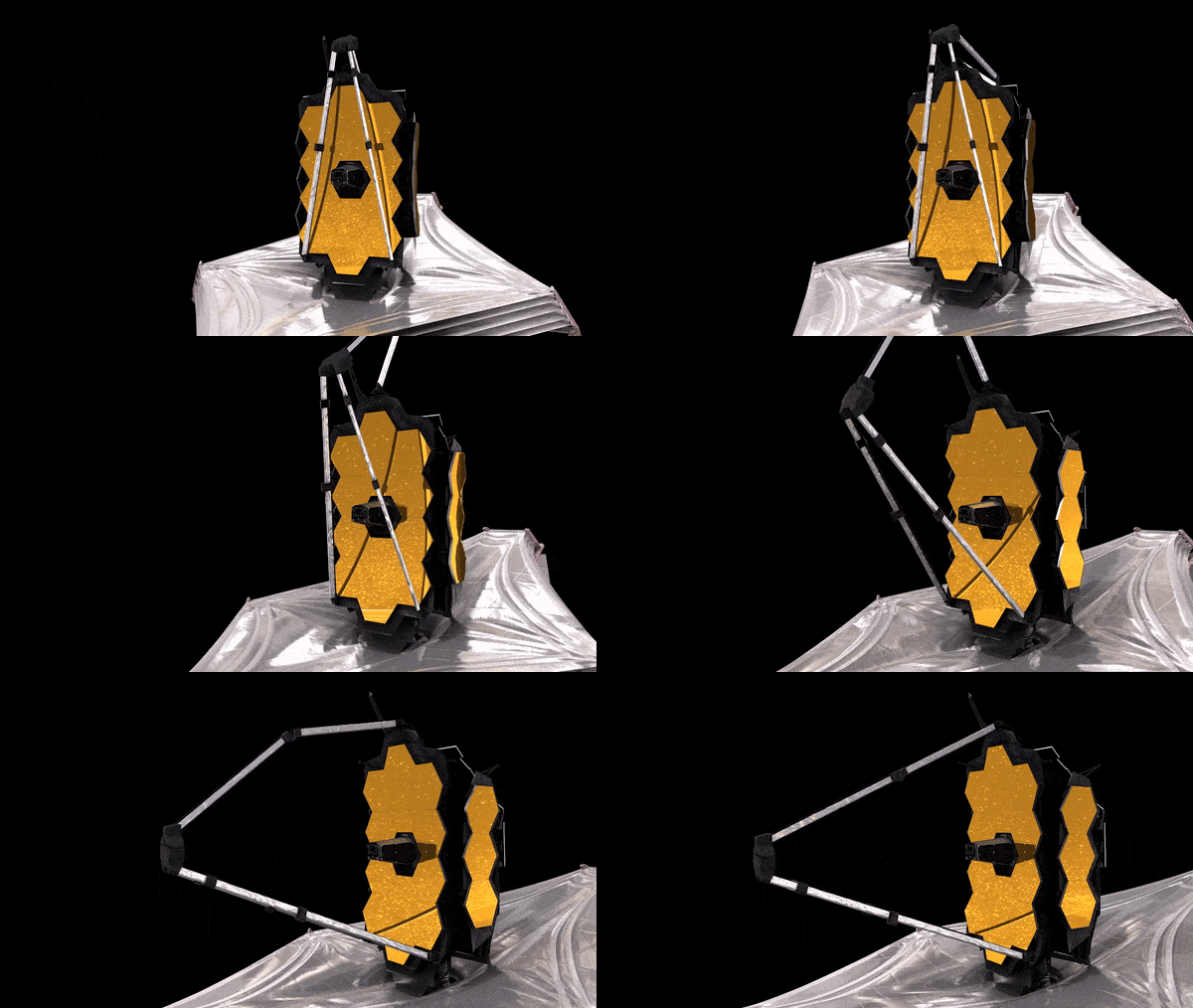
JWST secondary mirror deployment. Credit: NASA

On January 6th JWST deployed the radiator systems that serve to remove excess heat from the observatory. Stowed flat against the rear of the main mirror assembly, the radiator panels were successfully extended out and away from the body of the observatory, freeing the mechanisms required to unfold the two “wings” of the primary mirror.

At 6.5 metres in diameter, and comprising 18 hexagonal gold-covered segments JWST’s primary mirror is too big to fit in the payload fairings of any operational launch vehicle, thus the use of the two “wings” to the port and starboard sides of the mirror.

Work started on unfolding these on January 7th, commencing with the port wing. The operation commenced at 14:30 GMT, the wing unfolding in five minutes  – although latching it into place took a further two hours. A similar operation was then initiated on January 8th to deploy the mirror’s starboard wing, with telemetry received at 18:17 GMT to confirm it had locked into place in its deployed configuration.
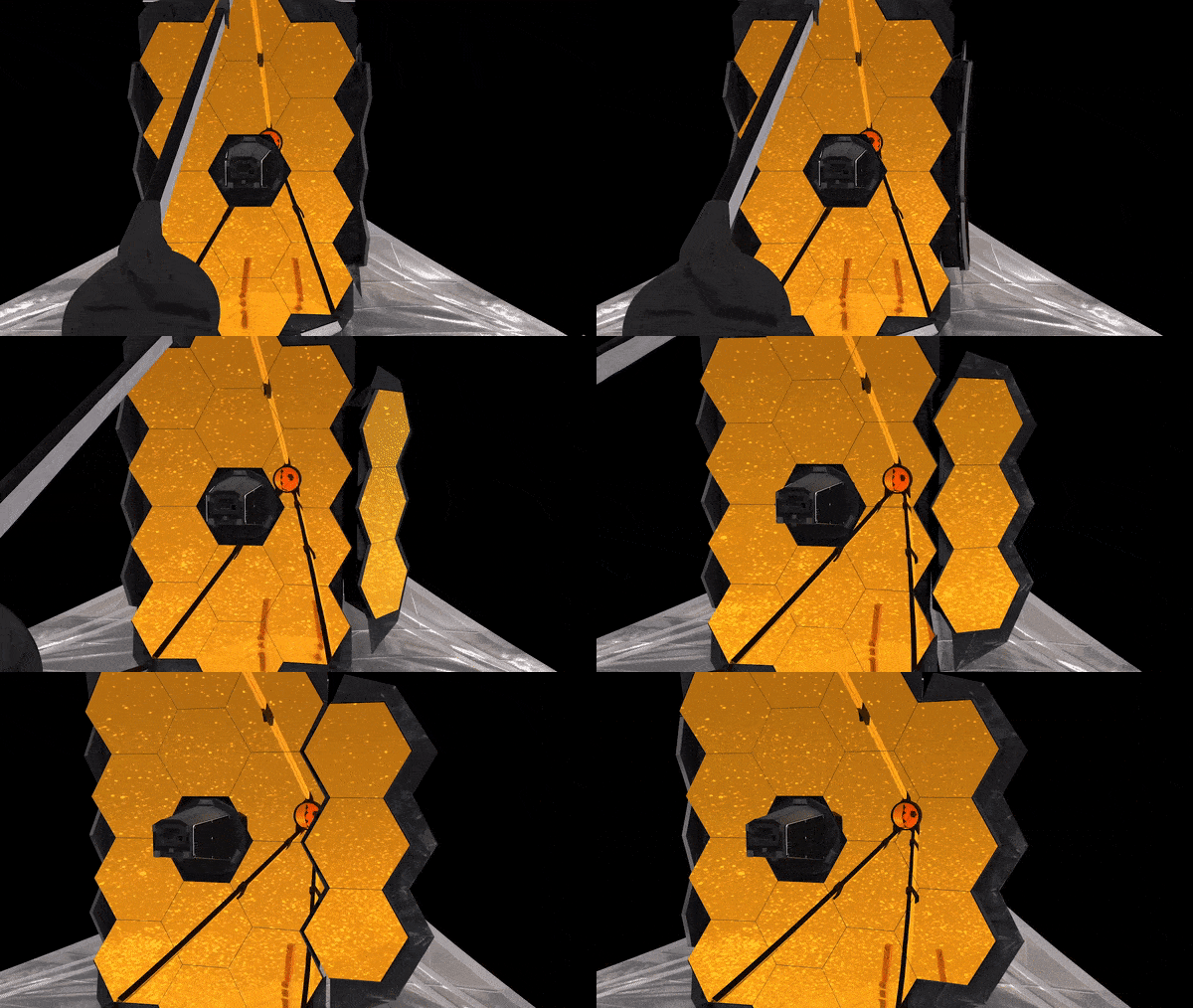
Unfolding one of JWST’s primary mirror segments. Credit: NASA

The successful unfolding and latching of the primary mirror segments marked the end of the deployment phase of the mission, allowing the JWST mission and engineering teams to move onto the commissioning phase of the mission.

In all, this will take some five months to complete; the first part of which involves correctly align the 18 individual mirrors that make up the observatory’s primary mirror so that they all work in concert to gather and reflect light into the secondary mirror. This is a multi-step process, in which each of the 18 segments is gently adjusted by means of 6 actuators located behind it to ensure proper alignment – with the secondary mirror also having actuators that allow minute adjustments to be made to it, assisting the alignment process whilst ensuring the gathered light remains correctly focused on the non-moveable third mirror. It is not an easy process, the work is expected to run the full 120 days of the commissioning period.

2022 Space Highlights II

In the last instalment of Space Sunday, I mentioned some of the forthcoming missions planned for 2022. In addition to those I mentioned then (limited by space), here are some more – all of which I hope to cover in more detail as the year progresses.

  • Axiom missions to ISS: Axiom Space plan to launch two “all private” missions to the International Space Station (ISS) utilising SpaceX Falcon 9 and Crew Dragon. Each mission will last around 8 days and focus on science and educational outreach. The first mission will launch at the end of February 2022, and the second in the autumn.
  • Jupiter Icy moons Explorer (JUICE) mission: ESA’s mission to Jupiter, to primarily study three of its moons – Ganymede, Europa and Callisto – should launch in May 2022. Arriving in Jovian orbit in 2029, it will then create a 3-year study mission.
  • Psyche asteroid mission: set for July 2002 and launched via a Falcon Heavy booster, NASA’s Psyche mission will study a metallic asteroid of the same name that orbits the Sun between Mars and Jupiter. It is believed the asteroid is the exposed nickel-iron core of an early planet. Thus, studies of it may offer new clues about how terrestrial planets like Earth form.
  • India’s Gaganyaan space missions: India plans to complete an uncrewed launch of its new Gaganyaan crew vehicle in summer 2022, with a second test flight before the end of the year.
An artist’s impression of India’s Gaganyaan crew capsule and is service module. Credit: ISRO
  • ExoMars Rover launch: the long-awaited European Mars rover mission will launch between August and October, carrying the Rosalind Franklin rover to Mars. Once there it will join the ExoMars Trace Gas Orbiter (TGO), which arrived at Mars in 2016, to study the red planet.
  • Dream Chaser ISS operations commence: Sierra Nevada Corporation’s Dream Chaser Cargo space plane will commence resupply flights to the ISS, carrying up to 5 tonnes of supplies and equipment to the station and returning around a tonne to Earth. The maiden Dream Chaser launch will mark the second flight of ULA’s new Vulcan rocket.
  • Lunar missions:
    • US Nova-C lunar lander: the Intuitive Machines Nova-C land will launch atop a SpaceX Falcon 9 vehicle early in 2022, carrying five NASA Commercial Lunar Payload Services (CLPS) payloads to the Mare Serenitatis, including a UK-built lunar rover.
    • Russia: the Luna 25 robot mission to the Moon’s South Pole will launch in July, marking the first Russian mission to the Moon in 45 years, and the first to land in the lunar Polar Regions. It will carry nine instruments to research the lunar regolith and exosphere (atmosphere).
Russia’s Luna 25 under construction. Credit: Roscosmos
    • NASA lunar drilling mission: scheduled for launch in December 2022, the Polar Resources Ice Mining Experiment-1 (PRIME-1) is the first-ever mission designed to harvest water ice from inside the moon — a resource NASA hopes to utilize for its Artemis program.

In Brief

Biden White House Commits to ISS Extension

The Biden administration  has formally supported extending operations of the International Space Station through the end of the decade, an announcement that is neither surprising nor addresses how to get all of the station’s partners, notably Russia, to agree on the station’s future.

NASA has wanted to continue operating the ISS through until 2030 for several years, but has lacked outright political support to do so. In 2018, the US Senate agreed to extend US ISS operations through until 2028 or 2030, but the move failed to gain the required two-third House majority in order to pass. Support from the White House may help the agency gain full US support for the mission, and as a result of it, the European Space Agency has further indicated it would seek a resolution among members to continue to fund their side of station activities.

However, the major sticking point for operations lies with Russia. Most of the Russian modules on the station are growing increasingly old and subject to failure, and as such, Roscosmos is reluctant to continue supporting operations beyond 2024. In addition, geopolitics may impact the future of the ISS: Russia has already announced plans to operate its own space station at the expense of continued international cooperation with the ISS.

China Complete Key Station Robot Arm Test

On Thursday, January 6th, a large robotic arm on China’s space station successfully grasped and manoeuvred a cargo spacecraft in a crucial test ahead of upcoming module launches.
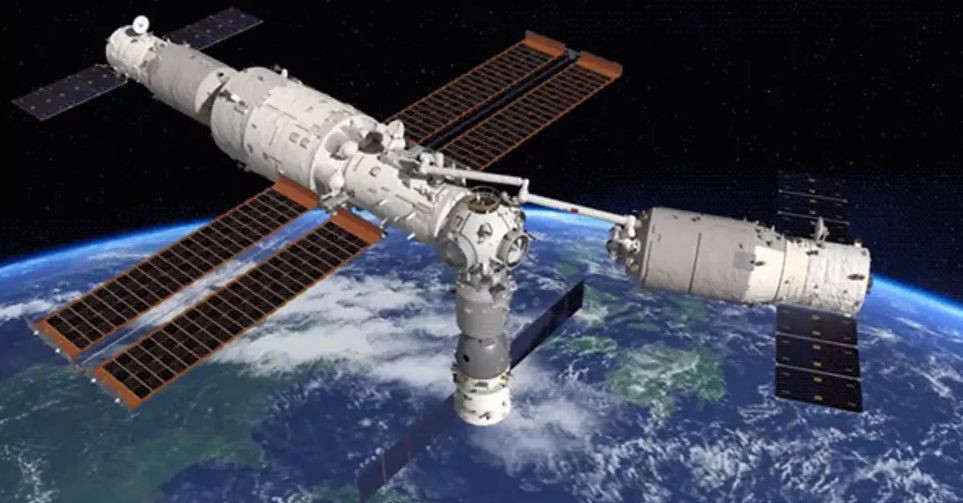
An artist’s impression of the robot arm test on the Chinese space station. Credit CMSAThe 10 metre long robotic arm on the Tianhe-1 module of China’s new Tiangong space station was used to grasp Tianzhou-2 supply vehicle that has been docked with the module since the end of May 2021, and move out away from the station, angling it through 20 degrees before returning it to the Tianhe-1’s forward docking port, where it reattached itself.

The 47-minute operation began at 22:12 UTC, as was designed to test the robot arm’s ability to manipulate and move large modules that will form a part of the station as it progresses. In particular, the test is vital to China’s plans to launch two science modules – called Wentian and Mengtian – to dock with Tianhe-1 in May / June and August / September 2022 respectively, thus completing the Tiangong space station.

Hubble Space Telescope’s One  Billion Seconds

One January 1st, 2022, the Hubble Space Telescope (HST) achieved another milestone in its distinguished career – notching up 1 billion seconds in orbit since its launch on April 24th, 1990. That’s 31.7 years of near-continuous operations in Earth’s orbit.

A joint NASA / ESA project, HST has contributed massively to our understanding of the solar system, our galaxy and the universe as a whole. Despite recent issues with the observatory, it is hoped that HST will continue to operate through the 2020s and well into the 2030s.

Clau Dagger’s Awakening in Second Life

Kondor Art Centre – Into the Future Gallery: Clau Dagger

January 6th 2022 saw the opening of Awakening, an exhibition of art by Clau Dagger, which is being held at the Into The Future Art Gallery, a part of the Kondor Art Centre, operated by Hermes Kondor.

Specialising in avatar studies, Clau is an artist photographer whose work I’ve not previously seen exhibited in-world, but who has – as this exhibition demonstrates – a talent for creating images that not only present her avatar, but offer an entire story within – and beyond – their frame. As someone who always tends to look for a narrative within a picture, this makes her work particularly fascinating to me.

Kondor Art Centre – Into the Future Gallery: Clau Dagger

Comprising over 30 images spread across the three levels of the gallery building, the art within Awakening presents an visually engaging mix of studies that are richly expressive in terms of their colour and presentation, and which offer a range of themes and stories. From “simple” pictures celebrating the seasons, through to those focused on fantasy, horror, science fiction and glamour, with dips into literature and film, this is a collection that will capture the eye and offer a richness of story that extends will beyond the framing of each picture on its own.

While there are many who practice the art of avatar study and in creating single-frame stories with their images; Clau’s work stands apart in the level of detail presented in each piece. From backdrop through props, to angle, framing, focus and pose, everything within each picture is brought together not just the create an image, but to create a world that lives beyond the limits of each image.

Kondor Art Centre – Into the Future Gallery: Clau Dagger

One aspect of this “larger than the frame” story aspect of Clau’s work is her conscious directing of her avatar’s eyes. Rather than looking out of the image towards the camera, Clau frequently directs her avatar’s gaze to a point off-camera, with the rest of her avatar’s pose set to suggest a reaction to something out-of-frame and entirely separate to the camera’s position. This gives these pieces – such as Ritual Night, Holy Gral [sic] and Cabell (as three examples) – a cinematic feel, we are caught in a moment of something wider, that were the camera pan around, we’d see more of the story and the action would resume.

Another factor that brings a number of these pieces to life is their richness of colour. Often with avatar studies, there is a tendency to tone down colour in post-processing an image, to add “natural” haze or “natural” light. While this is true in several of the pieces within this exhibit, there are also pieces here where the colour has either been left untouched or perhaps enhanced (e.g. Supernatural, Under the Holiday Tree, Spring Fae and Metamorphosis) that further intensifies their framing and story.

Kondor Art Centre – Into the Future Gallery: Clau Dagger

All of which makes for an exhibition that is genuinely worth visiting, one that lifts avatar studies to a new dimension of expression.

SLurl Details

Patch Thibaud’s Hanging Gardens in Second Life

Hanging Gardens of Babylon, January 2022 – click any image for full size
In this palace he erected very high walks, supported by stone pillars; and by planting what was called a pensile paradise, and replenishing it with all sorts of trees, he rendered the prospect an exact resemblance of a mountainous country. This he did to gratify his queen, because she had been brought up in Media, and was fond of a mountainous situation.

– Berossus, priest of Bel Marduk, 4BCE, quoted by Flavius Josephus

The above words  – admittedly quoted almost 300 years after they were said to have been written – are the earliest mention of the fabled Hanging Gardens  of Babylon.

Hanging Gardens of Babylon, January 2022

Listed as one of the  Seven Wonders of the Ancient World by Hellenic culture, the gardens were said to have been constructed close to the city of Babylon and alongside the grand palace built by the Neo-Babylonian King Nebuchadnezzar II (642-562 BCE). As the quote from Berossus notes, they were said to have been a remarkable feat of engineering; an ascending series of tiered gardens containing a wide variety of trees, shrubs, and vines resembling a large green mountain constructed of mud bricks, which he ordered built in order to help his queen, Amytis of Media to overcome her homesickness for her native lands.

Hanging Gardens of Babylon, January 2022

Whether or not Berossus was writing literally or figuratively is unclear: a lot is known about Nebuchadnezzar II’s reign and works – and there is no mention of fabulous gardens built for Amytis (or any of his other queens) isn’t listed amongst them, nor do any other ancient Babylonian texts from the times around the period in which the Gardens were said to have existed make any mention of them; further, of all the ancient Seven Wonders, the Hanging Gardens alone are the one for which the location has not been definitively established.

Hanging Gardens of Babylon, January 2022

This has led some scholars to believe that the texts quoting descriptions of the Hanging Gardens are actually describing palace gardens that were known to exist, such those that Assyrian King Sennacherib (704–681 BCE) had built in his capital city of Nineveh (close to the modern city of Mosul in Iraq), and Berossus attributed them to Nebuchadnezzar for purely romantic / political reasons; others lean more the the belief the Hanging Gardens were simply the result of romantic imaginings.

Hanging Gardens of Babylon, January 2022

However, whether real or not, the legend has given rise the many descriptions of the Hanging Gardens, together with a plethora of illustrations and paintings, such that it is possible to (re)create how they may have appeared through 3D modelling – or to use the basic descriptions to offer an interpretation of how the Hanging Gardens may have appeared, complete with personal expressions and twists.

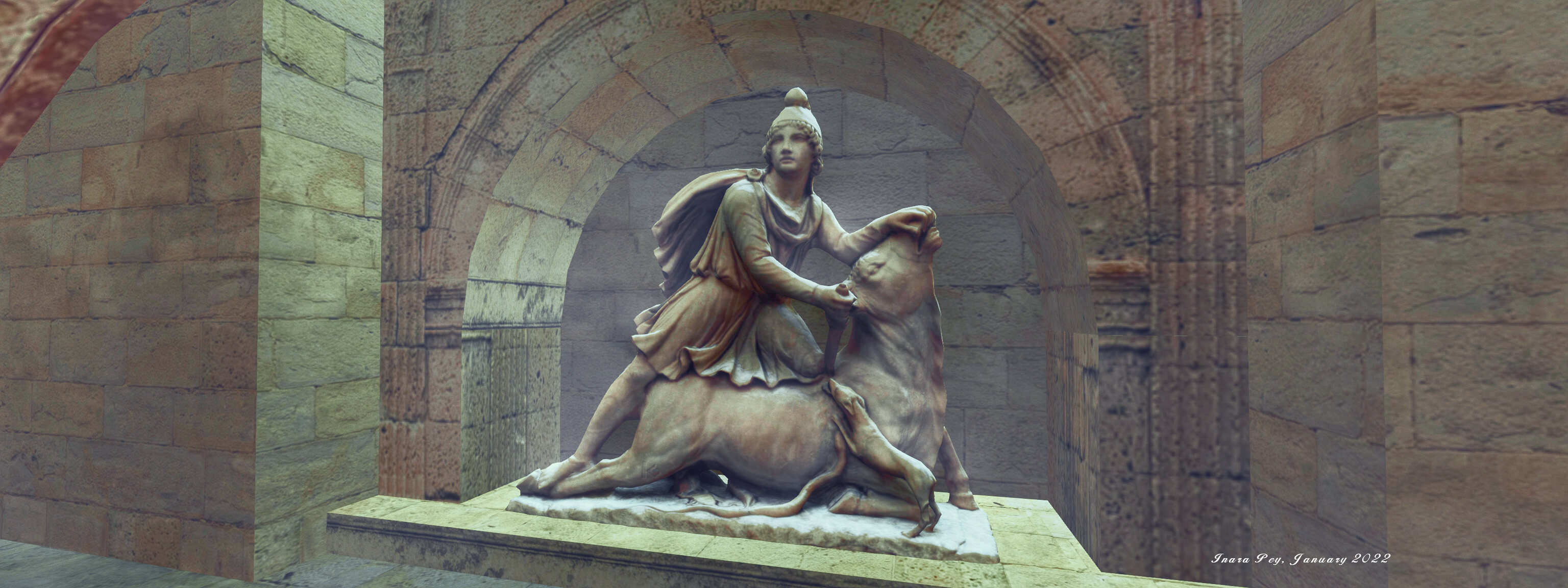
This is precisely what Patch Thibaud has done within Second Life, with his utterly fabulous Hanging Garden of Babylon, a Full region design (utilising the private Full region land capacity bonus), and which is currently highlighted in the Destination Guide. Patch is a long-time Second life resident who has, down the years created some outstanding builds in-world. In fact, I recently wrote (in part) about one of his most famous – The Cathedral – which has become both an outstanding statement of art in its own right and a venue in which art can be presented, courtesy of it being located within Chuck Clip’s Sinful Retreat arts estate (see: A Cathedral and Silent Beauties in Second Life).

Hanging Gardens of Babylon, January 2022

With this build, Patch (with the assistance of Cristabella Loon and Lιlly Hawk (NatalieRives)) brings together a genuinely stunning interpretation of  the Hanging Gardens that mixes into it elements that are not from the period in which the Gardens were said to exist but also from periods a lot more recent, including touches that might be seen has echoing the Greco-Romano period in which the legends of the Hanging Gardens began to gain wider circulation within the (then) Known World.

The centrepiece of the design is the great “mountain” of the gardens, here presented as a towering palace, tiered without and with multiple levels within, the structure rises from the waters and surrounding gardens to offer a place of rooms, stairs, walkways, rooms, outlying tiers where trees and shrubs grow as per the classic descriptions of the Gardens. Routes window up through the interior of the building and via outside stairways and ramps connect the various levels and eventually reach the “rooftop” gardens.

Hanging Gardens of Babylon, January 2022

The latter is a formal garden, richly laid out around a water feature, and of a kind that would look at home in the gardens of any grand European home or palace of the 18th or 19th centuries. Surrounded by building elements with the Greco-Roman lean, this “rooftop” garden also sits within rooms that have a distinctly Renaissance styling. Taken on its own, this rooftop area, complete with terraces and infinity pool, would be eye-catching enough, but it is just the jewel in a stunning crown of the design.

However, I’m not going to ramble on about the build here – I hope the photos I’m including here will encourage you to visit – what I will say is that this a genuinely engaging build, from the outlying gardens through the lower levels of the palace to the rooftop gardens. Throughout all there are numerous places to sit, paths to explore and – obviously – multiple opportunities for photography, the Hanging Gardens of Babylon is one of the Seven Wonders of our Digital World. And don’t miss the boat ride around and under the palace!

SLurl Details

2022 TPV Developer meeting summary, week #1

Pemberley, December 2021 – blog post

The following notes are taken from the TPV Developer meeting held on Friday, January 7th, 2022.

These meetings are generally held every other week.  They are recorded by Pantera Północy, and her video of the meeting is embedded at the end of this report – my thanks to her for allowing me to do so – and it is used with the chat log from the meeting and my own audio recording to produce this summary, which focuses on the core topics discussed.

SL Viewer

[Video: 0:00-1:28]

There have been no official viewer updates to mark the start of the year, leaving the current crop as:

  • Release viewer: version version 6.5.1.566335, formerly the Cache+ 360 Capture viewer, dated December 7, promoted December 15 – No change
  • Release channel cohorts (please see my notes on manually installing RC viewer versions if you wish to install any release candidate(s) yourself).
    • The Jenever Maintenance RC viewer, version 6.5.2.566860, issued on December 17.
    • The Koaliang Maintenance 2 RC viewer, version 6.5.2.566879, issued on December 17.
    • The Tracy Integration RC viewer version 6.4.23.563771 (dated Friday, November 5) issued Tuesday, November 9.
  • Project viewers:
    • Performance Improvements project viewer version 6.5.2.566967, dated December 17.
    • Performance Floater project viewer, version 6.4.23.562625, issued September 2.
    • Mesh Optimizer project viewer, version 6.4.23.562614, issued September 1.
    • Legacy Profiles viewer, version 6.4.11.550519, dated October 26, 2020.
    • Copy / Paste viewer, version 6.3.5.533365, dated December 9, 2019.

General Viewer Notes

  • The Performance Improvements project viewer is currently going through a round of bug fixing prior to being promoted to RC status. However, no further additions / changes to the existing feature set beyond the fixes are planned.
  • Depending on how things go, it is possible the Performance Improvements viewer may be the next to be promoted to RC status.
  • [2:17-2:30] The Legacy Profiles project viewer is awaiting further server-side updates before proceeding.

Upcoming Feature Work

[1:30-1:51]

  • At the end of 2021, the Lab issued a blog post reviewing the year and offering an overview of some projects planned for release in 2022.
  • Vir indicated that discussion on those projects mentioned in the post (and others?) is still on-going, and that the Lab is not ready to discuss time frames, etc., for any particular feature or release at this point in time.

In Brief

  • Mojo Linden arrived after the meeting had ended, and reiterated that:
    • A focus for the year remains on performance improvements.
    • A key aspect of work as a whole remains improving the entire New User Experience (NUE).
    • He also clearly dodged questions on the specifics of the new “avatar expressiveness”.
  • [3:20-9:50] A general discussion on building the viewer, of interest to viewer devs and self-compilers.

CyberNorm: the two sides of an artist in Second Life

Art Korner Main Gallery: CyberNorm – The art of “Cyber”

Update, June 27th, 2022: Art Korner has Closed.

Recently opened in the Main Gallery at Frank Atisso’s Art Korner is an intriguing exhibition that presents two sides – two personalities, if you will – of a single artist: CyberNorm (aka ndl1971).

As “Norm” the artist – who has had their work displayed in several exhibitions in Düsseldorf, Germany, between 2018 and 2020 – explores art using the brush and canvas, using the medium as a means to explore life and politics in a somewhat playful manner, and explore aspects of gender politics. Meanwhile, as “Cyber”, the artists works with the digital medium, expressing their imagination through structured, mathematical terms – in this case through the use of fractals.

Through both forms of art, the CyberNorm particularly explores the subject of control: the use of political standpoints to exert control over the world as a whole, and the ability of mathematics to present structure and control within the digital domain.

Art Korner Main Gallery: CyberNorm – The art of “Cyber”

At Art Korner, these two sides of the art’s work are displayed across the two floors of the gallery building. The lower level is primarily given over to the art of “Cyber” (with one exception), and the upper level to the work on “Norm”.

The digital art offers a vibrant richness, bringing together the richness of natural forms with those of more abstracted elements to form pieces that are all individually unique and captivating. Some of these offer suggestions of Nature and life, while some capturing the infinite beauty of the Mandelbrot set, while others suggest textile-like pieces that offer their own fascination.

Art Korner Main Gallery: CyberNorm – The art of “Norm”

The display on the gallery’s upper floor offers paintings that demonstrate “Norm’s” approach to political commentary / satire, together with broader pieces that offer food for thought on the topic of what might be seen as commentary on gender, continuing female sexual emancipation and societal freedoms, including how (for some) these might be seen as threatening (as with Dragon and the Firefly, for example).

Taken individually, both halves of this exhibition contain much to hold the attention; together the present a wealth of expression and contrast the play off one another, revealing as they do two very different sides of the artist’s nature. For those interested, it will remain open through until February 2nd, 2022.

Art Korner Main Gallery: CyberNorm – The art of “Norm”

SLurl Details

A Winter’s Lost Dreams in Second Life

Lost Dreams, January 2022 – click any image for full size

It’s been three years since I last visited Cathy Vathiany’s (zaziaa) ever-evolving region design Lost Dreams (which started life as Les Reves Perdus (“Dreams Lost”), which has itself hopped around the grid a few times. So when I learned it had re-opened in a new location and with a new design in November 2021, I added it to my list of places to visit – although after initially dropping in in December, I had a couple of issues getting back to it in order to take photos.

Cathy has always had an eye for engaging, rural-themed region settings; places where Nature tends to stake a centre seat and where there is always a richness of detail waiting to be found and appreciated. Sometimes these looks have had a distinctly European / North American lean, although it has also taken us to the orient and to Scandinavia. With this iteration, we slip to somewhere that presents something of a sense of both Arctic and Antarctic climes.

Lost Dreams, January 2022

The current Lost Dreams might be mentally split into five areas: three on the main landmass, and the remaining two formed by a pair of outrigger islands. One of the latter is where the landing point can be found, a rocky plug of an island to the west of the region. Small, and dominated by two large trees, this island at first appears to offer little beyond the landing point itself. However, below the cliffs, a stone outthrust heavy with fallen snow has been taken over by penguins that lend that suggestion of the southern hemisphere to the region.

A bridge sitting upon high stilts connects the landing point’s island with the largest landmass in the region: a large, rugged space that can, as noted, be mentally / visually split into three. First, there are the rugged westerlands, sitting on the far side of the bridge, a hulking shoulder of rock splitting the path from the bridge into two. The left branch descends downwards close to the cold-looking waters of the bay in which the landing point island sits, passing through a narrow defile before rising once more to the uplands of the island.

Lost Dreams, January 2022

The second arm of the path twists around the rocky shoulder to reach a second bridge spanning a smaller cove formed by the outflow from waterfalls that mark the terminus of a fast-flowing stream. Here the path splits again, one arm twisting by to descend the down to the shingle shoreline that huddles around the feet of sheer curtain wall cliffs.

The other arm of the path passes across the second bridge before winding upwards, and doubling back on itself as it reaches the bank of the stream, itself fed from a further set of falls that drop from the highest peaks in the region. Crossing this is possible by way of a pair of tree trunks trimmed into a rough bridge to re-join the path rising up through the defile mentioned above.

Lost Dreams, January 2022

Once joined, the path lead up to the centre part of this large island and a large stone lodge sitting on an outstretched table of rock that is home to a skating rink, a children’s play area, a carousel and other outdoor points of interest. It is here that a more northern hemisphere aspect to the setting can be found in the form of deer wandering the grounds.

Paths wind around the grounds here, with one curling back down to the low-lying eastern end of the land, and the rest of the main landmass. This is home to a a cosy hideaway and, a little further away, a little folly. from here, a final bridge – this one made of stone – reaches the final aspect to the setting: a small, low island that is home to a pool of water and a little camp site.

Lost Dreams, January 2022

Such is the nature and aspect of this little island, that is it possible to image that once upon a time it many have formed a headland reaching outwards from the rest of the main island, but time and tide have intervened, creating a channel of cold water to separate the two and necessitate the stone bridge.

Within all of this, there are lots of additional elements and details: water birds stand along the coastal areas, there are outdoor sit points and places to dance awaiting discovery, and further wildlife give the setting additional depth, as does the local soundscape. All of which leaves us with another thoroughly engaging place to explore and photograph and not to be missed before a seasonal change comes along!

Lost Dreams, January 2022

SLurl Details