2021 SUG meeting week #29 summary

* Nourish *, April 2021 – blog post

The following notes were taken from the Tuesday, July 20th, 2021 Simulator User Group (SUG) meeting. The meeting was recorded by Pantera Północy, and the video is embedded at the end of this summary.

Server Deployments

Please refer to the server deployment thread for updates.

  • There was no planned deployment to servers on the SLS Main channel on Tuesday, July 20th.
  • Wednesday, July 21st should see all servers on the RC channels re-started. Due to the manner in which simulator deployments are made, this will show as a updated release number (2021-07-16.561609), although there are no changes to the code itself. However, during the restart process, approximately 1/3 of RC servers (not the simulator code) will see changes designed to improve performance “in some situations”. In addition, the deployment notes further state:
As mentioned in some of our recent deploy plans we’ve been investigating the effectiveness of region restarts at the ten day limit. We believe some of the issues Residents are encountering with regions that have long uptimes are due to issues at the machine level, not the simulator level. Our instance refresh for Second Life RC channels this week is an attempt to gather data as to whether this is correct or not.

The two RC updates had been planned for the week have now been altered as follows:

  • The ability for estate owners / managers to set a default EEP environment across an entire estate has been pushed back to a future release.
  • Opening custom chat ranges to estate managers through the simulator debug console has been put on hold as a result of “privacy concerns” – primarily that people might not be aware how far their local chat is carrying on regions where the range has been increased over the “usual” 20m. As such, consideration is being given to adding a viewer-side change to inform people of the local chat range.

SL Viewer

The Fernet Maintenance RC, version 6.4.21.561414, dated July 14th, was updated to de facto release status on Monday, July 19th.  This leaves the rest of the currently available official viewers as:

  • Release channel cohorts:
    • None.
  • Project viewers:
    • Legacy Profiles viewer, version 6.4.11.550519, dated October 26.
    • Copy / Paste viewer, version 6.3.5.533365, dated December 9, 2019.
    • Project Muscadine (Animesh follow-on) project viewer, version 6.4.0.532999, dated November 22, 2019.
    • 360 Snapshot project viewer, version 6.2.4.529111, dated July 16, 2019.

Agni / Aditi Account Syncing

This has been an issue for some time, causing pain for many creators who wish to use Aditi (the beta grid) for testing, due to significant issues in trying to log-in.  The matter has been under investigation for several months, and a solution new appears close, with Simon Linden commenting:

We’ve tossed together some code and stuff and now have the ability to copy your account from production SL (here) to our beta grid. If any of you would like that, send me an IM. We’ve tested it a bit and are ready to try the first volunteers. 
There are a few things to note, however: you should clear your viewer cache before logging in to Aditi; when you log in, your outfit may look messed up. Just change it. We’d love to get some feedback on this.

So, if you are interested in regaining access to Aditi, drop an IM to Simon, stating your reason for requiring access and willingness to participate in testing.

HTTP-Out Warnings

To quote Monty Linden (making a long-awaited return to SUG meetings!):

A refresh to a component of the HTTP-Out system, our HTTP proxy, is underway. Changes are meant to be transparent involving operational improvements, but we’re letting everyone know so if you see issues having to do with reachability of external servers or reliability of HTTP access, please speak up. Jira’s always appropriate for reporting issues but be specific in the details. We’re currently serving about 200K requests per minute via LSL so if you tell me “it happened last Thursday,” I’m not going to find anything. Time, place [region], target – details matter.  At some point soon, this will go out to Aditi as a non-simulator deploy. [I] Want to encourage reports of issues if anyone sees problems. Especially blockages of things that should not be blocked.

In Brief

  • The meeting includes a general discussion on teleports. teleport failures, region crossings issues and how they might be related and one (physical region regions via forced unseat / teleport) might help in diagnosing force TP failures – and whether or not this is the case.
  • There has been a question on whether texture transfer via UDP through the simulator is still / again possible. Commenting on this, Monty Linden stated:
Texture delivery was to be blocked for UDP but not certain that happened. They won’t enjoy it. Would like a capture of a shift-ctrl-3 screen. texture asset delivery via simulator is one of our most pessimal systems. Will check on the UDP status – that’s curious.
  • Refer to the video below for additional information.

Space Special: four fly on New Shepard NS-16

New Shepard NS-16 on the pad at Blue Origin’s launch facilities in Culberson County, west Texas. Credit: Blue Origin

On July 20th, 2021, the 52nd anniversary of Apollo 11 landing on the Moon, Jeff Bezos became the second billionaire to make a sub-orbital flight into space aboard a vehicle he had made possible, following on the heels of Sir Richard Branson (see: Space Sunday: Unity 22 flies). But whereas Branson took over an hour to make his trip up and back again aboard his space plane VSS Unity (including a leisurely club to launch altitude slung under the wing pylon of the carrier aircraft MSS Eve), Bezos made the trip in 10 minutes and 18 seconds, thundering aloft whilst sitting on top of his sub-orbital New Shepherd launcher.

This was the first of several notable differences between the two flights, some of which Blue Origin has done much to belabour over the last couple of weeks, and took time out to do so during Bezos’ flight.

Of these, the most notable is that while Branson’s Virgin Galactic may offer a longer overall experience, it comes at a cost of the altitude reached: around 86 kilometres. By contrast, the more powerful BE-3 engine of a New Shepard carries passengers in excess of 100 km, taking them above the Kármán line, which as I’ve noted before, is widely (but no exclusively) see as the boundary between Earth’s atmosphere and space.

A simplified diagram showing the NS-16 flight plan from launch through to landing with the booster and the capsule. Credit: Blue Origin.

How big a point this might be is debatable – in the United State, where both companies operate, the boundary is put at 80 km, which the Virgin Galactic flights clearly cross – and as I’ve noted before in Space Sunday, both altitudes mean that passengers on the two vehicles get to experience about 3 minutes in a micro-gravity environment and get to see more-or-less the same view out of their vehicle’s windows (albeit through much larger windows in the case of New Shepard, again as Blue Origin have belaboured of late.

NS-16, as the July 20th flight was officially designated, being the 16th flight of a New Shepard booster and capsule combination, technically also marks both the first time New Shepard has carried humans aloft, and marks the first flight of a fare-paying passenger aboard a commercial sub-orbital vehicle.

The New Shepherd NS-16 “crew”: Jeff Bezos, Mark Bezos, Mary “Wally” Funk and Oliver Daemon. Credit: Blue Origin

T18-year-old Dutch student Oliver Daemon was a late addition to the flight after the original winner of the auction for his seat had to postpone flying with Blue Origin. As Oliver’s father made the second-highest bid, the sat was awarded to him, and he gave it to his son.  Oliver joined Bezos and his brother and venture capitalist Mark Bezos aboard the vehicle as the youngest person to date to fly into space, bookending the crew with the 82-year-old and utterly remarkable Mary Wallace *Wally” Funk, who would, with the trip, become the oldest person to date to fly into space.

The flight had been scheduled for a lift-off at around 13:00 UTC – although as was pointed out by the live stream commentary in the run-up to the launch, this was not a hard-and-fast launch time; as the flight would be sub-orbital, it was not constrained to a specific launch window in order for it to reach a required orbit.

“Wally” Funk gives a wave from her seat aboard RSS [Reusable Space Ship] First Step, the capsule atop NS-16, as she awaits the start of her sub-orbital flight. Credit: Blue Origin
The four passengers – and this is the correct term for them, as New Origin is an entirely automated vehicle that requires no flight crew – boarded the vehicle 30 minutes ahead of the planned lift-off time. A planned countdown hold at T -15 minutes became slightly drawn-out, causing the launch time to slip past the planned 08:00 (local) lift-off, but otherwise things proceeded smoothly.

With four minutes left in the countdown, New Shepard switched to fully automated control of itself, carrying out final flight control checks by gimballing its rocket motor exhaust and “waggling” the fins at the booster’s base, as the crew access arm was retracted. At zero in the countdown, the BE-3 motor ignited, taking some 7 seconds to run up to full thrust, at which point the holding clamps released, allowing the vehicle to launch.

NS-16 clears the launch tower. Credit: Blue Origin

From here, things proceeded rapidly and smoothly. Tracked by cameras both on the ground and aboard helicopters, the New Shepard vehicle ascended rapidly, reaching 6.2 km altitude in just 60 seconds.

At this point, the BE-3 throttled back as the craft passed through Max-Q, the period when the maximum dynamic pressures are exerted on the vehicle as it punches its way through the denser atmosphere building a shockwave around itself. Following Max-Q, a period of several seconds, the motor throttled back up to full power, pushing the craft through Mach 1.

Reaching apogee – the RSS First Step capsule (the fainter, lower object) approaches its maximum altitude, the booster already dropping back towards Earth. Credit: Blue Origin

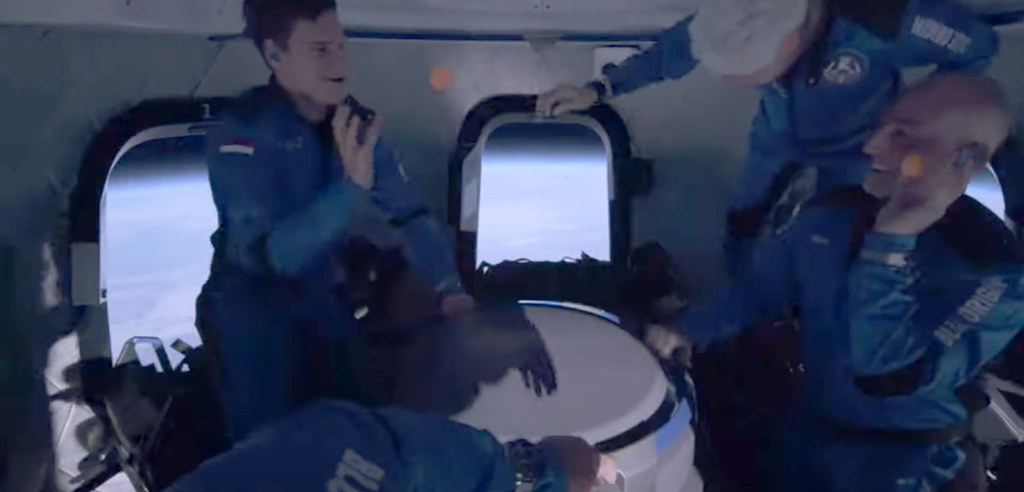
At 2 minutes 20, MECO – main engine cut-off – occurred, the vehicle at an altitude of 58.5 km – high enough to see the curvature of the Earth – and still accelerating. Just a few seconds later, at roughly 78 km altitude, the capsule separated from the booster and entered its parabolic “coast” phase during which the four passengers experienced microgravity and were allowed to move around the cabin.

While the capsule continued upwards to a apogee of 108 km, the booster, being heavier,   reached an apogee somewhat lower, then started a vertical descent back towards a landing pad using a mix of the fins at its base and “wedge fins” at its top that were deployed after capsule separation, together with gas-fired RCS systems to remain upright. Just under 7 minutes from launch, it passed generated the classic double boom of passing back through the sound barrier to sub-sonic speed, and at 1.2 km above the ground re-ignited its BE-3 motor to bring itself to a successful landing.

Oliver Daemon and Mark Bezos toss little balls to one another in micro-gravity as “Wally” Funk floats behind them aboard ESS First Step. Credit: Blue Origin

Continue reading “Space Special: four fly on New Shepard NS-16”

Cica’s Summer Day in Second Life

Cica Host: Summer Day

Cica Ghost opened her latest region installation on Sunday, July 18th. Entitled Summer Day, it is, as always with Cica’s installations, accompanied by a quote; one that might possibly have more meaning when taken with the installation than may perhaps have been the case with some of Cica’s recent works, a point I’ll come back to in a moment. That quote is:

Sometimes you will never know the value of a moment, until it becomes a memory.

– Dr Seuss

The scene is quite simple – a rolling landscape under a deep teal sky, white horses gambolling and frolicking amidst the grass and under the shade of trees; a chap fishing on a little lake where he is watched by a swan, the fish under the water perhaps teasing him by ignoring his line and bait; and a woman (his wife?) sitting outside of a house, fussing a pair of geese, one of which is perched on her lap.

Cica Host: Summer Day

What is surprising is that unlike Cica’s other region-wide installations, Summer Day has few sit-points within it – just the bench with its white cat and the little boat bobbing off-shore, so far as I could see; and there are none of the usual animations / dances that tend to be a hallmark of her work. It is this lack of animations and sits, combined with the use of the quote from Dr. Seuss that led me to wonder if, perhaps, there is a message to be found within this Installation.

Seuss’ words remind us that memories grow from the experiences we have – or create – in our lives; so it is important we ensure we make time to have experiences – moments – that will result in happy, lasting memories – be it through engaging in something we enjoy, appreciating nature’s beauty or simply having fun. Otherwise, there’s a risk that when we page back through our memories, there is a risk that rather than having a richness of experience to enjoy, we find that all we have are a lot of “what if I had just…” memories.

Cica Ghost: Summer Day

So might Summer Day be a little poke Cica is giving us to maybe take a break from computer screen and keyboard and make time for the things that will give us happy memories? Those moments needn’t be complex: just space to enjoy a favourite past-time (the chap fishing), or to enjoy the touch of nature (the woman leaving the washing and fussing the geese) or simply taking time to play (symbolised by the horses), especially if we can share the fun with a friend or loved one.

Obviously, I don’t want to put words into Cica’s mouth, but I found it hard not to escape this feeling / sentiment as I wandered Summer Day, although it is true you might find it says something different. Which is why (as always with Cica’s work), I recommend playing it a visit yourself, rather than just relying on what is written here.

However, while you do so, please excuse me if I pop out to the garden for a moment, and make some memories playing with my cat 🙂 .

Cica Ghost: Summer Day

SLurl Details

2021 viewer release summaries week #28

Logos representative only and should not be seen as an endorsement / preference / recommendation

Updates from the week ending Sunday, July 18th

This summary is generally published every Monday, and is a list of SL viewer / client releases (official and TPV) made during the previous week. When reading it, please note:

  • It is based on my Current Viewer Releases Page, a list of all Second Life viewers and clients that are in popular use (and of which I am aware), and which are recognised as adhering to the TPV Policy. This page includes comprehensive links to download pages, blog notes, release notes, etc., as well as links to any / all reviews of specific viewers / clients made within this blog.
  • By its nature, this summary presented here will always be in arrears, please refer to the Current Viewer Release Page for more up-to-date information.
  • Note that for purposes of length, TPV test viewers, preview / beta viewers / nightly builds are generally not recorded in these summaries.

Official LL Viewers

  • Release viewer: Project UI RC viewer, version 6.4.20.560520, dated June 14th, promoted June 23rd – No change.
  • Release channel cohorts:
    • Fernet Maintenance RC viewer updated to version 6.4.21.561414, on July 14th.
  • Project viewers:
    • No updates.

LL Viewer Resources

Third-party Viewers

V6-style

  • No updates.

V1-style

Mobile / Other Clients

  • No updates.

Additional TPV Resources

Related Links

A trip to Blackwood Farm in Second Life

The Blackwood Farm, July 2021 – click any image for full size

Following a recommendation from Shawn Shakespeare (SkinnyNilla), I opted to spend a little time on the farm. The Blackwood Farm, to be precise, a Homestead region gorgeously presented for public visits / use by Corvus Blackwood.

Sitting under a burnished summer sky, the clouds turned to bronze by a low-hanging Sun, the region presents as a single island into which  a channel of water has cut its way, roughly dividing the landscape almost into two. To the west, the land is predominantly low-lying, to the east it is dominated by a raised table of rock marked to the north and south by ribbons of scrubby coastline, the former of which sweeps east and west across the width of the region, curving past a small off-shore isle to the west, the home of a squat lighthouse watching over the channel between the two landmasses.

The Blackwood Farm, July 2021

The western side of the setting is home to the Blackwood Farm. This is a place, we’re informed by a large friendly sign close to the landing point, that is family owned and operated. An unfenced field of corn sits just behind the sign, stretching south along the track leading up to the farm, fir trees and a rocky mound also sitting with it within an oval of rutted tracks.

An aging gateway and fading wall guard the entrance to the inner sanctum of the farm. They face the imposing farmhouse that is flanked by barns to either side, and is fronted by a square fenced field of cattle.  It is a peaceful, pastoral setting: chickens wander freely, apples are in the process of being picked from a little copse of trees, a little lemonade stand awaits those in need of refreshment. In fact the setting is so peaceful, deer are happy to graze on the grass within the farm’s grounds.

The Blackwood Farm, July 2021

The farm is overlooked to the west by a uplift of land topped by a windmill that offers one of the many places to sit within the setting, a pair of batterer trailer homes sitting in the shadow of the hill, between it and the span of the south coast. Very rough and ready in their set-up, the two trailers are clearly occupied: a fire pit is burning, a fan is on to cool seats under one of the trailer’s awnings – but both have been left to a little goat to watch over. It forms one of several small vignettes awaiting discovery by visitors, and which bring the entire setting together as a whole.

Over to the east, the primary upland is home to the Apple Fall Old Manufactory, a structure that is so popular among region designers that at times it feels as if it is a required feature within an public region. Its popularity is likely down to both its aged looks and its flexibility of use. Here it has been turned into a charming house, complete with a large patio terrace that stretches from it to a little open-sided potting shed. It is an altogether eye-catching setting – but do please be aware that the house is actually a private residence, as indicated by the localised ban lines that will appear if you stray too close.

The Blackwood Farm, July 2021

The rest of the hilltop is very much open to exploration, as is the rough coastline to the north and below it. Reached by steps cut into the slope of the upland, this coastal area is again a place of little vignettes – a camp site, walks, a dock stretching out over the water and little boats that again add to the richness of the setting.

Those wishing to rez within the region can do so by joining the local group (fee: L$250) – but those who do re asked to clean-up after themselves.

The Blackwood Farm, July 2021

Such is the all-round natural looks to the setting, it really is an ideal location for avatar photography whilst the landscaping is equally photogenic; what is more, the setting works equally well under a range of different environment setting to the default – as I hope can be seen in a couple of the images here.

Whether or not you opt to play with the environment settings or use the shared environment, The Blackwood Farm is visually and – thanks to its sound scape – aurally engaging, richly detailed, and a joy to explore and photograph. This being the case, it should come as no surprise that I’d note it as a recommended visit.

The Blackwood Farm, July 2021

SLurl Details

Space Sunday: rovers, rockets and telescopes

An image of a ridge line on the flank of “Mount Sharp” (Aeolis Mons) captured by MSL rover Curiosity on Sol 3167 (July 4th, 2021). A CGI model – to scale – of the rover has been superimposed on the image to show how the rover’s climb up the ridge might appear to someone watching it. Credit: NASA/JPL with additions by Seán Doran

Rovers on Mars continue to been busy as they trundle around the planet. While it has been there the longest, NASA’s Mars Science Laboratory (MSL) rover Curiosity has been somewhat out of the news, courtesy of it’s sister Perseverance and China’s Zhurong. However, it has recently re-grabbed the science news headlines thanks to a couple of studies.

Methane blips have pinged on Curiosity’s Tunable Laser Spectrometer (TLS) six times since the rover landed in Mars’ Gale crater in August 2012. These events have been seen as important, because methane is the by-product of two processes that share equal interest to scientists, because one is the result of organic processes – life – and the other, though inorganic in nature, points to geological activity closely tied to the presence of liquid water, a vital ingredient for past or present life as we know it to thrive.

A critical factor with methane is that once exposed to sunlight, it breaks down over a period of just 300-330 years, so for Curiosity to be able to detect it, it must have come from a relatively recent source – one that still may be active. The problem until now has been to locate that source – or even confirm Curiosity’s findings.

The European Space Agency’s Trace Gas Orbiter, part of the ExoMars mission, and currently studying Mars. Credit: ESA

The best placed tools for doing the latter are aboard the European Space Agency’s Trace Gas Orbiter (TGO), but to date, TGO has been unable to detect any methane within Gale Crater. The could either be because there isn’t any methane to be found, or the minute amounts  – just 10 parts per billion (10 ppb) – is too small and too localised for TGO to accurately detect from orbit, and Curiosity just happens to be sitting practically on top of it.

In one of two reports released in June, members of the MSL’s extended science team they have pin-pointed the source location for the methane, and that the rover happened to arrive in Gale Crater at a point extremely close to it.

This was done by treating each point of detection as a discrete packet of methane, then calculating the wind speed and direction at the time it was detected. This allowed them to trace the parcels back through time to their possible points of emission. By doing this for all of the different detection spikes, they were able to triangulate regions where the methane source is most likely located- and one of them is just a few tens of kilometres to the north-west of “Mount Sharp” and Curiosity’s area of exploration.

Sadly while tantalisingly close to the rover, the point is still well outside of Curiosity’s route of exploration.

MSL Curiosity, imaged by the HiRISE camera aboard NASA’s Mars Reconnaissance Orbiter, on April 18, 2021. Credit: NASA/JPL

A second study coming out of Curiosity’s science data suggests that a process has been at work on Mars that has been both eradicating evidence for possible past life on Mars – and creation conditions in which new life might arise.

In short, when reviewing the result of samples taken of ancient mudstone, a sedimentary rock containing clay, taken from two points just 400 metres apart and believed to have both been laid down some 3.5 billion years ago. Both should have been very similar in nature, rich in clay, an important element in the search for life, as it is both created in the presence of water and is an excellent medium for storing microbial fossils. However, one of the samples contained just half the anticipated amount of clay minerals in comparison to the other, but a much higher concentration of iron oxides –  the compounds that give Mars its rusty hue.

The researchers behind this discovery believe it is the result of one of the two areas of mudstone being exposed to brine: salty water that leaked into the mineral-rich mudstone and effectively leached the clays and other minerals out of them, effectively eradicating both the geological and possibly the biological record that might otherwise be present in the deposits. Given that evidence of potentially brine-rich outflows have been found elsewhere on Mars, this study suggests this process might be common to regions of the planet believed to have once housed bodies of water, possibly destroying any evidence of past life.

However, the process – called diagenesis – is not all bad news. While it may well help erase any record of past organic activity from parts of the surface or Mars, it may also have triggered new life processes under the surface, the salty water being a source of potential energy that could help kick-start new organic processes.

Image of the “Raised Ridges” that Ingenuity captured on its ninth flight. Credit – NASA / JPL

The findings of both of these studies are being used to inform the science mission of NASA’s latest Mars rover, Perseverance, allowing the science team to apply what has been found in Gale Crater to Jezero Crater, to better direct that rover towards places of interest.

“Percy”, to use the nickname for NASA’s latest Mars rover is also being assist in finding places of interest – and the best route to them – by the Ingenuity helicopter. This has now completed its 9th flight , during which it acted directly as an aerial scout for the rover, including the “Raised Ridges”, a feature that suggests it may one once had a water channel beneath it. Ingenuity has also identified a dune field that could result in “Percy” becoming bogged down – as happened with the MER Spirit rover in 2009/10 – ending its mission.

What is particularly fascinating about this work is that the information gathered by Ingenuity can be fed back to Perseverance and used by its auto-drive system to identify local hazards – rocks, etc – the rover can then navigate itself around without having to “‘phone home” for assistance from the Earth-based driving team.

Ingenuity’s view of the “Séítah” dune field on it’s ninth flight. Part of the helicopter’s landing gear can be seen on the left side of the screen. Credit: NASA / JPL 

Meanwhile, China’s Zhurong rover is now 2/3rds of the way through its initial 92-day / 90 Sol mission. During that time, the rover has travelled a total of 450 metres, and on July 12th, 2021, it arrived at a special point of study – but one that is neither geological nor meteorological / atmospheric, the rover’s primary science interest.

Instead, the rover had arrived at the impact / landing point for the backshell and parachute that had helped it to reach the ground safely. Following it separation from these during descent, the rover had moved away from it under the power of its lander’s rocket motors ready to make a soft landing. The backshell and parachute continued downward to eventually land some 350 metres from the lander / rover.

Studying both the backshell and parachute helped engineers understand how well both handled the descent through the Martian atmosphere, something that can help inform future missions. At the same time, the rover imaged raised mounds in the region, which could be inverted impact craters or possibly small volcanic domes or other features could be the result of tectonic activity – their nature has yet to be made clear (one of which has been incorrectly labelled as a “outflow delta” in the video below).

Continue reading “Space Sunday: rovers, rockets and telescopes”