A festival for live action role-play in Second Life

Courtesy of SLarp Fest

On Sunday, March 21st, Second Life will play host to SLarp Fest, a one-day celebration of live action role-play (LARP). The event is a co-production by IndieCade International Festival of Independent Games and the Playable Theatre Project, and is the latest in a series of events traditionally held in the physical world to leverage the potential of Second Life as a means to provide attendees with a unique digital experience.

For those unfamiliar with it, IndieCade is the only standalone festival for independent games in the United States. It was founded in 2005, and held its first showcase event at the annual Electronic Entertainment Expo (E3) in 2007, with its first festival following in 2008. Between 2009 and 2015 the festival took place in Culver City, California, moving to Santa Monica City College in 2018. A “sister” event, IndieCade Europe was held in the UK between 2007 and 2009, before being rebooted in 2016 as the IndieCade Conference and Expo, held France.

Regarded as “the video game industry’s Sundance“, IndieCade gives invited independent video game developers the opportunity to showcase their work alongside of a conference track featuring classes, panels, workshops and keynotes related to games development. In doing so, it has become a major attraction for independent game developers and others in the industry.

As with so many events the world over, the SARS-CoV-2 situation forced the IndieCade organisers to “go digital” in 2020, hosting events and activities through various on-line mediums. As a part of this IndieCade 2020 Anywhere and Everywhere festival, a presence was established in Second Life: IndieCade Oasis, which for 2021 will play host to SLarp Fest.

Part of IndieCade Oasis – the in-world venue for SLarp Fest 2021

Conceived by IndieCade and the Playable Theatre Project, SLarp Fest is an experiment in adapting live action role-playing games – a long-standing part of IndieCade’s repertoire – to a digital format, the idea being to allow experienced and novice role-players alike to join is a series of specially-adapted live action role-play scenarios, and to participate in a number of other activities.

A live action role-playing game (LARP) is a form of role-playing game where the participants physically portray their characters and enact a plot of the game. The players pursue goals within a fictional setting represented by the real world environments while interacting with each other in character. The outcome of player actions may be mediated by game rules or determined by consensus among players. Event arrangers called gamemasters decide the setting and rules to be used and facilitate play.

– Live action role-play definition, via Wikipedia

SLarp Fest is curated by Celia Pearce (Artemesia Sandgrain in Second Life), one of the co-founders of both IndieCade and the Playable Theatre Project. She is also the author of a number of books and papers on viral worlds, including Communities of Play (MIT Press 2009). Working with IndieCade Oasis region designer Jenn Frank (Nova Conundrum in Second Life) – herself a long-term Second Life resident through her main account and a writer focused on games and technology – Celia has sought to provide an environment that is more interactive and immersive than can be achieved through the more “traditional” approaches to digital engagement, such as Zoom.

I was growing increasingly frustrated by the limitations of the Zoom proscenium, so I invited some of my favourite LARP designers to experiment with avatar embodiment to see if we could adapt their work for a virtual world. Jenn and I worked with the creators to take advantage of the capabilities of the Second Life, along with the massive amount user-created content, to build something truly unique and immersive. Our play testing thus far has indicated that the experiment is working!

– Celia Pierce (SL: Artemesia Sandgrain) on the origins of SLarp Fest

SLarp Fest will feature four live action role-play scenarios attendees can play, including Angel Falls, developed specifically for Second Life and the event
Commencing at 09:00 SLT on Sunday, March 21st, SLarp Fest is open to anyone who wishes to attend. Throughout the day the festival will present a range of activities for attendees, including card games, a carnival, pirate ships, the chance to play MadPea’s Escape Room and, of course, the opportunity to participate any of the four live action role-play scenarios that are the focus of the festival. These are:

  • 09:00-11:00 – First Impressions (aka D&D Speed Dating): find your fantasy character their own adventuring group in a speed-dating-style event! A fast, zany take on conventional fantasy tropes. Game by Marc Majcher, Adapted for Second Life by Evan Torner (UC Game Lab).
  • 11:00-13:00 – Angel Falls: players attend a funeral as conflicted humans and comforting but flawed angels in a scenario about seeking resolutions when it is already too late to resolve anything. Developed specifically for Second Life and SLarp Fest by Celia Pearce, Jenn Frank and Annika Waern, and inspired by the film Wings of Desire.
  • 13:30-15:30 – Romancing Jan: a racial, orientation and gender inclusive take on a Regency era matchmaking game, played in full costume at a fancy outdoor tea dance in a period pavilion. Game by Athena Peters, who also adapted it for Second Life.
  • 16:00-19:00 – The Sleepover: play as adolescents learning and sharing knowledge about sex, sexuality, and gender identity at a sleepover party during summer camp” From the IndieCade 2021 Finalist anthology Honey & Hot Wax by Julia B. Ellingboe and Kat Jones (Candyland Games), and adapted for Second Life by the authors.
SLarp Fest will include a range of activities, including the LARP sessions, arcade games, MadPea’s Escape Room, a carnival and more

Those wishing to attend the event should register their intent to allow the organisers to get a feel for the potential number of attendees. In addition, registration will provide access to the sign-up forms for the LARP scenarios. Note that registrations will close at 23:59 SLT on Thursday, March 18th.

Further details on SLarp Fest and IndieCade can be found via the links below, and I’ll have more on the event, including the SLurl, ahead for the opening.

Related Links

Firestorm 6.4.13 release

On Monday March 15th, 2021, the Firestorm team released version 6.4.13 of their viewer.

Regarded somewhat as a maintenance update more than a major release, the primary am of 6.4.13 is to hopefully move Firestorm into its quarterly cadence of releases.

That said, as well as fixes and updates, this release includes a number of additional and new capabilities added by the Firestorm team, and these form the focus of this overview.

Installation

  • There is no need to perform a clean install with this release if you do not wish to.
Table of Contents


  • Do, however, make sure you back-up all your settings safely so you can restore them after installing 6.4.13.
  • Again, please refer to the Firestorm 6.4.13 release notes for additional details of all changes and updates in this release.

Linden Lab Derived Updates

This release brings Firestorm up to parity with the Lab’s 6.4.12.555248 Dawa Maintenance RC, which focused on bug fixes. This viewer became the Lab’s default viewer on February 1st, 2021.

Menu Updates

Avatar Menu: Recreate  LSL Bridge

If you encounter issues with the Firestorm Bridge, you can now recreate it via Avatar → Avatar Health → Recreate LSL Bridge.

Note: you must be on a script-enabled region / parcel for this to work.

World Menu: Bulk Windlight Import to EEP

With Firestorm 6.4.13, it is now possible to bulk import Windlight .XML files directly to inventory as EEP settings / assets.

  • Go to World → Environment → Bulk Import
  • Select the EEP type you’d like to use for the import process (days, skies, water).
  • A file selection window will open. Use this to navigate to the folder on your computer containing the corresponding Windlight .XML files.
  • Use SHIFT-left-click / CTRL-left-click to  highlight the .XML files you wish to import and click Open at the bottom of the window.
  • The window will close and the import process will import the .XML files and convert them to corresponding EEP settings and assets using the original Windlight file name, placing them in the Settings folder in your inventory.
Bulk import of Windlight .XML file to EEP settings / assets

Side notes:

  • You must ensure you select the correct import type / .XML fly type for this to work. For example: if you click on Skies, you must import .XML static sky files. Selecting the wrong import option or the wrong file type will result in a file validation error.
  • Remember that the viewer already includes around 200 of the more popular Windlight .XML files already converted to EEP settings .
    • These can be found in the Library Environments folder, and can be copied to your Settings folder (or a folder of your choice) in inventory and used from there.
    • It  may be easier to check this folder for the more popular Windlights, as you may find those you have on your computer.

World Menu: Asset Blacklist Sound Button

The Asset Blacklist floater now includes a Play Sound button. When a sound item you’re added to the list is highlighted, the button will be enabled and can be used to hear the sound in question.

Build Menu: Mesh Uploader

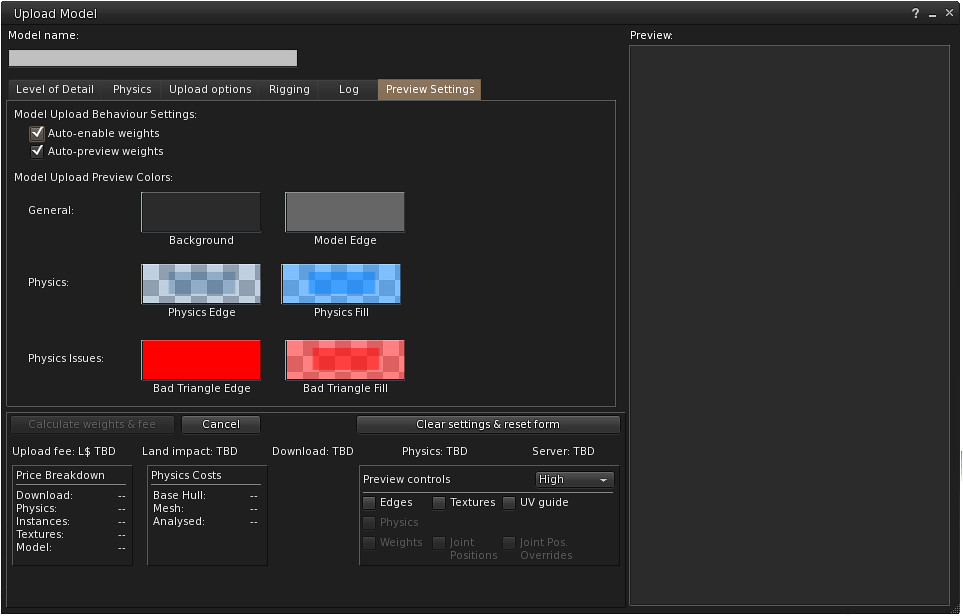
The Mesh Uploader now includes a new tab: Preview Settings.

Mesh Uploader Preview Settings

Preferences Updates

Move & View: Avatar Rotation Speed

  • Movement → Avatar Rotation Turn Speed slider: alters the rate at which your avatar responds to turning. 0-100 as estimated percentage of the maximum turn rate. Note that high values will be snappy/jerky.

User Interface: Use Small Camera Window

With the introduction of Camera Presets, the standard camera floater was revised to include buttons for setting and using the Presets capability. However, some have found this revised floater intrusive.

When checked, Preferences → User Interface → Interface Windows → Use Small Camera Window will replace the revised camera floater with the “old” pre-Camera Preset camera floater. Unchecking the option will display the revised window floater once more.

Using the “old” camera floater

Notes:

  • The revised camera floater can be resized to something approaching that of the “old” floater, for those who would like to retain the new floater but wish to reduce the amount of screen space it takes up.
  • If, for any reason, you revert to an earlier version of Firestorm (while available) with this option enabled, the next time you use Firestorm 6.4.13, you will have both versions of the camera floater displayed. Toggle the setting to correct.

User Interface: Time Format

  • Preferences → User Interface → Top Bars → Time Format: a drop-down allowing you to set the preferred time format (12 hour or 24 hour notation, etc.), as displayed in the top right corner for the viewer.
Time format options

Continue reading “Firestorm 6.4.13 release”

2021 viewer release summaries week #10

Logos representative only and should not be seen as an endorsement / preference / recommendation

This summary is generally published every Monday, and is a list of SL viewer / client releases (official and TPV) made during the previous week. When reading it, please note:

  • It is based on my Current Viewer Releases Page, a list of all Second Life viewers and clients that are in popular use (and of which I am aware), and which are recognised as adhering to the TPV Policy. This page includes comprehensive links to download pages, blog notes, release notes, etc., as well as links to any / all reviews of specific viewers / clients made within this blog.
  • By its nature, this summary presented here will always be in arrears, please refer to the Current Viewer Release Page for more up-to-date information.
  • Note that for purposes of length, TPV test viewers, preview / beta viewers / nightly builds are generally not recorded in these summaries.

Official LL Viewers

  • Current release viewer: Project Jelly viewer (Jellydoll updates), version 6.4.13.555567 and dated February 5th, 2021, promoted February 17th – No change.
  • Release channel cohorts:
    • No updates.
  • Project viewers:
    • No updates.

LL Viewer Resources

Third-party Viewers

V6-style

V1-style

Mobile / Other Clients

  • No updates.

Additional TPV Resources

Related Links

Crossing The Divide in Second Life

The Divide, March 2021

A tweet from Second Life blogger and photographer Rig Torok concerning one of his recent region outings set a bell clanging in the back of my head when it showed up in my time line. It featured an image of, and URL to, a place called The Divide,  was sure we’d visited in the not-to-distant past, but which which failed to show up on my listed of blogged destinations.

That prompted me to rifle through Windows Explorer, and sure enough, there was a folder from December 2019 with a couple of photos of the setting, some rough notes  – and nothing else; so we’d clearly visited, but for whatever reason, had either never fully explored or I’d simply forgotten to go back for photos and write-up thoughts for a post. Hopefully, this piece will therefore make up for things.

The Divide, March 2021

The work of Xen (Xenia Nordberg) and Coriel (Coriel7766), and sitting on a sky platform over a Full private region that leverages the Land Impact bonus, The Divide is described as a study of contrasts, an expression of duality inspired by the works of Hayao Miyazaki.

For those unfamiliar with Miyazaki, he is a Japanese Anime artist, writer, director and producer of animated films. He is internationally regarded as one of the accomplished film-makers and story tellers in the history of animation. His work is characterised by a range of recurrent themes, including humanity’s relationship with nature and technology, elements of which are evident within The Divide, both directly and indirectly.

The Divide, March 2021

Humanity’s relationship with nature is perhaps most clearly shown in the divide within the setting: to one side, and containing the landing point, sits a very Japanese theme town or village. To the other lies a sinuous, climbing valley, the separator between the two a narrow river channel spanned by bridges.

On the one hand, these two settings speak of both more prevalent aspect of our relationship with nature in our standing apart from it in our towns and cities of concrete and glass whilst constraining its presence to parks and gardens. On the other it represents our underlying need to embrace nature and the escape it can offer in its open spaces and amongst its flora and fauna.

The Divide, March 2021

The town itself is a marvellously compact affair that packs a lot into it, which  admittedly can make moving through it a little heavy going thanks to things like texture loads; I found it easier to disable shadow rendering entirely other than when actually taking snapshots, just to get the textures to load in a little faster and to offer smoother walking / camming. Streets run between an assorted collection of buildings, bunting and lanterns stretched overhead as if for a festival, a subway station hinting at a connection with places further afield whilst hiding a surprise.

While a good number of the town’s buildings are simple façades, others offer interiors to be explored, adding depth to the setting’s sense of place. Little side gardens may also await discovery, again harking back to the idea of our relationship with nature in the manner they offer retreats from the hustle of the street life just a few metres away. An interesting curio sits on the west side of the town: a mushroom-like rock rising above the surrounding buildings, topped by an ancient ruin that is itself home to a able-top D&D style game.

The Divide, March 2021

The human / technology reference is also much in evidence throughout, from the very obvious – all the neon signage, the vehicles, and so on – to the more subtle (anyone spot the reference to a certain film franchise focused on technology?). There’s also the pointers to the speed of modern life such as the “fast food” kiosks for grabbing a bite while on the move, countered by little temple-like places where life can be put on pause and more spiritual matters addressed.

Across the water, the valley and parkland offers the means to escape and explore and presents an interesting mix of themes and ideas. There are Chinese elements such as the of pandas in their bamboo copse, for example, and more studies in our relationship with nature, notably typified by the little shrines along the path that climbs up into the hills.

The Divide, March 2021

To the south of the setting, beyond a bamboo curtain sits a ramshackle home. Reached via a concrete bridge, it again echoes the ideals of relationship: humans living within nature, with our relationship with technology represented through the use of a converted shipping container for the house – the same kind of contain that is used to transport all our little electronic and computerised gizmos around the globe aboard massive ships guided by satellites circling the world high overhead.

Some of the landscaping along the valley and its climbs could perhaps do with a little tidying up, but as long as you follow the paths and steps, you shouldn’t have too much of an issue in finding your way around. Make your way all the way to the top of the steps that wind up through the head of the valley, a zipline awaits to offer a faster way back down – just mind the trees on your way!

The Divide, March 2021

Rich in detail, expressive in design, The Divide presents a lot to be discovered and enjoyed. My thanks to Rig for the reminder.

Slurl Details

Space Sunday: vistas of Mars and more on rockets

Released on March 5th, 2021, this image was captured on February 22nd, 2021 (Sol 4), using the Mastcam-Z system on NASA’s Perseverance rover. It shows a raised section of outflow delta sediments approximately 2.3 km west of “Octavia E. Butler Landing”, where the rover touched down. It was likely formed by material carried into the crater by flowing water that gradually settled as the flow of water met the calmer waters of the crater lake. The remnant is approximately 25-30m high and some 200m across at its base, as indicated by the horizontal scale. Beyond it can be seen the crater wall forming the backdrop to the image. Credit: NASA/JPL

NASA’s Mars 2020 Perseverance rover has spent a further week prepping itself to commence full-time operations on Mars, while also clocking up a distance of 90+ metres while further exercising its driving skills. The mission has also started honouring the Navajo people and their language.

Prior to the mission launching, the science team divided the anding site in Jezeo Crater into a grid with each cell covering an area of 1.5 square kilometres and after a US national park exhibiting similar geology. The plan was to compile a list of names inspired by each cell’s national park that could be used to name features observed by Perseverance. However, as the rover landed in the cell named for Arizona’s Canyon de Chelly National Monument (Tséyi’ in Navajo), in the heart of the Navajo Nation, the mission team reached out to the Navajo Nation through team member Aaron Yazzie, himself a Navajo (or Diné), to seek their permission and collaboration in naming new features on Mars.

Navajo Nation President Jonathan Nez, Vice President Myron Lizer enthusiastically agreed to the idea and worked with advisers to make an initial list of 50 words in the Navajo language that could be used by the rover’s team in  dubbing surface features imaged by the rover.

The partnership that [we have] built with NASA will help to revitalize our Navajo language. We hope that having our language used in the Perseverance mission will inspire more of our young Navajo people to understand the importance and the significance of learning our language. Our words were used to help win World War II, and now we are helping to navigate and learn more about the planet Mars.

Navajo Nation President Jonathan Nez

“Máaz” (Navajo for “Mars”) is currently the first target for scientific study by Perseverance. Credit: NASA/JPL

These names have already started to be used, and more are being added to the list. There is, however a complication: the accent marks used in the English alphabet to convey the unique intonation of the Navajo language cannot be read by the computer languages Perseverance uses. So instead, the science team is working with the Navajo to produce unaccented phonetic representations of the names which the rover can interpret.

The first of the Navajo names to be used is “Máaz” (the Navajo word for Mars – or “Maaz” to the rover). It has been applied to the first target for study by the rover, a large, flat rock the rover is due the commence studying soon. A second rock, dubbed “Yeehgo” (Yéigo in Navajo) has been used as a test subject for the rover’s SuperCam.

“Yeehgo” some 3.1m from the rover was used as a test subject for the SuperCam imager system and lasers on March 10th (Sol 16), during the rover’s driving operations. This images so the image contrasts from Navcam imagers (main picture) to Mastcam-Z (lower right) and Supercam mosaic of 2 images.Credit: NASA/JPL

Developed jointly by the Los Alamos National Laboratory (LANL) in New Mexico and a consortium of French research laboratories under the auspices of French space agency CNES, SuperCam is an instrument suite that can provide imaging, chemical composition analysis, and mineralogy in rocks and regolith from a distance. It comprises two lasers that can “zap” rocks and other features multiple times per second while using it imaging system and four spectrometers to analyse the vapour and dust given off by the laser strikes to determine the composition of the material struck and potentially identify bio-signatures and assess the past habitability of the rock.

“Yeehgo” was used as a means of testing the resolution of the Remote Micro-Imager (RMI) on the SuperCam system, with the rover’s high-resolution Mastcam and Navcam systems (both of which are mounted on the rover’s mast just below the SuperCam) also capturing images for context. The rock was also a target for the laser systems, which the on-board microphones picked up as they fired, the lasers sounding like a fast swinging Newton’s Cradle (sorry, no “pew-pew!” from Mars).

Since departing “Octavia E. Butler Landing” the rover has been scouting locations of interest,  in particular looking for an area when it might safely drop off the Ingenuity drone helicopter. The latter is intended to complete its test flights in the first 30-60 days of the mission in order to free-up the rover so it can drive much further afield and get on with its primary science mission in earnest.

Along the way, Perseverance paused to take in objects such as the rocks mentioned above, and to perform checks of its underside using the imaging systems on its robot arm, checking on the ejection of the “belly pan” covering the underside caching system that will deposit samples of rock and material for collection by a future sample-return mission.

I’ll have more on the Mars 2020 mission over the coming weeks.

Left: March 12th (Sol 18), the imaging system on the rover’s robot arm is used to check the underneath of the vehicle ahead of the release of the belly pan (outlined) covering the sample caching system. The four forward cameras of the Hazcam system can be seen at the top of the picture. Right: March 13th (Sol 19), a view from the rover’s rear Hazcam system images the belly pan on the ground as the rover resumes its drive. Credit: NASA/JPL

Continue reading “Space Sunday: vistas of Mars and more on rockets”

Celebrating St. Patrick’s Day with Seanchai Library

Seanchai Library

It’s time to highlight another week of storytelling in Voice by the staff and volunteers at the Seanchai Library. As always, all times SLT, and events are held at the Library’s home in Nowhereville, unless otherwise indicated. Note that the schedule below may be subject to change during the week, please refer to the Seanchai Library website for the latest information through the week.

Sunday, March 14th,19:00: The Quiet Man

Released in 1952, John Ford’s The Quiet Man is regarded as a classic Irish-American romantic comedy / drama. Starring John Wayne, Maureen O’Hara (and assorted members of their RL families!) and Barry Fitzgerald, it is a popular choice among critics and film-lovers.

The screenplay for the film was drawn in a large part from a short story of the same name originally published in 1933 in the Saturday Evening Post, and penned by Irish author, Maurice Welsh. Together with a number of other short stories by Walsh, The Quiet Man was gathered into a single volume of his short stories, The Quiet Man and Other Stories, which dealt with many recurring characters living in rural Ireland of the 1920s, and set against the backdrop of the civil unrest which affected the country at that time, while examining the complexities and occasional intrigues of life, love and Irish traditions.

Join Caledonia Skytower as she reads Walsh’s original tale of The Quiet Man, Paddy Bawn Enright to mark the upcoming 2021 St. Patrick’s Day.

Monday, March 15th: 19:00 Leviathan

In 1914, the world is divided into Darwinists and Clankers. The Darwinists have evolved genetics to make animals more useful to humans. The Clankers have built their society on machinery technology.

Prince Aleksandar Ferdinand, the would-be heir to the Austro-Hungarian throne and part of the Clankers, has spent his life facing an uncertain future: because his mother was of common blood, he has been barred from taking his father’s title in the fullness of time.

But when his father and mother survive Gavrilo Princip’s assassination attempt in Sarajevo only to be poisoned later the same day, Aleksandar finds himself the centre of intrigue. Despite the fact that he has no legitimate claim to the throne, the Germans are intent on neutralising him, fearful that he might nevertheless unite the people behind him, possibly fracturing the alliance of nations forming the Clankers.

Forced on the run aboard a battletorn war machine crewed by a handful of men loyal to his late father, Aleks encounters Deryn Sharp, a young woman who has disguised herself as a boy to serve aboard British Air Service Leviathan, a living whale flying ship.

Despite their differences, and with the inevitability of war darkening every horizon, Aleks and Deryn embark on a fantastical, around-the-world adventure that will change both their lives forever.

Join Gyro Muggins as he dives into Scott Westerfield’s 2009 novel of an alternate past.

Tuesday, March 16th

12:00 Noon: Russell Eponym, Live in the Glen

Music, poetry, and stories.

19:00: Darby O’Gill and the Banshee’s Comb Part 1

With Shandon Loring.

Both sessions at The Glen.

Wednesday, March 17th, 19:00: St Patrick’s Day Special at The Glen

  • 15:00: The Quiet Man reprise with Caledonia Skytower.
  • 18:30: Celtic music (with dancing!) from Ktadhn Vesuvino.
  • 19:0;: The Poetry of Ireland with Shandon Loring.

Thursday, March 18th 19:00: Darby O’Gill and the Banshee’s Comb Part 2

With Shandon Loring.