A Northern Shore in Second Life

Northern Shore, December 2019 – click any image for full size

On Sunday, December 8th, 2019 Elvira Kytori opened Northern Shore, a Full region forming part of her White Dunes estate. Primarily a residential region, it offers some waterfront public spaces.

Normally I’d be hesitant in blogging a region like this, simply because the public areas are so localised, and there is a risk of visitors accidentally intruding into tenant’s homes. However, Northern Shore  – as is often the way with Elvira’s designs – offers something just that little bit different.

Northern Shore, December 2019

To get directly to the point, Northern Shore is inspired by Stockholms skärgård, the Stockholm archipelago. The largest archipelago in Sweden, comprising approximately 24,000 islands and islets. Many are home to private houses, villages and small towns, and during the winter, the sea between come of the islands can freeze over. Most interestingly, all the the isles in the chain are subject to Allemansrätt (or “everyman’s right”), a law which gives anyone the right to go ashore or anchor on any ground not in the direct vicinity of buildings.

It is the rich diversity of islands within the archipelago that Elvira has sought to capture within the confines of a single region – and she has done so exceptionally well. Scattered across Northern Shore in such a way as to look entirely natural, is a series of islands and islets of varying sizes with rocky outcrops spaces around them. Some of these islands – notably the larger ones – have the rental properties on them, others off tributes to the fishing and formed a part of Skärgården’s history.

Northern Shore, December 2019

The landing point is to be found on one of the largest two islands in the group. It faces a broad, iced-over channel to face the waterfront of the other large island. Both offer working wharves for fishing boats – although none will be putting to sea given the presence of the ice. Wharves extend out into the waters, while boathouses, cabins, and places of business line the shore, although the paths and walks linking them are few: visitors must pick their way over the rocks in places.

Inland from these lie the rental houses, all of which are wooden built, their exterior boards painted in what might be seen as a “typical” Scandinavian look. These sit within their own parcels, many of which can be distinguished by gate and fence or line of trees; others may not be so obviously demarked – hence the need for care when exploring.

Northern Shore, December 2019

Travelling between islands is a matter of walking on the ice – or, if you prefer, by skating (which is welcomed) by those with skates. But again, be aware that several of the smaller, outer islands are also given over to rentals and may not offer much in the way of public spaces.

For those interested in living within this northern winter setting, the parcels in the region can be rented via the mail boxes on their walls. For those who enjoy photography, images can be submitted to the White Dunes estate Flickr group. While for those who enjoy exploring Second Life, the region makes for an engaging visit.

Northern Shore, December 2019

With thanks to Shawn for the pointer!

SLurl Details

Lalawood: unconventional, interactive and anarchic

Lalawood, La Maison d’Aneli

Now open at La Maison d’Aneli, curated by Aneli Abeyante, is a multi-level collaborative installation entitled Lalawood which is quite the most unconventional – and potentially controversial (for some) interactive installation I’ve seen in Second Life for quite a while.

Designed by Onyxxe, Iono Allen, JadeYu Fhang and Theda Tammas, Lalawand is difficult to quantify. Intended to be humorous, it is also in part pointed, perhaps controversial, irreverent (with what appears to be a healthy dose of self-satire), anarchic and – perhaps most of all – unconventional.

You never heard of LALAWOOD? What a pity! It is the best playground in Second Life. A kind of LEGOLAND, just without the first L. Yes you understand well. Finally a place where you are allowed to show off your talents, value and persona without any restraints … You will meet kings, queens, godfathers, godmothers and many other successful gods. You even can bump at Philip Linden while wandering around.

– Onyxxe, describing Lalawood

Lalawood, La Maison d’Aneli

The installation comprises six levels, including the landing point where something of an introduction to the installation is to be found, together with instructions on how to best view the installation. From here there is a teleport to the first actual level of the installation itself.

To describe the five primary levels of the installation would be to spoil the element of discovery and perhaps unduly influence personal interpretation of Lalawood. suffice it to say each includes interactive elements, starting with the “iLala” music player that provides a music track to accompany your exploration of the installation (it is essential you have local sounds active). These interactive elements combine in-world objects and those presented to your inventory you are asked to add to your avatar.

Perhaps the easiest way to define Lalawood is that it is an exploration of self and the role of ego in our Second Life persona. In this, it raises topics we may well find familiar through our experiences in Second Life (the roles of sex and drama), and a sideways look at many of the attractions / activities people find within the platform (artistic expression, creativity, the ability to generate income), and how these might affect, challenge and change us.

Lalawood, La Maison d’Aneli

In this, the presentation of the themes might best be termed anarchic; some may seem to border on being insulting to those who engage the the various pursuits noted above (art, etc.) – hence why a sense of humour is emphasised in the instructions for the installation. However, there is a strong dose of self-irreverence on display by the four artists themselves as they satirise themselves as much as anyone else.

How one responds to Lalawood really does come down to a mix of personal sense of humour and ability to interpret the various elements found throughout its different levels. I confess that while I found myself smiling in places, in others I found things perhaps a little forced, while the inconsistency of teleports (some are interactive click-to-TP, others open the map and require a manual TP) a little distracting as the latter drew me out of any sense of being involved in the installation. So I’ll leave it to you to plumb the depths of the installation and draw your own conclusions, lest anything I might add here unfairly biases your experience.

SLurl Details


High Fidelity changes direction (3): layoffs & shuttering apps and access

via High Fidelity

In April 2019 during a High Fidelity General Assembly meeting, Philip Rosedale announced the company would no longer be sitting within the content creation / public space provisioning area, and would instead switch to focus on software / platform development. He followed-up on that announcement a few days later with a blog post outlining the company’s move to try to develop a virtual workstation / environment that would allow people to work collaboratively whilst geographically separate.

Since that time, the company has been working on the virtual workspace idea, apparently developing it to a point where a desktop versions has been undergoing widespread testing involving teams from some 75 organisations.

However, in a December 11th blog post, Updates and a New Beginning, Rosedale announced that while the company plans to continue use the technology they’ve developed, and hopefully carry it forward into the future, they  do not plan to commercialise it at present, and are again pivoting to a new project.

Simply put, having taken a close look, while we can see that remote work is going to continue on its growth trajectory and we do have customers using it—the opportunity is not big enough today to warrant additional development. 

The work we’ve done over the past six months has been valuable in helping us understand how to make a 3D VR environment usable, stable, and accessible to first-time, non-gaming audiences, and that is intellectual property we will take forward into future work.  

– Philip Rosedale, December 11th, 2019

The pivot means that the company is shedding a further 50% of its staff (approx 40 people, given 20 people, or 25% of staff were let go in May 2019). Further, and as from January 15th, 2020, High Fidelity will be shuttering public access to its code repositories on Github (although users are welcome to fork them, if they wish), and will also be withdrawing all their apps from the Steam and Oculus stores and from the Apple App Store and Google Play.

For now, Rosedale is not revealing what the new project is, but given the shuttering of the current platform code repositories and a comment in the December 11th blog post, it might be related to a more virtual world style of platform / application.

Giving up on the current generation of HMDs doesn’t mean we’re giving up on Virtual Worlds. A team is already working on a new internal project, and although we aren’t going to talk about it now, we will have more to share about what we are doing when we are ready.

– Philip Rosedale, December 11th, 2019

A FAQ has been produced to accompany the blog post, answering core questions existing user might have about platform accessibility, account registrations, blockchain use, buying / selling HFCs, etc. And those who have a High Fidelity account should refer to that document. 

The announcement comes on the heels of a blog post from Rosedale published on December 9th, 2019, in which he continues to ruminate on the hard realities surrounding the state of VR at this point in time.

In Requiem for the HMD, he admits something that many of us have always felt: the the current generation of HMDs can at best only enjoy a modest success, and the technology as a whole still has a long way to go before it is liable to reach a “mainstream” place in the consumer market. In particular, he notes four things he believes the technology requires in order to reach this point: comfort of wearing, the inclusion of see-through displays and at desktop screen resolutions, and the ability of people to be able to type tat normal speeds in VR. To these I’d actually add more fundamental requirements such as cost per unit, overall ergonomics and compelling use cases – but these are topics for another blog post.

In the meantime, Updates and a New Beginning makes for interesting reading, as it offers a further honest evaluation of VR as it is today from someone who has been one of its strongest evangelists. For those who are having to depart High Fidelity as a result of the company’s further shift in direction, the hope is that they are able to transition smoothly into other work opportunities.

For those users who would like to keep the spirit of High Fidelity’s VR platform alive, as noted, they have until January 15th, 2020 to fork the code into their own repositories. There also the likes of Tivoli Cloud in development by former High Fidelity alumni Caitlyn Meeks and Maki Deprez that may blossom into new homes for HiFi users.

Related Articles

Sansar R38 release overview

A Victorian Christmas

On Tuesday, December 10th, Linden Lab deployed the Sansar R38 release, entitled “Rediscover the Party” release. It’s again something of a comparatively small update, but brings with it changes that have been requested by users and creators.

Key updates with this release that are covered in this article comprise:

  • Changes on logging-in.
  • Codex improvements to help world discovery.
  • Events changes.

As always, please refer to the formal release notes for full details of all the updates in R38.

Changes on Logging-In

With this update, existing users are no longer channelled to the Nexus by default (forcing them to cancel the world launch in order to reach their Home Space or Go Home from the Nexus). Instead, existing users are delivered to their Home Space directly on logging-in.

Also, with this release, the Quest Log is closed by default when logging in (as per multiple user requests). It will open automatically on accepting a new quest or can be re-opened manually via Go → Quests.

The Codex and Discovering Worlds

Since the introduction of the Nexus and Prime Portal with the R36 release (see: Sansar: R36 – Avatar 2.0 the Nexus, the Codex and more) there has been concern that forcing users to go to the Nexus and visit the Prime Portal in order to discover new worlds was causing a bottleneck on users willingness to discover new worlds and explore, and simply stick to those within their Codex.

At the time of the R36 release, Linden Lab stated they would monitor the situation and make changes as and when they felt it necessary. With this release, and following the voiced concern and their own tracking of user behaviour, the functionality found in the client version of the Codex has been updated to shift the Prime Portal functionality to the Codex with the Lab noting:

We (and you) found that after the change to make the Prime Portal in the Nexus the hub of all travel we noticed that it was actually much more difficult and confusing, especially for newer players, to find new interesting and populated Worlds to explore.

We’re bringing back the old view which we used to call the Atlas; where all published Worlds were always available from the Explore menu. There’s no longer a requirement to travel to the Nexus and interact with the Prime Portal in order to find new Worlds to explore and people to meet.

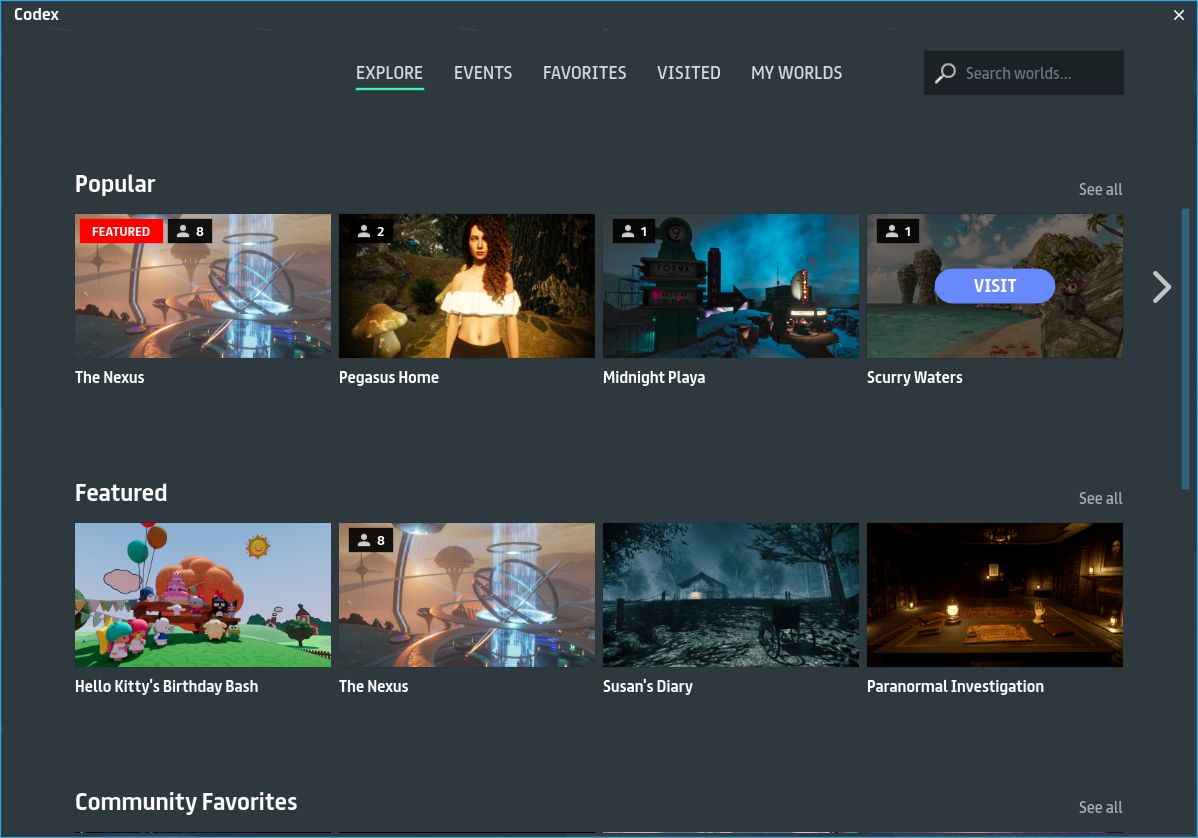
The new-look Codex – avoids the need for users to go to the Nexus and the Prime Portal to discover new worlds

As such, the updated Codex now resembles the Prime Portal panel. By default, it will open on the Explore tabs that offers:

  • A list of events ordered by time and date, with the most recent first.
    • Hovering the mouse over a thumbnail will bring up the Interested button (adds the event to your calendar) or transfer you to the event if it is about to start.
    • Alternatively, clicking on an event thumbnail will display more information about it.
  • Worlds ordered in terms of Popular (visitors at the time the Codex was opened); Featured (those selected by the Sansar team for special highlighting); Community Favourites (worlds that have previously enjoyed a high level of activity by users); New (worlds recently published) Recently Updated (self-explanatory).

Further:

  • In all cases of the above, a full list of events or worlds in each category can be accessed by clicking the See All buttons associated with each category.
    • Note that clicking See All from the Popular list will open a page of ALL published worlds.
  • Tabs at the top of the Codex allow for easy movement between the Explore page and those for Events, and worlds the users has: marked as a favourite; visited; or created.
  • The search and sort options from the Codex remain as per R36.

These changes have been welcomed by users and creators on Sansar Discord.

Events Update

Users can now see the level of interest in an event (web Atlas event page shown)

One of the problem with events – in terms of getting together with other users – is actually seeing how popular an event might be with others ahead of time, rather than on arrival.

To help with this, Sansar R38 introduces a count of those who have registered an interest in an event. This is displayed on the event detail page on the web Atlas or within the Codex / Prime Portal.

However, there is a slight issue with this in the initial release: the number of those interested in attending an event is not registering / updating in the Codex or Prime Portal event details pages.

Feedback

Another small updated compared to R36, but one that responds to multiple requests from users and creators, and which hopefully encourage exploration of worlds by users. I admit that since the introduction of the Prime Portal as the means for discovering worlds, I’ve actually been using the web version of the Atlas in preference to going to the Nexus / Prime Portal, so I’ll be interested to see how the new Codex changes my behaviour in future.  Hopefully the events interest indicator on the Codex  / Prime Portal will be fixed in an upcoming point release.

2019 Simulator User Group week #50 summary

The Boho Refuge, October 2019 – blog post

No major news again this week.

Simulator Deployments

Please refer to the server deployment thread for news and updates:

  • On Tuesday, December 10th, the SLS Main channel was updated to simulator version 2019-12-04T20:29:26.533447, originally deployed on Thursday, December 5th, and comprising:
    • A build of release 2019-11-15T21:13:13.532828 using new build technology.
    • Addresses some cases of scripts erroneously stopping.
    • Fixes a crash.
  • On Wednesday, December 11th, there should be an RC deployment to the BlueSteel RC. Simulator version 2019-12-06T21:03:45.533558 comprises internal fixes.

Deployment Notes

  • The Tuesday deployment started a little later than usual.
  • Further, as some of the processes managing deployments are being modified to increase stability, some deployments may run longer than usual. Once this work has finished, it is hoped deployments will be faster and more stable.

SL Viewer

At the end of week #49, the following viewers were updated:

  • On December 4th, the Maintenance RC viewer updated to version 6.3.5.533275.
  • On December 5th, the Love Me Render RC viewer updated to version 6.3.5.533347.

On Monday, December 9th the Copy / Paste project viewer updated to version 6.3.5.533365. The rest of the official viewer pipelines are as follows:

  • Current Release version 6.3.4.532299, formerly the Ordered Shutdown RC viewer, dated November 4th, – No change.
  • Release channel cohorts:
  • Project viewers:
    • Project Muscadine (Animesh follow-on) project viewer, version 6.4.0.532999, November 22nd.
    • Legacy Profiles viewer, version 6.3.2.530836, September 17th. Covers the re-integration of Viewer Profiles.
    • 360 Snapshot project viewer, version 6.2.4.529111, July 16th.


A B&B winter in Second Life

B&B ‘Let it Snow’, December 2019 – click any image for full size

Occupying a quarter full region held by Belle Onedin and Blue Blauvelt that they’ve opened to the public as a winter setting for photography and appreciation. Using the title Let it Snow. It’s a charming, highly photogenic setting suggestive of a coastal village with a slight fairytale look to it.

B&B ‘Let it Snow’, December 2019

It’s a setting that doesn’t need an extensive amount of description. centred on a small square of over-sized cobbles, it features two snow-bound cottages and a towered house, all of which are in various states of readiness for the holiday season. Trees are decorated, presents are wrapped and snowmen are waiting to greet visitors in gardens surrounded by dry stone walls while paths wind their way between and around the homes.

B&B ‘Let it Snow’, December 2019

Around them, the snow falls steadily (which can impact viewer performance, but adds depth to the setting), encouraging visitors to wrap up and look the part – and the sense of frigid air is increased by the the off-sim snowy islands that have been placed off-shore.

B&B ‘Let it Snow’, December 2019

Opportunities for photography in this setting are manifold, indoors and out – and even on the icy water on a rowing boat (although the snow can make touching it to sit on it a little difficult).

There are also charming little touches to be found that help give life to the setting without making it appear twee. These include an Saint Bernard and her pups making the most of a igloo kennel, the shell of an old greenhouse turned into a cosy snug tucked away in the lee of an old wall and under the shelter of snow-laden trees and a wolf howls from a snow-covered hill, while pheasants fuss around a truck that seems to be filling-in for Santa, given the sack and gifts that has fallen from its flatbed.

B&B ‘Let it Snow’, December 2019

I could wax lyrical over this setting – but really, it is a place that that deserves to be seen (just do give things an opportunity and load and render). There is something decidedly delightful about the location, which also avoids a fair few of the props and items that tend to appear in multiple winter regions, and so offers a visit  that is very worthwhile. Those taking photos are also invited to submit them to the parcel’s Flickr group.

Do be sure to drop in and see for yourself.

B&B ‘Let it Snow’, December 2019

SLurl Details