Kun-Tei-Ner: a water world in Second Life

Kun-Tei-Ner; Inara Pey, May 2019, on FlickrKun-Tei-Ner – click any image for full size

Update: in keeping with Lotus and Fred offers different regions designs through the year and at different locations, Kun-Tei-Ner has closed. Slurls have therefore been removed from this article.

Kun-Tei-Ner is the name of the latest region design by the combined talents of Lotus Mastroianni and Fred Hamilton (frecoi). Between them, Lotus and Fred have been core parts of the design teams behind the likes of The Missing Whale (see The Missing Whale in Second Life), Little Havana (see A trip to Havana, with a little Voodoo In My Blood) and, most recently HoPe (HoPe: a world without humankind). In some ways, Kun-Tei-Ner, which opened on May 19th, 2019, is a continuation of HoPe.

With HoPe, we were presented with an environment that had suffered some kind of catastrophe, at least one part of which appeared to have been some form of natural disaster. In Kun-Tei-Ner, the theme of the natural disaster / event is continued, with the world apparently having suffered a massive ecological and environmental change, leaving it pretty much a water world, as the description of the region explains:

This is a place years ahead of us with no land. Humans have produced a lot of things…and many things are [now] useless. A city grows up on a huge mountain of containers filled with broken technological stuff, abandoned or fallen from ships.

Kun-Tei-Ner; Inara Pey, May 2019, on FlickrKun-Tei-Ner

And so it is that we are invited into one of the most unique and original environments currently to be found in Second Life: a marvellous mini archipelago of tall, close-packed islands rising from the sea, built from shipping containers gathered from who-knows-where, brought together to create the shoreline, hills, apartments and places of commerce this corner of humanity’s survivors treat as home.

Stacked together like Lego® bricks – and almost as colourful – the containers form everything one might expect from a close-packed group of islets: there are high peaks, valleys, ocean fronts, low-lying “flatlands” … Yes, all are obviously painted metals, but attempts have clearly been made to make things look more natural and return a hint of nature to the setting, with ivy and vines strung from the sides of some containers, well clear of where they might otherwise be splashed and contaminated by salt water.

Kun-Tei-Ner; Inara Pey, May 2019, on FlickrKun-Tei-Ner

The containers that have been converted into homes have had holes cut into their sides or have had their end or doors removed, the holes replaced by wooden frames, sliding doors, and windows cut from what looks to be sheets of acetate plastic. Others offer places of commerce: a pizza bar here, an little Japanese-style food market there ….

These, with their lit neon signs, at first look incongruous given the overall theme of the setting, but it is clear that power is not an issue here: the upper reaches of the container “hills” are lit by flashing neon billboards, and someone has taken the opportunity to place traditional wooden advertising hoardings up as well. Perhaps some of the power for the neons signs comes from the wind turbines sitting just of the “coast” of these iron islands, but there are signs of other industrial activity as well: great pipes rise from the waters to plug themselves into containers, while others run from one set of containers to another as a tall smoke stack belches orange smoke to drift in the wind.

Kun-Tei-Ner; Inara Pey, May 2019, on FlickrKun-Tei-Ner

It is clear from this that there is some form of heavy plant hidden within some of the stacked containers. Does it provide power? is it helping to grow foodstuffs hidden by corrugated steel walls? That’s up for you as a visitor to decide. There are other signs that technology has survived as well: a large satellite communication dish points its eye towards a spot in the sky, while a satellite receiver appears to be obtaining video signals from another orbital system.

Finding your way around the islands is a matter of following the LED arrows on the floors and walls of the containers, while bridges formed from wood and rope, open-ended container and metal gantries connect the different islands. The arrows point to multiple routes and passages around the islands, making exploration a walk of discovery, at least some of which is observed from above by a flying sculpture of a whale shark.

Kun-Tei-Ner; Inara Pey, May 2019, on FlickrKun-Tei-Ner

The paths offer a lot to see, from the interiors of the living containers, to the food market and pizza bar to multiple places to sit, indoors and out. They can also offer plenty of opportunities for photography.. Just be sure to give the region the time it deserves when visiting.

The region designs by Lotus and Fred are generally available for around a month before they kick-off their next project. So, in case that will be so for Kun-Tei-Ner, a visit sooner than later might be advisable to avoid missing what is – as noted – a fascinating setting worthy of exploration.

Promoting Second Life: LL at MomoCon

Linden Lab’s booth at MomoCon 2019. Credit: Linden Lab

During a couple of his public chat sessions in 2018, Linden Lab CEO Ebbe Altberg indicated that as well as continuing with the work to enhance Second Life, introducing new technology and new capabilities, Linden Lab would also be looking at new ways that might help grow the Second Life user base, possibly through a number of different channels / approaches.

One of the more interesting of these approaches is taking place between May 23rd and 26th, 2019, as Second Life makes a début at MomoCon 2019 in Atlanta Georgia.

Defined as a “geek culture convention”, MomoCon is an annual event held in wither March or May of each year, which the official website describes as:

One of the fastest growing all ages conventions in the country. Fans of Japanese Anime, American Animation, Comics, Video Games, and Tabletop Games come together to celebrate their passion by costuming / cosplay, browsing the huge exhibitors hall, meeting celebrity voice talent, designers, and writers behind their favourite shows, games, and comics and much, much more over this 4 day event.

– Official MomoCon website

MomoCon has its roots deep within the anime community – it started life as a offshoot of Georgia Tech’s anime club, Anime O-Tekku, with the first convention, called Techwood Con, held in 2004. In 2005, it became MomoCon (“momo” being Japanese for “peaches” and Georgia being the Peach State), and the convention enjoyed rapid growth over the next few years as a free-to-attend event.

In 2012, MomoCon became a paid-to-attend event, and experienced massive growth: in 2018, for example, over 35,000 unique visitors attended the convention over its four days, with a programme encompassing anime and animation, games, comics, manga, contests, demonstrations, cosplay activities, photo shoots, screenings, concerts, robot wars, and more.

Visitors have been dropping into the booth since the conventions opened. images credit: Linden Lab

While such a venue for the presence of Second Life might initially seem a little unusual, the fact is that there is a rich and vibrant cosplay community in Second Life, some of which does encompass anime, which also has a large following among Second Life users. As such – and given the event is also about on-line activities – there is a potential for Linden Lab and Second Life to engage with people face-to-face and potentially bring new users into the fold. A further reason for appearing at MomoCon in particular is that Linden Lab have a physical presence in Atlanta, with their support centre being located there, thus making the logistics of an appearance at the convention somewhat easier.

Even so, the company’s presence at MomoCon does represent something of an experiment for Linden Lab, as their head of Second Life marketing, Brett Linden noted to me.

This is our first presence at MomoCon and it represents a new test for us to try in person outreach at themed consumer events where we feel there is potential to introduce Second Life to new audiences. As part of our presence, we are demoing Second Life to attendees with the goal of registering new users on site.

– Brett Linden, heads of Marketing for Second Life

How successful the booth might prove to be remains to be seen. Certainly, Sansar has spent a fair amount of time “on the road” over the last couple of ears, which if nothing else, can help raise brand awareness. As such, seeing Second Life out and about  – and possibly able to both garner users and / or change preconceptions is worth the time and effort. Depending on the Lab’s view of how things went, and their willingness to discuss them I hope to have a follow-up on this a little further down the road.

With thanks to Brett Linden for taking  time out for his vacation to discuss the Lab’s presence at MomoCon with me. 

I’ve been Eclipsed!

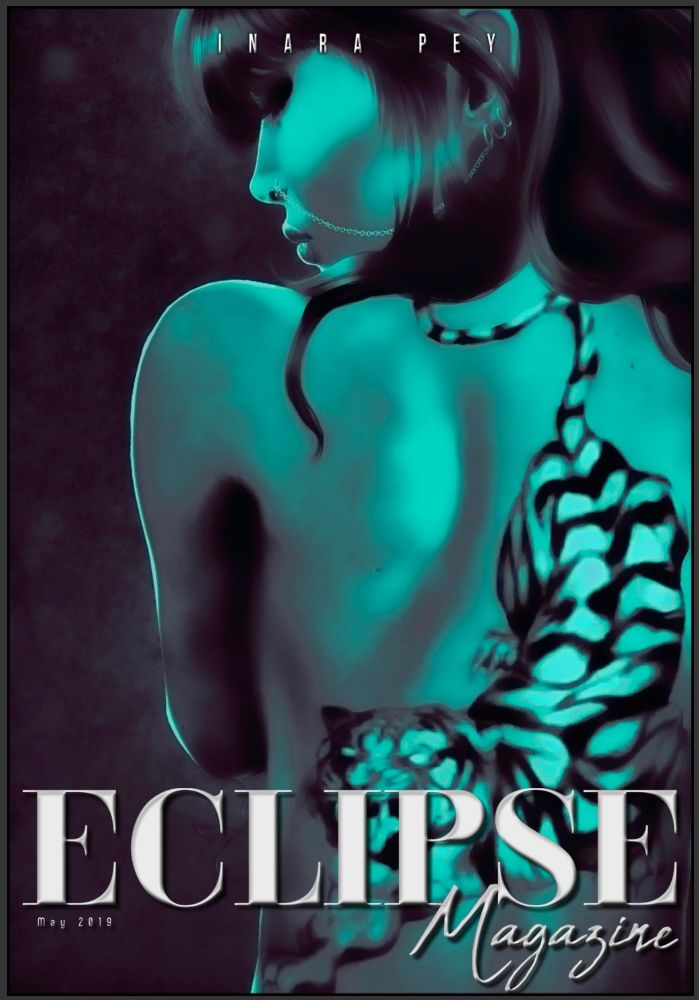
Eclipse Magazine May 2019 cover

In April 2019, I was approached by Trouble Dethly, the owner / publisher of Eclipse magazine with a request that caught me off-guard: would I like to be the cover feature in the May 2019 issue of the magazine.

I say “taken aback” because the request came out of the blue and also because the cover features in Eclipse are intended to “showcase … a group or resident that has taken the Second Life concept of “‘your world, your imagination’ to such extraordinary heights that it has greatly impacted the culture and lifestyle of this virtual community.” Leaving both false modesty and ego firmly locked in a biscuit tin hidden under the floorboards of my mind, I really don’t see myself fitting this description.

However, after discussing things with Trouble a little more, I opted to go ahead, and the May issue came out (for me, being in the UK) in the “wee  small hours of the morning” (so to speak) of Thursday, May 23rd, 2019.

Within it is a celebratory article on the team behind FaMESHed, as they mark their seventh anniversary – a piece that makes superb reading; a tour of featured Linden Homes in Bellisseria; a perspective on Moki Yuitza’s Into The Net (which I also examined at the start of the month) and a host of regular columns covering home and garden décor, photography, fiction, places in SL to visit and readers’ own stories. All of which adds up to a cornucopia of interest quite outside of yours truly.

In closing, I’d like to offer my thanks to Trouble for both the invitation to be featured in the magazine and for encouraging me to do so, to Cajsa Lilliehook for the interview and turning a veritable wall of textual ramblings from me into something coherent, and especially to Lessthen Zero for the time she took in photographing me – I genuinely loathe having my photo (real or virtual) being taken, and Lez did so much to put me at ease and produced some truly amazing (and flattering!) shots, and the unnamed photographer who toured some of my favourite SL locations to take additional photos for inclusion in the piece.

You can catch all issues of Eclipse on-line, with the May edition available directly here: https://issuu.com/eclipsemagazinesl/docs/eclipse_magazine_may_2019.


Captivated by FionaFei’s art in Second Life

FionaFei: Shuǐmò

Shuǐmò, or shuǐmòhuà (suiboku-ga in Japanese), is a type of East Asian ink wash painting that uses different concentrations of black ink to create an image. It first emerged in Tang dynasty China (618–907), before spreading to Japan (14th century), Korea and to India. Beside the use of black ink in place of colours, it is also marked by the emphasis of the brushwork being on the perceived spirit or essence of the subject, rather than directly imitating its appearance.

It is also a form of art that has been quite marvellously brought to life by Second Life and physical world artist FionaFei as the basis of her latest art exhibition. This features a core element called Wo Men Dakai, which Fiona describes thus:

Wo Men Dakai (Chinese for “My Door Opens”) is an art installation I’ve created in the style of Chinese ink brush painting. The purpose of the space is for a role-play Firefly-based RP where my RP character YiLi graduates into a Registered Companion. However, the inspiration for the creation is from my own personal artistic journey in real life and in second life, and most of it really stems from who I am as an artist in both realities.

– FionaFei

FionaFei: Shuǐmò

While not everyone might be familiar with Joss Whedon’s (too) short-lived science fiction TV series Firefly (from which I freely admit taking my first name in Second Life!), having such knowledge is not s prerequisite for any visit to, or appreciation of, this installation.

From the landing point, visitors are invited to walk along unrolled scrolls of xuan paper, the traditional material for Shuǐmò painting. On these are painted the Chinese symbols for Wo Men Dakai as they point the way to a pair of great red doors. When touched, these will slowly open (just give them time) to reveal the gallery space proper.

FionaFei: Shuǐmò

This is a spherical space that is the embodiment of shuǐmò; a Chinese water garden wherein all the major features are produced as ink wash images / pieces: the bridge, the lilies floating on the water, the rocks on which the art is displayed, the overhead rocks from which water falls in black-and-white lines to fill the pool of the water lily garden.

FionaFei: Shuǐmò

Shuǐmò might be described as an ancient Oriental form of what we in the west call impressionism; a form of art where – as noted above – the aim is to capture the essence, not imitate the physical.

So, for example, when painting an animal, the ink wash painter seeks to present the animal’s temperament, not is muscles, sinews and bone structure. And so it is with the gallery structures here: the form and essential essence of the bridge, the lilies and surrounding plants are provided, while the intrinsic details: complete railings on the bridge, the details veins on leaves and petals is not so relevant.

Within the space are two marvellous and contrasting selections of art.

The first is a trio of 3D pieces, again in a traditional Chinese style bordering on shuǐmò, but which use add splashes of colour – red and green – that, together with the animations – bring a sense of life and vitalities to the pieces in an completely enticing manner.

The second is a beautiful set of charcoal on newsprint studies of the human body. These fourteen drawing offer the strongest contrast to the shuǐmò theme, presenting as they do a very western approach to anatomically detailed art featuring the human body, male or female – but which, through the use of charcoal in varying concentrations, nevertheless contain within them an echo of shuǐmò.

“I see life and my journey as a painting. It can be forever an evolving piece,” Fiona notes of her art. “At any given time, you think you’ve reached the end of it, but you can always add to it, layer it, and change it. In a sense, each brush stroke is like a footprint.”

In recognition of this, and as a part of the interactive nature of the exhibit, visitors are invited to take a selection of footprints (shoes, bare feet and paws), wear them, and leave their own marks (albeit temporary) as they “follow their own path” through the installation. There are also some koi carp gifts available at the landing point as well.

FionaFei: Shuǐmò

A truly marvellous exhibition by a wonderfully talented artist – but don’t just take my word for it. Go and see for yourself. My thanks to Pieni for the pointer!

SLurl Details

A farewell to Chouchou?

Chouchou, 2018

Update, October 1st: it has been announced Chouchou will remain in Second Life as part of the Second Life Region Preservation Society (SLRPS) – see Chouchou set to remain in Second Life – and there’s more for details).

Update, May 23rd: following an e-mail exchange on May 23rd, Second Life user Rikutojam from Japan, who managed to contact Juliet Herberle, one half of ChouChou, Rikutojam was able to confirm that it is the couple’s wish that the Chouchou region close in late June.

Reports that the ChouChou regions look set to close “soon” have been doing the rounds over the last 24 hours, together with hopes that Linden Lab might be able to step in and preserve the regions as a part of Second Life’s cultural heritage.

Designed by Japanese pianist Arabesque Choche and vocalist Juliet Heberle, who together form the successful musical duet of Chouchou, the regions are among some of the longest running, unchanged private island environments to be found in Second Life, and are an absolute delight for all who encounter them. I made my first visit in 2012 (see Chouchou: blending music and art in SL), and have been back many times since, being particularly drawn to the sky build of  Memento Mori (located on ChouChou V), a quite remarkable cathedral.

Chouchou: Memento Mori

A Collaborative build by Juliet in collaboration with Miya Grut, and with the support of Yuki Aabye, this is a build pre-dating mesh and is utterly stunning in the intricate beauty of its construction. It’s a place to go when one wants to contemplate thoughts and gain a measure of piece – and which marks ChouChou is a place worthy of preservation entirely on its own.

But it stands far from alone; from the timeless minimalist beauty of the waterlogged ground level, through to Memento Mori and passing by way of Islamey, another sky build, ChouChou is truly an artistic delight.

With its tea house built over water, and walks under cherry blossoms, Islamey was once the venue for concerts, and remains another place for quiet contemplation; somewhere you can come when you want to give free passage to thoughts and ideas, or when you simply want to let Chouchou’s music gently soothe you.

ChouChou: Islamey

As I noted in my last article on ChouChou prior to this one (see Return to Chouchou and a musical crossing of the divide, from 2018), the regions are quite transcendental in presentation and emotional response. Therefore, and if you have not visited it before or if you wish to renew your memories of these stunning regions lest they do vanish from Second Life, I would strongly suggest you visit them in the next few days.

In the meantime, and if I may, I’ll leave you with my own 2018 video of Memento Mori.

SLurl Details and Links

2019 SL User Groups 21/1: Simulator User Group

Amrum; Inara Pey, April 2019, on FlickrAmrumblog post

Server Deployments

There have been no release notes for the week #21 deployments. however:

  • On Tuesday, May 21st, the SLS (Main) channel updated to server maintenance package 19.05.10.527185, containing internal fixes.
  • On Wednesday, May 22nd, the three RC channels updated with server maintenance package 19.05.17.527341.

SL Viewer

  • The Alternate viewer wiki page has now been retired and replaced by a new Alternate Viewers page.
  • The de facto release viewer was updated to version 6.2.2.527338, dated May 20th, formerly the updated Teranino Maintenance RC.

The rest of the current SL viewer channels remain as:

  • Release channel cohorts:
  • Project viewers:
  • Linux Spur viewer, version 5.0.9.329906, dated November 17, 2017 and promoted to release status 29 November – offered pending a Linux version of the Alex Ivy viewer code.
  • Obsolete platform viewer, version 3.7.28.300847, May 8, 2015 – provided for users on Windows XP and OS X versions below 10.7.

In Brief

  • Teleport Fail Issues: following the last Server User Group meeting on Tuesday May 14th, there was a test of a teleport fix Simon Linden had been working on, and a further test was carried out following this week’s meeting, with Simon Linden commenting:

Last week’s test was really helpful – it showed that one problem seemed to be fixed, but exposed another one that I hope is fixed this week. If it goes well, that new teleport code may go out onto RC channels next week.

  • Teleport Attachment Issues: this is a separate issue to that being investigated by Simon Linden, and which is more related to . there’s no current update on the work being put into fixing this, but as Simon observed in the meeting:

As far as I know, the problems with attachments tend to be with crossings and not teleports … while much of the code is the same, there’s usually a fundamental difference in crossings because you’re already connected to that region before you go there, whereas with teleports you are not … which was part of the big disconnect issue we had before.

  • Script Processing Issues: as reported in my week #18 SUG summary, there have been numerous reports of script run time issues, with some reporting that problems only started occurring following the roll-back on April 18th, 2019. BUG-226851 outlines some of the problems. The Lab are looking into this, but at present there are no updates on the problem.