Sansar Product Meetings week #16: Lindens and events

Skye Naturae Virtualis

The majority of the following notes were taken from my recording of the Sansar Product Meeting held on Thursday, April 18th, which served to introduce members of the Sansar team, discussing changes to featured experiences, and raised the possible instigation of a possible Office Hours with the product team. The meeting was followed on April 19th by an announcement concerning the use of PayPal as a supported payment service provider, which is noted at the end of this report.

Lindens

The meeting took the opportunity to introduce:

  • Kelly Linden: Kelly is worked at the Lab for 15 years, obviously primarily with Second Life, where he headed the scripting team; he now leads the scripting development team for Sansar.
  • Skylar Linden: Skylar heads the Sansar Live Events team, and is leading the work on the work with events and the Atlas that is currently in progress.
  • Signal Linden: has been part of the Sansar team for three years, working in a number of areas, including the web API, and is currently focused on some transform tool changes in the Edit mode, and which see the addition of some hot keys to allow toggling between things like move and rotate, etc.
  • Lankston Linden: a data analyst  for Sansar, focusing on typical activities within Sansar – how many people are doing X at a given time, etc., how many are using Y, helping to determine trends within the platform, etc.
    • The analytics Lankston is helping develop are intended for use by the Lab, but Landon Linden indicated that developing analytics for use by Sansar creators. This should hopefully start to happen towards the end of the second half of 2019.
  • Harley Linden, who head the Sansar support team.

Featured Experiences

Featured (Recommended in the web version of the Atlas) have not been updated in a while. The web version comprises a 3×3 grid, and in the future:

  • Three of these featured experiences will probably be reserved for the Lab’s content partners.
  • Three will feature experiences that align with other internal goals the Lab has which “may or may not be obvious”. These might, for example, focus on live music concerts.
  • The remaining three will be open to Sansar creators, and will be changed on a weekly basis.

The criteria on how the last three are selected still have to be determined, however:

  • It is likely that a creator featured one week will not be eligible to be featured the following week, even with a different experience.
  • There is likely to be some form of public “voting / nomination” for potential experiences through the Sansar Discord channel.
  • It might be that the three slots will be determined by an over-arching theme (e.g. holiday themes during notable holiday weeks, or themes like clubs, games, etc.

Discord

  • Sansar’s Discord channels have been opened to the public.
    • A new public channel (or channels) is available for those who might hear about Sansar and who want to check the community, etc., before opting to install the client and sign-up.
    • This means the content of the existing channels will be available for anyone on the public Sansar Discord channel to read, but only registered Sansar users will be able to post to them.
  • The Lab is additionally look to reach out to other communities on Discord and generate interest in Sansar (e.g. the live music community).

In Brief from the Meeting

  • Linden Lab is looking to expand the number of avatars a single instance of an experience can handle. The limit has been 35, but 50 is being looked at with tests of up to 65.
  • There is a known issue with voice that can see it suddenly drop / fail within an experience where multiple people are chatting.
  • With the next release (as previously reported) events and the Atlas should be fully re-integrated. However, it is still TBD on whether the event will feature the primary instance of the supporting experience, or will be tied to a dedicated instance of the experience.
  • Product Office Hours: the idea here is for sessions (possibly on Twitch) in which specific topics could be addressed (e.g. “how to rig an avatar”). Feedback on this idea has been asked for via Discord.

PayPal Support

On Friday, April 19th, Linden Lab announced – via Steam – that with immediate effect, they would supporting PayPal as a payment service provider, allowing users to purchase Sansar Dollars, store items, and tickets to events using PayPal.This is something users have been requested since at least the time of the public beta.

Full details on adding PayPal to your Sansar account can be found in Adding a payment method to your account, which also includes:

Fantasy Faire 2019: Seanchai’s Tales

Fantasy Faire 2019: Trollhaugen

This week, Seanchai Library joins with Fantasy Faire to present stories of fantasy and science fiction throughout the week and the Fantasy Faire LitFest. Join them at the LitFest region of Trollhaugen.

Monday 22nd 19:00: Selections from the Works of Ursula Le Guin

Gyro Muggins presents selected excerpts from two different works by the late author Ursula Le Guin: Left Hand of Darkness and The Lathe of Heaven.

Published in 1969 as a part of the Hainish Cycle, Left Hand of Darkness established Le Guin’s status as a major author of science fiction. The novel follows the story of Genly Ai, a native of Earth and the envoy of the Ekumen, a confederation of planets that includes Earth. He is sent to the planet Gethen (also know as Winter), to persuade the nation states of that world to join the Ekumen, but he is stymied by his lack of understanding of Gethenian culture: the people there are ambisexual, with no fixed sex, something that plays a powerful role in the culture of Gethen, which Ai finds hard to understand. And then there is the intrigue he finds…

Originally published in serial form by Amazing Stories in 1971, The Lathe of Heaven is set in Portland, Oregon in the year 2002. Now a city of three million inhabitants and continuous rain, in a United States now an impoverished nation, as is much of the world, thanks to the impact of global warming. For Portland, this means the poorer inhabitants to have kwashiorkor, or protein deprivation. Within this environment, a battle of wits ensues between a psychiatrist and a patient with psychic dream powers.

Tuesday, April 22nd 19:00: Nothing But Trolls!

From Neil Gaiman to J.K. Rowling, as well as more traditional adventures, Caledonia Skytower presents a troll’s eye perspective

Wednesday, April 23rd 19:00: Celebrating Ursula K Le Guin

Seanchai Library joins Litfest’s celebration of the life and works of Ursula K. Le Guin.

Thursday, April 24th: 19:00: Halloween in April – X-Files: The House On Hickory Hill

With Shandon Loring and Calaedonia Skytower. (Also in Kitely grid.kitely.com:8002:SEANCHAI).

Space Sunday: exoplanets and Mars missions

An artist’s impression of Proxima-b with Proxima Centauri low on the horizon. The double star above and to the right of it is Alpha Centauri A and B. Credit: ESO

In 2016, astronomers reported their discovery of a planet orbiting our nearest stellar neighbour, Proxima Centauri (see: Space Sunday: exoplanets, dark matter, rovers and recoveries). Since then, the debate has swung back and forth on the potential of it being suitable for life.

While the planet – called Proxima-b – lies within it’s parent star’s habitable zone, there are, as I’ve previously reported, some significant barriers to it being a potential cradle for life. In particular, red dwarf stars are volatile little beasts (Proxima Centauri is just 1.5 times bigger than Jupiter), with their internal activity convective in nature. This tends to give rise to massive stellar flares that can bathe planets orbiting them in high levels of biologically harmful radiation. In addition, many planets discovered orbiting red dwarfs are so close to their parent as to be tidally locked – always keeping the same face towards their sun. This means they are liable to extremely hostile conditions: high temperatures on one side, freezing cold on the other, with the region around the terminator liable to violent weather – assuming they have an atmosphere; over longer periods of time, the onslaught of X-ray radiation and charged particle fluxes from their parent star can literally strip away any atmosphere, unless a planet can replenish it fast enough.

This latter point is the conclusion reached by a team of scientists at NASA’s Goddard Space Flight Centre in Greenbelt, Maryland in reference to Proxima Centauri b in 2017 (see: Space Sunday: Curiosity’s 5th, Proxima b and WASP-121b), although they were working largely from computer modelling.

The Earth-sized Proxima-B and its parent star

However, all that said, if Proxima-b does still have an atmosphere, then a new study conducted by researchers from the Carl Sagan Institute (CSI) suggests life might have got started on Proxima-b, and might even still exist there.

In essence, the team from CSI examined the levels of surface UV flux that planets orbiting M-type (red dwarf) stars like Proxima-b would experience and compared that to conditions on primordial Earth. At that time, some 4 billion years ago, Earth’s surface was hostile to life as we know it today, thanks to a volcanically toxic atmosphere and the levels of UV radiation reaching the surface from the Sun; however it is believed the it was the period when life first arose on Earth.

In particular, the team modelled a range of possible surface UV environments and atmospheric compositions of four nearby “potentially habitable” exoplanets: Proxima-b, TRAPPIST-1e, Ross-128b and LHS-1140b. These models showed that as atmospheres become thinner and ozone levels decrease, more high-energy UV radiation is able to reach the ground – which was to be expected. But when they compared the models to those developed for Earth as it was 4 billion years ago, things got interesting: the exoplanet models suggest that the UV levels they experience are all lower than the Earth experienced in its youth, when the first (pre-oxygen) life is believed to have existed – suggesting that despite their harsh conditions, life might have gained a toehold on them.

With Proxima-b this is particularly interesting, as it is liable to be somewhat older than the Earth, possibly by as much as 200 million years. This means there is a possibility that if simple life arose there early enough after the planet’s formation, it might well have had enough time to adapt to the development environment as atmospheric conditions changed, and thus survived through to current times.

The news from Proxima Centauri doesn’t end there. A team of researchers from the University of Crete and the Observatory of Turin has found possible evidence of a second planet orbiting the star.

Proxima Centauri b was identified using two instruments operated by the European Southern Observatory in Chile, which recorded “wobbles” in Proxima Centauri’s spin as a result of planetary gravitational influences. One of those instruments, called HARPS, has been the focal point for the team claiming there’s evidence for a second planet orbiting the star. By studying data gathered over the last 17 years, they believe they have found sufficient evidence to suggest a second planet could be affecting the star’s spin.

The team estimate that this second planet could have a mass approximately six times that of Earth, putting it in the category of a super-Earth / mini Neptune class of planet in terms of potential size, and that it likely orbits its parent at a distance of approximately 1.5 AU (1.5 times the average distance between the Earth and the Sun) once every 5 terrestrial years. . At such a distance, it’s likely that the surface temperatures of the planet is likely to be around -230oC.

Confirmation that the new planet does actually exists is now required – hence the research time offering their report for further peer review.

Curiosity Samples Clay on Mars

Curiosity has been on the road for nearly seven years. Finally drilling at the clay-bearing unit is a major milestone in our journey up Mount Sharp.

– Curiosity Project Manager Jim Erickson

With these words, issued in a press release on April 11th, the Mars Science Laboratory team announced a major goal for Curiosity rover had been achieved.

While it may seem are to believe, despite seven years on the surface of Mars, and with multiple drilling samples obtained, gaining a direct sample of clay rock has proven elusive. While the rover has previously sampled clay deposits and the minerals they contain, these have been contained in samples of mudstone the rover has sampled, rather than from an actual layer of clay.

“Aberlady” and the sample drill hole, April 6th, 2019. Credit: NASA/Caltech/MSSS

The primary goal for the mission is to determine whether Mars ever have the right conditions for microbes to live. It’s a question that can be answered by sampling the planet’s soil, air, and rock and carefully analysing it. This goal was actually met in the first several months of the rover’s time on Mars while it was still exploring the crater floor, but the more evidence Curiosity can gather, the clearer our understanding of past conditions in Gale Crater and on Mars become.

In this, clays play an important role. They form in water, a key requirement for life, and can act as repositories for chemical and minerals that might be indicative of conditions suitable for past life. This particular sample of clay came from a rock formation on the side of “Mount Sharp” dubbed Aberlady, which Curiosity drilled on April 6th, 2019.

Continue reading “Space Sunday: exoplanets and Mars missions”

Taking a birds-eye look at Bellisseria

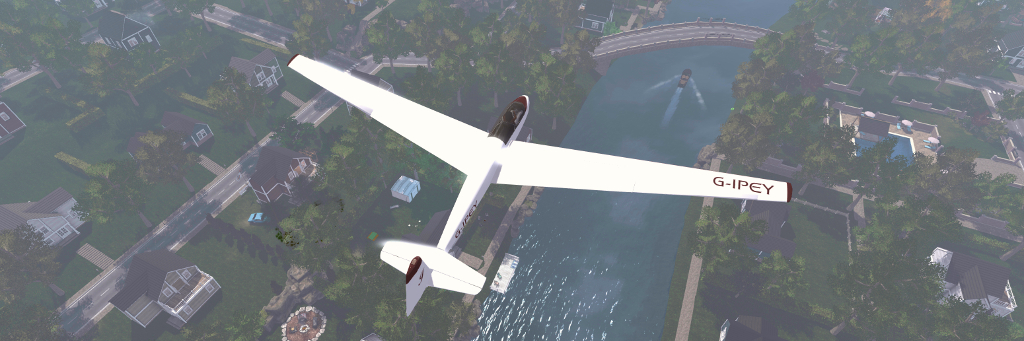
Plane sailing: over the Capitol Springs bridge and a boat passes under it

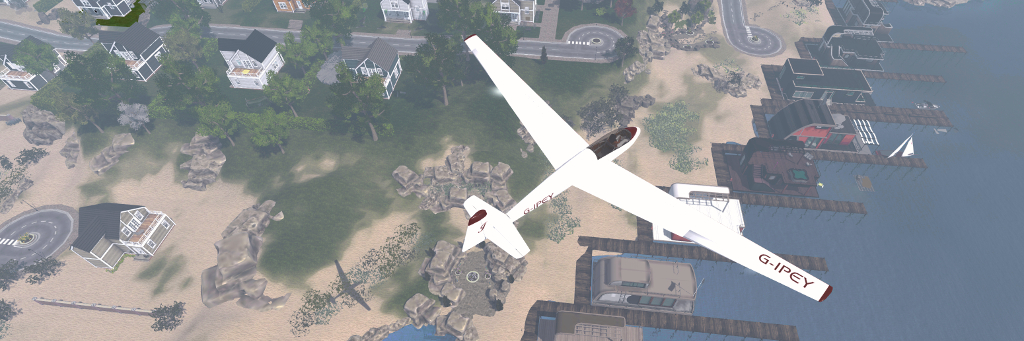
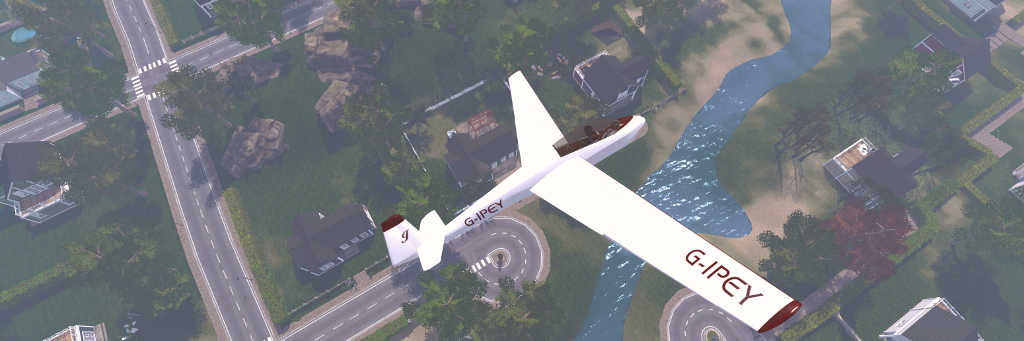
I decided to take a little time off on Easter Sunday and go for a flight around part of Bellisseria, the new Linden Homes continent, and have another look at it. However, rather than taking a ‘plane or helicopter, I decided to see things in a more leisurely manner, flying my Ask 13 sailplane.

Regular readers will know I picked up one of these sailplanes, made by Rene Underby and based on the Schleicher ASK 13, just over a year ago (see Plane sailing in Second Life: the ReneMarine Ask 13). Since then, I’ve been aloft in it on numerous occasions, both on my own and with Caitlyn. It’s a great way to fly in SL, and I thoroughly recommend it to anyone who has a love of flying in Second Life.

The Winchester: one of the two 2-storey home designs n the Traditional type of Linden Home

However, getting off the ground in the new continent isn’t that easy. As I’ve mentioned elsewhere, there are no airstrips, and sailplanes are not intended to get airborne off of water 🙂 . Fortunately, the Ask 13 comes with its own aerotow, so with a little cheating (rezzing the saiplane on the roof of my houseboat and then calling up the tow plane) I managed to get airborne. Not ideal, but it worked and got me up to an altitude where I could release the tow.

To be honest, I really wasn’t sure how far I’d get; as we all know, region crossings – physical or TP – have been something of a roll of the dice of late, and on a boat trip on Saturday I ended up losing my boat every few region crossings, so that  after the fourth time I ended up dumped and having to re-log, I gave up. However, Sunday’s trip was nothing short of superb.

Over the north-east coastal regions

As my houseboat is down in the south-west of the new continent, I headed east and north, tracking the local thermals and taking time out here and there to grab a snap.

One of the critiques levelled at the land houses in Bellisseria is that they are “cookie cutter”; I’m not sure this is an entirely fair assessment. Sure the select of houses is, at present, limited to four styles in a single theme, and the parcels are all fairly regularly set, but coupled with the general road infrastructure, trees, etc., to me give a feeling of suburbia. And while it may not always be obvious from ground level, the blending of the suburban housing with the coastal areas and the houseboats is actually nicely handled; there’s a good sense of the grasslands giving way to more sandy ground that gently merges into beaches and water.

The Adams, one of the single-storey homes in the Traditional range

I’m not going to cover the houses in great detail here, because Ricco Sanez has written an excellent piece on them, looking at all four styles. What was interesting in passing overhead was being able to see what use people were making of the garden / yard space, including some imaginative use of off-parcel placement of items along some of the waterways. These left me a little curious as to the view the Lab might have of them; from my perspective I felt they added to, rather than detracted from, the general environment.

Airborne also gives you a sense of how much space remains within the continent – and equally – how crowded it might come to feel, depending on the way in which future developments are handled.

Circling a thermal to gain altitude

Overall, my trip by air was fun – very much helped by the fact I managed my tour without getting thrown by a bad region crossing – actually, the second flight I’ve made over the continent since it opened; my first being a powered flight around the coastline and was actually equally successful – up until I hit the dreaded banlines whilst trying to make a water landing.

And landing this time around? Well, that was easy. After running the thermals along the western mountains before turning inland between them, and setting down in one of the undeveloped SSPE regions. Nevertheless (and to repeat my old chestnut) it would be nice to have an inland airstrip or two. These, with the odd park and hiking  / riding trail (if not already a part of the planning) could, as I’ve previously mentioned, add further attractiveness to the inland districts.

Is it a bird…? Is it a …? passing over Belliseria in my Ask 13

Note: we asked, the Lab listened. Three days after this article was written, a coastal airstrip was opened off the south-west coast of Bellisseria, as I was able to report on the day it opened – see: Bellisseria gains a coastal airstrip in Second Life.

The Teegle Animesh horse

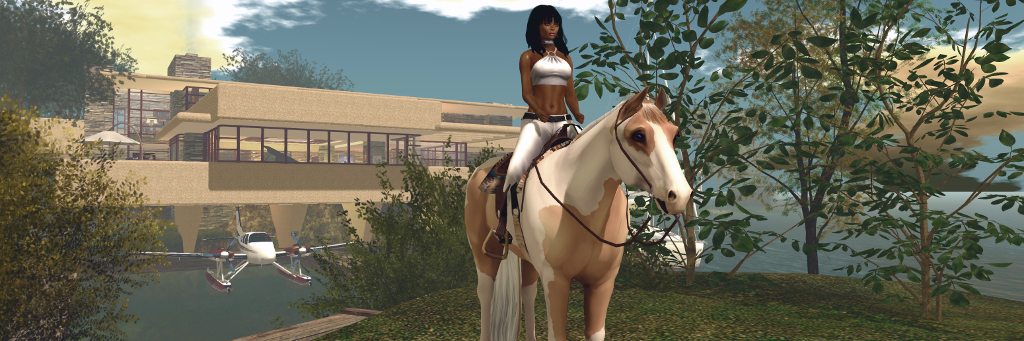
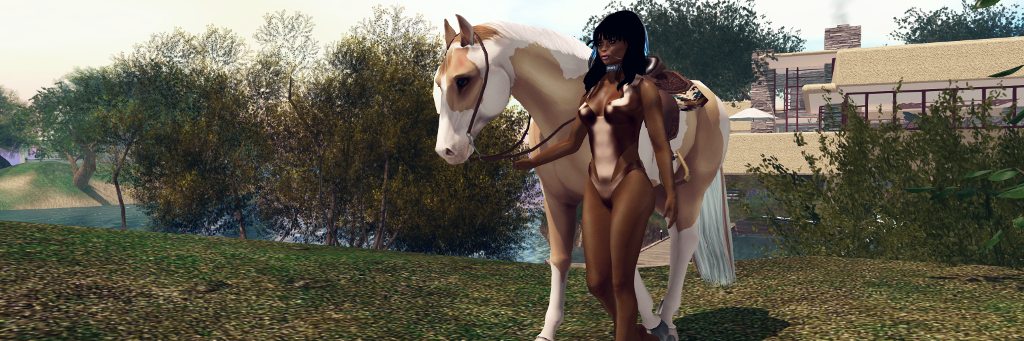
Teegle Animesh horse

At the start of April 2019 I reviewed the Water Horse Animesh horse – a horse that, unlike Bento horses, is not limited to having to be worn in order to be ridden – as it has its own skeleton, completely independent of an avatar, an Animesh horse can also be rezzed in-world, where it can wander, or ridden in the style of a vehicle, making it perfect for use both when riding, or as region décor.

However, the Water Horse model isn’t the only Animesh horse. Teegle, for example, are currently developing their own horse, which is currently in public beta – and in the interests of comparing the two, I recently picked one up and took it for a test drive. Err, ride.

Currently, the Teegle horse comes in two styles: a paint and a Hanoverian. The former might be seen as more suited to an American style of riding, and the later leaning towards more European riding, but the fact is that as both horses are supplied sans tack, you’re free to decide which you’d like, and then choose your preferred style of tack, or even swap riding tack depending on your mood.

The horse is supplied at two price points, which at the time of writing were: L$1,500 for the No Copy version, and L$6,000 for the copy version (allowing you to rez as many as you like). Again, note that these prices are purely for the horse, no riding tack is included; you can however ride them bareback. Tack will cost an additional L$750 from Teegle, although there are other suppliers. Other points worthy of note with the horses at both price points are functionally identical, and:

  • You can set them to be ridden by yourself or, when rezzed in-world, by others.
  • When rezzed in-world each horse can carry a rider and up to two passengers.
  • The basic LI for a Teegle horse is 28LI. With riding tackle attached, this rises to 35 LI.
  • The no Copy version come with a guarantee of automatic replacement if lost as a result of a bad region crossing, or broken as a result of incorrect editing. Replacements are delivered via the horse management HUD.
  • Horses can be individually renamed.
  • Retexturing is possible, but requires the purchase of texture packs at L$450, which include skin, mane and eye colour options.
  • The wander option when horse is rezzed in-world, does not require Pathfinding to be enabled within a region.

The HUDs

Two HUDs – both of which are still under development at the time of writing – are supplied with each Teegle Animesh horse.

  • A Management HUD, which:
    • Allows the horse’s gender to be set.
    • Includes a button that provides a chat link to a dedicated web page listing all Teegle pets you may have purchased. The last grind location the animal was recorded as being at, together with the date and time, is listed, allowing you to relocate a “lost” horse. A redeliver option is also provided here as well.
  • A riding HUD, which provides:
    • 4 different click-selectable riding speeds: walk, trot, canter, gallop. Riders can also move between these by tapping the UP arrow key (or W if WASD is set for avatar motion and the horse is being worn).
    • 4 horse animations: spook, (horse jumps sideways nervously and looks around); buck, rear, and reward (rider leans forward and pats the horse).
    • An autowalk function: set the horse walking in a straight line. The rider can look around, take snapshots, etc., or simply steer.
    • Follow (rezzed horse only): the horse will automatically follow the named avatar.
    • Lead (rezzed horse only): lead the horse via the halter when walking.
The Teegle riding HUD. Note the Lead / Follow options are only available when the horse is rezzed in-world

Riding the Horse

Before riding the horse, make sure any AO you have (scripted or client) is turned off to avoid any conflicts. Then either:

  • Add it to your avatar from inventory as a worn attachment.
  • Mouseover the horse in-world, right-click and select Ride.

The first option will add the horse to you, with you in the saddle (if attached to the horse); the second will place you in the saddle (if attached) of a rezzed horse. Note that if worn, you’ll need to the manually attach the riding HUD; if the horse is mounted while rezzed in-world, you’ll be asked if you’d like to accept the HUD, which then attaches automatically (note this is a slightly different HUD to the one in your inventory, as it includes the Lead and Follow options for the rezzed horse).

Movement is via the usual WASD / Arrow keys, with W / Up for forward motion, with double-taps advancing through the four speed options. Tapping the Down keys while moving forward will step back down through the riding speeds. When riding the horse from rezzed, the Down arrow will play a nice backwards walking animation.

Camera-wise, riding the horse from rezzed fixes the camera in a good position above and behind the horse, regardless of any camera offsets you may have set (not something seen with the Water Horse Animesh horse). Riding the horse from worn may leave the camera awkwardly positioned if you use custom camera offsets, the mousewheel and CTRL-Mousewheel generally fix this.

You can lead a Teegle Animesh horse to water…

Passenger Riding

Passengers can ride with you simply by clicking the horse. The rider can then select who “drives” the horse via a left-click to display the menu, and then the Driver option (rider 1= the avatar in the saddle; rider 2 = the passenger directly behind the rider; rider 3 = rearmost passenger). Who has the reins is indicated via local chat. The same menu option is used to take back control.

Riding Permissions

Who can directly ride a Teegle Animesh horse when rezzed in-world is also set via the menu: left-click the horse, then Settings > Driver Perm. At the time of writing, the options were limited to Private (owner only) and Public (anyone), but I understand more granular options will be added.

Other Capabilities  / Options

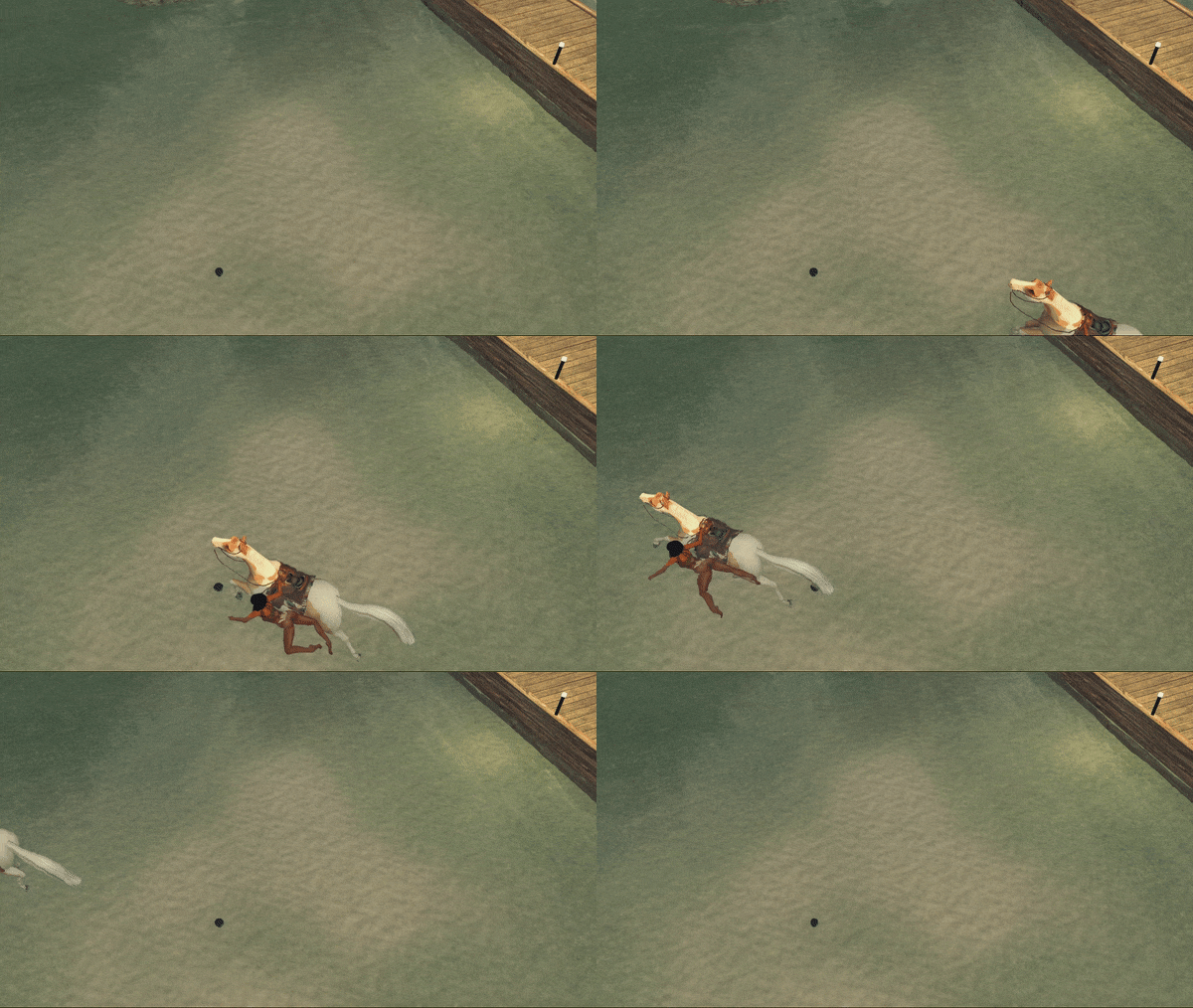
… and you can have it swim!

As the Teegle Animesh horse is still in development, it is hard to say what else might be included. However, some of the current additional capabilities include:

  • Linden Water swim option: the left-click menu offers a Settings option to have the horse swim in deep enough Linden water, complete with a companion swimming animation for the rider (but not passengers).
  • Flying option: you can set the horse to fly or disable flying (so no accidents when trying to jump an obstacle).
  • Motion function: set the horse to physical (default), so it will respond to objects around it (useful for racing, when wandering in  paddock, etc), or non-physical (useful for things like dressage).
  • Set wander distance via chat.
  • Rename function: Teegle horses can all be given their own name.

Adding Tack and Other Options

Riding tack by Teegle is easy to attach to the horse:

  • Rez both horse and tack in world.
  • With neither selected, right-click on the tack and selected edit.
  • Press and hold the SHIFT key and then left-click on the horse to additionally select it.
  • Click the Link button in the edit floater (arrowed, below).
  • The tack will correctly orient itself and attach to the horse, as seen in the inset image, below.
Adding options such as riding tack – use the Link option in the Edit menu (arrowed)

To remove an attached item (e.g the saddle or entire riding tack):

  • Rez your horse in-world.
  • Left-click the horse for the menu.
  • Click Unlink to display the Unlink menu.
  • Use the numbered buttons to unlink the required items.
  • Move your horse away from the unlinked objects and then delete them.
Removing items – use the Unlink option in the horse’s menu

Continue reading “The Teegle Animesh horse”

2019 SL User Groups 16/2: Content Creation summary

Puddlechurch; Inara Pey, March 2019, on FlickrPuddlechurchblog post

The majority of the following notes are taken from the Content Creation User Group (CCUG) meeting, held on Thursday, April 18th 2019 at 13:00 SLT. These meetings are chaired by Vir Linden, and agenda notes, meeting SLurl, etc, are usually available on the Content Creation User Group wiki page.

SL Viewer

  • The Estate Access Management (EAM) RC viewer, version 6.2.0.526190, dated April 12th, 2019 was promoted to the de facto release viewer on Wednesday, April 17th. See my EAM overview for more information.
  • The Teranino Maintenance RC viewer updated to version 6.2.1.526357 on April 18th.

All other SL viewers in the pipelines remain unchanged:

  • Release channel cohorts:
  • Project viewers:
  • Linux Spur viewer, version 5.0.9.329906, dated November 17, 2017 and promoted to release status 29 November – offered pending a Linux version of the Alex Ivy viewer code.
  • Obsolete platform viewer, version 3.7.28.300847, May 8, 2015 – provided for users on Windows XP and OS X versions below 10.7.

Environment Enhancement Project

Project Summary

A set of environmental enhancements allowing the environment (sky, sun, moon, clouds, water settings) to be set region or parcel level, with support for up to 7 days per cycle and sky environments set by altitude. It uses a new set of inventory assets (Sky, Water, Day),  and includes the ability to use custom Sun, Moon and cloud textures. The assets can be stored in inventory and traded through the Marketplace / exchanged with others, and can additionally be used in experiences.

Due to performance issues, the initial implementation of EEP will not include certain atmospherics such as crepuscular rays (“God rays”).

Resources

Current Status

The bug stomping continues.

Animesh Follow-On

Vir is now looking at adding shape support (or similar) to Animesh, which Vir sees as possibly being approached in a couple of ways:

  • To make Animesh objects behave as much as possible like avatars. This might be done by issuing a command to load a given shape into an Animesh, or just have a similar appearance resolution to avatars, which would allow associations with body parts for any attachments contained within the Animesh’s contents.
    • Advantage: either route offers the closest compatibility to the way in which avatars work, making it easy to port stuff over from using with avatars to using with Animesh (e.g. Animesh NPCs).
    • Disadvantages:
      • This is a much more complex project to implement as it requires substantial changes to the Bake Service, which can be a performance bottleneck. So a concern is that adding Animesh support to the Bake Service could have a further adverse impact on its general performance.
      • While applying a body shape could be done via the simulator (avoiding the Bake Service), but this again involves added complexity in the amount of asset information fetching the Simulator already has to do.
  • An alternative approach would be to offer a more granular control, using LSL to set the values usually set by shape sliders.
    • Advantages: It can reduce the complexity by allowing s subset of slider changes to be replicated via LSL (e.g. face, hands, etc), rather than trying to have the entire slider system replicated.
    • Disadvantages: This doesn’t give the same level of compatibility to the way avatars work, and if all the sliders were required, it would add considerable additional work with LSL calls for the 130+ sliders.

Which approach should be taken is down to whatever the most common use-case for customising Animesh might be (a likely topic for discussion). Currently, either approach will require additional server / viewer messaging, so Vir is looking at that.

There are also questions on what else might be preferable to add to Animesh (e.g. extending Bakes on Mesh to support Animesh, adding attachments support, etc), and the relative priorities people place against the various options as to any order as to how things might be tackled (would applying shapes be sufficient? Should it be shapes then another requirement, or is there another requirement that should take priority over shape support?).

Attachments are an issue in themselves; as Animesh doesn’t have an associated agent, there are no attachment tables for it to use, making basic attachment to s specified point difficult. Also, avatar attachments are effectively individual linksets applied to a common root – the avatar.

However, as an Animesh object is a single linkset, adding attachment to one object is more akin “merging” the attachment’s linkset into that of the Animesh, making them one continuous linkset. This clearly add complications; for example, how do you identify all the parts of the attachment to remove them when detaching, and how do you ensure they detach as a single object, rather than a coalesced group of unlinked items?.

One potential solution might be to have a means by which individual prims within the Animesh linkset can be flagged with an associated joint within the skeleton, thus allowing attachments to be made to that joint, and somehow “faking” the fact that the attachment linkset is not part of the Animesh linkset.

Exactly how this would work in practice still has to be properly determined, together with an mechanism for handling local position and the attachment’s position and rotation offsets. It is further unclear at present whether this approach might required support from and additional viewer UI element or could be controlled entirely through LSL.

Bakes On Mesh

Project Summary

Extending the current avatar baking service to allow wearable textures (skins, tattoos, clothing) to be applied directly to mesh bodies as well as system avatars. This involves viewer and server-side changes, including updating the baking service to support 1024×1024 textures, but does not include normal or specular map support, as these are not part of the existing Bake Service, nor are they recognised as system wearables. Adding materials support may be considered in the future.

Resources

Current Status

Anchor Linden is dealing with issues related to handling alpha layers in the new baking channels – with some of them not getting correctly baked, and which may need some fixes in the baking process. BUG-226599 is also being looked at; although a feature request, it might actually be the result of an underpinning bug.

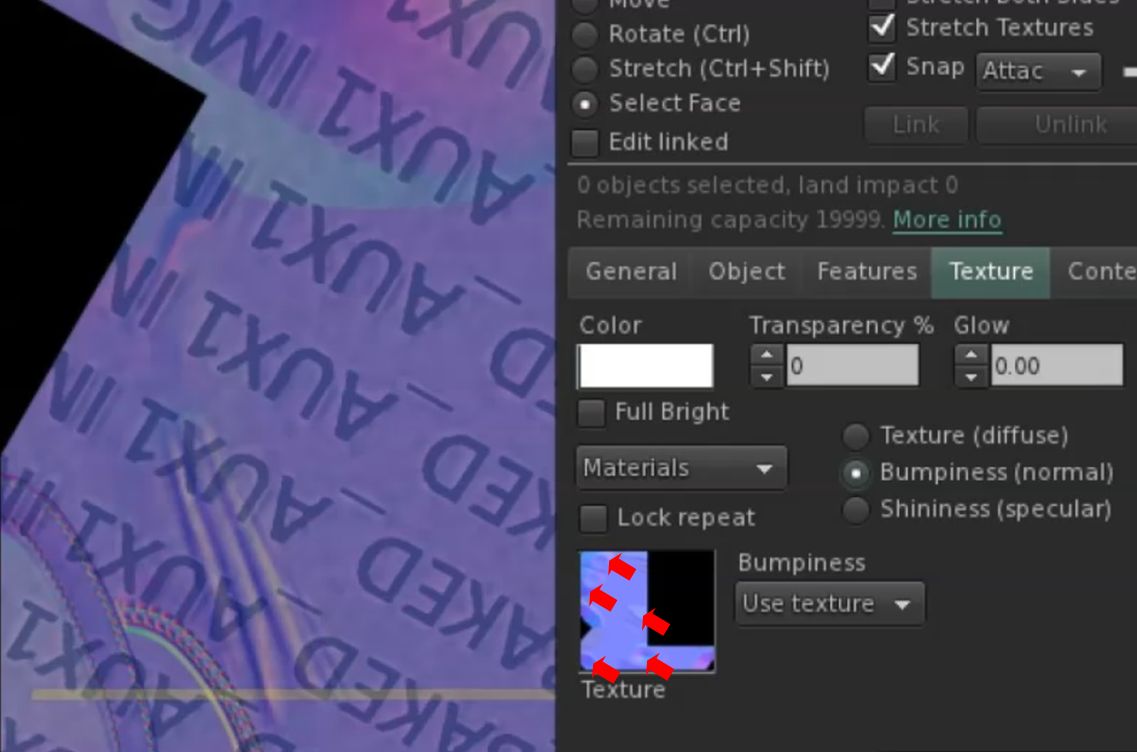
Following the April 11th CCUG, Cathy Foil carried out further tests to apply materials to a Bakes of Mesh surface. This involves using a script to take the UUID for one of the new universal bake channels (e.g.BAKED_ AUX1), and pointing it to a normal map (shown in the place holder normal map image “BAKED AUX1 IMG”, right), then wearing a universal wearable that uses the same bake channel. This results in the normal map then being applied to the desired face, as show in the image of the normal map in the Edit floater (arrowed on the right, above). This approach also appeared to allow a layering of normals on a face. However, the method is not currently seen as a recommended approach to materials with BoM, and probably won’t be treated as a supported technique.