 It has been some time since my last Mars Science Laboratory (MSL) rover report, so it’s time to play catch up with Curiosity, and take a look at what is happening with Opportunity.
For the last 16 months, Curiosity been engaged is studying “Vera Rubin Ridge”. Originally seen as a measn for the rover to traverse from one area of interest on “Mount Sharp” to another, the ridge became a point of interest itself when the rover imaged a rock formation that could fill a gap in the science team’s knowledge about the mound’s formation.
At the time the rock formation was noticed, engineers had been in the process of trying to overcome a issue with the rover’s drill that had prevented its use for several months. A potential work-around had been tested on Earth, so investigation of the rock formation offered the opportunity to test the updated drilling approach. Curiosity was therefore ordered to reverse course in the hope the tests would be successful and a sample of the rock could be gathered.
While successful, this was actually complicated – the issue with the drill feed mechanism also meant that the usual means of sorting samples post extraction had to be abandoned in favour of a new approach. However, the initial success meant Curiosity could resume drill-based sample gathering and analysis, marking the start of period of exploration around the ridge area – albeit it one interrupted by the 2018 global dust storm. In December 2018, this work concluded with the rover collecting its 19th overall sample on Mars, at a location on the ridge called “Rock Hall”.
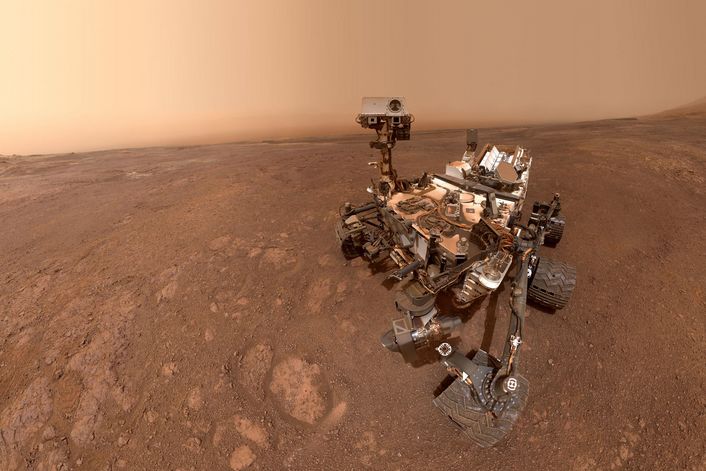
Since then, the rover has been completing its work on the ridge, which included taking a “selfie” on January 15th, comprising 57 individual images taken with the Mars Hand Lens Imager (MAHLI) camera on the end of its robotic arm. At the ed of January, Curiosity said farewell to “Vera Rubin Ridge”, resuming its traverse southward towards the “clay bearing unit” it was originally heading to when it stopped at the ridge in September 2017.
At the same time, the science team for the rover released a paper revealing a new mystery about “Mount Sharp” and showing how instruments aboard the rover were re-purposed to allow it to be made.
As I’ve previously reported, previous studies of “Mount Sharp”- more correctly called Aeolis Mons, the 5 km (3 mi) high mound at the centre of the crater – suggested it was formed over two billions years, the result of repeated flooding of the crater laying down bands of sedimentary deposits, some of which were blown away by wind action, others of which settled. Over the millennia, these layers were sculpted by wind action within the crater, until only the central mound was left.
However, this type of water-induced layering should have resulted in the lower slopes of Mount Sharp being heavily compressed; but measurements of the local gravity environment of the terrain Curiosity has been driving over in its ascent up “Mount Sharp”, indicate the layers of the lower slopes are less dense than thought, meaning it is relatively porous. This indicates they were not buried under successive layers as had been thought, and thus some other process must have given rise to the mound.
The measurements were obtained by re-purposing the accelerometers Curiosity uses as a part of its driving / navigation system. Normally, these are used to determine its location and the direction it is facing with enormous precision. But, through a subtle piece of reprogramming, engineers were able to turn them into a gravimeter, allowing Curiosity to measure local gravity every time it stopped driving, and with massively greater precision than can be achieved from orbit.

Given the results tend to dispel the idea that water action was primarily responsible for filling the crater with sediments subsequently added to and shaped by wind action, it’s been proposed that “Mount Sharp” has been formed almost entirely as a result of Aeolian (wind-driven) sedimentation. This would leave the layers forming the mound a lot less dense in comparison to layers laid down and built up as a result of water action and settling.
However, this doesn’t entirely explain why the mount was formed, and further study is required before it can be said with certainty that wind played the core part in building and sculpting “Mount Sharp”. In the meantime, the re-purposing of Curiosity’s accelerometers is another example of the flexibility found within NASA’s robot explorers, as Ashwin Vasavada, Curiosity’s project scientist, noted in response to the new information.
There are still many questions about how Mount Sharp developed, but this paper adds an important piece to the puzzle. I’m thrilled that creative scientists and engineers are still finding innovative ways to make new scientific discoveries with the rover.
– Ashwin Vasavada, Curiosity’s project scientist.
New Plan to Contact Opportunity
It is now seven months since communications with NASA’s other operational Mars rover, Opportunity, was lost as a result of the planet girdling dust storm that ran from late May until around the end of July 2018, and which forced the rover to go into a power saving safe mode as there were insufficient sunlight for its solar cells to recharge its batteries.
In late August, ith the skies over Opportunity clearing of dust, NASA initiated an attempt to nudge “Oppy” into trying to resume contact with mission control using what is called the “sweep and beep” method. This involved sending a series of wake up commands throughout the day, then listening for the “beep” signal that would indicated “Oppy” had received the signal and was once again awaiting commands, allowing attempts at recovery to commence. Unfortunately, this has not been the case.

Originally, it had been intended that if no response was received in 45-day period, NASA would switch to a purely passive means of listening out for “Oppy” in the hope the rover might send a message. But on January 25th, 2019, the space agency indicated they would be taking a different tack.
The new approach means that the “sweep and beep” approach will be continued, but slightly differently. In order to account for the possibility that Opportunity has both and off-kilter clock and both of its primary X-band communications systems, the outward commands designed to nudge a simple “beep” response from the rover will be replace by a command for it to switch away from using its primary communications system(s) to it secondary, the hope being that it would allow the rover to respond, and enable a more detail assessment of Opportunity’s condition to be made.
This effort is expected to continue for “several weeks” before NASA will again reassess the likelihood of re-establishing contact with the rover. However, a new threat is in the offing for Opportunity as winter starts to settle in the hemisphere where it is operating; if its solar panels are not working efficiently, the exceptionally low winter temperatures could damage it beyond recovery.
Continue reading “Space Sunday: Mars,the Moon and space hotels”








 Inara Pey: Living in a Modemworld