Logos representative only and should not be seen as an endorsement / preference / recommendation
Updates for the week ending Sunday, January 6th
This summary is generally published every Monday, and is a list of SL viewer / client releases (official and TPV) made during the previous week. When reading it, please note:
It is based on my Current Viewer Releases Page, a list of all Second Life viewers and clients that are in popular use (and of which I am aware), and which are recognised as adhering to the TPV Policy. This page includes comprehensive links to download pages, blog notes, release notes, etc., as well as links to any / all reviews of specific viewers / clients made within this blog.
By its nature, this summary presented here will always be in arrears, please refer to the Current Viewer Release Page for more up-to-date information.
Note that test viewers, preview / beta viewers / nightly builds are not recorded in these summaries.
Official LL Viewers
Current Release version 6.0.1.522263, dated December 5th, promoted December 13th. Formerly the Spotykach Maintenance RC viewer – No change.
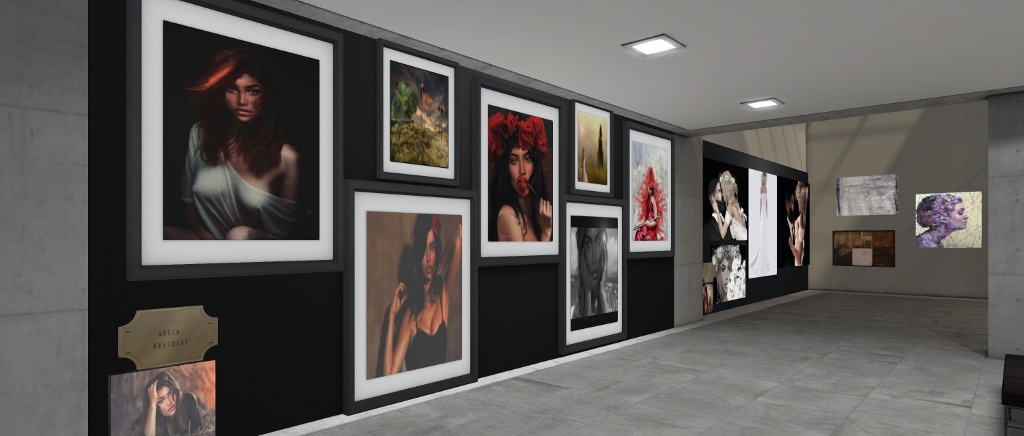
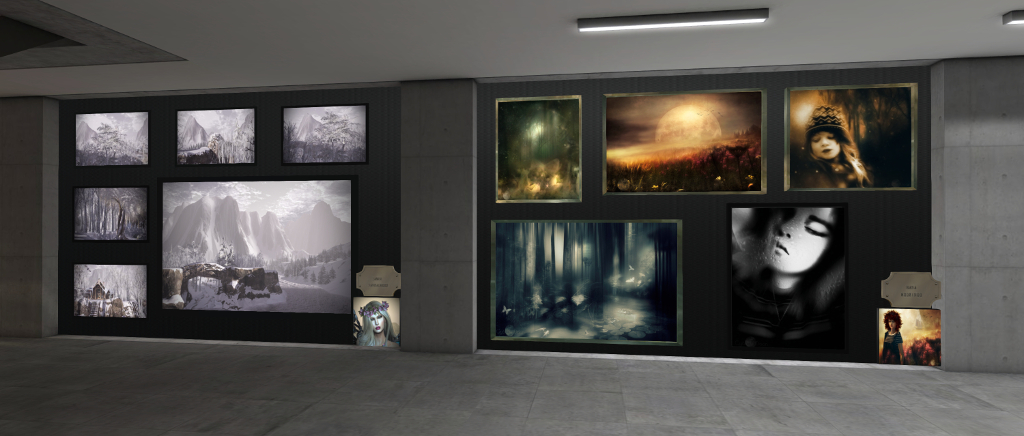
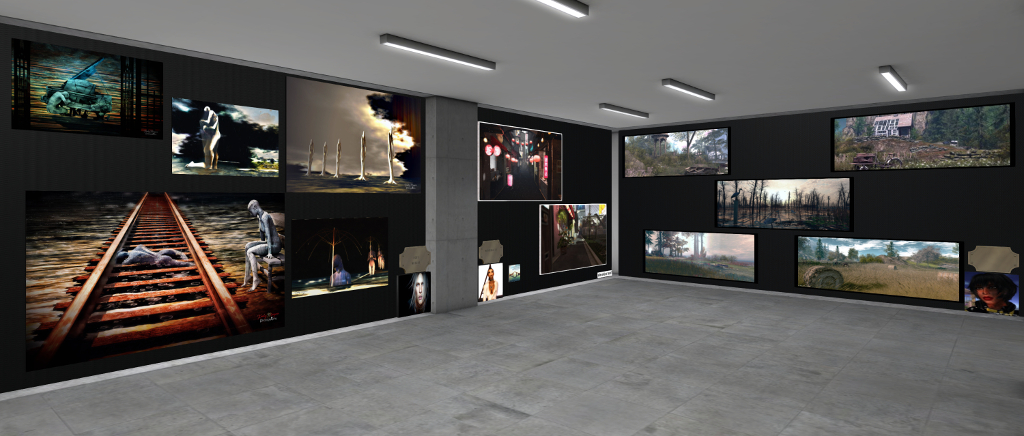
Kultivate magazine and the Windlight Art Gallery are celebrating the re-opening of the latter – now housed in a new gallery building – with their first art exhibition for 2019.
Officially opened on Sunday, January 6th, 2019 at 13:00 SLT (a time I was unfortunately unable to make in-world, despite being one of the artists – my apologies to all), the exhibition features work by 18 artists: Camellia (captainofmysoul), Marcel Mosswood, Maaddi Benazzi (maaddi), Caly (CalystiaMoonshadow), Dream Kolda (DreamMakerXDreamBreaker), Kayly Iali, artandsoul Constantine, Cybelle Moon (Hana Hoobinoo), anyia, Jamee Sandalwood Hiess (Jamee Sandalwood), Tequila Mockingbird (Tequila Krovac), Pieni, Kody Meyers (KodyMeyers), Fuyuko ‘冬子’ Amano (Wintergeist), John Brianna (johannes1977), Karma Daxeline (Karma Weymann), Seraphim Placebo and, as noted, yours truly.
Such a gathering brings together a rich mix of art and images, encompassing both the physical and the virtual. John Brianna, Kayly Iali, Marcel Mosswood and Pieni, for example, offer a mix of their own paintings and drawings, Cybele Moon presents more of her captivating fantasy images, and artandsoul Constantine offers a selection of physical world photographs.
As might be expected, the SL images largely split themselves between avatar studies and landscapes, although Kody Meyers present some quite stunning interpretations of Mistero Kifeng’s sculptures. I also have to admit to being drawn to both the marvellous monochrome winter images by Jamee Sandalwood Hiess and aniya’s self-portraits.
The new Windlight gallery building is a design from the Fanatik range and which is popular among gallery owners. It offers plenty of space, with high ceilings and good lighting, while an upper level offers additional display space, its mezzanine design avoiding any feeling that the space is crowded.
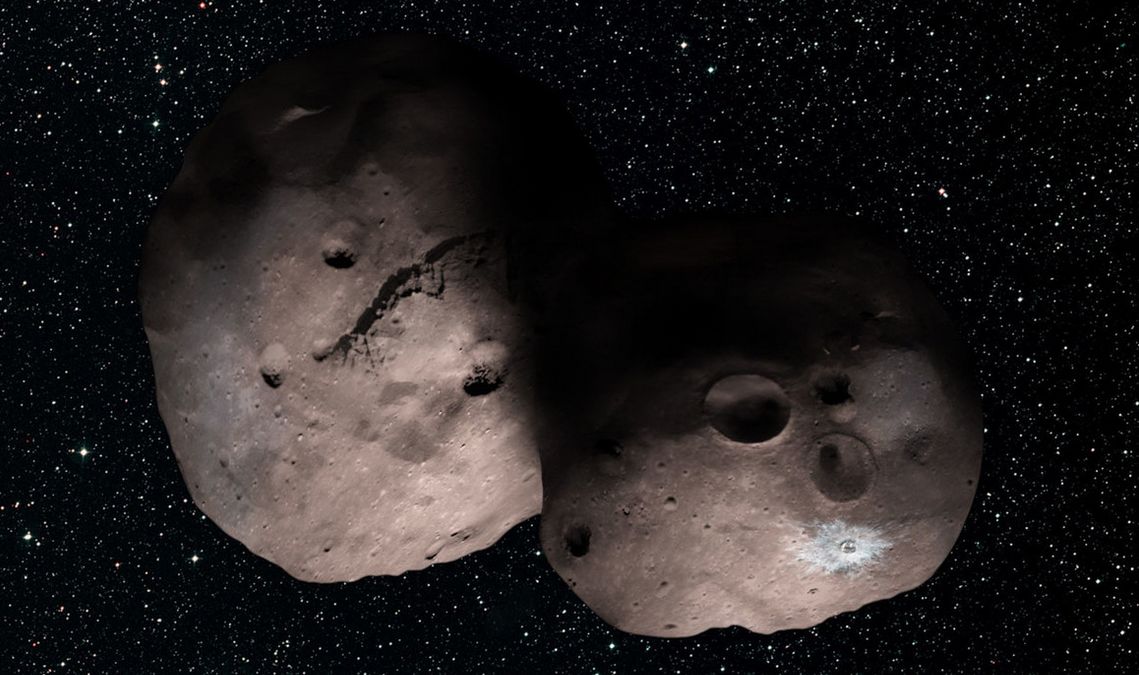
An artist’s impression of how the surface of Ultima Thule might look, based on the images and data returned by New Horizons thus far. Credit: NASA
We set a record. Never before has a spacecraft explored anything so far away. Think of it. We’re a billion miles farther than Pluto [and] Just like with Pluto, we could not be happier. What you’re seeing is the first contact binary ever explored by spacecraft: two completely separate objects that are now joined together.
– Alan Stern, New Horizons principal investigator
The astronomical year got off to a flying start on January 1st, 2019 when NASA’ New Horizons vehicle – the same craft that flew by Pluto and Charon and their attendant moons in 2015 – shot past (486958)2014 MU69, a trans-Neptunian Object (TNO) residing in the Kuiper belt. A relatively tiny object, and dubbed Ultima Thule, it wasn’t even known about when the New Horizons mission launched in January 2006.
As I noted in my previous Space Sunday report, Kuiper Belt objects are of particular interest to planetary astronomers and scientists as they represent the oldest near-pristine material in the solar system, and so could contain many secrets, from how rocky planets formed through to the origins of life. Ultima Thule itself has been of particular interest because data gathered from the Hubble Space Telescope (HST) suggested it might be a binary object due to its apparent brightness fluctuating, suggesting two bodies orbiting one another. However, as New Horizons slipped into the final days leading up to the fly-by, it seemed to report no variance’s in the light reflected by the object.
The space craft reached its point of closest approach to Ultima Thule at 05:33 UT on the morning of January 1st, 2019. However, the nature of the approach, coupled with the huge distance between Earth and the vehicle meant that the first images and data wouldn’t be received for several hours after the probe has passed the object (it takes over 6 hours for radio signals to reach Earth from the vehicle), so at the time of closest approach, scientists and the public had to make do with the images received in the 24 hours preceding it.
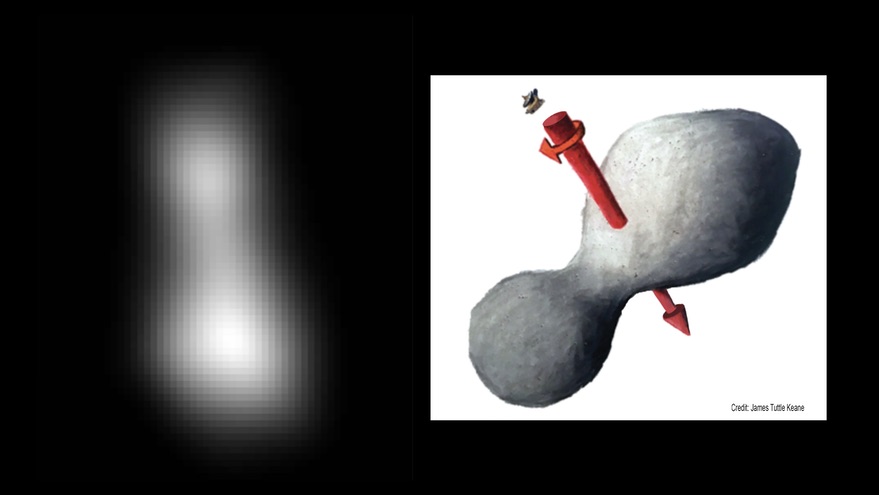
Left: a composite image of Ultima Thule taken by New Horizons on December 31st. 2018, at a distance of approx. 1.2 million km revealing the object to most likely be a “contact binary”. Right: a sketch showing the estimated rotation axis of the object relative to New Horizons, helping to explain when no variances in brightness were recorded ahead of the encounter. Credit: NASA / JHU APL / SwRI; James Tuttle Keane
These images, captured while New Horizons was still more than 1 million kilometres (635,000 mi) from Ultima Thule, were enough to confirm that, rather than being either a single elongated object (as suggested by the lack of variance in brightness the probe was recording) or two objects orbiting one another, Ultima Thule is in fact a “contact binary” – objects conjoined after gently colliding with one another, to form a shape initially referred to as a “bowling pin” (this latter changed to “dirty snowman” as clearer images were received). They also revealed why New Horizons wasn’t seeing any brightness variations: whereas Hubble was seeing Ultima Thule from more of an “end on” angle (like a bottle tumbling through the air towards you), New Horizons was approach it more-or-less along its axis of rotation (like standing in front of a slowly turning propeller), so it was always reflecting the same amount of light.
The initial images led members of the New Horizons mission team to call Ultima Thule the “first ever” contact binary object to be explored. However, this might be disputed; the nucleus of comet 67P/Churyumov–Gerasimenko, as seen by ESA’s Rosetta mission, as has two lobes connected by a narrow “neck” region which could mark it as a contact binary.
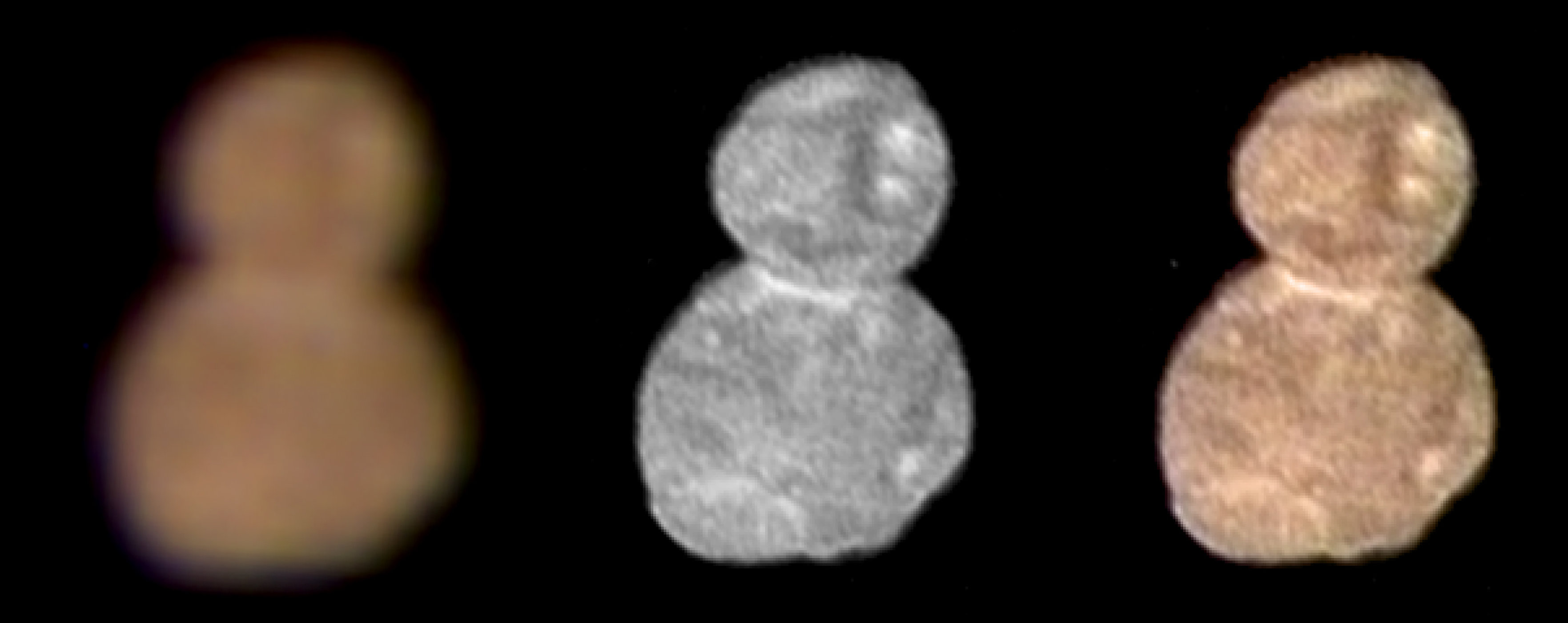
This first colour photo of Ultima Thule reveals its red colour as seen by New Horizons spacecraft from a distance of 137,000 km (85,000 mi), captured on January 1st, 2019, shortly ahead of the point of closest approach. From left to right: an enhanced colour image, a higher-resolution black and white image, and a composite combining both into a more detailed view. Credit: NASA / JHU APL / SwRI
Nevertheless, there is still something magical about the way the two lobes came together – as a member of the New Horizons team put it, the bump of them joining would have been so gentle, had it been caused by a car bumping your own, it wouldn’t result in any real damage. The lobes themselves are of unequal size; at 19 km (12 mi) across, the larger has been dubbed “Ultima”, while the smaller lobe has been dubbed “Thule”, and is 14 km (9 mi) across. Combined, these give the object an overall length of some 33 km (21 mi). That they came together so gently has already been seen as a confirmation of the pebble accretion theory of planetary formation.
The exterior of both lobes is probably a mix of water, methane and nitrogen ices, doubtless mixed with other elements / minerals, and the reddish hue revealed in the colour images thus far returned is likely the result of the irradiation of ices on its surface – a process witnessed on Pluto. However, it will not until photographs taken much closer to the object – notably those at closest approach, a mere 3,500 km (2,200 mi) – are received in mid-February, that we’ll have a clear view of the object’s topography.
Following the fly-by, the images received by mission control were taken at distances between 137,000 km (85,000 mi) and 28,000 km (18,000 mi) from the object, and part of the initial data transfer. In all, some 7 Gb of data was gathered, but due to the complexities involved, it will take 20 months for all of it to be received on Earth. In fact, at the time this article was written, and due to the passage of the Sun between the spacecraft and Earth, data transfer has been suspended for five days (January 5th through 10th, 2019) to prevent data loss due to solar interference. Even so, the images that have been received have been enough to not only reveal some of Ultima Thule’s secrets, but to also create new mysteries about it.
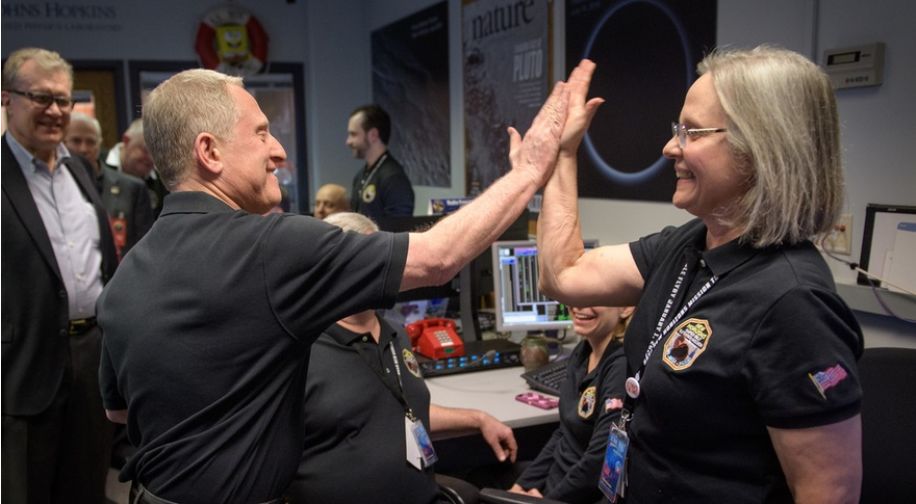
Alan Stern, the principal investigator for New Horizons, high-fives Alice Bowman, the mission operations manager at JHU APL, after controllers received a transmission from the spacecraft confirming a successful fly-by of Ultima Thule on January 1st, 2019. Credit: NASA / Bill Ingalls
One of these mysteries is that computer modelling suggests that given the way the two lobes came together, Ultima Thule should have a rate of spin to complete one revolution every 3 or 4 hours. However, data from New Horizons indicates it is spinning far slower: one revolution every 15 hours. So something must have slowed it down – the question is, what?
The most obvious explanation would be the gravitational influence of nearby objects – say two or three small moons orbiting Ultima Thule. However, due to the risk of collision, the space around Ultima Thule was surveyed well ahead of the fly-by, and astronomers are convinced there is nothing orbiting it either beyond 800 km (500 mi) or closer than 160 km (100 mi) – although that does leave a fairly large sphere of space between the two which may yet reveal one or more objects. More will be known on this in late January, when data on New Horizons’ own studies of the space around Ultima Thule should be received by mission control.
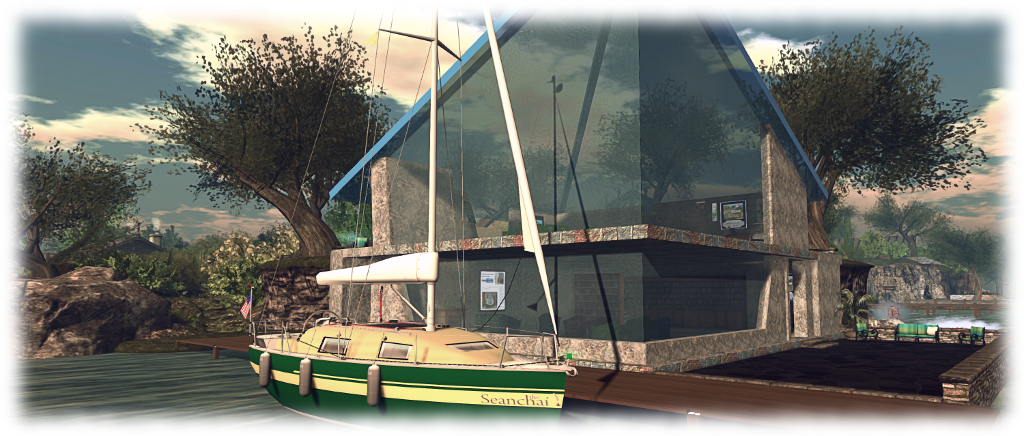
It’s time to highlight another week of storytelling in Voice by the staff and volunteers at the Seanchai Library. As always, all times SLT, and events are held at the Library’s home at Holly Kai Park, unless otherwise indicated.
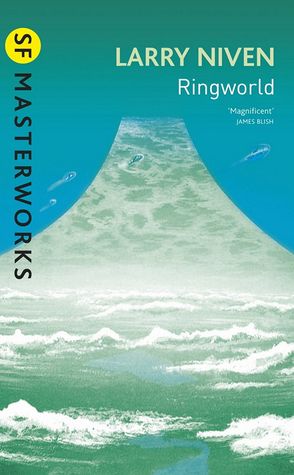
Monday, January 7th 19:00: Ringworld
Gyro Muggins opens the covers of the first in Larry Niven’s science fiction series focused on a gigantic artificial ring, the Ringworld, built around a distant star at a distance roughly equivalent to the orbit of the Earth around the Sun. About 1.6 million km wide, it rotates to provide a gravity on its inner surface roughly equivalent to that of Earth and has an atmosphere suitable for humans. It was built by a race known as the Puppeteers, who have been working to affect both humans and the cat-like, warrior Kzin.
Regarded as a classic, Niven’s novel (and later series) is also curiously contradictory. On the one hand, it is focused on exact science of advanced technologies, but on the other it engages in bizarrely pseudo-scientific fantasy conceptions.
The series sits within Niven’s broader Known Space series, the fictional setting of about a dozen novels and several collections of short stories, and which encompasses his Man-Kzin wars series. In addition, the idea of the ringworld found within the series is regarded as the inspiration for the Halo series of video games, and there are multiple similarities between the two.
Tuesday, January 8th 19:00: The Time Keeper
The inventor of the world’s first clock is punished for trying to measure God’s greatest gift. He is banished to a cave for centuries and forced to listen to the voices of all who come after him seeking more days, more years.
Eventually, with his soul nearly broken, Father Time is granted his freedom, along with a magical hourglass and a mission: a chance to redeem himself by teaching two earthly people the true meaning of time.
He returns to our world – now dominated by the hour-counting he so innocently began – and commences a journey with two unlikely partners: one a teenage girl who is about to give up on life, the other a wealthy old businessman who wants to live forever. To save himself, Father Time must save them both. And stop the world to do so.
Join Caledonia Skytower and Kayden OConnell as they read Mitch Albom’s 2012 novel.
Wednesday, January 9th 19:00: The Jennifer Morgue
Corwyn Allen reads the second volume in the Laundry Files by Charles Stross.
Bob Howard is an IT expert and occasional field agent for the Laundry, the branch of Her Majesty’s Secret Service that deals with occult threats. In this second outing, Bob Howard finds himself dragged into the machinations and conspiracies of megalomaniac multi-billionaire Ellis Billington, The Black Chamber and The Laundry…
Dressed in a tuxedo (what else for a globe-trotting British Secret Agent?) and sent to the Caribbean, Bob must infiltrate Billington’s inner circle via his luxurious yacht. His mission? Prevent the Billington from violating a treaty that will bring down the wrath of an ancient underwater race upon humanity’s head.
Offering a wonderful pastiche on both the world of James Bond and a wonderful mimicking of Ian Fleming’s style of writing, Stross produces a novel that also evokes Lovecraftian overtones that is delightfully entertaining to read. In true Bond style, Bob is (reluctantly) partnered with an American agent – in this case a stunningly beautiful woman who also just happens to be a soul-sucking succubus from another dimension. Which, being the case, marks Bob’s mission somewhat differently to those of Bond: not only must he stop the bad guys and come through this at best shaken, he must totally avoid being stirred towards getting the girl…
Thursday, January 10th
19:00: Moana Part 1
With Shandon Loring & Caledonia Skytower. Also in Kitely grid.kitely.com:8002:SEANCHAI.
21:00: Seanchai Late Night
Contemporary science fiction and fantasy with Finn Zeddmore.
Update: Maoz has closed. SLurls have therefore been removed from this article.
Take a break from the cold and come hang out at Maoz! It’s a little tropical retreat that’s inspired by the idyllic, provincial life in the Philippine Islands. Take pictures, surf, play games with friends or just frolic in the water and the sand.
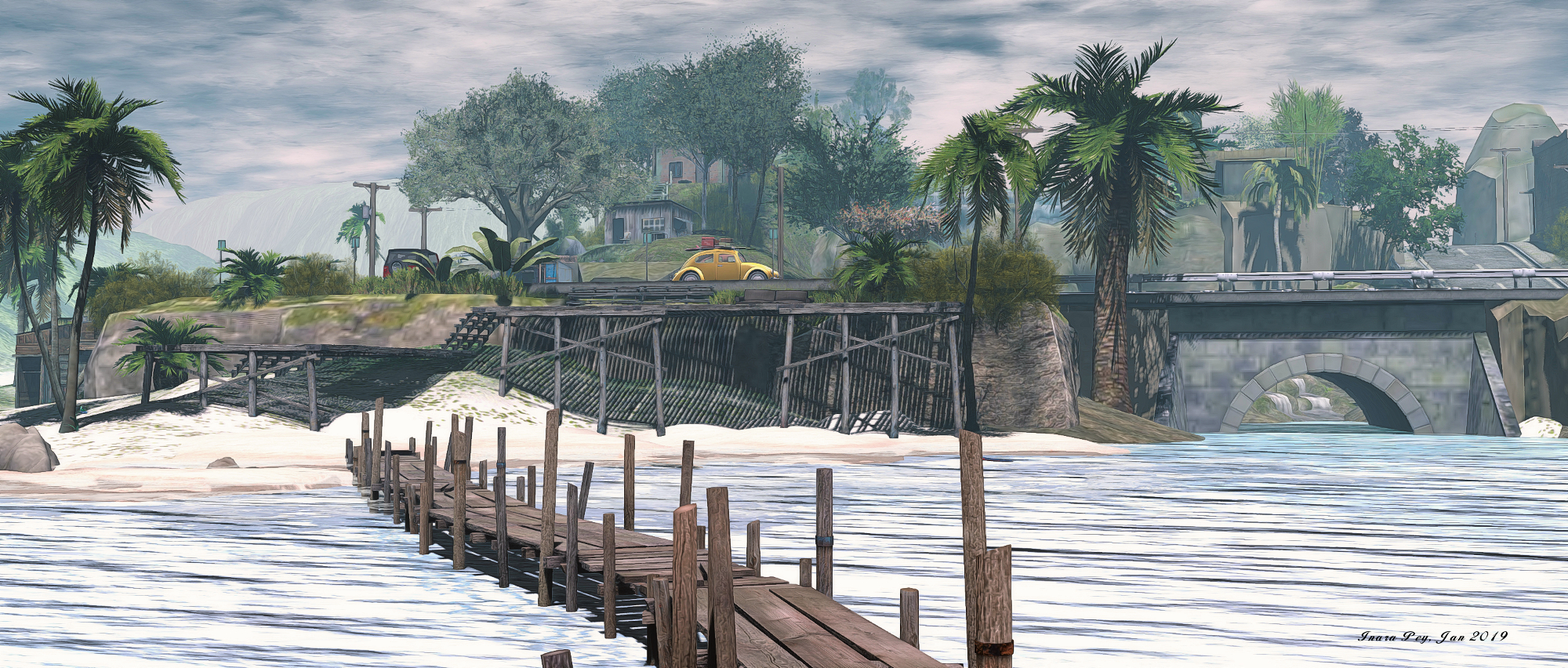
So reads the description for Maoz, a Homestead region I dropped into after seeing Loverdag’s images at the start of the year. Designed by Cate Ansaldo (CATEvogel) and Dylan Vogel (LordDylan Ansaldo), this is simple region with the design intended – as the description indicates – to reflect the provincial Philippine life. Surround by low-lying hills that don’t quite adjoin the region, it has the feeling of a coastal location through which a broad road passes, beaches to one side offering surf and volleyball, overlooked by a parking lot where it is easy to image passing tourists pausing to take photos.
Maoz
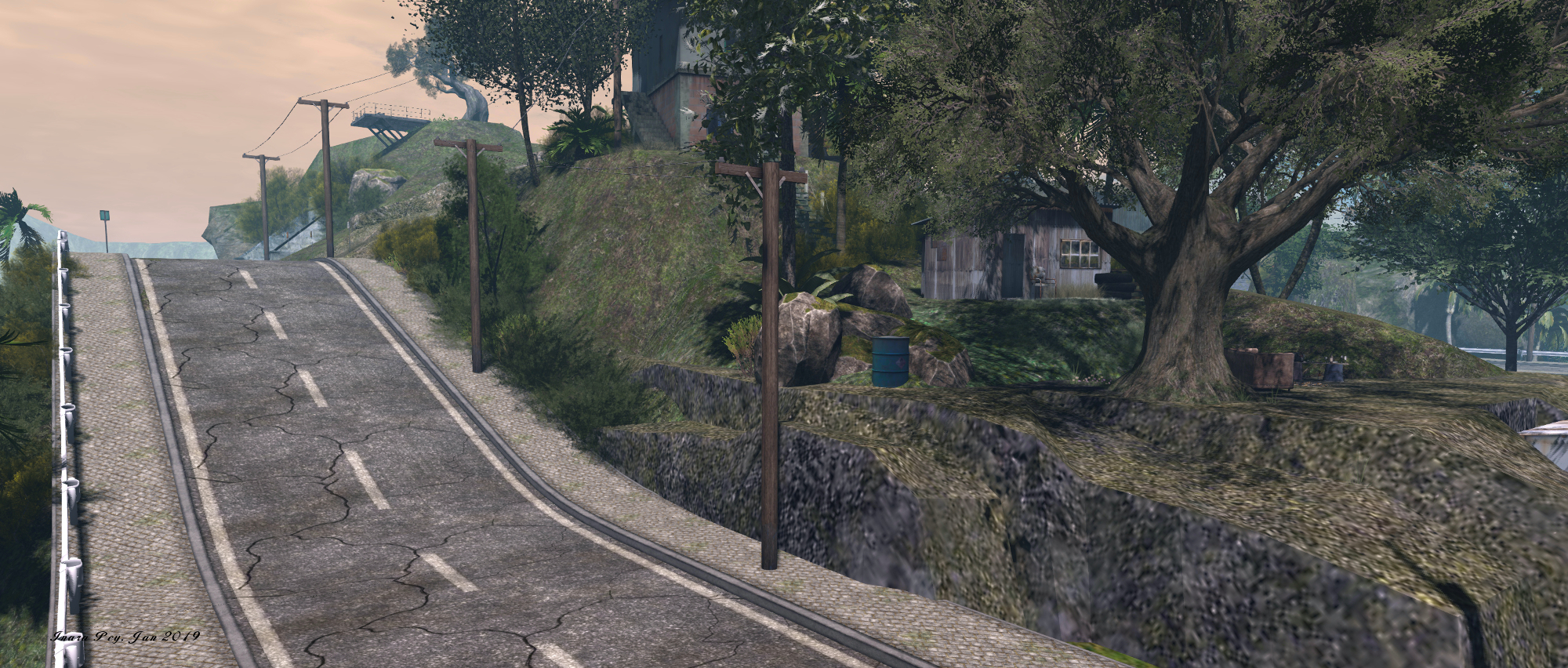
Rising in uneven steps from west to east, the setting is marked by water tumbling through a series of falls, small shanty houses scattered between rocks and trees, and the ribbon of the road, which together with the vehicles scattered along it, gave me the impression I was perhaps on a road trip. Roadside huts and shops sit as possible distractions for drivers, promises of food and beer presenting the temptation for a stop along the way.
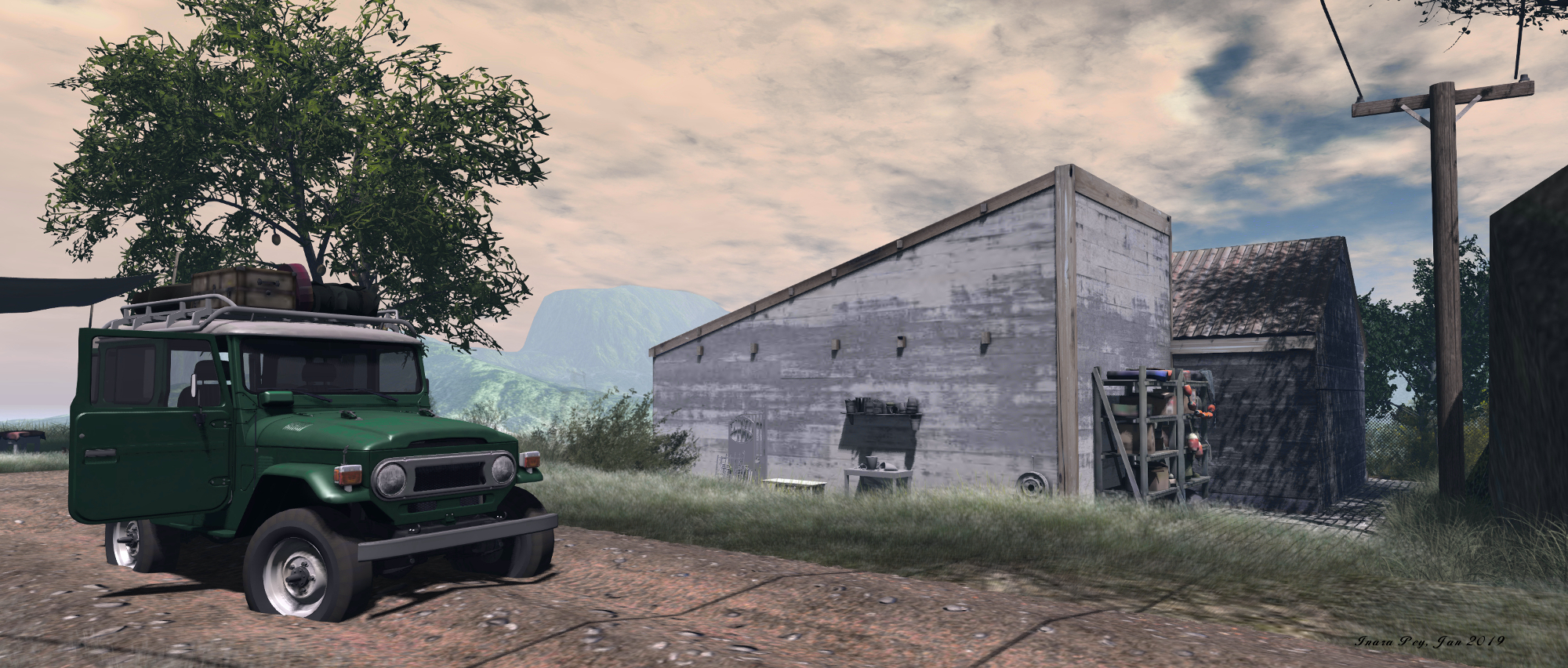
Tucked away on one corner of the region sits a small but homely house, a Toyota Land Cruiser parked alongside, doors open and roof rack laden as if someone is about to take to make a journey or has just returned from a trip to somewhere. Not far away is one of those tempting stops, the bicycle laden with platters of fresh fruit outside apparently enough to persuade one driver to swing across the road and pull up, the No Parking sign under which it has been parked clearly not a deterrent.
Maoz
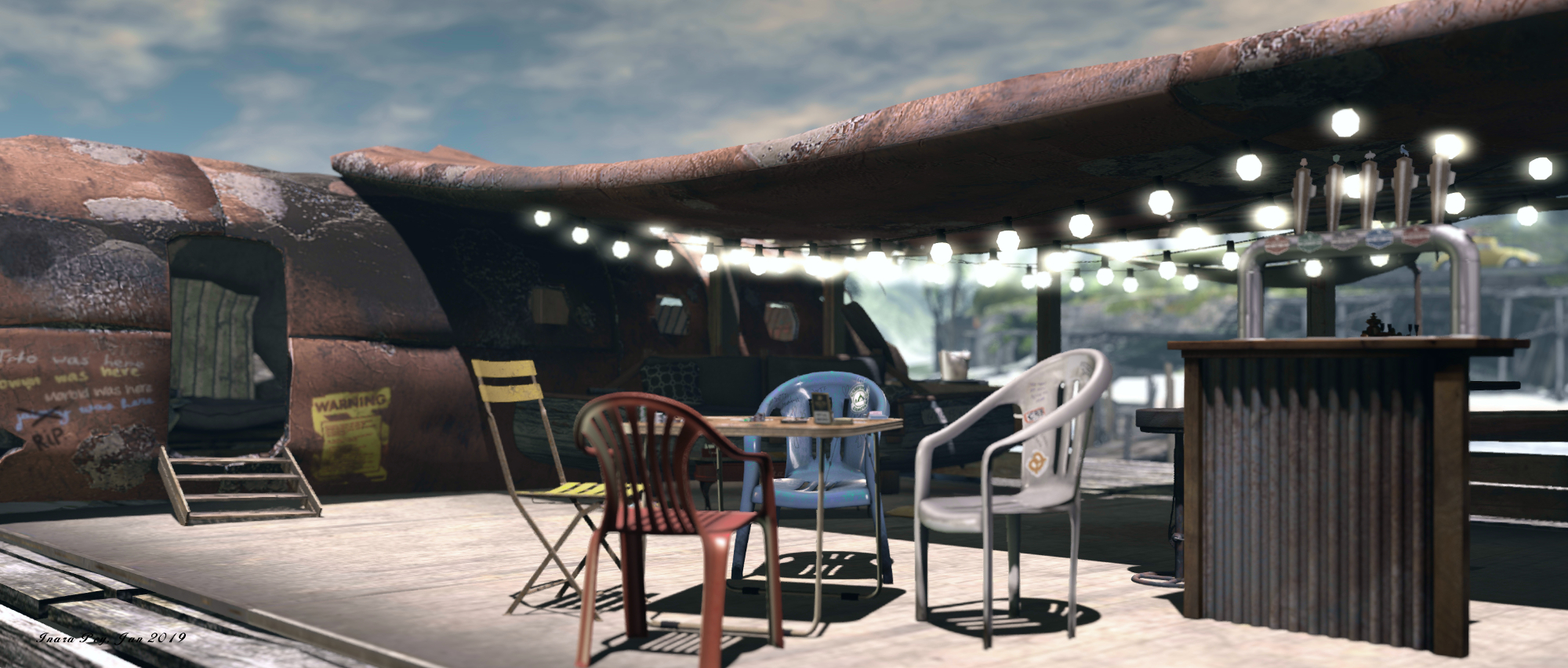
Off the coast to the west, reached by a long board walk clearly placed by the locals to avoid the rolling surf, lies a bar built within the confines of a rocky sandbar rising above the waves. A makeshift place, constructed in part from the fuselage of a wrecked ‘plane, it’s clearly a popular stopping point: the rusting flank of the aircraft is festooned with the autographs of visitors past. Those who don’t fancy the walk out to it can find refreshments and sweets at Linda’s Store on the beach, within easy reach of the volleyball net awaiting players.
Scattered around the region are numerous places to sit, indoors and out – including a caravan perched at the top of a steep track and offering views out to sea, and back over the waterfalls down to the rolling surf, or within (or on) the VW Beetle parked at the landing point. Rezzing is also open to visitors, making this an ideal place for photography. However, as auto return is disabled, please do remember to pick up anything you set out, should you choose to do so. There is also a Flickr pool open for submissions of images taken.
Maoz
As notes, a simple, photogenic layout that offers a place to get away to while waiting for the snowy, winter regions to warm themselves up as thoughts now turn to spring in the northern hemisphere. It is also, apparently, a place given to occasional squalls of rain, so when visiting, you might want to keep a brolly handy!
Lyric Art Gallery – Black and White: Ebcy Clift (l) and Boone Blanco
Opening on Saturday, January 5th, 2019 at the Lyric Art Gallery is Visual Feast: Black and White, an exhibition featuring over 30 artists (and for which I’m kicking myself, as I was invited to participate… and then forgot!). Each of those artists participating was asked to submit and image on the theme of winter landscapes, although some of the art displayed takes a slightly different turn on presentation, with several pieces, while monochrome, focused on avatars.
Exhibitions like this are often an interesting way of getting to see work by artists / photographers with whom you might not be familiar or otherwise get to see – or to re-acquaint oneself with the work of artists not seen in a while. Such is the case for myself, in coming across First Touch by Leonorah Beverly, and artist whose work I only recently encountered for the first time, instantly finding her landscape work instantly captivating. With First Touch, whilst not a landscape, demonstrates her skill in presenting an evocative story within an image.
Lyric Art Gallery: Emma D’Souza (l); Beccha (c) and Leonorah Beverly
Within those pictures that keep more-or-less to the theme of winter landscapes, these is a fascinating mix; from “straight-forward” pieces with fields of snow or trains chugging between snow banks, or houses sheltering under thick blankets of snow, through to more subtle views of winter: snowflakes drifting through an open window (Black and White by Beccha); or wonderfully atmospheric, with a bridge caught under a sullen sky; the clouds portents of cold weather (Bridge Over Troubled Water by Mishe Mactavish).
The avatar studies are equally broad ranging, with several encompassing the winter theme as the setting, others focused purely on the avatar(s) imaged. While it is not surprising avatars get to feature in some of the images – we can be much a part of a winter setting as fir trees, snowmen and frozen ponds -, I admit to being surprised at the number of images that more-or-less eschew the winter theme (or present it only minimally) in favour of presenting a portrait, either completely or to a greater degree. Which is not to say any of them are any the less captivating – I found Pure by Andre Mascot (Snouman) particularly striking, for example.
Lyric Art Gallery: Gwen Enchanted (L); Gustaf (pv544); Fenn MacMoragh (r)
All told a very eclectic, engaging exhibition that offer more of a mix than might be expected from the invitation / greeter description. For those able to attend, the official opening will take place at 11:00 SLT, on Saturday, January 5th, 2019, with music by DJ Fae.





 Inara Pey: Living in a Modemworld