Victorian scandals, future oppression, and reflections on life

Seanchai Library

It’s time to highlight another week of storytelling in Voice by the staff and volunteers at the Seanchai Library. As always, all times SLT, and events are held at the Library’s home at Holly Kai Park, unless otherwise indicated.

Sunday, August 26th

13:30: Tea-time at Baker Street

Back from a well-earned break, Sherlock Holmes and John Watson return to their rooms at 221B Baker Street to be joined by Caledonia Skytower, Corwyn Allen and David Abbot and Bryn Taleweaver, as Seanchai Library’s popular Sunday feature resumes.

“This photograph” by Sidney Paget, July 1891 (wikimedia)

This week comes one of Sir Arthur Conan Doyle’s most well-liked mysteries to have engaged his Great Detective, and which first appeared in The Strand Magazine in 1891, before going on to be the first story in the 1982 collection, The Adventures of Sherlock Holmes. It was also the first of Doyle’s detective series to be illustrated by Sidney Paget. I’m of course talking about A Scandal in Bohemia.

In March 1888, Dr. John Watson, married and with his own medical practice is returning home when, on a whim, he drops in at 221B Baker Street to see Holmes. No sooner has Watson arrived, than Holmes demonstrates some of his incredible deductive powers – which are shortly given greater exercise when, after receiving his expected guest, who arrives during the reunion, Holmes pronounces  him to be not “Count Von Kramm” as he purports, but rather Wilhelm Gottsreich Sigismond von Ormstein, Grand Duke of Cassel-Felstein and the hereditary King of Bohemia.

Admitting Holmes has correctly identified him, the king reveals he is seeking Holmes’ assistance in a matter of some delicacy. It revolves around a liaison he had five years’ previously with an American opera singer, Irene Adler, and which could now threaten his upcoming marriage to a Scandinavian princess. Thus Sherlock Holmes comes to pit his wits against an adversary he will forever only refer to as “the Woman” …

18:00: Magicland Storytime: Aladdin and the Magic Lamp

With Caledonia Skytower at the Golden Horseshoe.

Monday, August 27th 19:00: The R-Master

In the 21st century utopia has arrived in the form of a repressive but seemingly benevolent, if omnipresent, bureaucracy. Their perfectly ordered world, seemingly run for the benefit of all, is actually ruled with an iron fist. In claiming to have people’s best interest at heart, those in power keep the population occupied and docile with menial tasks and the promise of advancement with the aid of the strictly controlled drug, R-47.

For the vast majority, R-47 actually does nothing.But for a special few, observed and selected by the ruling Council, it can massively enhance their intellect, elevating them to the status of “R-Masters” allowing them to solve problems, see advancements, and help ensure – wittingly or not – the Council’s control over the world, cosseted and pampered well away from the drudgery of ordinary life.

However, there is a darker side to R-47: just as it can elevate the intellect of some of those chosen to receive it, so to can it reduce them to imbeciles – and there is no way of knowing who the outcome might be in advance. Wally Ho is one selected to receive R-47 – and suffers the latter fate.

Determining it will raise his problem-solving abilities and restore his brother, Etter Ho obtains R-47 and takes it. But, once elevated to the privileged ranks of the R-Masters and witness the truth behind the Council’s rule, Etter determines the established status quo cannot allowed to continue, and Big Brother must be brought to heel.

Join Gyro Muggins as he reads Gordon R. Dickson’s 1973 novel about life in what is now our times!

Tuesday, August 28th 19:00: Calypso

David Sedaris is a Grammy Award-nominated American humorist and radio contributor, known for his collections of essays and short stories which are mostly autobiographical and self-deprecating in content and style.

When he buys a beach house on the Carolina coast – which in tpyical fashion he names “Sea Section” -, Sedaris envisions long, relaxing vacations spent playing board games and lounging in the sun with those he loves most. And indeed, that’s how it appears to start, apart from one annoying little truth he soon discovers. To quote an unrelated film: “no matter where you go, there you are”; which for Sedaris means when all is said and done, you cannot take a vacation from yourself.

This realisation brings Sedaris’ formidable powers of observation and dry humour to the fore as he considers middle age and mortality and the dawning understanding that life has reached a point where perhaps life has reached a point where the best parts of the story are behind you, rather than awaiting your arrival. Dark, yes; a little morbid, possibly, but the humour is unmistakable and so deeply rooted in the unfolding of this personal tale, it’s impossible not to become caught up within it.

Join R. Crap Mariner – the perfect voice to bring life to Sedaris’ words – and hear more.

Wednesday, August 29th 19:00: More Tales of the Arabian Nights

With Caledonia Skytower – check the Seanchai Blog nearer the time for more details.

Thursday, August 30th

14:00: Fireside Tales Eclectic Readings with Meteor Mags

“A Public Presentation of Poetry, Pirates, Pumas, Pussycats, Planets, Ponies, and Prehistoric Pteranodons.”

19:00: Ghost Pirates!

With Shandon Loring. Also presented in Kitelyhop://grid.kitely.com:8002/Seanchai/144/129/29.


Please check with the Seanchai Library’s blog for updates and for additions or changes to the week’s schedule.

The current charity is Feed a Smile.

Firestorm fund-raiser

Firestorm fund-raising market

The Firestorm team has launched a fund-raiser, primarily to help cover the cost of a new main server, used to host the team’s JIRA, web site, wiki, code repository, and so on. However, as the Firestorm blog post on the matter also notes, the team also have recurring costs involved in the license they have to pay in order to use the Kakadu codec for rendering in the viewer, and costs involved in running the land costs (albeit subsidised by the Lab) involved with the Firestorm Community Gateway.

To this end, the new fund-raiser is planned as a hopefully long-term event, and also designed to help people get rid of their unwanted gacha items.

Located over the Firestorm gateway regions is a “Firestorm market” featuring stalls and vendor boards where visitors can purchase collected and donated gacha items. Note that despite the confusing blog title, this is not itself a gacha event – there are no machines, just the opportunity to buy individual items and complete sets previously sold via gacha vendors, which the Firestorm team have collected or have received as donations.

The prices of items vary throughout, and many of them might well be offered under the acronym WTGTG – when they’re gone, they gone.

Firestorm fund-raising market

Anyone wishing to donate items can do so by contacting Kio Feila in-world.

In addition, those wishing to help the Firestorm team but who don’t find anything of interest on sale, can make direct L$ donations, or flow links to the Firestorm listings on the Marketplace, which male and female Firestorm Jackets can be purchased, with all funds also going towards helping cover the team’s costs.

All funds raised will be used directly and solely towards  the Firestorm operating costs and overhead; all Firestorm team members are volunteers who receive no financial or L$ compensation.

2018 SL UG updates #34/3: TPV Developer meeting

Ponto Cabana; Inara Pey, July 2018, on FlickrPonto Cabanablog post

The following notes are taken from the TPV Developer meeting held on Friday, August 24th 2018. A video of the meeting is embedded below, my thanks as always to North for recording and providing it. The second half of the meeting is dominated by general discussions on the Environment Enhancement Project, which is covered via my CCUG updates, particularly the week #34 update, and so these aren’t repeated in the notes below – please refer to the notes in the link or watch the embedded video.

SL Viewer

[1:12-5:37]

The Voice viewer has had one bug filed against it following its promotion to release status, but this is considered “not too terribly serious”.

The Animesh RC viewer updated to version 6.0.0.518949 on August 24th,  in the wake of the promotion of the Voice RC viewer to de facto release status, bringing it to parity with the latter.

All other SL viewers in the various pipelines remain as per the start of the week:

  • Current Release version 5.1.8.518593, dated August 14, promoted August 20. Formerly the SL Voice RC viewer – NEW.
  • Release channel cohorts:
    • Love Me Render RC viewer, version 5.1.8.518751, released on August 20.
    • BugSplat RC viewer, version 5.1.8.518305, August 7. This viewer is functionally identical to the current release viewer, but uses BugSplat for crash reporting, rather than the Lab’s own Breakpad based crash reporting tools.
  • Project viewers:
  • Linux Spur viewer, version 5.0.9.329906, dated November 17, 2017 and promoted to release status 29 November – offered pending a Linux version of the Alex Ivy viewer code.
  • Obsolete platform viewer, version 3.7.28.300847, May 8, 2015 – provided for users on Windows XP and OS X versions below 10.7. This viewer will remain available for as long as reasonable, but will not be updated with new features or bug fixes.

Of these, the BugSplat viewer (previously reported as coming to the end of its run) is with QA following its merge up to the Voice viewer release, and so a new RC version should be appearing in week #35. At the time of the meeting, the Love Me Render RC viewer had yet to be merged up to the Voice viewer code base.

The Love Me Render viewer should also address the KDU issues previously noted, with a fix to prevent the OpenJPEG textures that create problems from being created. However, the Lab is still working with Kakadu to try to obtain a better fix for issues.

Week #35 should also see the release of a new maintenance RC viewer.

Estate Access Management Viewer

[6:55-7:38] Feedback on the new EAM project viewer hasn’t been as broad as the Lab had hoped (i.e. the viewer hasn’t been tested by many region holders); however, the feedback that has been obtained has been taken on-board by the Lab. Currently, it is anticipated this viewer should be proceeding to RC status relatively quickly.

There are discussions on the EAM viewer that take place around 14-20 minutes into the meeting, however most of this can be covered by reading my EAM viewer overview.

Bakes On Mesh

[4:24-5:20] The order of events to get Bakes on Mesh working on Aditi are:

  • AIS update to support the new asset types used by Bakes on Mesh (and the new assets to be used by the Environment Enhancement Project). This is now due to clear the Lab’s QA and start deployment – at the CCUG meeting, Vir suggested this could start to happen in week #35.
  • A simulator update to support the Bakes on Mesh messaging, etc.
  • The Bake Service update to support  the use of 1024×1024 textures. This is ready to go, but is dependent upon to the simulator update being deployed.

EEP / TCO / ARCTan

[7:56-8:41] The Environment Enhancement Project, the TCO (viewer texture caching project) and ARCTan project (re-aligning rendering costs) all involve Graham Linden. His priorities are currently:

  • EEP shader work  – see my week #34 CCUG summary for more.
  • TCO viewer caching work.
  • ARCTan – see my week #34 CCUG summary for more.

The TCO project will hopefully improve texture caching in the viewer (as well as allowing users with 64-bit operating systems to set larger caches than is currently possible) and also include improvements to texture handling in the renderer.

“Avatar Last Names” Project

[8:42-10:40] The project to re-implement avatar last names is progressing, but is still not ready for deployment. The current focus on the project is ensuring the all of the Second Life services, both visible and non-visible to users, will correctly handle and resolve name changes (e.g. everything from how an avatar’s name is displayed in their profile / in-world tab through their groups, to object / asset ownership to SL web properties like the Marketplace, forums, and so on).

Given this, there are no dates available on possible deployment of the capability or how things like user suggestions for last names will be managed. Nor has the cost for making a name change been determined.

Mac OpenGL Support  / Linux Viewer Builds

[34:23-35:40]

  • Nothing new to report on how the Lab is going to handle rendering on the Mac viewer following Apple’s decision to deprecate OpenGL support. Options are still to be investigated.
  • Work on the Linux 64-bit viewer is progressing as a background task. It is hoped that more positive news will be forthcoming towards the end of the year. However, any Linux build will have a degree of limited functionality, by virtue of the fact that Vivox has discontinued providing voice support for Linux on account of its low user numbers compared with other operating systems.

In Brief

[24:26-25:51] JIRA Update: the Second Life JIRA update is now scheduled for Wednesday, August 29th, 2018. During the update, the service will be unavailable for several hours. An official blog post should precede the update.

[26:15-27:27] Abuse Reports: a cap was introduced recently that loads Abuse Report categories from the server, rather than having them hard-coded in the viewer. However, some users remain on older viewers that ho not recognise the cap, and which have out-of-date categories stored within them. This causes  reports filed using the correct categories to be delayed in processing until then can be reviewed and correctly re-classified.  So far the Lab has opted not to block incoming ARs purely on the bases of them having an invalid category.

[31:35-33:15] Duplicate Calling Cards: some time ago there were improvements made to the viewer to handle the deletion of calling cards. However, duplication of cards can still be an issue for those who like to have them inventory. To help with this, the Lab’s support team is adding a function to their inventory fix transform that will also remove duplicated calling cards (and duplicated calling card folders).

Discovering a Missing Melody in Second Life

Missing Melody; Inara Pey, August 2018, on FlickrMissing Melody – click any image for full size

The heat of summer has left the grass long and golden, roots reaching deep into the soil to gain moisture. Closer to the local stream and river, the grass and moss are still green, benefiting from both the plentiful water seeping into the land on either side of the waterways and from the shade offered by tall trees of a rich woodland. But the seasons are turning; the sky offers a paler Sun than might have been blazing down in the midst of summer and the trees are slowly losing their canopies of leaves, scattering them across the ground below, where their gold and reds form a slowly decaying carpet and litter the calm surfaces of the river’s arms.

Such is the tranquil scene awaiting visitors to Missing Melody, a Homestead region designed by Bambi (NorahBrent). Still under construction, it is nevertheless open to those wishing to explore it, offering a beautiful autumnal look and feel with – at the time of our visit at least –  a delightfully minimalist approach to a setting Bambi describes as a “shabby rustic theme”; an approach I hope continues through to the region’s completion in this form, and things don’t become too crowded.

Missing Melody; Inara Pey, August 2018, on FlickrMissing Melody

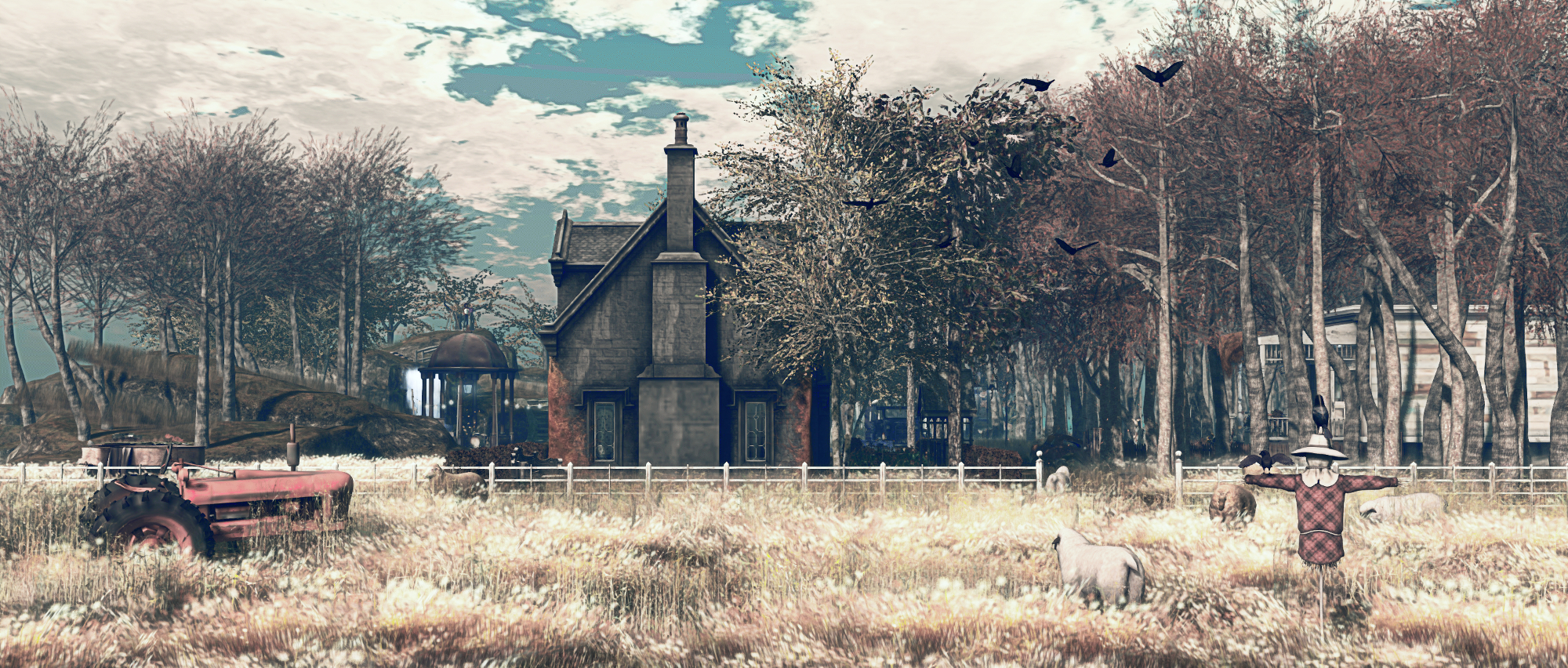
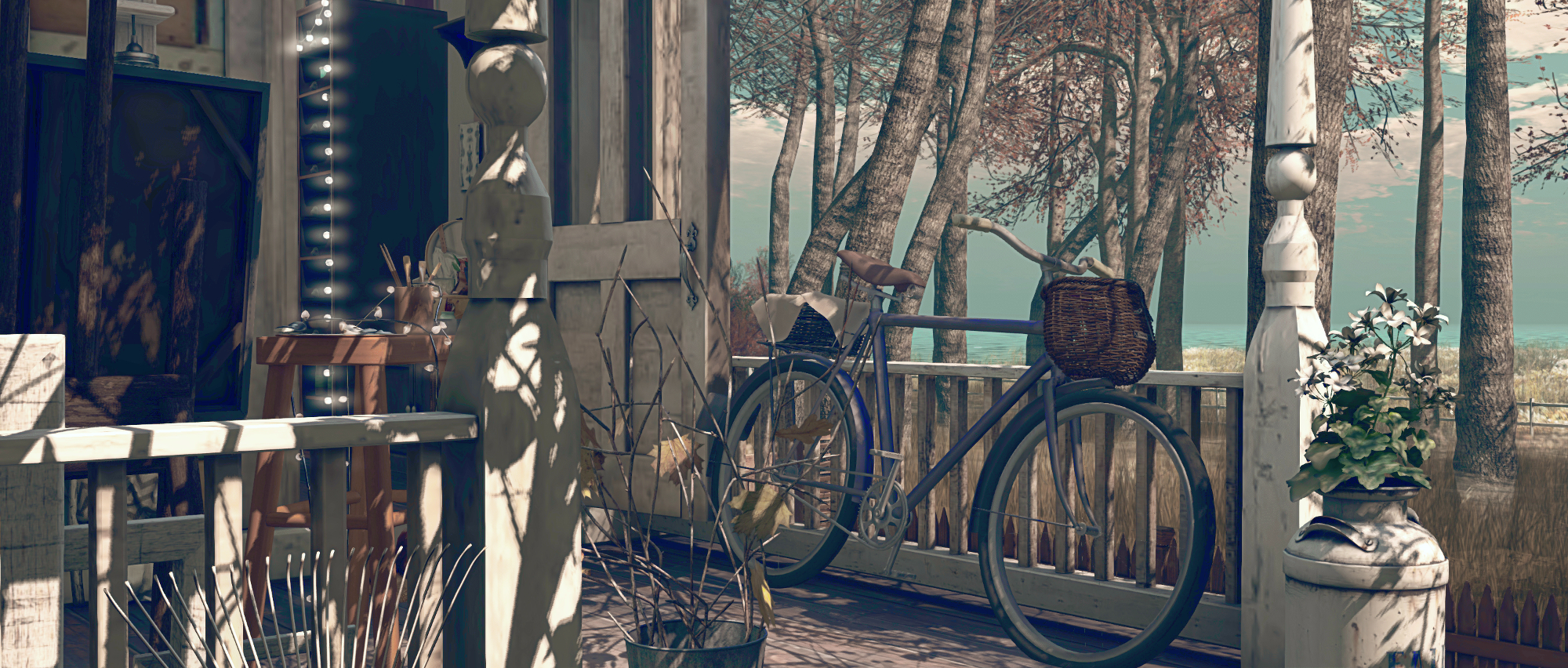
The yellowing grass sits at the northern end of the island, lapping around the broken tower of an old windmill and appearing to leave a tractor stranded within the waves of seeded grass heads as sheep graze fitfully. From a distance, it might be easy to mistake the grass for a field of corn and the lodge sitting close by for a farmhouse. Closer examination, however, reveals the truth of the grass, while the lodge appears to be more of an artistic retreat than part of a working farm.

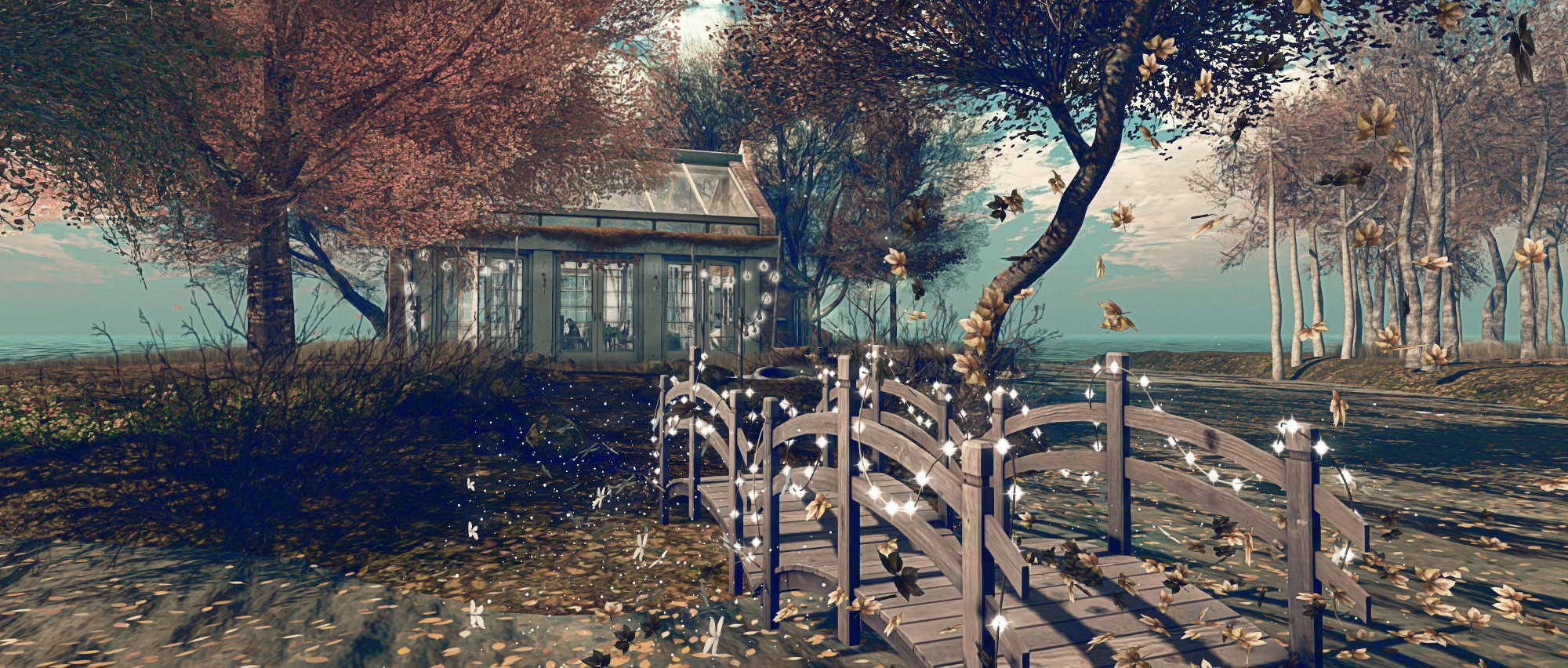
An unsurfaced road, rutted and marked by rocks on either side runs past the lodge and points the way south to where a bridge reaches over a branch of the river (almost the landing point) to arrive at a little café. Such little places are very much a staple of many regions designs, offering places to sit and perhaps cam around the setting.

Missing Melody; Inara Pey, August 2018, on FlickrMissing Melody

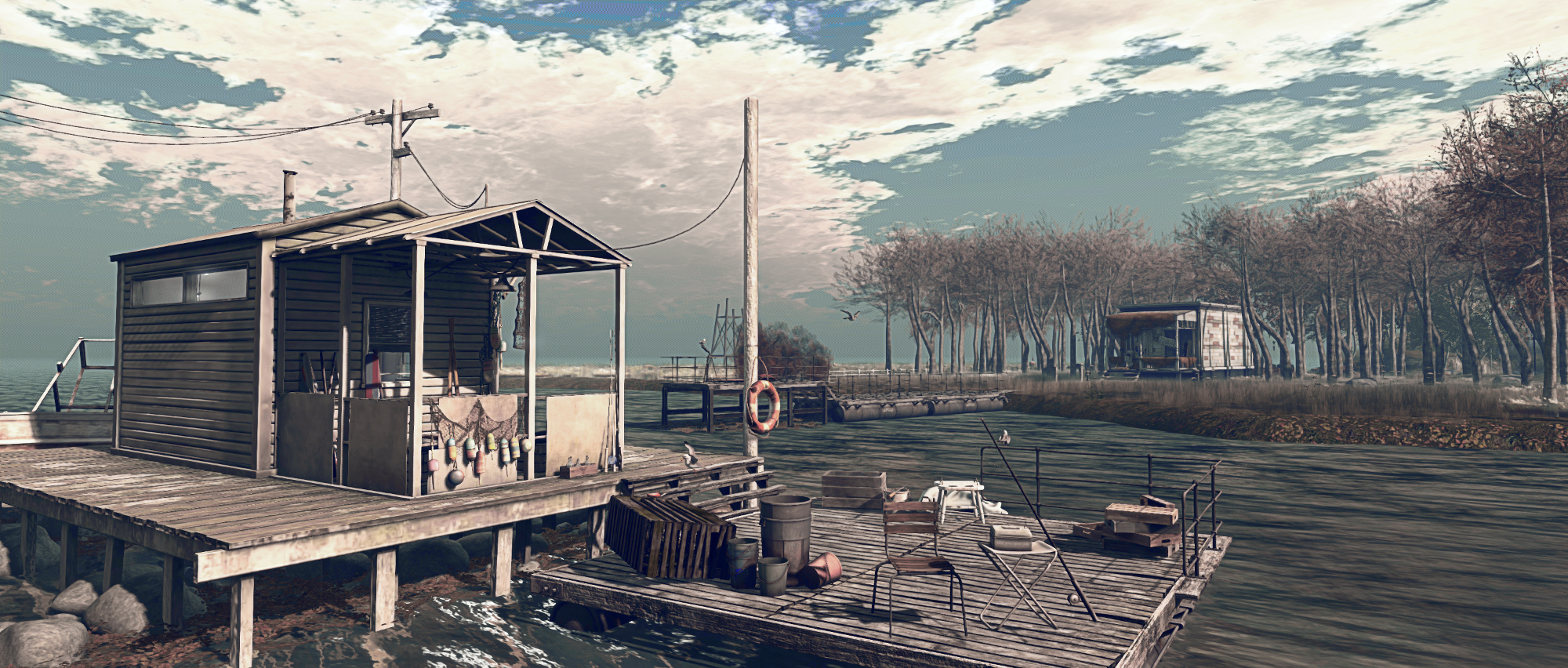
Between lodge and café, the road runs through the region’s woodland and past an old shack that fits the region’s shabby theme perfectly while also offering a cosy interior with a rich homeliness about it. Behind the shack, a path directs feet towards a deck reaching out over the coastal water. This almost – but not quite – reaches an off-shore fishing shack converted for use as a little snug for couples.

Eastwards from the road, the land gets a little more rugged in nature. Bridges and steps offer a way up among the rocky humps, passing a wrought iron gazebo and passing over tumbling falls to reach a shabby platform of a tree house before the land tails off into a small headland dominated by a great water tower.

Missing Melody; Inara Pey, August 2018, on FlickrMissing Melody

The theme of music is presented here not only in the region’s name, but also in the way the wrought iron gazebo offers a home for a musical trio of guitar, piano and drums, with pillows, logs and benches set out under strings of lights bulbs to offer space for an audience should musicians arrive.

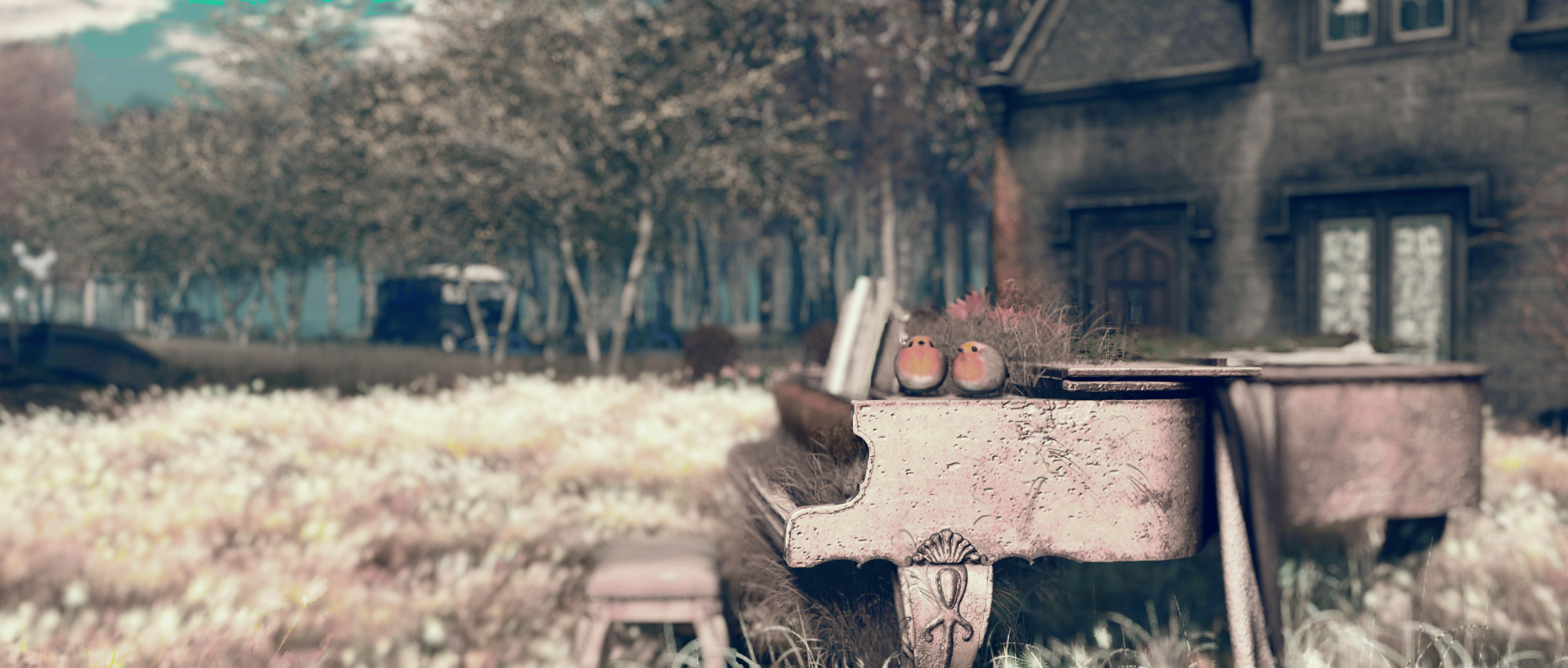
Meanwhile, the idea of a missing melody is perfectly framed by the weathered form of an old grand piano sitting behind the hunter’s lodge. Apparently being slowly claimed by nature, the piano would appear to be more of an artistic statement, carefully placed with sheet music anchored by vines, while an old curtain or blanket hangs from the ppiano’s closed lid. The placement of these, and the little models of two little robins, perhaps giving the lie to the piano simply having been abandoned and add to the idea that the nearby  lodge is the residence of someone with an artistic bent.

Missing Melody; Inara Pey, August 2018, on FlickrMissing Melody

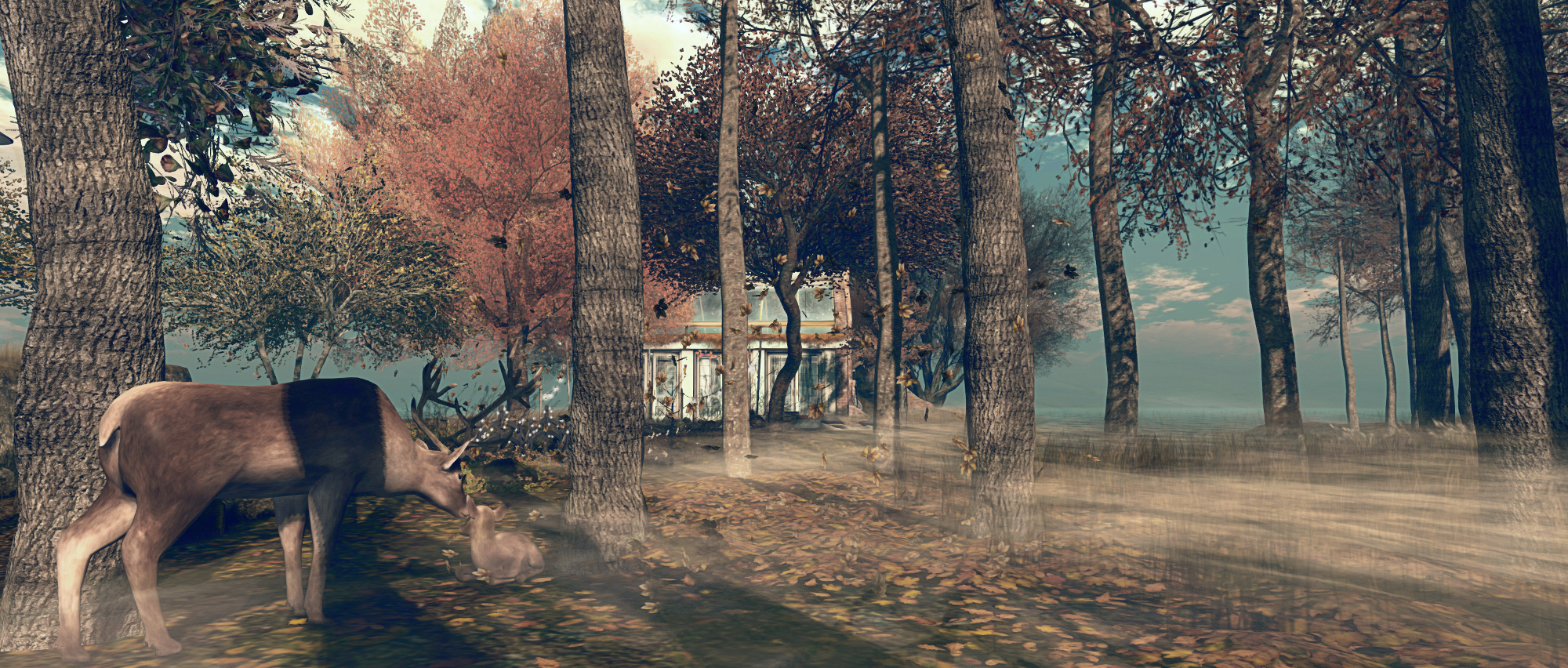
There are a lot of little touches through Missing Melody – picnic benches along the roadside, little snuggle points scattered around the landscape; deer to be found within the woodlands with their misted ground, and plenty of opportunities for photography (rezzing is permitted with auto return set to 60 minutes – but do remember to clear up props ahead of that limit).

Yes, there are a couple of rough edges – trees floating over water, for example; but again, this is a region still under construction, an matters like that will be addressed. In the meantime, Missing Melody is already a photogenic destination – and our thanks again to Shakespeare and Max for the nudge in suggesting we visit.

Missing Melody; Inara Pey, August 2018, on FlickrMissing Melody

SLurl Details

2018 Sansar Product Meetings week #34: permissions system

No Spectators: The Art of Burning Man – Truth is Beauty, by Marco Cochrane

The following notes are taken from the Sansar Product Meeting held on Thursday, August 23rd. These Product Meetings are open to anyone to attend, are a mix of voice (primarily) and text chat. Dates and times are currently floating, so check the Sansar Atlas events sections each week.

Attending this meeting were Eliot, the Sansar Community Manager, with Bagman Linden (Linden Lab’s Chief Technology Officer, Jeff Petersen), Birdman, SeanT and Nyx Linden.

Edit Mode Move to Server-Side

  • Edit mode became server-centric (rather than client-local) on Wednesday, August 22nd.
  • The one drawback in this move is that it means that when editing a scene for the first time, there will be a delay in accessing Edit mode while the server is spun-up and loads.
  • The move paves the way for the introduction of the new licensing / permissions / supply chain system.
  • It will also in time allow for things like creators being able to work collaboratively within the same scene.
    • This is indicated as being “pretty far down the line”, and unlikely to appear before 2019.

Licensing / Permissions / Supply Chain System Deployment

It had been intimated in previous meetings that the licensing / permissions / supply chain system could start to be deployed in the September release. However, Nyx Linden was a little more cautious in addressing when the  deployment might occur.

  • The Lab is still working on some bug fixes and wish to ensure the first stage of deployment is smooth and successful.
  • Due to the way in which things are interlinked, the deployment would be pretty much all of the core supply chain / licensing / permissions system, although further extensions to the capability may be added in the future.
  • The system will include a “Save to Inventory” option.
    • This will initially only allow for objects to be “added to” – so an object can have a script or lighting capabilities added to it and then saved back to inventory. It will not initially allow for disparate objects (e.g. walls and floor and roof) to be combined into a single object.
    • It will however allow creators to use licensed components (e.g. scripts, sounds, lights) from other creators in their own items, and then sell those items, with the component creators also receiving payment.
    • The ability to combine disparate objects into a single unit will be added over time.
  • All items sold through the Sansar Store prior to the permissions system deployment will be set to “no resale” to prevent them being wrongly re-used / re-sold.
  • Items uploaded after the system is deployed will always be available for re-use in other peoples’ objects.
    • However, the original creator will have the ability to set whether or not their creations can be re-sold. So, if an item flagged as “not for re-sale” is used as a component in another creator’s object, they will not be able to then place that object for sale.
  • Clothing and avatar accessories will not be included in the initial permissions system deployment.

Experience Loading

  • The Lab is continuing to look at experience loading and when to “drop” the loading screen and allow people to start moving around within an experience.
  • One option being considered is to have everything within immediate viewing range of a spawn point to be caches by the client prior to dropping the loading screen, then having lower resolution textures on the faces of more distant objects or those that are initially “out of sight”, which are then progressively swapped out for hight resolution textures during the first one or two minutes the user is in the experience.
  • This would allow access to experiences to be somewhat quicker for some, although it would mean that spawning followed by immediate rapid teleporting might result in seeing some of the lower-grade textures prior to them being swapped out.
    • However, the experience wouldn’t be like SL, where actual objects are still being rendered (resulting in an avatar walking into a wall that has yet to render in their view; all of the physical objects would be visible in Sansar, some might just briefly have lower quality textures.
  • Sansar caches sizes: Sansar uses a 10Gb “large” cache and a 10Gb “small” cache for smaller files. Both of these will be user-configurable in the future)

Disabling Capabilities in Run-Time

  • Some types of experience that would benefit from having some run-time capabilities such as free camera movement or teleporting disabled in the Runtime mode (e.g. blocking the ability for someone to avoid traps in a game by teleporting past them, or using the free cam to cheat their way around a maze).
  • Bagman confirmed the back-end technology, as it stands, doesn’t allow for this, but it is something the Lab is aware of, and something they do want to address and make possible. However, it is not as high on the priority list right now as some other aspects of interactivity and options for creators the Lab wants to add to the platform.

VR Avatar Options

The Lab is working on “switching on” the avatar in VR, including the ability to see your hand  / body in first-person VR (one would hope this is also extended to Desktop as well); the ability to use hand gestures (e.g. give a thumbs-up, clench a fist, etc.) through the VR controllers,  etc.

In Brief

  • Avatar collisions: The R25 update should include the ability to disable the avatar collision capsule, making in possible for other avatars to come as close to you as possible (and even pass through your own.
  • Finding people within an experience: this has been previously discussed, and the Lab is a looking at options (e.g. “teleport to friends” or a teleport request option or an ability to be directly teleported to friends on accessing an experience, etc.
  • Voice indicator: another long-standing request – a means to more easily identify who is speaking on Voice – also being looked at.
  • Object hand-off: the ability to directly pass an object from one avatar to another is also being looked at by the Lab.
  • VR Options:
    • VR Look Book: this will be coming “soon” to Sansar, allowing VR users to change outfits, swap avatars without having to come out of VR.
    • Tactile feedback: a small vibration is being added to VR hand controllers when picking up or dropping objects.
    • Ability to change the client settings from within VR: this isn’t currently being looked at, but is seen as perhaps needing to be moved up the priorities list.
    • Text chat in VR: is seen as requiring a more technical solution – a virtual keyboard, etc., – although it is on the UI team’s radar.
  • Server crash: There are occasions when an experience server can crash, leaving the local “instance” of the scene running on the client. When this happens, the use has no idea the server has crashed – and nor, initially, does the client. As there can be latency and other network delays between server and client, the Sansar client has a very long-time out while waiting for updates (around 90 seconds). During this time, the only indicator that something has happened as that other avatars in the experience will not more or respond to voice / chat. Bagman has indicated the Lab will see if there is anything that can be done to make such crashes clearer to the user when they occur, rather than just waiting on the time-out.


Abstract and surreal in Second Life

La Maison d’Aneli: Cullum Writer

Now open at La Maison d’Aneli Gallery, curated by Aneli Abeyante, and located in the gallery’s sky exhibitions space, is a series of exhibitions which – with one exception – might be described as exercises in the surreal and the abstract, mixed with a little geometry.  The artists sharing the space are Cullum Writer, JudiLynn India, Senka Beck and 9Volt Borkotron, and Aneli Abeyante herself. Four of these artists are exhibited on the upper level of the gallery space, and one on the lower, who shares the space with Megan Prumier, who completes the current set of artists.

“My work is entirely intuitive,” JudiLynn says of her paintings. “I get lost in the layering of texture and colour. My work embodies my spirit and personality [and] my goal is to allow you to experience the image with your own mind’s eye.” The result of this approach is highly individual painting, rich in colour, abstract – sometimes surreal – in nature, which are by turns wonderful primal and, despite their abstract nature, very natural.

La Maison d’Aneli: JudiLynn India

This latter aspect is though the layering of colour to which JudiLynn refers, and the colours themselves, offering a rich foundation of what might be called earth colours – greens, blues, browns, which are overlaid and blended with bright, vibrant yellow, oranges, red, golds and more, to create images that can be so richly interpreted by the imagination.

Facing Judilynn’s exhibit is that by Aneli Abeyanti. Fully embracing geometry in their form and motion (most of the pieces are animated), these are glorious pieces of modern abstract art, mesmerising in form and movement. A small display, true – just seven pieces; but one not to be missed.

Maison d’Aneli: Aneli Abeyanti

Between the two, and to one side is Detoxomania an immersive 3D art piece of abstract form by Senka Beck and 9Volt Borkotron. In terms of colour, this is again a primal installation in may respect, the colours and motion within it intended to illicit an emotional response. It’s also ethereally tactile. Moving (or camming) through it, it is as if the various elements can be felt as one passes them.

“It isn’t about substance abuse,” Senka explains of the piece, which might be seen as a surreal landscape, “but about the mania of interpreting our lives in terms of toxicity. Toxic people, toxic relationships, toxic environments, toxic thoughts … Please enter, reflect and detoxify if you may.” To aid those wishing to do so are places within the installation to sit and contemplate.

Maison d’Aneli: Senka Beck and 9Volt Borkotron

Born in Porto Alegre, Brazil, Cullum Writer found her artistic inspiration through Second Life. From in-world snapshots, her expressionism has grown to encompass fractals, collages, and digital art with a defined geometric foundation. She presents some 14 pieces at La Maison d’Aneli on the lower floor of the exhibition space. All of them are abstract in nature and exceptional at capturing the eye. Some appear to be traditional painting in form, others more digital in origin, with a stylistic flow from left to right as you face her display area.

Also on the lower level, and standing quite aside from the more abstract exhibitions Is a small monochrome exhibition of Megan Prumier’s always evocative avatar studies.

La Maison d’Aneli: Megan Prumier

Overall, an interesting, eclectic selection of art across five exhibitions.

SLurl Details