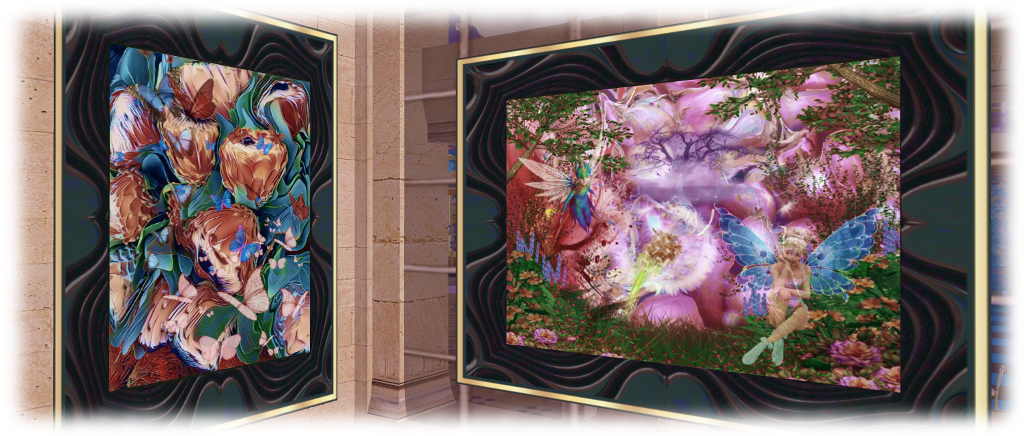
Now open at the Paris Metro gallery in Second Life is Mystery of Nature, an exhibition of art by Sisi Biedermann, presenting 14 pieces of work for our appreciation.
“I joined Second Life in 2007, and back then I never realised how much this would mean to me, ” Sisi says of her art and her time in Second Life. “Back then I had just started painting with acrylics after a very long break where I raised my children and looked after my family and my work. I started taking photos in Second Life in 2008, and have developed my style ever since.
“Over the years, I have amassed several hundred paintings, and I still get a lot of inspiration from nature, Second Life and northern islands such as Faroe Islands and Iceland.”
The pieces selected for this exhibition reflect Sisi’s love of nature, whilst offering pieces with a slight fantasy twist to them, complete with a touch of the abstract. From landscape studies to works focused on people / avatars, it’s a remarkable selection, rich in colour and depth, broad in style and composition. Nature is reflected in all of them, from being the focus Fern through to the autumn leaves framing The Chinese Tower or the mountains and Moon seemingly forming the backdrop of Top of the World.
The fantasy elements are perhaps clearest in Faery Land and Magic Book, but so too is it event in other pieces as well – such as The Bridge, with its rich symbolism, and the framing of The Edge. Similarly, the abstract nature within the pieces is both obvious and beautifully subtle.
This is a superb selection, of art, one well worth visiting and the individual pieces very collectible for hanging at home.
I first became aware of Anu’s existence in Sansar courtesy of a Product Meeting which took place there. Built by AnuAmun (aka (AnuAmun Alchemi in Second Life), it is an intriguing build, bringing together a curious mix of ancient and future, in what is simply described as “a happy place, filled with smiling faces”.
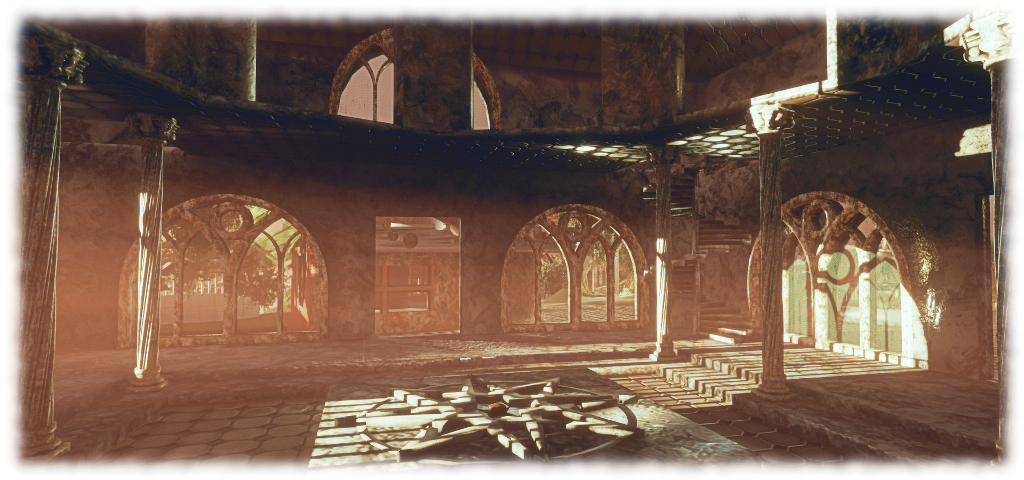
The first thing that tends to strike visitors on arrival is the lighting. Set at what appears to be sunset, the sky a burnished orange, the lighting is one of the major features of the experience – as becomes clear as you explore. The spawn point seems to be the corner of a park, and gives the first indications of the juxtaposition between old and possibly futuristic: the ground is partial covered with strange hexagonal elements, themselves covered in part by soil; odd metal structures and panels sit with ruined stone walls and bare rock faces.
Facing the spawn point is a set of aged stone step and footpath, guarded by plant-bearing statues and lit by tall (electric? gas?) lamps. These point the way to a small greensward, again mixing futuristic metal stairs and free-standing hexagons with more traditional park benches. More stone steps set into the slope lead the way up to a paved plateau where sits what might be an old temple, the stonework weathered and partially exposed beneath what might once have been pristine white daub, but above which rises a new-look tiled roof.
Alongside this temple is a small, more modern-looking building, the walls neatly squared and at least partially covered in a painted stucco finish and the windows neatly framed in wood. Empty inside, save for s set of stairs, this smaller building has both a balcony and rooftop terrace for looking out over the scene. The temple is more impressive: the wide, tall windows with their intricate stone arches suggest windows from a Norman cathedral, and allow the light of the lowering sun to stream through in streams of God rays, illuminating the temple’s interior and the cobbled area before it.
While seemingly natural from above, the plateau on which these buildings sit overlooks a lower area, paved by a mix of the hexagonal elements and stone, and where the sides of the “plateau” reveal they are the walls of an industrial-looking structure built back into the hill. Thus the question is raised: which came first: the industrial-like structure with its walls partially scrawled with graffiti, or the temple above it?
The area before this (non-accessible) structure can be reached via a slightly circuitous route from the spawn point – just wall out onto the grass to the right of the park area where the table and chairs can be seen, and follow the route under the stone arch a short distance from them, and you’ll find the way. This route also provides access to an old stone stairway climbing another hill, where sits a large platform facing the temple across the shallow valley between the two – although (at the time of writing) there’s no means to reach the top of the platform.
Walk to the paved area before the more industrial elements beneath the temple site, and you’ll find a bridge spanning the steam flowing through the setting, and which provides access to a long tunnel burrowing under the platform-topped hill. There’s also a lighthouse-like tower rising from a corner of this paved area, a further set of step apparently providing access to it – although for some reason attempts to access it bounce you back down the steps.
All-in-all, Anu is a mystical, mysterious setting. You can’t help but feel there is a story waiting to be told here – a story yet to reveal itself. I’ve no idea if the experience is still a work-in-progress, but parts of it had that kind of feel about it notably around the structure on which the temple sits, the tunnel through the hill across the valley, and the area around the platform above it. If it is a WIP, then further visits may well be in order to see how it develops, and whether that story starts to unfold.
On Tuesday, December 5th, the Main (SLS) channel was updated with the server maintenance package 17#17.11.17.510835, previously deployed the three RC channels. This comprises:
IMs sent to an off-line resident will only be sent to verified email addresses.
Internal Changes to Outgoing Emails.
On Wednesday, December 6th, the three RC channels should be updates with a new server maintenance package, 17#17.12.01.511131, comprising “internal improvements”.
E-mail Verification
The Main (SLS) server deployment sees a further step in the Lab’s plan to reduce the volume of e-mail traffic it generates by only sending e-mails to those addresses Second Life users have actually verified as being valid with Linden Lab (see Making Email From Second Life (More) Reliable).
With this deployment, and if you have not verified your preferred SL-related e-mail address with Linden Lab, you will no longer receive off-line IMs as e-mails. So, if you haven’t already done so, ad wish to continue receiving off-line IMs as e-mails from wherever they originate in-world, make sure you have verified the e-mail address recorded in your viewer with Linden Lab. Should you require detailed instructions on how to do this, please refer to my blog post Important: verifying your e-mail address with Second life.
SL Viewer
The Project Render Viewer updated to version 5.1.0.510978 on December 4th (although the wiki page still lists it as dated November 30th). All other viewers remain unchanged from week #48 at the time of writing:
e have been no SL viewer updates since the end of week #45, leaving the current viewer pipelines as follows:
Current Release version 5.0.9.329906, dated November 17, promoted November 29th – formerly the “Martini” Maintenance RC
Release channel cohorts:
Wolfpack RC viewer arrived, version 5.0.10.330001, released on November 30.
Alex Ivy 64-bit viewer, version 5.1.0.511060, December 1.
Voice RC viewer, version 5.0.8.328552, October 20 (still dated Sept 1 on the wiki page).
Obsolete platform viewer version 3.7.28.300847, dated May 8, 2015 – provided for users on Windows XP and OS X versions below 10.7.
Marketplace Listings Issues
For the last 10 tens there have been on-going issues with Marketplace items becoming unlisted/ associated with their related items. The issues have been subject to continuing investigation. The Lab has also been attempting to recover listings as investigations have continued. On Monday, December 4th, the Grid Status Page was updated:
Identified – We have identified a solution to this matter and are actively working through the support cases and JIRA tickets that have been submitted. If you have been affected by the issue (Marketplace listings unlisting) and have not reported it to us yet, please file a support case. Thank you again for your patience as we slay this dragon.
To which Oz Linden added, during the Simulator User Group on Tuesday, December 5th:
We found and fixed some problems and repaired many listings. I won’t claim we found all problems because I have no way to be sure of that (ever) … Anyone who lost a listing should file a support ticket. We have a process in place to recover the listings we can. So far I believe that’s most of them.
Enhanced Environment Project
Rider Linden is working on the Enhanced Environmental Project (EEP), which comprises a number of changes to how environmental (Windlight) settings are handle. They include the ability to define the environment (sky, sun, moon, clouds, water settings) at the parcel level; a new environment asset type that can be stored in inventory and traded through the Marketplace / exchanged with others; scripted, experience-based environment functions, an extended day cycle and extended environmental parameters.
This work, which involves both viewer and server-side updates, is generally part of my CCUG meeting updates. However, Rider is still considering how best to convert existing custom Windlight settings people have created into inventory assets. If anyone has any ideas on how to make this work, to please file a JIRA for the Enhanced Environmental Project, and ask in the description that it be brought to his attention.
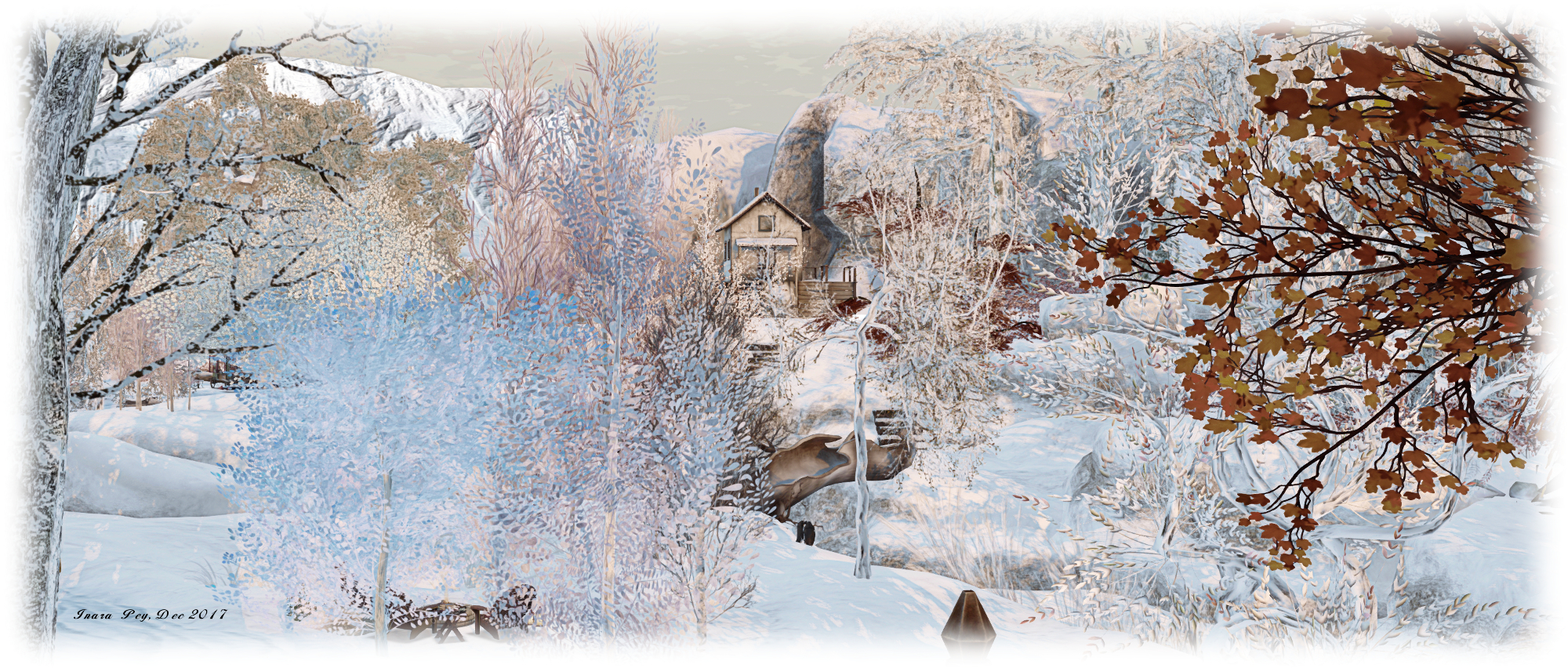
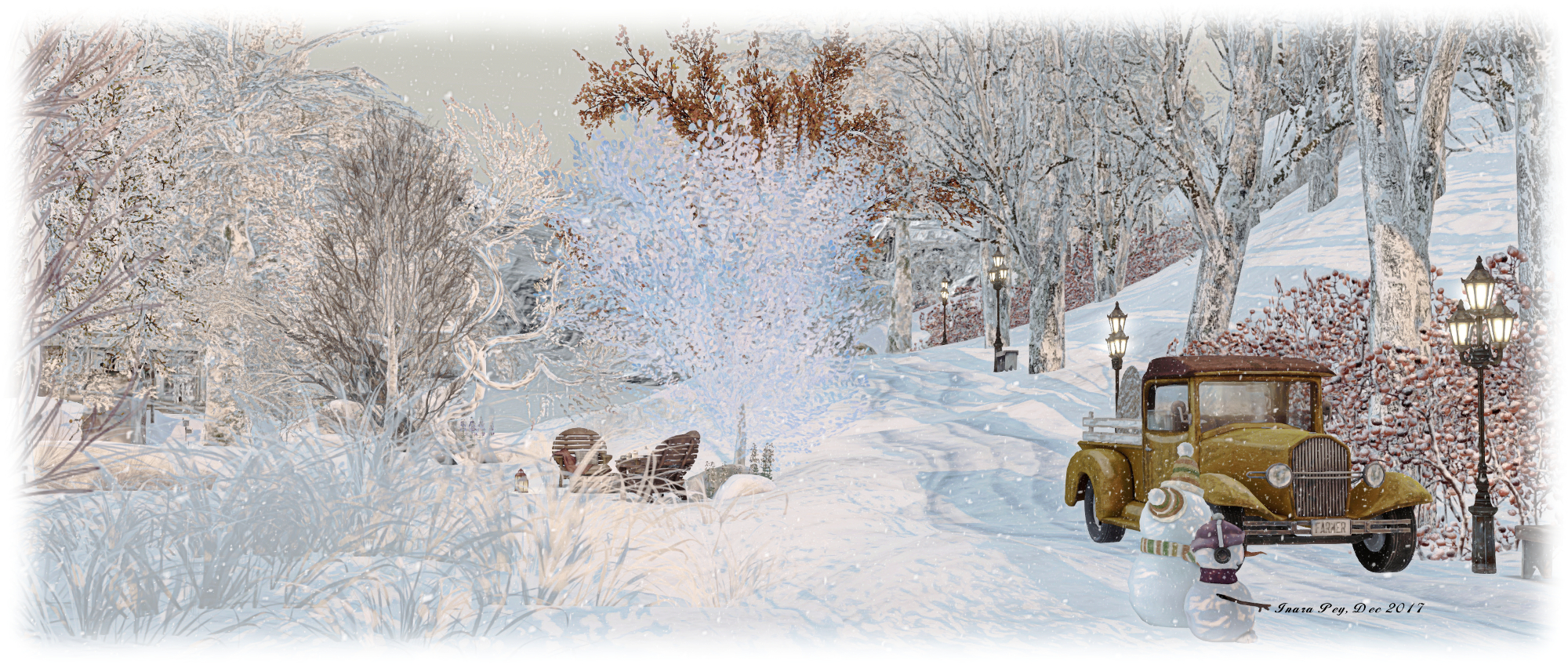
It’s always a pleasure to visit The Mill, the homestead region designed by Shakespeare (SkinnyNilla) and Max (Maxie Daviau). It’s a place we’ve paid numerous visits to, on account that it receives a seasonal rebuild, so when Shakespeare dropped an invitation for Caitlyn and I to drop in and see the Winter 2017 build.
As is the tradition with The Mill, a visit commences at the titular location for the region: the great stone mill, currently located in the south-east corner of the region. From here, track runs through the snow, circling a little café serving welcome hot drinks. From here, steps lead up and to the west, where a snowy little cabin sits, overlooking the region’s frozen river. An old pick-up truck is struggling to the cabin, trying to deliver a Christmas tree, having driven past a little row of houses beyond a rocky arch.
Alternatively, a decorative bridge reached a short walk from the landing point offers a way across the river to where a church keeps watch on a deck built out over the ice, and a little carousel. Here the route divides once more, one track leading up a hill and under the boughs of a giant Virginia Oak to a house atop the hill, the other running around the base of the hill. This lower road follows the high bank of the river to where a set of stone steps leads up to the lower end of a sleigh run – the upper end not far from the hilltop house.
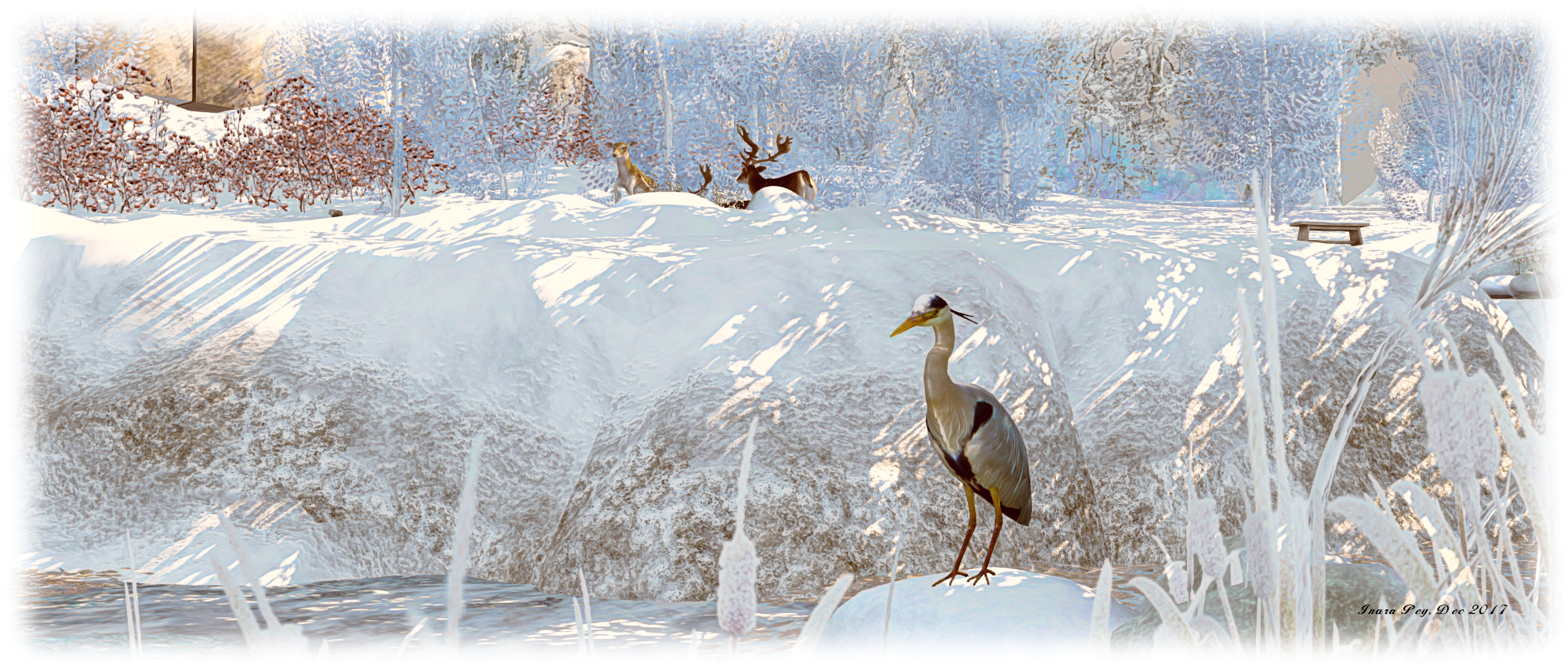
With riverside camps, hillside look-out points, horse, deer and sheep wandering throughout, The Mill presents a perfect rural winter scene, with plenty of places for people to enjoy taking photos or enjoy the setting. Accompanying the region is a superb audio stream in the form of Martini in the Morning – one on my personal favourites, and with which I share some history, having helped introduce Brad “Martini” Chambers to the world of Second Life.
For those who prefer not to explore with the audio stream active (as we generally do), there’s a gentle ambient sound scape for the region, complete with some seasonal touches with the help of Nat “King” Cole, Dean Martin and – I believe – Matt Munroe at the carousel.
As always, The Mill is a joy and a pleasure to visit – make sure you do, and don’t forget to offer a token of appreciation via the little bear by the landing point to help Shakespeare and Max continue to offer the region for visitors to enjoy.
Now open at Solo Arte, curated by Melania (MelaniaBis), is 1928 Polo Nord, the latest installation by Terrygold. Best known for her evocative avatar studies, for this installation Terrygold has turned to history. Working with the assistance of Melania and Annalisa Muliaina, she has built an installation commemorating the ill-fated polar expedition of the airship Italia in 1928.
Italian aviator, aeronautical engineer Umberto Nobile was one of the pioneers of airship design in the early 20th century. In particular, he was responsible for the airship N-1, the Norge, which, in 1925 was used by Norwegian Arctic explorer Roald Amundsen for a flight over the North Pole. Nobile helped arrange the expedition and served as the pilot. While it was a success, he and Amundsen fell out over who deserved the greater credit for the feat.
Possibly to cement his reputation as an Arctic explorer, Nobile decided to organise his own polar expedition, this time using the airship Italia, sister to the Norge, and which he also designed. After preparing the expedition over some three years, Nobile and his crew departed Svarlbard, the launch-point for the expedition on May 23rd, 1928. After a 19 hour flight, they arrived over the north pole in the early hours of May 24th. The plan had been to hover over the pole and drop off a team of scientists and equipment to establish a temporary polar base. However, strong winds prevented this, and after two hours circling the pole, the airship started on its return trip to Svalbard. It never made it.
Thanks to the strong winds and worsening weather, Italia crashed on the Arctic ice on May 25th. Seven crew were killed in the crash, one when the control gondola stuck the ice and was ripped away from the airship’s envelope and six more, who were in the envelope at the time of the crash and were carried away with in the winds, never to be found.
Seven of the surviving crew were eventually rescued in the world’s first combined polar air-sea rescue operation – although it took almost two months for all of them to be recovered (one man died of exposure). The survivors were able to use the equipment intended for the temporary polar base, equipment salvaged from the control gondola and – thanks to the quick wits of the chief engineer – additional supplies and equipment he threw out of the ruptured airship envelope, even as it rose back into the sky after the crash, carrying him and the others trapped aboard it to their deaths.
In commemorating these events, 1928 Polo Nord presents a two-part installation. At the landing point is a photographic record of the expedition, neatly displayed within the frame of an airship’s hull. Each picture is accompanied by text captions in English or Italian, which can be triggered in local chat by clicking on the appropriate country flag. The photos are of the expedition itself, the Italia, the crash site and the support ship, the Città di Milano – the crew of which were partially responsible for rescue operations being delayed by a week as they failed to maintain a proper radio watch, and so didn’t pick up the SOS signals from the crash survivors.
At the forward end of the airship hull is a model of the Fokker Dr4 flown by Einar Lundborg of the Swedish Air Force, who effected the first rescue (Umberto Nobile himself, although he wanted Lunberg to take his injured mechanic). Lunbborg himself became stranded with the remaining survivors when he returned to attempt a further rescue, and his aircraft crashed.
A teleport is located in front of the ‘plane leads down the to second part of the installation – and Arctic ice where the survivors awaited rescue following the crash. This includes the wreck of the control gondola, the crashed Fokker Dr4 and the famous red tent which gave the survivors a degree of shelter. And don’t miss the poem by Judy Barton commemorating the crash.
1928 Polo Nord makes for a most unusual – but still engaging – installation.
Logos representative only and should not be seen as an endorsement / preference / recommendation
Updates for the week ending Sunday, December 3rd
This summary is published every Monday, and is a list of SL viewer / client releases (official and TPV) made during the previous week. When reading it, please note:
It is based on my Current Viewer Releases Page, a list of all Second Life viewers and clients that are in popular use (and of which I am aware), and which are recognised as adhering to the TPV Policy. This page includes comprehensive links to download pages, blog notes, release notes, etc., as well as links to any / all reviews of specific viewers / clients made within this blog
By its nature, this summary presented here will always be in arrears, please refer to the Current Viewer Release Page for more up-to-date information.
Official LL Viewers
Current Release version 5.0.9.329906, dated November 17, promoted November 29th – formerly the “Martini” Maintenance RC – NEW
Cool VL viewer Stable branch updated to version 1.26.20.38 and the Experimental Branch (Animesh) updated to version 1.26.21.4, both on December 2nd (change log)
Mobile / Other Clients
MetaChat updated to version 1.2 on November 24th (no release notes) – included here as no week 47 summary).









 Inara Pey: Living in a Modemworld