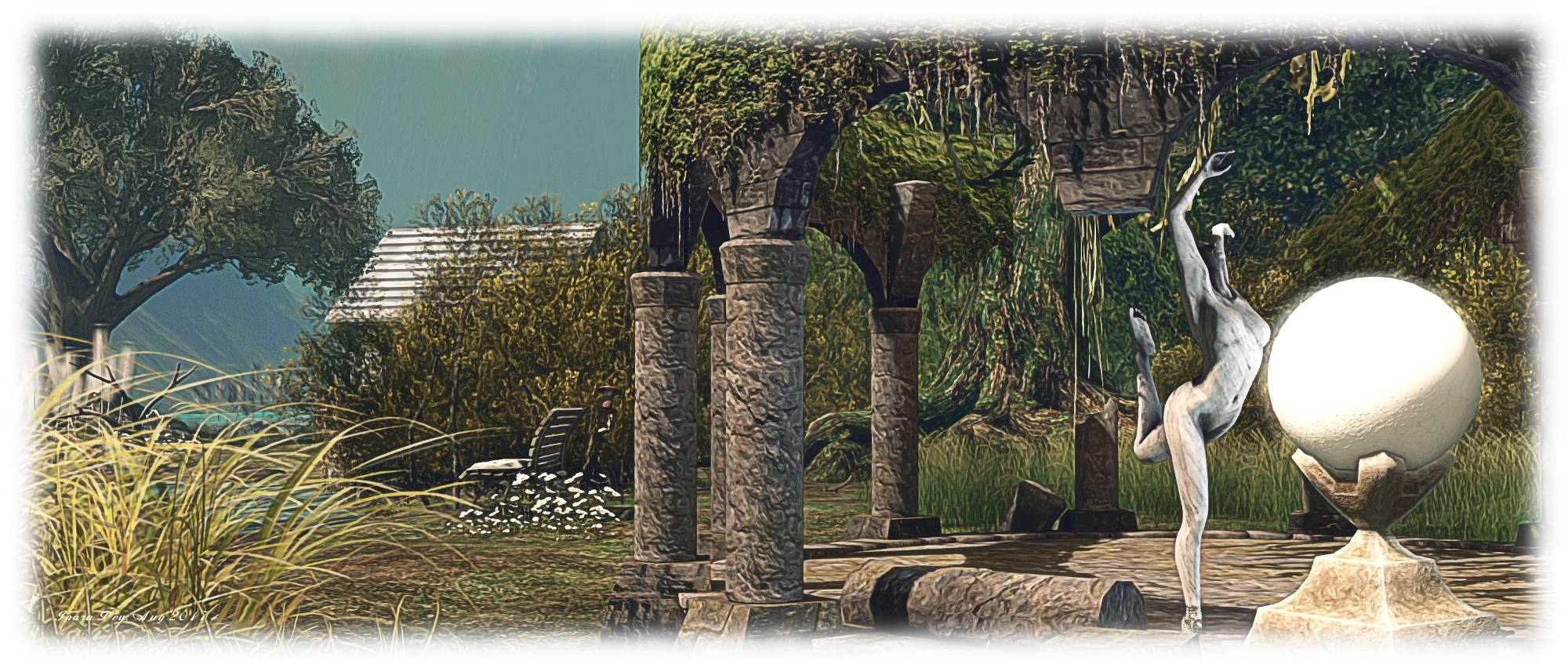
“It’s all prims except the dragon and the birds,” Cica Ghost says of her newest installation, which opened on Sunday, August 6th. Given that the majority might be seen as “retro” in using prims, the title – Future – might seem a little odd. But there is more to this build than may at first appear to be the case.
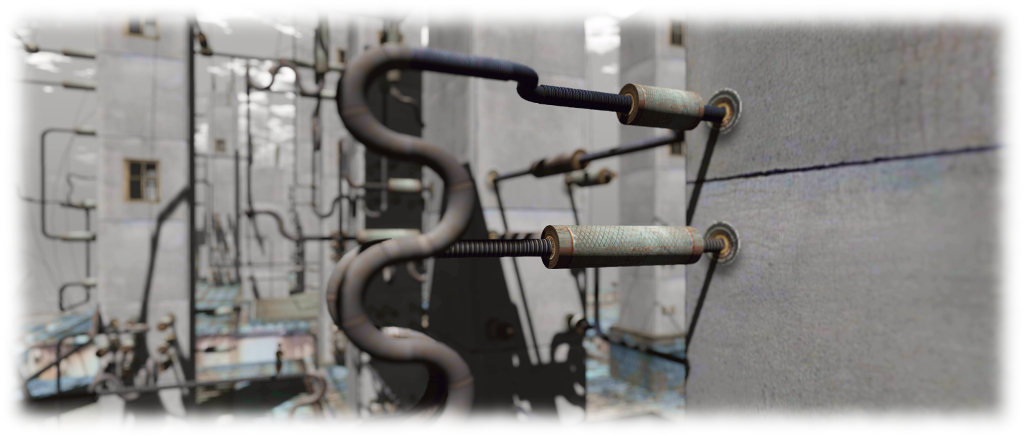
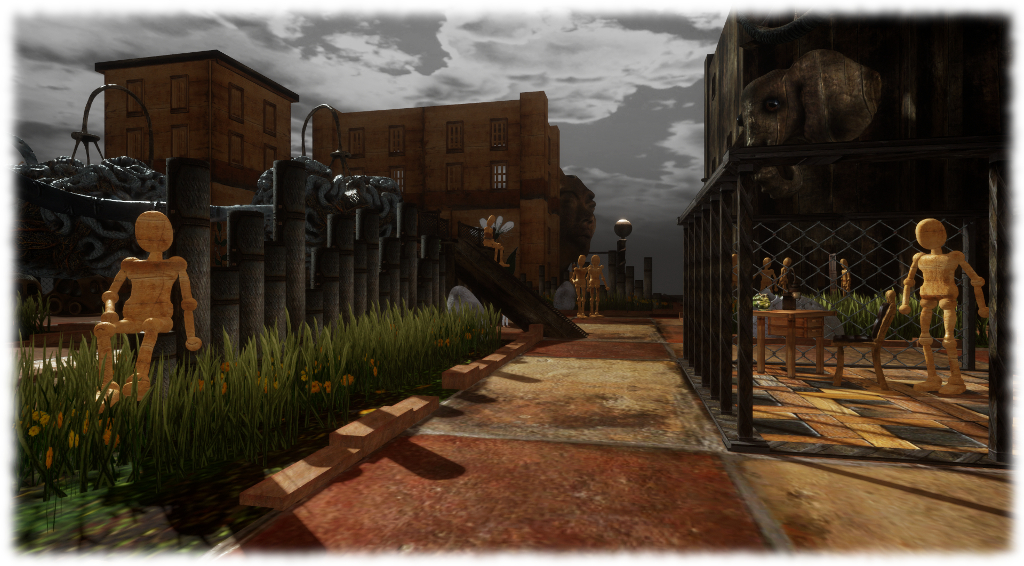
The core of the build is a series of windowed, concrete-like towers rising from a huge metal base. These are connected by metal “wires” which runs up out of the base, from walls and rooftops – and even support a number of these blocks as they stand above the base platform. Resistor-like elements in them suggest the wires might be some kind of electrical circuit.
More of the wires arc over the build, and spheres slowly ride some of these, just as some of the “resistors” run back and forth along some of the horizontal segments. The idea that these wires conduct electrical current is further heightened by the way they appear to be insulated where they join with the tower structures, and by flickering lightning-like arcs zapping between some of the roof-top “resistors”.
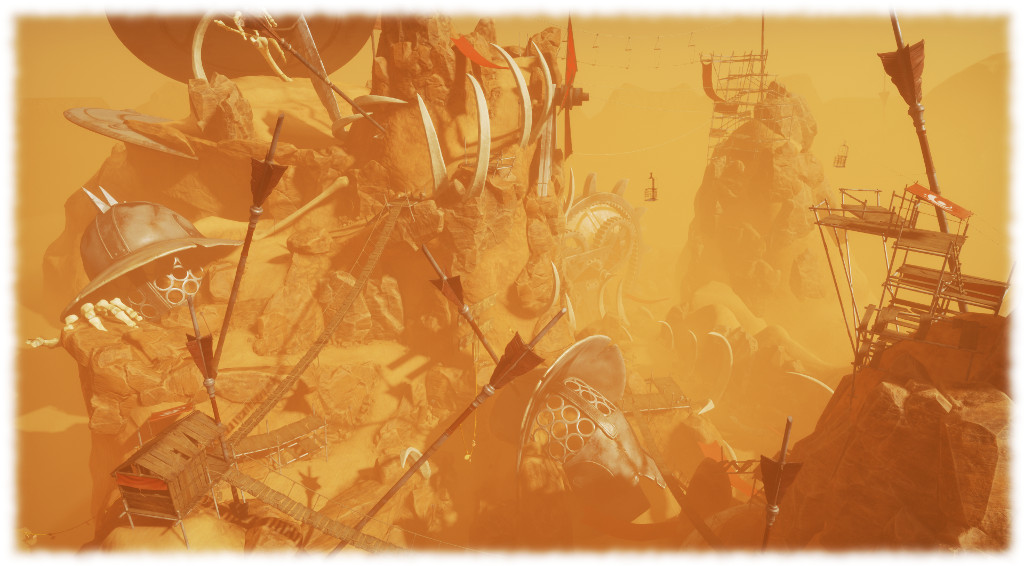
It’s a strange, industrial landscape, largely grey in nature, set under a grey sky and surrounded by grey water where, rather incongruously, the mesh dragon raises its head, Nessie-like. A checker board landscape also rises hump-backed from the waters in places, and offers a dry path from the landing point to the installation, as well as places from which more of the wires rise into the sky. But what does it all mean?
That’s the open question, and I’d venture to suggest that the answer lies in the quote Cica gives for the installation: If you don’t imagine, nothing ever happens at all. It comes from Paper Towns by John Green, and on one level it sits as an invitation for use to imagine for ourselves what Future might represent. But there is also more to it, particularly when considered along with the other essential element of the installation: the audio stream.
Featuring much of the extended soundtrack from Blade Runner, the audio is something which must be listened to when touring the installation. Cica selected the sound track because she likes it, rather than it having a specific relationship with the build, or meaning within it. However, it naturally completes the build, adding a further sense of depth to it, and presence within it.
What is interesting here – to me at least – is that Green’s quote from Paper Towns is essentially about identity and discovery; Blade Runner is strongly focused on the same issues – identity and discovery (the Replicants and who / what they are and have been / might be). Thus, when combined, they offer us even more of an invitation to examine, explore and consider Future and what it might mean to us.
Cica has a gift for making whimsical, evocative and thought-provoking installations. Future definitely sits within the latter category, and could well have you visiting and pondering for longer than you might have expected!
Logos representative only and should not be seen as an endorsement / preference / recommendation
Updates for the week ending Sunday, August 6th
This summary is published every Monday, and is a list of SL viewer / client releases (official and TPV) made during the previous week. When reading it, please note:
It is based on my Current Viewer Releases Page, a list of all Second Life viewers and clients that are in popular use (and of which I am aware), and which are recognised as adhering to the TPV Policy. This page includes comprehensive links to download pages, blog notes, release notes, etc., as well as links to any / all reviews of specific viewers / clients made within this blog
By its nature, this summary presented here will always be in arrears, please refer to the Current Viewer Release Page for more up-to-date information.
Official LL Viewers
Current Release version 5.0.6.326593, released on May 26th, promoted June 20th – formerly the AssetHTTP RC viewer – overview – download and release notes – No change
On August 6th 2016, NASA delivered the Mars Science Laboratory (MSL) to the surface of Mars in what was called the “seven minutes of terror” – the period when the mission slammed into the tenuous Martian atmosphere to begin deceleration and a descent to the surface of the planet which culminated in the Curiosity rover being winched down gently from a hovering “sky crane” and then lowered until its wheels made firm contact with the ground.
The “seven minutes of terror” actually had a double meaning. Not only did it represent the time MSL would smash into Mars’ atmosphere and attempt its seemingly crazy landing, at the time of the event, the distance between Earth and Mars meant it took seven minutes to be returned to mission control from the red planet. Thus, even as the initial telemetry indicating the craft was entering the upper reaches of Mars’ tenuous atmosphere was being received, mission controls knew that in reality, the landing had either succeeded or failed.
Obviously, the attempt succeeded. Everything worked flawlessly, and Curiosity was delivered to the surface of Mars at 05:17 GMT on August 6th, 2012 (01:17, August 6th EDT, 22:17 PDT, August 5th). In the five years since that time, it is helped revolutionise our understanding of that enigmatic world – as well as adding somewhat to its mystery.
To call the mission a success is not an exaggeration; within weeks of its arrival inside the 154 kilometre (96 mile) wide Gale Crater, Curiosity was examining an ancient riverbed en route to a region of the crater dubbed “Yellowknife Bay”. It was there the rover made its first bombshell discovery: analysis of the area showed that billions of years ago it was home for the ideal conditions to potentially kick-start microbial life. It was, in essence, the achievement of mission’s primary goal: to identify if Mars may have once harboured the kind of conditions which might have given rise to life.
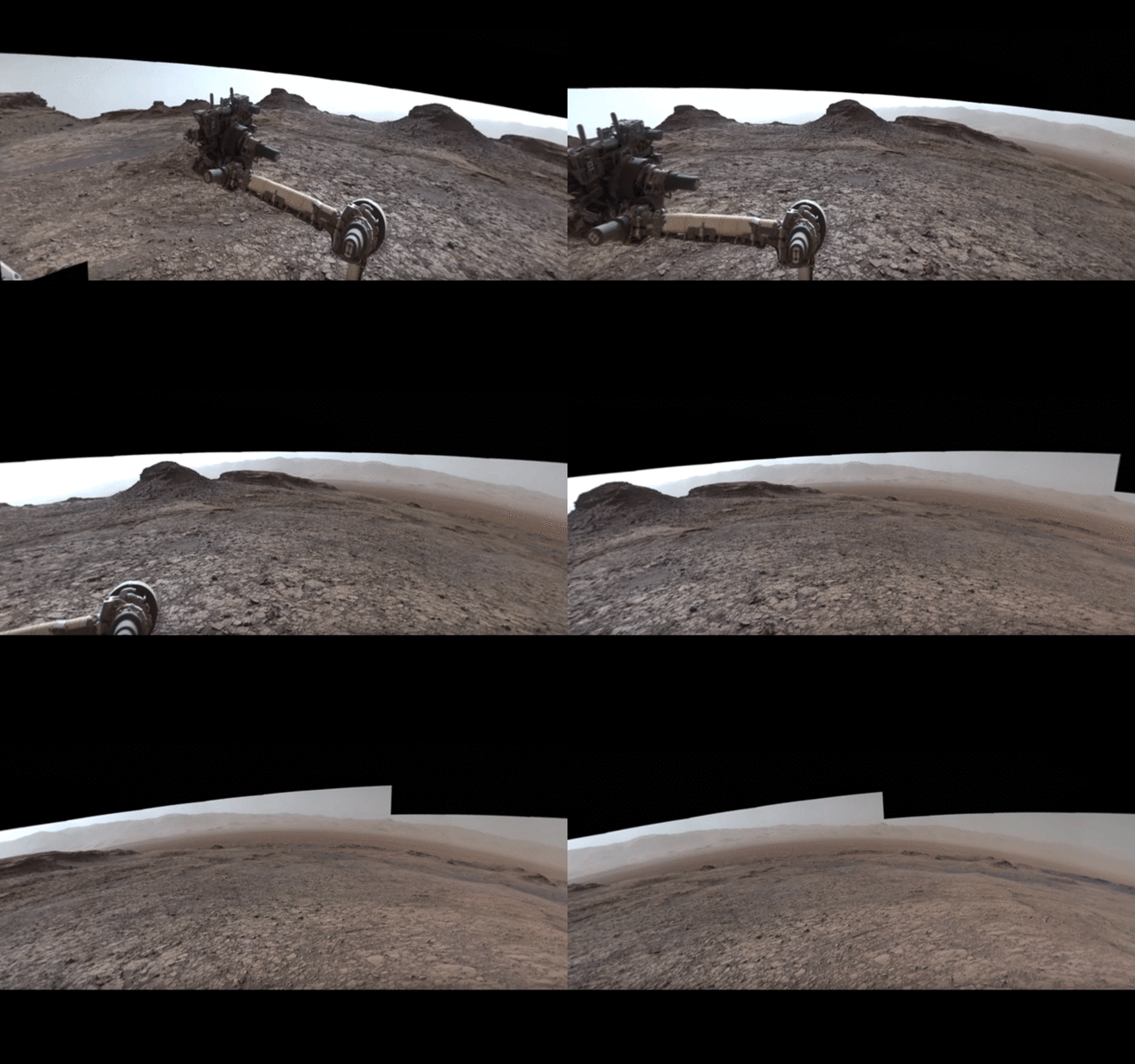
This 360-degree view was acquired on August 6th, 2016, by Curiosity’s Mastcam as the rover neared the “Murray Buttes” on lower “Mount Sharp”. The dark, flat-topped mesa seen to the left of the rover’s arm is about 15 metres (50 ft) high and about 61.5 metres (200 ft) long. Credit: NASA/JPL / MSSS
For the first year following its arrival on Mars, Curiosity continued to survey the regions relatively close to its landing zone, finding more evidence of a benign ancient environment. Then it started out on the next phase of its mission: the long traverse towards the massive bulk of “Mount Sharp” – officially called Aeolis Mons. A huge mound of rock deposited against the crater’s central impact peak, “Mount Sharp” rises from the crater floor to an altitude of some 5.5 km (3 mi), and imagining from orbit strongly suggested its formation was due, at least in part, to the presence of water in the crater at some point in Mars’ past.
The 8 km (5 mi) trip took the rover a year to complete, in part due to its relatively slow speed, in part due to the fact is had to travel a good way along the base of “Mount Sharp” to reach a point where it could commence an ascent up the slope; but mostly because there were a number of points of interest along the way where the mission scientists wanted to have a look around, investigate and sample.
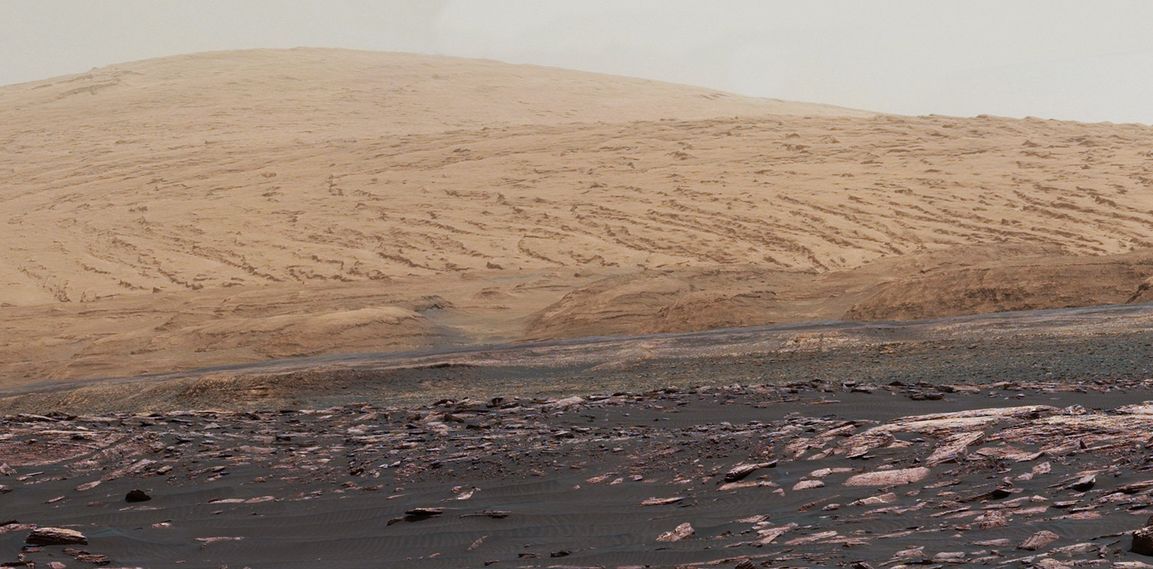
Mount Sharp as seen from Curiosity, on January 24th, 2017. The light grey banding befpre the sandy coloured slopes is the clay unit the rover will reach in about 2 years. In front of it is the “Vera Rubin Ridge”, the next location for study by the rover. Credit: NASA/JPL / MSSS
For the last three years, the rover has been slowly making its way up “Mount Sharp”, climbing around 180 metres (600ft) vertically above the surrounding crater floor and visiting numerous points of interest – such as “Pahrump Hills”, the mixed terrain where “Mount Sharp” merges with the crater floor. Along the way, Curiosity has both confirmed that “Mount Sharp” was most likely the result of sedimentary deposits laid down during several periods of flooding in the crater before the water finally receded and wind action took over, sculpting the mound into its present shape down through the millennia.
The lakes within Gale crater may have actually been relatively short-lived, perhaps lasting just 1,000 years at a time, but Curiosity has shown that even during the dry inter-lake periods, water was very much a feature of Gale Crater, finding evidence of compressed water channels within the layers of rock which sit naturally exposed on “Mount Sharp’s” flanks.
In December 2014, NASA issued a report on how “Mount Sharp” was likely formed. On the left, the repeated depositing of alluvial and wind-blown matter (light brown) around a series of central lakes which formed in Gale Crater, where material was deposited by water and more heavily compressed due the weight of successive lakes (dark brown). On the right, once the water had fully receded / vanished from the crater, wind action took hold, eroding the original alluvial / windblown deposits around the “dry” perimeter of the crater more rapidly than the densely compacted mudstone layers of the successive lake beds, thus forming “Mount Sharp”
Alongside the sedimentary layering of the mudstone comprising “Mount Sharp” and the compressed and long-dry water channels, a further sign that the region was once water rich comes in the form of the mineral hematite, which Curiosity has found on numerous occasions. Right now, the rover is making its way towards a feature dubbed “Vera Rubin Ridge” which orbital analysis shows to be rich in this iron-bearing mineral which requires liquid water to form. Beyond that is a clay-rich unit separating the hematite rich ridge from an area which show strong evidence for sulphates. These are also indicative of water having once been present, albeit less abundantly than along “Vera Rubin Ridge”, and thus hinting at a change in the local environment. Currently, Curiosity is expected to reach this area in about two years’ time, after studying “Vera Rubin Ridge” and the clay unit along the way.
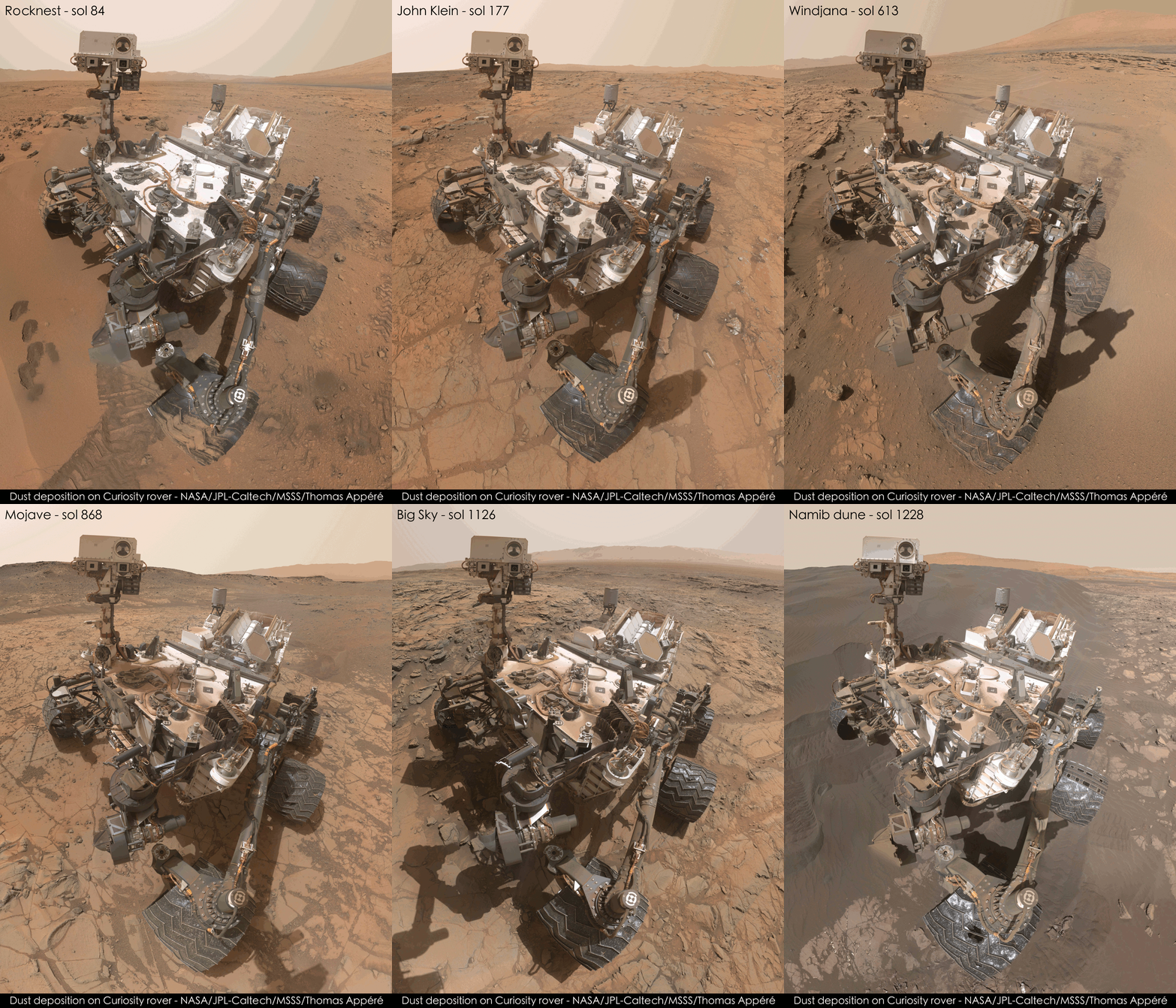
Selfies from Mars: how Curiosity has weathered the dust on Mars over five years – the dates are given as Sols – Martian days, top left and the locations where the pictures were taken. Credit: NASA/JPL
Throughout the last five years, Curiosity has remained relatively healthy. There has been the odd unexpected glitch with the on-board computers, all of which have been successfully overcome. There has been some damage to the rover’s aluminium wheels. This did give rise to concern at the time it was noted, resulting in a traverse across rough terrain being abandoned in favour of a more circuitous and less demanding route up onto “Mount Sharp”. But overall, the wheels remain in reasonably sound condition.
The one major cause for concern at present lies with Curiosity’s drill mechanism. Trouble with this first began when vibrations from the drill percussive mechanism was noted to be having a negative impact on the rover’s robot arm.
More recently – since December 2016, in fact – all use of the drill has ceased, limiting Curiosity’s sample gathering capabilities. This has been due to an issue with the drill feed motor, which extends the drill head away from the robot arm during normal drilling operations, preventing the arm physically coming into contact with targets. Attempt to rectify the problem have so far been unsuccessful, so engineers are loot at ways to manoeuvre the rover’s arm and place the drill bit in contact with sample targets, avoiding the need to use the feed motor.
So with five years on Mars under its belt, and barring no major unforeseen incidents, Curiosity will continue its mission through the next five years, further enhancing our knowledge of Mars.
Caitlyn and I first visited Whimberly, the Homestead region designed by Staubi (Engelsstaub) in January of 2017. Back then, both of us were struck by the elegance and serenity of the region. So seeing it back in the Destination Guide with an updated image suggesting a make-over, had us hopping back at the start of August for another look; and it was well worth it.
The landing point to the north-east of the region places visitors outside a flat-roofed summer-house surrounded on three sides by an ornate wall while the fourth sports a wooden deck build out over the water. Cosily and elegantly furnished, the house suggests a summer getaway or a lover’s tryst.
An old fountain sits alongside this summer-house, birds chirping happily (or perhaps in a demand for food!) while hopping along the retaining wall, while beyond the fountain, a stone arch provides access to one of several seating areas suitable for individual visitors or couples, all of which are scattered far enough apart from one another to offer a sense of seclusion.
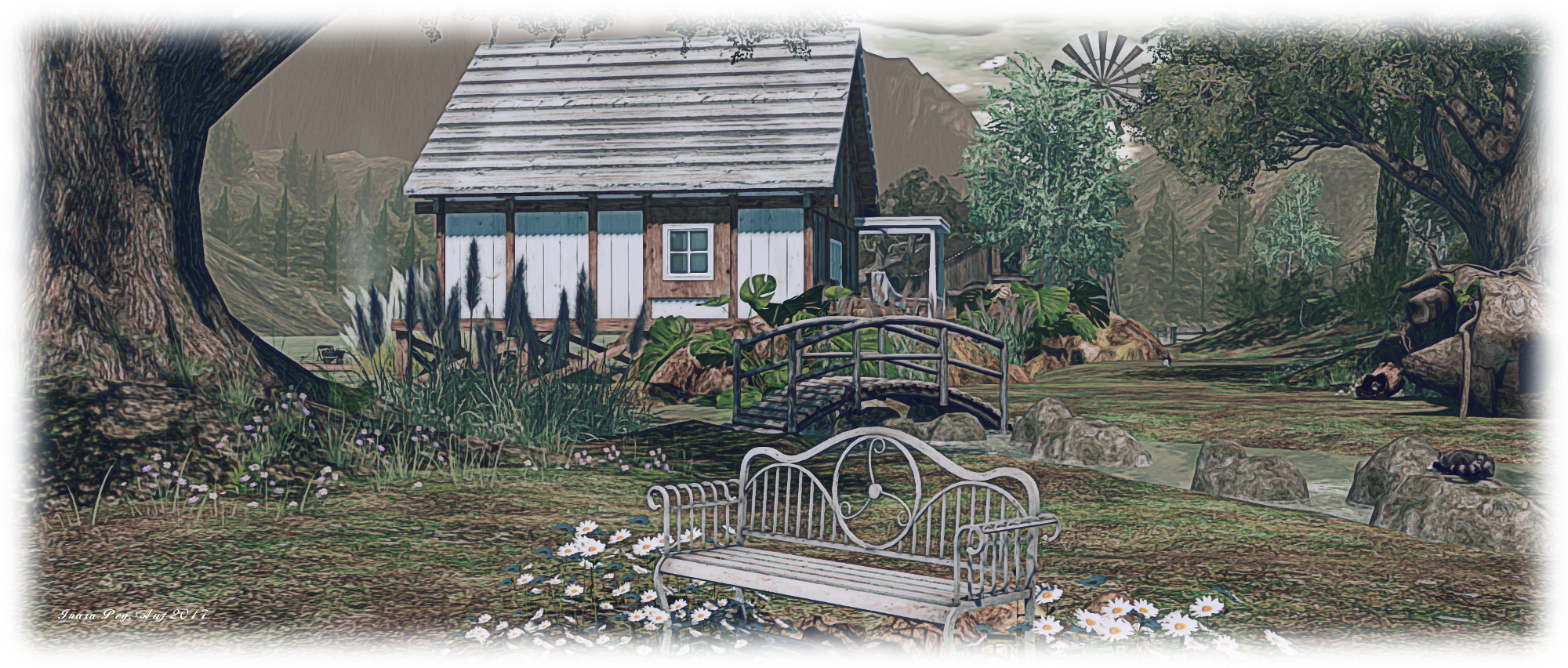
A stream, crossed by three bridges, dissects the land into two halves of unequal size. The northern part with the landing point, offers a walk east and south, passing both the seating spot mentioned above and then another, further to the east, before the smallest of the three bridges provide a means to rejoin the larger part of the land. Westwards, past a wooden jetty were one can rez a little motor boat to putter along the stream, the land turns hilly.
A grassy path climbs the gentle slopes of the hill, revealing an old barn looking to the north-west and overlooking a tiny islet where a picnic awaits on the far side of the little rope bridge. The grassy trail then continues southwards between the shoulder of the hill and the water to where another bridge – this one crafted from the interlocked trunks of two trees – crosses the stream and offers access to a grand house.
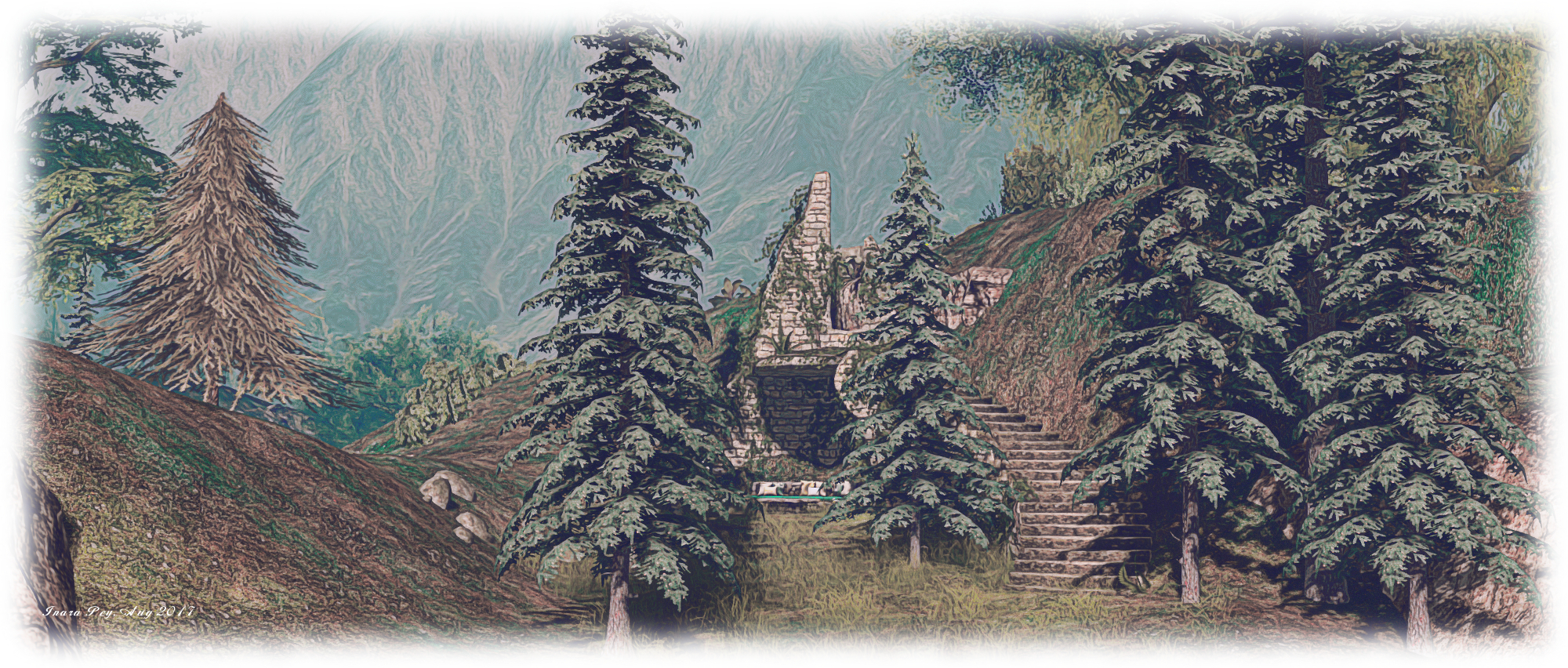
With a paved courtyard, terrace to the rear, the house presents an idyllic place to live, the full height conservatory to the rear offering a magnificent view. Board walks point the way to where a deck extends out over the waters of a bay which cuts deeply into the land. A humpbacked finger of land points back to the north-eat from the house, and visitors can follow the grassy walk along the flank of its slope above the stream, or walk along its ridged back to where another cosy snuggle point sits within the ruins of an old tower, and stone step present a route up to the highest point on the island.
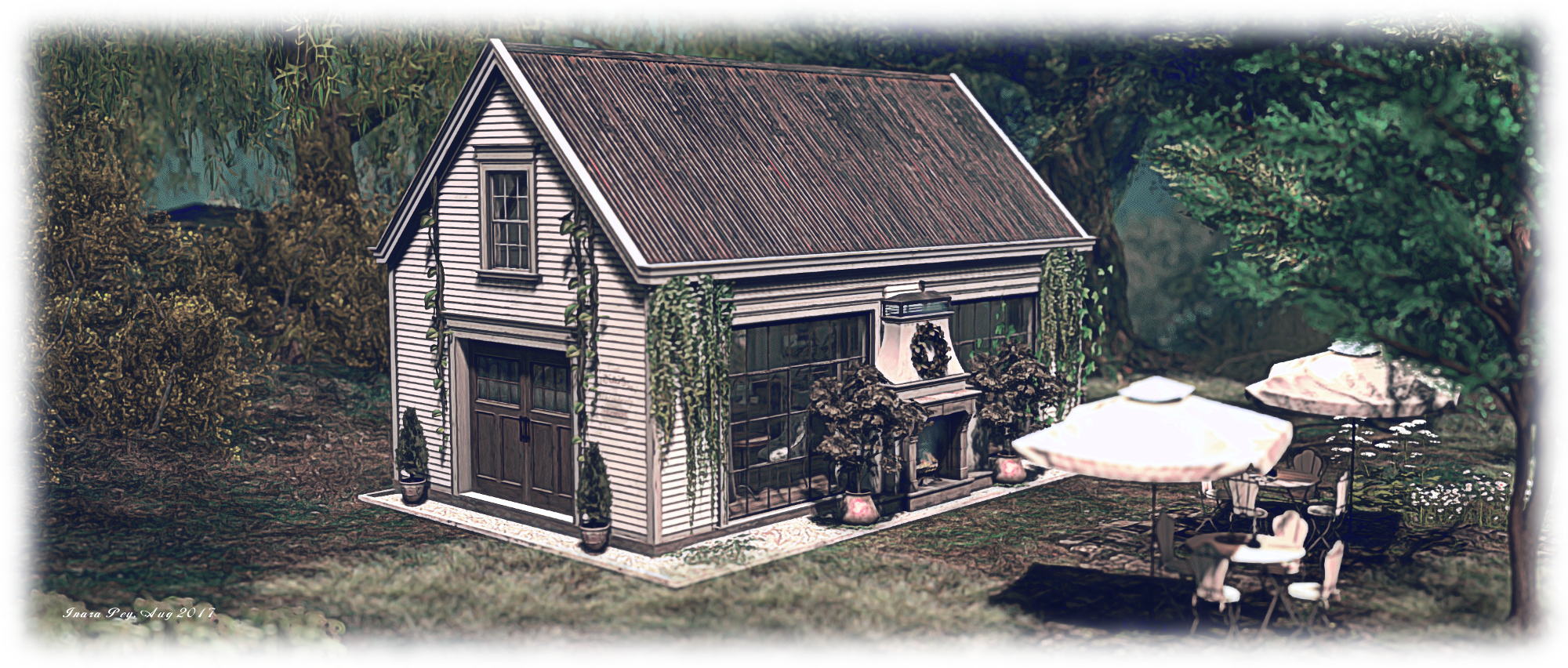
A stylish barn conversion sit at the top of the hill, offering a view to the south and west, back towards the big house. Shaded by fir trees and with the peak of the hill just behind it, it sits as a cosy café where a break from exploring can be enjoyed. For the adventurous, a zip line offers a rapid descent to the little farmstead in the south-eastern corner of the land, located not far from where another summer-style house is built out over the waters surrounding the island.
Set within the confines of surrounding hills, Whimberly sits as an island on a lake somewhere – I’d say at least – deep in Europe. A place to while away the summer days and unwind from the demands of everyday life; where nothing really matters other than the presence of nature around you.
It’s time to kick-off another week of storytelling in Voice by the staff and volunteers at the Seanchai Library. As always, all times SLT, and events are held at the Library’s home at Holly Kai Park, unless otherwise indicated.
Sunday, August 6th 13:30: Tea-Time at Baker Street
Tea-time at Baker Street continues with readings from The Casebook of Sherlock Holmes, the final set of twelve Sherlock Holmes short stories first published in the Strand Magazine between October 1921 and April 1927.
This week: The Adventure of the Sussex Vampire
Do vampires really exist?
In 1896, Mr. Robert Ferguson believes they do.
After writing two letter to Sherlock Holmes about vampires, he arrives at 221B Baker Street with a strange tale about his second wife, a Peruvian, who has apparently taken to sucking the blood of their recently born baby. Prior to being discovered in the act by her husband, she has also been found beating Ferguson’s 15-year-old, partially disabled son from his first marriage. Now she has locked herself in her room, and refuses anyone but the maid to see her.
Deducing the reality of the situation, but keeping it to himself, Holmes agrees to travel to Ferugson’s Sussex home with Watson. There, and with the family all gather together, he seems more interested in gazing out of the window than in dealing with the situation at hand …
Monday, August 7th 19:00: More Than Human
Gyro Muggins reads Theodore Sturgeon’s genre-bending 1953 novel which brings together three of her earlier works to weave a story about people with extraordinary abilities which can be combined – “bleshed” (itself a blending of “blend” and “mesh”) to make them even more extraordinary.
Take, for example, Lone, the simpleton who can hear other people’s thoughts and make a man blow his brains out just by looking at him; or Janie, who moves things without touching them. Then there are the teleporting twins, who can travel ten feet or ten miles, and Baby, who invented an anti-gravity engine while still in the cradle, and Gerry, who has everything it takes to run the world except for a conscience.
Six people struggling to find who they are and whether they are meant to help humanity, destroy it, or represent the next step in evolution, the final chapter in the history of the human race. Through them, Theodore Sturgeon explores questions of power and morality, individuality and belonging, with suspense, pathos, and a lyricism rarely seen in science fiction.
Tuesday, August 8th 19:00: Keep It Brief
With R. Crap Mariner.
Wednesday, August 9th 19:00: Secrets of the Divine Ya-Ya Sisterhood
When Siddalee Walker, oldest daughter of Vivi Abbott Walker, Ya-Ya extraordinaire, is interviewed in the New York Times about a hit play she’s directed, her mother gets described as a “tap-dancing child abuser.”
Enraged, Vivi disowns Sidda. Devastated, Sidda begs forgiveness, and postpones her upcoming wedding. All looks bleak until the Ya-Yas step in and convince Vivi to send Sidda a scrapbook of their girlhood mementos, called “Divine Secrets of the Ya-Ya Sisterhood.”
As Sidda struggles to analyze her mother, she comes face to face with the tangled beauty of imperfect love, and the fact that forgiveness, more than understanding, is often what the heart longs for.
Also presented in Kitely (hop://grid.kitely.com:8002/Seanchai/108/609/1528).
Thursday, August 10th 19:00: TBA
Check the Seanchai Library blog for updates.
Please check with the Seanchai Library’s blog for updates and for additions or changes to the week’s schedule.
The featured charity for August and September is Little Kids Rock, transforming lives by restoring, expanding, and innovating music education in schools.
On Monday, July 31st, Sansar opened its door to the public Creator Beta, allowing anyone to sign-up for an account and give it a go. Unsurprisingly, people from Second Life have been among the first to take a look, so I opted to start my public coverage of Sansar with a getting started guide and then some suggestions on where to go and how to interact with things inside experiences.
One thing the Lab has always made clear about Sansar is that the July 31st opening was not the release of a polished, finished product. Sansar is going to take time to build-out, with features and capabilities being added on a rolling basis. Given this, what might be the Lab’s views and thoughts on Sansar’s development up to now and looking ahead?
Just ahead of the Creator Beta opening, Bjorn Linden (aka Bjorn Laurin, the Lab’s Vice President of Product) and Widely Linden (head of Product for Sansar), together with Pete Linden (aka Peter Gray, the Lab’s Director of Global Communications) and Xiola Linden (SL Community Team Manager), sat down with Sansar and Second Life users to discuss such things. The following is a synthesis of Bjorn’s and Widely’s comments in the two (of three) sessions I was able to attend.
Why is the Public Beta Called “Creator Beta” Is it for Creators Only?
The beta is open to everyone, but because Sansar is still growing, the Lab’s focus remains on creators – those making both original content for upload and use in Sansar, and those creating experiences using that content (regardless of whether they made it themselves or purchased it through the Sansar Marketplace), to ensure they have the tools they need to build and design. At the same time, the Lab will continue to build Sansar out with other capabilities – avatar customisation, community tools and so on – which will be of benefit to all users, be they creatives or visitors.
Why Sansar Doesn’t Use Established Engines
Well, first of all Sansar is built on a whole new code-base. There is not a single line of code that is the same [as Second Life]. We’ve taken a lot of lessons from Second Life, a lot of the initial planners of Second Life were involved in Sansar; but we’ve rebuilt everything. That’s why its taken time. We decided not to use Unity or Unreal; we decided to build our own platform and create our own destiny.
One of the thing for that is about users. User creation in Unity and Unreal is extremely hard; we’ve seen that. For example, if Unity were to do a big upgrade, or Unreal, all the user creations [in Sansar] would break [and] they cannot fix that. That’s why we wanted to create our own destiny. We built out own platform … its taken a few years, but now I see its been worth it. We have our own platform, we control our own destiny; user creations will look the same after an update. That, for us, has been very important.
Right now, Sansar is very VR headset / controller biased. However, it does also run in a Desktop mode somewhat similar to Second Life (1st and 3rd person movement). The Desktop mode is running a little behind VR mode, capabilities-wise (you cannot really manipulate things in the Sansar runtime environment via the Desktop, for example), so how does the Lab regard the Desktop mode?
When we build things, we have to start at the top and then go down. We start with the VR and all the features, then we’re going to bring those features, as many as we can, into non-VR as well, because we know VR is not going to take over the world tomorrow. But we can’t just make features and then add on VR; we have to make VR first and then bring it down fast. And we’re going to do it fast now, as we have a platform to build on. I want people to be able to pick up things on the Desktop and all that stuff, so it’s coming, we’re working on it very fast.
Bjorn Linden
So I wanted to speak to that. The HMD does allow a whole other level of immersion, and it’s really great and Sansar does it very, very well. But in the work it took us to be able to do it well, we made Desktop really good. Because VR is very technically demanding to do, and the desktop mode was very much the beneficiary of that effort. So what that means in more practical terms is the renderer is very efficient, is very fast. And then means you don’t have to have a crazy expensive gaming PC to run Sansar.
Is it going to run at 60 fps on a three or four year-old laptop or a five-year-old laptop? No. But it will run at least as fast as Second Life does on that same desktop, and look prettier doing it. So Desktop really benefited through our efforts in VR. And people are in desktop, and we know that; that’s why it’s really important, unlike some apps, you can with a single press of a button or an icon, just instantaneously switch back and forth between the modes … you just smoothly transition between desktop and VR modes. And there are times you want to do one, there’s time you want to do the other. So HMDs, if anything, helped to make Sansar even better for Desktop.
Widely Linden
Avatar Development
Currently, the Sansar avatars appear – to Second Life users – to be very basic: limited customisation, fairly generic looks, etc., no ability to add anything other than basic attachments at present (rings, hats, sunglasses, etc.). What is likely to happen with the avatars?
People are very interested in their avatars, and attachments [as enabled when the public beta launched] is a first step. I chose to let everyone do avatar attachments because I spoke to many of you, and you wanted that in Sansar. You can’t put it in the store yet, you can’t sell attachments, but this is just the first step … but it’s working, it’s solid, it’s not crashing.
I’ve been spending a lot of time working with partners, the big corporations that have given us access to technology that no other platforms are using how we are planning to use them. So, for example, if you sell a dress, I do want to have a one size fits all; when you put it on, it should fold and crease just like in real life. We have that working on our servers so we will roll that out all these things … we will reveal more of these things in the next couple of months, actually, how it will look and feel like. And you will get full access to everything … You will have access to all this stuff [like] you have access [to it] in Second Life. Just give it a bit time to make it right! Me and my team, we’re working very hard on it!
Second Life has really self-selected for an audience that is very interested in, and really enjoys playing with, avatars: customising avatars, dressing avatars, really focused on that. This is an area in which – and I’ll just be up-front – Sansar is not at parity with the degree of flexibility in regards to crafting an avatar that you currently have in Second Life. You can customise your avatar in Sansar, it looks pretty nice as you do it, but we still have a way to go there.
Now, that being said, we have some stuff coming on-line here over the next good chunk of time that will I think rapidly set the Sansar avatars apart, and allow creators to achieve some effects that were impossible and are just so painfully difficult or costly to achieve in Second Life that it would be generally frowned upon. And so it’s going to be interesting times ahead in regards to avatars in Sansar.
And I think where they’ll start to really take off is as we work to make them more and more active and emotive; improving the face animations, getting those to be more expressive; getting hands to actually interact with objects and look like they’re actually touching the objects; not just in the right general vicinity, but actually have the fingers in the proper grip to hold objects. That stuff is on its way.
Widely Linden
The Sansar avatars are actually extremely, extremely advanced. I would actually go so far [as to say] they are among the most advanced avatars there is today, on any platform. Just the female avatar in Sansar has over 125 bones in the face, to make it work as we want it, to make it look realistic. That’s more than actually humans have.
I want you to build your own avatars. for now that technology we put in is so new, no-one else is using it, we’ll be able to use it for a long time, to make it look realistic, and that’s part of it. When they talk normally it’s going to look better as well, it’s going to look better, in any language, it doesn’t matter. It may Chinese, could be English, could be Swedish, could be Portuguese, Spanish. It’s going to look good. We’ve spent a lot of time on that, and I’m super excited about these small things that make it immersive, that make us want to spend more time in there.
But this is just the start. I talked about the 125 bones in the face [for comparison, the SL avatar has around 133 bones in total], that’s part of what is so complicated; because if you move one of those bones, it’s going to break everything. So we’re working on a way so we can lock those down, and there’s still going to be a way for you to be able to create like a werewolf, so it look normal when the werewolf talks, or holds, or whatever a werewolf does. And we are working on that, it’s going to happen. Just give us some time. I want you to be able to have talking animals, talking trolls, whatever. It’s going to be there.
The next step for the avatars is you’re going to be able to make them bigger, smaller, fatter, thinner. All that stuff, it’s in the works and it’s very exciting.








 Inara Pey: Living in a Modemworld