Flights, dragons, archives and reports

It’s time to kick-off another week of storytelling in Voice by the staff and volunteers at the Seanchai Library. As always, all times SLT, and events are held at the Library’s Second Life home at Bradley University, unless otherwise indicated.

Sunday, January 8th:

13:30: Tea-Time at Baker Street – “Kinda!”

A cosy event at the Seanchai Library fireside room.

18:00: Magicland Storytime

Caledonia Skytower presents Tales of Maui at the Golden Horseshoe.

Monday, January 9th 19:00: Flight of the Phoenix

flight-phoenixGyro Muggins continues Elleston Trevor’s gripping 1964 novel which spawned two films, the classic 1965 version starring James Stewart, Richard Attenborough, Hardy Krüger. Peter Finch and Ernest Borgnine, and the 2004 featuring Dennis Quaid, Giovanni Ribisi and Hugh Laurie

Twelve men survive the crash of their cargo plane when a blinding, unexpected sandstorm forced it from the sky in the middle of the Sahara. Stranded and alone and facing a slow, agonizing death under the unrelenting Libyan sun, only two of them have the skills to avert a terrible fate: the brilliant, obsessed engineer Stringer, and the tormented pilot Towns. Bitter enemies, they must now work together to build an impossible dream from the wreckage and fly it to freedom … if madness, rage, suspicion, and the merciless desert don’t destroy them first.

Tuesday, January 10th 19:00: How to Speak Dragonese (How To Train Your Dragon #3)

Climbing on to a Roman Dragon Rustling ship by mistake in your first ‘Boarding an Enemy Ship’ lesson is bad enough. But to then discover that Alvin the Treacherous is also on board proves to Hiccup he couldn’t have been more wrong, especially when he steals his copy of How to Speak Dragonese. Can Hiccup save the dragons and the day?

Caledonia Skytower reads the third How To Train Your Dragon book by Cressida Cowell.

Wednesday, January 11th 19:00: The Atrocity Archives

atrocity-archivesBob Howard is a low-level techie working for The Laundry, a super-secret government agency. While his colleagues are out saving the world, Bob’s under a desk restoring lost data. None of them receive any thanks for the jobs they do, but at least a techie doesn’t risk getting shot or eaten in the line of duty. Bob’s world is dull but safe, and that’s the way it should have stayed; but then he went and got Noticed.

Now, Bob Howard is up to his neck in spycraft, alternative universes, dimension-hopping Nazis, Middle Eastern terrorists, damsels in distress, ancient Lovecraftian horror and the end of the world.

Only one thing is certain: it will take more than control-alt-delete to sort this mess out…

Join Corwyn Allen as he delves in The Atrocity Archives, the first volume of the Laundry Files, by Charles Stross.

Thursday, January 12th

19:00: The Minority Report

minority-reportShandon Loring continues an exploration of the world of Philip K. Dick. This time he brings us another short story turned into a blockbuster movie: The Minority Report.

The tale first appeared in 1956 in Fantastic Universe, and very much reflects Dick’s own concerns about the future direction of the world and the survival of free will within authoritarian states, however apparently benign.

John Anderton, the head of Precrime – an enforcement agency able to arrest suspects prior to them committing any acts of public harm, thanks to predictions made by three “Precogs” – finds himself accused of murdering a man he has never met.

Convinced there is a conspiracy against him, Anderton goes on the run, seeking the Minority Report that will clear his name. In doing so, he discovers that what is afoot is not so much a conspiracy as a series of interlinking alternate realities…

21:00 Seanchai Late Night

With Finn Zeddmore.


Please check with the Seanchai Library SL’s blog for updates and for additions or changes to the week’s schedule.

The featured charity for January / February is Heifer International, working with communities to end world hunger and poverty and to care for the Earth.
On display at Gallery 23 in Second Life

Gallery 23: January-February

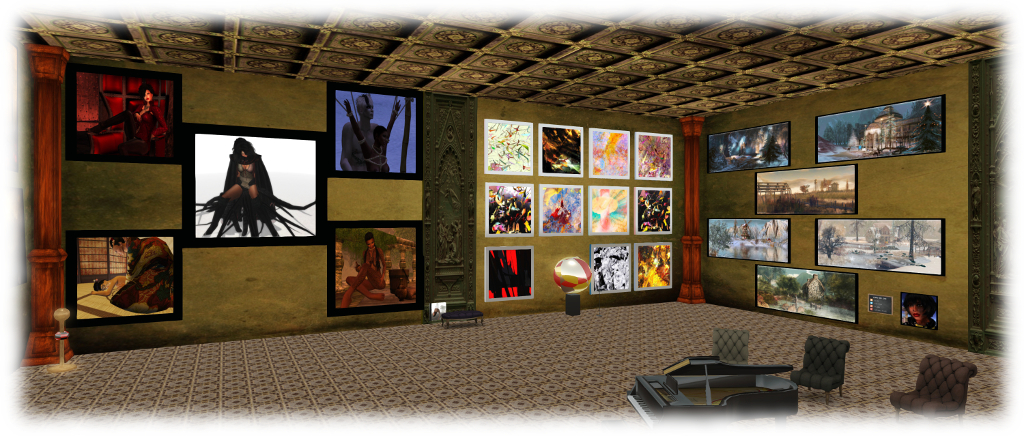
Now open through until the end of February 2017 at Virtual Chelsea Hotel’s Gallery 23, curated by enola em (enola Vaher), is an ensemble art exhibition featuring the images and art of Talitha Alice Minx, Vonnie Fox, Dulcis Taurog, Azu O, Miles Elventhauer, Hana Hoo (Hana Hoobinoo) and yours truly.

This is an eclectic and fascinating exhibition which brings together a number of artists of very contrasting styles, yet all of whom complement one another within the confines of the gallery’s walls. I will confess that not all of my fellow exhibitors were familiar names to me – but I will say that having spent time setting up at the gallery and having plenty of time to admire their work has made me something of a fan in some cases.

Gallery 23: Miles Elventhauer

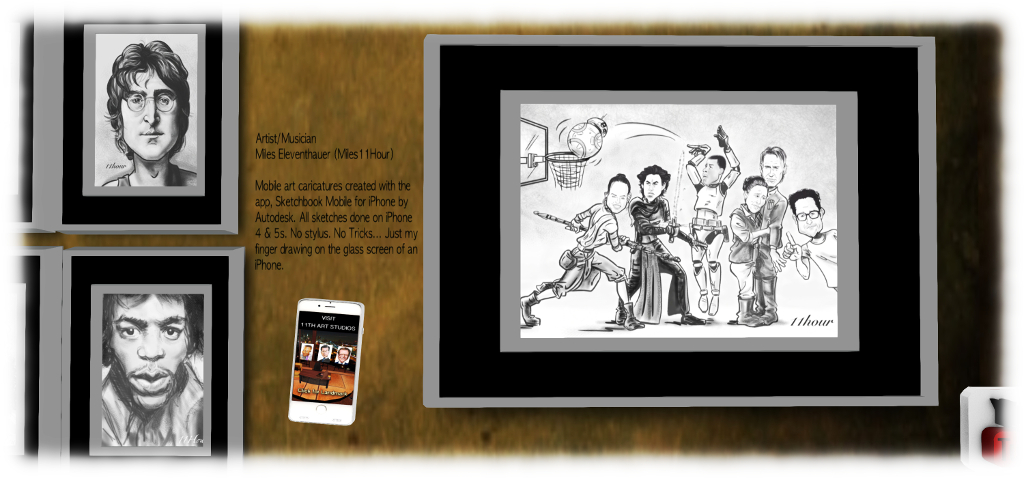
Take Miles Elventhauer for example. His work, located on the wall immediately to the right of the gallery’s entrance, is focused on caricatures of the famous and well-known, and he offers 8 individual drawings together with two ensemble pieces.  I challenge anyone not to identify all of those featured in the pieces.  However, as eye-catching and attractive as they all are, what makes this works stunning is that no pencil, pen, brush or stylus was used in their creation.

“All were created with the Mobile Sketchbook for iPhone app, ” Miles says of his work. “No stylus, no tricks. Just my finger on the glass of an iPhone 4 or 5.” Given he rarely exhibits outside of his own studio (“I live in New York, so I wanted to do the Chelsea,” he told me), this exhibition marks the perfect opportunity to gain an introduction to his art.

Gallery 23: Dulcis Taurog

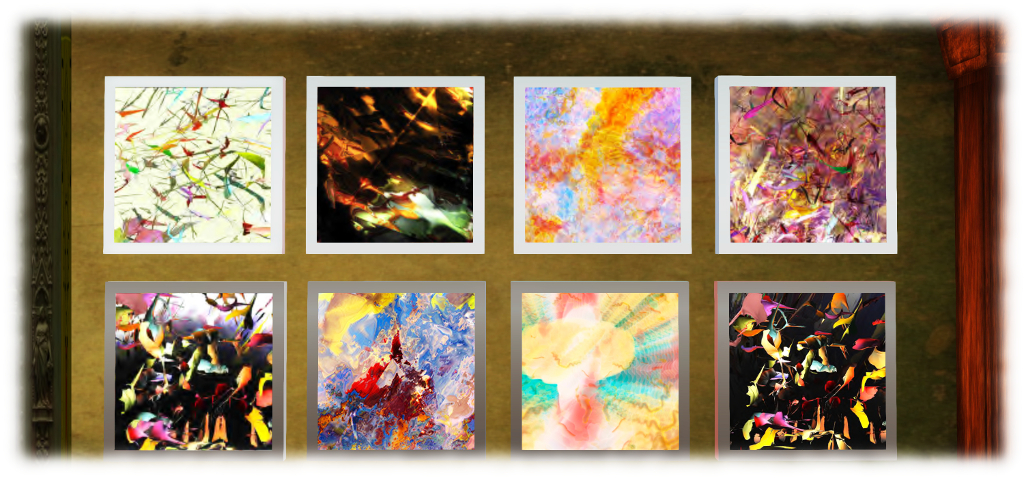
Dulcis Taurog, with whom I share a corner of the gallery space, is another artist whose work has to be seen to be appreciated. Entirely abstract in approach, it may at first appear to be art uploaded from the physical word, or digitally produced through PhotoShop or a similar application. However, this is not the case.

Rather, she utilises her own objects created in-world, or uses viewer elements such as the sculpty image window, the refraction sliders in the environmental editor, using texture from her inventory to replace the viewer’s default wave image,  all to create fabulous abstract images of extraordinary complexity and beauty.

Gallery 23: Hana Hoo

As noted above, this is a fascinating exhibition given the breadth of styles and images on display, with many of the pieces available for purchase. I’m delighted to have been given the opportunity to be part of things at Gallery 23 and the Virtual Chelsea Hotel, and my thanks to Enola for allowing me to do so.

SLurl Details

  • Gallery 23, virtual Chelsea Hotel (Lanestris, rated: Moderate)

Nagare no Shimajima, Restless Times, Second Life

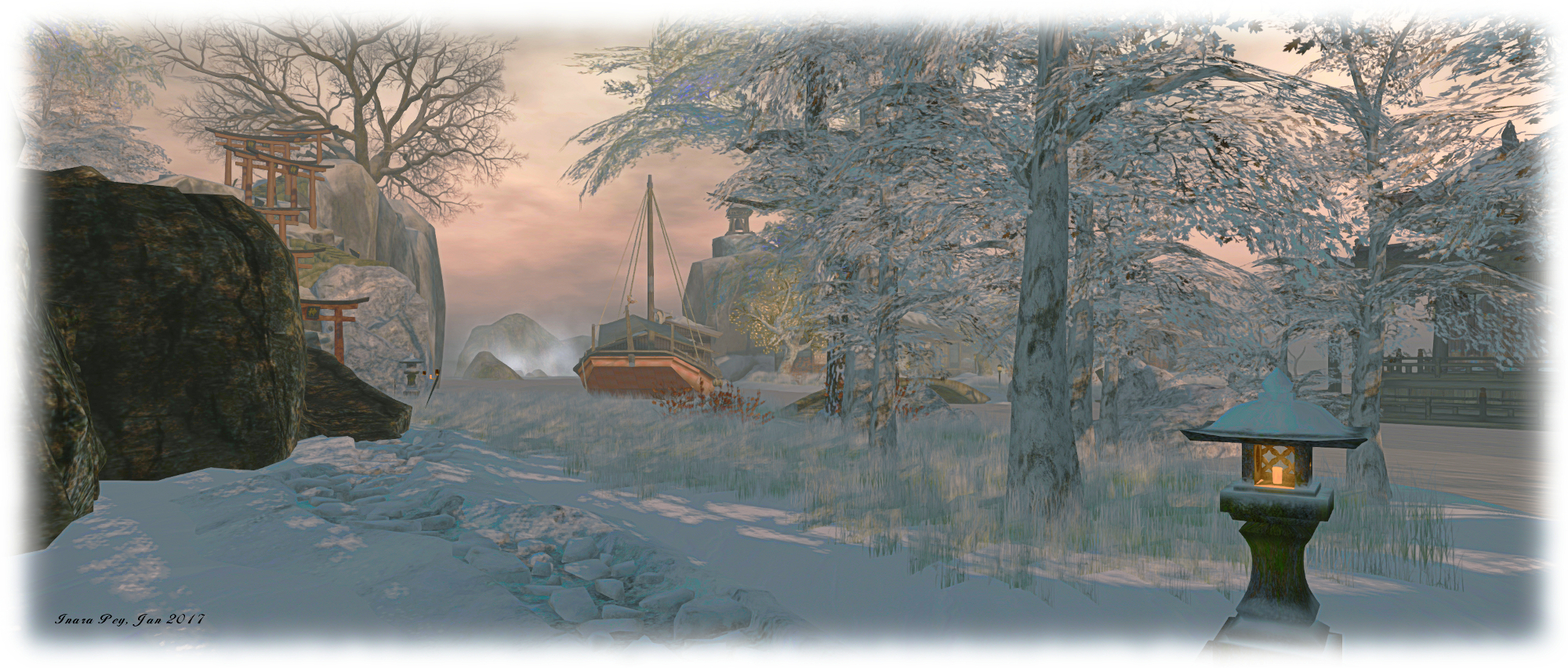
Nagare no Shimajima, Restless Times; Inara Pey, January 2017, on FlickrNagare no Shimajima, Restless Times – click any image for full size

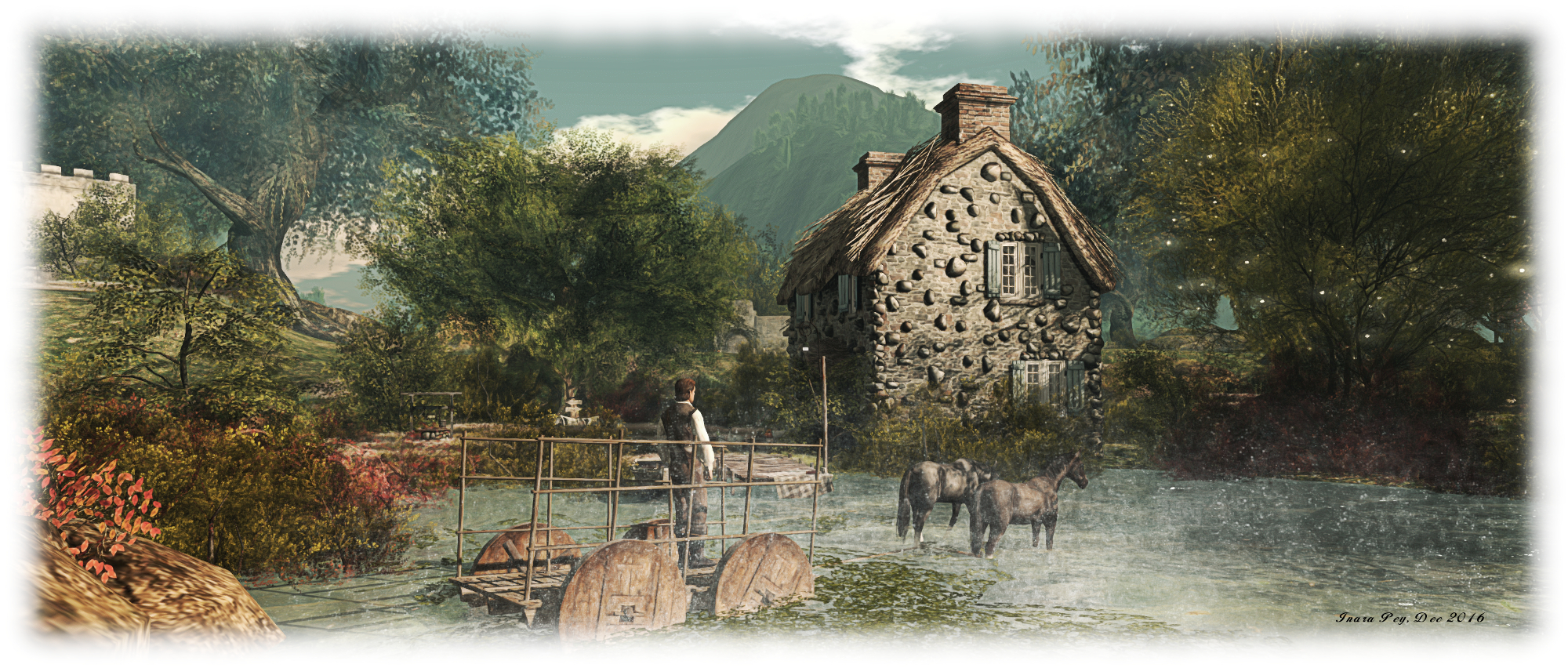
In October 2013, I visited Nagare, the home of the Blue Lotus Clan, offering both a place to visit and the opportunity for those who enjoy the art of traditional Japanese katana, nagi and short blades traditional fighting to join the clan’s C:SI (Combat Samurai Islands system) dojo. At that time, Nagare occupied a quarter region parcel on Southern Cross. A lot has changed since then, and thanks to a nudge by Loverdag, I realised it was high time I revisited.

Today, Nagare – now called Nagare no Shimajima  (Nagare Islands, or Flow Islands) – occupies a homestead region of its own: Restless Times. One of the original designers of Nagare, Lila Aquacade is still responsible for much of the design the region, sharing the work with  Ratatosken Karu, and Roll (Pradalia) and Be Ino (Inorelin Ragowski), while the region is home to both the Blue Lotus clan and the Eternal Blades clan.

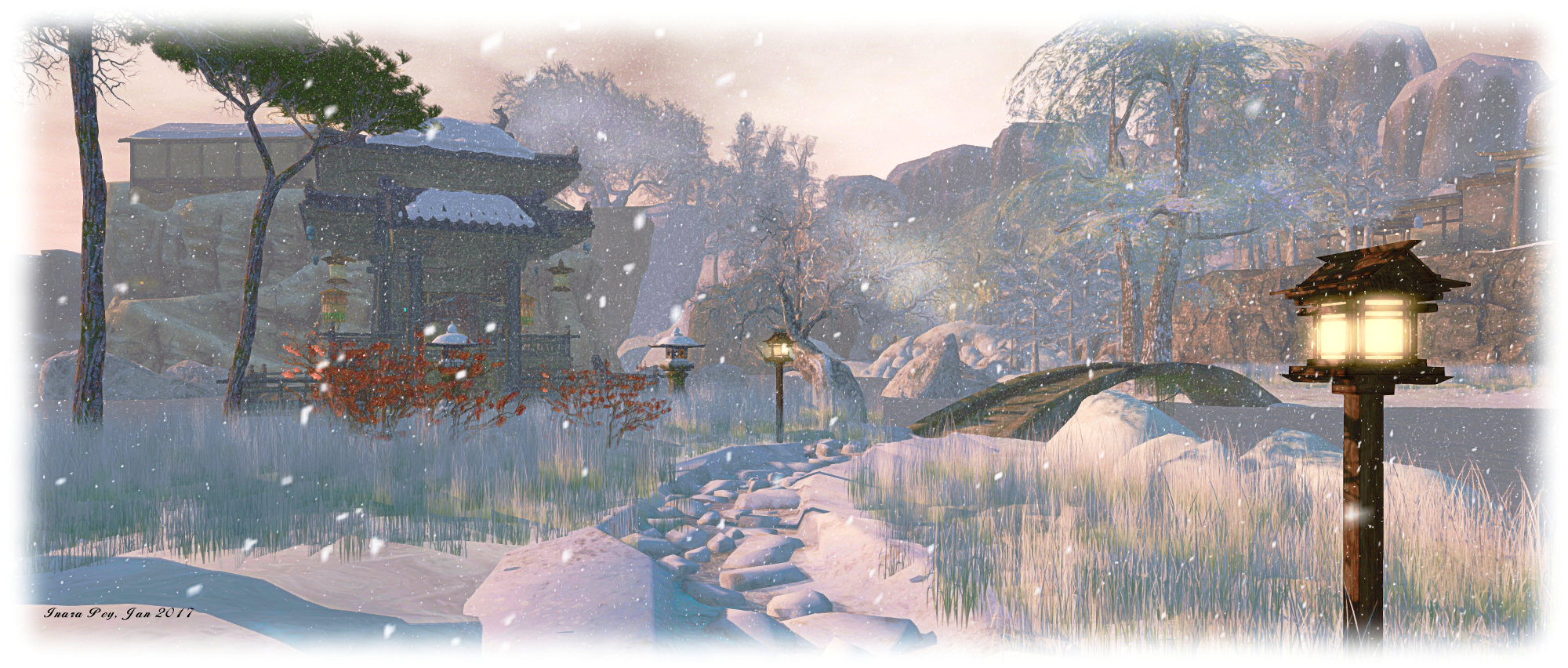
Nagare no Shimajima, Restless Times; Inara Pey, January 2017, on FlickrNagare no Shimajima, Restless Times

Given Lila’s involvement, there are many echoes of the original Nagare to be found here – the rugged landscape mixed with water channels, the large house boat occupying one of the latter and so on – but the increased space of an entire region means, obviously, that there is far more to explore.

As Nagare no Shimajima is a combination of public spaces and residential areas, the creators have defined a clever way of differentiating the two: public spaces are all connected via bridges; the more private residential island can only be reach via the little boats at the wooden quays. These can be rowed, sampan-style, by clicking on the boat to obtain a pole before boarding. Obviously, if you do take one, please respect the privacy of people’s domiciles, and do return any boat you use to its originating quay when done.

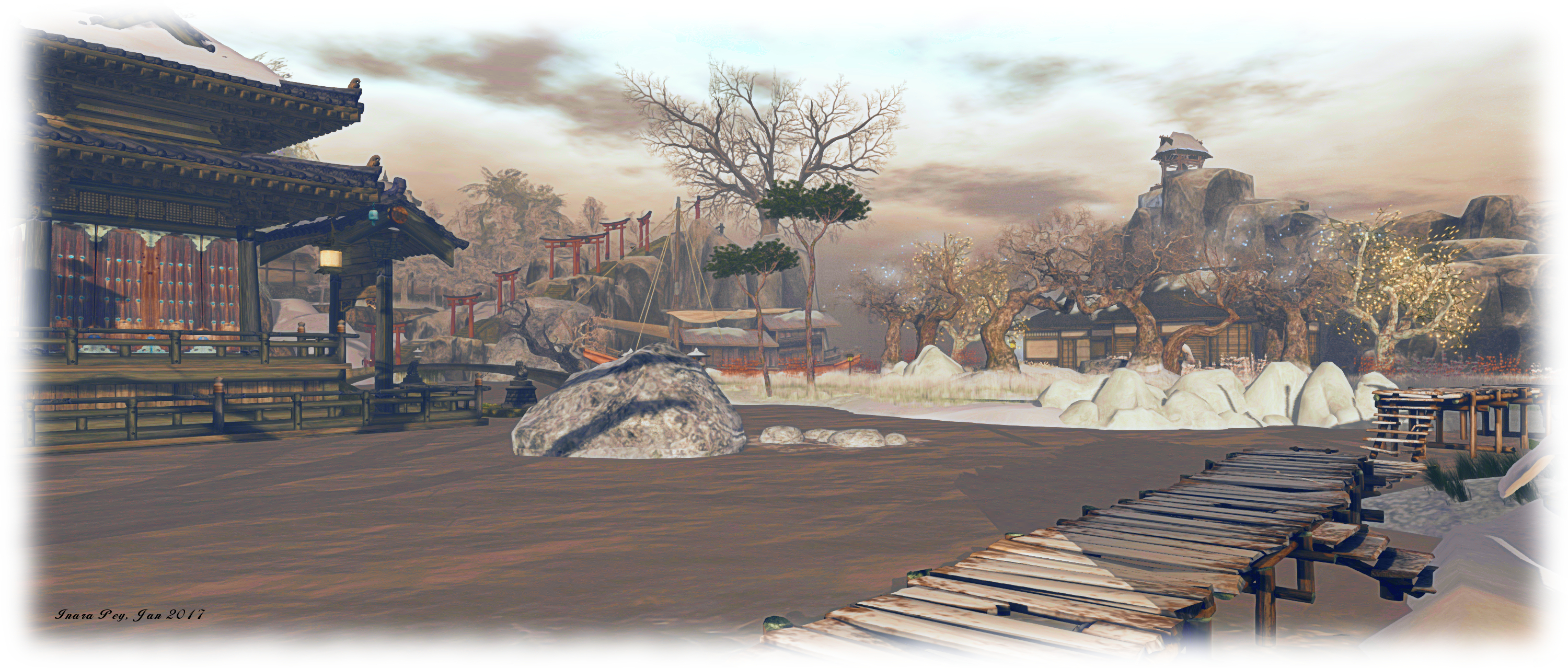
Nagare no Shimajima, Restless Times; Inara Pey, January 2017, on FlickrNagare no Shimajima, Restless Times

The landing point is located alongside the walled sparring area, occupying a broad sweep of rocky ledge between a wall of cliffs forming the west side of the region and a sharp drop down to the channels and bays which break up the eastward lay of the land. A path, marked by an aged torii gate, winds down to the lower levels of the region, where the bridges span the water. However, before leaving the landing point pagoda, I strongly recommend you collect the Nagare no Shimajima information card: it provides a wealth of information on where to go, the history of Nagare and the Blue Lotus and Eternal Blades clans, as well as information on Japanese religions and spirits in a highly conversational and engaging manner. In short, it is an excellent read.

Through this card, one can also about some of the little touches which have been added. Take heed of the warning about attempting to leave one of the cliff-top shrines before you have completed offering up prayers! That said, it does appear to be in need of a slight revision: while it refers to the teleporter being within the watchtower overlooking the sparring area, the only system I could find is located alongside the landing point pagoda (with another at ground level sitting on a snowy slope), while the sky dojo appears to be undergoing (re)construction.

Nagare no Shimajima, Restless Times; Inara Pey, January 2017, on FlickrNagare no Shimajima, Restless Times

In 2013, I thoroughly enjoyed my visit to Nagare-as-was, my natural bias towards oriental regions notwithstanding. Visiting Nagare no Shimajima brought back several of those memories and was equally enjoyable.  Right now the region is caught in the depths of winter. I believe its appearance changes with the seasons, going on some photos I’ve seen. I’ll certainly be returning to find out!

SLurl Details

Lucid Dreams with Miles Cantelou in Second Life

DiXmiX Gallery: Lucid Dreams

Now open at the Black Gallery wing of DiXmiX Gallery is an exhibition by Miles Cantelou entitled Lucid Dreams. As an admirer of Miles’ work, the opening of this exhibit was one of two I very much wanted to attend – my problem being, they were both taking place at the same time, and in the end, events within SL conspired to keep me from making both of them.

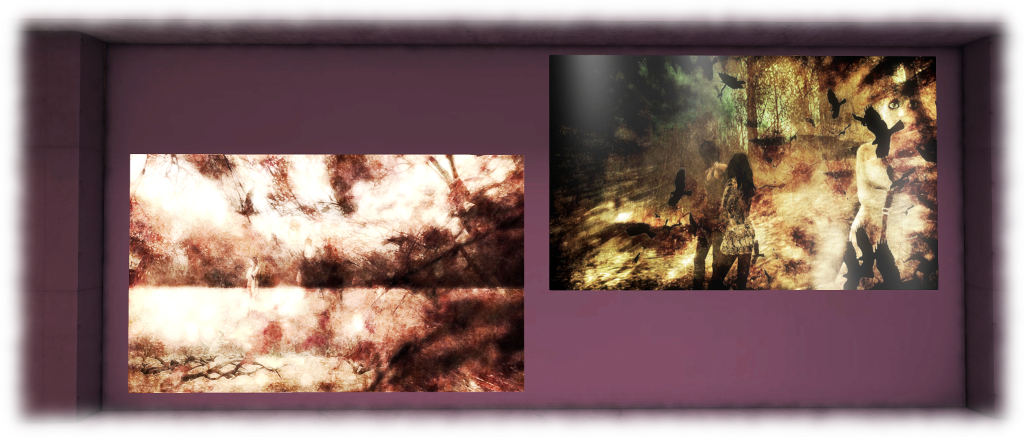
Those familiar with Miles’ work will know that his pieces tend to be boldly stated and processed, resulting in a very unique look and feel, to the extent that Lucid Dreams is very much an apt title: observing his work is very much akin to entering – or recalling – a dream; one lucid enough for us to give it shape and form, yet elusive enough to encourage us to look deeper and harder, to understand what we are seemingly being told.

DiXmiX Gallery: Lucid Dreams

Within the fourteen pieces displayed at DiXmiX is ample demonstration of Miles’ ability to compose not only an image, but an entire story within a frame, his use of colour, monochrome and layered effects each becoming a singular voice within each tale displayed.

Quite where this stories might take us is a further beauty held within Miles’ art; boldly textured, they often offer us a glimpse of a place we’ve visited or be focused on something we’re familiar with, thus our thoughts are prodded in one direction, but at the same time, we are pulled in another as well take in the complete image, not only its look, but its feel as well.  Thus again, as with a sense of conscious dreaming, we see not necessarily what is there, but what is suggested by the artist’s touch and words.

DiXmiX Gallery: Lucid Dreams

Lucid Dreams is an excellent exhibition by a master visual storytellers, and will remain open through until the end of January 2017.

SLurl Details

Behind the scenes with Bento in Second Life

Bento: extending the avatar skeleton

Note: this is a compressed version of an article which first appeared in Kultivate Magazine’s January 2017 issue, and which here includes some personal feedback on being peripherally involved in the project.

There can now be few – even among those having only joined Second Life in the last few months – who cannot be aware of project Bento, the work to significantly enhance the Second Life avatar skeleton to better support mesh avatar models, how they are animated and how they might be customised. I was able to observe Bento almost throughout its lifespan. As such, I thought more of a look inside the project might be of interest.

Bento’s heart comes in the form of one person: Vir Linden. Despite the avatar skeleton being one of the most fundamental parts of Second Life which could if interfered with, cause all sorts of issues, Vir was convinced things could be done to make the lot of mesh avatar creators and animators much easier, and without putting additional stress on either the simulator or the viewer. So in early 2015, he started looking at what might be achievable.

Vir Linden, Senior Software Engineer at Linden Lab, and technical project lead for Bento

By roughly April 2015 he felt he had enough information to put together a presentation he could put before senior staff at the Lab. Despite the ambitious nature of the project, potentially adding (at that time) 106 new bones to the avatar, the response was enthusiastic and positive. Troy Linden joined Vir from the Product Team, and Bento was born.

Initially, the work was in-house, involving Lab staff and the Moles. However, as the potential  for the project grew, it quickly became apparent that wider expertise would be needed to both give input to the project and help steer the development work. And so it was that a core Bento User Group came together, comprising Lab staff with expertise with the viewer, with the server, and – most significantly – content creators noted for their expertise in developing mesh avatars and avatar accessories (human and non-human), and the people behind the most popular tools for avatar creation and animation: Gaia Clary and Matrice Laville (Avastar) and Cathy Foil (Mayastar).

Like, Vir, Cathy, Gaia and Matrice deserve special recognition for their work on Bento. Not only did they embrace the project and work to update their products to support Bento, they also took on a lot of the grunt work involved in updating essential code used by the viewer to make Bento happen – and they were enthusiastic about doing so. If you make use of a Bento head and are adjusting things using the sliders, offer a word of thanks to the three of them: they’re the people who carefully went through the avatar files in the viewer to get as many of the sliders as possible working with the new facial bones for you to be able to do so.

Vir linden (foreground) and Matrice Laville at a Bento project meeting
Vir Linden (foreground) and Matrice Laville (in the top hat, left) at one of the closed user group Bento project meetings (note the fellow in the top hat to the right of the picture is Rider Linden)

Bento meetings initially took place at a small desert island on Agni, the Main grid. This sat on its own channel to ensure the necessary tweaks to the simulator end of things could be made to try out ideas and options and generally lay the foundations of the project. This work progressed over a period of just over six months until there was a good level of confidence that the project could be taken to the next stage.

This involved moving things to Aditi, the beta grid, and opening things to the public at large. The use of Aditi meant that more extensive testing of simulator and viewer changes could take place, more space could easily be made available for people to experiment, and more people in general could get involved. In time, these meetings would eventually move back to the main grid. It also marked the start of my ability to publicly report Bento progress on an almost weekly basis.

Bento enables much more flexibility when creating and animating human and non-human mesh avatars

At the start of the public phase of Bento, the skeleton had stabilised with some 92 additional bones – 60 of which were evenly split between hands and head. However, as the work progressed, this number tended to vary for a time as the need for further bones was identified while some of the new bones were found to be redundant and could be removed. As the same time, additional use cases for Bento were proposed, with every effort being made to incorporate as many as practicable. There were even some fundamental shifts made in how Second Life functions so that more could be achieved through Bento.

An example of this lies with bone translations and rotations. In essence the SL animation system had always worked on the assumption that sliders only affect translation and scale whilst animations only affect rotation, allowing both to work cooperatively.As the animation system was not necessarily seen as an intrinsic part of Bento, little thought was initially given to changing it. However, during the public beta phase of the project, a strong case was made for allowing both translation and rotation through animations – and as a result, the necessary updates were made to the animation system to support this without potential conflicts occurring.

Continue reading “Behind the scenes with Bento in Second Life”

SL project updates 2017-1/1: general status

A Painter's Link, Salomon Beach; Inara Pey, December 2016, on Flickr A Painter’s Link, Salomon Beach (closing January 6th, don’t miss!) – blog post

Server Deployments

The RC channels were re-started on December 28th, 2016, to the consternation of some on the Server thread of the technology forum as there was no accompanying update. A rolling restart of the Main (SLS) occurred on Tuesday, January 3rd, 2017, again with further consternation on the thread.

However, as a quick check through the viewer can reveal, both of these operations were simply restarts to keep things running (reasonably) smoothly, as shown by the server version numbers remaining unchanged when viewed in the viewer (Help > About viewer).

No restart is anticipated for the RC channels on Wednesday, January 4th, given they were restarted at the end of December. The usual run of deployments + restarts are expected to resume in week #2 (week commencing Monday, January 9th) with the three RC channels.

SL Viewer

With the holiday break, there has been no movement with the official viewer, with four currently occupying the various pipelines:

  • Current Release version: 5.0.0.321958, dated December 1st, promoted December 5th – formerly the Project Bento RC viewer
  • Maintenance RC viewer, version 5.0.1.322513, dated December 21st – some 42 fixes and improvements + Bento support
  • 360-degree snapshot project viewer, version 4.1.3.321712, dated November 23rd – ability to take 360-degree panoramic images – hands-on review
  • Obsolete platform viewer version 3.7.28.300847, dated May 8, 2015 – provided for users on Windows XP and OS X versions below 10.7.

It had been indicated that the Lab might get a project version of their 64-bit viewer out prior to the holiday break, but this proved not to be the case.