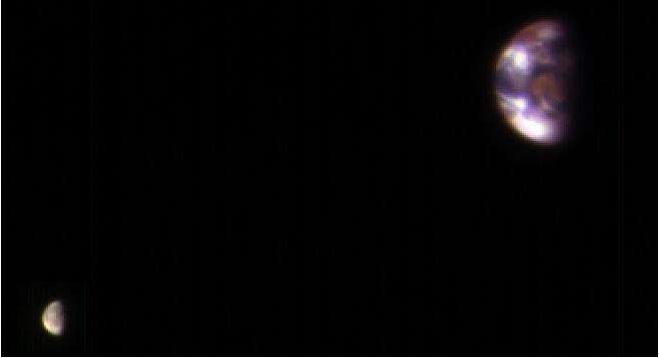
Two marbles sit on a midnight background, one a swirl of blue, white, brown and green, the other tinted in shades of grey. Together they are the Earth and her Moon as seen by the most powerful imagining system currently orbiting the planet Mars.
It is, in fact a composite image, although Earth and the Moon are the correct sizes and the correct position / distance relative to one another. The images were captured by the High Resolution Imaging Science Experiment (HiRISE) camera on NASA’s Mars Reconnaissance Orbiter (MRO) on November 26th, 2016.
The images were taken to calibrate HiRISE data, since the reflectance of the moon’s Earth-facing side is well-known. As such, this is not the first image of our home planet and its natural satellite captured from Martian orbit, but it is one of the most striking. Whilst a composite image, only the Moon’s brightness has been altered to enhance its visibility; were it to be shown at the same brightness scale as Earth, it would barely be visible. That it appears to be unnaturally close to Earth is in fact an illusion of perspective: at the time the pictures were taken, the Moon was on the far side of Earth relative to Mars, and about to pass behind it.
The image of Earth shows Australia prominent in the central area of the image, its shape just discernible in this high-resolution image, taken when Mars and the MRO were 205 million kilometres (147 million miles) from Earth.
For me, this is another picture demonstrating just how small, fragile and unique our home world actually is.
Falcon 9 Makes Triumphant Return to Flight
With Federal Aviation Authority (FAA) approval given, SpaceX, the private space company founded by Elon Musk, made a triumphant return to flight status with its Falcon 9 launch system on Saturday, January 14th.
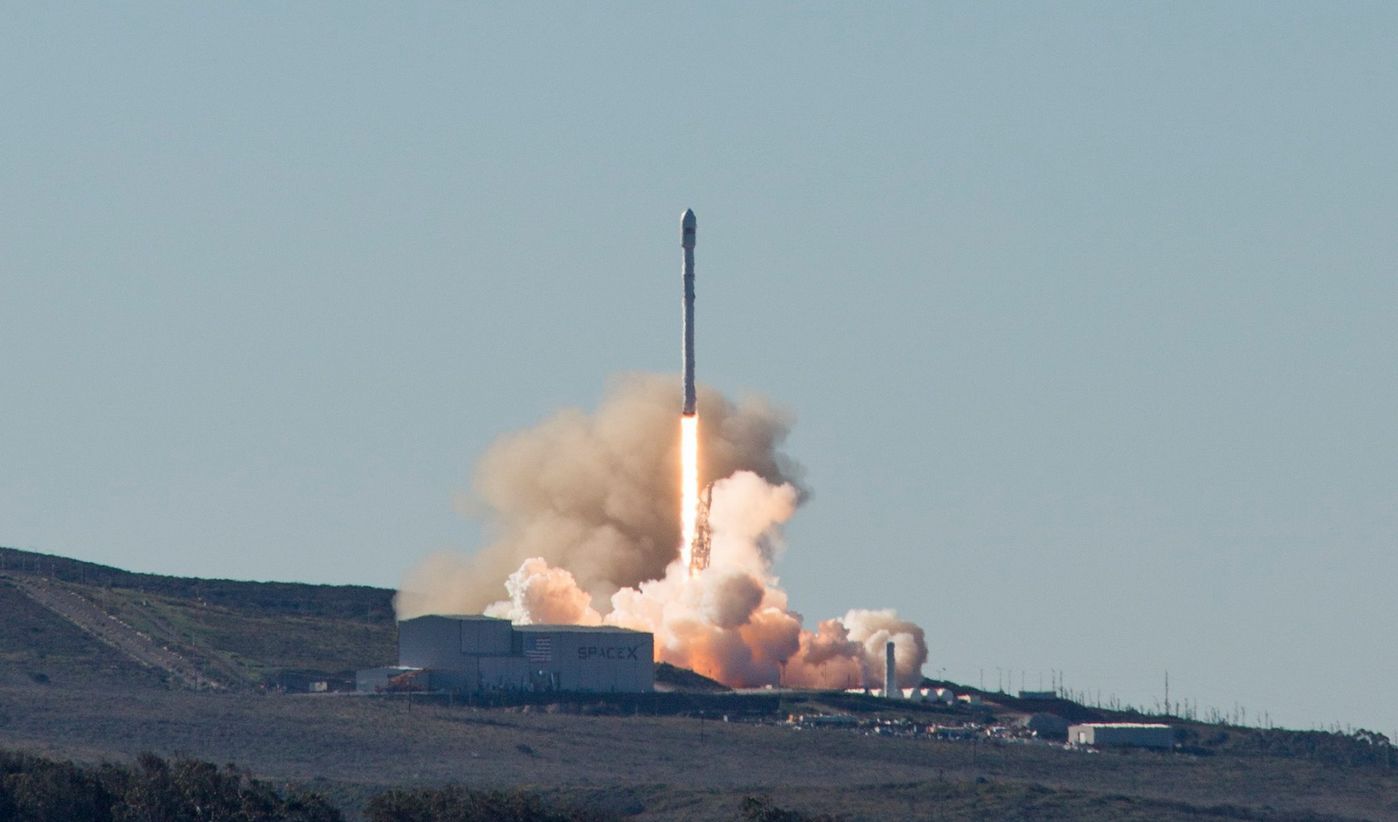
SpaceX launches had been suspended in September 2016, after a Falcon 9 and its US $200 million payload were loss in an explosion during what should have been a routine test just two days ahead of the planned launch (see here for more). Towards the end of 2016, and following extensive joint investigations involving NASA and the US Air Force (The Falcon 9 was located at Launch Complex 40 at the Canaveral Air Force Station when the explosion occurred), SpaceX were confident they had traced the root cause for the loss to a failure of process, rather than a structural or other failure within the vehicle itself. However, they had to wait until the FAA had reviewed the investigation findings and approved the Falcon 9’s return to flight readiness before they could resume operations.
The January 14th launch came via the SpaceX West Coast facilities, again leased from the US Air Force, and saw a Falcon 9 booster lift-off from Space Launch Complex 4E at Vandenberg Air Force Base in California. The rocket was carrying the first ten out of at least 70 advanced Iridium NEXT mobile voice and data relay satellites SpaceX will launch over the coming months, as Iridium Communications place a “constellation” of 81 of the satellites in orbit around the Earth in a US $3 billion project.
All ten satellites were successfully lifted to orbit and deployed following a pitch-perfect launch, which had to take place at precisely 9:54:34 local time (17:54:34 UT) in order for all ten satellites to be correctly deployed to reach their assigned orbits. However, all eyes were on the Falcon 9’s first stage, which was set to make a return to Earth for an at-sea landing aboard one of the company’s two autonomous drone landing barges, Just Follow The Instructions.

Operating the Falcon 9 on a basis of reusability is core to SpaceX’s future plans to reduce the overall cost of space launches. While the company has previously made six successful returns and landings with the Falcon 9 first stage, this being the first attempt since September 2016’s loss added further pressure on the attempt. but in the event, it went flawlessly.
After separation from the upper stage carrying the payload to orbit, the first stage of the Falcon 9 completed what are called “burn back” manoeuvres designed to drop it back into the denser atmosphere. Vanes on the rocket’s side were deployed to provide it with stability so that it dropped vertically back down to Earth, using its engines as a braking system and deploying landing legs shortly before touchdown – and the entire journey was captured on video, courtesy of camera built-into the rocket’s fuselage.
Continue reading “Space Sunday: looking back on Earth and landing rockets and probes”










 Inara Pey: Living in a Modemworld