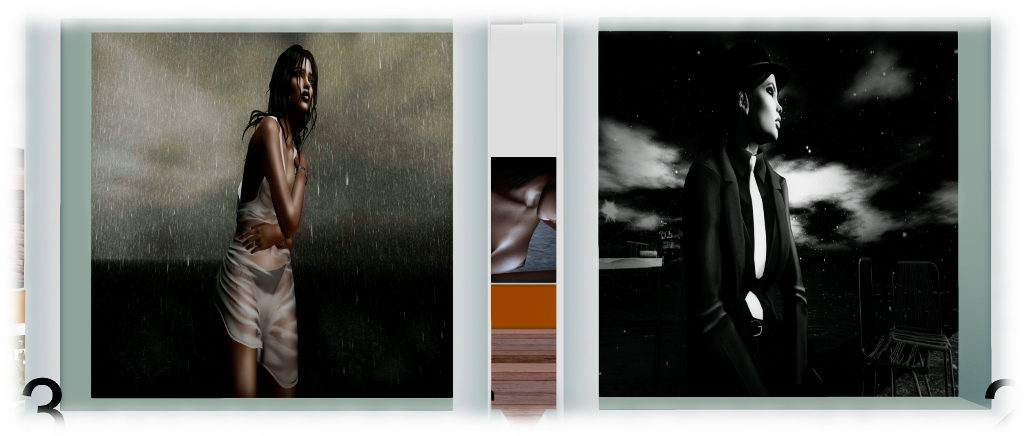
Open now at Artful Expressions, the boutique gallery curated by Sorcha Tyles, is the January 2017 featuring the art of Uma Sabra and KyRaLy (ElizzaLiza). As with the opening exhibition at the gallery (see here), these are two artists perfectly suited to being displayed together, their styles complimenting one another perfectly.
Both artists focus on avatar studies, with each presenting pieces which largely – although not exclusively – focus of the face in close-up, with both opting for minimal backgrounds with their subjects. The resulting images are hauntingly evocative in tone, look and emotional content.
“I think it is simply amazing that one can be able and can have all the freedom in the world to create digging deep into imagination,” KyRaLy says of Second Life. “It is a gift that one can see inside of things, the essence of things…” This is perhaps a perfect reflection of her work; each image is offering us a look not so much at her subject, but into them: who they might be, what they were feeling at the time the photograph was captured.
This is especially true of the images in which the subjects are not looking at the camera; by capturing them in a moment where their focus is apparently elsewhere, KyRaLy has imbued them with enormous humanity and vulnerability. Which is not to say those in which the subject is looking at the camera are any the less captivating for their emotional content.
Uma plumbs similar depths with her studies. However, where KyraLy has apparently chosen a number of subjects / faces for her pieces, Uma has focused largely on portraits of a single avatar. This makes them more intimate in presentation, as we are given the opportunity to share in the changing moods of the one individual cross a number of images – and perhaps, time.
Four out of her nine pieces are not limited to a facial portraits, but offer a more complete study (including on nude shot). These demonstrate a considered use of focus and background to produce pieces every bit as poignant as her closer studies.
As noted above, these are two sets of images by two artists who are well suited to side-by-side exhibition, and the display of their work at Artful Expressions is not one to miss. Bravo, as well, to Sorcha on her second exhibition, and for her choice of artists.
On Wednesday, January 4th, Linden Lab issued a “showcase” video alongside the public launch of the Sansar YouTube channel.
The launch of the channel is part of the Lab’s promise to gradually reveal more and more of the platform as they move towards opening the doors to public access. Its launch was accompanied by some in-depth media pieces in which Sansar is discussed in far more details than has until now been the case – including word on the platform’s currency, and the overall progress on the platform towards public access.
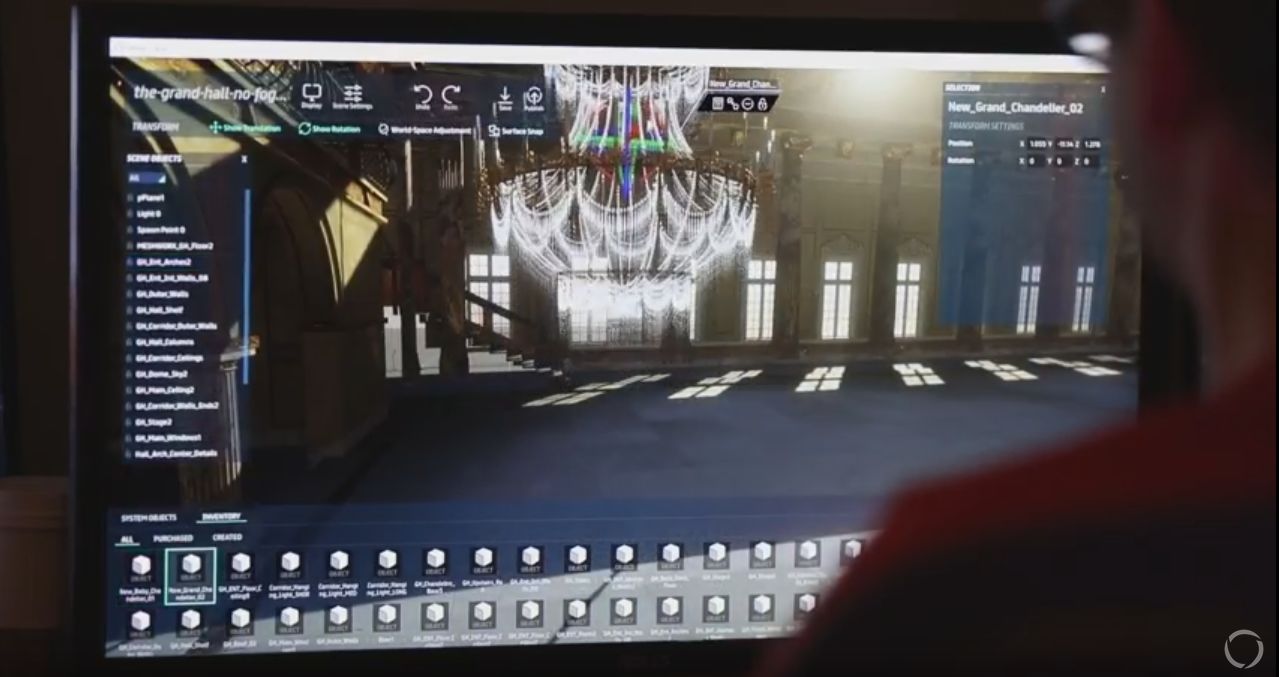
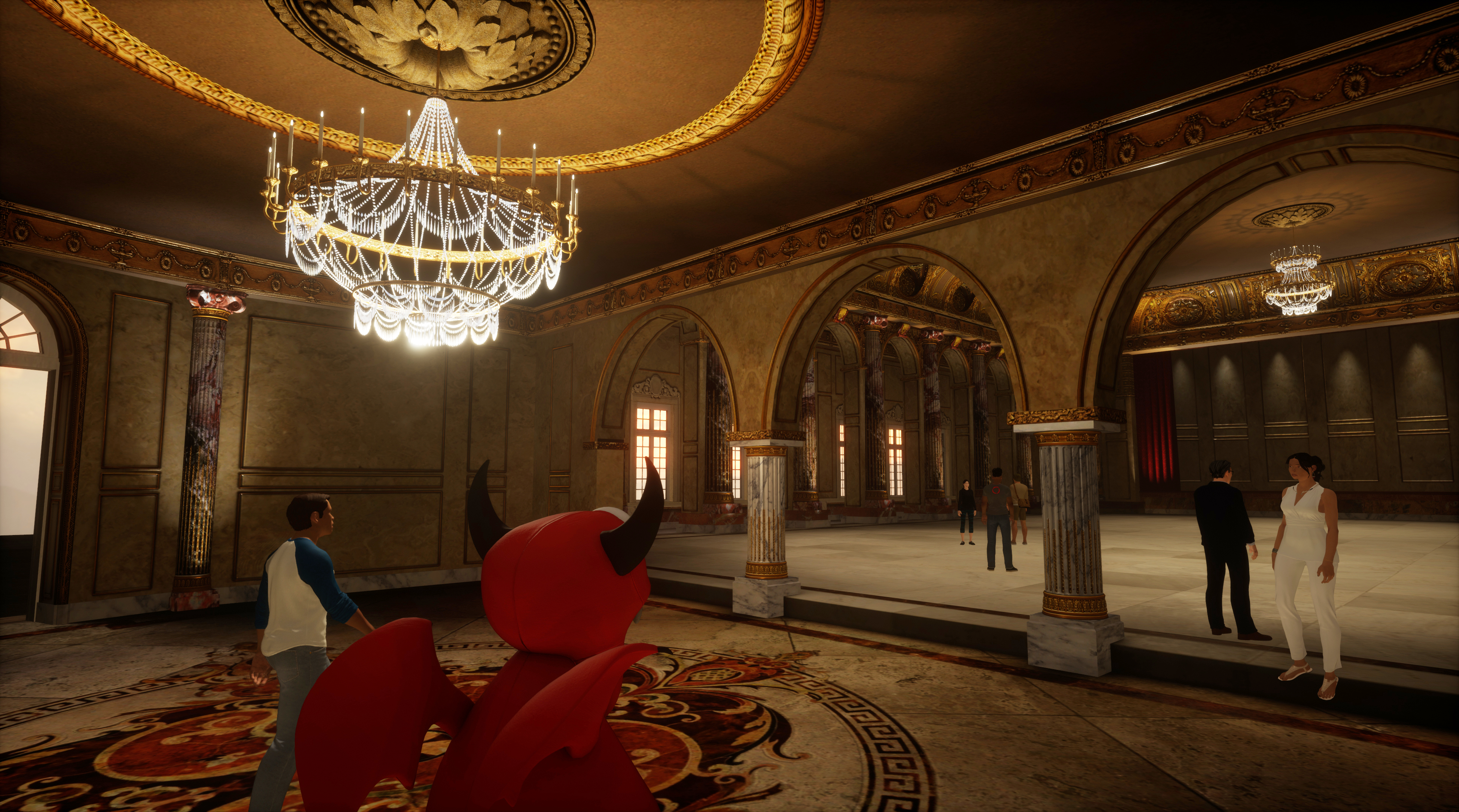
The video itself – embedded at the end of this article – was filmed by Draxtor Despres and features Loz Hyde of Meshworx fame, the video runs to just over 1 minute 30 seconds, and demonstrates the build environment of Sansar as used without a headset and controllers as Loz puts together a grand hall.
Loz Hyde working in the Sansar editing environment. Credit: Linden Lab / Draxtor Despres
There’s actually not a lot to see in terms of the mechanics of the environment, but Loz’s view of the overall rendering (by which I assume he means the run-time environment, is “amazing”.
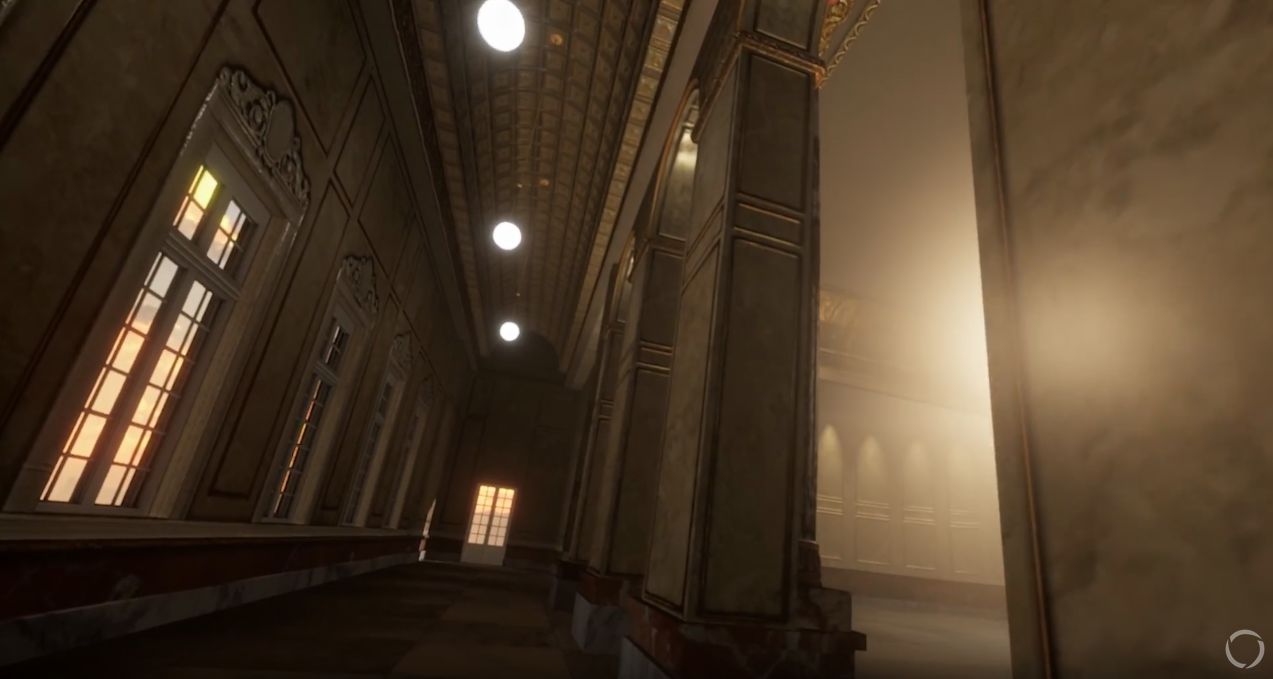
We do get to see the latter as well – or what appears to be the latter – when Drax takes us inside via a HTC Vive. The environment, lighting and detail certainly looks impressive, but again, may from SL are liable to be unimpressed with the detail shown, simply because it is a single interior space, and nothing is shown of it in situ as it were. Hopefully more comprehensive shots of spaces within Sansar will come in time. Certainly what is shown offers an impressive taster of what can be achieved in terms of architecture and fittings.
Inside Sansar – the run-time environment (?). Create by Loz Hyde. Credit: Linden Lab
Elsewhere come hints of the size of the Creator Preview programme, and why content creators like Loz are being asked to showcase their work, with the Lab’s CEO noting:
We have over 12,000 creators registered for access to the platform, so we have way more creators than we need to get the feedback, and to ensure they get the tools they need to be successful. We’re really asking these early creators to explain what it is they want to do in Sansar, and if we think the platform is not yet ready to do that, we’re asking them to wait.
Of these 12,000, around 500-600 have so far been accepted into the Creator Preview, and the Lab has revealed that the Sansar currency is now in operation: the Sansar Dollar (S$), which will be traded on the SandeX – both of which, I assume – are operated under LL’s subsidiary, Tilia Inc, and are something of a port of the facilities and “currency” services the lab built around the Linden Dollar and LindeX. Like the Linden Dollar, the Sansar Dollar will be exchangeable for fiat money, and the system supports payout at least via PayPal.
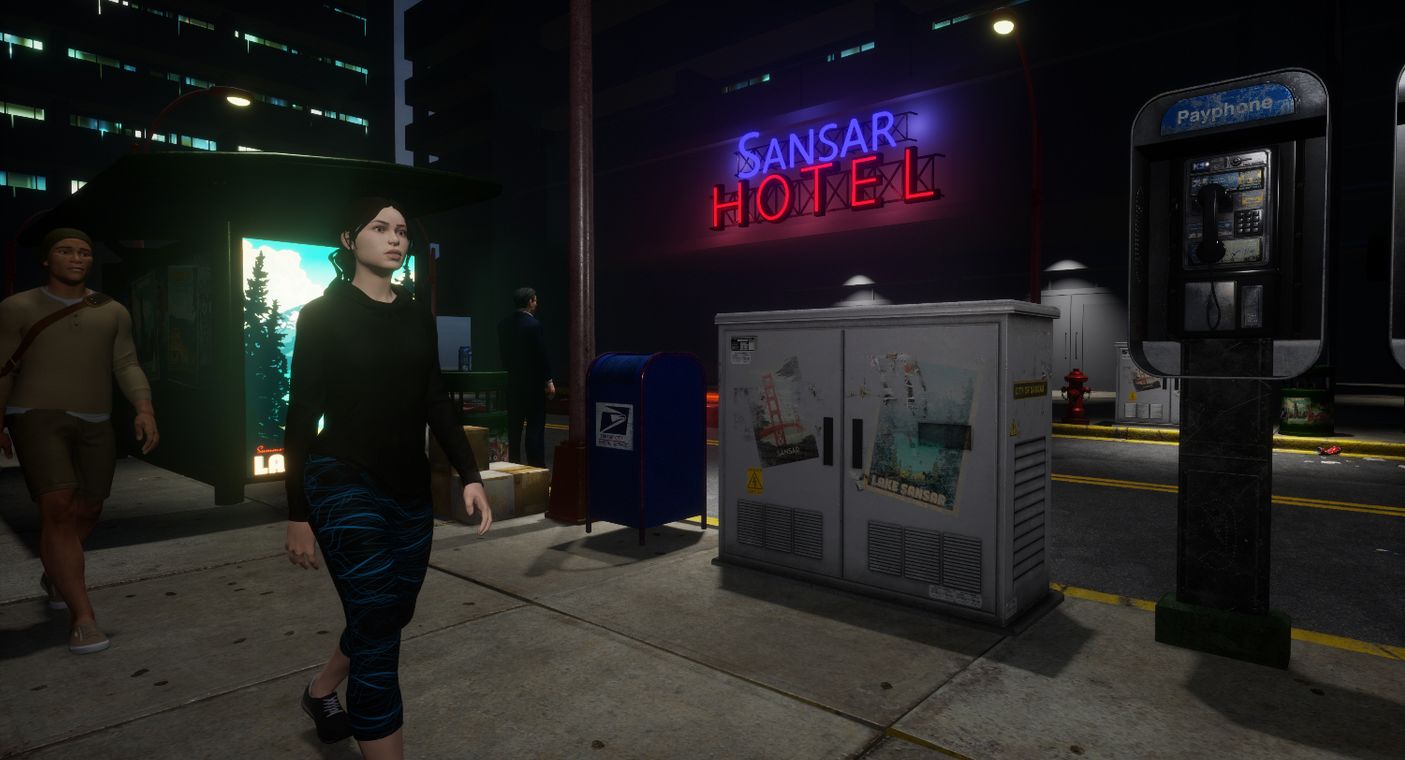
Sansar Avatars. in a city street scene in Sansar created by Paul Lapointe Credit: Linden Lab
What’s interesting here is that the “currency” system (the Lab will doubtless refer to Sansar Dollars as “tokens”), is that it is in operation, with the creators currently engaged in Sansar able to buy and sell their creations among themselves, with the Lab’s Director of Global communications, Peter Gray, noting:
With this new step, they’re [creators] also able to start buying and selling their creations with one another. And so, it’s the start of that sort of economic engine that’s getting warmed up in this creator preview period, and ultimately it will expand. Today they’re able to buy and sell items—pieces of content, but ultimately, creators will be able to monetize entire experience.
This actually makes a lot of sense, not only in terms of kick-starting the Sansar economy and establishing a nascent revenue model for both creators and the Lab, it also means that Creators and leverage one another’s creations to build out their experiences and – as Peter Gray notes – sell those on as well.
How much the Lab might be generating in revenue from these initial creator-creator transactions – given a “sales tax” is a core part of the revenue model – isn’t indicated (I would actually be surprised if any is at this point being leveraged – outside of a “purchase fee” for S$, simply because the Creator Preview is supposed to be a cooperative venture). However, Dean Takahashi at VentureBeat notes, there will also be a small “hosting fee,” or a property tax equivalent in the real world, for the spaces that you create in Sansar. Again, this isn’t entirely a surprise, but seeing it stated clearly is interesting.
Like the L$, the Sansar Dollar will operate on a user-to-user basis, with the Lab functioning as an exchange operator, not a bank. Currently the exchange rate is running at around S$100 per US dollar, making the S$ more expensive than the L$. However, this is only an initial exchange rate; ultimately, the Lab expects the market to define the exchange rate naturally, so the value might over time move towards something more in keeping with the L$.
One risk that comes with opening the exchange mechanism to a limited audience of users (creators) is the risk that the exchange itself could be manipulated through things like volume purchases of S$. The Lab is seemingly aware of this with CEO Ebbe Altberg noting that various caps are in place and thresholds are deliberately low at this point in time.
For those hoping to get into Sansar “soon” as a part of the opening-out to the public, the interviews accompanying the video release suggest that they might have to remain patient:
Toms Hardware: So, you’re running the private creator preview for Sansar for the next quarter or so?
Ebbe Altberg: Yeah. We’re trying to be data driven in the process as opposed to date driven. I wouldn’t say we have all kinds of luxuries and that we’re taking our sweet time, but we want to make sure that it’s incredibly great by the time any user can get access.
Again, this really shouldn’t be a surprise. As I’ve mentioned previously, building something like Sansar is a huge undertaking, one in which time frames are bound to slip. As such, we shouldn’t be holding
T articles from VentureBeat, Tom’s Hardware and UploadVR cover a lot of ground, and I highly recommend reading them all – links below. In the meantime however, and to give myself more time to digest them, I’ll leave you with the preview video.
On January 2nd, Tyche Shepherd issued her year-end summary on the general size and state of the Second Life main grid.
In all, 2016 has seen a slightly larger loss of private regions compared to 2015: 992 private regions (Full and Homestead) removed from the main grid in 2016 compared to 825 the previous year. This represents a reduction of some 5.6% over 4.4% for 2015. In terms of grid size, the loss of private regions was slightly mitigated by an increase in Linden owned regions, leaving the grid with a net shrinkage of 884 regions overall for 2016.
Taking the year-on-year figures from 2010 onwards (that being the last year the grid exhibited a growth in the number of regions), we get the following breakdown for private regions:
2010
2011
2012
2013
2014
2015
2016
24,483
23,857
20,994
19,273
18,600
17,775
16,783
Increase
%age
Loss
%age
Loss
%age
Loss
%age
Loss
%age
Loss
%age
Loss
%age
810
3%
626
2.56%
2863
12%
1719
8.2%
673
3.5%
825
4.4%
992
5.6%
While the loss is something of an acceleration over 2015 and 2014, it is still not as drastic as the declines in private regions seen in 2012 and 2013 . Nevertheless, it does indicate a further drop in approximate gross monthly revenues for the Lab. Working on the basis of Tyche Full Private Region surveys I have to hand, a breakdown of recent monthly revenue from private regions can be given as:
November 2013: US$3,857,000 (+/- US $52,000)
March 2016: $3,385,000 ( +/- US $43,000)
December 2016: US$3,162,000 (+/- US $39,000)
This represents around an 18% drop in monthly revenues over a three-year period. While uncomfortable, it’s not outright alarming at this point in time, representing an average loss of about US $19,305.55 per month, compared to the staggering US $63,500 (approx) per month loss the Lab experienced in 2012.
Of course, a loss is still a loss, and sooner or later, continuing revenue decline will have an a visible impact. But it is hard to determine when that might actually be. The surface evidence seems to be that at this point in time, while of concern, the decline isn’t adversely affecting the Lab’s ability to do business. They are still continuing to invest in both Second Life and Sansar, including recruiting for positions working on both. While it is hard to be precise, a reasonable estimation suggests that the company is generating around US $49 million in revenue through Second Life. While we don’t know how much of that is bankable as profit, it’s still a tidy sum in terms of operating revenue for a company of LL’s size.
Some have raised concerns over how much of an impact Sansar will have on SL’s landmass in 2017. I actually don’t think it will. While I anticipate the decline in land will continue (but hopefully at a slower rate than 2016), I simply don’t think Sansar will have any immediate impact on Second Life one way or the other. Not in its first year, at least.
To me, the more interesting question is what can LL do to further offset revenue drops incurred by region losses (and sadly, the answer isn’t simply to reduce tier: that could actually do far more harm than good, given the amounts involved). The Horizons initiative, for example, is one way of spawning additional revenue. We’re now around half-way through that process, and I estimate the Lab has generated around US $45,000 from it thus far. 2016 also saw the private region buy-down offer, which appeared to be enthusiastically received, although numbers are far harder to ascertain on that. Are we liable to see further initiatives in 2017? I’d actually be very surprised if we didn’t.
Update: Fancy’s Deep has been relocated to Blake Cove and the SLurls in this article have been updated to reflect this. The submarine tour mentioned also no longer appears to be operating, but the relocation of the town means it is now alongside the regions devoted to the merfolk community.
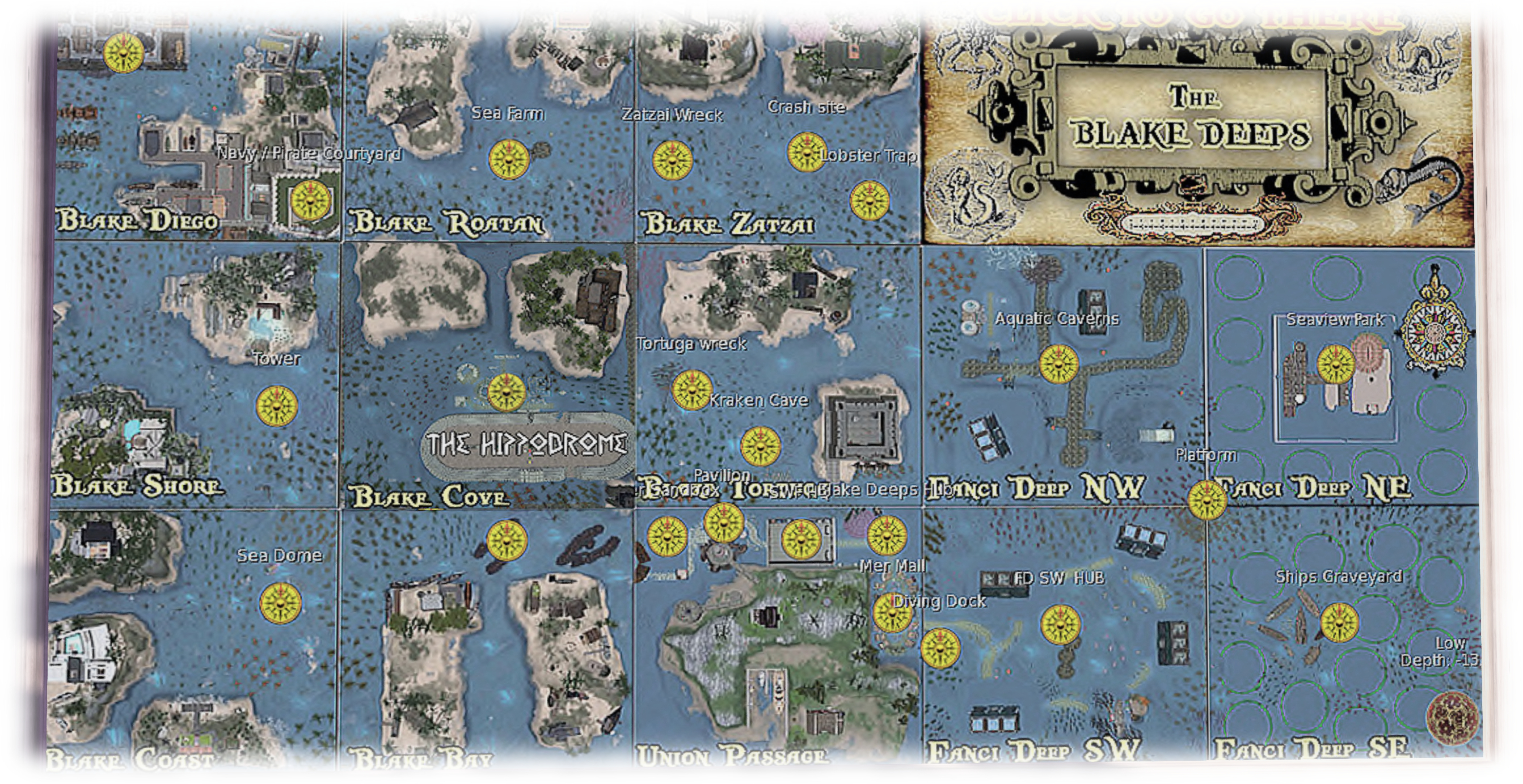
Back in 2015 I wrote about the merfolk of Fanci’s Deep, who were holding a week of underwater activities to encourage folk to explore their undersea community, centred around the four regions of Fanci’s Deep. These form a part of the Blake Deeps, covering roughly 13 regions to the east of Blake Sea and south of Blake’s Passage as it cuts its way westward from Blake Sea to Second Norway.
Recently, Caitlyn and I have been spending time within the Deeps, and so I felt a further blog post was overdue on their secrets.
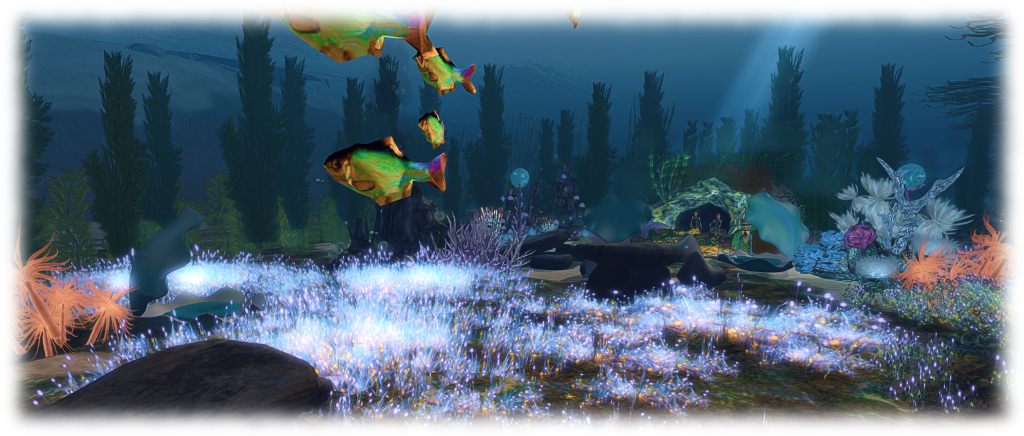
One of the many garden spots in Blake Deeps where you can dance with merfolk
With 13 regions to visit, it can be a little hard to know where to start. However, there are several places which can serve as a base for wider explorations, and I’ve listed them at the end of this article (as well as mentioning them in the text). For me, one of the best locations to start your explorations is the historic Freeport Township of Flotsam, Blake Cove.
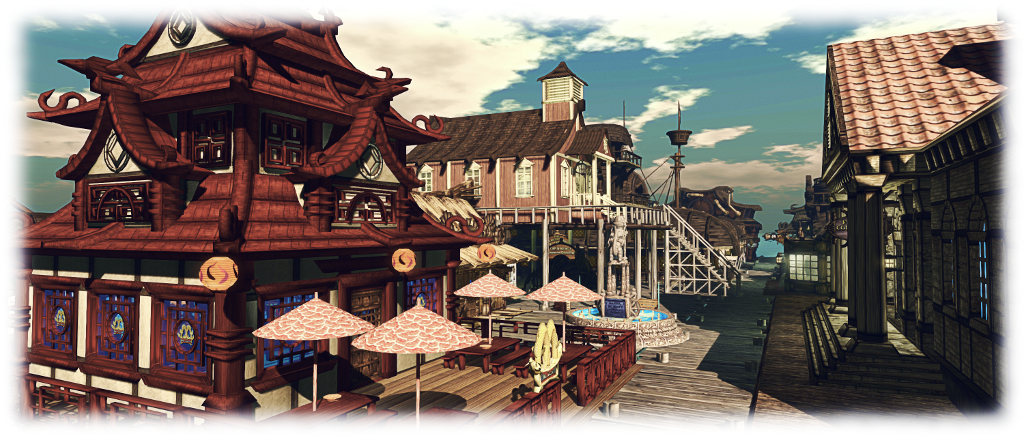
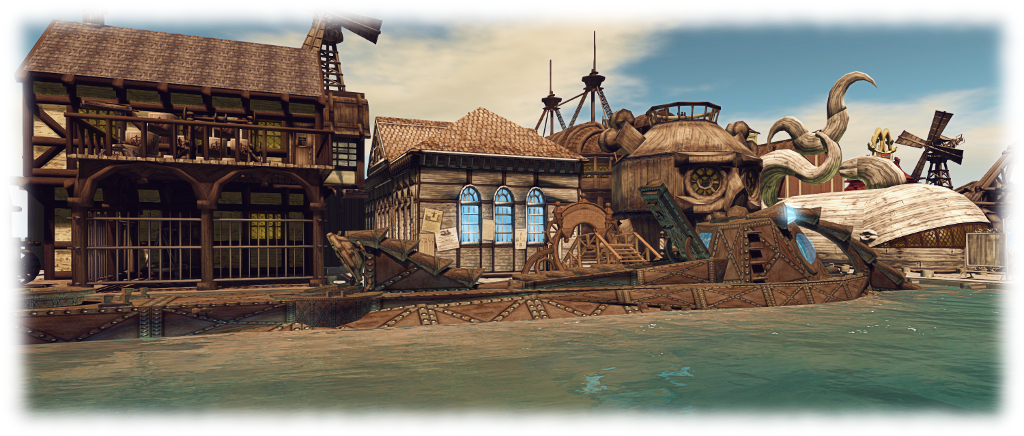
Designed by Aley, Flotsam is a wonderful mix of humour and homage, focused on pirates, but with a literary aspect. Built entirely on wooden platforms over the water, the town boasts a bank, shipyards, shops, quayside moorings and even the golden arches of a McSushi’s!
A clue to the literary homage can be found berthed at one of the quays: Captain Nemo’s submarine Nautilus, from Jules Verne’s 20,000 Leagues Under The Sea and as visualised Walt Disney 1954 film; feel free to board her and look around. There is also a reference to Journey to the Centre of the Earth: a “mole” tunnelling machine, also to be found on the south side of town. If you take your seat inside, you’ll be taken on just that journey – although finding your way through it does take a little time and effort; not all the routes are at first obvious.
There’s a further reference to Nemo, as well (as there is elsewhere within the Deeps): look for the tunnel leading down to the Captain’s undersea observatory, which sits directly under the town on the sea bed.
Given all this, the town really is worth a gentle wander – there is so much to see, both in the design of the buildings and within them. When walking the quays on the south side of the town, keep an eye out from the Kraken – itself a literary reference. Look out for the fire pits as well, as they offer a teleport system around points of interest around the region as a whole.
Flotsam is also the home to a submarine tour, although sadly not aboard the Nautilus. This is perhaps the best way to gain a feel for all that is available within the Deeps. At 30+ minutes in length, it’s a long tour, but your guide – Annie – makes it more than worthwhile, providing as she does a wealth of information on the history and myths of the regions. And she’s not against offering an opinion or two (“Don’t even get me started with his ideas about “Sea Chickens”, she grumbles whilst discussing Nemo’s undersea farming project, which apparently involves genetically modified cows and attempting to “grow tuna in their cans”).
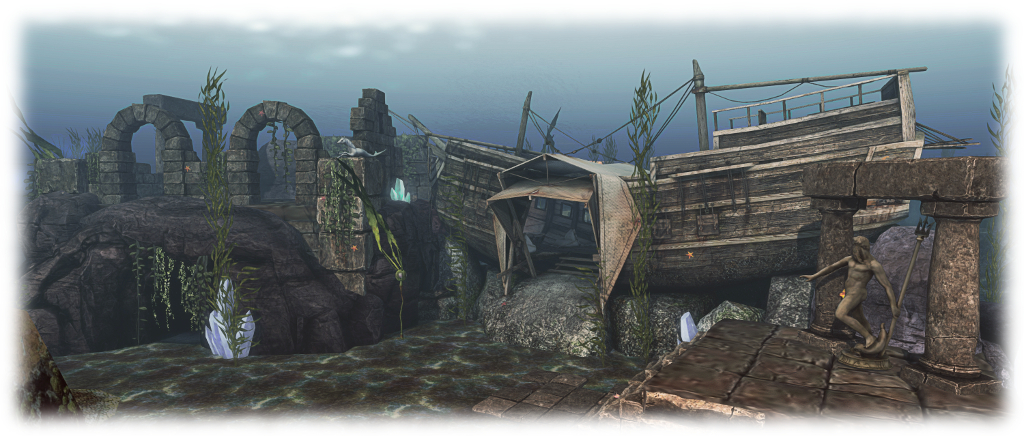
Merhomes around Fanci’s Deep take many forms: caves, conventional houses, shells – even the wrecks of sunken ships
Another starting point for explorations is the Fanci’s Deep welcome area. Here you can obtain assorted freebies to help you feel at home – such as mertails or a diving helmet and even a mini-sub. Advice is provided on the best viewer settings by which to enjoy your underwater experiences and where to go and what to visit. Alongside of this is the Safe Waters Foundation, which offers further information, complete mer outfits and transformation kits, and information on mer communities across Second Life.
The welcome centre provides walking / swimming access to the four Fanci’s Deep regions, were both public spaces and private merhomes can be found. Do please respect the privacy of the latter, but feel free to enjoy the former, most of which offer underwater dances every different to those found in a land club!
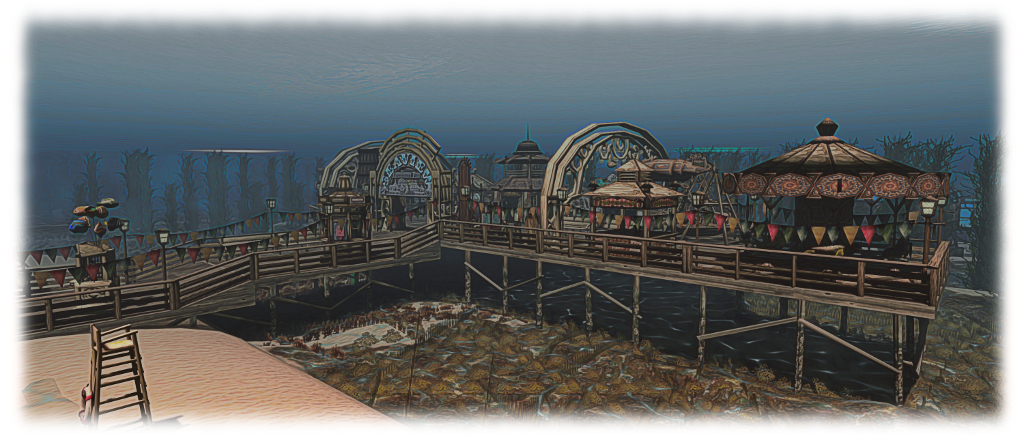
Elsewhere, you can try your hand at undersea chariot racing, visit sea farms, even have a day out at the (undersea) beach, complete with pier top funfair and an aquatic circus nearby!
When visiting the various locations within Blake Deeps, keep an eye out for the maps similar to the one shown at the top of this article – they offer map-based teleports to many of the locations to be found throughout the regions. However you travel around the Deeps – teleport, swimming, tour sub, your own sub or simply by following your nose and swimming / walking, these are an enchanting set of regions to visit.
Given their nature and the aforementioned Nemo references, it seems appropriate I finish this piece with a song from Sarah Brightman.
“When I put on paper or canvas a thought, a dream or something real, seen with my eyes or perceived by my imagination, my concern is not that the others understand,” Grazietta Blauvelt (Grazietta Cazenove) says of her art. “But that [by] looking at those traits and those colours. they are able to get excited and to give a personal interpretation of what catches their eye from my paintings.”
I was recently able to experience this first hand, having received a landmark to the Ocean Inside Me Gallery, where Grazietta displays her work. I cannot in all honesty remember who passed the information on to me – my apologies to whomever it was; parts of the holiday season have become a bit of a blur so much was going on. But I offer my thanks, as it made for an enjoyable visit.
The gallery sits within a watery location, a set of round stepping-stones crossing the water from the landing point to the entrance. These bordered on one side by a 3D work by Gwen Ferox (violetile), and a story framed by a series of Grazietta’s paintings. Both reflect Grazietta’s love of narrative and in people allowing their imagination free rein.
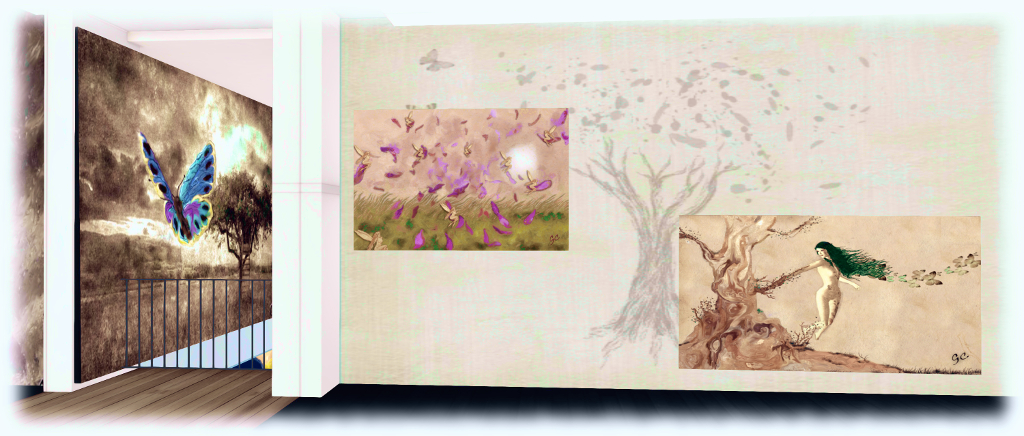
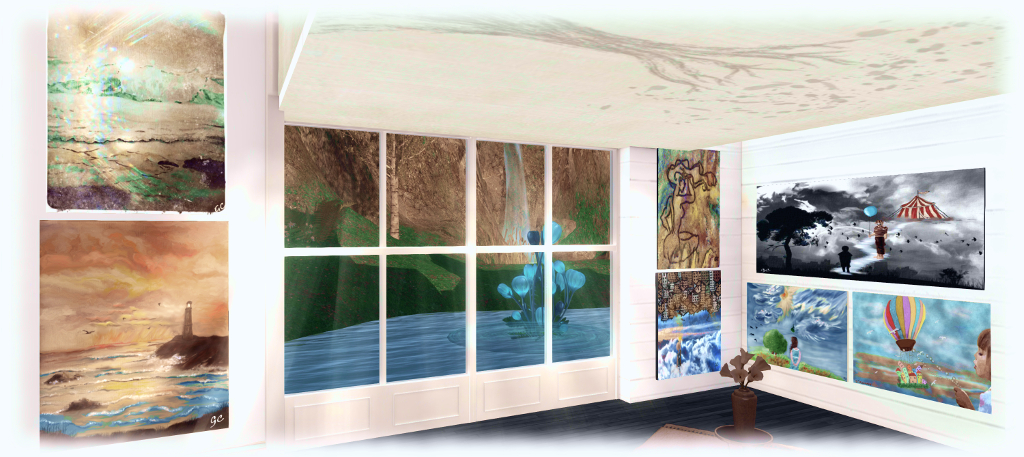
Occupying the multiple rooms of the gallery’s two floors, Grazietta’s art spans a broad spectrum of formats: crayon, oil, watercolour, digital and pencil, with many encompassing two formats – oil and digital, oil and pencil, etc. The subject matter ranges from landscapes to portraiture to abstract, with many – most? – of the pieces exhibiting a bold use of colour and / or strong contrasts in their content – I found myself being constantly drawn back to Volando (“Flying” – seen to the left of the middle image in this article), for example such is the magnificent contract between what appeared to be a digitally post-processed photograph and an oil painted butterfly in full vibrant colour.
This are pieces filled with stories, ideas, imaginings and more, as richly diverse as the styles used in their creation, all set within an environment which encourages one to linger. This is not only because of the comfortable chairs and opportunities to sit down found within the various rooms, but because Grazietta has extended her art into the very structure of the building, by re-texturing walls and stairways with some of her art.
All of the art is available for purchase, and a guest book is available for those wishing to leave a comment.
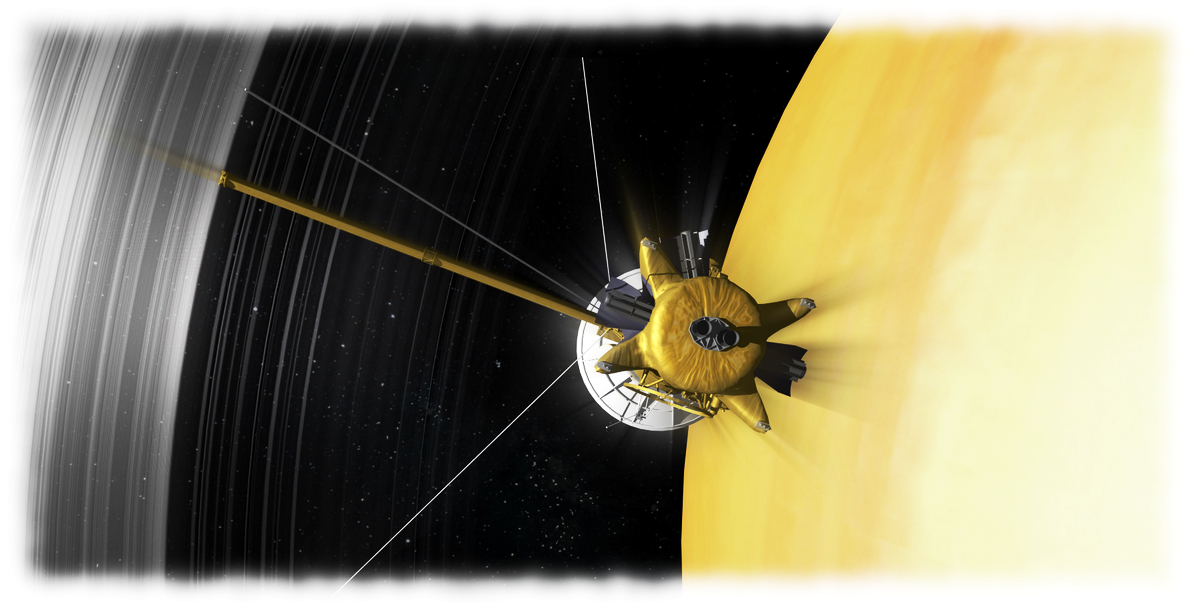
Artist’s concept of Cassini’s final orbits between the innermost rings and Saturn’s cloud tops (see below). Credit: NASA
As we enter a new year, I thought I’d take a quick dip into some of the astronomical and space events which will occur in 2017.
January / February
The Quantids Meteor Shower: reaching a peak on January 3rd / 4th, this should be visible for those in the northern hemisphere graced with clear night skies, as the Earth passes through the debris trail from asteroid 2003 EH1. Just look towards Ursa Major (The Plough / The Big Dipper) and you could see up to 100 “shooting stars” per hour as dust and minute debris from the comet’s tail burn up in the upper atmosphere.
SpaceX Return to Flight: while no date has been confirmed, it is expected this will take place in January / February 2017 – see my expanded report below.
Catch a Comet: February will see Comet 45P/Honda-Mrkos-Pajdusakova pass the Earth on its way back out into space, having swung around the Sun in December. A short period comet, orbiting the Sun every 5.5 years, it should be visible just before dawn between the constellations Aquila and Hercules. On the morning of February 11th it will be at its closest to Earth – 12,320,000 km (7,700,000 mi), and should be visible to the naked eyes as a tiny fuzzy ball.
Southern Hemisphere Annular Eclipse: Africa and South America get to see an annular eclipse on February 26th. This is when the Sun and Moon are exactly in line with the Earth, but the apparent size of the Moon is smaller than that of the Sun. Hence the Sun appears as a very bright ring, or annulus, surrounding the dark disk of the Moon.
March / April
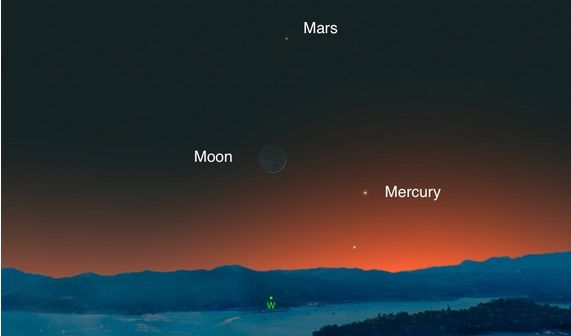
The Moon-Mars-Mercury Triangle: looking out toward the crescent moon just after dusk on March 29th should reveal the celestial triangle between the Moon, ruddy Mars (relatively high above the horizon) and tiny Mercury, much closer to the horizon. The latter will actually be at its most distant from the Sun at the time and at the highest above the horizon it ever gets, marking one of the rare occasions it can easily be seen as a naked eye object.
The Moon-Mars-Mercury “triangle”. Credit: Andrew Fazekas
Jupiter’s Bright Opposition: Jupiter and the Sun will be sitting almost exactly on opposite sides of the Earth relative to one another during March and April (opposition actually occurring on April 7th). This means that Jupiter will be one of the brightest objects in the night sky, and on April 10th will be a brilliant companion for the full Moon, appearing just above and to the right of the Moon’s limb.
Cassini’s Final Grand Tour: On April 22nd, NASA’s long running Cassini mission to Saturn will enter its final phase as the spaceraft bearing the mission’s name commences 22 final orbits which will see it passing between the planet and its rings to come within 1,630 km (1,013 mi) of Saturn’s cloud tops.
China’s Tianzhou 1 to Fly: while it has yet to be confirmed, April has been earmarked for the maiden flight of China’s automated resupply vehicle, Tianzhou 1, which should rendezvous with the Tiangong-2 orbital laboratory to deliver consumables, fuel and other supplies. The mission is key to China’s longer-term aim of establishing a crewed space station in orbit.
June
Saturn’s Opposition and Rings: Saturn will also be in opposition in June, revealing it as one of the brightest objects in the night sky, sitting within the in the constellation Ophiuchus. Saturn will be angled to show its northern hemisphere at this opposition, so the rings will inclined at an angle of 26° to our line of sight, which is almost the maximum inclination they can have, making them visible to even a modest telescope (30-cm / 6-in).
August / September
Perseids Sparkle: it’s the most prolific meteor shower in the year visible in the northern hemisphere, with 60-110 “shooting stars” visible per hour at peak times, with some visible for up to a second at a time. Peak activity will occur between the 9th and 14th August – just look towards the constellation Perseus. But you’ll have to be out really early to see them – around 2:00am local time where you are. They’re the result of the Earth passing through the debris trail left by 1992’s Comet Swift-Tuttle,
The Great American Eclipse: the United States gets the best of this year’s solar eclipses, with a total eclipse occurring on August 21st. Totality (the complete eclipsing of the Sun by the Moon) will be visible in a narrow band stretching across the continental United States – see the video from NASA, below. Check with NASA for the best observing times in your location.
Dragon V2’s fiery ascent: although the first crewed flight of the Dragon V2 capsule has been delayed until 2018, SpaceX are targeting August 2017 as the month for the first uncrewed flight of the system, an important step on the way toward full certification to carry astronauts to and from the International Space Station.
Farewell to Cassini: it won’t be visible from Earth, but at 11:07 UT on September 15th, 2017, NASA’s Cassini mission to Saturn will come to an end as the vehicle, which has been in space for 20 years, 13 of them in orbit around the planet, plunges into the upper reaches of Saturn’s atmosphere and burns up. It will be a fiery and sad end to a magnificent mission, and I hope to present a Cassini special in these pages later in the year.






 Inara Pey: Living in a Modemworld