Second Life Oculus Rift support suspended

Development of Oculus Rift support within the official Second life viewer has been suspended.

On July 1st, I blogged about the new Oculus Rift project viewer designed to support both the DK-2 and CV-1. The release, coming almost two years after the initial project viewer was made available, had been long anticipated among Oculus Rift HMD users in SL, and so the response was initially enthusiastic in terms of people downloading  it.

Unfortunately, as I subsequently reported, thanks to feedback from TTech, Ai Austin, Rai Fargis – who raised BUG-20130 on the viewer (still open at the time of writing, although that may change) – and others, the new project viewer had more than a few issues with it, and was seen as something of a step back in terms of general usability.

Now it seems that the Lab have – for the foreseeable future, at least – decided to cut their losses in developing Second Life viewer support for Oculus Rift. Posting in the Oculus CV-1 forum thread, Oz Linden announced:

Thank you for experimenting with our Oculus Rift Project Viewer and offering your feedback. Unfortunately, the Project Viewer that we recently made available didn’t meet our standards for quality, and so we’ve now removed it from the Alternate Viewers page.

By definition, Project Viewers aren’t ready for primetime. The purpose of these experimental Viewers is to share with you the earliest possible version of what we’re working on, so that you can see what we’re up to, help discover problems, and provide feedback. In this case, though, we’re not ready for that, as those of you who tried it have seen.

We can’t say at this point when or even if we may release another Project Viewer for experimenting with the Oculus Rift in SL.

We want to prioritise our development efforts around initiatives that we know will improve the virtual world and bring more value to SL Residents, and due to some inherent limitations with SL, it may well not be possible to achieve the performance needed for a good VR experience. (In fact, this is one reason why we’re creating Project Sansar a new, separate platform optimized for VR).

We greatly appreciate the interest in trying SL with the Oculus Rift and are grateful that several of you took the time to try the Project Viewer. We regret that the quality was not up to our standards, and we will of course keep the community posted if we release a new Project Viewer for VR in the future.

Providing support for high-end HMDs within Second Life was always going to be problematic; most of the content found in-world is unoptimised (and our avatars even more so), so producing the means by which the viewer could comfortably meet the levels of performance required for such HMDs, such as a consistent frame rate of at least 75 fps (DK-2) or 90 fps (CV-1), was always going to be doubtful.

However, the Lab has remained reasonably bullish through about trying to offer an acceptable level of HMD support within Second Life – albeit it with caveats. For example, speaking at the TPV Developer meeting on Friday July 1st and just ahead of the Oculus Rift project viewer appearing, Oz said that offering HTC Vive support at some point for Second Life was something the Lab  “would like to be able to do”.

So what went wrong?

Well, we don’t actually know. Interestingly, most of the issues experienced with the new project viewer weren’t performance related, but focused on general usability: as UI problems, rendering issues, image resolution problems, etc., all of which had been acceptable on the previous release of the Oculus rift project viewer. Whether these point to something being fundamentally wrong with the viewer build, or whether there have been some intrinsic changes to the Oculus SDK software (the latest version of the viewer have leapt forward significantly in SDK support when compared to the last viewer)  which are not limiting options for integrating it into the viewer is hard to say.

All we do know is that from Oz’s forum comment, it would seem that fixing the problems which have been encountered would seem to be a non-trivial task – and once of potentially questionable value when compared to the possible return in terms of benefits to a broader cross-section of users other SL improvement initiatives might bring.

Does this mean the end of all attempts to provide HMD support in Second Life?

Again, that’s hard to say. In the short to medium term, I’d say most likely it does insofar as the Lab is concerned, given the general thrust of Oz’s comment. but that doesn’t mean a third-party developer might not be sufficiently motivated to at least take up the challenge and see how far they can get. Longer term, however, the door might not be so firmly closed.

HMD technology is still in its infancy. so who knows what might come down the road in a couple of years time, and how it might influence the Lab’s thinking with regards to Second Life? Time ell tell on that one.

With thanks to Baz DeSantis for the nudge.
Project Bento User Group update 18 with audio

Project Bento – extending the SL avatar skeleton

The following notes and audio were taken from the weekly Bento User Group meeting, held on Thursday, July 7th at 13:30 SLT at the the Hippotropolis Campfire Circle . For details on the meeting agenda, please refer to the Bento User Group wiki page.

Note that this update is not intended to offer a full transcript of the meeting, nor does it present the discussion points in chronological order. Rather, it represents the core points of discussion, grouped together by subject matter were relevant / possible, whilst maintaining the overall context of the meeting.

Viewer Updates

Project Viewer

There have been no further updates to the project viewer, version at the time of writing. Vir is continuing to try to nail down the remaining bugs, but there are no significant fixes in the pipeline as yet.

The project viewer is due to be merged up to de facto release viewer (which updated on Tuesday, July 5th). It’s currently not clear if this will result in a new version of the project viewer being put out without any actual Bento changes, or whether the Lab will wait until there are fixes and updates to Bento before putting out a new version of the viewer.

Experimental / Test Viewer

There is an updated experimental viewer for the proposed skeleton and slider modifications. A summary of the updates included in this version of the viewer can be found on the Machinimatrix website. In short:

  • There is a new bone, mFaceJawShaper, intended to resolve issues around the jaw angle (see my Bento update #17 for background)
  • Additional tweaks to existing facial bones
  • Some slider changes

In support of these changes, there is also an updated mesh model. Bento creators are asked to take a look at the updates in this viewer and experiment with them, and provide feedback and details of any issues back to the Lab as soon as possible. This model has not been added to the Bento Test wiki page so as not to cause any confusion with the models already there.

Overall, the Lab is looking to lock this viewer down, so that changes and be reviewed and, if approved, incorporated into the main Bento project viewer. Once this has been done, it is very unlikely that any further skeleton or Avatar_LAD file changes will be made.

Those wishing to test the experimental viewer should note that they must use the BentoExperimental1 region on Aditi to upload models or animations that use the new bone, as it is currently unsupported on Agni (the main grid).

These changes will result in some displacement of jaw / mouth joint positions when viewing models with do not have the updates. Matrice Laville and Cathy Foil provided some suggestions on how to correct such displacements, both generally (Matrice) and with specific reference to Maya / Mayastar (Cathy).

Bento Heads and Sliders

Translations  / Rotations and Animations

The reasons for the new experimental viewer lay in the recent discussions about potential issues which could impact Bento’s effectiveness with human heads.

The Machinimatrix summary linked to above (which also forms the release notes for the Avastar 2.0 Alpha 4 update), provide a comprehensive explanation of the  situation. However, in short,  the SL animation system has worked on the assumption that sliders only affect translation and scale whilst animations only affect rotation, allowing both to work cooperatively. With Bento, animations can now also leverage bone translations, and this can lead to conflicts when attempting to run animations on avatars modified using the sliders.

Exactly how severe these conflicts are has been a topic of hot debate within the forum thread for the last few weeks. As a result, Medhue Simoni has produced a video (below) which hopefully defines what is and isn’t possible within the existing project viewer, while the Avastar team and Cathy have attempted to further address some of the concerns expressed by mesh head creators in an attempt to make the system more responsive to their needs.

During the meeting, Cathy, Vir and Matrice gave a further summary on why these changes appear to be coming so late in the day.

Head Appearance Slider Limitations

Setting the Egg Shape slider to 0 results in the chin bone sliding forward, rather than down: a result of trying to get a single slider to try to work with multiple head bones
Setting the Egg Shape slider to 0 results in the chin bone sliding forward rather than down to give a pointy chin: a result of trying to get a single slider to try to work with multiple head bones. Weighting models should help compensate for this

Another issue with Bento heads – again, notably human heads – is trying to tie all of the available bones to the existing sliders such that using the sliders to change the shape of a Bento head is reasonably consistent with using the same sliders to morph the shape of the system avatar (so users see a reasonably consistent result whether they are using a Bento head or working with the system avatar).

Unfortunately, this has not been possible with either the Head Shape or Egg Head slider, due in no small part to the complexities in trying to control the position of so many head bones with these sliders.

As a result, when using the extreme left / right ranges of these sliders, odd results can be seen. Setting the Egg Head slider to 0, for example, results in the chin bone being pushed forward, rather than down, resulting in an exaggerated pointy chin. It is believed that weighting heads will help compensate for this, but as Matrice, Cathy and Vir explained during the meeting, the sliders are such that issues like this cannot be easily avoided.

Height Issue

One fix that should hopefully be forthcoming when the next version of the project viewer does appear, is for the avatar height offset issue (BUG-20013), in which (mainly) quadruped avatars may appear to be standing on the ground in their own view, but are seen as standing in the ground by others.

In short, an avatar’s position relative to the ground it is standing on is calculated using the position of a number of bones within the avatar and various other factors. However, how and when these calculation is updated within the viewer occurs in a somewhat unpredictable manner, with the result that while an avatar may appear to be standing on the ground in one view, it is standing in the ground when seen by others.

To fix this, Vir has revised the height calculation to run almost constantly. This should hopefully result in all viewers consistently calculating an avatar’s height above the ground, including the impact of any animations which may affect it, and thus produce a consistent set of results: everyone sees the avatar standing on the ground.

Alt_Eyes

Bento includes a set of alternate eye bones, the Alt_Eyes, which are tied to the appearance sliders governing the “primary” eyes (size, position, etc.).

These were originally added so that those wishing to have eyes which are not animated by the default system eye movements could make use of them. However, it is now been confirmed that running eye animations at a higher priority to the system animations is sufficient to override them on the “primary” eye bones.

Further, even where models have been made which incorporate additional eyes (e.g. in Aki Shichiroji’s wyvern), the Alt_Eye bones may not actually be used / it might be preferable to not have them change size / position on the basis of altering the “parent” avatars eyes via the appearance sliders.

A suggestion has therefore been put forward to de-couple the Alt_Eyes from the eye bones (and just have them linked to the head shape sliders). This couple potentially open them up for more varied use, such as with hair, cheek bones etc.  As the Lab is keen to lock down both the skeleton and the Avatar.LAD file as soon as then can, this is something which needs to be agreed ASAP, preferably through forum thread discussions.

Shivers Unleashed: an international music festival in Second Life

Shivers Unleashed
Shivers Unleashed Festival

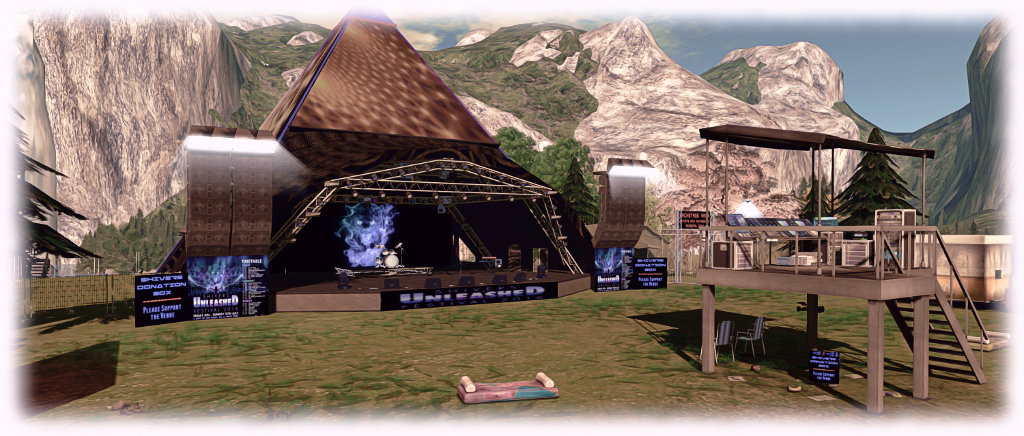
Friday, July 8th through Sunday, July 10th sees the fifth Shivers Unleashed music festival take place in Second Life.

Organised by Shivers Productions, led by Mania Littlething and Anakin Muircastle, the festival brings together 20 headline artists and bands on the main stage across the weekend, supported by DJ sets on a separate “chillout” stage as well. With the exception of just one year, The Shivers Unleash Festival, or SUF, has been a part of the Second Life music scene since 2011, and is truly international in flavour. This year, for example, features artists from across Europe and North America and from South Africa and Japan, all of whom come together to celebrate and share a love of music with SL residents.

Shivers Unleashed
Shivers Unleashed Festival

I had the opportunity to chat with Mania littlething in the run-up to the event, and one of the first questions I asked her was how SUF came into existence.

“It actually started while being drunk with my partner,” she replied, laughing. “We had a Halloween event at our club and we got the idea to some time host a really big cool festival. That got realised in the summer of 2011, when we hosted the first ever Shivers Unleashed Festival!”

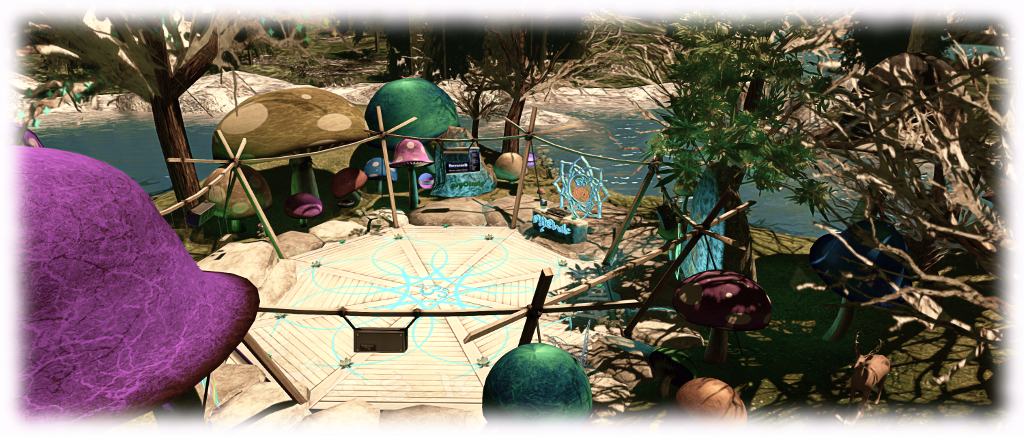
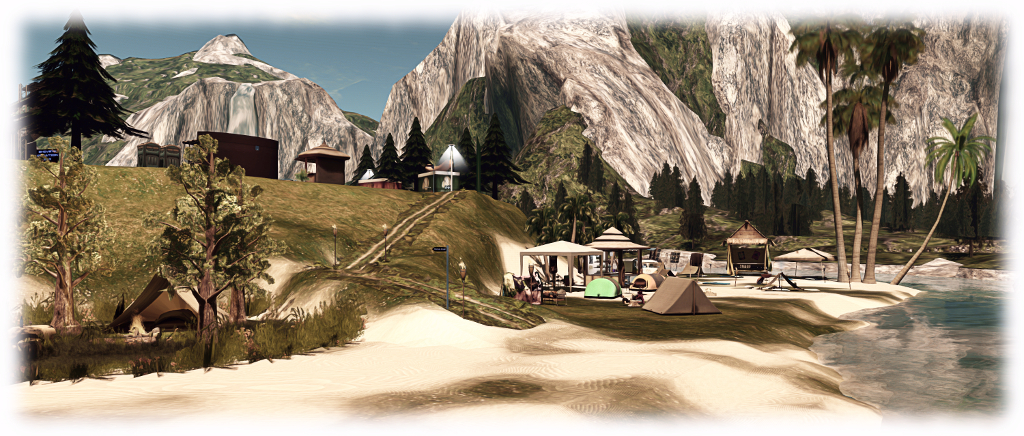
This year sees SUF take place on a dedicated region featuring a main stage for the headline acts, a second “Psychedelic Circle” (or PsyCircle) stage for DJ parties, a small marketplace area and a beach camp site where festival attendees can kick-back and simply enjoy the atmosphere. Over the three days of the event, a quite eclectic mix of music will be presented from acoustic / vocals through to synthpop and cyberpunk rock, going by way of electric blues, rock, metal, dubstep, psytrance and more. Given this mix, I asked Mania how the festival arrived at its line-up.

Shivers Unleashed - main stage
Shivers Unleashed Festival – main stage

“Well, the basic idea has always been to gather, in our opinion, best and most impressive artists of Second Life on our stage over the one weekend,” she replied. “Of course, because we’re looking for acts, our personal taste plays a role; but we start several months ahead of each festival, scouting around, asking those we’ve particularly liked if they would come back and perform. When we find cool acts we hadn’t previously come across, we invite them as well.”

She continued, “We’re also looking for new acts, or those who haven’t previously appeared at SUF. So this year, for example, we’re featuring Yadleen, a German composer who has only been performing in SL for the last four months.  But our main objective is to create a special event with special acts. And it’s always nice when we can bring acts who are not often to see in SL; this year, for example, we’re delighted to have Nnoiz Papp and Cyberpiper performing on stage!”

All of which adds up to an interesting mix – so, if you’re in the mood for music this weekend, why not drop in to Shivers Unleashed? Check the schedule below for acts and session times (all in SLT), and check-out the artists and bands in the Festival Guide. You can also catch a preview video for this years acts on YouTube.

Friday, July 8th – Live Sets

10:00 Dje Atolia  (France)
11:00 Psiquence
Noon Wolfie and the Bad Reputation (Gibraltar)
13:00 UKD Project  (Italy)
14:00
Plastik Guitar (Portugal)

Saturday, July 9th – Live Sets

08:00 Deceptions Digital (Germany)
09:00 Paris Cloyd (USA)
10:00 Bolt (South Africa)
11:00 Switchboard of Souls (USA)
Noon
Nnoiz Papp (Germany)
13:00 Cyberpiper (Luxembourg)
14:00
Paris Obscur and Lisa Brune (France)
Shivers Unleashed - PsyCircle stage
Shivers Unleashed Festival – PsyCircle stage

Sunday, July 10th – Live Sets

08:00 The Black Stripes (Japan)
09:00 Aminius Writer (Germany)
10:00 Zoz Quandry (UK)
11:00 Yadleen (Germany)
Noon
Option Y (USA)
13:00 Cellshader (USA)
14:00
Red Heaven (Canada)

Weekend DJ Sets – PsyCircle

Friday 15:00
Lunna Darwinian
Friday 16:00
Minna Freedom
Friday 17:00
TBA
Saturday 15:00
GreySunshine
Saturday 16:00
Saaryi Ossic
Saturday 17:00
Annie of Fractal Psy
Saturday 18:00
TBA
Sunday 15:00
Chillout
Shivers Unleashed - camp site
Shivers Unleashed Festival – camp site

Additional links

All_Most Real in Second Life

Nitroglobus Hall: ALL_MOST REAL

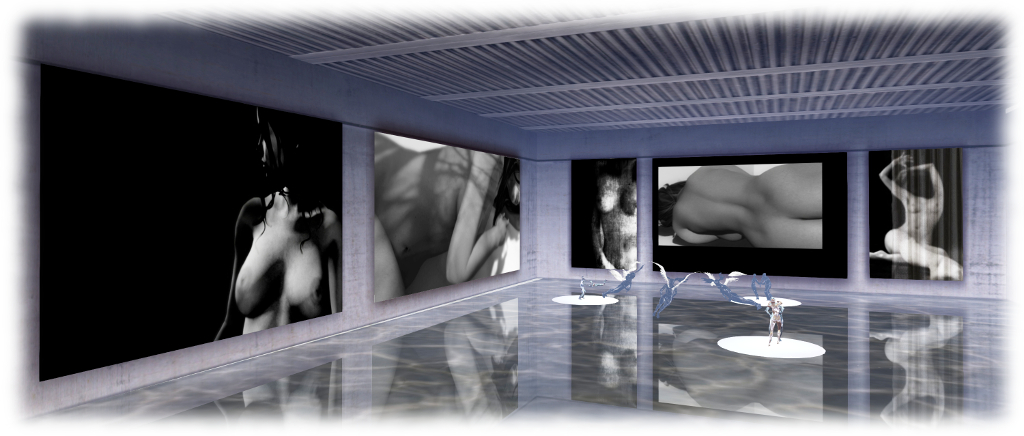
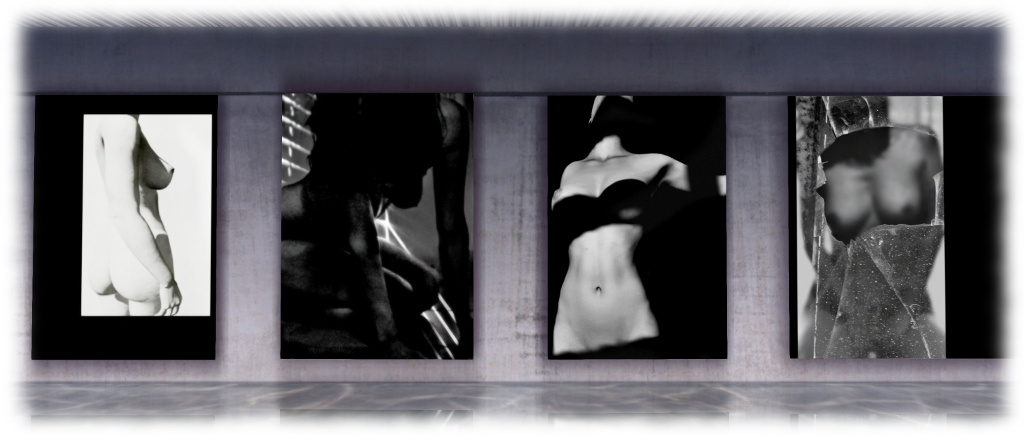
Now open through July at Nitroglobus Hall, curated by Dido Haas, is ALL_MOST REAL, an exhibition by MM (myster). Comprising 18 monochrome nude and avatar studies, it is an extraordinary exhibit, demonstrating both the depth of mood, feeling and sheer realism which can be achieved through Second Life photography, whilst also highlighting the extraordinarily narrow boundary which exists in our perception of what might constitute “reality”.

ALL_MOST REAL is a quest on reality and perception, and how they influence our emotions,” the artist states in introductory notes for the exhibition. “We know perceptions win over facts and reality so many times, conditioning our lives. In MM’s search for realism, could it be that the doll finally (like Pinocchio) transforms pixels into flesh?”

Nitroglobus Hall: ALL_MOST REAL

Of the 18 images presented here, with six from the physical world, the rest from the virtual. Together they offer a set of works not only of subtle, sensual beauty, each with its own story to tell, they also toy with our perceptions, and invite questions on the nature of reality and transformation. Where, exactly, does the avatar model cease and the human model start – and vice versa?

Which is not to say that any formal challenge is being made to visitors; there is no demand that we attempt to sort one from the other – although MM did tell me that she did ask several friends to examine the images to see if they could! Rather, as she notes in her introduction to the exhibition, it doesn’t matter if you solve the “puzzle” of which images might have been taken in which medium; it is on how they individually and collectively speak to you, and the journey they encourage you to take.

Nitroglobus Hall: ALL_MOST REAL

This challenge to our perceptions of the avatar / human “divide” also resonates deeper, touching on matters such as our own level of investment in our avatars; the way in which we can project our living essence into the digital through them. Thus the journey offered in studying the pictures becomes uniquely personal.

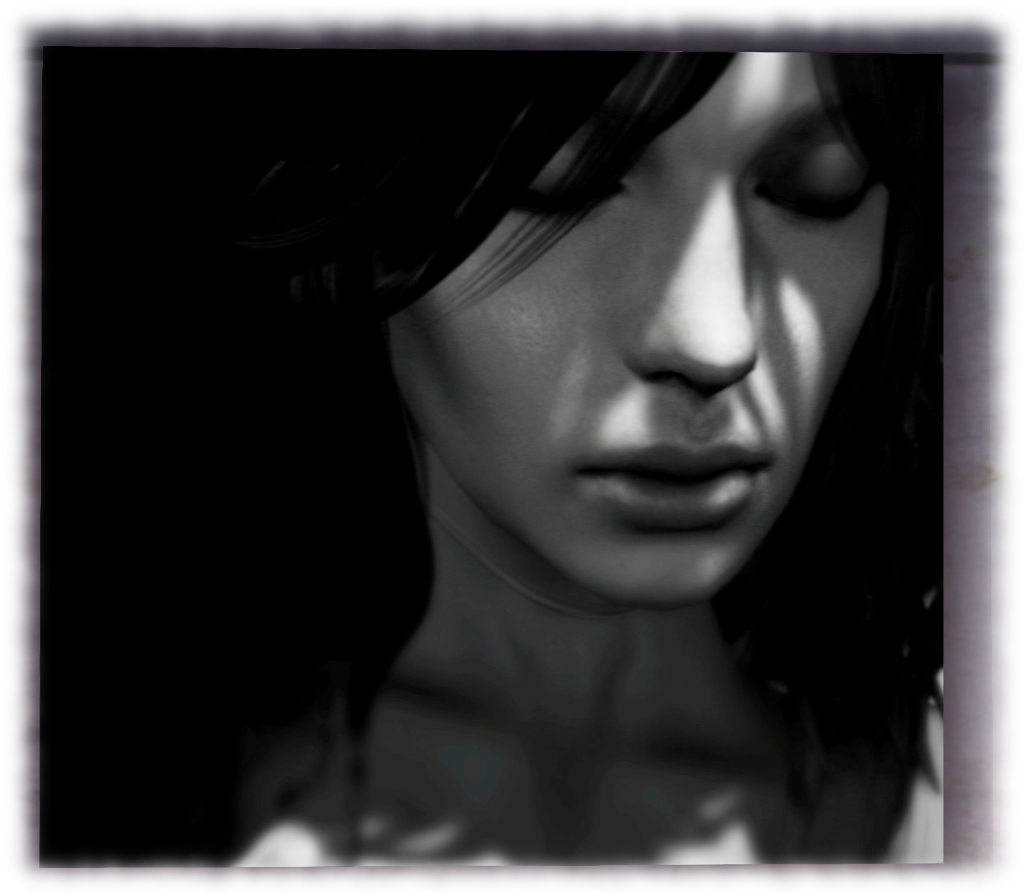
Some three months in the making, All_MOST REAL is a stunning and captivating exhibition; one which really should not be missed. Whether depicting a physical model or an avatar, the beauty and life permeating each of the images is as undeniable as it is breathtaking. Take All_Most Real 15, for example (below). Such is the natural depth and tone to the picture, it is hard to escape the feeling – the desire – that if we look long enough, the subject’s eyes will open and her lips will soften into a loving smile at us.

Nitroglobus Hall: ALL_MOST REAL

Highly recommended  – an  exhibition which should not be missed.

SLurl Details

USA Today’s further look at Project Sansar and Social VR

Project Sansar promotional image via Linden Lab

On July 4th, I noted USA Today’s video short on Project Sansar and the Lab. At the time, I indicated that there didn’t appear to be a related article to go with the video. However, that’s now changed, and Ed Baig, USA Today’s tech reporter, has indeed written an article to sit alongside the video, which appeared on July 6th under the title Second Life’s creators try for a third — in virtual reality.

“Third”? You may wonder. “What third?” The answer is something of a play on words – Linden Lab’s “first life” is (like the rest of us) firmly rooted in the physical world, where it sits as a corporate entity employing over 200 staff, 75-ish of whom are focused on Project Sansar (the rest doubtless made up of those managing Second Life, running Blocksworld, taking care of the company’s administration and management and (potentially) working with Tilia Inc.). Their “second life” is, obviously, Second Life itself, thus leaving Project Sansar as the company’s nascent “third life”.

Ed Baig: looking further inside Sansar and Social VR for USA Today

As with the video, the article doesn’t reveal much that is new about Project Sansar itself per se, however, it does delve more into the concept of “social VR” – the term that Linden Lab and the likes of High Fidelity,AltSpace VR (both of whom are also mentioned in the article) and Facebook are increasingly using to define their new platforms.

In the case of Sansar, this “social” element is not just about people together who are already engaged in the virtual domain, but in allowing the creators of the environments hosted by Project Sansar to directly attract their own audiences to the experiences they build.

At this point, it’s probably worth diverting slightly and stating something that by now I would hope would be straight out of the British Guide to Stating the Bleedin’ Obvious, particularly for those who have been following Project Sansar’s development, but is worthwhile repeating just in case.

And it’s this: as with various other aspects of discussing Project Sansar, “creator” actually has a wider context than perhaps it does within Second Life. In the latter, by-and-large, we tend to regard “creators” as the folk who design and make the goods we use to dress our avatars and furnish our land. Outside of lip service, it’s perhaps not a term closely linked with those who obtain land and regions in SL and use these goods to create and environment. However, with Project Sansar, it is pretty clear “creator” is intended to encompass both: it applies to both those who can build and model with the tools supported by the platform, and those with the desire to “build” an environment they can share with others, even if “build” refers more to shaping the land and obtaining content designed, made and supplied by others.

Ed Baig was able to explore Mars within Sansar, using one of the Lab's early experience set pieces
Ed Baig was able to explore Mars within Sansar, using one of the Lab’s early experience set pieces

In his article, Ed Baig illustrates this, together with the concept of “social VR” and the ability for experience creators to be able to attract their own audience by quoting the idea of learning the French language:

If you search Google for “I want to learn French” you might find in the search results a virtual reality experience in Sansar where you can actually “go to virtual places in France, meet French people and have French dialogue at the boulangerie,” Altberg says.

This actually brings up another point – and one I really must remember to ask the Lab about next time I have the opportunity to do so. And that’s the idea of Project Sansar as a “white label” environment. This was first mentioned back in early 2015, and hinted at in interviews since. If it is still a central aim for the platform, then it could be a powerful aspect to Project Sansar, allowing experience creatorsattract audiences through gateways they define and in a manner such that the audience isn’t even aware they are entering an environment hosted by Linden Lab or is something of a relative of Second Life.

But I digress; Sansar as a white label platform is a topic for another article (and one long overdue to appear in these pages!). In terms of the USA Today piece, the social aspect is further touched upon with the idea that in the future, people from geographically disparate locations will be able to meet and work together far more easily in virtual spaces than up to now has been possible (thanks largely to the work in facial and body tracking, which allow avatars to be a lot more nuanced and expression in their reactions to others).

Elsewhere, the idea of the potential “cannibalisation” of Second Life by Project Sansar is touched upon.  This has been a controversial statement when raised in the past. However, while it is true that Second life thus far in its history faced serious competition, the times really are now changing, and just because SL hasn’t yet faced a competitor capable of luring its user base away doesn’t mean that at some point in the medium-term future it won’t.  As such, references to the risk of “cannibalisation” shouldn’t be taken as a sign the Lab is in any way willing to “sacrifice” Second Life on the alter of Sansar, but rather that it is a pragmatic acknowledgement that the risk actually now does exist for Second Life to be supplanted in people’s hearts and minds, and thus, for the sake of the Lab’s own survival, better it came from within than from without.

Like the video before it – which is included at the head of the article,  there’s nothing here that’s particularly revelatory about Project Sansar for anyone who has been keeping abreast with developments on that platform. However, the overview of the “social VR” approach is worth a read in and of itself. While for anyone who has not thus far dipped a toe into the waters of Project Sansar, Ed’s piece offers a pretty good starting point in understanding what it is about.

SL Project updates 16 27/1: Server, viewer, Oculus Rift

Legacy Ridge; Inara Pey, July 2016, on Flickr Legacy Ridgeblog post

Server Deployment

Despite the holiday in the US for July 4th (which has previously pushed server deployments back 24 hours), the Main (SLS) deployment did in fact take place on Tuesday, July 5th. This was the server maintenance package previously deployed to the three RC channels in week #26, comprising the following fixes:

  • BUG-11836  Increase max animation size – animation files up to  250Kb can now be uploaded
  • BUG-6035 (non-public) LSL email registration (for receiving email from outside the region) can break without automatic recovery.

There was no planned RC deployment on Wednesday, July 6th.

SL Viewer

As expected, the Inventory Message viewer, version 4.0.6.315555 (dated May 23rd) was promoted to the de facto release viewer on Tuesday, July 5th. This viewer sees the removal of deprecated and unused UDP inventory messaging mechanisms from the viewer. Pending its adoption by third-party viewers, it will also eventually see the removal of server-side support for these messages, most likely towards the end of 2016.

Currently, this leaves the official viewer line-up, RC and project, as follows:

  • Maintenance RC viewer, version 4.0.6.316883, dated June 24th –bug  fixes and updates
  • Project viewers:
    • Visual Outfit Browser project viewer, version 4.0.6.316422, dated July 1st – ability to preview images of outfits in the Appearance floater. Expected to be updated to release candidate status soon
    • Oculus Rift project viewer, version 4.1.0.317313, dated July 1st – Oculus Rift DK2 + CV-1 support. However, this update appears to have significant issues, see below for more
    • Project Bento (avatar skeleton extensions) viewer, version 5.0.0.317134, dated June 30th
    • Project VLC Media Plugin viewer, version 4.0.6.316258, dated June 15th – replaces the QuickTime media plugin for the Windows version of the viewer with one based on LibVLC
  • Obsolete platform viewer, version 3.7.28.300847 dated May 8th, 2015 – provided for users on Windows XP and OS X versions below 10.7.

Oculus Rift Project viewer 4.1.0.317313

There appear to be significant issues with this project viewer, which is intended to support both the DK-2 and CV-1 versions of the Oculus Rift headset. For further information, please refer to the following links: