Second Life on the go: Lumiya on Windows?!

lumiya-logoLumiya is an Android client for Second Life which is really quite remarkable. I’ve followed its development through these pages at length since it first appeared back in 2012, all the way through to the most recent 2.6 iterations; and while things have been quiet for a while, rest assured, development work is continuing, although developer Alina Lyvette has been very caught-up with physical world matters.

But did you know you can also run Lumiya on Windows*?

I suspect the responses to this question would be a combination of “No,” and “Why would I want it to?” The former is to be expected, and the latter not unreasonable; after all if you have a computer capable of running the Second Life viewer reasonably well why would you want to try anything else?

One possible “why” might be if you have a relatively low-end laptop you use when on the move, and would like to use it on occasion to access SL, but don’t want to meet the costs involved in running Bright Canopy’s (very excellent) service (which I’ve also covered in these pages), and would prefer something bigger than the average android device screen when accessing SL.

While I’ve not played at length with things, I did come across an Android emulator called Bluestacks which runs on the PC, and used to be available for Mac*. It makes running Lumiya on Windows a breeze in four easy steps:

  • Download and run the Bluestacks installer
  • Run the Bluestacks player and sync it to your Google Android account
  • Run Google Play and install Lumiya (note the app does have a one-off purchase fee if you have not previously installed it)
  • Launch Lumiya.
Running Lumiya via Bluestacks on a Windows notebook

There are a few things to note when running Lumiya in this way. Obviously, being built for Android, it is intended for touch screen use. While Bluestacks does a credible job of allowing mouse and pointer control and the use of keyboard controls such as the arrow keys and WASD, I tended to find that things did sometimes “stick”, prompting a return to the on-screen movement / camera focus keys (lower right corner of the screen).

Given Lumiya is running on a “standard” computer, it’s also easy to slip into the expectation that it will respond to things like ALT-camming when it obviously won’t – this is still an Android app running through an emulator, after all! Given this, it goes without saying that if you’re new to Lumiya, you have a lot to learn via the UI and options – feel free to use my reviews linked to above 🙂 .

Also keep in mind  that as Lumiya is an Android app, the graphics don’t have the same fidelity as the viewer, and running it through an emulator isn’t going to magically give you that kind of fidelity. If that is what you’re looking for when on the move and don’t have a good laptop, then Bright Canopy is your best option outside of a new computer / GPU.
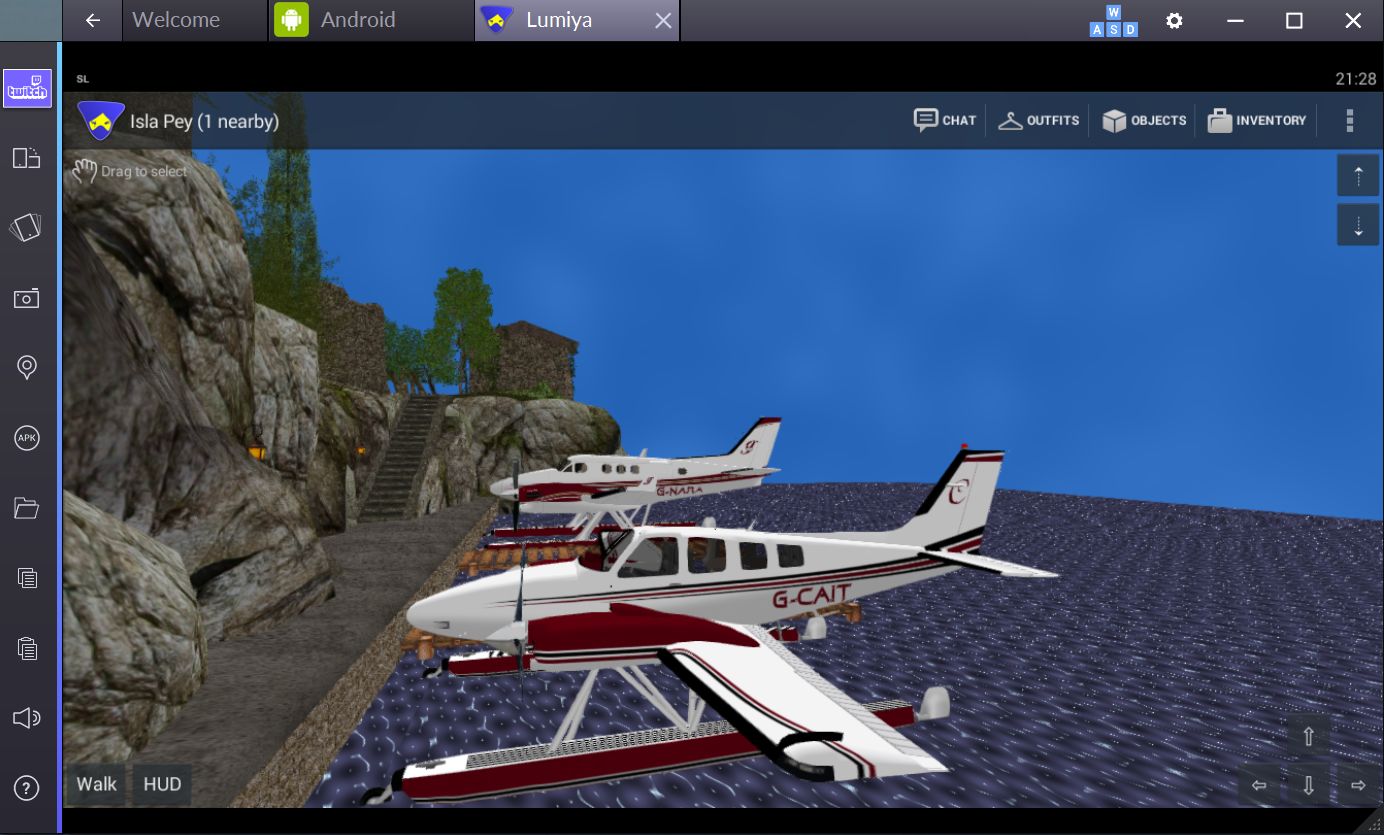
Lum iya may not have the same graphics fidelity as a full viewer, but if your looking for something that can provide you with an in-world view while on the move with a laptop, running in on Bluestacks might be a viable option
Lumiya may not have the same graphics fidelity as a full viewer, but if you’re looking for something that can provide you with an in-world view while on the move with a low-end laptop and for whatever reason, don’t want to use Bright Canopy, running it in through the Bluestacks emulator might be a viable option

Also, as you are running through a laptop there might be a temptation to push Lumiya’s settings to the max. I’d actually suggest some caution here; your little laptop / notebook may appear to have more umph that an Android device, but you will take a performance hit in driving things too high.

Overall, I found running Lumiya on an Asus PCee 1201N to be pretty acceptable – certainly a lot less tasking than running a full-blown viewer. I wouldn’t want to do it all the time, but as an alternative and occasional means of access, it’s more than acceptable. The UI, intended for touch screens, works well with mouse and pointer, and while there were occasional niggles (sometimes I had to swap back to using the on-screen movement keys via mouse, for example), my biggest issue came down to trying to use conventional SL keyboard shortcuts simply because I was sitting in front of a keyboard!

Whether this kind of approach would appeal or not is down to the individual – but as noted above, if you are looking for the occasional access to SL from a low-end laptop / notebook whilst on the go and either don’t want to fiddle with the small screen of and android device or would prefer not to use Bright Canopy, then this might be an option for you.

Addendum, June 3rd: While Bluestacks was promoted as a “free” emulator, some 36 hours after installing it, I received a notification requiring a subscription payment of either US 2.00 per month or to install sponsoring games in order to keep using it to access Android apps.

*Note: Bluestacks used to offer an emulator for Mac systems as well. It’s no longer available through their own website, but can be obtained from this review on the TechApple website. However, as I’m not a Mac user, I have no idea how up-to-date it is compared with the latest Windows version of the emulator or whether it is a viable option.

Lumiya on Bluestacks was tested using an Asus PCee 1201N with 2 Gb RAM, Intel Atom 330 processor and Nvidia Ion 2 GPU  using shared memory. 

Mourningstar: exploring a fallen angel in Second Life


Mourningstar
Mourningstar

Mourningstar is described as “An exploration of the ideas of the fallen angel, the vengeful god, and the diverse perceptions of Lucifer in various religious and social traditions. A virtual pilgrimage, proposing an alternate mythology…”

An immersive installation by Anahera (Fox Nacht), Mourningstar is in three parts – theological, Romantic and (for want of a better term) “present day”. Literary, theological and practical references are to be found throughout, making for an interactive piece. On arrival, do take a moment to read the notes on how best to full appreciate the installation.

Mourningstar
Mourningstar

The pilgrimage starts in the theological: a heavenly walk towards the upraised hand of God, culminating with a quote of Isaiah 14:12: How art thou fallen from heaven, O Lucifer, son of the morning! How art thou cut down to the ground, which didst weaken the nations!  And thus we, too are cast down to the ground, landing amidst a litter of broken angel wings within a ruined landscape – a reminder that around a third of the heavenly hosts fell with Satan – within a landscape. 

Through this grey engraving of a landscape lie a series of paths marked by arches. One continues the theological theme, taking us to the Tree of Knowledge. But here, as with the celestial hand above, a question mark is thrown over God’s role in things. In the heavens, the hand of God has strings attached to fingers and thumb, suggestive of a puppet master, while at the Tree of Knowledge, we are asked to ponder What sort of father would deny his children knowledge?

Mourningstar
Mourningstar

The remaining paths through the landscape encompass the great 19th Century Romantic era of poetry, encompassing an extract from Alfred de Vigny’s 1824 tripartite poem, Éloa, ou La sœur des anges (Éloa, or the Sister of the Angels), which offers Satan as capable of love, but unable to deny his own twisted nature, thus drawing the one who loves him – an innocent young angel – Éloa, down into hell.

Also to be found here are images of the great English Language Romantics – Blake, Bryon, Coleridge, and  Mary and Percy Shelley. According to Ruben Van Luijk,  writing in Children of Lucifer:  Origins of Modern Religious Satanism, these Romantics were spurred on by Milton’s Paradise Lost to see Satan as the ultimate rebellious hero, a champion of individual freedoms in an age of increasing political and social constraint.

Mourningstar
Mourningstar

One final path remains, one perhaps not so easily seen. It lies to one side of the reading area where visitors can delve into the writings of Blake, Byron and Milton. It leads to a pair of ram’s horns planted in the ground – their meaning clear enough – together with the definitions of “Belief” and “Faith”. A teleport disk before these provides the way to an examination of modern Satanism, with an introduction by Professor Darren Oldridge, and which sharply contrasts with the view of the Romantics.

I’m not so sure Mourningstar is an “alternate mythology” so much as a visual immersion into the theological, philosophical, Romantic and modern interpretations of Satan’s influence on people’s thinking and actions; one which also takes a short, sharp poke at the Christian view of a benevolent God in the process. Wisely, no attempt is made by the artist to direct or lead our thinking. Instead, we are encouraged to explore, examine, consider, and determine for ourselves.

Mourningstar will remain open through until the end of June.

SLurl Details

A trip to the Countryside in Second Life

Countryside, Habitat Springs; Inara Pey, May 2016, on Flickr Countryside, Habitat Springs – click any image for full size

In November 2014 I wrote about a Mainland location called The Back 40, designed by Dicky (Dick Spad). At the time, I was enchanted by that discovery; so you can imagine my absolute delight in discovering Dicky has a full region as well, also open to the public (aside from the corner where he has his private residence).

Countryside is every bit as enchanting as The Back 40, offering a fabulous outdoors environment which can be enjoyed through solo exploration or – more ideally – in the company of a friend / someone close to you.

Countryside, Habitat Springs; Inara Pey, May 2016, on Flickr Countryside, Habitat Springs

Surrounded by a rolling landscape created by the use of region surrounds, it’s hard to tell where the region ends and “beyond” begins, which helps give this region a feeling of being far bigger than the 256 metres on a side we’re allowed. Largely flat, the land is naturally divided into a series of areas by the river flowing through the region and the use of broad greenswards, very strongly suggestive of fire breaks to be found in heavy areas prone to forest fires.

From the landing point in the south-east corner of the region, one can strike out north or west, the greenswards offering a choice of routes through the groupings of trees. Head north, and you’ll pass woods and meadow, a fire watch tower and reach grasslands stretching up to the river, on the other side of which sits Dicky’s private residence.

Countryside, Habitat Springs; Inara Pey, May 2016, on Flickr Countryside, Habitat Springs

Head west from the landing point and you’ll again come to the head of the river: a large pool of water fed by a waterfall, where bears fish and beavers are constructing a lodge. Cross the river via with little wooden bridge, and the landscape gradually changes, edging away from the open wilds to a more rural environment with neatly laid crops, fenced  fields and meadows, and a small farm fed by a dirt track, the sidings of a railway spur close by.

It is, in a word, quite beautiful. And that’s really just the start; it’s possible to wander for what seems miles around the region and still come across something new – be it more wildlife, another little snuggle place or a further vantage point ideal for photographs. Do keep an eye out for Morgan Garret’s marvellous little birds, which I also blogged about far back in the mists of time – or December 2013, to be exact. We have a number of them scattered around the island home, and they really are quite fantastic and life-like.

Countryside, Habitat Springs; Inara Pey, May 2016, on Flickr Countryside, Habitat Springs

Back in November 2014 I noted how Dicky’s work at The Back 40 demonstrates you don’t necessarily need a full-sized regions to create something memorable. With Countryside, it is fair to say that Dicky shows us just what can be done when you do have a full-sized region at your disposal, and are prepared to put the time into developing it and its surroundings.

I’ve visited many regions over the years I’ve been exploring Second Life, and all of them have been fabulous in their own unique ways; but I don’t think I’ve been to a region that is quite so natural-looking and well-blended as Countryside.

Very highly recommended – and you can still visit The Back 40 as well!

Countryside, Habitat Springs

SLurl Details

SL project updates 16 22/1: server, viewer

{Ville Par La Mer} / Royaume de Versailles; Inara Pey, May 2016, on Flickr {Ville Par La Mer} / Royaume de Versaillesblog post

Server Deployments

As always, for the latest information, please refer to the server deployment thread.

  • On Tuesday, May 31st, the Main (SLS) channel was updated with the same server maintenance package previously deployed to all three RC channels, which included a server crash fix.
  • On Wednesday, June 1st, all the RC channels should be updated with a new server maintenance package, comprising the addition of mnemonic names to be used in LSL scripts when attaching to the new attachment points on the Bento skeleton extensions and minor internal changes.

SL Viewer

There have been no changes to any of the viewer channels so far this week, leaving things as per the end of week #21:

  • Current Release viewer, version 4.0.5.315117 (dated May 11), promoted May 18th – formerly the Quick Graphics RC viewer download page, release notes
  • RC viewers:
    • Maintenance RC viewer, version 4.0.6.315551, dated May 23rd – a modest but useful set of 24 fixes and updates to the viewer
    • Inventory Message RC viewer, version 4.0.6.315555, dated May 23rd – removal of deprecated and unused UDP inventory messaging mechanisms from the viewer
  • Project viewers:
    • Project Bento (avatar skeleton extensions), version 5.0.0.315657, dated May 26th – this build includes the “reset Skeleton” option and additional slider updates
    • Oculus Rift project viewer, version 3.7.18.295296, dated October 13th, 2014 – Oculus Rift DK2 support
  • Obsolete platform viewer version 3.7.28.300847 dated May 8, 2015 – provided for users on Windows XP and OS X versions below 10.7.

Project Bento

As anticipated, Project Bento, the avatar skeleton enhancements project, was deployed to the main grid to mark the start of more widespread testing, on Tuesday, May 31st. You can find out more via the following posts:

Project Bento arrives on the main grid in Second Life

Project Bento, the Lab-initiated, collaborative project involving Second Life content creators to bring greater capabilities to mesh avatars and – potentially – rigged attachments – is now available on Agni, the Second Life main grid.

The news – not entirely unexpected, as the Lab has been gearing-up to make the move for the last few weeks – came via an official blog post on Tuesday, May 31st.

Project Bento has been in development for over a year, the initial phases of the work being carried out by the Lab behind closed doors, before a period of closed development involving a number of expert creators and tool makes – notably the Avastar team who produce the avatar plug-in for Blender, and Cathy Foil, who produces Mayastar, a similar plug-in for Maya. I was also invited to observe this initial work – my sincere thanks to Oz Linden for the opportunity – so that I could follow the project and report on its development, which I was able to start doing in December 2015, once the project had been publicly announced, and the project opened to greater input from content creators and animators.

Project Bento has involved staff from Linden Lab, notably Troy Linden, Oz Linden and Vir Linden, together with assistance from Alexa Linden, Simon Linden, Rider Linden, Aura Linden and others. It has also involved SL content creators including the folk from Avastar, Cathy Foil, Toady Nakamura, Siddean Munro and Flea Bussy
An early Project Bento meeting. The project has involved staff from Linden Lab, notably Troy Linden, Oz Linden and Vir Linden, together with assistance from Alexa Linden, Simon Linden, Rider Linden, Aura Linden and others. It has also involved the folk from Avastar and Mayastar as well as many content creators and animators

At that time, Bento introduced over 90 additional bones to the avatar skeleton, with no fewer that 30 being added to avatars hands to allow for finger manipulation, and another 30 to the head for facial expressions. To further support the new additions, new attachment points were added to the skeleton and – most recently of all – a good number of the bones (particularly those in the face) were hooked-up the viewer appearance sliders, allowing them to adjust elements of suitably rigged mesh heads, etc.

Net result: the ability for mesh avatars to be far more expressive and customisable than before, and much, much better support for non-human avatars. There’s also the potential for a wide range of other uses – such as Aki Shichiroji’s wyvern pictured below, or  rigged attachable pets – even the potential for gowns and other clothing to move naturally with an avatar’s movement.

Aki Shichiroji demonstrates a wearable wyvern utilising Bento bones for animation. Inset: the model under development at a Bento meeting.
Aki Shichiroji demonstrates a wearable wyvern utilising Bento bones for animation. Inset: the model under development at a Bento meeting (main image courtesy of Linden Lab)

Many of the possibilities for Bento are highlighted in a special promotional video released by the Lab and embedded at the end of this article, made with the full support for the creators who have been actively engaged in the project for the last 6-12 months.

It is important yo note that – as the official blog post states, this still a testing release of Project Bento: making it available to a wider audience than is possible when it is constrained to Aditi, and thus allowing further testing of things like overall simulator / grid performance with larger numbers of Bento avatars operating, looking out for other issues, etc., which may not have come to light during the Aditi testing, and also further refining and improving the viewer so it might progress to a release status.

Which brings up a further important point, again as the official blog post notes:

Anyone wishing to view the new content must be running the latest Bento Project Viewer.

If you encounter Bento avatars and are not using the Bento Project Viewer, you may see some strangely behaving avatar animations and meshes. If you’re using a very old (i.e. no longer supported) viewer, encountering Bento content may even cause a crash.

Some TPVs have already starting integrating the Bento code into experimental versions of their viewers. However, if you are testing Bento, working with content which leverages Bento capabilities, you are best off using the official project viewer for the purposes of bug reporting, etc.

There is also a Project Bento User Group wiki page for  those wishing to get involved in the project. However, please note that the meeting venue will likely be changing from Aditi to Agni now the project is available on the main grid.

Note, as well, that Project Bento is intended for use with mesh avatars and models – the capabilities are not intended to work with the default avatar form, as it was felt that attempting to do so risked potential content breakage and / or other issues which could impact the project.

Nevertheless, the new capabilities could herald a new era for mesh avatars within Second Life, with more realistic non-human avatars, greater dexterity with human-style avatars and even the potential for expressive, customisable mesh heads! So, welcome to the start of a new era for mesh avatars in Second Life.

Useful Links