Writing in Readwrite on March 2nd, Ryan Matthew Pierson looks at Linden Lab’s Project Sansar and the Future of Virtual Reality. It’s an interesting article in that Mr. Pierson is a journalist who likes to research his subject, rather than relying on cliché or the input of jaded pundits.
As such, what is presented is a brief, but fair potted history of Second Life, charting the highs and lows, and pointing out that while it can be “dark” it’s simply not all about the adult naughties and nasties. So it is that Mr. Pierson charts the highs and lows of Second Life, with input from someone who know it well: Gary Wisniewski (Wiz Nordberg in SL) the founder of Treet.TV.
Starting with the rise in SL’s popularity in 2006/7, thanks to the attention of the media, the reader who might be unfamiliar with Second Life is given glimpses into the platform’s magic which are painted as effectively with words as they might be illustrated by an image:
You could travel quickly from island to island, experiencing a fantasy world filled with a lush forest one minute and a sprawling post-apocalyptic CyberPunk-style city the next. Just about everywhere you went, there were crowds of people taking in the sights, chatting about their experiences, or dancing the night away in one of Second Life’s many nightclubs.
He also touches on the broad appeal of the platform:
This appeal extended well beyond tech-savvy early adopters. Many residents found that you could do things in Second Life that transcended physical disadvantages. For example, someone bound to a wheelchair could dance the night away in Second Life’s nightclubs, or even fly through a mountain range like a superhero.
Ryan Matthew Pierson
The darker side of SL isn’t shirked, as noted, with Mr. Pierson pointing out the platform did suffer from a reputation for seediness – and that the Lab sought to try to address it as best they could through maturity ratings and safeguards, and without impinging unnecessarily on people’s freedom of choice.
From here, and via an all-too-brief mention of Relay for Life (when, oh when will journalists realise the sheer depths of human interest these is to be found within Second Life’s ability to support global fund-raising events in what is – when compared to the physical world costs involved in trying anything nearly so large – so utterly cost-effective? But I digress, as charity isn’t the focus of this article), the piece gently segues into an overview of Project Sansar.
In this, nothing exceptionally new is mentioned regarding the Lab’s new platform, although the parallels with the likes of WordPress and YouTube are avoided. The familiar comments on the VR tech support, the shift in revenue model away from land, and the desire to make it easer for “creators” all get the usual mention, as do the plans to make Sansar more broadly accessible to consumers:
Linden Lab also wants to make Project Sansar more cross-platform accessible. Where Second Life is largely tied to a desktop-only experience, Project Sansar’s users will be able to log in and enjoy the virtual world from various other platforms including mobile devices as well as HMDs.
It’s likely that SL users will find the Readwrite article frustrating for its lack of new information on Project Sansar. However, that more information isn’t provided stems not only from the fact that the Lab isn’t as yet ready to divulge more details – assuming they keep to their desired time scales, I’d expect this to start happening from about the middle of 2016 onwards – but from the fact that Mr. Pierson isn’t actually writing for Second Life users. He’s addressing the audience the Lab is primarily trying to reach: those ready to invest themselves in opportunities presented by the emerging wave of new VR technology.
That said, it’s fair to say the Readwrite piece isn’t perhaps as engaging as Sophie Charara’s recent piece in Wearable, but as an attempt to encapsulate both Second Life and Project Sansar, it’s a pretty good overview of the past and the present – and the Lab’s hoped-for future.
I recently wrote aboutCasablanca in Second Life, a fabulous recreation of the film and its sets, built by TracyLynne Carpenter for Sommer Carpenter, who hosts the build in the sky over her home.
Following that article, Sommer and TracyLynne both contacted me, and Sommer extended an invitation for Caitlyn and I to visit another of TracyLynne’s builds which demonstrates their joint passion for art, films and literature, which this time takes the form of an homage to writer Ernest Hemingway. It’s a build that is not open to the public (in fact it can only be accessed via a number of secret, or hidden entrances, making fining your way in an adventure in itself) so I’m not including a SLurl, but Sommer did give me permission to write about it.
Hemingway’s Wine Cellar
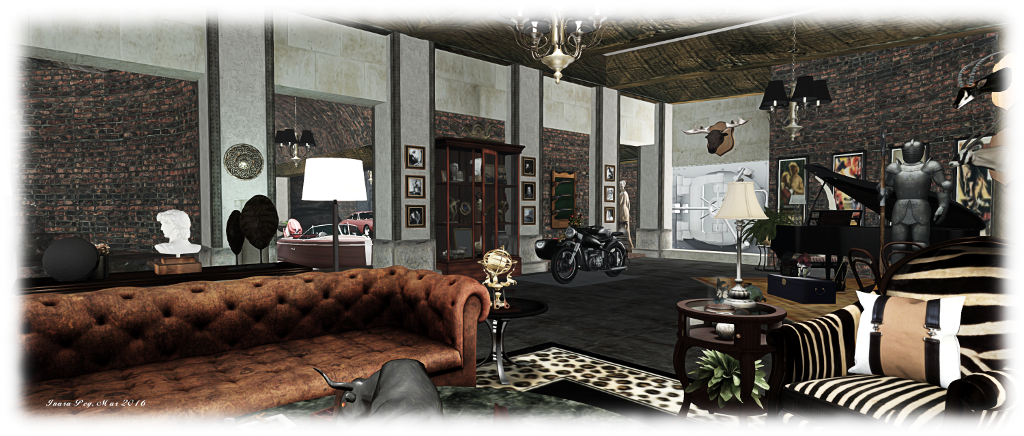
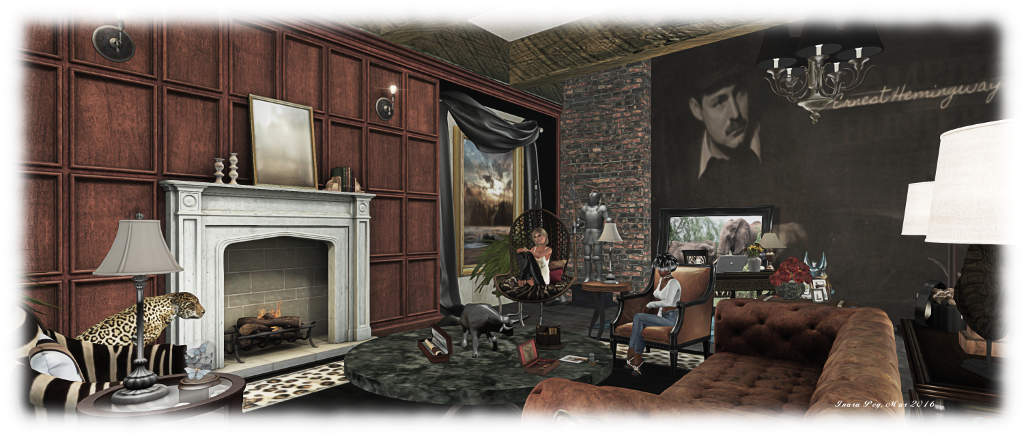
Residing under the grounds of a vineyard and winery, the “front door” to the build is cunningly hidden behind a secret door tucked away within a waterfront wine cellar, itself nested against the rocks of the vineyard island. Behind this, a brick-walled passageway leads the visitor to an underground lounge area. Comfortably furnished, this contains many nods and mementos to Hemingway, from the motorbike sitting against one wall, through to the posters of the film adaptations of his works, moving by way of nods to his love of hunting, enjoyment of cigars (and time in Cuba), photographs of the man himself, and more.
Adjoining this is a vaulted room, off of which sits a small bar area decorated in the manner of a gentlemen’s club. In both of these are more references to Hemingway – although some might be a little more esoteric. Is the model of the Titanic, for example, simply an adornment, or is it an oblique reference to Glenway Wescott, whom Hemingway unflatteringly presented through the character of Robert Prentiss in The Sun Also Rises, and once wished had perished, “with all his irk” in the Titanic disaster? Is the first aid cabinet a reference to Hemingway’s time as an ambulance driver in World War One?
Hemingway’s Wine Cellar
More obvious are the nods to Hemingway’s love of boats and fishing: tackle and rods are to be found, while on a wall hang images of Pilar, the fishing boat he acquired in 1934; and his love of the “occasional” tipple noted by the bar (and wine cellar setting).
There are further rooms to be found here as well. One of these, decorated in an oriental style, is hidden behind a further secret door, a tunnel leading from it back out to the sunlight and another nod to Hemingway’s love of sea fishing. Others are a little more obvious – such as the bathroom sitting behind the huge silver door normally found guarding a bank vault, while a bedroom, complete with a reminder of Hemingway’s time in Key West, Florida, can be found at the end of another brick walled passage opening of the main lounge area.
Hemingway’s Wine Cellar
Together with the above ground design of the island, this is another marvellous build by TracyLynne. Beautifully detailed, magnificently brought together and beautifully atmospheric, Caitlyn and I thoroughly enjoyed out time exploring.
Our thanks to Sommer for extending the invitation to visit, and allowing us to wander and enjoy the comforts of this hidden treasure.
One of the things I’m striving to achieve within this blog is ease of access to information, be it through the way I use categories and tags for posts or through the use of the available menu options within the blog’s theme.
This inevitably means that I reshuffle things every so often: rationalising tags, re-ordering categories and fiddling with the menus. I hope that such re-orderings help make finding information and topics in this blog easier as things grow, be it via category searches or through general searches or the tag cloud, or through the menus.
It is the latter in particular which I’ve revised. The work isn’t finished, as I’ll be adding, tweaking and moving things over the next few days as time allows, but I think there is enough there to offer the menu for people to try, if they’re so-minded 🙂 .
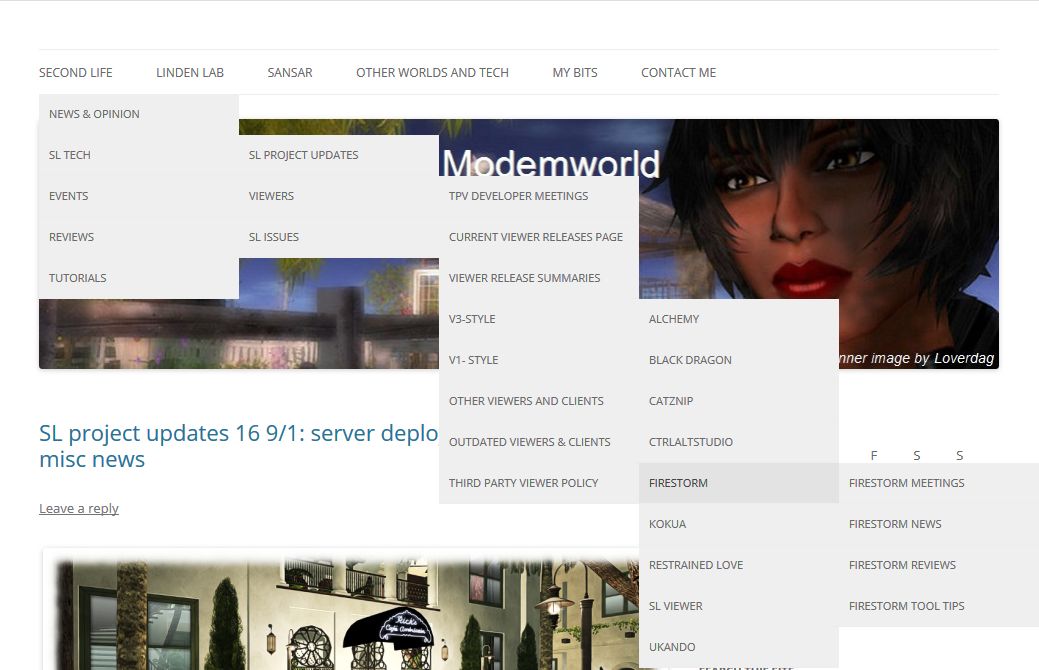
There are now six main headings to the menu, most of which should be self-explanatory:
Second Life: which covers all things directly related to SL, and has five sub-menu items:
News and Opinion – for news and views on Second Life;
SL tech – for all my weekly SL project updates, news and reviews of the viewers and clients I cover in the blog; and news on significant SL issues
Events – all coverage of the events I’ve previewed / reported on, arranged by topic ( Bay City, BURN2, VWBPE, RFL, etc,)
Reviews – all my art previews and reviews, my reviews of SL regions, Sl product reviews, etc.
Tutorials – (hopefully) useful tutorials I’ve written or found and had permission to reproduce here
Linden Lab: news, views and reviews more directly related to the Lab than purely about Second Life, including things like tier, Blocksworld, meeting transcripts, etc
Sansar: news (via the Lab or the media) on Project Sansar, plus my own speculations / thoughts
Other Worlds and Tech: my coverage of other virtual world environments, my AR and VR related reports, my space and astronomy items and any general tech news I cover
My Bits: the About Me bit, with personal notes on blogging and other assorted bits
Contact Me form.
Hopefully, the topics in the menus and sub-menus will make it easier to find things, whether it is specific information you want on a topic (e.g by selecting “Firestorm News” for just that topic or all the articles I’ve published on Firestorm by clicking the “Firestorm” menu item)
As with previous iterations of the menu note that:
Clicking the menu title will display all articles related to all of the sub-menus associated with that item. So if you Click “Sansar”, you will get both the “Sansar News” and “Sansar Speculations” articles
Similarly, clicking on a sub-menu option will display all the articles listed under that menu item, and within any sub-menu associated with it. So if you navigate to SL Project Updates (Second Life > SL Tech > SL Project Updates), and click on it, all on my SL project update reports will be displayed in newest to oldest order. However, if you navigate to the 2015 Updates sub-menu item, only my 2015 updates will be displayed
Clicking the blog banner will return you to the front page.
Hopefully, these changes won’t confuse those who have made use of the old menus, and will further assist people in finding information in these pages.
Casablanca: Rick’s Café Américain – “Of all the gin joints, in all the towns, in all the world, she walks into mine.” – blog post
Server Deployments
The Main (SLS) channel was updated on Tuesday, March 1st, with the server maintenance package deployed to the three RC channel is week #8. This comprises a server crash fix and “minor internal improvements.”
The server deployment thread lists any RC deployments for the week as “TBD”. however, speaking at the Simulator User Group meeting on Tuesday, March 1st, Simon Linden indicated it is unlikely there will be any RC deployment until week #10 (week commencing Monday, March 7th 2016). These will apparently have an update that addresses a means by which a simulator can be intentionally crashed.
SL Viewer
Currently, the official viewer from LL remain unchanged from the end of last week:
Current Release version: 4.0.1.310054, January 15 – formerly the Maintenance RC viewer download page, release notes
Release candidate viewers:
Maintenance RC viewer version 4.0.2.311655, dated February 26th
HTTP updates and Vivox RC viewer version 4.0.2.311302, dated February 22nd
Quick Graphics RC viewer version 4.0.2.311103, dated February 17th
Project viewers:
Project Bento (avatar skeleton extensions) version 5.0.0.310099, dated January 20th
Oculus Rift project viewer version 3.7.18.295296, dated October 13th, 2015
Obsolete platform viewer version 3.7.28.300847 dated May 8th, 2015.
OpenSSL Update
As noted in my last TPVD meeting notes, the Lab were awaiting an update to OpenSSL. This has now been released and there is minimal impact for SL. This therefore should require any fast-tracked update to the viewer.
Grid-wide Experiences
The simulator user group meeting saw a general discussion about allowing broader access to the Experience Keys database (the KVP) without land owners necessarily having to grant permission to specific Experiences.
The idea here is that there are applications which rely on persistent data or utilise grid-wide data exchange (e.g. a teleport network, a vending system network, etc.), and applications which require script settings survive the script reset. Currently, the way to achieve this is to use external data stores (see BUG-11499 for one example).
Some feel that if there were a way to dissociate the KVP database from things like avatar influences, then it could be used for such applications, removing the need for external data stores and the rick of those data stores vanishing / not being available. However, this is not something the Lab is particularly keen on, for a number of reasons. For example, it could result in their servers storing a lot of data and carrying a lot of database quires and updates, something that might not scale terribly well with volumes and associated storage space cost. Nor would it necessarily safeguard the data any better (if the Experience owner downgrades to Basic or ceases paying their Premium subscription, the data will be lost).
During the discussion Oz indicated that the Lab has no plans to make grid wide experiences available any time soon, due to concerns about how “certain internal features” would scale.
Krissy Sinclair: Virtual Worlds, Disability, and New Cultures of the Embodied Self, Ethnographia Island
In January 2016, I wrote about an interview with Tom Boellstorff (Tom Bukowski in Second Life), a professor of anthropology at the University of California, Irvine, and which appeared in that august body’s newsletter, UCI News.
WithinA (virtual) world without Parkinson’s, Heather Ashbach discussed Tom’s work, touching on the fact that it is now part of a National Science Foundation funded study examining how on-line environments affect social interaction and self-understanding as well as physical-world experiences of disability. Having commenced in July 2015, this study will run through run through until June 2018, and one element of the work is currently taking place in Second Life at Ethnographia Island. Jadyn Firehawk, one of the participating artists in the Ethnographia Island study, IM’d me about it, prompting me to hop over and take a look.
The formal title of the research at Ethnographia is Virtual Worlds, Disability, and New Cultures of the Embodied Self, and Tom is co-Principal Investigator alongside Donna Z Davis (Tredi Felisimo in Second Life), a strategic communications professor at the University of Oregon. Donna specialises in mass media & society, public relations, strategic communication, virtual environments and digital ethnography. The work they are undertaking focuses on the experiences of people with disabilities who are using immersive virtual spaces to represent themselves free of the shadow of any disability, and do things they may not be able to do in the physical world.
In their introduction to the work, Donna and Tom describe it thus:
Since some early human first picked up a stick to use as a cane, people with disabilities have been at the forefront of technology innovation. What can their creative uses of and adaptions to on-line social interaction teach us? The researchers will explore this question by studying how people with disabilities create and interact socially in virtual worlds, and how they use different kinds of devices in their homes to experience these on-line environments.
Donna Z Davis and Tom Boellstorff (Tredi Felisimo and Tom Bukowski in Second Life), co-researchers in Virtual Worlds, Disability, and New Cultures of the Embodied Self, supported by the University of California, Irvine; the University of Oregon; and the National Science Foundation.
Twenty 32×32 metre studio parcels have been made available to applicants with disabilities, who have been invited to share their experiences, insights, and thoughts on their disability: what impacts has it had on them in terms of their experiences, social interactions, dreams, and how have they used it? How have they used it to change their experiences living with that disability?
How applicants use their space has deliberately been left open, although some pointers were given as to how they might think about using it: for expression through 2D or 3D art, thought media presentations / displays, as a space in which they can develop art or expression through external media such as blogs, or the creation of interactive spaces designed to give others insight into their experience or as a game – or any combination of these ideas.
Jadyn Firehawk at her installation, Reconstructing Identity After Disability, Virtual Worlds, Disability, and New Cultures of the Embodied Self, Ethnographia Island
The result is a series of studies, widely varied in nature and content, some of which – such as Jadyn’s own Reconstructing Identity After Disability. This is a beautifully presented and moving story of how she has come to deal with her bipolar disorder after the condition left her unable to continue in her career as an assistant professor at the University of Texas, Austin, and how the use of virtual spaces in Second Life and the friends she has made here have empowered her creativity in both the digital and physical realms.
“When I sent in my application to participate in the project, I did not know yet what I wanted to build,” Jadyn says of the installation. “All I knew was, I wanted to create an installation that somehow represents the many-faceted, (re)enabled life that SL has made possible for me, but I had no idea exactly what I was going to build.
“I started looking back in my inventory to things that dated back to my earliest days in SL, and realised it essentially documents my entire time in SL. From that I got the idea of perhaps doing my build as a sort of museum exhibit, telling the story of my time in SL.”
Involvement in the project has been both cathartic and insightful for Jadyn, providing her with a clearer view of the last fifteen years of her life, the changes her condition has wrought and a understanding of ow she has come to terms with it.
Solas NaGealai chose to produce a 3D representation of Edmund Blair Leighton’s 1901 painting The accolade, allowing visitors to become a part of the setting, sharing in both her creativity and her love of nostalgia.
“I met Tom and Donna through the Parkinson’s disease support group at Creations Park four years ago, and I’m thrilled to be taking part,” Solas NaGaelai says of her involvement in Ethnographia. “Not just for the creative aspect but to be amongst others that have disability. I have a hunger for learning and adapting, and from what I see so does each individual involved in the project. The insight of dealing with their life challenges to me is a very enlightened experience, and helpful one.”
Solas was diagnosed with a particular form of Parkinson’s Disease known as Young Onset Parkinson’s Disease (YOPD) – the same form of the disease which struck Michael J. Fox. When first diagnosed, she was a full-time fashion designer. However, as the illness progressed, she was forced to leave that career behind. Fortunately, her discovery of Second Life provided Solas with a means to re-engage in her passion for design, notably through her Blue Moon Enterprise label.
For her piece, Solas has created a model based on Edmund Blair Leighton’s 1901 painting The Accolade. It’s an interactive piece in which visitors will be able take free costumes she has designed and dress as either the queen or the knight and take their places within the scene. As such it reflects both the creative freedom Solas has found in Second Life, and offered her the mean to present visitors with the opportunity to share in her love for a bygone era, as depicted by Leighton and his peers.
Slatan Dryke: Virtual Worlds, Disability, and New Cultures of the Embodied Self, Ethnographia Island
Virtual worlds, as Tom and Donna note, are just a part of the much larger domain of internet technology and on-line presence which we can use to define ourselves and potentially reach beyond our personal limitations, whatever form they may take. But studying the “whole” of the digital environment really isn’t that possible; as such, smaller scale studies like Virtual Worlds, Disability, and New Cultures of the Embodied Self allow researchers to focus down on smaller communities and groups and investigate specifics.
Through it, and the involvement of those participating in it, both Donna and Tom are confident they will be able to present a better understanding about how new on-line technologies influence how we think about our bodies, how we think about social interaction, and how we think about the role of the internet in everyday life, all of which will have implications for improving health care and social support for people with disabilities.
Visitors are welcome to tour the installations, and I recommend taking a look at the accompanying website when doing so – the links are given again below for convenience.
STOP PRESS NEWS
Having opened its doors in November 2015, Ethnographia Island had originally been set to run through until March 2016. However, as I worked on this article, Tom and Donna were in discussions concerning additional funding for the work.
On Friday, February 19th, they were able to tell me that the funding had been confirmed, and that as a result, Ethnographia Island is set to double in size with the addition of a second region.
“This means not only more spaces for individual disabled folks to have parcels for some creative building, but also some larger, collaborative parcels where groups of people with disabilities can let their imaginations run free!” Tom said as they passed on the news to me.
So, if you have a disability of any kind and would be interested in a parcel, please IM Donna (Tredi Felisimo in SL) or Tom (Tom Bukowski in SL), or email them at dzdavis@uoregon.edu or tboellst@uci.edu. They would love to have you participate!
“I create in Second Life for my own amusement, things for photos, things to adorn my avatar with, things just to see if I can,” Zib Scaggs says of her work as a creator and photographer. “I share many of those creations with others who adorn their avatars and take their own photos too. Simple enough.”
Simple it may be, but it is also something that has led to Zib becoming the latest artist to be invited to exhibit her photography at Dathúil Gallery, operated by Max Butoh and Lυcy (LucyDiam0nd). Entitled Slow Motion Riot and a Nude, the exhibition opens on Thursday, March 3rd at noon SLT, and will run through until the end of the month.
“The images,” Zib says of the exhibition, “are of those things I have made, or avatars I adorn.” She also notes that she doesn’t look for hidden messages or nor deeper meanings in life or art.and doesn’t hide them in her own work. Thus, Slow Motion Riot and a Nude presents a series of images, some in muted colours and tones, some black-and-white, which should be interpreted exactly as the eye sees them, and not with any idea that there is a particular story or nuance behind them.
Sitting between the images are little behatted zebras in ones and twos (and which also feature in one of the images in the exhibition). When touched, these will offer the visitor a little gift created by Zib, and which may be one of the items featured in the pictures around the gallery.
Given the artist’s statement about her work, I’m loathe to say too much on it, lest I perceive meanings which aren’t intended to be there. What I will say, however, is that each of the pieces offer at Dathúil is both intriguing and eye-catching; when taken together, they present another exhibition which should not be missed.
As noted towards the top of this piece, Slow Motion Riot and a Nude officially opens on Thursday, March 3rd at noon SLT, and runs through until March 30th.








 Inara Pey: Living in a Modemworld