There were many remarkable space images published throughout 2015. However, perhaps one of the most memorable came at the end of the year, and coincided with the release of Disney’s Star Wars: The Force Awakens. Captured by the Hubble Space Telescope, the image was immediately dubbed by the media as the “cosmic lightsaber” due to the manner in which part of the image resembles the double-sided lightsaber used by Darth Maul in an earlier Star Wars film.
It shows a new-born star laying within a cloud of dust, which is shooting out two beams of light from its poles and which seem to cut through the surrounding material and space.
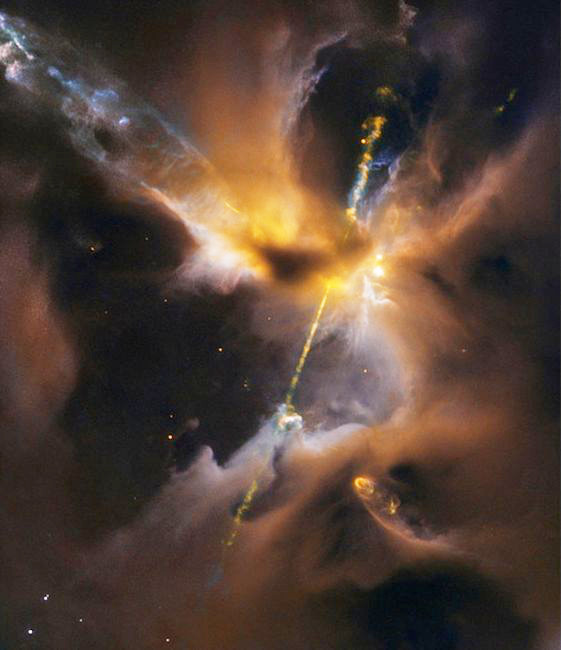
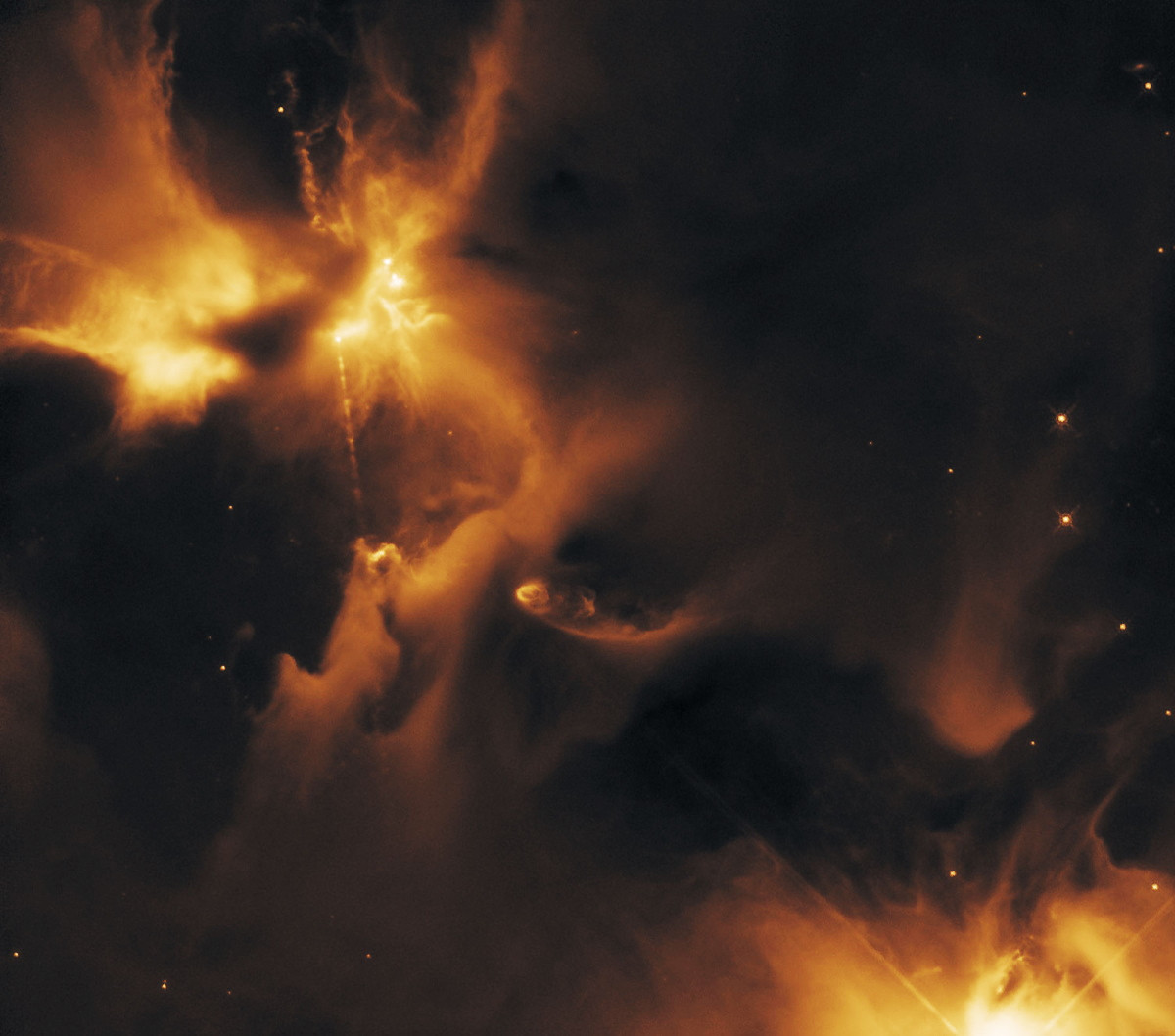
The beams are no optical illusion, but the result of material from the surrounding dust cloud falling into the star, only to erupt into supersonic jets of material ejected up through the star’s poles and into space. As the jets travel outwards, so they encounter other dust and material, and distinctive arced shock waves form within the “beams”, which gradually give rise to knotted clumps of material called Herbig-Haro (HH) objects, and are ubiquitous in star-forming regions, although they are relatively short-lived in astronomical terms.
Given the nature of the HH object seen by Hubble (officially designated HH24), it is thought that the star causing it is very young – just a few thousand years old. It lies in a “stellar nursery” some 1,350 light-years away “in” the constellation of Orion, and which has one of the highest concentrations of HH objects yet found in our galaxy.
Monkeys to Mars?
There is a mounting effort to see humans set foot on Mars some time within the next 25 years; however, Russia is apparently set on getting “crew” to Mars by 2017, in the form of four macaque monkeys.
The simians have been selected on the basis of their cognitive and learning abilities, and have been undergoing 3 hours a day of training for a possible flight to Mars, with news of the proposal first reaching the public domain in October 2015. The training is has been taking place at the Institute of Biomedical Problems in Moscow, and initially comprised training the monkeys to operate a joystick system to “shoot” targets on a screen, as indicated by a cursor. Successful “hits” saw the monkeys rewarded with a sip of juice.
This has been followed by training the monkeys to solve simple puzzles and mathematical problems. “What we are trying to do,” Inessa Kozlovskaya, responsible for the team training the monkeys, “is to make them as intelligent as possible so we can use them to explore space beyond our orbit,”
The Russian plan is to send the monkeys on a six-month voyage to Mars, during which their heath and ability to function during a prolonged stay in zero gravity conditions will be assessed, together with their exposure to cosmic radiation. However, Russian officials have refused to indicate whether the mission will include a return trip to Earth.
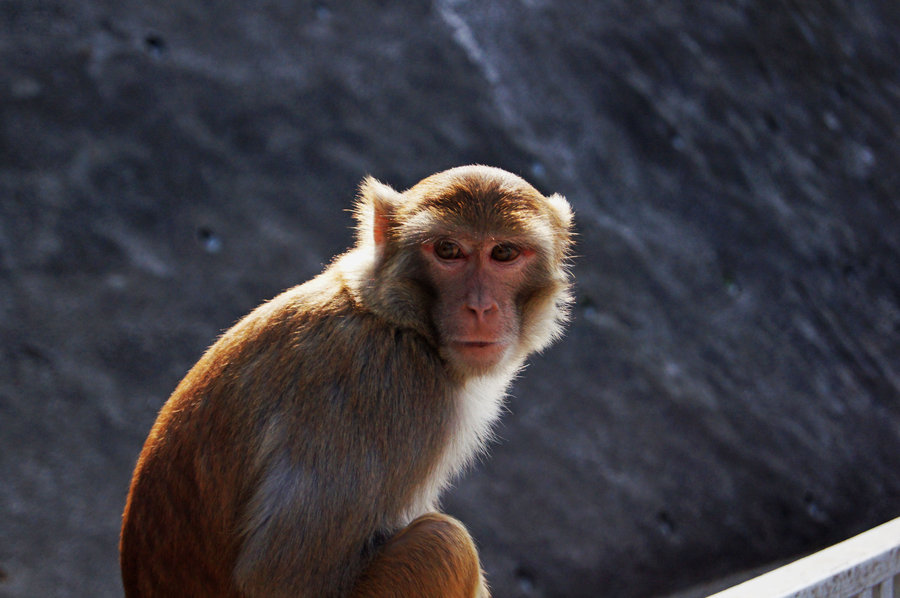
Sending animals into space isn’t new. The very first animal to enter space was in fact a rhesus macaque called Albert. He flew a short-duration ballistic flight atop a US V2 in 1948, but died of suffocation mid-flight. His successors were no less fortunate. Alberts II, and IV were killed on impact when their capsule parachutes failed to deploy, and Albert III died when his V2 exploded on the edge of space.
Continue reading “Space Sunday: cosmic lightsabers, monkeys to Mars and junk in orbit”



 Inara Pey: Living in a Modemworld