Xin is the home region for the store of the same name, a place I was drawn to it after seeing images by Goizane Latzo. It is one of a number of regions which have taken a theme of disaster / apocalypse as a theme – perhaps the most notable (in terms of bloggers) being Sera Bellic’s The End of the World As We Know it, which I visited last month, although I’ve yet to blog about it.
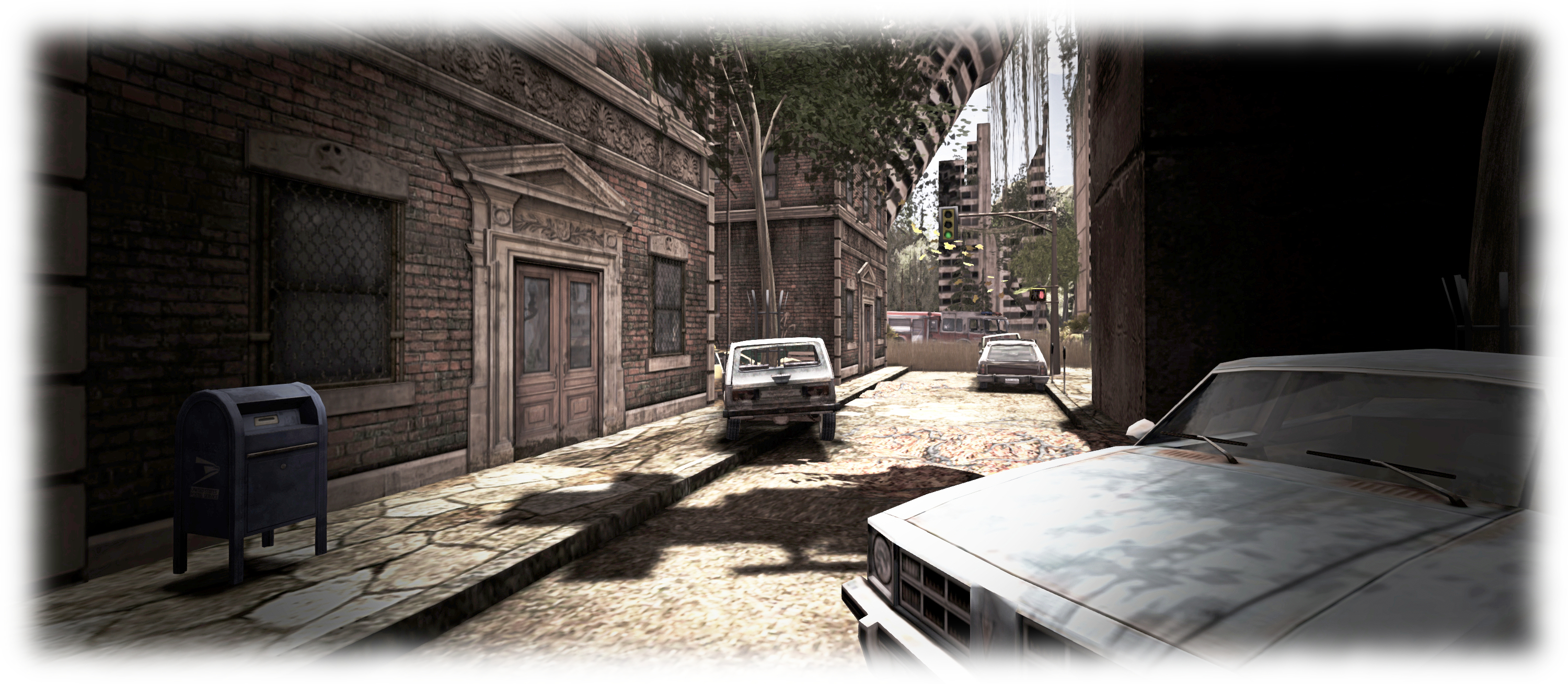
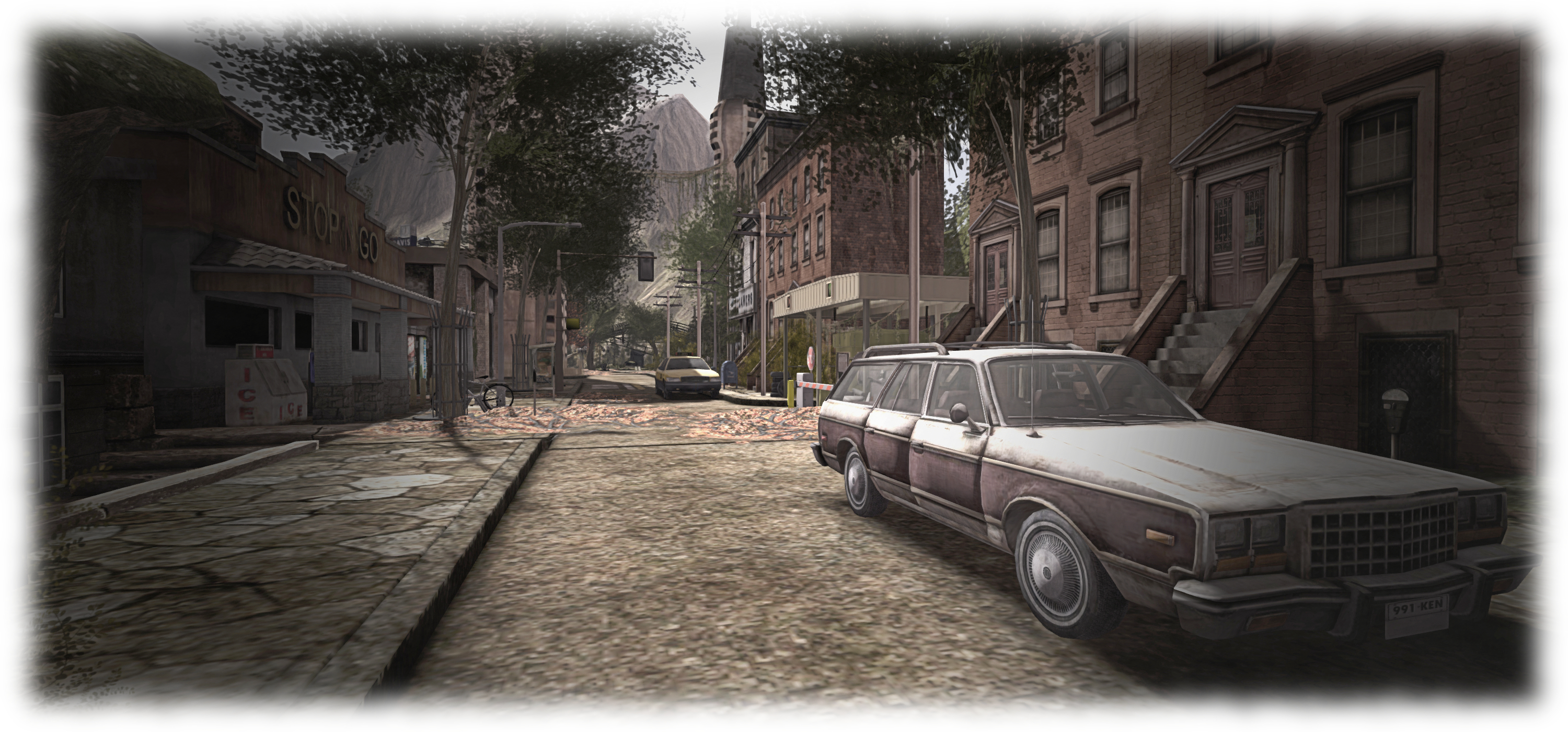
In the case of Xin, designed and built be Alice Pvke (although apparently, ” Jaix helped for like nine seconds”! 🙂 ) it’s unclear as to precisely what has happened; the arriving visitor is presented with a town surrounded by mountains, and which is in a state of ruin. High-rise building stand broken or have toppled over to crash into their neighbours, while down below, the streets are slowly decaying, and the local freeway overpass is in a state of collapse.
Has there been an earthquake or some other natural disaster? Or is the destruction the result of a war or some other man-made catastrophe? Whatever the cause, it would appear it left the local citizens in a state of turmoil; while the streets are now deserted, there are signs of city-wide violence; vehicle sit riddled with bullets, and even one of the city’s fire trucks appears to have been the target of deliberate assault, its once pristine bodywork battered and dented, its windscreens and side windows smashed-in.
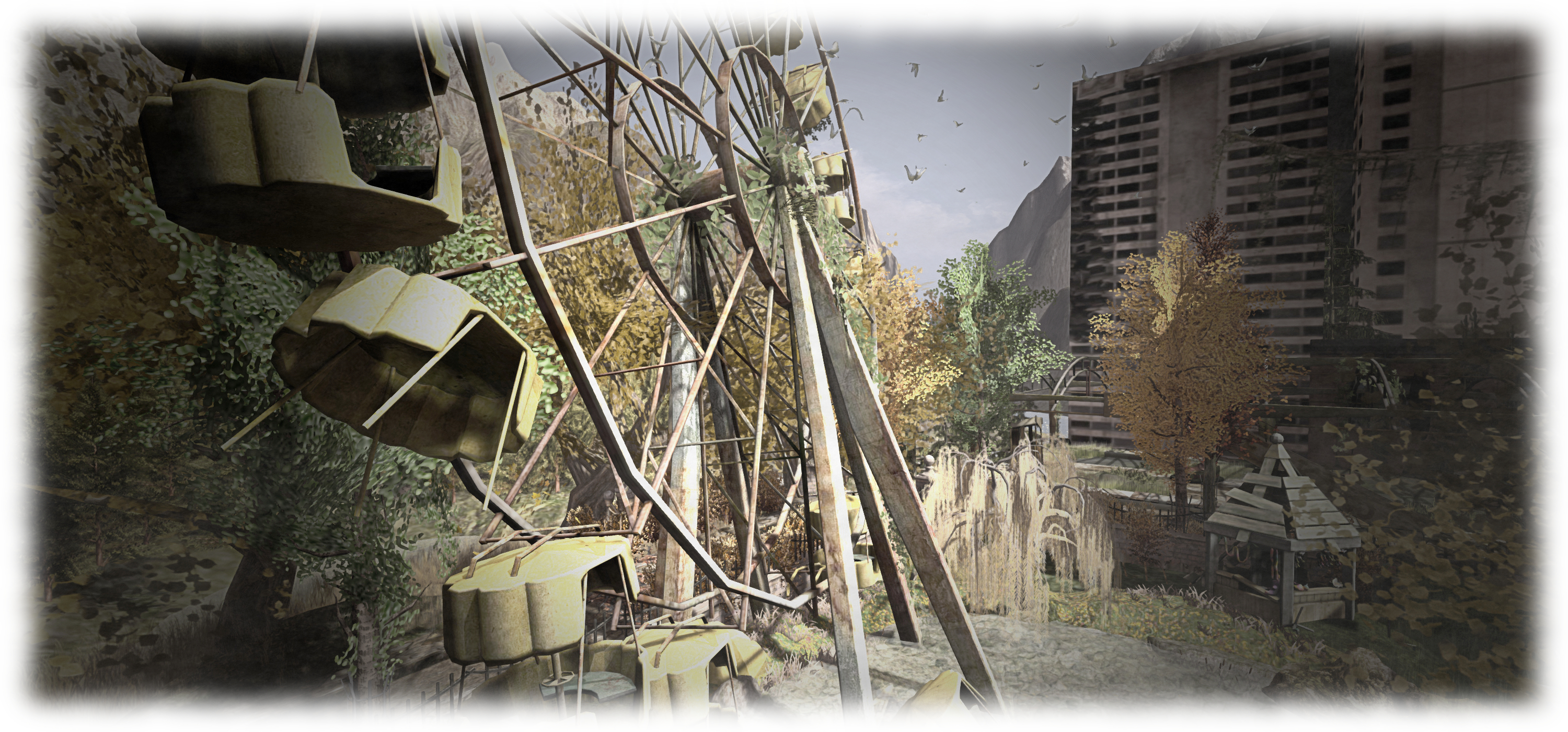
Across town sits an old amusement park, the bumper cars sitting pathetically amidst the ruin of their track, while a once proud Ferris wheel lies broken across the street, its cars sitting in a jumbled heap.
Everything about this town speaks to a once thriving metropolis; now humanity appears to have fled, and slowly, but surely, nature is gradually reclaiming the neighbourhood. Grass, the seeds of which no doubt carried by the wind, has started to lay claim to the flat roofs of some of the smaller buildings, while vines and creepers climb the sides of others, and to spread themselves along the old power lines that connect some of the skyscrapers. The streets themselves are starting to crack and break-up as roots and grass force their way up through ever-widening gaps in the ageing tarmac.
For those seeking an atmospheric backdrop for photos, Xin might provide a useful option – although admittedly, rezzing is disabled. Those looking for the store should take a look underground near the landing point.
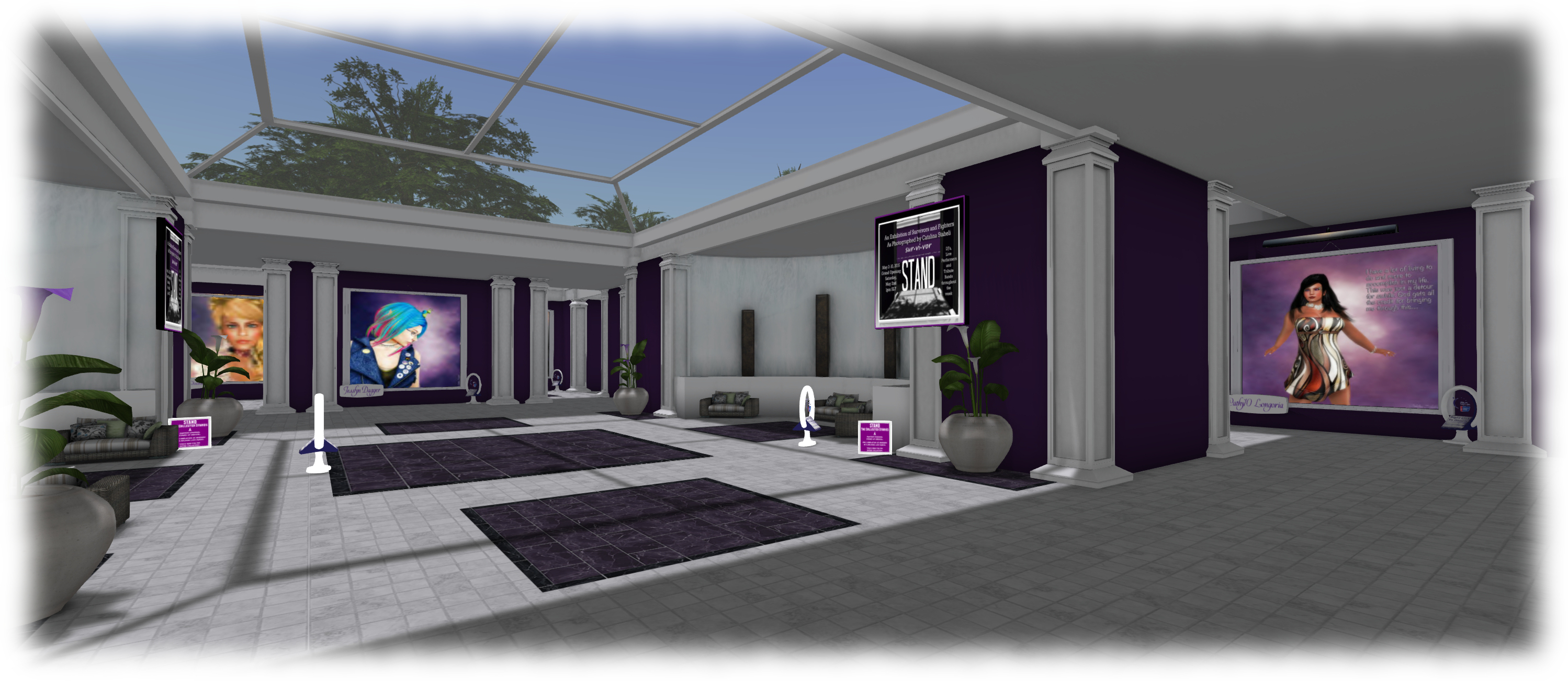
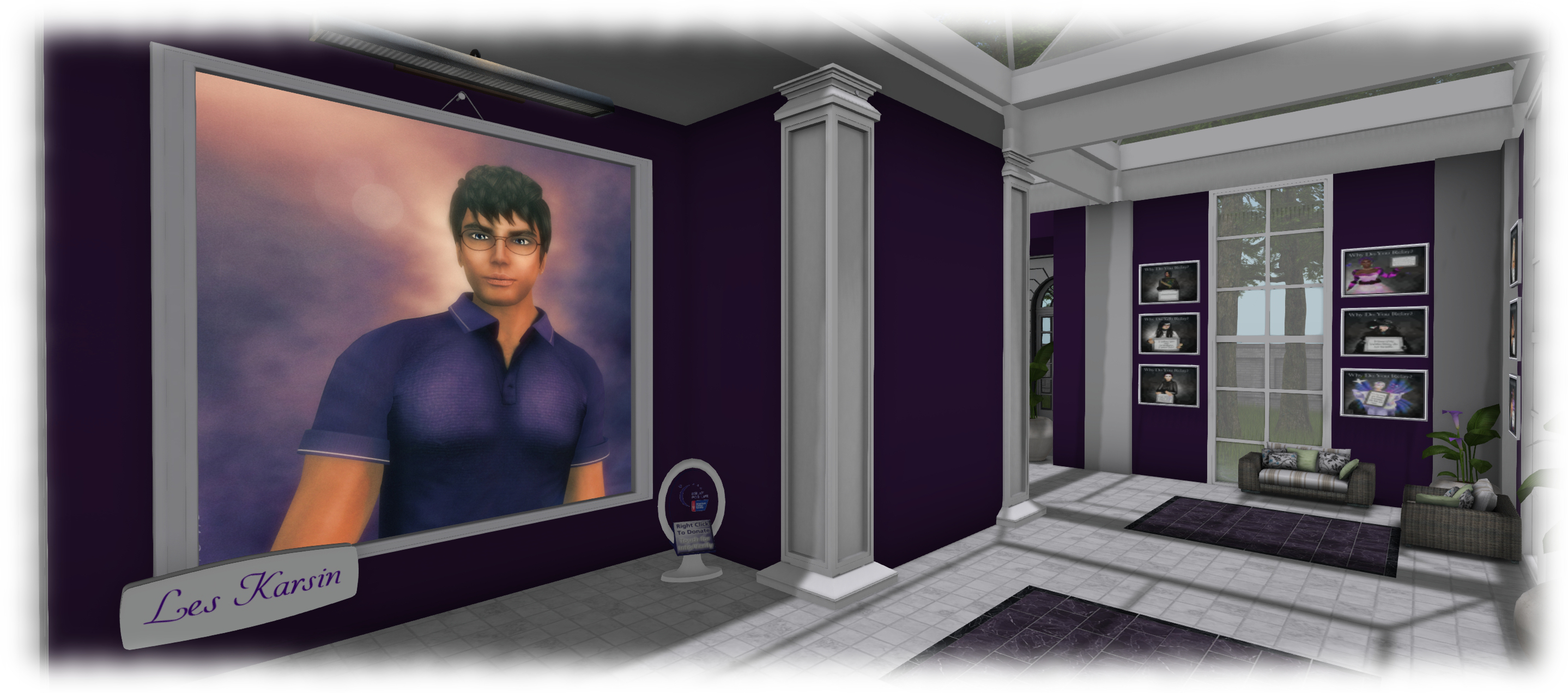
Stand is the title of a portrait exhibition currently open in a purpose-built gallery above the Relay Rocker’s Relay d’Alliez region and a part of Rocker’s Relay for Life campaign.
The portraits, all of which have been taken by Catalina Staheli, feature some of those who have been faced with cancer in one of its many forms and have either survived, or are living within its ever-present shadow – and in one case, someone who lost their life to the disease.
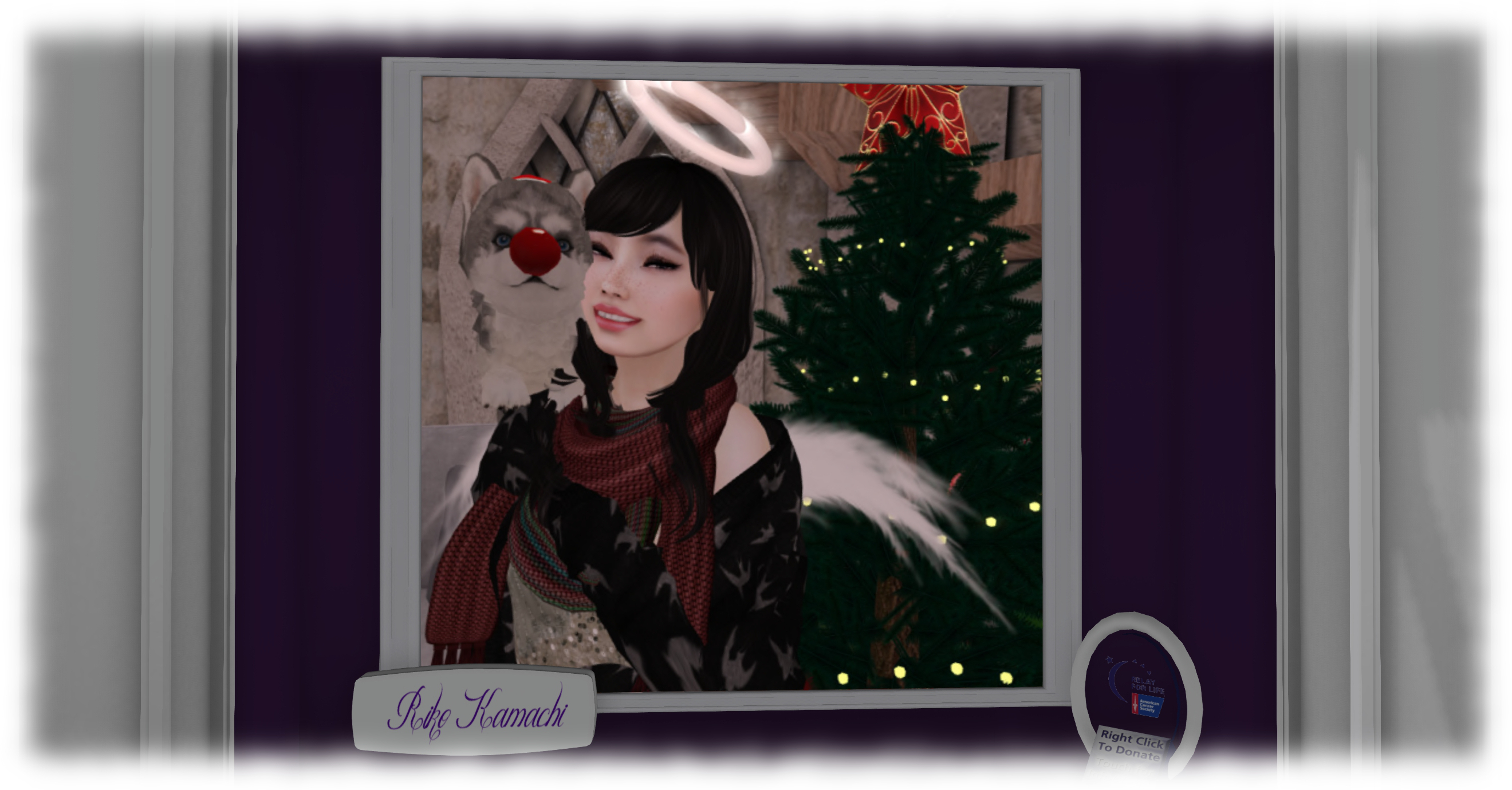
Each of the pictures features several images of the subject, which change every 30 seconds to show them in different poses (and even different forms, if they use more than one avatar in SL), with one image of each of them offering a quote.
Each of the framed portraits is displayed in its own space or alcove, allowing visitors to focus solely on each in turn without distraction. In addition, those featured in the portraits have each written a brief personal story, which offer moving reading, and can be obtained through the information givers found within the gallery space along with RFL kiosks for those wishing to make donations to RFL of SL and the American Cancer Society.
Taken together, the portraits and the gallery space – also, I believe, designed by Catalina – present a moving and inspirational exhibition, and full kudos should go to her for developing the idea for the exhibit and for producing such remarkable pictures. Thanks, as well, should go to the Relay Rockers for agreeing to host such an exhibition; even though there were some misgivings at first, as Trader Whiplash, the Rocker’s Co-Founder, freely admits.
“As always I asked the same question I have asked of the Relay Rockers for 11 years,” he said. “How much work it involved and how much will it raise? The answer was unclear. We weren’t even sure it would raise any money at all! We talked for a few days. We met resistance in several directions from the team, including myself.”
“I was however wrong,” he added with a laugh. “I totally underestimated the importance of this event. This exhibition not only captures the essence of survivorship, it celebrates our diverse community here in Second Life and does much to explain how a virtual world can become the seventeenth largest Relay For Life in the world!”
Also on display in the gallery are some of Catalina’s Why I Relay challenge, which was also featured at this year’s Fantasy Faire. The challenge offered anyone supporting RFL of SL with the opportunity to have their photo taken by Catalina, together with a short message on why they participate in RFL.
This is a remarkable, inspirational and poignant exhibit; inspirational in the stories that are to be found here, and poignant through the presence of the portrait set of Riko Kamachi, one of the early participants in the exhibit, but who sadly lost her life to cancer before she could provide her story. Instead, she is remembered here in pictures and in the words of those who knew her.
Stand, will be open through until the end of the RFL Weekend on Saturday 18th and Sunday 19th July 2015, and I urge you to find the time to pay a visit; it beautifully encapsulates and spirit and meaning of Relay for Life of Second Life.
On Saturday, May 23rd, NiranV Dean released version 2.4.2.5 of his Black Dragon viewer, which brings with it three core updates:
Revisions to the Unified Snapshot floater
An experimental cinematic camera
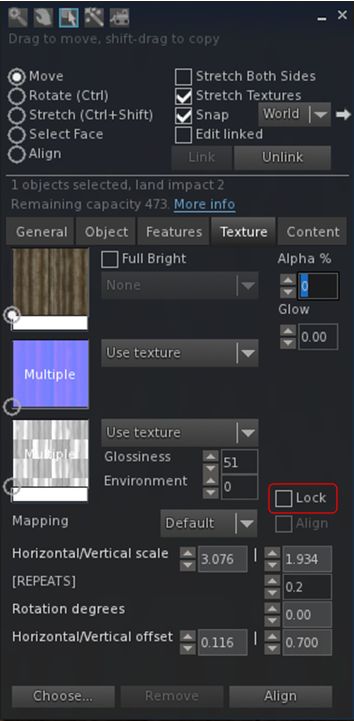
A “lock” feature to synchronise map changes (diffuse, normal and specular) across all three channels simultaneously.
Unified Snapshot Floater Updates
The snapshot floater updates include:
An option to save the snapshot upload type
Automatic file format changes when switching to profile/inventory upload and back
Fixes for auto-refresh
Improved world freeze – the entire world is now frozen, and allows proper camming around.
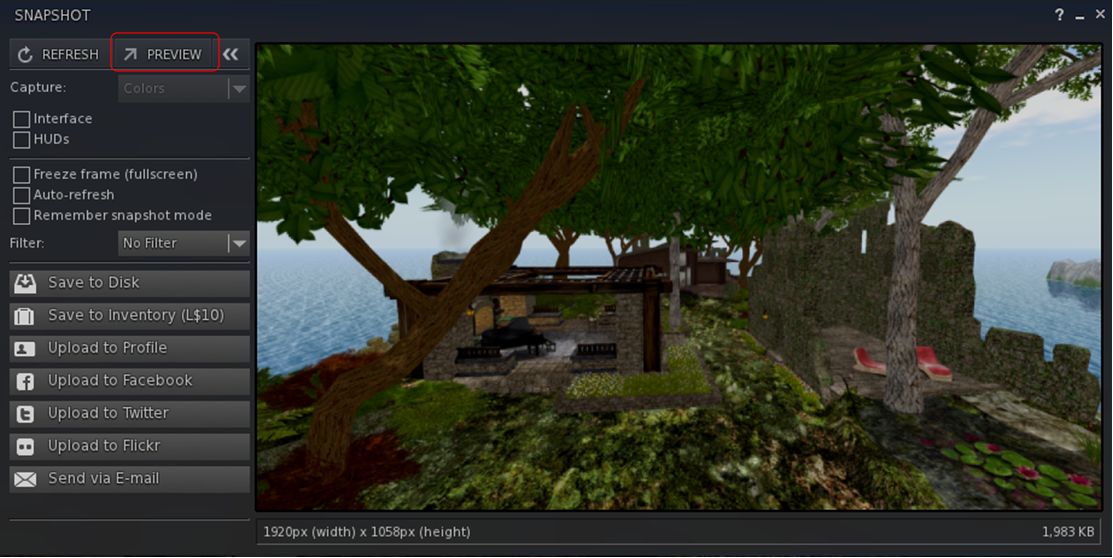
However, what is likely to find favour with a lot of users (assuming it is adopted by other viewers, including LL’s) is the ability to now preview snapshots in a separate, resizeable texture panel.
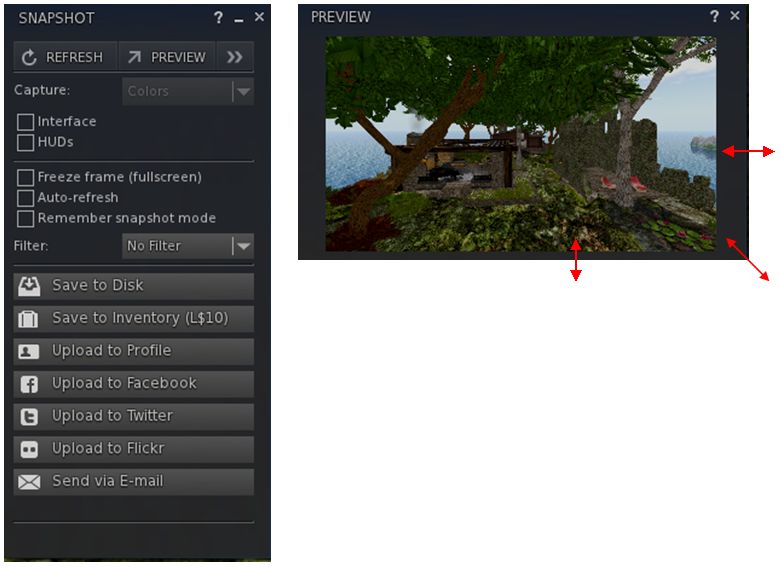
The alternative snapshot preview panel can be accessed via the Preview button in the Unified Snapshot Floater
This is enabled by a new Preview button in the snapshot floater, as shown above. However, do note that this does not “tear off” the existing preview pane, but actually opens a separate panel, linked to the floater – the original preview pane will remain open as well, until such time as it is closed using the << button at the top of the snapshot floater. Also, as it is a separate panel, the resizeable preview panel must also be closed separately to the snapshot floater.
Once opened, the alternate preview panel can be resized by dragging from the sides, the top or bottom edge or from the corners to more readily suit your requirements. note also that in doing so, the image will retain the correct aspect ratio.
The additional preview panel can be resized via dragging from the top / bottom / sides / corners
I did encounter a slight problem with the updated snapshot floater – not with the new preview panel, but in the fact that the floater appears to be locked into saving images to disk in PNG format without my having changed any install defaults. On selecting either JPEG or BMP, the floater defaulted back to PNG.
Cinematic Camera
The Cinematic Camera is an experimental option, enabled through a debug setting, UseCinematicCamera. The camera will track head movements as you move – and is most effective if you’re using one of the Black Dragon over-the-shoulder third-person views. You’ll need to ensure your avatar’s head movement is free to follow the mouse as well.
If I’m honest, I didn’t have too much success playing with it – but that could easily be down to me doin’ it wrong. However, Niran has provided a video which may help to demonstrate things:
Texture Sync Lock
The “Lock” option on the Texture tab of the Build floater operates in a similar manner to the Synchronise option found in the official viewer. When set, it ensures that changes made to the spinners for repeats, offsets and rotation on a texture are applied across all three materials maps.
This allows the viewer to use a single set of spinners for adjusting offsets, etc., against a set of maps applied to a surface / object and ensures they are applied across all three maps correctly.
Niran also provides some advice when using the Lock capability:
Note that this might cause the spinners and/or faces to revert sometimes, this is NORMAL behaviour, it’s due to lag which was already present long before this change (sadly). Usually happens if you use the spinners via mouse repeatedly, to prevent it most of the time you should type in your desired values directly and press enter ONCE then wait a bit.
Feedback
An interesting set of updates, and the ability to use a resizeable preview panel for snapshots could fine some popular support given some people have found the default preview panel size in the Unified Snapshot floater to be overwhelming. As such, it’ll be interesting to see how the Lab and other TPVs option to implement this particular change or not (I understand Niran will be contributing the updates to LL, if he has not already done so, as he did with the original Unified Snapshot floater code).
Note also that as well as the features outlined above, this release includes a number of fixes, updates and changes – please refer to the release notes for details of these.
Updates for the week ending: Sunday, May 24th, 2015
This summary is published every Monday, and is a list of SL viewer / client releases (official and TPV) made during the previous week. When reading it, please note:
It is based on my Current Viewer Releases Page, a list of all Second Life viewers and clients that are in popular use (and of which I am aware), and which are recognised as adhering to the TPV Policy. This page includes comprehensive links to download pages, blog notes, release notes, etc., as well as links to any / all reviews of specific viewers / clients made within this blog
By its nature, this summary presented here will always be in arrears, please refer to the Current Viewer Release Page for more up-to-date information.
Attachment fixes RC viewer (Project Big Bird) updated to version 3.7.29.301943 on May 21 – core updates: a number of fixes for various attachment issues (download and release notes)
Black Dragon updated to version 2.4.2.5 on May 23rd – core updates: updates unified snapshot floater; experimental cinematic camera (release notes)
Restrained Love updated to version 2.9.10 on May 19th, and then to version 2.9.11 on May 25th – core updates: bug fixes (release notes: 2.9.10 and 2.9.11)
Obedience is a new, mixed-media installation at the Jüdisches Museum, Berlin, created by Saskia Boddeke (Rose Borchovski in Second Life) and Peter Greenaway, which has an interesting cross-over with our virtual world.
The installation takes as its theme the story of Abraham and Isaac; a story which raises questions which are addressed differently by the three major religions – Jewish, Islamic and Christian – in which it can be found.
As the tale goes, Abraham is commanded by God to offer his son in sacrifice as proof of his devotion. Thus, the first question is framed: which is the stronger – devotion to the will of God, or the love of a father for his son? Within this sits a second question, one which holds relevance to us all today regardless of our religious leanings: which is the more important to us – obedience or trust, and where can the balance between the two be found?
Obedience seeks to explore these issues by leading the visitor through fifteen rooms in which Boddeke and Greenaway retell the sorry using a variety of mediums and approaches. In doing so, they offer a means of taking the narrative apart, creating emotionally charged scenes and vignettes which focus the visitor’s eye and thoughts.
The cross-over with Second Life comes via a special installation created by Bryn Oh and Jo Ellesmere at LEA 1, also entitled Obedience.
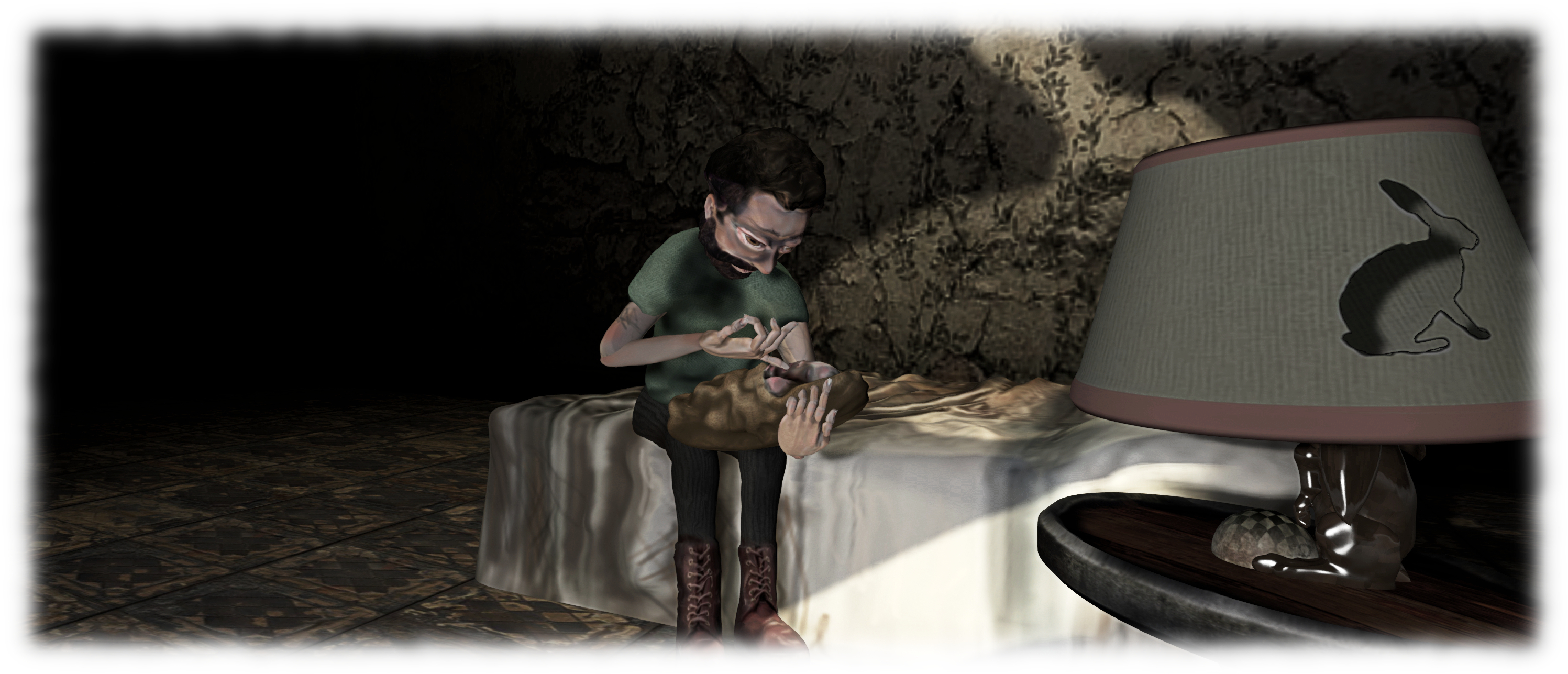
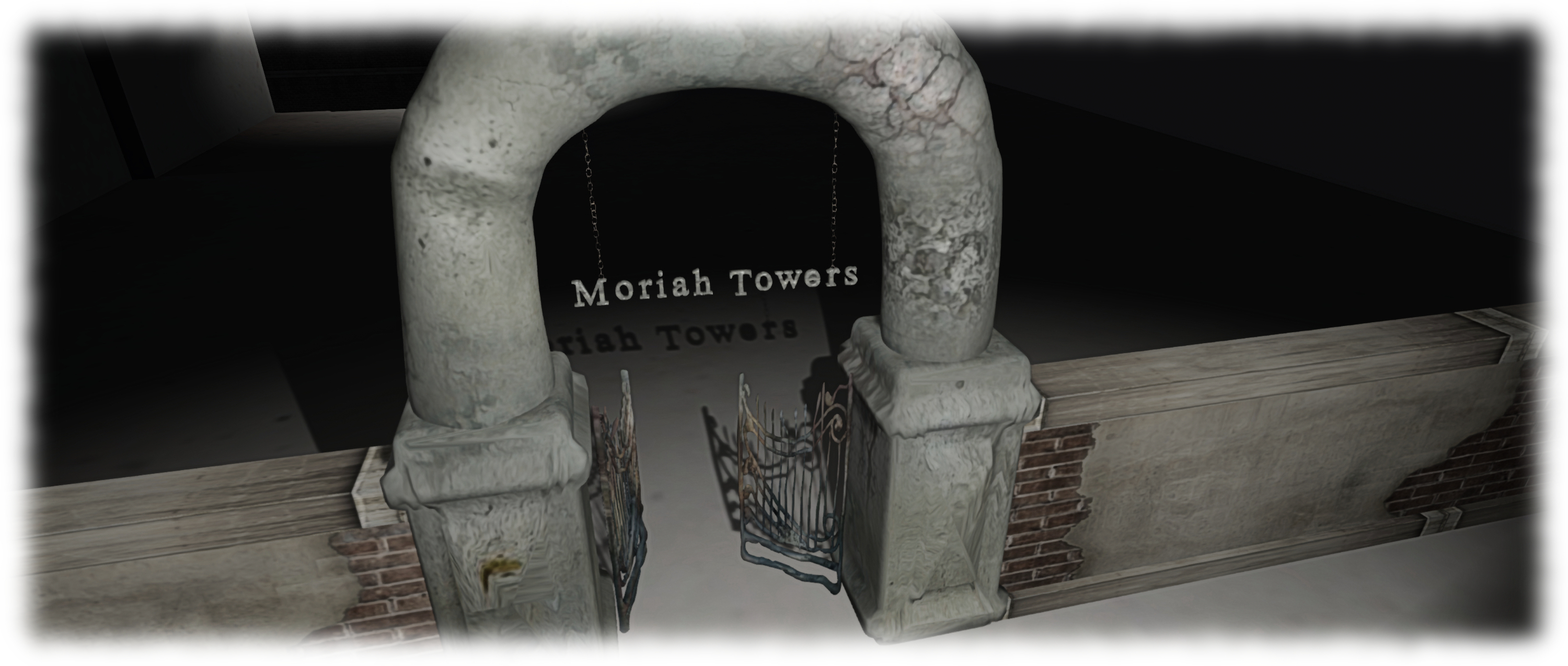
As with the exhibit at the Jüdisches Museum, visitors to the LEA 1 installation are encouraged to explore a series of “rooms” in which the story of Abraham and Isaac is presented through a set of distinct vignettes, all of which are given a contemporary turn – Abraham, see initially as a doting father, appears to hear the Voice of God through his television, for example, while the mountain range of Moriah from the Book of Genesis becomes a series of tall buildings called Moriah Towers.
Obedience, LEA 1: Abraham obeys the Voice of God, taking his young son out…
“This is a very important exhibition in that it is a high profile use of Second Life as an artistic medium and its mere presence within a museum of this calibre legitimises the virtual space as an art medium for some, who before now may not have associated it in this way,” Bryn states in her own introduction to the LEA 1 installation and its link to the Berlin work. “Credit for this should be given to both Saskia and Peter who are staunch supporters and believers in this medium, they could easily have created the work without using the virtual space yet pushed the idea on the Museum directors and have them interested as well. ”
The link comes not only in the presentation of the Abraham and Isaac story individually in the physical and virtual spaces, but also in fact that the virtual environment we can explore at LEA 1 is being shown on monitors within the Museum, and visitors there have the opportunity to to join us in-world and explore the installation here; through the use of two avatars, isaak001 and ishmael001. So if you see either of them wandering through the LEA 1 space, do keep in mind they are visitors to Second life from the Jüdisches Museum.
The story of Abraham and Isaac is not an easy read, and by bringing the story into a modern setting, Bryn underlines some of the more uncomfortable elements within it, whilst also drawing attention to the broader question of obedience and trust. It also raises an further uncomfortable questions, which I’ll come to anon. In terms of obedience and trust, the contemporary approach taken here offers potentially broader interpretations than the purely Biblical.
Take Abraham’s hearing the voice of God through his television. Here there seems to be a question lurking as to our relationship with the media upon which we rely; just how far can it be trusted? And what if it – say, as a state apparatus – demanded obedience? There are other possible subtleties here as well, such as the Lovecraftian nature of the chair in which Abraham sits, which seems to open doors into other lines of thought.
Nor does Bryn doesn’t stop short on showing Abraham’s willingness to sacrifice his son, either. This scene takes place atop of the aforementioned Moriah Towers,s and is brutal in its and terrifying in its vivid portrayal, despite God’s intervention, Abraham’s faith and trust having been demonstrated.
However, this is not the most powerful and poignant scene in the series. That comes last of all – providing you take the time to locate the teleport to reach it. Bryn carries the story forward in what, to me, is the most poignant scene of all. Here we see the aftermath of events. Abraham may well have proven his faith in God, but he has betrayed the trust of his son, who cowers against a wall, terrified. “What happens once Gods presence has withdrawn after testing Abraham’s faith?” Bryn asks, “How might the moments go when Abraham and Isaac are now alone and words are needed to explain?”
Since my last Space Sunday update, NASA’s Curiosity rover on Mars has experienced successes to overcome some setbacks, major and minor.
The major success came in the form of what amounts to “corrective eye treatment” for the rover’s famous laser system, which has been zapping rocks and soil hundreds of thousands of times in order to analyse the resultant plasma, and thus understand the chemical and mineral composition of the target material.
Called ChemCam, the Chemistry and Camera instrument, actually comprises a laser system and a telescope / camera connected to a spectrograph. The laser is in fact two systems in one, a primary laser, used to “shoot” targets and generate the plasma, and a smaller rangefinder laser used to accurately focus the telescope camera on the intended target. However, several months ago, this rangefinder laser suffered an unrecoverable failure.
Since that time, the ChemCam team have had to rely on taking multiple images of a target rock at multiple focal lengths in order to determine the best focal length the telescope should use when the main laser is set to fire.
The ChemCam mast element on Curiosity, showing the main telescope aperture, at the centre of which sits the laser “barrel”
The problem here is that the images had to be taken, transmitted to Earth and then assessed by a team of scientists to determine the best focal length setting for the telescope, which then had to be transmitted back to Curiosity, which then had to make the required focal adjustments. Only then could the main laser be successfully fired and accurate images for analysis obtained by the telescope. Obviously, all of this is a very protracted process compared to the rover being able to automatically focus the telescope directly.
However, as a part of a recent software upload to Curiosity, the international team responsible for ChemCam were able to install an update that has resorted Curiosity’s ability to auto-focus the ChemCam telescope. Now, instead of having to send a series of images to Earth for analysis, the rover can simply run the images taken at different focal lengths and then run them through an on-board algorithm which then selects the optimal focal length for the telescope, allowing the laser firing to proceed.
A series of test firings using the new software were carried out on Thursday, May 21st, and the results weren’t only positive – they indicated the new, software-driven auto-focus technique actually yields better quality results than the original method.
The second success for Curiosity actually has its origins provide to my last Space Sunday report. As indicated at that time, Curiosity was attempting to reach a point dubbed “Logan Pass”, an area sitting at the head of a series of shallow valleys and marked by the confluence of two different types of rock.
At the time of my last report, Curiosity had already been diverted from the original route selected for getting to the target. Images of the route revealed it in part comprised what NASA calls “polygonal sand ripples”, which can cause the rover to suffer extreme traction difficulties and wheel slippage. As a result, a decision was taken to attempt the ascent to the desired science location via slightly rougher terrain; it didn’t work out.
“Mars can be very deceptive,” said Chris Roumeliotis, Curiosity’s lead rover driver said of the attempt. “There appeared to be terrain with rockier, more consolidated characteristics directly adjacent to these ripples. So we drove around the sand ripples onto what we expected to be firmer terrain that would give Curiosity better traction. Unfortunately, this terrain turned out to be unconsolidated material too, which definitely surprised us and Curiosity.”
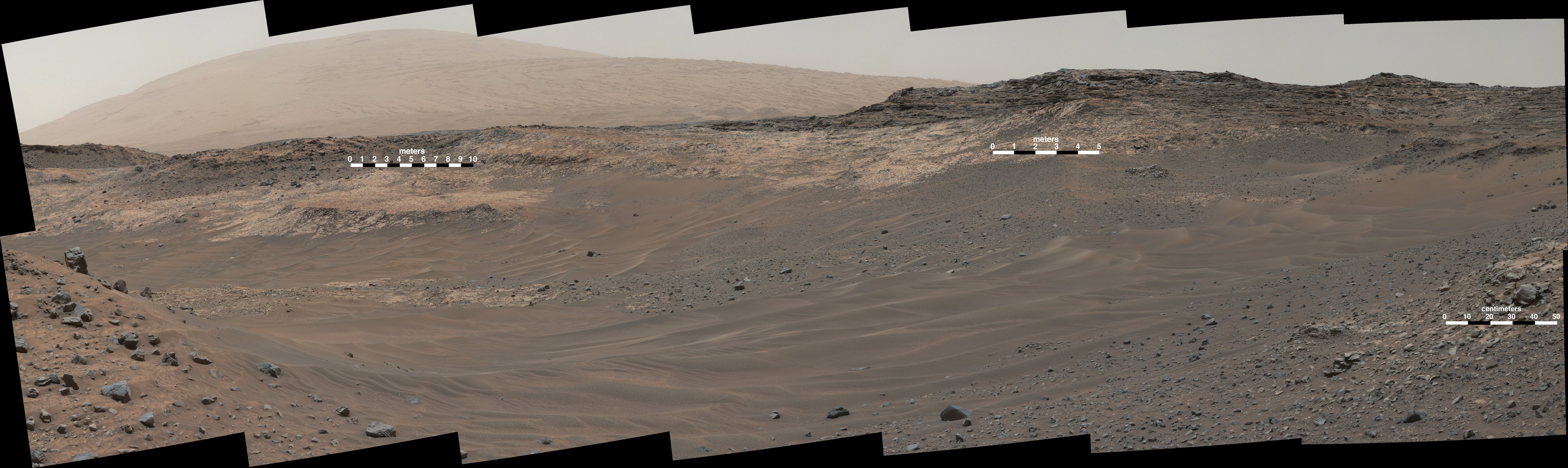
Too dangerous to drive: this Mastcam image, take by Curiosity on Sol 981 (May 10th, 2015 PDT), shows the two areas of rock the rover was attempting to reach in the middle distance (the light-coloured rock and the more grey rock above). The sand in the centre of the image had been judge too loose for a safe traverse, so the rover team had hoped to reach the target over rougher terrain, as seen to the right of this image (click for full size)
Two attempts to climb over this “unconsolidated material” (that’s loose rocks, pebble, sand, and dirt to you and me) came to an end when the rover experienced wheel slippage beyond acceptable limits, forcing the drive to stop. Coupled with indications of some sideways slippage – something the rover certainly doesn’t want to encounter lest it topple over – the decision was taken to reverse course and try an alternative route offering a way to another point at which the two rock formations meet and are both exposed.
On Thursday, May 21st, the rover successfully completed a climb up a 21-degree incline to reach a point overlooking an area where the two different strata of rock sit one atop the other, presenting an environment rich in scientific potential, and where the rover may spend some time engaged in investigations.
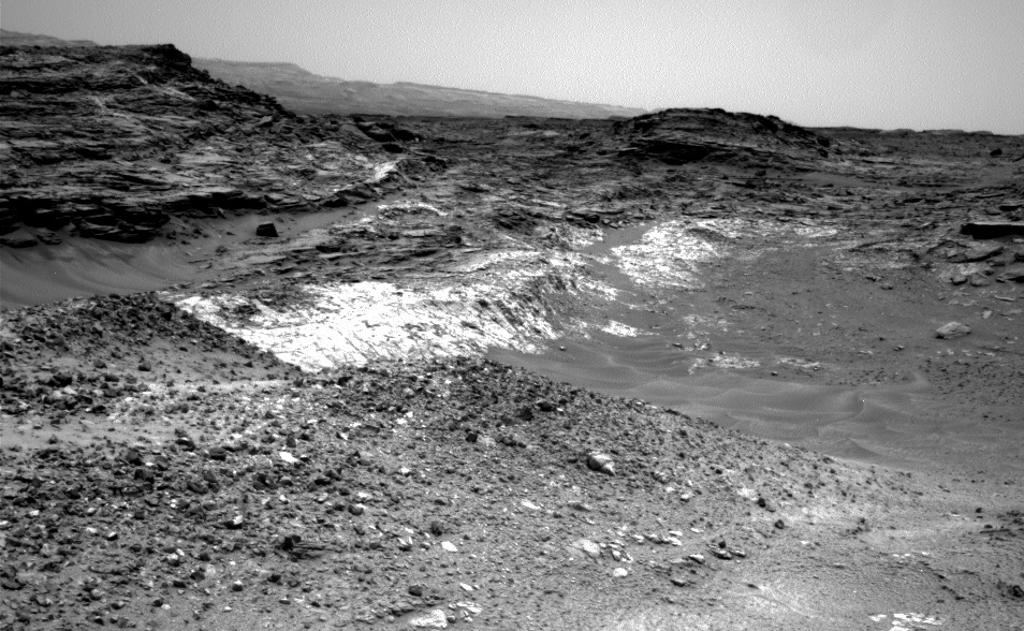
Rover’s reward: a Navcam image taken by Curiosity on Sol 991 (May 21st, 2015 PDT), following the large stage of a rough, steep climb. Central to the image can be seen an area of pale rock overlaid by darker material. The marks the meeting point of two different rock formations, which may give further clues as to the nature and history of “Mount Sharp’s” formation (click for full size)






 Inara Pey: Living in a Modemworld