I don’t usually blog on fashion in SL, but this is something special, and I extend my thanks to Strawberry Singh for bringing it to my attention.
66 million girls around the world are not in school simply because of their gender. Do it in a Dress is an Australian-led campaign run by One Girl which is helping to change this by raising money to help educate young girls in Sierra Leone, a country where only one in six girls aged 11 or over receives an education.
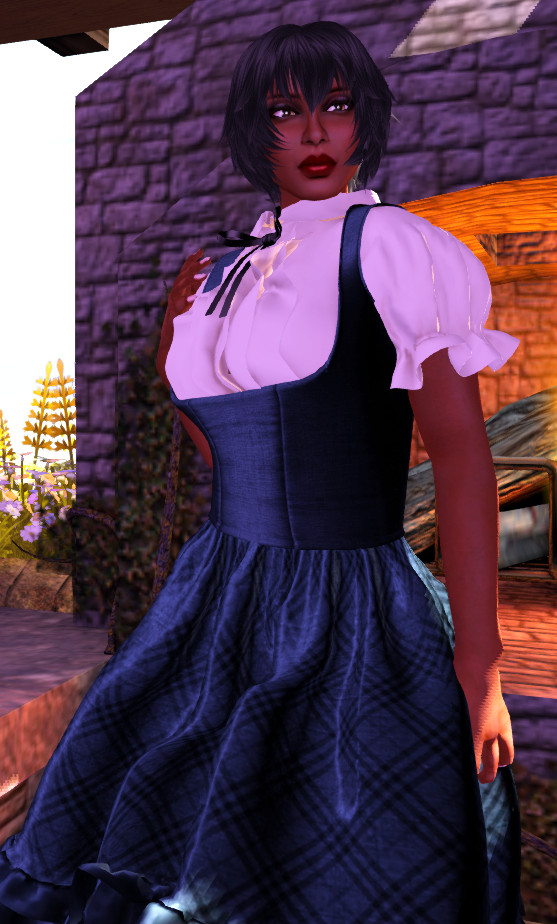
The blue design and blouse from Juno Mantel in the Do It In A Dress range
Designer Juno Mantel has now brought the campaign to Second Life.
Under the Do it in a Dress banner, Juno is offering a vintage school dress, available in 5 individual colours, for L$250 (or whatever over that you’d like to pay) – with 100% of the purchase prices going directly to the campaign.
The dress is mesh, and includes and alpha layer. A demo is available for those who wish to try before they buy. Both the dress and the demo can be obtained from the special display in Juno’s store, and for those who don’t wish to buy the dress, they can contribute directly through Juno’s campaign page, where the total raised to date can be tracked.
Men, women and children have been joining the Do it in a Dress campaign, which is held annually in the physical world every October. Since it started in 2001, it has raised over AU$326,800, helping to educate 1089 young girls in Sierra Leone, where the average cost of a girl’s education amounts to AU$300.
Now’s the chance for avatars to join in the effort as well, with Juno’s campaign running from through to December 7th. When you’ve purchased your dress, why not show-off photos of you wearing it around SL on the Do it in a Dress Flickr group? and remember, guys, this is one for you as well!
On November 5th, Latif Khalifa posted a notice to the Radegast blog that he is ending development of the Radegast viewer, and ceasing work on other virtual worlds open-source projects in which he has been engaged. Citing health reasons, Latif stated:
It saddens me to have to inform you that I won’t be able to continue work on Radegast or my other opensource projects. My health has been deteriorating over the past few years to this point where my use of computers is down to just a few minutes daily. Not being able to work for several years bring its own set of problems.
This isn’t necessarily the complete end for Radegast – as Latif notes, the code is open-source, and as such will remain available should anyone wish to continue with its development.
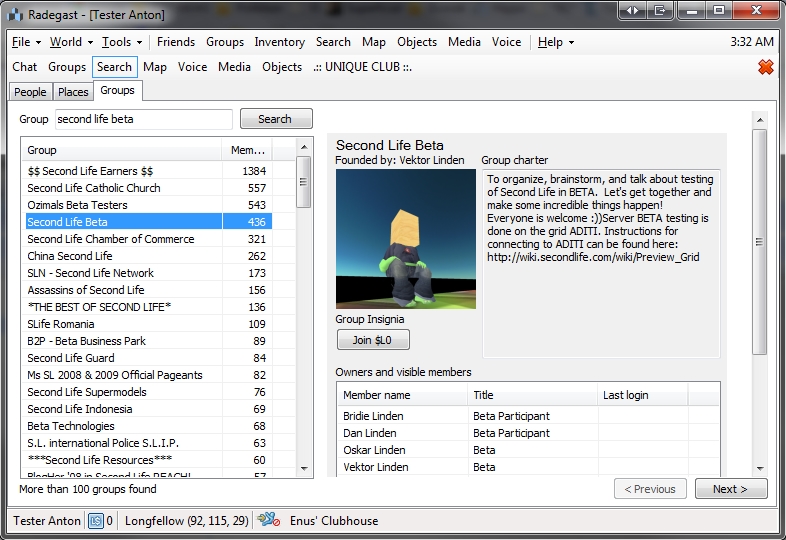
Radegast is a lightweight virtual worlds client that offers considerable flexibility of use for users, including the ability to render in-world scenes in 3D, thus enabling avatar movement and interactions. Almost all of the core capabilities found in a the full viewer are available within Radegast, including inventory management, the ability to change outfits, chat, IM, teleport, undertake group management activities, manipulate objects and their contents, script, use voice (local chat) listening to music streams, use avatar gestures, and more.
Radegest gives you almost all the capabilities of a full viewer in a lightweight package (image courtesy of Radegast)
Radegast has particularly seen considerable use with visually impaired users, offering speech recognition for controlling UI and entering text in chat and text-to-speech for reading out loud incoming messages, and a special accessibility guide has been written in support of this.
As Latif has kept the client up-to-date with all major SL and OpenSim changes to date (including mesh rendering, server-side appearance for SL, etc.), there is no danger of it suddenly ceasing to work in the immediate future for those who do use it on a regular basis; so there is no need to immediately abandon it, even if the option to continue developing it isn’t taken up by another developer.
Radegast offers a full 3D rendering view. While it might now have ALM, windlights and all the intensive bells and whistles, it takes avatar movement and rendering mesh and sculpts in its stride (click for full size)
Latif himself has been a towering force within the open-source community, working on a number of viewer projects, including Singularity and, most recently, Replex, and he has been heavily committed to the support of the OpenSim community as well as working to improve the user experience in Second Life. He is the founder of the Advanced Worlds SL group in support of the creation, design and development of technologies for virtual worlds, and the promotion of open standards and open-source software.
While there has been no similar notice on the Replex blog, that Latif has indicated a withdrawal from his open-source projects suggests that work on this viewer may also be suspended unless someone else is steeping into the breach. However, I am still awaiting confirmation on this.
There is little doubt that his presence, if he is forced completely away from virtual worlds, will be very much missed – as the comments following the announcement on the Radegast blog demonstrate. In the meantime, my personal message to Latif – someone I’ve been privileged to call a friend for a good while now, and who has always been a huge amount of fun, even when we’ve bumped heads on occasion(!) – is simply this: look after yourself, and am hoping things improve in the future.
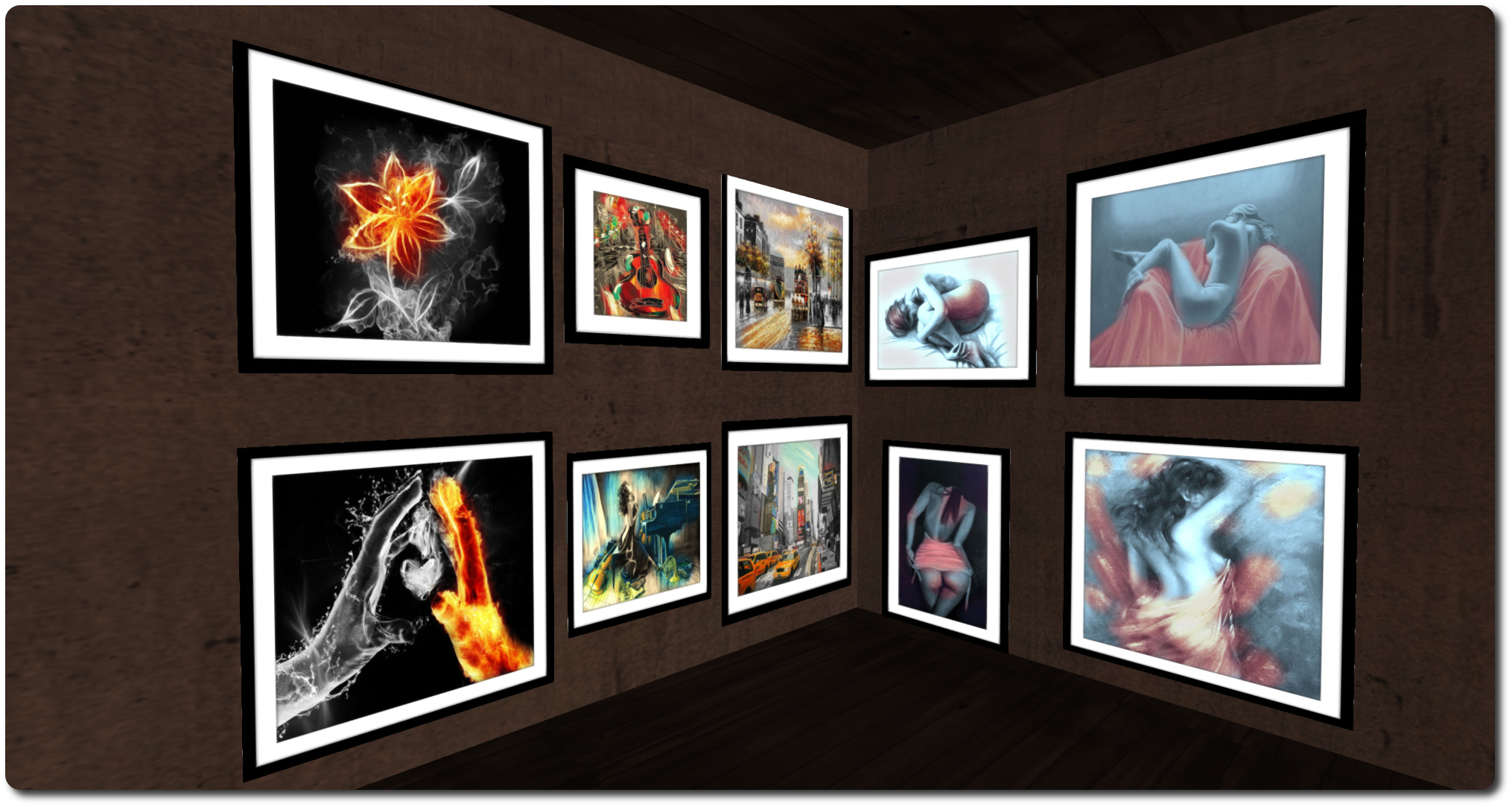
la Maison d’Aneli – FrancheskaCarter – click any image for full-size
I received an invitation from Aneli Abeyante to attend a special vernissage of the first exhibition to be held at her new gallery, la Maison d’Aneli, which opens on Tuesday, November 11th, 2014. Unfortunately, I cannot attend the preview itself, so I hope she won’t mind me writing about it in advance.
The inaugural exhibition features work by Littleone Aries, Tani Thor, FrancheskaCarter, Nino Vichan and Cayenne Avon, with the opening featuring a special concert featuring Pol Jarvinen’s work and the music of Yummy and Coffee Jaworower.
la maison d’Aneli is a brick-built gallery within Impress allen’s region of Virtual Holland. The ground floor feature gallery spaces for Littleone Ares, Tani Thor, FrancheskaCater and a display / telpeort area for Pol Jarvinen and the concert area. Upstairs, the exhibition space is devoted to a joint piece by Nino and Cay, entitled Companions, and of which more anon. Lines on the floor invite visitors to tour the gallery in a specific order of artists, commencing with Littleone Ares, then progressing through the Companions exhibit, then Tani, Francheska and finally to Pol, and the teleporter up to the concert space.
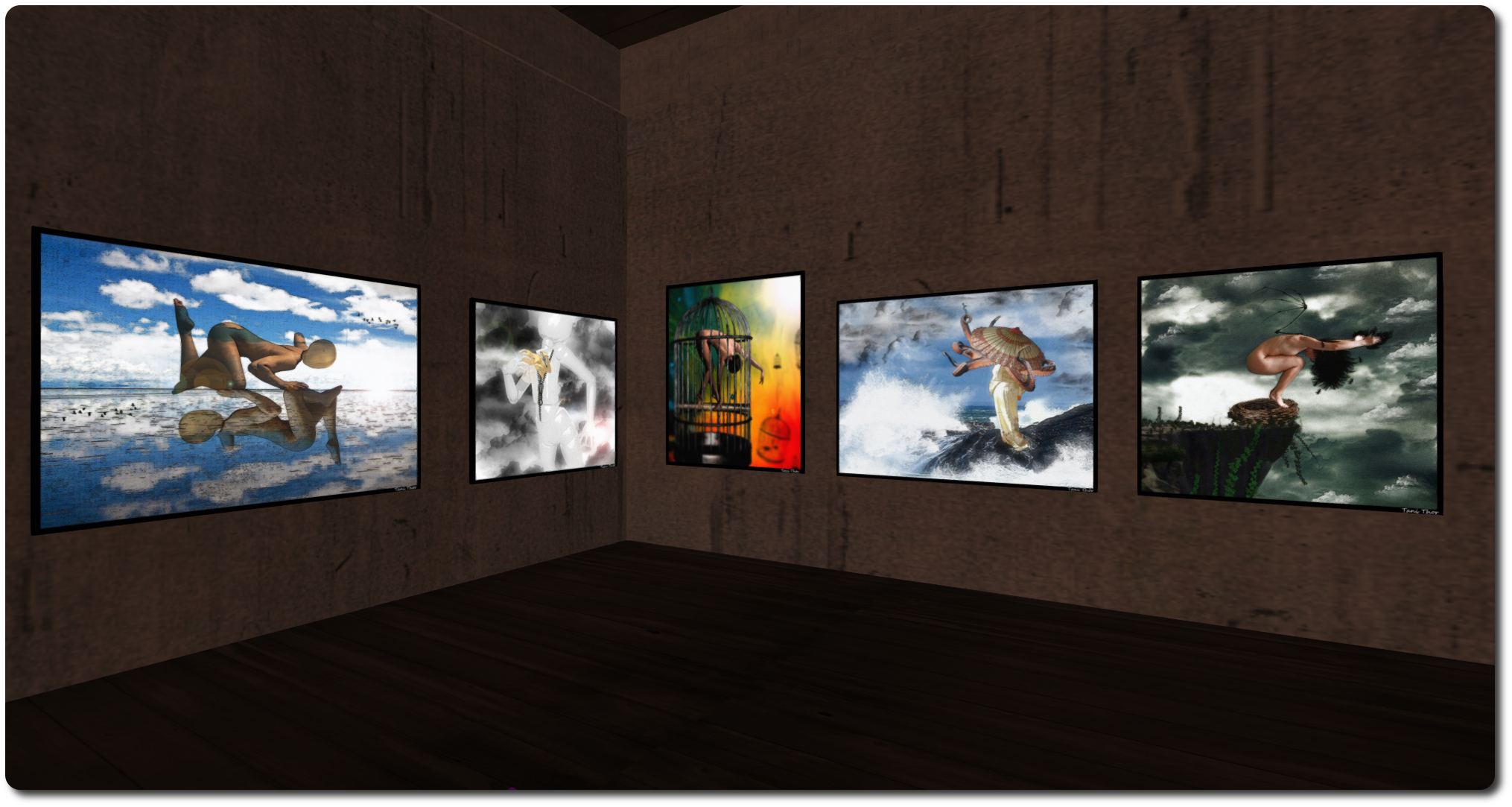
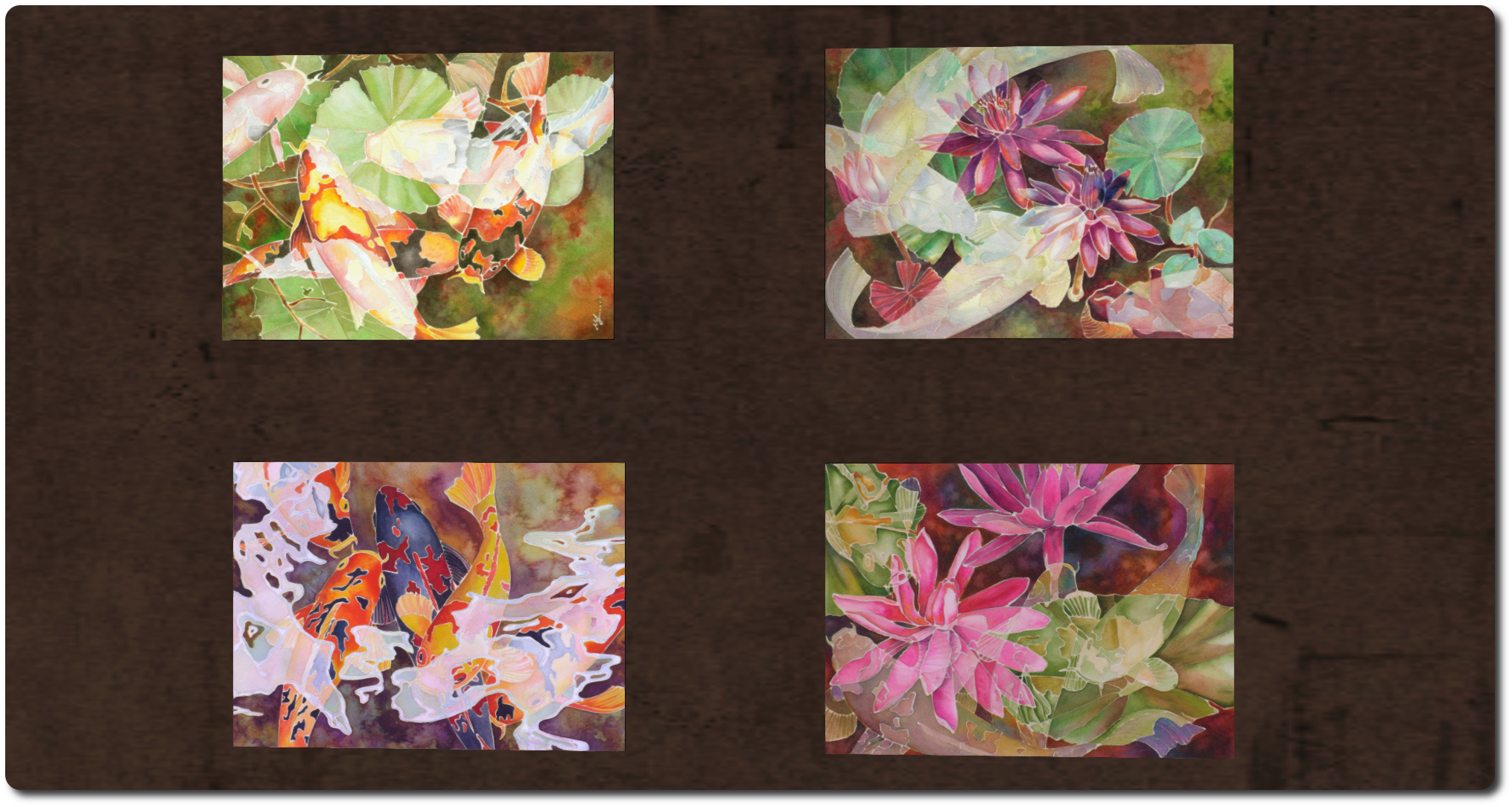
Littleone, Tani and Francheska offer strongly contrasting styles in their work, which makes this a varied and striking opening exhibition. I’ve not been overly familiar with any of their work prior to my visit, but found all three appealing in very different ways; there is a powerful sense of abstract in Littleone’s pieces, which at the same time have a hint of intricate glass art. Tani’s work is more surreal in approach, the images presented quite striking in both their power and statement.
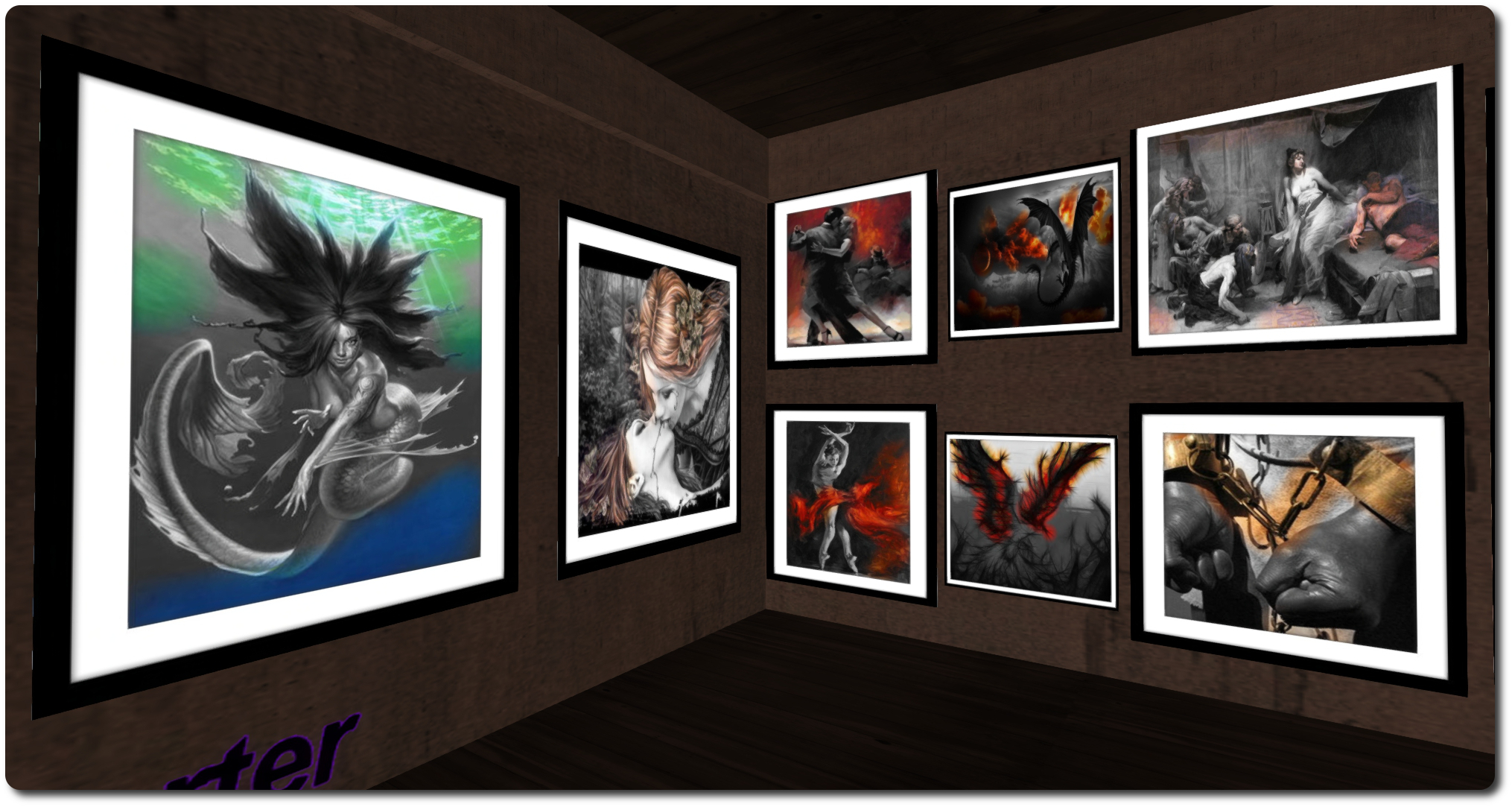
FrancheskaCarter’s work, which forms the largest part of the exhibition, draws on a number of themes, styles and influences, presenting a dynamic display of art that is – to me, at least – quite magnetic; and I say that without any intent to slight either Tani or Littleone. There is so much to captivate here, the interweaving of styles, forms and contrasts is entrancing.
Just look at Murbian, with its New York-like street of today and Urbaniste above it, featuring a street scene from over a century before; these pieces both complement and contrast with one another not only in the scenes they depict, but also in the manner in which they are presented. The New York picture possesses bold, modern strokes, the picture showing us a horse-drawn past offer far softer lines and colour, immersing us further in the bygone age it represents. Similarly, Chati offers an immensely powerful statement, while Amoureux magnificently captures the power and sensuality of the Argentine tango.
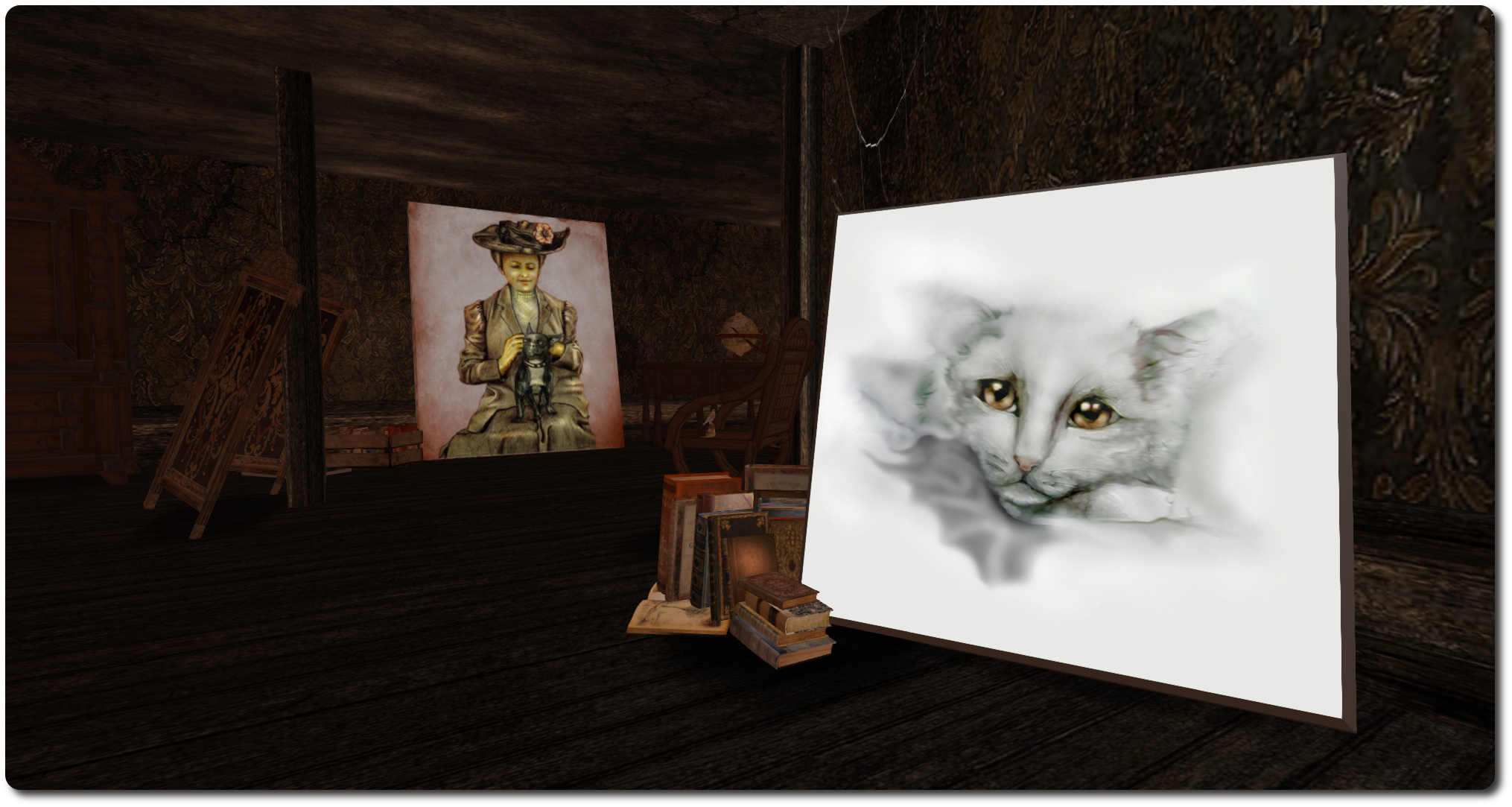
Upstairs, Cay and Nino offer a very different piece. “Welcome to the attic,” the introductory note card reads “Filled with memories of the companions who shared our lives.” following this is a short poem recalling the love and affection offered to us by favourite pets. This is, in short, a little trip down memory lane which is at once very personal, and almost somethings any of us who have shared our lives with a pet will instantly emphasise with.
Here, amidst the clutter one can all too often find in a roomy attic – old copies of newspapers, toys long forgotten, packing crates and travel trunks, furniture past its prime and more -, lie a series of paintings and drawings of pets and their owners from times past. Each picture tells a story of its own, and each draws us into it in an almost intimate way, at the same time conjuring memories of those pets we have ourselves loved, and who offered us unconditional love in return. This is a wonderfully personal display in many ways, both through the pictures offered and the setting itself.
As an inaugural exhibition, this is, as noted above, quite a stunning array of art (all of which is offered for sale, and would grace any home), and one not to be missed. Congratulations to Aneli on both the opening of the gallery and this excellent exhibition.
Linden Lab CEO Ebbe Altberg was in New York recently, attending the Engadget Expand NY 2014 event, which took place on November 7th and 8th. While there, he participated in a panel discussion hosted by Engadget’s Ben Gilbert, exploring the subject of Back to Reality: VR Beyond Gaming. Also appearing on the panel were:
Marte Roel, co-founder, BeAnotherLab and the open-source project called The Machine To Be Another, which is designed to explore the relationship of identity and empathy through VR immersion. The approach is particularly seen as a means of helping in conflict resolution (by allowing a person to experience a situation from another’s perspective). The group is perhaps most widely known for the Gender Swap Experiment, in which participants experience the illusion of being in one another’s body
Matt Bell, co-founder and Chief Strategy Officer at Matterport, a company providing a means to imaging interior spaces and reproducing them as 3D models which have the potential to be utilised in a number of ways.
At just over 34 minutes in length, the panel isn’t long, and the opportunity for discussion of questions and views is further reduced by the first ten minutes being devoted to each of the panelists giving an overview of their particular platform / interest. However, once past this, there are some interesting observations made on the status of virtual reality outside of the games environment, some of which tend to echo commentary from elsewhere.
For example, discussion is held around the idea that immersive VR is more than simply seeing and hearing; we rely on other senses as well – smell and touch in particular. The latter is perhaps particularly relevant as the ability to generate a natural sense of feedback through touch, say through a haptic glove – is in many ways essential to move one beyond being something of an observer of a digital 3D environment to being a participant within it.
The Engadget Expand NY panel for Back to Reality: VR Beyond Gaming. For left to right: Ebbe Altberg, Matt Bell, Marte Roel and host Ben Gilbert
Marte Roel particularly notes this being the case with The Machine To Be Another, where users can use haptic capabilities to interact with the characters they meet by shaking hands and so on. Ebbe Altberg also observes a little later than haptics can help one enter more deeply into the illusion created by VR, noting that while it is possible to see the texture of a surface in a digital environment, the brain knows it is simply seeing an image, but if you can also feel the texture of that surface, the brain is further tricked into a deeper level of immersiveness and engagement – and move it beyond what James Cameron recently referred to as the “I can stand and look around” situation we currently have.
The flip side to this, as Ebbe Altberg also points out, is that the fidelity of the “real” experience – sight, sound, smell, touch, isn’t necessary in every potential use case for VR. There will be situations (indeed, there all ready are) where the full sense of immersiveness isn’t required; as such, over-emphasising things one way or another in terms of requirements or prerequisites would be a mistake, as there is liable to be a broad middle ground.
Even so, it cannot be denied that the technology is – for the time being, at least – one of the more obvious problems facing VR when it comes to mass adoption. There’s no denying ht Oculus Rift and its imitators and competition are still cumbersome, awkward and unappealing, lacking both convenience of use and portability. This is going to have to change – as the panel acknowledges. Indeed, we are already seeing attempts to improve the overall form factor – take the Zeiss cinemizer for example, or the Vuzix Wrap headsets. The problem here is that of price; even at $599, the Vuzix Wrap 1200DX VR is liable to be around $300 more than the Oculus, a pice point liable to keep people thinking VR more a “geeky” adjunct to activities than central part of them.
The Vuzix Wrap 1200DX VR “VR in a pair of sunglasses” – offering the kind of lightweight, non-nerdy approach that will help further acceptance of VR, but currently at a price.
Ebbe Altberg appears confident this could occur within a couple of years. He’s potentially a lot more optimistic than Oculus VR CEO Brendan Iribe, who, when talking to Techcrunch in May 2014, suggested it could be another five years before people will be pulling compact (and presumably low-cost) VR glasses from their pocket and using them with the same ease they do with a part of sunglasses today.
Nor is it necessarily just the headsets; it’s the other accoutrements as well – haptic gloves, controllers, sensors systems, recognition systems. As the panel again acknowledge, these all need to mature and become more widely accepted. They also, frankly, need to become a lot cheaper. High Fidelity may well sign the praises of the STEM system, but it still dumps a minimum $300 extra on the cost of entry into some VR environments. Perhaps the answer lies in the improved integration and capabilities with existing hardware, as has been the case with mobile technologies: the more integrated things have become within the mobile ‘phone, the more central it has become to our everyday lives, something Matt Bell indirectly touches upon.
Matt Bell (holding the Galaxy Note 4), Marte Roel and Ben Gilbert (far right) during the Engadget Expand NY panel. Ebbe Altberg is slightly off-camera to the left (image via Bryan Bedder/Getty Images on Zimbio)
For a discussion on the future of VR outside of gaming, the conversation is surprisingly light; familiar verticals are pointed to as being very well suited to VR – education, health, virtual tourism, etc – but there’s no real probing of potentials. This is in some ways a shame; however, as Ebbe Altberg points out, predicting the overall future for VR isn’t that straightforward, given it could well cut through everything in its applicability:
It’s like an infinite number of potential use-cases for it… When people ask what’s the killer app, there’s going to be lots of killer apps, just like it is on the Internet in general or in the world in general. So I think of VR as a horizontal thing, something that you can able to apply to almost anything you’re trying to do.
Even so, it would have been interesting to hear thoughts on just how VR will be leveraged to a position of being not just an ancillary aspect of how we do certain things, but a piece of technology people see as vital to their every day lives as their mobile ‘phone. Will the catalyst simply because the hardware is available? Might it be come about as a result of multiple independent uses of VR which infiltrate our lives until it becomes an accepted part of everyday life – a quiet revolution, if you will, rather than the kind of sudden “whiz-bang, here it is!” that seems to be anticipated?
When limited to a 24 minute time frame, there’s obviously only so much that can be discussed in such a forum; as such, I couldn’t help be feel the topic might have been done more justice had it been given more time and a broader panel of participants. Nevertheless, what is there is worth listening to, and it has to be said the Ebbe Altberg does a respectable job to hoisting SL’s and the Lab’s flag and profile.
Updates for the week ending: Sunday November 9th, 2014
This summary is published every Monday and is a list of SL viewer / client releases (official and TPV) made during the previous week. When reading it, please note:
It is based on my Current Viewer Releases Page, a list of all Second Life viewers and clients that are in popular use (and of which I am aware), and which are recognised as adhering to the TPV Policy. This page includes comprehensive links to download pages, blog notes, release notes, etc., as well as links to any / all reviews of specific viewers / clients made within this blog
By its nature, this summary presented here will always be in arrears, please refer to the Current Viewer Release Page for more up-to-date information
Official LL Viewers
Current Release version: 3.7.19.295700, released on October 29th – formerly the HTTP pipelining viewer (release notes)
Maintenance viewer RC version 3.7.20.296368 released on November 6th – a broad range of fixes for voice, privacy, rendering, texture animation, avatar distortion, inventory management, sounds, Mouselook in Mac, multiple UI fixes in script editor, Pay flow, chat, stats floater, edit menu, etc (download and release notes)
Attachments viewer RC version 3.7.20.296355 released on November 5th – adds some fixes to previously released changes in the way joint offsets in rigged meshes are handled & fixes some issues found with adding and removing attachments after the recent AISv3 deploy, and improves the status information shown in inventory for attached objects (download and release notes)




 Inara Pey: Living in a Modemworld