SL projects update week 50 (3): miscellaneous items

Server Deployments week 50 – Recap

As always, please refer to the week’s forum deployment thread for the latest news and updates.

  • Tuesday December 10th, 2013 saw the main channel updated with the server maintenance project that was on the RC channels in week 49.  This project includes a few miscellaneous bug fixes
  • Wednesday December 11th, 2013 saw the three RC channels updated with a new server maintenance project containing a single bug fix.

The RC channel bug fix is related to vehicles getting into a “bad” state where they appear sat upon / selected even if they have lost their passengers as a result of a region crossing. When in this state, they defeat the parcel / region auto return.

As the fix for this issue is currently only on the three RC channels and will not be promoted to the main channel until 2014 due to the code freeze / no change window, and because this issue may lead to vehicles accumulating in regions where there is a lot of traffic, Maestro Linden has requested that support move any main channel regions which are affected to an RC channel.

2014

These deployments were the last scheduled deployments for 2013. They also mark the last scheduled rolling restarts for the year as well, as there are no plans to restart any channels in either week 51 or week 52. The only exception to this will be if any major issue / fault occurs within the grid which necessitates a restart.

The next scheduled server-side deployments will take place in week 2 of 2014, the week commencing Monday January 6th, 2014.

Some information on updates which will be forthcoming in 2014 were given during the final Server Beta meeting of 2013. These include:

  • Andrew Linden’s work on “Uniform Scaling” LSL Functions for linksets (see part 1 of this week’s report). There are a couple of basic rules with the new functions: no prim in the linsket can be smaller than 1 cm or larger than 64m, and all prim centres must be within 54m of one another in order to be linkable. There will be two new functions as a part of this work:
    • integer llScaleByFactor(float factor):  uniformly scale a linkset by the specified factor (e.g. 2.0 to double the scale).  Returns TRUE if successful, FALSE otherwise
    • float llGetMaxScaleFactor(),   float llGetMinScaleFactor(): return the maximum / minimum scale factors that will work in llScaleByFactor due to limits in place by prim scale and linkability distance restrictions
  • An update to llLoadURL, so it will have a 0.1s delay instead of 10s (although there is still a throttle in place to prevent someone from spamming somebody else in order to crash their viewer)
  • llGetObjectDetails() & OBJECT_STREAMING_COST will be amended to return data when targeting an agent. Currently, OBJECT_STREAMING_COST doesn’t give you much of anything when targeting an agent; once this change is in place, it will return the sum of the streaming costs of all worn attachments (excluding HUDs)

SL Viewer

The “Project Interesting” (viewer-interesting) RC viewer updated on Thursday December 12th to version 3.6.13.284757, which includes a number of fixes from the initial release:

  • BUG-4675 Viewer crashes while reading chat history
  • SH-4606 Interesting: Small objects do not load until they are very close.
  • SH-4627 [INTERESTING RC] “Object out of range” is not detected on teleport.
  • SH-4631 [INTERESTING RC] Parts of linked objects are not shown in new release Second Life 3.6.11
  • SH-4641 Interesting: Incorrect amount of system memory detected on Mac

This may be the last RC update for 2013, unless something like the Google Breakpad RC is slipped out for another round of testing on Friday December 13th.

STORM-68

As noted in part 2 of this week’s report, STORM-68 is a third-party contribution which will allow a builder / creator to specify the default permissions applied to a new prim object (cube, cylinder, torus, etc.) on creation. Further testing has been taking place since my last update, and a number of issues and bugs have been resolved as a result. The test plan for the changes is complete and the viewer-side changes now look ready to go to LL’s internal QA. Again, this change requires server-side updates, so it is unlikely to appear in an RC viewer until the server updates are reasonably available on the grid, although this will hopefully happen in the early part of 2014.

Kokua 3.6.12 released; CtrlAltStudio and UKanDo added to TPV Directory

Kokua Update

Thursday December 12th saw the Kokua team release version 3.6.12.30743 of the viewer. This appears to be a fairly contained update, focused on updating the viewer with the recent SL viewer 3.6.11 GPU Table updates and the 3.6.12 NameUpdater changes. Neither of these involved functional changes to the viewer from LL’s side, but do bring Kokua to parity with the current SL 3.6.12 code base.

In addition, the short-form release notes highlight the following updates from the Kokua team:

  • UI enhancements by Jessica Wabbit.
  • UK-english dictionary added to the spelling checker
  • Removal of packaged PCRE libraries from Linux 64-bit builds as they caused web kit to fail to load on newer Debian based distributions.

The release notes also point out that when the viewer is started for the first time following installation, there will be a notice and link to check graphics drive availability. The Kokua team urge caution if the option is taken to update drivers, as system breakages have resulted in the past. They also point out that the notice is a recommendation to check for updated drivers, not a requirement to update.

Related Links

CtrlAltStudio and UKanDo

The CtrlAltStudio and UKanDo TPVs have both undergone self-certification and have been added to the Third-party Viewer Directory (TPVD).

The associated wiki page for CtrlAltStudio describes the viewer as :

The CtrlAltStudio Viewer has been set up in order to try out and share a number of ideas, the first being stereoscopic 3D display and some initial Oculus Rift support . It is based on the Firestorm Viewer which it tracks closely while adding particular features.

The associated wiki page for UKanDo describes the viewer as:

UKanDo gives a whole new perspective in Second life by using a camera placement adopted by the vast majority of third person video games.

Also includes RLV along with plenty of other useful tools. It won’t have all the gadgets/gizmos a lot of the bigger viewers have, the aim is to keep it as lite as possible with only the fixes, gadgets and gizmos we need to keep the Viewer stable and up-to-date! The Avatar happy! And to aid with building!

(Please note that descriptions are supplied by the viewer developers, not Linden Lab.)

Congratulations to both viewers, both of which I’ve been following in these pages. You can catch-up with them as follows:

Winter everso Slightly Twisted

Slightly Twisted
Slightly Twisted (Flickr) – click any image for full size

I like whimsy; I like to smile. Sometimes I don’t feel as if I smile enough. In fact, there are times when I can be pretty dour in SL (we’ll leave the other life out of this, OK?); yet when I think about it, most of what I see and do in SL does bring a smile to my face. Otherwise, why would I be here?

One of the things that I do enjoy about exploring SL is that so much of it contains the whimsical and the lyrical, making exploration and blogging a joy. So when I saw that Katz Jupiter had reworked her region, Slightly Twisted, into ” a whimsical but  serene and peaceful  landscape filled with art, animals and fun elements,” I had to hop over and take a look. Truth be told, a visit was long overdue; the last time I had dropped in was nigh-on 18 months ago, when the region was hosting The Gathering of Sky Women in July 2012.

Slightly Twisted; Inara Pey, December 2014, on FlickrSlightly Twisted (Flickr)

Katz’ profile gives a little more information on the region’s winter design, stating: “Slightly Twisted reflects the beauty and serenity of winter in BC, Canada, as well as the special time of the approaching holiday season. Of course there is always a few twists to make it more fun.”

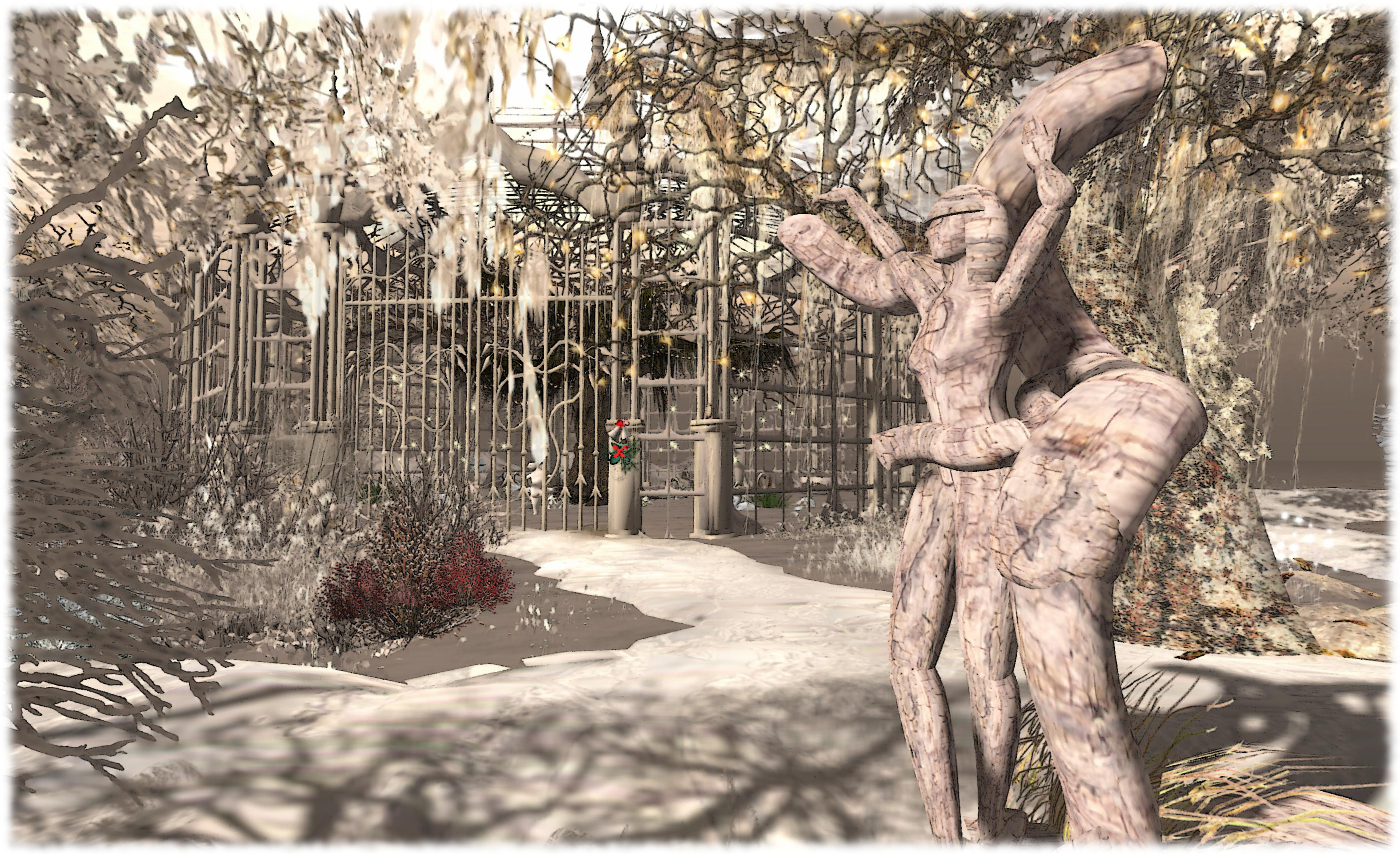
You might want to wrap-up warm for this one as well; winter is very, very much the theme here – the arrival point is even inside a frozen cave, complete with a huge statue of the Snow Queen by Fuschia Nightfire. Fuschia has worked with Katz on various art projects, and more of her sculptures can be found throughout the region, together with pieces by other artists such as Kicca Igaly and Chuckmatrix Clip.

A welcome poster, complete with seasonal greetings from Katz provides a list of activities within Slightly Twisted and a note on the default windlights. You can also grab a pair of cross-country skis to ease your travelling. If you take a set, do make sure you disable any AO you’re wearing or conflicts may result.

Slightly Twisted; Inara Pey, December 2014, on FlickrSlightly Twisted (Flickr)

Once outside, the full beauty of the region becomes apparent. The default windlight settings work well with the environment. Combined with the seasonal lights on trees, etc., the overall effect presents something of a winter’s evening feel, with a slight mist in the air. However, as I’m a bit of an awkward so-and-so, I opted to take the majority of my pictures using a combination of Annan Adored’s 2013 windlights (which I adore  – no pun intended – and so tend to use a lot), together with Jackson Redstar’s windlights, which have long been favourites and are probably the settings I use and play with the most.

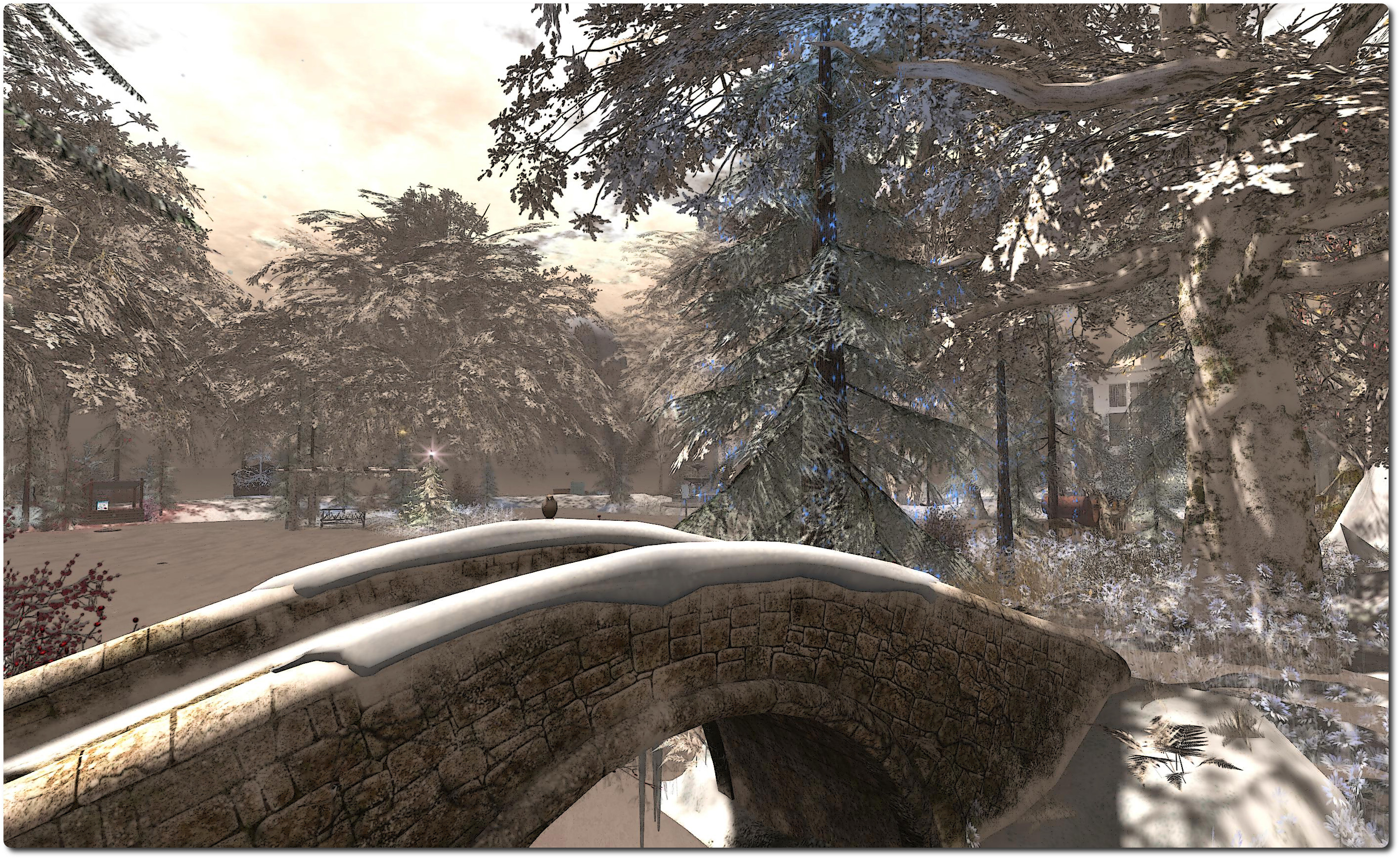
A large frozen lake offers plenty of space for ice skating – grab your skates from the little kiosk on the other side of the lake from the arrival cave. This is flanked on either side of the region by a large house and equally large frosted glasshouse. Around the lake are snow-covered paths, frosted trees strung with lights, horses and wildlife to be observed (and photographed!) and more.

The whimsy in the region comes in many forms; some of the art pieces have a certain whimsical feel, such as Kicca Igaly’s Musical Conductor, happily overseeing an invisible orchestra and their music as you skate across the ice, or the innocent (and rather cute) snowman by Trigit Amat, complete with felt top hat and scarf, standing with his back to the path, but who will deftly turn around and lob a snowball or two at passers-by. The polar bears busy with their ice ballet in the frosted glasshouse put me in mind of an advert we used to have for a certain chocolate bar (even if the ad did involve pandas and rollerskates, rather than polar bears and ice – but that’s the way my little mind works).

Slightly Twisted
Slightly Twisted (Flickr)

The pleasure of a build like this is in the composition and the detail, and Katz has done a fabulous job in bringing pieces together from a wide range of creators and artists to present a scene which really does encourage exploration and offers a lot of entertainment; so do take your time when wandering, you never know what might lie around a corner or among the trees. If you do tire of walking, there are balloon and horse rides to be found, adding even more enjoyment for explorers. If you feel like a break, there are places where you can sit and cuddle or watch the world go by. And if you get too cold outside, don’t forget the big house, which contains more art in both images and sculptures, to appreciate.

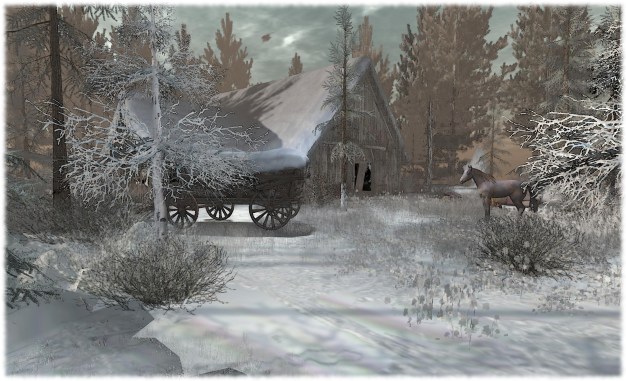
Above the lowlands, atop the hills there is more to see, including a cosy barn where Katz has some of her own artwork  on display.  There’s even a roaring log fire outside where you can warm your hands. Getting back down the hills after a visit is easy as well: simply grab a sledge and push off down the slope!

There’s more to see beyond this, but for me to say more would be to spoil things. Why not pay Slightly Twisted a visit and see what’s there for yourself?

Related Links

“Come in, come in! and know me better, man!” – The Dickens Project 2013

TDPFriday 13th December sees the The Dickens Project re-open its gates for a two-week long celebration of Charles Dickens and his work, which is centred on A Christmas Carol, but features so much more as well.

The Dickens Project is presented by Storyfests SL and will take place on land provided for the project through the generosity of Thinkerer Melville at the Greek Archon Theatre in Cookie. It will comprise daily presentations (in Voice) of Dickens’ seasonal classic, A Christmas Carol,  together with a special presentation of the story by the Avatar Repertory Theatre, as well as encompassing elements of his other works in an inateractive, immersive setting.

The project first opened its doors over Christmas 2012, as a part of global celebrations marking the 200th anniversary of Charles Dickens’ birth. Over the course of two weeks, thousands of visitors passed through the project’s gates, explored the life and times of Charles Dickens and attended presentations of A Christmas Carol and other works by the author. This year marks the next steps in the dream of creating a totally immersive environment for the enjoyment of live readings from the vast Dickens canon of works.

Caledonia Skytower, Shandon Loring (centre) and Kayden Oconnell in an evocative shot of the virtual / live performance by Bear Silvershade

At the start of December, I was fortunate enough to be invited to a very special presentation of A Christmas Carol which featured the talents of Caledonia Skytower, (who has conceived, directed and produced The Dickens Project), Kayden Oconnell and Shandon Loring. “Special”, because the event featured audiences in both the real and virtual worlds, as Caledonia Skytower (Judith Cullen in real life) sat before an audience in Tacoma, Washington. As such, I can very thoroughly, and at first hand, recommend at least one visit to the Project this year for anyone with a love of Dickens’ work or for the telling of wonderful tales through the medium of voice.

Dickens

The Schedule

The following presents the performance schedule as it stood on Thursday December 12th; however, as both the real and virtual worlds can be unpredictable, please be sure to check with the Storyfests SL blog for any revisions or additions to events or timings.

The main readings of A Christmas Carol will take place twice daily to offer audiences a choice of times to attend. Additional events are as currently indicated. As ever, all times are SLT.

All performances are free, but donations will be accepted on behalf of War Child North America.

Friday December 13th, 2013

  • 12:00 noon – Dickens’ Christmas Short Stories – Caledonia Skytower in Dickens Square
  • 17:00 – A Christmas Carol (an adaptation by Ada Radius) – Avatar Repertory Theatre.

Sunday, December 15th

  • Noon – Other Works of Dickens: Chapter Ten from Little Dorrit “Containing the Whole Science of Government” with Klannex Northmead.

Monday, December 16th:  A Christmas Carol: Stave One, “Marley’s Ghost”

  • 13:00Dubhna Rhiadra
  • 17:00 – Kayden Oconnell.

Tuesday, December 17th: A Christmas Carol: Stave Two, “The First of Three Spirits”

  • Opening of “Christmas Past” to guests
  • 13:00 – Corwyn Allen
  • 18:00 – Caledonia Skytower.

Wednesday, December 18th: A Christmas Carol: Stave Three, “The Second of Three Spirits”

  • Opening of “Christmas Present” to guests
  • 14:00 – Ixmal Supermarine
  • 18:00 – Kayden Oconnell.

Thursday, December 19th:  A Christmas Carol: Stave Four, “The Last of the Spirits”

  •  Opening of “Christmas Yet to Come” to guests
  • 13:00 – Dubhna Rhiadra
  • 17:00 – Corwyn Allen
  • 21:00 – Dickens Late Night with Caledonia Skytower, Shandon Loring and Finn Zeddmore.

Friday, December 20th: A Christmas Carol, Stave Five “The End of It”

  • 13:00 Ixmal Supermarine
  • 17:00 – Kayden Oconnell
  • 21:00 – Dickens Late Night with Caledonia Skytower and Kayden Oconnell.

 Sunday, December 22nd: Other Works of Dickens

Monday, December 23rd: A Christmas Carol (Part 1)

  • 16:00 – Caledonia Skytower with a possible repeat at 21:00.

Tuesday, December 24th: A Christmas Carol (Part 2)

  • 16:00 – Caledonia Skytower.

Thursday, December 26th: Other Works of Dickens

  • Times & Titles to be announced.

Friday, December 27th

  • The Dickens Project closes

Related Links

SL projects update week 50 (2): Fitted mesh, deformer, viewer code contributions

Mesh Deformer and Fitted Mesh

The future of mesh garments / wearables created using the now SL-defunct mesh deformer was the subject of some discussion at the Open-source Contributions meeting on Wednesday 11th December. While the deformer was never officially adopted by the Lab for use within Second Life, it was available in various test and experimental viewers, and the code could also be included in self-compiled viewers if people knew how.

Fitted mesh is coming....what of the future for garments made for the deformer?
Fitted mesh is coming….what of the future for garments made for / via the deformer?

This means that there are garments within Second Life that were created and uploaded for / with the deformer code, and which can resize with viewers using that code. However, as is the case with Fitted Mesh, the clothing would not deform when using a viewer without the requisite code. The same will be true once the Fitted Mesh updates reach a release candidate status and start to be more widely adopted: while Fitted Mesh (and Liquid Mesh) garments, etc. will deform to an avatar’s shape, items created using the mesh deformer will not; they will continue to behave like any other rigged mesh item.

This likely means that as the Fitted Mesh code does become more widely adopted, people will stop using any garments / attachables created using the deformer code, and the availability of such items in SL and on the SL marketplace will decline over time.

Whether or not this means deformer-based items will vanish from people’s inventories is something only time will tell. From the Lab’s perspective, the work involved in trying to pro-actively determine a method of identifying assets using the deformer code and removing them from the asset servers / inventories isn’t likely to be worth the end result. Therefore anyone with “old” mesh deformer garments and attachables will probably retain them until they opt to delete them from their inventory.

It appears unlikely that viewers using the deformer code will be pro-actively blocked from SL. What is likely to happen is that the code simply will not be formally adopted by those variants of TPVs which do not connect to any other grid than Second Life. However, this does leave a further interesting question as to the future of the mesh deformer, which has potentially seen far wider use in OpenSim communities than Second Life. While it would seem likely OpenSim will adopt the viewer-side changes required to enable Fitted Mesh (at least in the majority of cases), at this point in time, it is not clear whether the mesh deformer will be entirely abandoned. Whether there will be sufficient pressure within OpenSim for the deformer code to remain in use, and whether TPVs will feel obliged to incorporate the deformer into their viewers / OpenSim variants of their viewers as a result, remains to be seen. Currently, the only grid which has any kind of significant investment in the deformer is InWorldz, which provided funds for the code to be further enhanced and adopted it into their dedicated viewer in July 2013.

Materials and Numbers

Statistics are always a hard thing to determine. Back in the day, there was much controversy over figures released as to the adoption of mesh within SL following its deployment. The figures offered-up by the Lab at the time were vague enough that they could be taken to mean that mesh was either being rapidly adopted, or was seeing very slow growth (with the reality lying somewhere in between). This was not an attempt by the Lab to fudge issues at the time; it simply underlined the fact that numbers aren’t always the best means of trying to quantify something, so it’s perhaps better to allow the passage of time to speak for itself.

The most recent figures for materials suggest that over half of the regions in SL now have at least one materials-enabled item within them, and around 10% of avatars apparently utilise at least one materials-enabled item.  Again, these are figures that are likely to be interpreted either way, depending on how people look upon materials as a whole. Certainly, the term “object” is sufficiently vague so as to be pretty worthless as am objective yardstick, as it likely covers everything from an individual prim through to entire linksets, which leads to a huge variance in the visibility of objects using materials. On a personal note, I can only say I’ve made extensive use of materials in my house, and am more than pleased with the results.

I've used materials on my house; particularly on the stonework and stucco textures to prevoide added depth. Materials on the whole appears to be slowly gainly momentum
I’ve used materials on my house; particularly on the stonework and stucco textures to provide added depth. Materials on the whole appears to be slowly gaining momentum

Upcoming Code Contributions

There are a number of third-party code contributions in development for the SL viewer, some of which I’ve previously reported upon, and which are now progressing towards a point where they may well have public visibility through the likes of a release candidate in the new year.

STORM-1981 and STORM-1831

STORM-1981, contributed by Jonathan Yap, is intended to change the behaviour of tracking beacons to help make locating items in a region somewhat easier (e.g. locating lost items or scripted objects which are causing issues, etc.).  Under these changes:

  • Beacons would begin at a height of 0 metres and extend up to the maximum unassisted flight ceiling (5,020 metres)
  • The beacon colour will be blue from 0 metres to the base height of the object being tracked, and red from 5,020 metres down to the height of the object being tracked
  • Users can optionally set the beacon to pulse towards the target object using the CheesyBeacon debug setting (Advanced->Highlighting). The blue beacon will pulse up towards the object, the red beacon will pulse down towards the object.
Tracking beacons will be changing under STORM-1981, making it easier to locate objects, etc.

STORM-1831 covers the work being undertaken by Ima Mechanic, with assistance from Oz Linden, to improve syntax highlighting in the viewer’s LSL editor by allowing the viewer to obtain the information required for syntax highlighting directly from the simulator the viewer is connected to. This should eliminate issues with the current manually updated files used to manage syntax highlighting falling out-of-synch with new LSL syntax as new functions and parameters, etc., are added. Folded-in to this work should also be a change to the source code text allowance in the viewer’s LSL editor, increasing it from the current 65,000 characters to around 256,000.

The server-side cap updates required for both STORM-68 and STORM-1831 have been combined and passed into the simulator release stream, and while it is unclear as to when the cap updates will reach a server-side release candidate package, their progress is being tracked. Obviously, both STORM-1981 and STORM-1831 require viewer-side updates as well, and these will hopefully appear in viewer release candidate form once the server-side updates are sufficiently deployed.

STORM-68

A number of TPVs include the ability to specify the default permissions applied to a new prim object (cube, cylinder, torus, etc.) on creation. STORM-68 aims to add a similar capability to the LL viewer (and which will quite possibly supersede the capability in TPVs once implemented). This work is again coming from Jonathan Yap, although it requires server-side updates, which Andrew Linden has been taking care of. However,  this work has hit some problems in viewer / server interactions, which may be down to timing issues between requests and acknowledgements being sent between the viewer and  the simulator and vice-versa. As such, further testing is required, so it’s possible this work might take a little longer to appear in the new year.

The delight of finding a Sleepy Snail in Second Life

Sleepy Snail
Sleepy Snail

I’ve frequently commented on the fact that I find Rebeca Bashly’s work fascinating to see; the subjects she tackles can often challenge one’s perceptions and / or offer-up a visual interpretation of other mediums, such as with her fantastic realisation of Dante’s Inferno. I’ve covered a number of her pieces in SL, the most recent being Colour Key, and I’ve never failed to be completely drawn-in to her work.

She now has a new full sim installation at Per4mance Metales, which opened on December 10th, and which I’ve been itching to take a look at, but Things have been getting in the way – most through my own fault. So I’m getting to it a little later than hoped – but I’m glad it didn’t actually fall off my “to do” list.

Sleepy Snail is a complete departure from recent pieces by Rebeca, which is not to say it is any the less fascinating. What it may mean is unclear; I rather suspect it is more an expression of the artist’s sense of whimsy and fun than in having any deep-seated message or meaning; and as such, it is a visual delight.

Sleepy Snail
Sleepy Snail

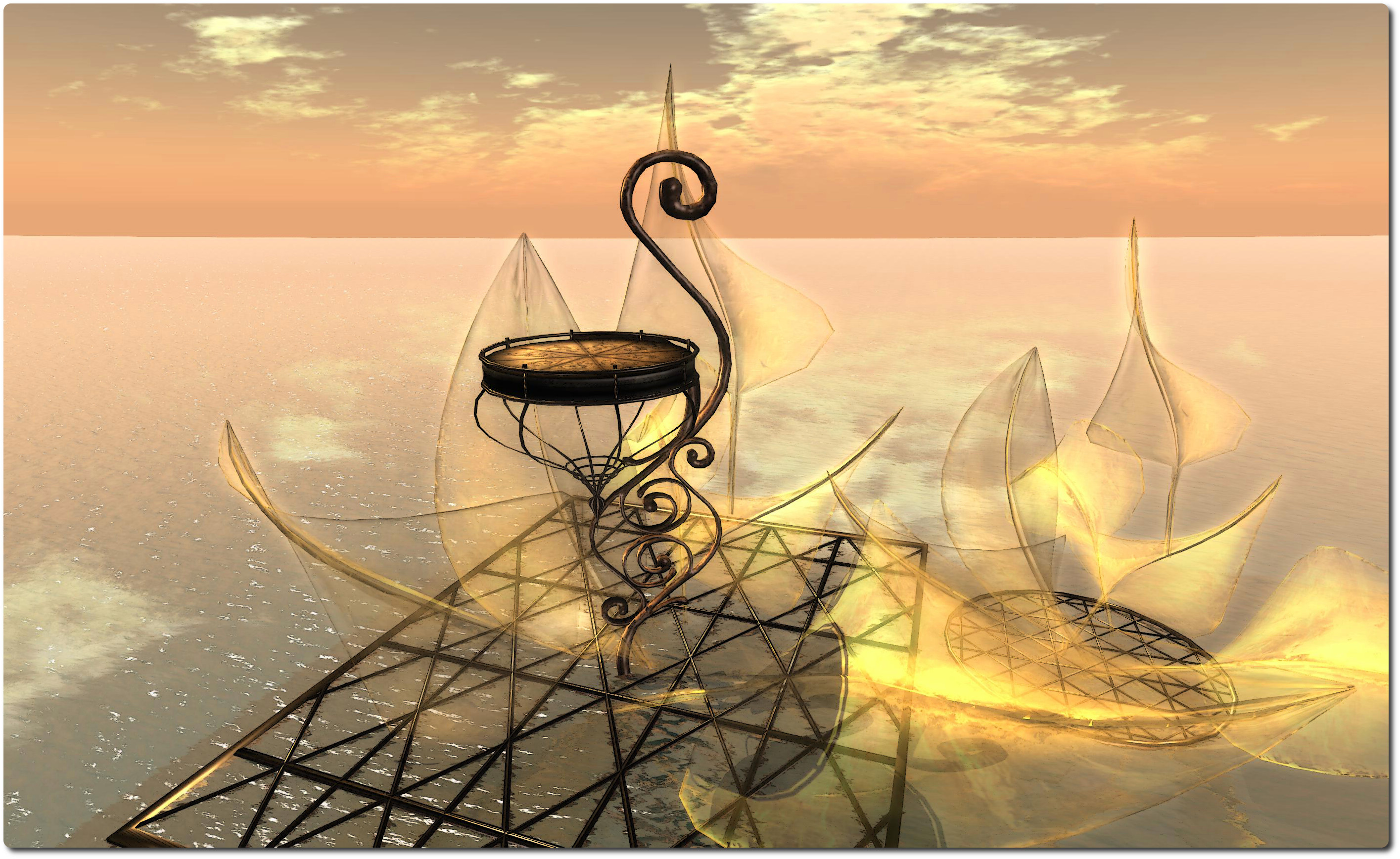
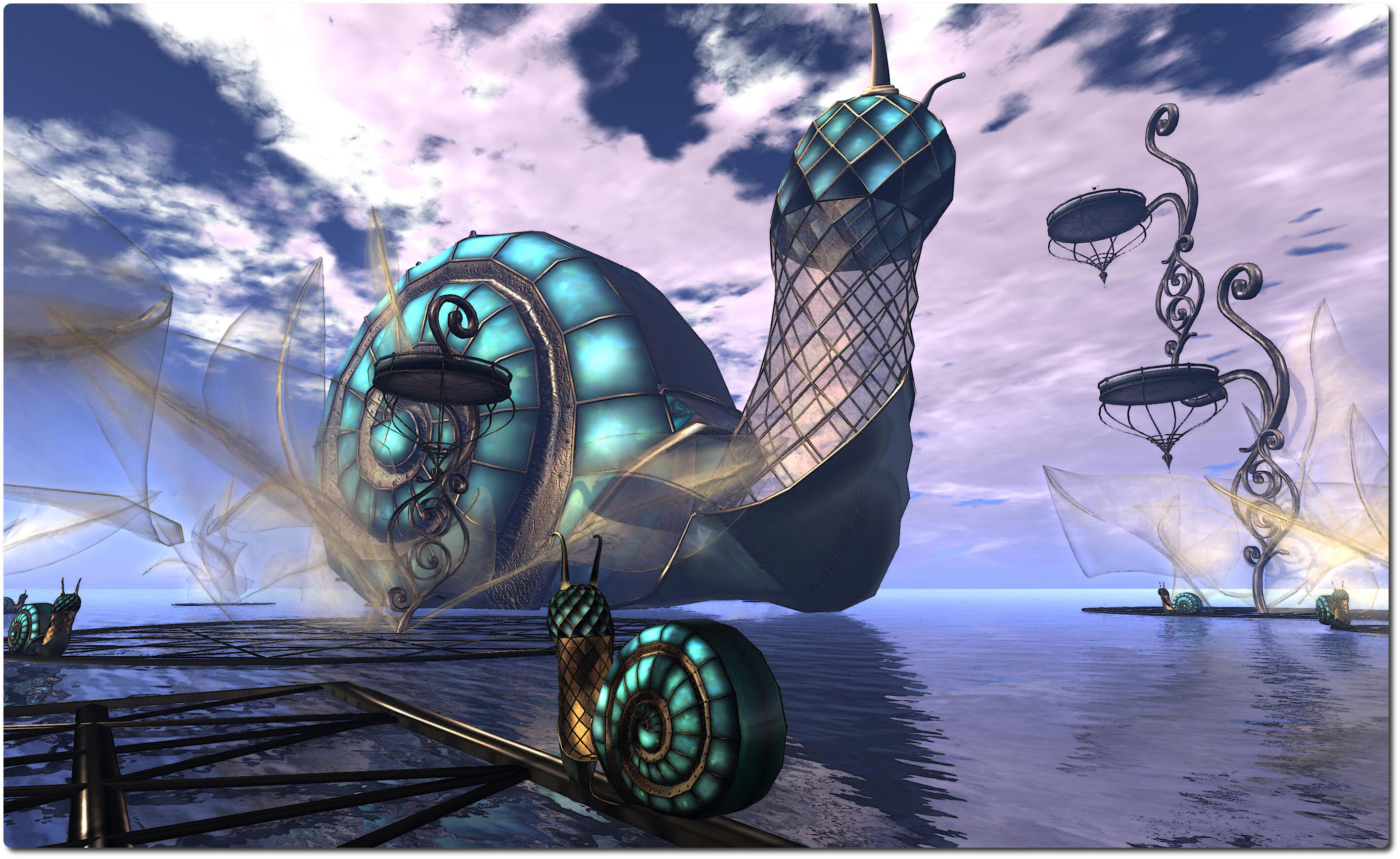
Ten lattice-like platforms, both square and circular, float on the water, each bearing beautifully formed translucent leaves. From the middle of some of these platforms rise ornate pieces which have an almost filigree-like look to them and which support circular platforms overhead. Several of the platforms, both with and without the ornate structures, have the most beautiful snails apparently slowly making their way around the outer edges.

In the centre of all this sits the most gigantic snail you’ve likely ever seen in-world. At over 115 metres in height, it is simply enormous – and wonderfully eye-catching; a huge copy of the the smaller snails sitting on the platforms. Looking to have been constructed of gold – or perhaps bronze (or both) depending on your windlight settings – and glass, it sits in the middle of the region like a gigantic piece of a jeweller’s artistry. In fact, taken as a whole, the installation does feel as if one has fallen into the workshop of some huge master craftsman’s workshop and among his most prized works.

Sleepy Snail
Sleepy Snail

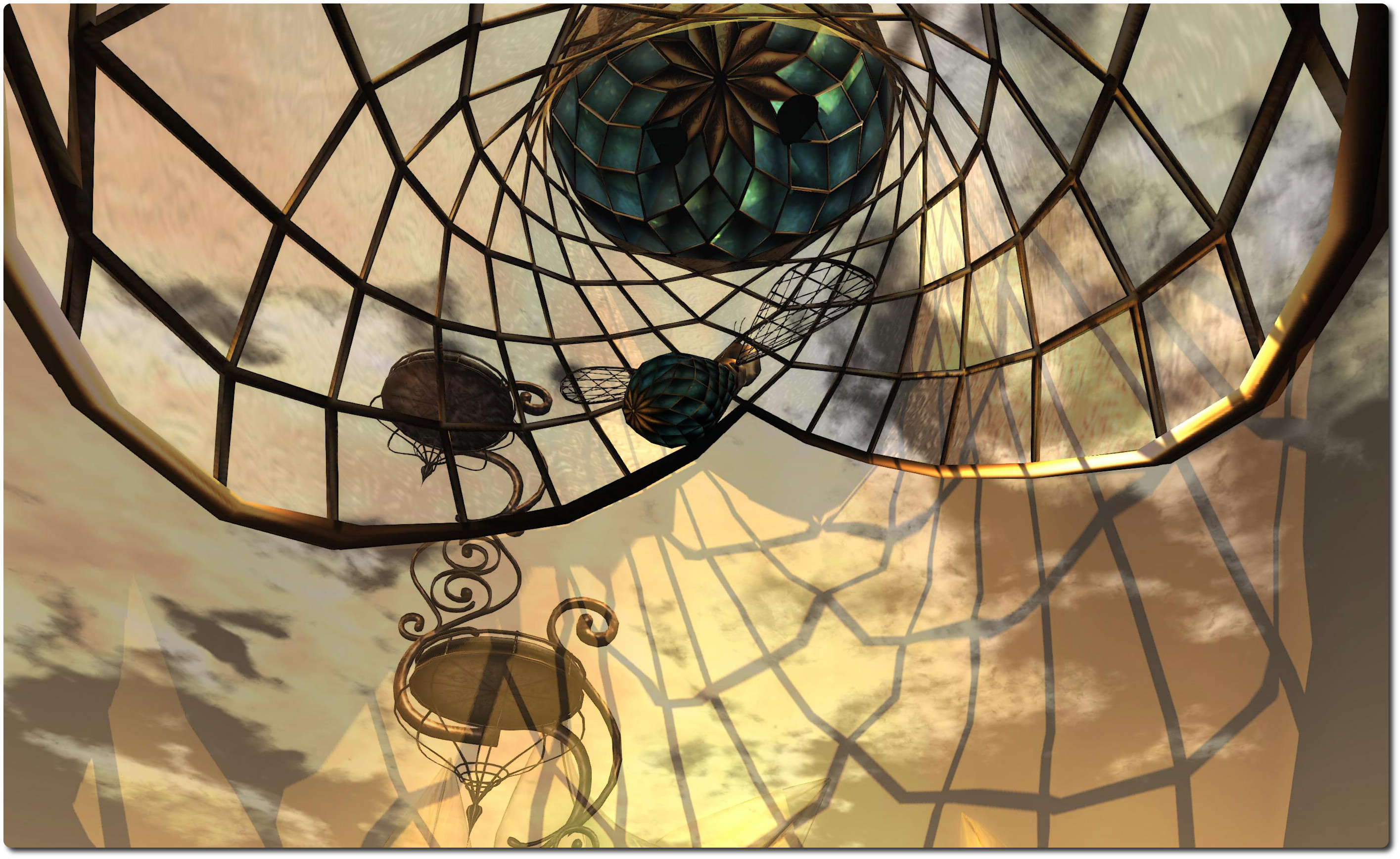
Inside the gigantic snail sits a further series of platforms, these somewhat more businesslike in design and linked by a series of spiral staircases, which lead the visitor all the way up to the topmost platform and a wonderful firefly like creation. More of the latter can be found elsewhere as well, hovering both inside the huge snail and out on the suspended platforms.

Like the jeweller’s handiwork, wonderful detail is evident everywhere – you just need to look. Having a little play with windlight settings helps bring some of the more delicate aspects of the piece gloriously to life. It doesn’t appear as if materials have been used in the designs, which is a little bit of a shame; I can’t help but feel they’d have added even more depth and beauty to the piece.

That is, however a very minor quibble. What Rebeca has created is breathtaking and delightful in its intricate simplicity (if you’ll forgive such a tangled reference) and quite amazing in its elegance. Oh, and when visiting, don’t miss the teleporter near the arrival point, it’ll take you up to a sky theatre where you can enjoy past art presentations and installations at Per4mance Metales.

Highly recommended.

Sleepy Snail
Sleepy Snail

Related Links

Sleep Snails SLurl (rated: Moderate)