In all, SAM has three primary instruments – all of which are focused on the primary science goal for the MSL mission – to investigate the suitability of Mars to support past, present, or future life. The three instruments are: a Quadrupole Mass Spectrometer (QMS), a Gas Chromatograph (GC), and a Tunable Laser Spectrometer (TLS). The QMS and the GC can operate together in a GCMS mode for separation (GC) and definitive identification (QMS) of organic compounds. The TLS obtains precise isotope ratios for C and O in carbon dioxide and measures trace levels of methane and its carbon isotope. These three instruments are supported by two further science instruments: the sample manipulation system (SMS) and a Chemical Separation and Processing Laboratory (CSPL).
While not all of these instruments may be used on every sample gathered by the rover, they present the most comprehensive suite of integrated analysis systems yet delivered to Mars and form the cornerstone of the MSL mission. As such, the mission team is eagerly awaiting the initial finding from SAM so that both further analysis can take place on Earth, and a determination made as to whether instructions should be sent to Curiosity to make it perform more targeted examination and analysis of samples delivered to SAM.
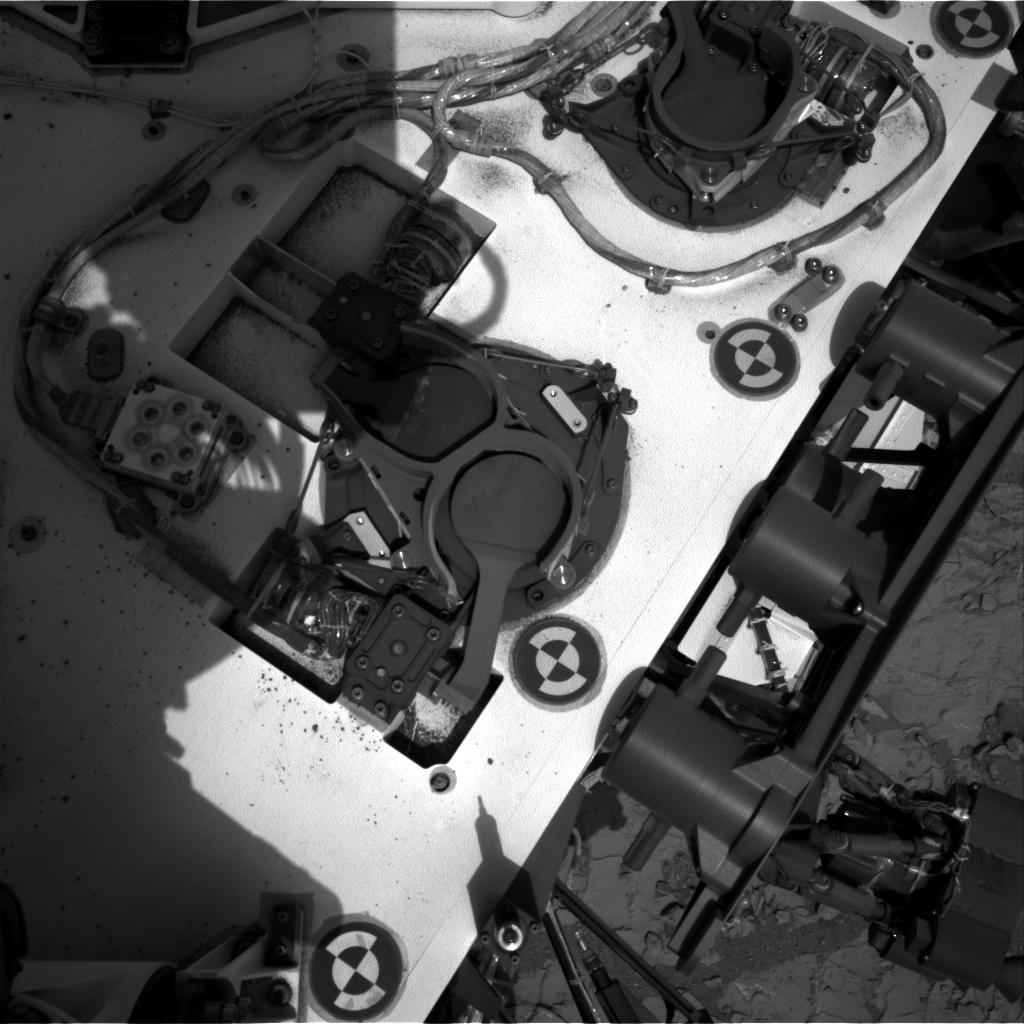
The delivery of these samples marks a further opening of a new chapter in the exploration of Mars, marking the first time a sample of Martian material from inside the rock surface of the planet – and thus untouched by atmospheric conditions – has ever been analysed.
Humans to Fly by Mars in 2018?
A story is circulating the Wednesday February 27th will see Dennis Tito, the first “space tourist” to ever visit the International Space Station (ISS), will announce a highly ambitious mission to send two people on a flyby mission around Mars in 2018.
Mr. Tito, who flew to the ISS in 2001 at a personal cost of some £13 million ($20 million) and who is himself a former NASA scientist at the Jet Propulsion Laboratory, Curiosity’s “home”, is expected to announce plans to use an uprated SpaceX Dragon spacecraft, together with the company’s yet-to-fly Falcon Heavy launch vehicle, which will see a crew of two (possibly 3) embark upon a 501-day mission to fly around Mars and back to Earth.
Currently, the Dragon space vehicle, which commenced resupply and support missions to the ISS in 2012, is not yet capable of flying a human crew – but SpaceX does have plans for a human-capable variant of the Dragon capsule, which should make an initial orbital flight in 2015. They also have plans for an unmanned variant – dubbed “Red Dragon”, to fly a sample / return mission to Mars also in 2018.
Mr. Tito is expected to make his announcement ahead of hosting a session at the IEEE Aerospace Conference being held in Montana, USA, entitled Feasibility Analysis for a Manned Mars Free Return Mission in 2018, on Sunday March 3rd. If speculation is correct, and a flyby mission is being planned by Tito’s Inspiration Mars Foundation, it will face some enormous hurdles. Not only ins the time frame for such a mission extremely tight – just 5 years, with the hardware itself not expected to fly until 2015, and then only in a low-Earth orbit configuration suitable for transporting crew to / from the ISS. The size of the vehicle also means the crew will have very minimal facilities in a “living space” of just 15 cubic metres in the capsule itself, supported by an additional “extended trunk” section of the vehicle which will contain consumables and (limited) personal effects.
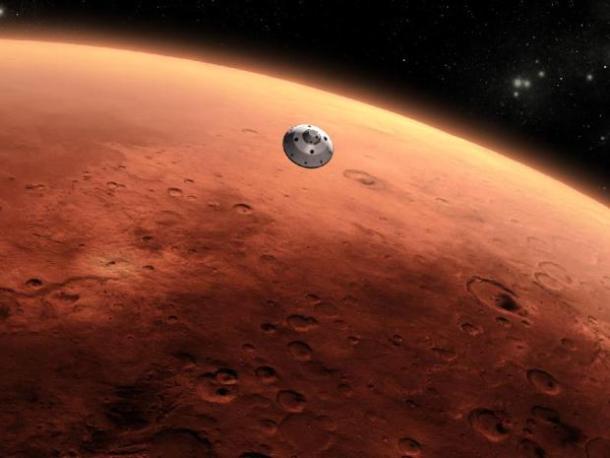
There are many practical questions to be answered in undertaking such a mission: if the mission is performed under ballistic conditions, the crew will be in free-fall for a year and a half, and thus have to deal with matters of muscle atrophy and bone calcium loss; there is the matter of providing suitable protection from solar radiation, particularly if the Sun ops to get lively, even if 2018 is in the middle of the “solar minimum” period between peaks of high activity. The scientific benefits of such a mission might also be considered questionable.
Mr. Tito himself apparently sees the mission as being primarily inspirational and is said to be open to the idea of the (most likely) two-person crew being both a man and woman, papers alleged to have been leaked on the mission noting, “The inspirational aspects and impact on the human population may be enhanced by representation of both genders.”
2018 is seen as an ideal opportunity for missions to Mars, as it is again a period when both Earth and Mars are ideally positioned in their relative orbits to allow “fast” transits between the two, the journey from Earth to Mars taking around seven or eight months. As such, it was often quoted in the late 1990s / early 2000s as an ideal date for the first human mission to the surface of Mars – something which is now slated (at least be NASA) for around 2030.
Images courtesy of NASA/JPL

 Inara Pey: Living in a Modemworld