In June 2012, I reviewed MetaHarpers’ The Inspiring Orientation, an installation intended to be part gallery, part orientation course, with various interactive elements intended to teach new users the basics of getting around in Second Life – walking, flying, chatting, using the camera, sitting, etc.

Opened to the public on February 5th, The Inspiring Orientation, Stage 2 now takes the concept a step further by providing additional interactive lessons covering such diverse subjects as in-world shopping, instant messaging, inventory management, profile creation, in-world combat and games, and exploration. At the same time, it revamps the original installation, and incorporates features such as media-on-a-prim. So what is it like?
On arrival, the installation appears familiar – the welcome area is the same as its first iteration, and the familiar tablet-like guides are still there. However, on stepping inside, it is clear things have been changed. Basic movement – walking and jumping – is quickly dealt with before moving onto the basics of camera control, which used to come somewhat later in the piece, and which is dealt with in a more compact manner. The rest of the initial elements of the piece remain largely unchanged until one arrives at the teleport portals, which in the original more-or-less marked the end of the process. While people can still teleport away at this point, a sign points the way to the new additions waiting to be explored.
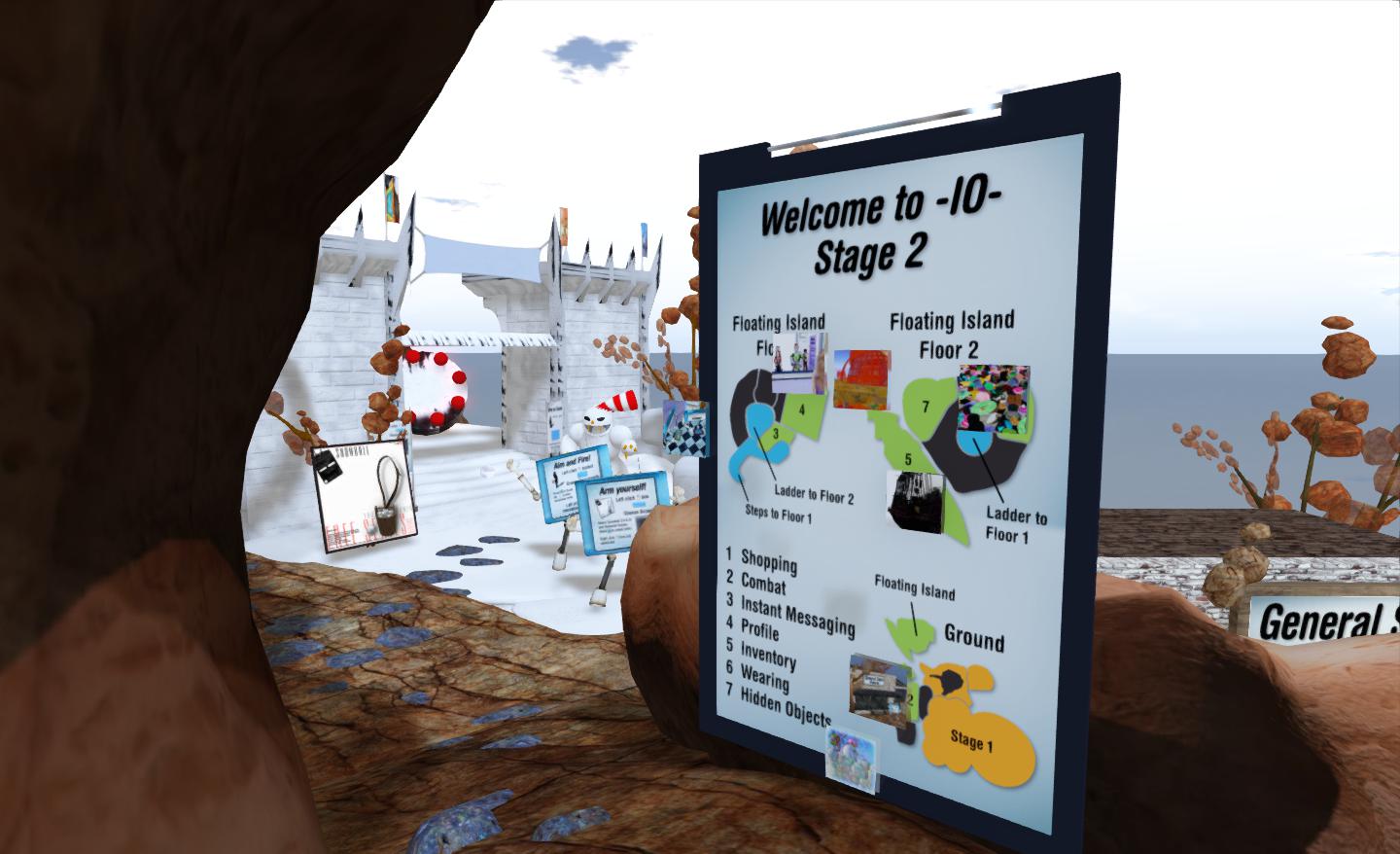
Here people can learn about shopping, instant messaging, profiles, inventory (including attachments, clothing layers, etc), dealing with “hidden objects” and combat, all in discrete units linked by footpaths, chair lifts and ladders.
There are several routes around this part of the installation, which can lead to a degree of repetition in instructions (accessing inventory, for example). However, this is no bad thing in that it allows for easy re-caps on lessons and pointers.

The inclusion of combat options might at first glance seem a little odd, but it actually does make sense given that, while “Second Life is not a game”, many people actually do join SL in anticipation of engaging in roleplay (which can include combat elements) and engaging in combat-related activities (the dreaded zombie hunting beloved of the official SL promo videos, etc). Ergo, getting people started on how weapons, HUDs, mouselook, etc., all work within the realms of combat isn’t necessarily a bad thing.
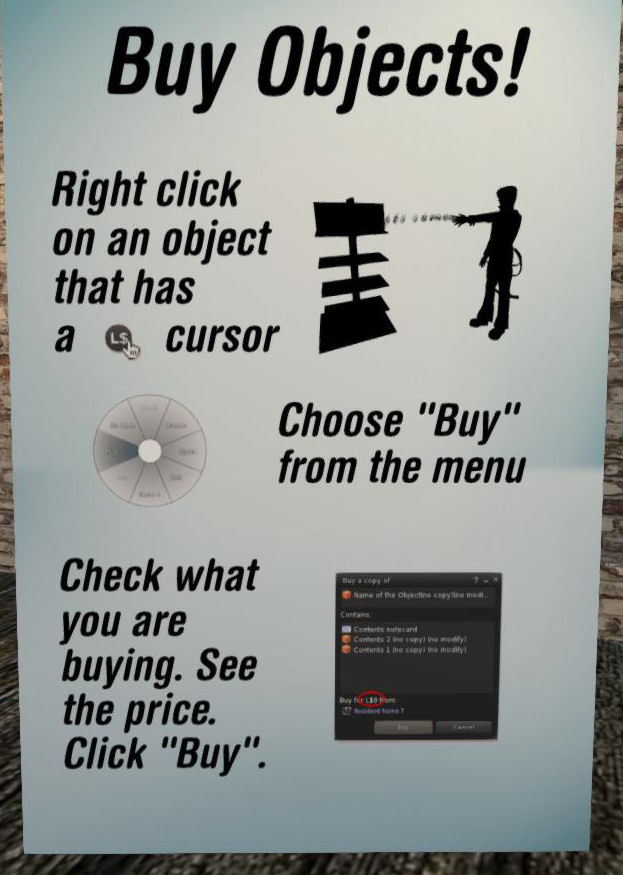
The use of media-on-a-prim in the portal area, is both new and subtle. Drawing on the Destination Guide to provide a click-through list of destinations and descriptions related to the selected portal, it does much to present users with far more choice on where they go next, and on seeing where they are likely to meet other users.
That said, there are a few niggles with the update. Given this is an exhibition intended to demonstrate a new user orientation, the almost exclusive use of screen shots of a popular TPV is surprising. Yes, it may weel be the most popular viewer in use in SL, but given this is a new user experience, and presumably something the creators would hope users would encounter early-on in their explorations of Second Life, I can’t help but feel that there should perhaps be more emphasis on the official viewer – particularly as this is the viewer the majority of new users will initially be using when they log-into SL.
It could also be argued that other essentials are missed or given scant explanation as well – such as the Marketplace, the use of the world map, search and the concept of teleports (although teleports is touched upon throughout the exhibit, if not fully explained). However, the piece is a work-in-progress (the team behind it plan to move it to a location of its own at the conclusion of its time at the LEA), so these are matters which may still be addressed.
One thing that does still disappoint me with the update, though, is that it still fails to reference the viewer’s own means of providing help to users. The How To guide still goes unmentioned, as does the Help options in the menu. The How To guide is certainly worth a reference, given it forms an easy aide-mémoire to some of the lessons given during the orientation tour.
Some might argue that The Inspiring Orientation fails to offer any significant advantages over a more straightforward approach to user orientation such as that provided by the Phoenix Firestorm Support Region. In some respects, I’m inclined to agree; the latter has the beauty of keeping to a KISS approach which make progress perhaps seemingly less time-intensive. However, The Inspiring Orientation perhaps offers greater visual and aural stimulation, and thus may better hold a new user’s attention than a more traditional “walk-and-read” approach.
Whether it is viewed as a prototype / alternative approach to engaging new users and unlocking some of the mysteries of the viewer or whether it is seen purely in terms of an art installation which encompasses learning experiences, The Inspiring Orientation remains an interesting insight into how an engaging and interactive user experience might be built. As such, it has always made for an interesting visit, and the Stage 2 updates provide plenty of additional food for thought, particularly for those interested in the new user experience ethos.
Related Links
- MetaHarper’s blog on the installation
- SLurl to the exhibit (Rated:General)

 Inara Pey: Living in a Modemworld
Related links, more information on the Stage 2 exhibit. Tighter integration with external help systems is planned, along with of course more stations. It’s a living exhibit with always more to do, and a couple surprises for explorers.
http://www.metaharpers.net/inspiring-orientation/inspiring-orientation-stage-2/
LikeLike
Yup, pointed out it’s very much WiP. Just a little disappointed that after stage 1 & our exchanges, How To within the viewer is still overlooked :). mind you, it is elsewhere as well…
LikeLike
I haven’t been there but it has to be a more welcoming area than the hell hole that is Ahern. Until LL address issues such as the hell hole that is Ahern, we’re not going to see much of an improvement in user retention, Ahern needs to be fixed, it’s a fecking disgrace.
I agree with your observations on the use of a TPV for screenshots, new users are unlikely to be using a TPV and I also agree that introducing combat options is a nice step.
LikeLike
I’ve not actually checked to see if Ahern is one of the listed destinations on the Destination Portals new users encounter when logging-in for the first time. Will try to have a peek next time I check on my parked test avie (if it’s not been kicked out by then). That said, I fully agree. Ahern really needs the SL equivalent of the Domestos treatment.
LikeLike
Perhaps a small toturial about 3th patry viewers and why most use them could be achieved!
Until the lab realizes that Rlv (or Rlva for that amtter) should be part of their viewers nobody will use them, and not only for the reasons any could think of!
LikeLike
On the contrary, TPVs shouldn’t form a detailed part of any new user experience other than to specify what they are and a link to the Third Party Viewer directory. All that should be covered in any new user experience are the controls and options common to all viewers.
It’s also fair to say many people do actually use the official viewers, whether or not they have RLV/RLVa.
LikeLike
There’s a master plan here that has been missed by the reviews and not communicated clearly by our team. Briefly:
1) In Stage2 we’ve developed technology that can automatically change the sign displays based on the user’s detected language. The basic signs support portuguese (brazil) and russian in addition to english now. We’re planning to use this same technology to automatically customize the displays to specific viewers UI’s without the user doing anything.
2) There’s a specific group of leaders operating within SL that have following audiences both in SL and in non-SL locations.We’re specifically developing a viewer that can be trivially customized, with no technical skill, in ways to help these particular movers and shaker to bridge their audiences. That is, take people from outside SL entirely and get them right into the place where they want to be, enjoying the performer / artist / creator / event that they already know they enjoy, now in SL’s unique format.
Both of these are long-view goals, we hope you’ll see the Inspiring Orientation as a stepping stone along this path as we develop the technology. Some of you may recognize me from the first two years of Firestorm’s founding work. We’ve think we’ve got a similarly big idea brewing with -io-‘s concepts.
One minor nitpick– The photograph at the top of the article depicts -io- Stage 1, as of June. As Inara’s mentioned it’s been heavily reworked in response to feedback, both in large obvious ways and smaller more subtle ones. I can provide updated pictures if desired!
LikeLike
Look forward to seeing the plans come together. Good to hear the “tablet” guides take native language into consideration; that’s alsways been a concern of mine – seeing non-English speakers catered for.
As to the initial picutre being of stage 1. It’s entirely deliberate on my part – hence the caption referring back. I refrained from including updated external snaps, as the new additions are more interesting in close-up.
LikeLike