Turning the screw on a one-week project

Staring on Monday 22nd October, Seanchai Library (SL) launch a new project: One Work in One Week. Given the time of year, the chosen piece is Henry James’ classic tale The Turn of the Screw.

First published in 1898, Turn of the Screw is perhaps best described as a “psychological ghost story”. In it, an unnamed narrator listens to a friend reading a manuscript written by a deceased former governess. The manuscript tells the story of how the young governess is hired by a man who has become responsible for his young nephew and niece after the death of their parents. He lives mainly in London and is not interested in raising the children himself. Accepting the post, the governess finds herself drawn into a deepening mystery involving the children, strange spectres and perhaps dark secrets.

Or does she?

Turn of the Screw is not your typical ghost story, it is a complex weaving of narrative, with a certain deliberate ambiguity which suggests more than one meaning behind the tale. Are the apparitions (far from any stereotypical ghosts), actual manifestations or something else? Is the governess a somewhat innocent witness caught-up in matters, or is she perhaps more of a protagonist in the unfolding of the tragic events?

It is this ambiguity which has made The Turn of the Screw a classic tale, dividing critics and readers alike. It has led to it becoming an excellent subject for many adaptations over the years, with films, television programmes, graphic novels, radio plays – even an opera and a ballet – either being based upon it or inspired by it.

The richness of the story, its ambiguity and its many turns makes it an excellent subject for audio presentation by the Seanchai Players, so why not go along and share in the unfolding mystery?

The Turn of the Screw will be performed in Voice at Imagination Island at the following times:

  • Monday 22nd through Thursday 25th October: 19:00 SLT
  • Friday 26th October: 20:00 SLT

Updates will be posted on the Seanchai blog, should you miss an evening.

“Off campus” Seanchai Library Events for the Week

Also this week, the Seanchai players will be presenting two further popular pieces on Sunday 28th October*:

*Updated to reflect latest information from Bear Silvershade of the Seanchai Players.

Related Links

Viewer release summary 2012: week 42

This summary is published every Monday and is a list of SL viewer / client releases (official and TPV) made during the previous week. When reading it, please note:

  • It is based on my Viewer Round-up Page, a list of  all Second Life viewers and clients that are in popular use (and of which I am aware) and which are recognised as adhering to the TPV Policy
  • By its nature, this summary will always be in arrears
  • The Viewer Round-up Page is updated as soon as I’m aware of any releases / changes to viewers & clients, and should be referred to for more up-to-date information as the week progresses
  • The Viewer Round-up Page also includes comprehensive links to download pages, blog notes, release notes, etc., as well as links to any / all reviews of specific viewers / clients made within this blog.  

Updates for the week ending: 21 October, 2012

  • SL Viewer updates:
      • Beta version rolled to 3.4.1.265898, October 16 (release notes)
      • Development version rolled to 3.4.2.266075 on October 19
      • The Mesh deformer project viewer rolled to 3.4.1.266081 on October 20
  • Kokua Beta released 3.4.0.0 (Pathfinding) October 15 – core updates: pathfinding tools
  • Niran’s viewer rolled to 2.0.2136 on October 18th – core updates: updates to top windlight toolbar buttons and to new Preferences overlay
  • Cool VL updates:
    • Stable branch jumped to 1.26.4.35 on October 21 – core updates: media plugin code to match the latest v3.4 viewer-development; backport of latest bug fixes from v3.4 viewer-development; further work on MOAP backport (which remains disabled as work progresses); implemented the new LL HTTP engine (currently disabled); added script editor support for new LSL functions and constants implemented in the latest LeTigre RC channel deploy; assorted fixes and clean-ups
    • Experimental branch jumped to 1.26.5.15 also on October 21 – core updates: Backported a v3.4-renderer-specific fix from viewer-development v3.4; implemented & enabled the new LL HTTP engine
    • Release notes
  • Lumiya release version 2.3.2 on October 20 – core updates:avatar name tags in 3D view; configurable avatar rendering limit; ability to touch attached objects; object menus displays as pop-up dialogue boxes in 3D world view; ability to view textures from inventory; support for subfolders in My Outfits. (release notes) – latest review in this blog
  • Libretto – removed from round-up page due to website being unavailable for a month and no response from creator on status (also removed from the SL Third-party Viewer Directory)

Related Links

Lumiya 2.3.2: tagging avatars, limiting their rendering, and wearing your outfits

Alina Lyvette has again been beavering away with Lumiya, adding features, fixing bugs and sorting a couple of things out. In this, I feel a little guilty, as one of the things she’s been sorting out is the Outfits folder. I mentioned last time around that there was a slight hitch with it, and Alina immediately started work correcting it, when really she should have been taking a break.

The result is yet another release for Lumiya, this one 2.3.2, which features the following key updates:

  • Avatar tags in 3D view
  • Object dialogs are now displayed as pop-ups
  • Ability to touch attached objects
  • Ability to view textures from inventory
  • Support for subfolders in My Outfits
  • Configurable avatar rendering limit

Avatar Tags in 3D View

Tagged!

This does exactly what it says on the label: displays the name tag over an avatar’s head, using either the avatar’s display name or legacy name.

Group names  are currently not displayed and frankly, when using Lumiya on a small screen, they’re something I can personally get by without; although I suspect Alina is working on adding them!

Note that there is an option on the Settings menu to display either legacy avatar names user names) or Display Names. This will determine whether Display Names or user names are displayed in the 3D world view as well as in chat, etc. Toggling between the two options will immediately switch between displaying other avatars’ user name or Display Names in chat and IM, but may require a re-log in order for the 3D world view to update correctly.

Object Dialogue Pop-ups

Until now, touching a scripted object in the in-world view and handling the menu was a bit of a convoluted affair: touch the object, switch to chat to see the menu, use the menu, swap back to the 3D view.

Well, no more. Touch an object and you’ll get an initial menu, complete with a TOUCH button. Tap that, and the menu for the object will overlay the in-world view, which you can used exactly as you would in a full viewer.

Touching Attachments

Lumiya 2.3.2 brings a new means of touching worn scripted attachments.

To touch one of your own scripted attachments:

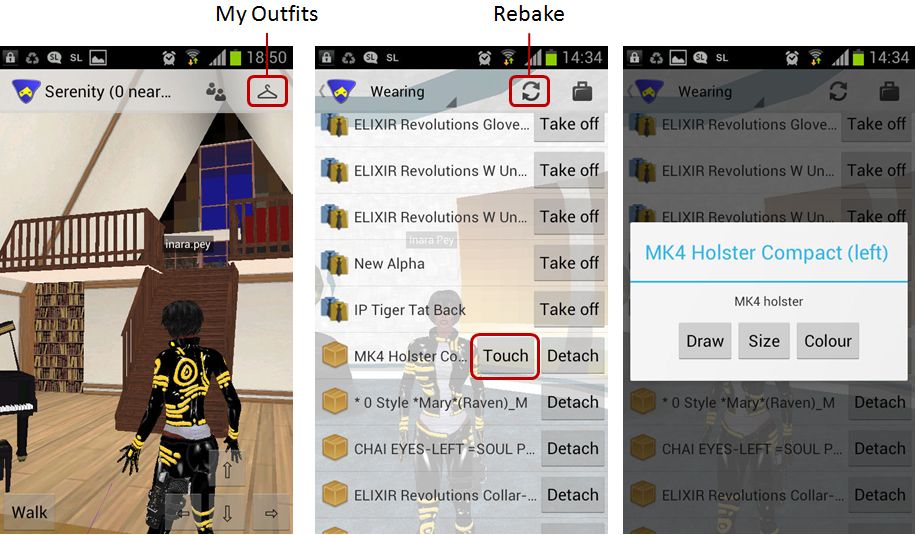
  • In the 3D view open the Outfits window (hanger icon)  – note that the text mode shortcut for attachments is no longer available from 2.3.2.
  • Switch to the WEARING tab in the Outfits window (if using Lumiya on a small screen, you may have to tap “My Outfits” to display a menu which will allow you to switch to a list of worn items)
  • Scroll through the list of worn items to the one you wish to touch – it will have a TOUCH button associated with it. Tap this to display the menu
  • When you have finished with the menu, tap the Back button on your device to clear the menu dialogue box.
Touching a scripted attachment on your own avatar

If you wish to touch an attachment worn by another avatar, you can do so in one of two ways: via the 3D world view or via text mode.

In the 3D world view:

  • Long touch the avatar wearing the attachment – aim for the middle of the avatar, not the attachment itself
  • A menu is displayed at the top of the screen, which includes a TOUCH button if the avatar is wearing anything touchable. Tap this to display a list of touchable items the avatar is wearing
  • Tap an item on the list; if it is publicly accessible (or if you’ve been granted access to the attachment by the user), any menu associated with the object should be displayed
  • When you have finished with the menu, tap the Back button on your device to clear the menu dialogue box.

Continue reading “Lumiya 2.3.2: tagging avatars, limiting their rendering, and wearing your outfits”

Coming in November: Premium promotion, but not just the usual?

I was playing with Lumiya 2.3.2 this afternoon (review coming soon!), when the veritable Lord of Dee, Ciaran Laval tapped me via IM about what appears to be an upcoming premium promotion, which looks set to be going live on the 14th November.

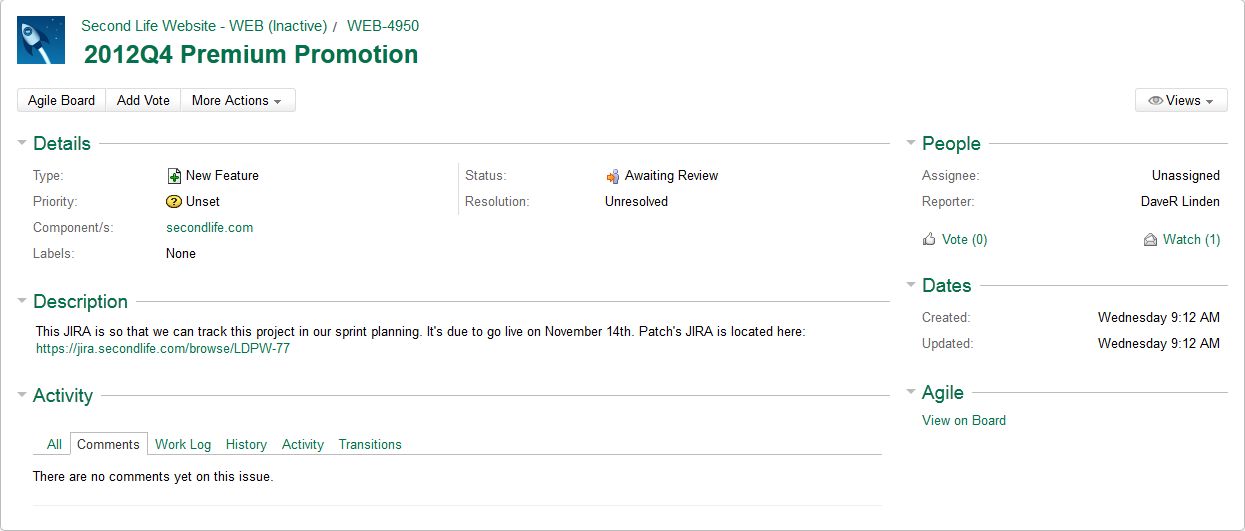
Ciaran spotted the news while taking a look through the JIRA, when he came across WEB-4950:

WEB-4590: click to enlarge

This is probably listed as a public issue in error, so I fully expect it to vanish behind the curtain next week. However, it raises interesting questions.  Why a JIRA for a promotional offer, and why a link to a Linden Department of Public Works JIRA (LDPW-77, closed to public access)?

Between them, these suggest that the promotion will be more than just the “typical” 50% discount on first payments when signing-up to quarterly membership, and that something in-world will play a part in the offer.

Now, the promo could simply be related to another premium gift, but given the last one was issued in late August, the time-frame seems a little short, premium gifts usually come out a little over once a quarter; we also have Christmas on the horizon, so I suspect that, as with last year’s sailing boat, we’re more likely to see the next gift in December.

There’s also the small matter of LL asking about what can be done to improve the Premium Wilderness Experience a few months back. While it remains open right now, could the offer be tied to a belated overhaul of this (which at the time of writing remains open). If so, it seems an awfully long time to get from the e-mail survey (May) to updating the experience, even allowing for protracted time frames at the Lab. There’s also the fact that while visited, the Wilderness Experience didn’t exactly set the SL world ablaze with positive reviews, and I rather suspect most of the feedback provided on the survey was at best lukewarm towards the whole idea. So I’m far from convinced LL are going to try to breathe life back into that specimen.

Premium Wilderness: too long in the tooth to inspire more interest?

I’m therefore leaning towards us seeing something new, and I’m tempted to lean even further (and risk toppling into error) towards it possibly being something akin to Linden Realms – that is, using the advanced creator tools. The “first set” of these was launched back in July 2012, and we’re still waiting for the updated permissions system associated with them to arrive. That the term “first set” was used in the blog post announcing their arrival, I’ve always wondered if LL LL have something else in the pipeline for the tools (beyond getting the permissions system sorted). So perhaps this promotion will see further tools added to the range and rolled out for Premium members to try in a new playground, a-la Linden Realms.

Guess we’ll find out on or around November 14th!

With thanks to Ciaran Laval.

When small and bright can get you discarded

Curiosity remains at Rocknest, its resting place for around the last couple of weeks, continuing with the scooping / CHIMRA / sample operations. When we last left the MSL rover at the end of my last round-up of news, command has been sent to Curiosity to prepare the way for a second sample scoop operation (Sol 65, October 11th).

Originally, the material from this scoop was earmarked for use in further CHIMRA cleaning exercises, designed to “scrub” the insides of the sample processing system clean of any remaining Earth-based contaminants, prior to samples being filtered through it ready for delivery to Curiosity’s on-board analysis systems.

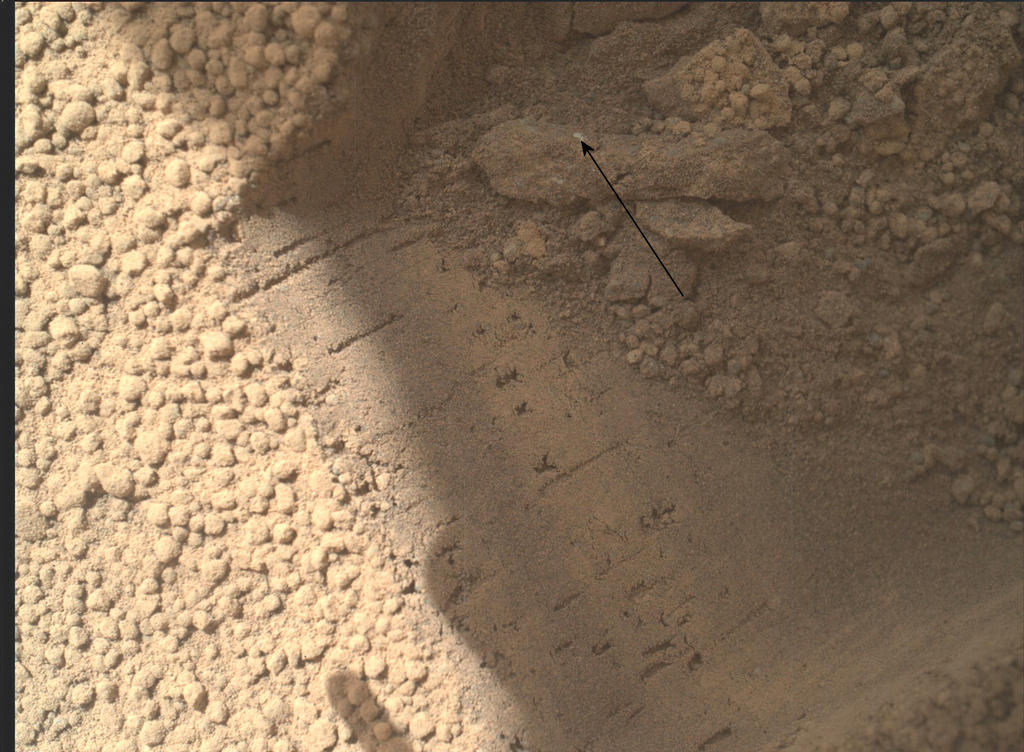
While a sample scoop of material was collected on Sol 66 (October 12th), operations were brought to a halt when images returned by the rover revealed a bright object – another possible FOD (Foreign Object Debris) within the hole created by the scoop when gathering the sample.

The potential FOD, imaged by the Mars Hand Lens Imager (MAHLI) within the scoop-hole from the second sample collection operation. This image shows an area some 5 centimetres (2 inches) across

As reported in my last update, a small, bright FOD was imaged close to the area of the first sample scoop, and after examination using MAHLI, the mission team determined it was most likely debris which had fallen from the rover itself – possibly a tiny fragment of wiring insulation which had originally fallen from the Descent Stage and lodged on the rover. Because of this, mission scientists were concerned that the object seen in the sample hole might be further debris from the rover itself and that some might have been collected by the scoop. It was therefore decided to abandon the sample on Sol 67, rather than risk having contaminants enter CHIMRA.

However, subsequent additional analysis of the object seen in the scoop hole showed that it was in fact embedded in the Martian soil, and therefore unlikely to have fallen from the rover. Closer examination of the ground immediately around the sample spots recorded more, and similar, bright objects, further pointing to the matter in the scope hole being of Martian origin.

These bright objects, possibly result of small pieces of material shearing apart to reveal their unweathered interior faces, will likely be the subject of further study, together with the original FOD seen on Sol 61. “We plan to learn more both about the spacecraft material and about the smaller, bright particles,” said Curiosity Project Manager Richard Cook of NASA’s Jet Propulsion Laboratory, Pasadena. “We will finish determining whether the spacecraft material warrants concern during future operations. The native Mars particles become fodder for the mission’s scientific studies.”

please use the page numbers, below left to continue reading this article

A Rusted Development; an overdue visit

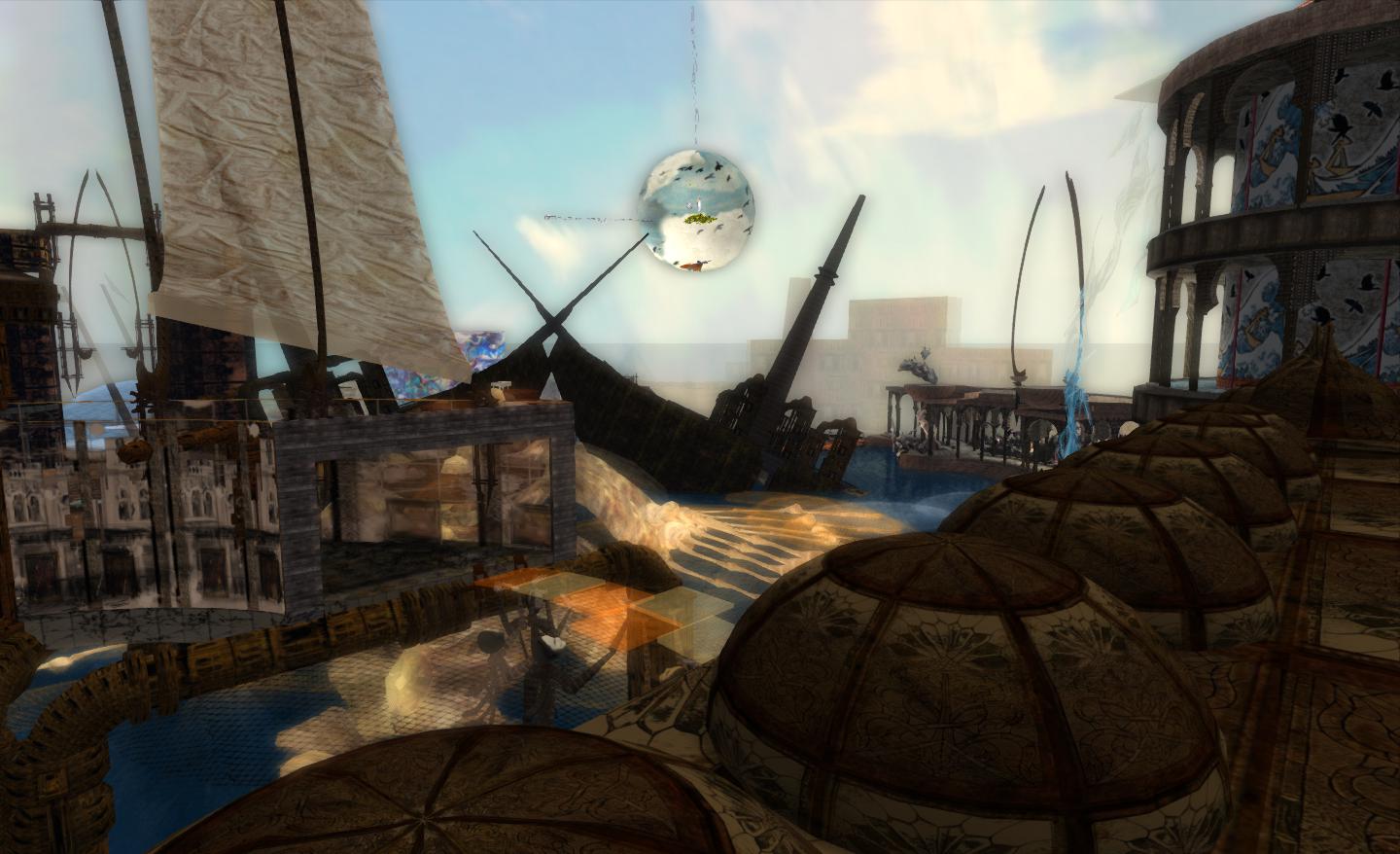
A Rusted Development is a collaborative art installation on LEA1 at the Linden Endowment for the Arts. It isn’t a new feature – anyone with an eye for art in SL will know it opened in May and is enjoying an extended run as part of the LEA’s Guest Curator initiative. I’ve taken my time getting to it as I wanted to leave others far more qualified than I to give thought and feedback on the installation – and then (to my shame) I forgot about it, only to be reminded when attending the opening of Solkide Auer’s new installation earlier in the week, and which sits adjacent to A Rusted Development.

A Rusted Development

The installation is curated by Rowan Derryth and the theme was inspired by her own works, although the overall structure and story for the piece came from Haveit Neox, whom Rowan credits as “The Conjuror”.

What firsts appears to be a bizarre conglomeration of industrial wasteland, water, bones, and scattered exhibits actually has a strong backstory, written by Havit Neox, which forms the basis for the installation itself, and provides a canvas for those collaborating in its final form in which to paint their own elements of a story.

The fabled merchant city that rode atop the back of a gigantic whale met with a calamity that ended its existence abruptly. In the middle of the ocean, a horrific storm caused two huge ships carrying toxic chemicals to collide into the swimming whale city. The whale and all the populace died in the flood of chemicals that saturated the waves.

The whale turned to bones, and the city to rust, it was nearly half a century before this city adrift was discovered. An expedition of artists, searching for land to build an art colony, came upon the decomposing city. With the intent to regenerate the place, they set to work by first towing to safe harbor the floating mass. Each artist then undertook their vision. The empty shell of the city suddenly filled in and expanded as each artist found their niche in the Rusted Development. No longer at the mercy of invisibility, the city humbles its rusted façade to the highlights of the art within.

Within Haveit Neox’s build, A Rusted Development features pieces from some of SL’s most highly regarded artists – Rose Borchovski, Artistide Despres, Claudia222 Jewell , Bryn Oh, Scottius Polke, Ziki Questi, PJ Trenton, Blue Tsuki, Stephen Venkman, Eliza Wierwight, and Trill Zapatero. Each is both an individual piece and also part of the larger whole, providing a further facet of the story, both in terms of the destroyed city itself and the lives of the artists who discovered it.

It would seem the community of artists who came across the ruins of the merchant city had been bound within a society where rules outweighed individuality and expression. Their reactions to the constraints under which they’ve lived, and what it has done to society as a whole appears to be a ventral running theme through many of the individual elements of the installation. Several pieces have a dark edge to them, perhaps reflective of the fate of those who once lived within the city as it was carried across the oceans.

There are works here which scale the range from the very large to the incredibly small and delicate. Each has its own tale – some dark, some perhaps edged with the macabre and others filled with a delicate pathos. Each offers a unique interpretation and a further expansion of the backstory. All of them present a genuinely immersive piece which requires more than one visit if one is to witness everything on offer, both above and below the waves.

If you’ve not already visited, you should.

Related Links