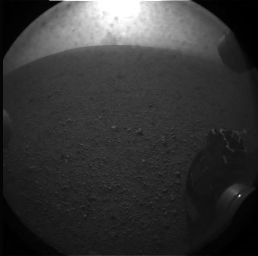
Mars, however, continued to smile on its newest visitor; even as the celebrations continued in the mission control room, the shout went out, “We have thumbnails!” – referring to the fact that the first compressed image had been received. It showed a murky black-and-white view with one of the rover’s wheels sitting intact and level on the surface of the planet.
It was followed seconds later by a slightly higher resolution image (256×256) captured by the Hazcams at the front of the rover which dramatically revealed Curiosity’s own elongated shadow cast across the surface of Gale Crater in further confirmation that the rover was in one piece and sitting level relative to its wheels (the images at the top of this article). The reason both images appear dull and splotchy is because they were taken through the protective covers over the Hazcams, which were splattered by dust thrown up by the motors of the decent stage as it gently lowered the rover on to the surface of Mars.

What Next?
Two hours after Curiosity arrived on Mars, Odyssey made another pass over the landing site which enabled the rover to transmit more data regarding its condition and to confirm a range of pre-programmed tasks had been performed. This effectively marked the start of a very long process of check-out and evaluation the rover will go through prior to it commencing its journey across Gale Crater. This process is liable to run into a number of weeks, something in marked contrast to previous missions, which were very much, “we’re up and running!” affairs. But with a mission duration of at least 687 days (and a power source capable of generating electrical energy for around fourteen years!), there is no reason to rush Curiosity’s time on Mars.
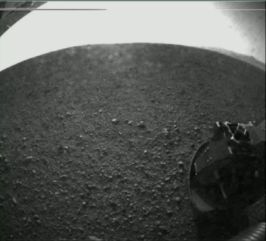
During this second pass at least one further image was received from Curiosity. This was also taken by the rear-facing Hazcams, only this time after the protective dust cover had been jettisoned, and at a resolution of 512×512. It again showed the rover’s wheel sitting comfortably on the planet’s surface, with the rim of the crater itself visible on the horizon above the wheel.
While Curiosity may well be safely on the surface of Mars, there is a lot of information on the EDL phase of the mission still to be returned to Earth – particularly the data from NASA’s MRO. This should be received some time later on Monday August 6th (PDT), and will hopefully include some amazing pictures taken even before Curiosity touched-down on Mars.
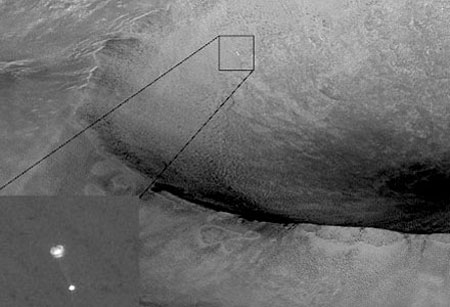
These should come in the form of 1600×1200 pixel images of the surface of Mars captured at a rate of five frames per second during the final powered phase of the rover’s descent from a height of some 3.7 kilometres right down to around 50 metres above Mars. Hopefully, these will provide a remarkable and unique record of Curiosity’s arrival. In addition, MRO itself was programmed to take a picture of Curiosity as it landed, using its HiRISE camera. If successful, it will mark the second time a vehicle landing on Mars has been imaged from orbit, MRO previously having captured a shot of the Mars Phoenix lander in 2008.
Tuesday should see the arrival of an image showing Curiosity’s surroundings, as captured by the MAHLI camera mounted on the robot arm. The arm will still be in its stowed configuration, but it should give a good view looking out over the side of the rover. By Wednesday, mission engineers should have collated enough data on the status and position of the rover in order for it to deploy the mast system, with its high-resolution cameras and the laser system, together with the high-gain antenna, which should significantly increase the amount of data that can be relayed back to Earth via MRO and Mars Odyssey. If all goes according to plan, the first high-resolution panoramic views of Curiosity’s surroundings should returned before the end of the rover’s first week on Mars.
Related Links
- MSL website (JPL)
- MSL website (NASA)
- MSL on Wikipedia
- Follow Curiosity on Twitter
- Eyes on the Solar System MSL EDL simulation
- Mission updates on this blog

 Inara Pey: Living in a Modemworld
Thank you very much for publishing these articles! I’m a great space fan, I’m devouring each of them ❤
LikeLike
You’re welcome. space exploration is something that really fascinates me – I’m glad you like the articles. I’ll doubtless be firing updates out now and again as Curiosity continues to send back data and images :).
LikeLike
Woo hoo! Hello Mars, we’re back again 🙂
(Well, we actually never left it. It’s getting crowded down there 🙂 )
LikeLike