Space Sunday: getting ready to fly on Mars

An art’s impression of the Ingenuity helicopter on Mars. Credit: NASA

If all goes according to plan, on Thursday, April 8th, we could be witnessing the first powered flight of an aerial vehicle on another planet as the blocky Ingenuity helicopter, part of NASA’s Mars 2020 mission, takes to the air for the first of what should be at least five proof-of-concept flights.

The helicopter itself is not a particularly exciting thing to look at: a cube-like fuselage no more than 20 cm across on its longest side that contains the vehicle’s avionics, a heater system to keep the sensitive circuitry warm and operating, a battery system to provide energy to the headers and the vehicle’s propellers, and its science systems. It is supported by four spindly legs just 38 cm long, and is topped by a mechanism of two contra-rotating co-axial rotor systems measuring 1.2 metres from tip-to-tip, with the main communications antennae above them, topped by the solar panels hat will be used to recharge the vehicle’s batteries.

Ingenuity and its systems. Credit: NASA

However, looks can be deceptive. Ingenuity is actually a highly capable aircraft and spacecraft combined. Its systems were designed to withstand 6+ months of interplanetary space travel , while its flight systems have been designed to get it into the air on  a planet where the atmosphere is only about ​1100 as dense as Earth’s.

To put that in perspective: Ingenuity will be attempting to lift off in an atmospheric density that matches our own at 30,000 metres  – that’s almost four times the height of Mount Everest and a height well beyond the capabilities of any Earthbound helicopter. And where the lower gravity of Mars means Ingenuity ways just one third as much as it does when measured on Earth, this offers little in the way of compensation for the rarefied atmosphere.

Hence why Ingenuity is a proof-of-concept vehicle: just getting aloft with be a tremendous achievement – but if it can be shown to do so repeatedly, and to manoeuvre successfully, it could dramatically alter future robotic and human missions to Mars by providing  aerial support for them as terrain scouts or standalone science vehicles carrying their own payloads  operating remotely or – in the case of human missions – flown drone-like from a base of operations.

The first phase of operations for the mission was for Perseverance to scout the land close to its landing point – Octavia E. Butler Landing – to  find a suitable area of level ground over which Ingenuity can fly. This required finding an area some 90 metres in length and roughly 12-15 metres wide relatively clear of significant obstacles that might limit landing options., and with an area 10 metres on a side from which the first flight will be made and which has been dubbed “the airfield”. 

The flight zone and “the airfield”, the area in which Ingenuity will be test flown. Credit NASA

This deployment requires a number of actions to occur, the first of which came on Sunday, March 21st, when the cover that had been protecting Ingenuity was dropped from under the rover (see my previous Space Sunday update). Once Perseverance is correctly positioned at the centre of “the airfield”, the rest of the deployment will take place over a period of 6 Martian sols (days):

  • Sol 1: restraining bolts locking Ingenuity in place under the rover will be released.
  • Sols 2 and 3: a cable also holding the helicopter will be explosively released, triggering a motor that will gently rotate the helicopter down into an upright position beneath the rover, allowing two of Ingenuity’s landing legs to spring into their deployed position in the process.
  • Sol 4: the remaining two legs on Ingenuity will be released to snap into place. At this point, the helicopter will be slung under the rover, held in place by a single bolt and a set of power connectors.
  • Sol 5: Perseverance will carry out a full charge cycle of Ingenuity’s batteries – until now, the rover has only charged the batteries to around one-third their capacity, enough to keep the helicopter’s system warm.
  • Sol 6: The rover will be commanded to release the helicopter, allowing it to drop the 13 centimetres to the ground.

At this point, things will get a little risky: there will be no means to communicate with the helicopter, and its batteries can only supply it with power for 25 hours without recharge. In this time, a final visual check on Ingenuity must be carried out using the WATSON imager on  the rover’s robot arm, and then the rover must carefully reverse away from the helicopter to a distance of 5 metres.

Once at this distance, the rover will be able to act as a communications relay between mission control and the helicopter, allowing mission control to command the helicopter to switch to charging its batteries from its solar cells and upload the required flight software.

In all, the flight team have 30 days from the moment Ingenuity is released from Perseverance to complete the planned five flights. After this time, the rover must commence its own science programme. The flight team will therefore be looking to complete those five flights in as short a space of time as possible. For the first flight, Ingenuity will do little more than attempt to rise to a height of 3 metres, hover for 30 seconds and then land safely. After this, the remaining four flights will be for longer and to heights of around 5 metres, and for increasing distances down “the airfield”.

If we get past those [flights], we will assess:  did we meet all our objectives during those flights? Do we want to go back and retry some of those things? Or, if everything goes really well, then we might try to stretch our capabilities beyond those basic capabilities.    

– Ingenuity chief pilot Håvard Grip

The late Jakob van Zyl after whom the elevated position from which Perseverance will observe Ingenuity’s flights has been named. Credit: NASA

All of the flights will hopefully be documented by Perseverance its powerful Mastcam-Z camera system and two on-board microphones from an observation point some 60 metres from “the airfield”, which it will drive to prior to the first flight.

This observation point has been dubbed the Van Zyl Overlook in honour of key Ingenuity team member Jakob van Zyl, the former director for solar system exploration and associate director for project formulation and strategy at NASA’s Jet Propulsion Laboratory, who passed away unexpectedly in August 2020.

When it makes its flights, Ingenuity will both make history and carry a piece of history with it: attached to the Helicopter is a small piece of fabric taken from the Wright Brother’s 1903 biplane, credited with making the he first powered, controlled flight on Earth on December 17th, 1903.

‘Oumuamua is Likely a Piece of a Planet

In 2017 the Pan-STARRS astronomical observatory in Hawaii identified an object of extra-solar origin on a course that would carry it around the Sun. Named  ‘Oumuamua, meaning “scout” or “messenger” in Hawaiian, it was the first such object to be positively identified as coming from beyond the solar system,  although it is now believed that as many as five such object could pass through the solar system every year.

‘Oumuamua, however, was not only the first to be positively identified, it was also highly unusual – so much so that it couldn’t be classified as either an asteroid or a comet, as it exhibited behaviour common to both – and behaviour and attributes not found in either. This has lead to a variety of possible theories being put forward for it might be – up to and including the idea it was actually an interstellar probe created by an alien intelligence.

An artist’s impression of 1I/2017 U1 (or `Oumuamua), which was first seen by the Pan-STARRS 1 telescope in Hawaii on October 19th, 2017, and subsequently studied by a number of telescopes around the world, including the VLT of the European Southern Observatory (ESO). Credit: ESO / M. Kornmesser

However, two astrophysicists from Arizona State University believe they now have solved the mystery of ‘Oumuamua.Taking the more comet-like behaviours of the object, Steven Desch and Alan Jackson started looking for combinations of ices and volatiles that, when affected by the heat of the Sun, who produce the kind of reactions seen with ‘Oumuamua.

Their research lead them to a combination of nitrogen-dominant ices that, under computer modelling, not only produced the kind of non-tail generating outgassing seen with ‘Oumuamua, they they closely match combinations of nitrogen, methane and other ices found on Pluto and Neptune’s moon Triton.

These findings, coupled with further computer modelling, tend to suggest ‘Oumuamua  is likely a part of a Pluto-like planet orbiting a star somewhere in our stellar neighbourhood (separate estimates of data gathered on the object suggest it is around a billion years old, so must has originated fairly close to us, given its observed velocity through the solar system). If correct, then Densch and Jackson may not only have solved the nature of ‘Oumuamua , they may have shown that a new class of exo-planets exists: so-called “exo-Plutos”.

Continue reading “Space Sunday: getting ready to fly on Mars”

Space Sunday: more from Mars and recalling a NASA legend

A CGI model of the Mars 2020 rover Perseverance on the surface of Mars. Credit; NASA

NASA’s Mars 2020 Perseverance rover has passed its first month on Mars, an event marked by the science and engineering teams continuing to check out the rover’s systems  and instruments as the rover continues its initial drive within Jezero Crater.

So far, all of this has been going exceedingly well. We’ve had no major technical issues. We’ve had no major technical issues.

– Ken Farley, Perseverance project scientist

Currently, the mission team are preparing to deploy the Ingenuity drone helicopter ahead of for a series of proof-of-concept flights. This has involved driving the rover short distances to locate a suitable area in which to deployed the helicopter, which is stored under the rover.

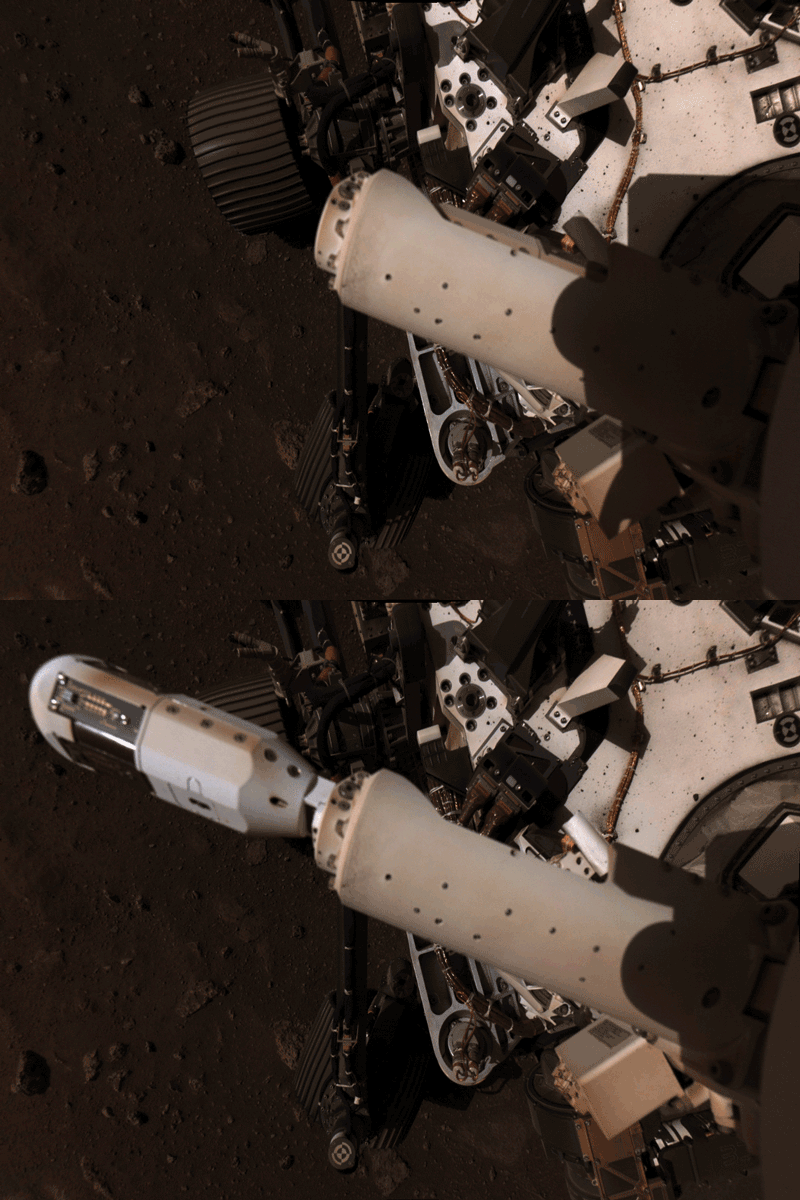
So a location was found during the past week, and on Sunday, March 21st, Sol 30 for the rover on Mars, the command was sent to eject the cover that projected the delicate helicopter during the rover’s arrival on Mars. The release of the cover was filmed by the WATSON imager on the rover’s robot arm, with raw colour and black and white images issued by NASA a few hours after the cover had been dropped.

Two images of captured by the WATSON imager on the Mars 2020 rover robot arm show fore-and-after views, one in black-and-white and the other in colour, of the detached protective cover for the Ingenuity helicopter droner. The helicopter can be seen stowed and attached to the rover’s belly at the top of each image. Credit: NASA/JPL

The next stage will be for the rover to move clear of the cover so the helicopter itself can be deployed, before the rover backs away even further to expose the drone to clear air. It’s not clear when this deployment will take place, but NASA will be holding a special briefing on Tuesday, March 23rd at 17:30 UTC at which members of the helicopter and rover team will discuss progress with the mission and what will be involved in the helicopter deployed and flight operations  commence. The briefing will by available on NASA TV and YouTube, with questions being accepted via social media using #MarsHelicopter.

The first flight won’t be made any earlier than the first week of April, but it will be filmed by the rover using its high-resolution Mastcam-Z systems, and an attempt will be made to record the sound of the drone flying. In all, five flights of the helicopter are anticipated, after which Perseverance will commence its own science mission.

As things stand, this will be a two-phase mission, the first being an exploration of the inflow delta created by the water that once flowed into the crater to form a lake. In particular, the rover will be looking for evidence of past life in the sediments and rocks. Along the way, it sell select a spot to deposit up to 10 samples it has gathered during its studies, which my be collected by a future sample-return mission.

The second phase will see Perseverance may its way out of the crater to examine the crater rim and the plains beyond. Here again, it will select a location to deposit up to 28 samples that may be gathered by a future sample-return mission.In all, both phases of the mission – which will be subject to change depending on discoveries made along the way – are expected to take around 7 years to complete and will see the rover cover some 35 km.

In the meantime, the rover’s microphones have been busy; as I reported in  my last Space Sunday, one has recorded the sound of the Martian wind. More recently, NASA has released a recording on the rover’s EDL (Entry, Descent. Landing) microphone capture of sounds of the rover driving on Mars.

Those expecting some high-tech sound of purring electrical motors and so on as depicted in sci-fi films are liable to be disappointed by the strange mix of bangs,clunks and thuds recorded as the rover’s aluminium wheels and its spring suspension deal with the uneven terrain. Two recordings were released, one at 16 minutes in length, and a 90-second “cleaned up” recording, that is embedded below.

If I heard these sounds driving my car, I’d pull over and call for a tow. But if you take a minute to consider what you’re hearing and where it was recorded, it makes perfect sense.

– Dave Gruel, lead engineer for Mars 2020’s EDL Camera and Microphone subsystem.

One of the reasons the sounds seem to be odd is because the EDL microphone isn’t designed to record the the sound of the mobility system directly, rather it is picking the sounds up through the body of the rover.

Glynn Lunney

Glynn Stephen Lunney may not be a name familiar to many interested in human space flight, but he was one of the legends of NASA, and who sadly passed away at the age of 84 on March 19th, 2021.

Born in November 1936 in the coal city of Old Forge, Pennsylvania, Lunney was encouraged by his parents to seek a career away from the mines. An early interest in flight and model aeroplanes led him to engineering in college, form where he enrolled at the Lewis Research Centre in Cleveland, Ohio, to study aerospace engineering, the centre at that time forming part of the US  National Advisory Committee for Aeronautics.

Graduating in 1958 with a Bachelor of Science degree, Lunney remained with the NACA as a researcher in aerospace dynamics at Lewis. He was thus one of NASA’s very first employees when on July 29th, 1958 President Eisenhower signed it into existence, subsuming the NACA into it in the process.

Lunney’s prowess in the fledgling field of space flight was immediately recognised, and he was transferred to Langley Research Centre, Virginia, where in September 1959, and aged just 21, he became the youngest member of the Space Task Group, the body given responsibility for the creation of NASA’s human space flight programme.

Glynn Lunney “in the trenches” (as the rows of consoles at mission control were called at the time) of the mission simulation centre, 1966. Credit: NASA
As a member of the Flight Operations Division, Lunney was one of the engineers responsible for planning and creating procedures for Project Mercury, America’s first manned space programme. Here he was a major part of the team that wrote the first set of mission rules by which both flight controllers and astronauts operated, and he also became the second man to serve as the Flight Dynamics Officer (FIDO), responsible for controlling the trajectory of the Mercury spacecraft and planning adjustments to it.

Such was Lunney’s quiet assurance, professionalism and engineering skill, he was one of three men selected by Christopher C. Kraft, the hands-on head of mission operations, to join him in becoming the first generation of Flight Directors responsible for managing all of NASA’s space flights, the other two being John Hodge and the legendary Gene Kranz. Together, these for men did much to establish the protocol  and procedures required for human space flight at that time, and they also oversaw the design and implementation of the first two Mission Operations Control Rooms which were to become famous as “mission control” in the Apollo era.

Lunney (seated, foreground) walking his team through the process of transferring guidance and navigation data from the Apollo 13 command module to the lunar module,  1970. Credit: NASA

Although only 29 when selected by Kraft, Lunney was, in addition to his responsibilities as a Flight Director, charged with overseeing the testing of core elements of Apollo flight hardware, including the launch escape system, and the first uncrewed flight test of the the Saturn V launch vehicle.

Lunney was particularly respected for his ability to absorb and retain information, running through scenarios and options much faster than any of his colleagues. This was especially important in the wake of the Apollo 13 explosion in  1970, with the vehicle en-route to the Moon.

While Genz Kranz and his White flight team tend to get all of the credit for successfully guiding the astronauts through the crisis and getting them back to Earth, it was actually Lunney who orchestrated the entire process of powering-up the lunar module, transferring the flight guidance and navigation data to its computer and  getting the Apollo 13 crew and critical equipment into the module within a very short time frame, whilst also leaving the command module in a condition whereby it could hopefully be powered up later. In doing so, he largely steered his team by using his own innate knowledge of systems aboard both craft.

Continue reading “Space Sunday: more from Mars and recalling a NASA legend”

Space Sunday: vistas of Mars and more on rockets

Released on March 5th, 2021, this image was captured on February 22nd, 2021 (Sol 4), using the Mastcam-Z system on NASA’s Perseverance rover. It shows a raised section of outflow delta sediments approximately 2.3 km west of “Octavia E. Butler Landing”, where the rover touched down. It was likely formed by material carried into the crater by flowing water that gradually settled as the flow of water met the calmer waters of the crater lake. The remnant is approximately 25-30m high and some 200m across at its base, as indicated by the horizontal scale. Beyond it can be seen the crater wall forming the backdrop to the image. Credit: NASA/JPL

NASA’s Mars 2020 Perseverance rover has spent a further week prepping itself to commence full-time operations on Mars, while also clocking up a distance of 90+ metres while further exercising its driving skills. The mission has also started honouring the Navajo people and their language.

Prior to the mission launching, the science team divided the anding site in Jezeo Crater into a grid with each cell covering an area of 1.5 square kilometres and after a US national park exhibiting similar geology. The plan was to compile a list of names inspired by each cell’s national park that could be used to name features observed by Perseverance. However, as the rover landed in the cell named for Arizona’s Canyon de Chelly National Monument (Tséyi’ in Navajo), in the heart of the Navajo Nation, the mission team reached out to the Navajo Nation through team member Aaron Yazzie, himself a Navajo (or Diné), to seek their permission and collaboration in naming new features on Mars.

Navajo Nation President Jonathan Nez, Vice President Myron Lizer enthusiastically agreed to the idea and worked with advisers to make an initial list of 50 words in the Navajo language that could be used by the rover’s team in  dubbing surface features imaged by the rover.

The partnership that [we have] built with NASA will help to revitalize our Navajo language. We hope that having our language used in the Perseverance mission will inspire more of our young Navajo people to understand the importance and the significance of learning our language. Our words were used to help win World War II, and now we are helping to navigate and learn more about the planet Mars.

Navajo Nation President Jonathan Nez

“Máaz” (Navajo for “Mars”) is currently the first target for scientific study by Perseverance. Credit: NASA/JPL

These names have already started to be used, and more are being added to the list. There is, however a complication: the accent marks used in the English alphabet to convey the unique intonation of the Navajo language cannot be read by the computer languages Perseverance uses. So instead, the science team is working with the Navajo to produce unaccented phonetic representations of the names which the rover can interpret.

The first of the Navajo names to be used is “Máaz” (the Navajo word for Mars – or “Maaz” to the rover). It has been applied to the first target for study by the rover, a large, flat rock the rover is due the commence studying soon. A second rock, dubbed “Yeehgo” (Yéigo in Navajo) has been used as a test subject for the rover’s SuperCam.

“Yeehgo” some 3.1m from the rover was used as a test subject for the SuperCam imager system and lasers on March 10th (Sol 16), during the rover’s driving operations. This images so the image contrasts from Navcam imagers (main picture) to Mastcam-Z (lower right) and Supercam mosaic of 2 images.Credit: NASA/JPL

Developed jointly by the Los Alamos National Laboratory (LANL) in New Mexico and a consortium of French research laboratories under the auspices of French space agency CNES, SuperCam is an instrument suite that can provide imaging, chemical composition analysis, and mineralogy in rocks and regolith from a distance. It comprises two lasers that can “zap” rocks and other features multiple times per second while using it imaging system and four spectrometers to analyse the vapour and dust given off by the laser strikes to determine the composition of the material struck and potentially identify bio-signatures and assess the past habitability of the rock.

“Yeehgo” was used as a means of testing the resolution of the Remote Micro-Imager (RMI) on the SuperCam system, with the rover’s high-resolution Mastcam and Navcam systems (both of which are mounted on the rover’s mast just below the SuperCam) also capturing images for context. The rock was also a target for the laser systems, which the on-board microphones picked up as they fired, the lasers sounding like a fast swinging Newton’s Cradle (sorry, no “pew-pew!” from Mars).

Since departing “Octavia E. Butler Landing” the rover has been scouting locations of interest,  in particular looking for an area when it might safely drop off the Ingenuity drone helicopter. The latter is intended to complete its test flights in the first 30-60 days of the mission in order to free-up the rover so it can drive much further afield and get on with its primary science mission in earnest.

Along the way, Perseverance paused to take in objects such as the rocks mentioned above, and to perform checks of its underside using the imaging systems on its robot arm, checking on the ejection of the “belly pan” covering the underside caching system that will deposit samples of rock and material for collection by a future sample-return mission.

I’ll have more on the Mars 2020 mission over the coming weeks.

Left: March 12th (Sol 18), the imaging system on the rover’s robot arm is used to check the underneath of the vehicle ahead of the release of the belly pan (outlined) covering the sample caching system. The four forward cameras of the Hazcam system can be seen at the top of the picture. Right: March 13th (Sol 19), a view from the rover’s rear Hazcam system images the belly pan on the ground as the rover resumes its drive. Credit: NASA/JPL

Continue reading “Space Sunday: vistas of Mars and more on rockets”

Space Sunday: Perseverance, SN10, and a little bit more

Part of a 360º panorama of Jezero Crater stitched together from 79 individual images captured by the high-resolution Mastcam-Z right-eye 110-mm zoom camera, captured on the afternoon of Sol 4 (Feb. 22nd, 2021). Credit: NASA/JPL

NASA is continuing to get the Mars 2020 rover Perseverance ready to commence science operations, with the past week has seen a number of milestones achieved – including the rover’s first drive on the surface of Mars.

Immediately following the post-landing check-outs, mission controllers were focused on swapping out the Entry Descent and Landing (EDL) software on the rover for the software that will be central to its surface operations. This work was completed on Friday, February 26th – Sol 8 on Mars for the rover. This paved the way for this week’s check-outs of systems.

On Sunday, February 28th, commands were sent to deploy the Mars Environmental Dynamics Analyser (MEDA). Located on the rover’s mast, this comprises two extensible booms and forms the rover’s “weather station”, a set of sensors that measure temperature, wind speed and direction, pressure, relative humidity, radiation, and dust particle size and shape, provided by Spain’s Centro de Astrobiología.

Created from a series of NavCam images recorded on February 28th, this .GIF reveals the deployment of one of the Mars Environmental Dynamics Analyser (MEDA) booms on Perseverance Mars rover. Credit: NASA/JPL

Following this, on Tuesday, March 12th (Sol 12 for the rover), the robot arm was put through its initial paces.

As with Curiosity, the robot arm on Perseverance forms a key part of its science and physical capabilities. At over two metres in length, it has 5 degrees freedom of movement, and ends with a 45 kg “turret” that carries numerous tools and instruments, including:

For its first use, the arm was extended from its cradle and raised to the vertical before being “wriggled” back and forth to confirm instrument stability. It was then lowered and put through a set of rotational moves (as was the instrument turret), before being returned to its cradle and the turret again rotated in two directions.

Images of the rover’s robot arm being put through a basic set of movements. The white “box” on the turret is the PIXL spectrometer, To the right of that is the sample / drill system and on the far side of the turret relative to PIXL is the SHERLOC / WATSON combination. Credit: NASA/JPL
Tuesday’s first test of the robotic arm was a big moment for us. That’s the main tool the science team will use to do close-up examination of the geologic features of Jezero Crater, and then we’ll drill and sample the ones they find the most interesting. When we got confirmation of the robotic arm flexing its muscles, including images of it working beautifully after its long trip to Mars – well, it made my day.

– Robert Hogg, Mars 2020 rover deputy mission manager

A further significant milestone was marked on March 4th (Sol 14), when the rover made that first drive. While covering less then eight metres, it was enough for the rover to perform a few basic manoeuvres intended to allow the engineering team to check-out the rover’s basic mobility capabilities.

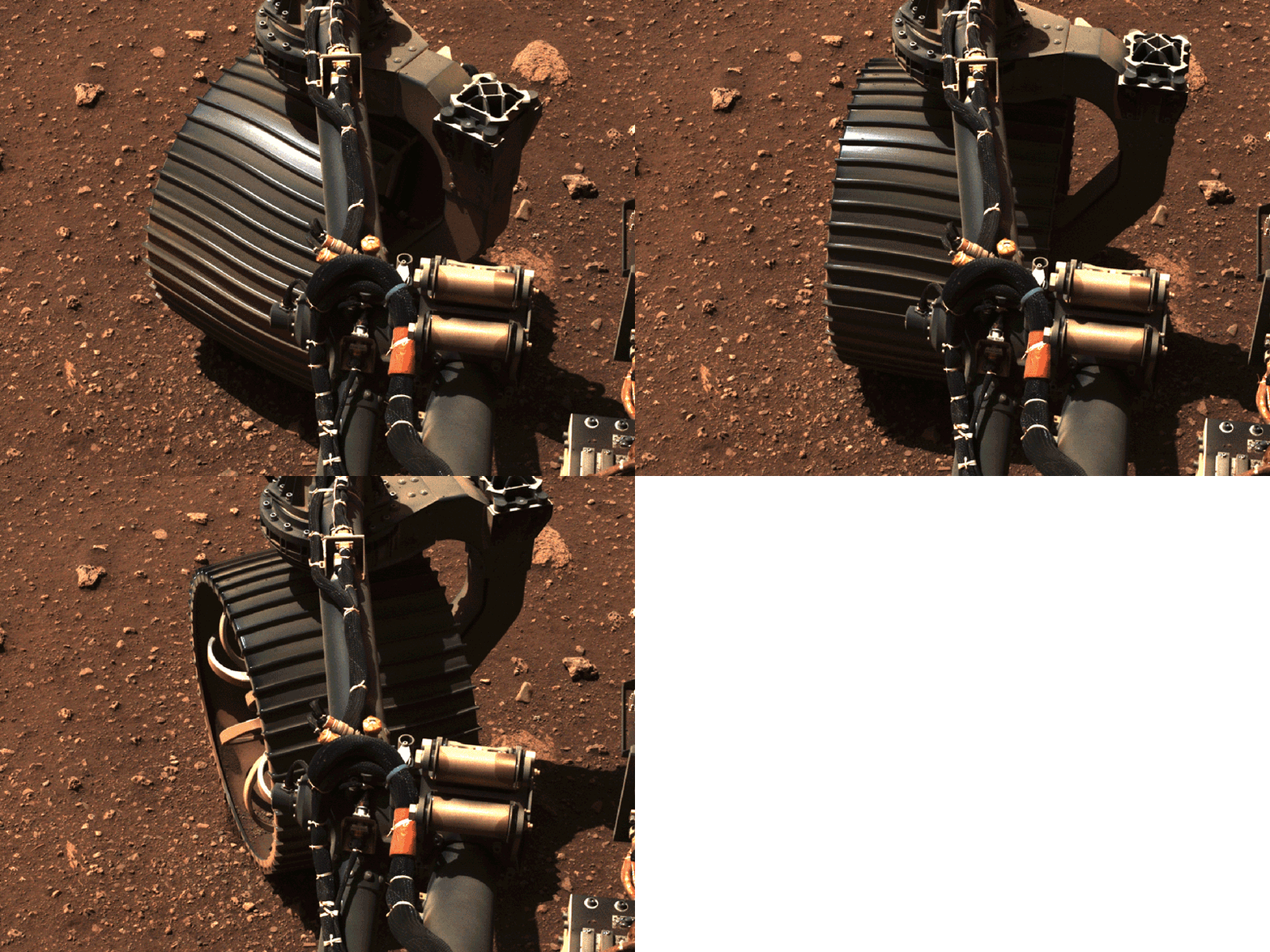
Perseverance wiggles one of its wheels in this set of images obtained by the rover’s left Navigation Camera on March 4th, 2021. Credits: NASA/JPL

Following a set of initial steering turns of the forward wheels (shown above), the rover drove forward 4 metres before turning 150o whilst standing still. It then reversed a further 2.5 metres to park in a new location. While comparatively short and taking 33 minutes to complete, this first drive is a small taste of what is to come. With its improved navigation and auto-pilot capabilities, Perseverance is  capable of covering up to 200 metres in a single day once surface operations commence.

This was our first chance to ‘kick the tires’ and take Perseverance out for a spin. The rover’s six-wheel drive responded superbly. We are now confident our drive system is good to go, capable of taking us wherever the science leads us over the next two years.

– Anais Zarifian, Mars 2020 rover mobility test bed engineer

This set of images shows parts of the robotic arm on NASA’s Perseverance rover flexing and turning during its first checkout after landing on Mars. These images were taken by the rover’s NavCam systems on March 3rd, 2021. Credits: NASA/JPL

The new parking position gave the mission team an opportunity to look back at the rover’s landing point and examine the surface and how the skycrane motors dispersed dust and regolith. The view also gave the mission team the opportunity to formally name the landing site, as has been done with past missions.

Using a press conference on the rover’s  progress held on Friday, March 5th, members of the Mars 2020 mission team announced the landing site will be known as the “Octavia E. Butler Landing”, named in honour of the African-American science fiction writer, who passed away in 2006.

Whilst not officially recognised by the International Astronomical Union, the body responsible for all official solar system designations, the name reflects the Jet Propulsion Laboratory’s practice of naming key sites for missions after noted scientists and science fiction writers (for example, the Curiosity rover landing site was dubbed “Bradbury Landing” after science fiction author Ray Bradbury, while the mountain it is exploring was dubbed “Mount Sharp” after American geologist Robert P. Sharp).

Depending on how reporting on the initial phases of the rover’s mission is handled by NASA, I’ll continue to update on Perseverance alongside other Mars missions either as a part of Space Sunday, or within a new series I’m debating running. In the meantime, the video below combines views of Jezero Crater captured by the rover’s Mastcam and NavCam systems during the rover’s first week of operations.

Continue reading “Space Sunday: Perseverance, SN10, and a little bit more”

Space Sunday: Mars, starships, rockets and spaceplanes

A panorama of Jezero crater captured by the Mastcam-Z system on Perseverance showing the stern deck of the rover with the crater rim on the far horizon. It comprises 142 individual images taken on Sol 3, the third Martian day of the mission (Feb. 21st, 2021). Credit: NASA/JPL / ASU / MSSS

NASA’s latest rover arrived on Mars on February 18th, 2021 as the core part of the agency’s Mars 2020 mission, the rover Perseverance, arrived on the red planet (see:  Space Sunday: ‘Perseverance will get you anywhere’ and  Space update: 2020 landing video and audio of the Martian wind).  Since then, work has been continuing in commissioning the rover ready to start its science operations, and it has continued to return images of its new home in Jezero Crater. And as has now been widely reported, it gave Internet sleuths a coded message to decode.

This came in the form of the red and white markings on the mission’s supersonic parachute. Intended to provide data on how the parachute unfurled and performed, it also contained a message in binary code – something hinted at by Allen Chen, the Entry, Descent and Landing lead for the mission whist referencing the parachute’s performance during the February 22nd press briefing I reported on in the second of the two articles noted above.

In addition to enabling incredible science, we hope our efforts in our engineering can inspire others.  Sometimes we leave messages in our work for others to find for that purpose, so we invite you all to give it a shot and show your work.

– Allen Chen, the Mars 2020 EDL lead, February 22nd

With the parachute lines edited out, a graphic overlaid onto the Mars 2020 parachute reveals the hidden message (read counter-clockwise from the centre outwards). Credit: NASA

The message, in binary code, was cracked in six hours, proving to the saying Dare Mighty Things, a phrase attributed to Theodore Roosevelt, the 26th President of the United States and the adopted motto of the Jet Propulsion Laboratory, responsible for the mission, together with the latitude and longitude of JPL’s offices in Pasadena, California.

Nor is the only coded message the rover carries. While its wheels are of  an improved design over those used on the Curiosity rover – which celebrated 3,000 days of continuous operations on Mars on January 12th, 2021 – the wheels on Perseverance also carry the letters “JPL” cut into their treads in Morse code.

Other curios carried by the rover include a “family portrait” of NASA rover types that run from tiny Sojourner, which arrived on Mars in 1998 as a part of the Mars Pathfinder mission, through the twins of Spirit and Opportunity Mars Exploration Rover mission, to Curiosity and Perseverance. Like a plaque to healthcare workers around the globe, this is something of a decorative / commemorative piece.

Captured by the NavCam system, the “family portrait”. of NASA rovers from Sojourner to Perseverance. Credit: NASA/JPL / MSSS

Another of the commemorative piece son the rover is a panel on which are mounted the three microchips that contain the names of the 10,932,295 people who applied to have their name included in the mission (you can also apply to have your name included in future missions), which located on the rover’s aft cross-beam, above its nuclear power supply.

Some of the curios also fulfil a practical use. For example, the SHERLOC ultraviolet Raman spectrometer mounted on the rover’s robot arm includes five samples of materials that may be used in future spacesuits that may be used on Mars.

A cropped view of the panorama seen at the top of this article showing the location of the name-carrying microchips on Perseverance (l). On the right, the microchips shortly after being maounted on the rover’s aft cross-beam. Credit: NASA/JPL

The intent of these samples is to test how the materials in them react to the Martian environment; however one of them – made of the materials used in helmet visors contains behind it a geocache inscribed with the address of the instrument’s fictional name-sake (221B Baker Street).

Mounted on the deck of the rover is a camera calibration target. Located between the colour and reflective marks on the outer ring of the calibration target are a series of symbols representing life on Earth which is intended to reflect the mission’s primary goal of looking for evidence of past life on Mars, whilst the Mastcam-Z system on the rover includes the massage:

Are we alone? We came here to look for signs of life, and to collect samples of Mars for study on Earth. To those who follow, we wish a safe journey and the joy of discovery.

– from the Perseverance rover

The sample panel on the SHERLOC instrument includes 5 samples of spacesuit materials including, left, visor material with a geocache behind it bearing the legendary address of Sherlock Holmes. Credit: NASA/JPL

Since its arrival at Jezero Crater, Perseverance has returned thousands of images of its surroundings,   commissioning and testing continues. It’ll still be another couple of weeks or so before the surface mission properly commences. These have revealed that in coming down roughly 2km from the mid-point of its landing area – a remarkable achievement in itself -the rover has found itself in a rich geological playground, including features formed by both the passage of water and wind.

Some, such as “Seal Harbour Rock” – most likely formed by the passage of wind – already has geologist excited.

Are these volcanic rocks? Are these carbonate rocks? Are these something else? Do they have coatings on them? We don’t know  – yet. We don’t have any chemical data or mineral data on them; but, boy, they’re certainly interesting, and part of the story about what’s going on here is going to be told when we get more detailed information on these rocks and some of the other materials in this area.

– Jim Bell, School of Earth and Space Exploration, Arizona State University

A broader version of the panorama over the back of the perseverance rover, with the position of “Seal Harbour Rock”, likely the result of wind erosion, marked and the rock itself highlighted in the inset image. Credit: NASA/JPL

China Starts Preparations for Rover Landing

Having arrived in Mars orbit the week before Mars 2020 made its Martian debut, China’s Tianwen-1 mission as entered a temporary parking orbit around Mars in anticipation of landing a rover on the planet’s surface in the coming months.

Comprising an orbiter vehicle, a lander and the rover, Tianwen-1 is China’s first interplanetary mission, Tianwen-1 will remain in its new circular orbit for around 3 months. During this time the orbiter, alongside of its main science programme, will collect high-resolution images of the surface of Mars, notably of the proposed landing site for the lander/rover combination.

Released in October 2020, this image captured from a camera mounted off the end of the orbiter’s solar panels shows the gold-colour orbiter an the land / rover contained within their protective aeroshell. Credit: China National Space Administration

The landing itself will follow a similar profile to those of NASA’s Pathfinder and MER missions: after entry into the atmosphere, the lander/rover will be slowed by parachute, with the final part of the decent using rocket motors to reduce speed before airbags are inflated to protect the vehicles through landing.

If successful, the lander will deploy the solar-powered rover, which will collect data on underground water and look for evidence that the planet may have once harboured microscopic life.

Continue reading “Space Sunday: Mars, starships, rockets and spaceplanes”

Space update: 2020 landing video and audio of the Martian wind

A CGI model of the Mars 2020 rover Perseverance on the surface of Mars. Credit; NASA/JPL

On Thursday, February 18th, NASA’s Mars 2020 mission delivered the rover Perseverance, carrying the helicopter drone Ingenuity, safely to the surface of Jezero Crater, Mars (see: Space Sunday: ‘Perseverance will get you anywhere’). Sine then, the rover has been going through its initial checks, and on Monday, February 22nd, members of the mission team gave the latest update on the rover’s status, which included a unique video and an audio recording.

The video was made up of images recorded by a suite of cameras specifically mounted on the rover and its landing systems specifically with the aim of recording the landing event in as much detail as possible. These cameras comprised:

  • A pair of camera on the top of the aeroshell that protected the rover and its “skycrane” descent stage through entry into, and initially deceleration and flight through, the upper atmosphere of Mars. These were intended to capture video of the supersonic parachute deployment.
  • A single camera attached to the skycrane that looked down on to the stowed rover, designed to record the process of winching it down in its harness and then delivering it to the ground.
  • A camera up the upper deck of the rover looking up at the skycrane to record the same, and the skycrane’s departure from the landing site.
  • A camera on the side of the rover and looking down, intended to record the vehicle’s descent via parachute and its approach for landing.
The Mars 2020 EDL cameras. Credit: NASA/JPL

With the exception of one of the aeroshell cameras, which appears to have failed when the explosive “mortar” fired the parachute package clear of the aeroshell, all of these camera captured some incredible footage of the landing sequence.

Once retuned to Earth, the footage was poured over by the mission’s imaging team at the Jet Propulsion Laboratory (JPL), with elements combined with audio recorded at JPL’s mission control during the landing, to produce an incredible short film, that puts the audience right there with the rover as it landed on Mars, as you can see below.

The first part of the film showed the deployment of the parachute system. This comprised firing the 67 Kg parachute pack out of the top of the aeroshell at 150 km/h, detaching a protective cover from the aeroshell (parts of which broke off) in the process.

The aeroshell cameras capture the deployment and unfurling of Mar 2020’s supersonic parachute. Credit; NASA/JPL

The package pulled the parachute harness out behind it until it reached its full extent (about 46 metres), which caused the 21.5m diameter parachute to deploy at a time when the vehicle was still travelling at around Mach 1.75. In all, this process took around 1.5 seconds to complete.

At this point the the rover down-look camera started recording, capturing the jettisoning of the heat shield that formed the lower part of the aeroshell. This demonstrated its aerodynamic nature by falling away without tumbling, leaving the rover’s look-down camera to film the inflow delta to one side of the crater  – and the intended landing point –  as the rover and aeroshell swayed under the parachute.

The heat shield is jettisoned and falls away with great stability. Credit: NASA/JPL
Not long after this, the rover and its skycrane descent stage dropped clear of the aeroshell, the view of the ground shifting dramatically as the descent stage used its motors to  propel itself away from the areoshell to avoid any risk of collision before gently veering back to centre itself over the landing zone.

This footage – still via the rover’s down-look camera – then captures the thrust from the rocket motors as the skycrane comes to a hover some 20 metres above the ground, then there is a sharp jerk as the rover is released to be lowered to the ground by the skycrane and its harness.

As the rover is released by the descent stage, so the remaining camera systems come into play, one looking down from the skycrane as the rovers is lowered, and the other on the rover looking up as it leaves the skycrane as it hovers steadily over the landing zone.

The skycrane and the rover capture the latter’s deployment just before touch-down from opposite ends of the harness. Credit: NASA/JPL

It was also this up-look camera that caught the last images of the skycrane as, with the rover on the ground, the harness cables and data umbilical detached, it re-oriented itself to fly away to crash some 700m from the rover.

As well as cameras to record the images of the landing, it had been hoped that one of the rover’s two microphones would record the sounds of the descent and landing. Unfortunately, it failed to do so, but over the weekend, it did capture the sigh of a gust of wind passing over the rover at about 5 metres/second, giving us our first direct recording of the Martian wind.

Since landing, various checks have been performed on the vehicle, and instrument packs deployed. The most important of these has been the RSM – the Remote Sensing Mast. This houses a range of instruments, including the SuperCam, the Mastcam-Z high-resolution camera and the rover’s main navigation cameras (NavCams). The latter are, like their cousins on Curiosity’s RSM, designed to assist with rover driving and navigation. However, they are far more capable and much higher resolution, each one capable of take up to a 20 megapixel image.

For their initial testing, there were operated at one-quarter of this capacity, taking a series of images around the rover, which were shown at the February 22nd press conference without any colour processing or white-balancing, so they showed Mars exactly as it were appear to a human standing there.

Two relatively low resolution images taken by the NavCams on Perseverance during initial check out. They show the rover and its surroundings in natural colour and lighting. Credit: NASA/JPL

Over the next few days, the remaining systems on the RSM will be tested, and the rover will also go into a data download mode.

Since launch, the on-board computers have been configured with software required to keep the rover safe during Mars transit and to allow it to play its part in the EDL phase of the mission.  As this programming is no longer required, mission control will transmit the initial data sets required for the rover and its systems to go through their commissioning procedures – which are liable to take a few weeks – and prepared it for its initial science mission software. During this week, further tests will also be carried out, including allowing the rover to complete a short drive.

I’ll have more on all of these actives in future Space Sunday updates, but for now, why not scroll back up and what that video again?