Mars as seen from 80 million km (50 million mi): a Hubble Space Telescope image of Mars captured during opposition on May 12th, 2016. Coincidentally, the Arabia Terra, one of the subjects in the report below, is the dark area in the centre of the image, together with Xanthe Terra. Cryse Planitia (Plain of Gold) is in the lower part of the light-coloured circular area dipping into the dark mass of Arabia and Xanthe Terra. North is to the top of the image, south to the bottom. Credit: NASA / ESA
It has long been believed that Mars once had oceans which covered most of the northern hemisphere lowlands about 3.4 billion years ago. Radar mapping from orbit has revealed layers of water-borne sediment similar to those found on Earth’s ocean floors, sitting on top of a layer of volcanic rock. In addition, there is strong evidence for an ancient shoreline and coastal areas around the rim of the ocean. The problem is, the evidence for the coastal areas is far from complete, leading to one of Mars’ many mysteries: if the lowlands were once home to a vast ocean, where did the shoreline go?
Alexis Rodriguez of the Planetary Science Institute in Tucson Arizona believes a study she and her colleagues have been carrying out may hold the key: sections of the Martian coastline may have been washed away as a result of massive tsunamis. And when I say huge – I mean waves towering some 120 metres (400ft) into the air.
The northern hemisphere of Mars when it was once home to an world-circling ocean, 3.4 billion years ago
The time of the Martian ocean coincides when the end of the period known as the Late Heavy Bombardment, when the planets of the inner solar system were subject to a disproportionately large number of asteroid impacts. Rodriguez and her colleagues have suggested that two particularly large meteoroids smashed into the northern hemisphere during this period, driving the tsunamis and reshaping the ancient shoreline.
The focus of the study is a region on Mars where the Arabia Terra upland region meets the lower-lying Chryse Planitia, and which should form a part of the ancient shoreline. Within it, Rodriguez and her team have identified two separate geological formations which may have been created by two separate tsunami events.
This set of images show the region where Arabia Terra flows down to Chryse Planitia. In figure A, the red line denotes the original ancient shoreline of the region. The grey area below and to the left of it denotes depositions believed to be the result of the first tsunami, together with outflow channels carved by the receding flood (blue arrows). The black line indicates the much younger shoreline of the region at the time of the second impact, which saw the formation of icy lobes in the region, and the embaying of features by slurry and material deposit by the receding waters. Images B and C focus on the coastal areas of deposition and embayment. Image created by Esri’s ArcGIS® 10.3 software
The older of the two looks every bit like a coastal region struck by a huge wave which deposited boulders over 10 metres across. As the water then receded back into the ocean, it cut large backwash channels through its debris and boulder field, depositing large amounts of surface material back into the ocean. Then, several million years later, the second impact took place.
This later event came at a time when Mars was effectively entering an ice age, and caused not so much massive tidal waves, but huge ice slurries which spread across the landscape, much of it freezing out, forming lobes of ice. The material which did make it back into the ocean also “embayed” older features there, partially burying them in the slurry.
Radar imaging has revealed subsurface large lobes of icy deposits along the outwash plains and channels in the Arabia Teraa / Chryse Planitia abutment, indicative of the study’s suggestion that some of the material deposited after the second tsunami event froze out before it could flow back to the ancient sea
The study isn’t conclusive, but does offer up some strong supporting evidence. Rodriguez and her team are the first to admit more research is required before the tsunami hypothesis might be confirmed or refuted. They are now examining other areas where the ancient coastline is “missing” to see if they exhibit similar evidence for tsunami events.
A revised infographic of the six largest dwarf planets, showing 2007 OR10’s revised 3rd place
While opinions may be in a state of flux over what constitutes a dwarf planet – the recent discoveries around Pluto’s interaction with the solar wind once again highlighting the debate, the fact remains that there are a fair few to be found in the solar system, with the largest five, as traditionally listed in descending order of volume, being: Pluto, Eris, Haumea, Makemake and … 2007 OR10.
These worlds are so small and so far away – in relative terms – that gathering data on them without actually paying them a visit, as we’ve done with Pluto, isn’t easy. In the case of 2007 OR10, this lack of information means it has been left without a name, only a designation related to its year of discovery.
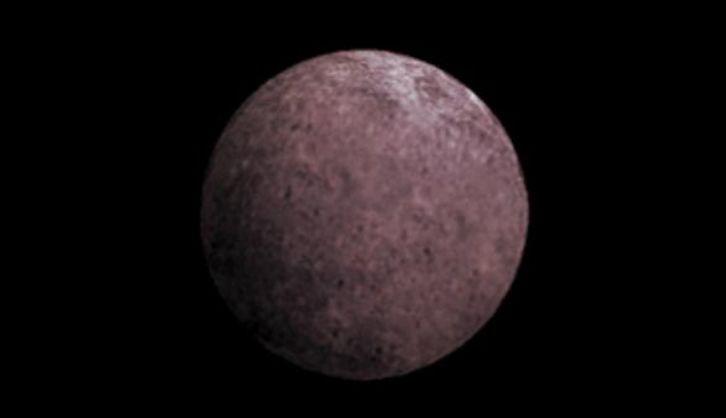
An artist’s conception of 2007 OR10. Astronomers suspect that its rosy color is due to the presence of irradiated methane. Credit: NASA
However, all this might now be changing after data gathered by the Kepler observatory (about which I’ve written in recent Space Sunday reports) has helped reveal the dwarf planet – which orbits the Sun once every 547.5 years – is actually the third largest such body beyond the orbit of Neptune, sitting behind Pluto and Eris, and thus it could be a lot more interesting than first thought.
Up until now, it had been thought 2007 OR10 was about 1280 km (795 mi) in diameter. However, such is the sensitivity of Kepler’s instruments in measuring light variations whilst seeking extra-solar planets orbiting nearby stars, that the observatory has been able to precisely measure variations in the brightness of this unusually dark little world. These measurements, combined with data obtained from the Herschel Space Observatory, suggest that 2007 OR10 is around 1535 km (955 mi) in diameter, or about 255 km (160 mi) larger than previously thought.
The upshot of this is the dwarf planet is liable to be a far more interesting place than previously thought, potentially covered in volatile ices of methane, carbon monoxide and nitrogen, and may even be somewhat active as a result of its interaction with the solar wind. It also means that it is really overdue for a decent name.
According to convention, the honour of naming it goes to the planet’s discoverers, in this case Meg Schwamb, Mike Brown and David Rabinowitz. They discovered it in 2007 during a search for distant bodies in the Solar System. In fact, Mike Brown has already suggested a name: Snow White, in recognition of the planet’s ice surface composition.
However, this hasn’t stopped suggestions rolling in from the general public – up to and including, “Dwarfy McDwarfface”, in recognition of the recent public voting on the name for the UK’s new polar research ship.
I have to admit that – and indifference to Mike Brown’s suggestion, which doesn’t take into account 2007 OR10’s likely rusty complexion – my personal favourite suggestion has to be that from Greenwood Space Travel Supply Co (shown above right), which puts forward a very strong case for the name of this little world. I’m also wearing my Dwarf Planet Pride Day badge with … pride!
Two Years of Weather Reporting on Mars
NASA’s Curiosity rover has completed its second year on Mars – its second Martian year, that is; August 2016 will actually mark the end of its fourth Earth year of operations in Gale Crater. This milestone is important, as it means that the rover has been able to accumulate data on two full cycles of Martian seasons and weather.
Gathering data over so long a period helps distinguish seasonal effects from sporadic events. For example, a large spike in methane in the local atmosphere during the first southern-hemisphere autumn in Gale Crater was not repeated the second autumn; it was an episodic release, albeit still unexplained. However, the rover’s measurements do suggest that much subtler changes in the background methane concentration may follow a seasonal pattern; while measurements of temperature, pressure, ultraviolet light reaching the surface and the scant water vapour in the air at Gale Crater show strong, repeated seasonal changes.
Monitoring the modern atmosphere, weather and climate fulfils a MSL mission goal, supplementing the better-known investigations of conditions billions of years ago. Back then, Gale Crater had lakes and groundwater that could have been good habitats for microbes, if Mars has ever had any. Today, though dry and much less hospitable, environmental factors are still dynamic.
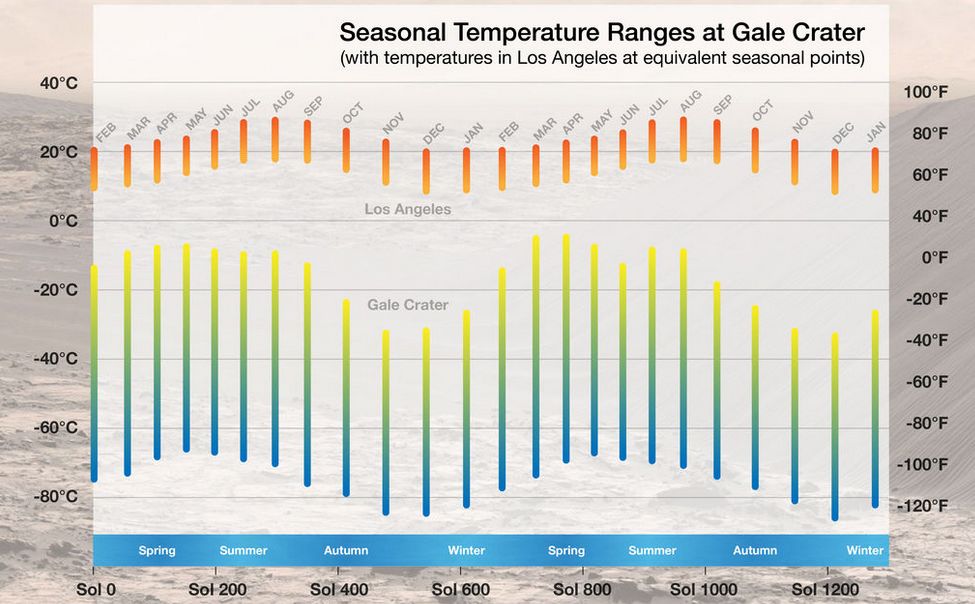
Curiosity’s Rover Environmental Monitoring Station (REMS), supplied by Spain’s Centro de Astrobiología, has measured air temperatures from 15.9o C (60.5o F) on a summer afternoon, to -100o C (-148o F) on a winter night.
Comparing temperatures at Mars’ Gale Crater (lower set of bars) to temperatures in Los Angeles. It shows key differences both in how much colder the Martian site is throughout the year, and also how much greater the difference between daily highs and lows. Mars has only about one one-hundredth as much atmosphere as Earth, and without that thick blanket of atmosphere the air temperature around Curiosity usually plummets by more than 55o C (100o F) between the afternoon high and the overnight low.
For the second time in less than a month, SpaceX has landed the first stage of a Falcon 9 rocket on a platform at sea, bringing the total of successful landings the company has so far achieved to three.
The landing came at 05:30 GMT on the morning of Friday, May 6th, just nine minutes after the rocket had lifted-off from Cape Canaveral Air Force Station in Florida on a successful mission to carry the Japanese communications satellite JCSAT-14 to orbit.
Following separation, the first stage of the Falcon 9 1a rocket performed a series of flight manoeuvres referred to as “boost back”, which culminated in the first stage making a successful touch-down on the deck of the drone ship Of Course I Still Love You, the same craft used to recover the first stage of the Falcon 9 rocket to lift the CRS-8 resupply mission to a safe rendezvous with the International Space Station in April.
The recovery of the booster stage was actually an unexpected event – SpaceX had believed that the nature of the mission would more than likely result in a failure to achieve a successful landing.
“Given this mission’s GTO [Geostationary Transfer Orbit) destination, the first stage will be subject to extreme velocities and re-entry heating, making a successful landing unlikely,” SpaceX representatives stated ahead of the launch.
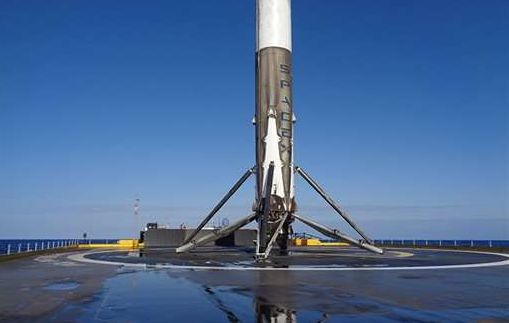
The Falcon 9 1a first stage secured on the deck of Of Course I Still Love You, following the successful May 6th landing. Credit: SpaceX
Ideally, the company would like to bring all of its boosters back to a touch-down on land, as was the case with their first successful landing in December 2015. However, some mission profiles mean that the Falcon 9 cannot carry sufficient fuel reserves to complete a set of “boost back” manoeuvres that would be enough for it to make landfall, so some landings at sea are inevitable if SpaceX is to get anywhere close to recovering the majority of its launchers.
Nevertheless, with three successful landings under its belt, and three first stage rockets requiring refurbishment in order to be able to fly again, SPaceX boss Elon Musk jokingly conceded, in a Tweet made after the landing, “May need to increase size of rocket storage hangar!”
The “Boiling” Waters of Mars
An international team from France, the UK and the USA have produced the strongest evidence yet that the distinctive recurring slope lineae (RSL) features seen on the slopes of Martian craters are produced by liquid water. And not just any water; the study suggests the water is “boiling”.
RSLs have been the subject of intense debate and discussion since 2011; in essence, they are ridges and rills which appear on the slopes of hills and craters, notably in the equatorial regions of Mars during the summertime. The significance here being that on Earth, identical features are always the result of free-flowing water. As the “recurring” in the title suggests, the Martian RSLs appear to be active – frequently renewing themselves on a seasonal basis, with new RSLs sometimes also appearing at the same time.
Two images showing the flank of the same crater, revealing what appear to be active RSL, periodically renewed during the Martian summer. Credit: NASA/JPL
However, the low pressure of Mars’ atmosphere means that water cannot survive long on the surface unprotected: it will either freeze or sublimate. So the idea of it surviving long enough to create trails in the sides of craters had many scientists scratching their heads. Then, in 2015, a NASA study put forward evidence RSLs might actually be the result of water containing a strong suspension of mineral salts – magnesium perchlorate, magnesium chlorate and sodium perchlorate. Such minerals could be sufficient enough to prevent water exposed to the surface environment on Mars either immediately freezing or sublimating.
Building on this idea, the French-led international team used blocks of water ice containing the same minerals and placed them on the slope of a simulated Martian crater housed inside a special Mars Chamber at the Open University in the UK. When the pressure in the chamber was reduced to the ambient surface pressure on Mars and the temperature adjusted to a typical Martian summer’s day, the team found the ice would melt, producing a liquid mix which effectively “boiled” filtering into the sand and moving down-slope. As it did so. the resultant vapour “blasted” sand grains upwards, creating ridges which would collapse onto themselves when they became too steep, forming channels almost identical in form to Martian RSLs.
It’s been a while since there has been any major news from NASA’s Curiosity rover as it explores “Mount Sharp” in Gale Crater.
The last time I covered the rover’s activities, it was investigating a series of sand dunes which are slowly descending down the slopes of “Mount Sharp” as a result of a combination of gravity and wind action.
This work was completed in March, when the rover resumed its progress up the flank of the mound, climbing onto “Naukluft Plateau”, a roughly flat area cut into the side of “Mount Sharp” where aeons of wind erosion has carved the sandstone bedrock into ridges and knobs which were thought could offer a challenge for the rover in terms of wear and tear on the wheels.
The plateau lay between the rover and the next major area of scientific interest for the mission, so the drive team have been edging the rover across the rough terrain in the hope of reaching smoother ground on which it can continue upwards without exposing its six aluminium wheels to risk of severe damage.
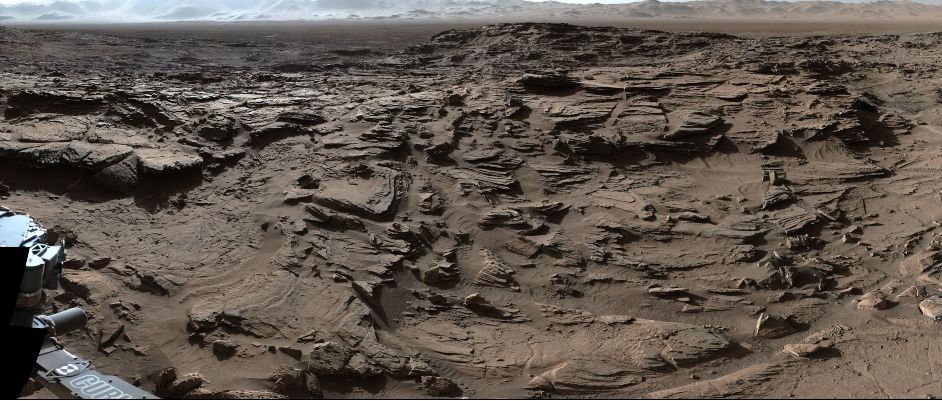
“Naukluft Plateau”, which Curiosity has been traversing since March 2016, shown in close-up, revealing how the surface has been shaped and scoured by the wind over the aeons. In the distance can be seen the rim hills of Gale Crater. This image was captured om April 4th, 2016, the rover’s1,302nd Sol (Credit: NASA / JPL)
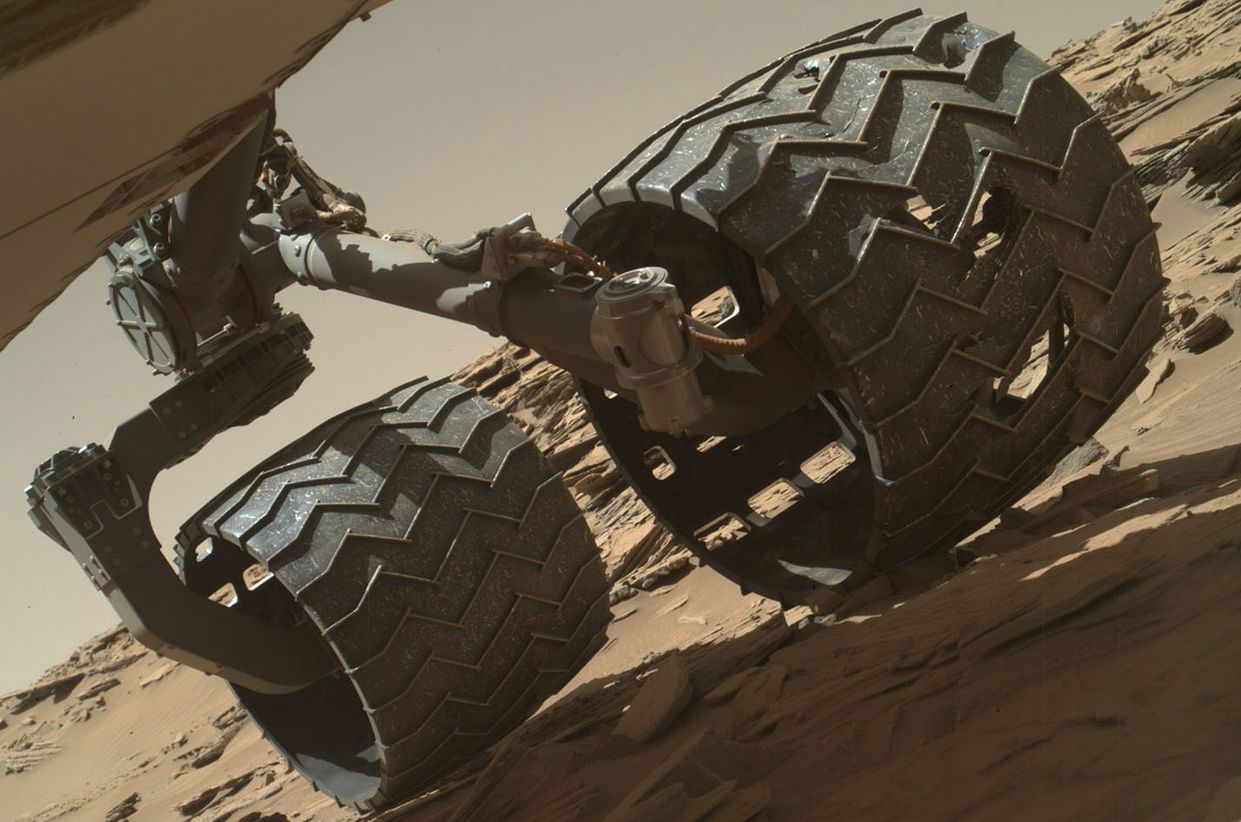
The roughness of the terrain on the plateau had raised concern that driving on it could be especially damaging to Curiosity’s wheels, as it is very similar to terrain the rover crossed in 2013 while en route to “Mount Sharp”, resulting in visible damage to some of Curiosity’s wheels, punching holes and tears into the aluminium, and prompting the mission team to undertake extensive tests on the wheels and their performance following such damage, using a duplicate of the rover here on Earth.
Because of the previous damage caused to the wheels, Curiosity was instructed to periodically image the condition of its wheels during the drive, a process which slowed progress but also revealed any damage being caused was not accelerating beyond what was projected to occur.
“We carefully inspect and trend the condition of the wheels,” said Steve Lee, Curiosity’s deputy project manager. “Cracks and punctures have been gradually accumulating at the pace we anticipated, based on testing we performed at JPL. Given our longevity projections, I am confident these wheels will get us to the destinations on Mount Sharp that have been in our plans since before landing.”
This image taken on April 18th, 2016 (Sol 1,315) by the Mars Hand Lens Imager (MAHLI) camera on the rover’s robot arm revels areas of damage on Curiosity’s centre left wheel, the result of periodically traversing very rough terrain since the rover arrived on Mars in 2012 (Credit: NASA / JPL)
In particular, the mission team is watching for breaks or tears which damage the zig-zag treads – called grousers – on the 50cm / 20 in wheels. If three of these grousers are significantly broken, Earth-based tests suggest the damaged wheel will have reached about 60% of its serviceable life.
However, since Curiosity’s current odometry of 12.7 km (7.9 mi) is about 60 percent of the amount needed for reaching all the geological layers planned in advance as the mission’s science destinations, and no grousers have yet broken, the accumulating damage to wheels is not expected to prevent the rover from reaching those destinations on Mount Sharp.
“Naukluft Plateau” is a part of the larger “Stimson formation” which includes a fracture area the rover reached a late April. Dubbed “Lubango”, the area was the target for the rover’s 10th drilling and sample gathering campaign, which was completed on Sol 1320, April 23rd, 2016.
“We have a new drill hole on Mars!” reported Ken Herkenhoff, a MSL science team member, when reporting on the sample gathering in an MSL update on April 28th.
After transferring the cored sample to the CHIMRA instrument for sieving it, a portion of the less than 0.15 mm filtered material was successfully delivered this week to the CheMin miniaturized chemistry lab situated in the rover’s body, which is now analysing the sample and will return mineralogical data back to scientists on earth for interpretation.
“Lubango” was selected for sample gathering after it had been determined following examination using the ChemCam laser and spectrometer, that it was altered sandstone bedrock and had an unusually high silica content. To complement the analysis of “Lubango”, the science team has been using the rover’s camera systems to locate a suitable target of unaltered Stimson bedrock as the 11th drill target.
“The colour information provided by Mastcam is really helpful in distinguishing altered versus unaltered bedrock,” MSL science team member Lauren Edgar explained in describing the current work. One possible target, dubbed “Oshikati” has been identified.
A white-balanced telephoto view of Gale Crater’s rim, as seen from the flank of “Mount Sharp” (Credit: NASA / JPL)
The ChemCam laser has already shot at the “Oshikati” to gather data for an initial analysis of the rock and assess its suitability for drilling operations. If all goes according to plan, Curiosity should make an attempt to gather samples from the rock on Sunday, May 1st.
SpaceX To Launch NASA-Supported Mars Mission in 2018
On April 27th, SpaceX announced it plans to launch an automated mission to Mars in 2018 as a part of a new space act agreement the company has signed with NASA. This will see the US space agency provide technical support to SpaceX with respect to an automated landing of a SpaceX vehicle on Mars, and provide scientific support for the mission.
An artist’s impression of Red Dragon arriving on Mars (credit: SpaceX)
SpaceX will undertake the mission using Red Dragon, an automated version of the Dragon 2 capsule vehicle which will enter service in 2018 to fly crews two and from the International Space Station.
Red Dragon has been on the drawing boards at SpaceX almost since the inception of the Dragon 2 programme. Designed to be launched atop the upcoming Falcon 9 Heavy launcher, due to enter operations later this year, it is specifically intended to carry science payloads almost anywhere in the solar system, and could potentially deliver as much as 4 tonnes of cargo to the surface of Mars (that’s the equivalent of delivering 4.5 Curiosity rovers to Mars in one go).
The 2018 mission is primarily intended to look at using a purely propulsive means of achieving a soft landing of a heavy vehicle on Mars. While parachutes could, in theory, be used to help slow a vehicle’s descent through the Martian atmosphere, recent NASA tests of the kind of large-scale “supersonic” parachutes required to slow large space vehicles during their descent haven’t proved overly successful during comparable testing at high altitude on Earth.
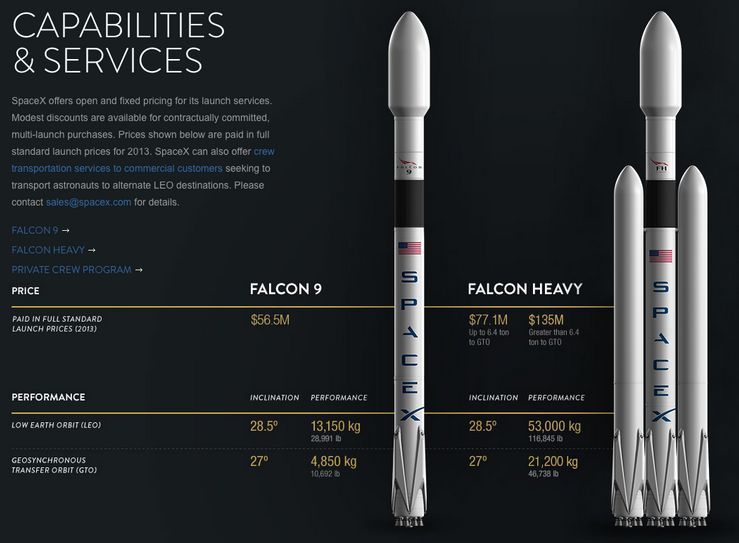
The Falcon 9 Heavy, which could lift scientific payloads aboard the Dragon 2 carrier vehicles almost anywhere in the solar system – compared to the current Falcon 9 (Credit: SpaceX)
Dragon 2 has been specifically designed so that a series of 8 rocket engines – called Super Draco motors – are embedded in the base of the vehicle. These can be used both as a launch abort system – firing a crew clear of a malfunctioning rocket during lift-off – and as a means of the vehicle achieving a “soft landing” on land rather than splashing down in the ocean (although the Dragon 2 is capable of this as well).
On Red Dragon, these super Draco motor allow the vehicle to slow itself down through its descent through the tenuous Martian atmosphere, and then act as a final cushioning break as the craft comes into land. Tethered tests here on Earth have already demonstrated Dragon 2 is fully capable of maintaining a hover until the thrust from the engines, and these tests will be expanded upon during the run-up to the mission.
The Red Dragon initiative is a commercial endeavour, funded entirely by SpaceX. NASA will not be contributing to the cost of the mission, but will be providing Earth-side logistical support and a suitable science payload of around 1 tonne. The exact nature of this payload will be defined in the future, but will likely include a diverse range of instruments which might be used to further characterise the Martian atmosphere, study and Martian weather and soil, and image the surface of Mars. Both SpaceX and NASA will share the data gathered during what is referred to as the EDL phase of the mission – the Entry, Descent and Landing. NASA will also supply a scientific payload for the flight.
Red Dragon marks the first phase of an ambitious programme SpaceX will be announcing in September, but which has been under development for about the last 6 years, for undertaking human missions to Mars in the 2020 / 2030s. I’ll have more on this later in the year.
Mars Odyssey: 15 years since launch and still going strong
Fifteen years ago, on April 7th, 2001, NASA launched their Odyssey mission to Mars. Since then, this orbital vehicle, whilst often overlooking in favour of its younger companions, Mars Express from Europe and NASA’s Mars Reconnaissance Orbiter, has done much to revolutionise our understanding of Mars.
Named for 2001: A Space Odyssey, the seminal science-fiction novel by Arthur C. Clarke, Odyssey arrived in orbit around Mars in October 2001. In doing so, not only did it overcome the failures of the 1999 Mars Climate Orbiter and Mars Polar Lander missions, it almost immediately scored its own major success: one suite of instruments found evidence for water ice close to the surface in large areas of Mars – as significant finding which has since gone on to shape much of our thinking about what lies within the Martian crust.
In 2010, Odyssey provided the highest-resolution (at that time) global map of Mars, stitched together from 21,000 images returned by the Thermal Emission Imaging System (THEMIS). Prior to that, in 2008 Odyssey spotted evidence of salt deposits across about 200 places in the south of Mars. NASA considers these areas to be signs of where abundant water used to sit. Scientists theorized the deposits could come from groundwater, which evaporated and left deposits of mineral behind. While in 2007, Odyssey imaged what appeared to be massive cave mouths on the surface of Mars.
THEMIS confirmed the openings – each between 100 to 250 meters (328 to 820 feet) across – were either vertical shafts running into the Martian crust or possibly openings leading to cavernous spaces beneath the surface. Dubbed the “seven Sisters” the openings were discovered on the flank of Arsia Mons, one of the gigantic Tharsis volcanoes, prompting speculation that they might be the collapsed roofs of lava tunnels within the volcano’s slopes.
A 2007 THEMIS image from Mars Odyssey showing entrances to possible Martian caves, dubbed the “seven sisters.” Clockwise from upper-left: Dena, Chloe, Wendy, Annie, Abbey, Nikki and Jeanne. Arrows signify direction of solar illumination (I) and direction of North (N) – Credit: GE Cushing, TN Titus, JJ Wynne, USGS, USGS, Northern Arizona University, and PR Christensen of Arizona State University
The vehicle has also operated in concert with the Mars Reconnaissance Orbiter in support of surface missions, including both the Curiosity and Opportunity rovers. As well as acting as a communications relay for such missions, Odyssey has been able to add context to the rovers’ work by providing thermal and other images which have helped science teams better understand the environments in which the rovers are operating. Nor does it end there. Odyssey has also been a careful observer of the Martian weather.
As each year on Mars lasts around 26 months, Odyssey has observed the planet through more than six Martian years. These observations have revealed some seasonal patterns that repeat each year and other seasonal events, such as large dust storms, which differ significantly from year to year.
A 2001 false colour map of Mars made from data gathered by Odyssey’s gamma ray spectrometer reveals the widespread distribution of hydrogen-enriched soil on Mars (in blue), the result of sub-surface ice deposits
In just this past year, Odyssey’s orbit has put the spacecraft in position to observe Mars in early morning light. Previously, the spacecraft flew over ground that was either in afternoon lighting or pre-dawn darkness. The new orbit enables studies of morning clouds and fogs and comparison of ground temperatures in the morning to temperatures of the same sites in the afternoon and pre-dawn, again helping to increase our understanding of the various atmospheric mechanisms operating on the planet.
With 15 years under its belt, Odyssey continued to work hard around Mars and shows no sign of stopping. So, happy anniversary, Odyssey!
On Land and Sea
Hard on the heels of Blue Origin’s third successful launch and recovery of their sub-orbital New Shephard capsule and propulsion module during a test flight, Elon Musk’s SpaceX has achieved what had been eluding them: launching a Falcon 9 rocket with a payload bound for the International Space Station and then landing the first stage of the rocket on a platform at sea.
The success comes after four prior attempted to land the first stage of the booster at sea – part of SpaceX’s efforts to develop a semi-reusable system to reduce overall launch costs – all ended with the booster crashing into the floating landing platform, or toppling over post touch-down.
The Falcon 9 1.1 furst stage of CRS-8 stands tall on the drone ship Of Course I Still Love You, following its landing on April 8th, 2016 (credit: SpaceX)
The April 8th launch, officially titled CRS-8, lifted-off from Cape Canaveral Air Force Station, Florida, at 8:53 GMT. After separating from the second stage of the rocket, which carrying the Dragon cargo craft up to orbit, the first stage of the booster performed a series of three burns to slow it down and boost it back towards the landing platform – referred to as an autonomous drone ship – that was keeping station downrange of the launch site. Eight and a half minutes after the launch, the first stage made a vertical descent over the platform, re-firing its main engines to slow itself as the landing legs deployed from along the side of the rocket’s body, and it eased into a gentle touch-down.
After the landing, crew boarded the platform to weld the rocket’s landing pads to the deck as a precaution against it toppling over while the platform was being towed back to port. Current plans call for the platform to undergo examination and testing at Kennedy Space Centre to ensure no structural damage occurred during the landing, before it is refurbished for a further at-sea landing, possibly in June 2016. The Falcon booster stage will also undergo post-flight examination prior to being refurbished for a future launch.
Blue Origin’s New Shephard lifts-off on Saturday, April 2nd on a successful sub-orbital test flight which saw both capsule and propulsion module successfully recovered
Blue Origin, established by Amazon founder Jeff Bezos, scored a three-for-three with launches and landings of their sub-orbital New Shephard launch vehicle.
Intended to offer passengers the opportunity to experience the microgravity of space, New Shephard is a two stage vehicle comprising the capsule unit which will eventually carry 6 people to the each of space, and a rocket stage simply called the “propulsion module”. Both are designed to be fully re-usable in order to reduce the overall cost of launch operations.
The Blue Origin propulsion module just a couple of seconds from touch down on April 2nd, 2016 (image: Blue Origins)
Having first flown on November 23rd, 2015, when the capsule unit reached an altitude of 100.5 km (63 mi) before parachuting back to a soft landing and the propulsion module made a powered descent and landing, the April 2nd, 2016, marked the third successful flight for both capsule and propulsion module, the latter now having been used for all three successful flights in November 2015, January 2016 and April 2016.
During the flight, the capsule – which was carrying a small science payload – reached a maximum altitude of 103.4 km (64.4 mi) before making a return to Earth under its parachutes, while the propulsion module steered its way back to the launch site to make a powered landing.
Nor was this a run-of-the-mill return for the propulsion module, as a the ascent / descent engine was re-lit at a much higher altitude that is expected during operational flights, at around 1,107 metres (3,600 ft), in a manoeuvre designed to further test the engine’s reliability and the wear and tear it might suffer during a flight. Understanding both of these factors will help Blue Origin better identify the overall costs involved in refurbishing rocket and engines between flights.
The New Shephard capsule, whilst primarily intended to fly people on sub-orbital flights, can also be used for science research, as demonstrated in this flight, which saw the capsule carry the Box of Rocks experiment from the Southwest Research Institute, designed to explore how rocky debris settles in microgravity, and the University of Central Florida’s Collisions into Dust experiment, which aims to better understand how large bodies interacted with dust in the early Solar System.
The New Shephard capsule being recovered following its parachute landing (image: Blue Origin)
While Blue Origin appear to be slightly ahead of SpaceX in terms of launching and recovering their rockets, it’s important to remember that the current New Shephard vehicle and the SpaceX Falcon 1.1 are very different beasts. Not only is the latter some 3 times bigger than New Shepard, the first stage of the vehicle flies much higher and faster than the Blue Origin vehicle, both of which make returning the first stage of the booster to a landing site to make a safe touchdown far more of a technical challenge.
That said, the sub-orbital capabilities of New Shephard are only one phase of Blue Origin’s plans. With the vehicle expected to commence crewed test flights in 2017 and offer sub-orbital tourist flights from 2018, the company plan to gradually uprate the vehicle to a point were it will also be able to undertake orbital launches and still be recovered.
Walking with Rovers
NASA is continuing to ramp public interest in Mars, with a new public outreach programme set to begin in summer 2016.
Destination: Mars builds on the ongoing cooperative work between the space agency and Microsoft in developing applications and opportunities for the Miscrosoft HoloLens system. As I’ve previously reported, NASA is already using the HoloLen aboard the International Space Station, and have also developed a means for members of the Curiosity science team put themselves “on” Mars using the HoloLens and data / images returned by the rover.
It is in the latter capacity that Destination: Mars is designed to work, offering the public, using the mixed reality capabilities of the HoloLens to “visit” Mars.
Apollo 11 Lunar Module Pilot and second man on the Moon, Edwin “Buzz” Aldrin, acts as a virtual host for Destination: Mars









 Inara Pey: Living in a Modemworld