Space Sunday: Artemis 3 – of Crew and Mission

The Artemis 3 Crew (l to r): Bresnik (commander), Parmitano (Pilot); Rubio (MS-1); Douglas (MS-1). Credit: NASA

On Tuesday, June 9, 2026 NASA held a major event to reveal the 4-man crew to fly the upcoming Artemis 3 Earth-orbit rendezvous mission and provide more information on the mission itself.

Originally planned to be the first Artemis mission to return humans to the Moon, Artemis 3 was wisely re-purposed early in 2026 to give astronauts a chance to get a hands-on feel for the vehicles intended to get them from lunar orbit to the surface of the Moon and back again, by testing them in the relative safety of low-Earth orbit. Prior to this re-purposing, the first opportunity any crew would have had to test either vehicle – to be supplied by Blue Origin and SpaceX and referred to a the Human Landing System (HLS) by NASA – in space would have been immediately before the first attempt to land one of the vehicles on the Moon. Needless to say, this was hardly an ideal approach.

Instead, Artemis 3 will now be a 2-week mission (the longest yet for a crewed Orion vehicle) that will be a sort-of updated version of 1969’s Apollo 9 mission, which saw the Apollo Lunar Module tested in orbit around Earth during a 10-day flight. However, there will be a number of obvious and key differences which I’ll be getting to shortly.

The all-male crew for Artemis 3 comprise three US astronauts and one European Space Agency astronaut, with three of the crew highly experienced spaceflight veterans and the fourth making his first trip into space. They are:

Randolph “Randy” James Bresnik, 58 (NASA): Commander

  • Randolph “Randy” Bresnik, Artemis 3 Mission Commander

    Born in Fort Knox Kentucky, Bresnik served in the US Marine Corps, logging an impressive 6,000 hours flying 81 different aircraft types, including time served as a test pilot before retiring with the rank of Colonel.

  • He joined the NASA astronaut corps in 2004, completing his training two years later.
  • First flew in space STS-129 in 2009 aboard space shuttle Atlantis. The 13-day mission was part of the International Space Station (ISS) construction, and he performed two EVAs alongside crewmates Michael Foreman and Robert Satcher respectively, to install external payload / experiment pallets on to the space station.
  • In 2011, he participated in the first ESA CAVES mission, a training course in which international astronauts train in a space-analogue cave environments such as might be used on Mars missions. Then in 2014 he commanded the NEEMO 19 mission, another analogue mission type, this one operated by NASA and using an underwater laboratory.
  • In 2017, he made his second trip to the ISS, this time launching aboard Soyuz MS-05 and spending 138 days on the space station as a part of the Expedition 52/53 crews, during which he performed three more EVAs, bringing his total “spacewalk” time to 32 hours.

Luca Salvo Parmitano, 49 (ESA): Pilot

  • Luca Parmitano (ESA): Artemis 3 Pilot

    Sicilian-born Parmitano was the first Italian (and third European overall) to command a crew rotation aboard the ISS.

  • He was educated in both Italy and the USA, gaining holding a masters degree in political science from University of Naples.
  • He served in the Italian Air Force after training with the US Air Force, rising to the rank of Colonel and logging over 2,000 hours on over 40 types of aircraft (both fixed-wing and rotary), including time as a test pilot.
  • Joined the European Astronaut Corps in 2009, and made his first flight to the ISS in 2011 aboard Soyuz TMA-09M.
  • During this mission he carried out two EVAs, the second called short after he almost drowned when a fault in his spacesuit filled his helmet with coolant water up to his nose, shorting out his communications headset in the process.
  • On returning to Earth, he indirectly followed in Bresnik’s footsteps, being selected for the 2014 ESA CAVES mission and then the NASA NEEMO 20 mission in 2015. He also participated in the ESA PANGAEA analogue mission in 2016.
  • He returned to the ISS as a part of the Expedition 60 in 2019, flying alongside Christina Koch, one of the Artemis 2 crew. Whilst there, he completed four more EVAs for a total EVA time to 33 hours 9 minutes; became the first DJ to perform a live set from space (as a part of an music festival taking place in Ibiza) and took command of the ISS for 3 months as a part of Expedition 61.
  • With a total time of just 59 minutes shy of 367 days in space, he is the second most experienced member of the Artemis 3 crew in terms of time in space.

Francisco “Frank” Carlos Rubio, 50 (NASA): Mission Specialist 1

  • Francisco “Frank” Rubio, Artemis 3 MS-1

    A graduate of the United State Military Academy, holding a bachelor’s degree in international relations, he logged over 1,100 hours flying helicopters for the US Army, with 600 hours on combat missions in Bosnia, Iraq and Afghanistan.

  • He then transferred to the Army’s medical service, qualifying as a flight surgeon and then a field surgeon with the US Army Special Forces, rising to the rank of Colonel in the process.
  • Joining NASA in 2017, he made his first flight into space aboard Soyuz MS-22.
  • Planned for 6 months, as I reported at the time, this mission lasted more than a year after the Soyuz vehicle suffered a serious coolant leak. As a result, he and cosmonauts Sergey Prokopyev and Dmitry Petelin eventually returned to Earth aboard Soyuz MS-23 after completing 2 back-to-back 6-month tours on the ISS.
  • As a result of this, he clocked up almost 371 days in orbit, taking the record for the longest continuous time in space for a US astronaut.

Andre Douglas, 40 (NASA): Mission Specialist 2

  • Andre Douglas, Artemis 3 MS-2

    The mission rookie, making his first flight in space, he serves in the US Coast Guard (USCG) as a special advisor to the commander of the service. During his career, he served both at sea and on-shore, including time as Commandant of the USCG Academy.

  • He holds both a bachelor’s and master’s degree in mechanical engineering; and further three master’s in naval architecture, marine engineering and electrical & computer engineering.
  • In 2015 he transitioned from active service to the Applied Physics Laboratory (APL) of Johns Hopkins University. Here he carried out wide-ranging research, published several papers and collaborated with NASA to assess lunar surface needs for human and robotic missions, and helped to guide technology development in both.
  • He joined NASA in 2021, completing his astronaut training in May 2024.
  • His first active duty role was on the back-up crew for Artemis 2, training alongside the prime crew ready to replace any one of them in the event of injury or illness. He also served as a member of the launch pad close-out crew responsible for getting the crew safety into their Orion capsule on the day of the mission’s launch.

Following the announcement of the crew, NASA came in for criticism in that it is an all-male team, critics claims the selection was the result of the Trump administration’s determination to eliminate all aspects of DEI from the federal workforce. Responding to the criticism, NASA Administrator Jared Isaacman pointed out that crew selection is based on specific criteria notably in this case, the need for well-qualified test pilots (Bresnik and Parmitano) and someone closely involved in the development of lunar flight systems (Douglas), whilst Rubio’s medical experience would enhance the science elements of the mission.

Artemis 3 Mission Profile

As currently defined, Artemis 3 will proceed in four parts.

In the first, Blue Origin will use their New Glenn rocket to launch their Blue Moon MK2 Pathfinder to low Earth orbit. Pathfinder is essentially a working crew module from their actual HLS vehicle, complete with RCS thrusters, solar arrays and a simulated set of cryogenic tanks actual Blue Moon HLS vehicles will require.

With the Pathfinder vehicle in orbit, NASA will launch the Artemis crew aboard an Orion vehicle atop a modified Space Launch System (SLS) rocket. This rocket will lack the Interim Cryogenic Propulsion (ICPS) upper stage replaced by a mass simulator, as the ICPS is not required for the mission. The Orion will then rendezvous with the Pathfinder vehicle to commence two days of vehicle testing. This work will include:

  • Docking against Pathfinder’s orbital docking adopter/airlock.
  • Testing the airlock system on the Pathfinder vehicle, with two members of the crew boarding the vehicle.
  • Testing the module’s life support system through practical use, and also testing the on-board control, data management, navigation and communications systems.
  • Carrying out a practical evaluation of the module’s living spaces in micro-gravity.
  • Testing the module’s spacesuit storage and dressing spaces, with one of the crew actually donning and doffing one of the new Artemis space suits being developed by Axiom (or a non-functioning prototype thereof, depending on which is available at the time of the mission).
A still from a NASA / Blue Origin animation of the Artemis 3 Orion vehicle approaching the orbital docking port on the Blue Moon MK2 Pathfinder vehicle. Credit: NASA / Blue Origin

This is a fairly comprehensive test of the Blue Moon MK2 HLS crew module; however, it slips behind Apollo 9 in that there will be no testing of the HLS main propulsion system, and Pathfinder will not detach from Orion for a free-flight test of its RCS systems; Orion will manage all control and manoeuvring of the combined vehicles.

Following the Blue Moon tests, Orion will then shift to a single day of testing the docking system that will form part of the SpaceX Starship derived HLS. This docking system will be sent aloft on a “standard” Starship vehicle which – as of June 9th – is not expected to carry any other elements of the SpaceX HLS, severely limiting the idea of on-orbit system testing.

The fourth part of the mission will be peppered across the entire 2 weeks, comprising a range of science studies. These will include observations and measurements of the Earth’s atmosphere, together with medical and environment studies that build on the human science experiments carried out as a part of Artemis 2, and which are designed to further increase our understanding of dynamic space environments and radiation patterns.

A still from a NASA / Blue Origin animation of the Artemis 3 Orion vehicle docked with the Blue Moon MK2 Pathfinder vehicle. Credit: NASA / Blue Origin

One additional element of the mission has yet to be confirmed, and that is the potential for an EVA test. Details on this are currently sketchy, and it ultimately depends on whether or not Axiom can deliver a working version of the new Artemis space suits. These are intended to be a modular, dual-purpose design so they can either be used as part of surface operations on the Moon or as EVA suits for micro-gravity work aboard the ISS and other space stations, so a test on Artemis 3 would help further validate the suit design for both roles.

If the suit carried aboard the Blue Origin Pathfinder vehicle is fully functional, then there will likely be a full test of the vehicle’s main lunar surface airlock system, including depressurising and repressurising it, testing the hatch mechanisms, etc. However, the individual wearing the suit will not actually exit the vehicle.

That the SpaceX vehicle is unlikely to be equipped with anything other than the HLS / Orion docking adaptor potentially puts SpaceX at a further disadvantage in terms of which HLS craft will be selected for Artemis 4 (and possibly Artemis 5), simply because the tests with the Blue Moon MK2 Pathfinder are liable to give NASA a greater degree of confidence in that vehicle. This is further supported by the fact that Blue Origin have already supplied NASA with two test articles of their lander’s crew module, own of which is fully equipped for ground-based training and simulations. SpaceX are unlikely to achieve this before late 2026 at the earliest.

However, this does suppose that Blue Origin will actually be able to participate in Artemis 3 as currently scheduled. As I’ve previously reported, the only launch pad capable of handling New Glenn was destroyed on May 18th, 2026, during the testing of a New Glenn rocket in preparation for its next flight. Whilst Blue Origin is hoping to have all reconstruction work at LC-36 completed well in time for Artemis 3, there is a huge amount of work to be done in this regard.

Given this, Blue Origin’s Senior Vice President of Lunar Permanence, John Couluris used the June 9th event to indicate that as well as trying to push ahead with on-site investigations and clean-up operations at LC-36 so as to allow rebuilding to commence sooner rather than later, Blue Origin is also seeking to accelerate plans submitted for approval in April 2026 for the construction of a brand new launch facility to support New Glenn operations.

A Google Maps view of Canaveral Space Force Base, Florida, showing the former “ICBM Row” along the coast, the “Skid Strip” runway originally use to test wing missile landings (and which is not the former Space Shuttle Landing Facility), with the locations of the current Blue Origin LC-36 facilities and the proposed location (LC-11) for the new “SLC-36B/11” New Glenn launch facilities.

Dubbed SL-36B/11, this is to be built on the company’s current engine test stand located at LC-11, Canaveral Space Force Station and a short distance from LC-36. The hope is that if the approval process can be accelerated, Blue Origin will be able to commence construction even as work continues at LC-36. If so, there is a possibility the company might have two launch pads available for New Glenn flights by the time of Artemis 3.

Obviously, this is a very ambitious plan, and as such there is still the possibility that Artemis 3 might yet be pushed back into 2028 (although political pressure could weigh heavily against this) in order to ensure Blue Origin is in a position to participate. This could also benefit SpaceX, as it might provide them with the opportunity to provide more than just the HLS docking adaptor for Artemis 3 testing (although this would likely be a long shot as well).

In the meantime, one interesting facet that did emerge from the June 9th event was that SpaceX and NASA are in discussions about changing the Artemis mission profiles when using the SpaceX HLS vehicle.

Renderings of the 16m tall Blue Origin HLS (l) and the 52m tall SpaceX HLS (r) as they are supposed to look on the Moon. The Blue Origin rendering  shows the surface airlock and egress/access steps to the right of the vehicle and the circular orbital airlock used for docking with Orion spacecraft to the left. The SpaceX orbital airlock is located at the nose of the vehicle, with the surface operations airlock + the elevator required to get crew from / to the surface of the Moon also shown. Credits: Blue Origin / SpaceX

Under current plans, both the Blue Origin and SpaceX HLS vehicles are launched into low-Earth orbit first and (after propellant loading / docking with a transport vehicle in the case of Blue Origin) then proceed to lunar orbit to await the arrival of a crew aboard an Orion spacecraft. However, the SpaceX / NASA discussions revolve around having the Orion vehicle rendezvous and dock with the SpaceX HLS whilst the latter is still in orbit and after it has received the propellant load-out it requires to carry out its lunar mission.

This approach actually makes a lot of sense. For one thing, it means that the crew could potentially make use of the the roomier facilities aboard the SpaceX HLS during the outbound trip to the Moon (and ensure it is all functioning smoothly) and it would potentially provide them was a “lifeboat” capability in the event of an Apollo 13-style accident. As such, it will be interesting to see had far these discussions progress.

Space Sunday: NASA’s nuclear electric plans, a goodbye to MAVEN and a New Glenn update

A composite image of SR-1 Freedom (rendering) approaching its orbit around Mars. Credit: NASA

Just over a month ago NASA announced plans to test a nuclear propulsion system on  mission to Mars. The news came as a surprise at the time, given it came a year after another nuclear propulsion project involving NASA had joined (along with the US Defense Advanced Research Project Agency (DARPA) had been cancelled.

Called DRACO (Demonstration Rocket for Agile Cislunar Operations), that project was formally initiated in 2021, with the intention of finally evaluating the deep space use of nuclear thermal propulsion (NTP) – that is, the use of a nuclear reactor to heat a propellant mass (usually liquid hydrogen) to generate thrust through the engine nozzles. Targeting a launch date in late 2027, DRACO was always ambitious, and inevitably ran afoul of technical and regulatory challenges starting it on the road to oblivion prior to funding via both DARPA and NASA being halted.

A rendering of the cancelled DRACO DRAPA / NASA nuclear thermal propulsion demonstrator mission. Credit: DARPA

The technological and regulatory problems faced by DRACO primarily concerned two key points. The first being the need for a liquid propellant (requiring substantial propellant mass and the additional mass and complexity of trying to keep the propellant in a liquid state through passive and active means in the full heat of the Sun).

More particularly, DRACO’s nuclear system was to be open cycle, meaning the liquid hydrogen would pass through the reactor system to turn it into the gas needed to propel the vehicle – irradiating it in the process. While people would likely not be too happy about a nuclear reactor spewing radioactive material into the upper atmosphere if it was used whilst in orbit around Earth, the bigger regulatory issue for DRACO was simply how could a system generating radioactive exhaust materials be safely tested on the ground?

Because of this, NASA’s new mission concept – called Space Reactor 1 (SR-1, with the vehicle itself to be called Freedom) instead intends to use nuclear electric propulsion. This is important because it allows the use of a closed cycle nuclear reactor – in this case a closed Brayton cycle fission reactor generating some 50 kW of electrical power. The key point here is that closed cycle reactors can avoid exposing a propellant to radiation, so the exhaust gasses exiting the engine is relatively “clean”. Thus, SR-1 theoretically avoids some of the regulatory issues faced by DRACO.

The “engines” in question for SR-1 are three 12 kW (nominal) Hall-effect thrusters. This in turn is important for a couple of reasons. Firstly, Hall-effect propulsion systems are well understood. Secondly, they utilise a far less volatile propellant than liquid hydrogen  – generally Xenon – which a) doesn’t need to be a liquid form,  and so b) avoids all the complexities of passive and active refrigeration. Both the use of the thrusters and the Xenon fuel therefore cuts out a lot of the technical complexities SR-1 could face when compared to DRACO. Further, SR-1 plans to use a propulsion module that has been in development for some time: the Power and Propulsion Element (PPE) which was to have been used on NASA’s (now cancelled) Lunar Gateway station. This could again help reduce the technical complexities designing SR-1 might otherwise face and it potentially gains political favour in that it offers a means to make good on some of the money already poured into Gateway.

A conceptual image with annotation of the proposed SR-1 Freedom vehicle. Credit: NASA

Nor is SR-1 intended to be a just demonstration of nuclear electric propulsion operating purely in near-Earth  / cislunar space as was the case with DRACO; it is to be a genuine deep-space mission, delivering a payload to Mars in 2029, In doing so it will prove the complete viability of nuclear propulsion in space missions. The payload in question is the Skyfall – and no, it has nothing to do with James Bond!

First revealed as a conceptual study in mid-2025 by NASA’s Jet Propulsion Laboratory (JPL) and AeroVironment, Skyfall is designed to build on the experience gained in flying the Ingenuity helicopter on Mars as a part of the Mars 2020 mission (in which it flew 71 times, often in support of the Mars 2020 rover Perseverance. As initially conceived, Skyfall would utilise six updated versions of the Ingenuity design to carry out a range of scouting flights across Mars. For the purposes of the SR-1 mission, the number of helicopters has been reduced to three – but how they will be delivered into the Martian atmosphere remains dramatic.

When first proposed, Skyfall was to carry six Ingenuity-class helicopter drones to Mars. As a part of the SR-1 mission the number has been scaled back to three. Credit: AeroVironment / NASA

In short, the mission will use a version of the capsule design used to deliver both Perseverance and the Mars Science Laboratory (MSL) rover Curiosity to Mars in 2021 and 2012 respectively. This will protect the three helicopters both on the journey from Earth to Mars and through the heat and buffeting of entry into the Martian atmosphere. After deploying its main parachutes to slow its decent through the atmosphere and jettisoning its heat shield, the capsule will extend a launch platform underneath itself, allowing the three helicopters to power-up their blades and take flight.

Once airborne, the three craft will operate in parallel, carrying out daily low-level flights of Mars, landing to both recharge their batteries and pass the Martian nights. Each will carry a small science package on board, including high-resolution camera to image the terrain they are overflying (to be used in the planning for future missions to Mars) and ground penetrating radar to reveal what lies beneath that terrain, be it rock, permafrost or deposits of water ice.

However, neither Skyfall nor SR-1 are certain to go ahead as planned. Firstly, there is the extremely tight development / test and construction time frame – just 30 months if NASA really is going to achieve a December 2028 / January 2029 launch for the combined mission.

More particularly for SR-1, there are multiple complications still to be overcome. Perhaps the biggest of these is the reactor feedstock: high-assay low-enriched uranium 235 (aka HALEU, with between 5% and 20% enrichment). While this is ideal for use in compact reactors, it requires a dedicated nuclear fuel cycle infrastructure for its production, and this infrastructure is both limited and already at capacity. Whilst the US government is trying to scale HALEU production, this is not going to happen in the short-term. As such, SR-1 could take considerably longer than 30 months to reach a state in which it might reasonably be launched.

Goodnight, MAVEN

On June 3rd, 2026 NASA confirmed their MAVEN (Mars Atmosphere and Volatile EvolutioN) mission had come to an end after a total of 11 years and the orbiter officially classified as lost. The news came some 6 months after all contact with the orbiter was lost and after a long series of attempts to r-establish communications and to understand what might have happened.

Launched in 2013 and commencing its science mission around Mars in 2014, MAVEN was intended to study the Mars atmosphere in an attempt to understand the composition of the upper reaches of that atmosphere and better understand the mechanism at work in stripping away that atmosphere – particularly that of the solar wind. For over 10 years, MAVEN revealed many of Mars’ secrets and the risks human visiting the planet will face (such as solar storms striking the planet quickly doubling surface radiation levels on a temporary basis).

An artist’s impression of NASA MAVEN spacecraft orbiting Mars. Credit: NASA

The first indication that something had gone wrong with MAVEN came on December 4th, 2025, when it failed to resume contact with NASA’s Jet Propulsion Laboratory (JPL) after a routine passage around the far side of Mars. Two days later, JPL received a data fragment from the orbiter, suggesting it was rotating in an unexpected manner and may have deviated from its orbital track. On both December 16th and 20th, 2025, MAVEN passed directly over Gale Crater and the rove Curiosity, but despite the scanning the sky with its high-resolution MastCam along the orbiter’s expected track, there was no sign of MAVEN.

Attempts to regain contact with the orbiter continued at regular intervals throughout early 2026, but by April it was evident that the chances of re-establishing contact were rapidly diminishing. Thus, on By June 3rd, NASA issued a statement terminating the mission while efforts to understand exactly what had gone wrong would continue. Currently, the favoured hypothesis is that MAVEN had an unexpected issue, lost its communications orientation with Earth and was unable to recover. This may have additionally caused the vehicle to drift out of its expected orbit and / or result in its solar arrays being no longer able to generate sufficient power to keep the vehicle’s batteries operating, so it likely ran out of power.

In all, it’s a sad end to a mission that achieved so much, especially given the longevity we’ve come to expect of Mars missions around or on the planet once they have safely entered orbit or landed.

Blue Origin: A Major Malfunction – Update

As per my previous Space Sunday article, on Thursday, May 28th, 2026, a Blue Origin New Glenn booster exploded with tremendous force (estimated to be the equivalent of 1 kiloton of TNT), levelling much of Launch Complex 36 (LC-36) at Canaveral Space Force Base, California, the only facility in the world capable of handling the rocket.

Based on the available images and information available at that time, and as I noted in that article, it seemed that LC-36 would be out of action for at least a year; something that could have major ramifications for Blue Origin and NASA’s Artemis programme. However, June 2nd, 2026, Blue Origin CEO, Dave Limp took to social media with an update on matters which included some surprising news and ended with an even more surprising prediction.

Blue Origin’s launch facilities at LC-36(A) seen in 2025 from the roof of the vehicle and payload integration building, showing a New Glenn rocket atop the transporter-erector vehicle. Credit: Blue Origin

On summary, Limp indicated that:

  • The propellant farm alongside the launch pad weathered the explosion reasonably well and will not require significant rebuilding / replacement (although images have revealed a couple of the tanks do have significant denting).
  • The damage done to the main vehicle and payload integration building appears to far less severe than reports suggested, and the water tower serving the deluge / sound suppression system is largely undamaged.
  • Despite receiving some major damage near its base, the surviving lightning conductor tower can likely be repaired without being demolished – a comment which drew multiple surprised responses given the apparent extent of the damage.
  • Rather than building a new transporter-erector (TE – the 1800-tonne vehicle used to move New Glenn from the vehicle and payload integration building to the launch pad and then act as the rocket’s launch tower), the company will now pivot to a new vertical launch platform / transporter, something they were already planning to do prior to the explosion.

Most surprisingly, however, was Limp’s prediction that Blue Origin will resume New Glenn operations by the end of 2026. Given all that has to be done, both in terms of the rebuilding work at LC-36 (to say nothing as to how long investigations into the vehicle loss will take & what might yet be required to clear New Glenn to resume flights, it is fairly hard to see how this can be achieved. As such, a lot of eyes will be watching Blue Origin and LC-36 very closely over the next 6-7 months.

Space Sunday: New Glenn – a Major Malfunction

The moment of total destruction: the complete New Glenn rocket “stack” is destroyed as 1,200 tonnes of propellant in the first stage tanks explode, send a mushroom fire cloud int the sky over the Florida Space Coast. Via: AP News

On Thursday, May 28th, 2026 the evening skies over Florida’s space coast were lit up by a massive explosion. Believed to be in the one kiloton of TNT range, visible from dozens of miles away and heard in Orlando, 90 kilometres from the coast, the detonation was that of a Blue Origin New Glenn launch vehicle. Not only did it vaporise parts of the rocket, it also dealt a significant blow to the company.

The New Glenn in question was a new vehicle, comprising a main engine system of 7 uprated BE-4 engines (currently the most powerful rocket motors in the world, rated at 2,844.5 kN of thrust each 100 kN more than the SpaceX Raptor 3) a new booster first stage called No, It’s Necessary (a reference to Christopher Nolan’s 2014 film Interstellar) and an upper stage and fairings, both without propellants or payload. It was undergoing a static fire test at Launch Complex 36 (LC-36), Canaveral Space Force Station, ahead of a planned launch scheduled for early June, New Glenn having been cleared to resume flights after being ground following the NG-3 mission in April, in which the rocket’s upper stage malfunctioned.

A static fire test is a routine in which a rocket is loaded with propellants, goes through a launch countdown and then very briefly fires its engines before shutting them down again. The intention is for the propellant systems and engines to “clear their throats” (so to speak), ready for the upcoming launch. To this end, the rocket was loaded with some 1,200 tonnes of liquid oxygen and liquid methane.

The vehicle explosion could be seen up and down Florida’s space coast, as was heard 90 km away in Orlando, Florida. Credit: various

The exact cause of the explosion has obviously yet to be determined. The first signs of trouble came as the static fire countdown reached its end. The water deluge sound suppression system was active, smothering the launch pad in hundreds of thousands of litres of water to prevent the acoustic vibrations generated by the seven BE-4 engines being deflected from the launch pad up onto the vehicle and damaging it. As a result, it is very difficult to see from the available video footage as to what happened next: whether the engines fired as expected with an explosion following, or whether the complete engine unit at the base of the rocket detonated on ignition.

What is clear is there was a destructive event at the base of the rocket giving rise to an initial fireball rolling flames up the sides of the vehicle. There was then a second explosion towards the top of the vehicle, roughly at, or just below, the bottom end of the upper stage – possibly an initial explosion of the liquid methane tank. However, both of these explosions were rapidly dwarfed by the vehicle’s entire first stage exploding, likely as a result of the liquid oxygen tank rupturing. This generated a mushroom fireball which rose into the evening sky with debris from the rocket being hurled up and outwards over considerable distances (so far in fact, that parts of the vehicle ended up scattered over the local beaches, caused fires in the coastal scrubland and came down off-shore, prompting several public safety warnings telling the public not to touch or move any debris they might find as it could be toxic).

The loss of a launch vehicle is obviously not an insignificant event – and fortunately, there was no loss of life. However, for Blue Origin, vehicle loss is somewhat secondary to the devastation wrought on LC-36.

This facility, leased from (at the time) the USAF in 2015, was completely rebuilt by Blue Origin at a cost of US $1 billion to be the only launch facility capable of handing New Glenn (a second launch facility planned for Vandenberg Space Force Base, California, has yet to break ground). With this explosion, much of LC-36 has been either completely destroyed or suffered significant damage, and until it is rebuilt New Glenn will not fly, no matter how quickly the cause of the explosion is identified and rectified (assuming it lies within the rocket).

Nor is this simply a matter of clearing the site and starting reconstruction. Rockets are nasty vehicles filled with things that can put a person in hospital – or worse – if not handled correctly. So before any reconstruction can begin, there will need to be a in-situ investigation across the site to clean it of any harmful materials whilst also looking for any clues as to what might have caused the explosion and recovering any surviving parts of the vehicle which might yield their own clues as to a possible cause. Such an investigation + clean-up is a non-trivial matter.

For example, in 2016, a SpaceX Falcon 9 exploded on LC-40 at Canaveral during a static fire test, completely destroying itself and its payload. It took over a year to get the pad back into operational order – the first 4+ months of which involved just such an investigation and clean-up. And that event was much smaller than the New Glenn explosion, with the pad and its infrastructure subjected to far less overall destruction.

Aftermath of destruction at LC-36: 1) the destroyed transporter-erector (TE); 2) the collapsed launch pad footing + elements of the water deluge system and the hydraulic actuators; 3) the collapsed 183-metre tall lightning conductor tower; 4 & 5) water deluge system feed pipes and other infrastructure stuck by the falling tower; 6) major damage or the corner support upright of the second, larger lightning tower (possibly requiring its demolition); 7) propellant tank farm – potential damage unknown; 8) water tower for deluge system, apparently undamaged; 9) (inset) a view of LC-36 as it looked sans the TE, before the explosion. Credit: Asher B.

By contrast and as shown above, the New Glenn explosion has completely wiped out the launch pad and its immediate infrastructure, brought down one of the two 183-metre tall lightning conductor towers and severely damaged the other, and utterly destroyed the transporter erector. The latter was the 1,800 tonne vehicle / platform used to move New Glenn rockets horizontally out of the vehicle and payload integration building a short distance from the launch pad and then, with the assistance of hydraulic actuators at the pad, raise itself, the rocket and the launch platform to a vertical position, and then act as the launch tower for the rocket.

In addition, it appears that the vehicle and payload integration facility close to the pad has suffered significant structural damage. Some reports state this damage extends to equipment and systems inside the building, including the twice-flown New Glenn first stage, Never Tell Me the Odds. However, this latter point was without formal confirmation at the time  of writing.

Given all of this, rebuilding and recommission LC-36 is liable to be a lengthy process. Frankly, if all of the statements on the extent of additional damage are correct, it’s hard to see the complex resuming launch operations before the end of 2027 at the earliest.

A wide view of Launch Complex 36, showing the (undamaged) pad and infrastructure to the right, and the vehicle and payload integration facility built by Blue Origin to the lower left. Reports indicate that the latter may have suffered extensive structural and internal damage. Credit: Blue Origin

Impacts

If LC-36 is out of commission for more than a year, then the overall impact is enormous for both Blue Origin and potentially for NASA’s Artemis programme. As it is, it has already put paid (for now, at least) to a pair of vital precursor missions related to Artemis Blue Origin was due to fly later in 2026 and early 2027.

These are the Blue Moon MK1 Pathfinder missions. They were both intended to deliver science payloads to the Moon – in the case of the second, NASA’s VIPER automated rover (which is the unluckiest lucky rover NASA has built, having lost its ride, was then practically cancelled, then resurrected and now is once more without a launch vehicle for the foreseeable future, and so could face cancellation again). More particularly, both missions would have allowed Blue Origin to check-out systems critical to both the Blue Moon MK1 cargo lander and its “big brother”, the Blue Moon MK2 crew lander (called the Human Landing System (HLS) by NASA).

Blue Moon MK1 and Blue Moon MK2 are set to be cornerstones of the Artemis programme, and by testing the systems common to both – the BE-7 engine system, the cryogenic fluid power and propulsion systems, avionics, continuous downlink communications, and precision landing system with an accuracy within 100 metres – during the Pathfinder mission, Blue Origin hoped validate their use aboard both landers and specifically move development the MK2 HLS vehicle significantly forward.

Blue Origin’s 8-metre tall Blue Moon MK1 cargo lander (foreground) and the 16-metre tall Blue Moon MK2 HLS share multiple common systems, which could have been tested on the two Blue Moon MK1 Pathfinder flights had the explosion at LC-36 not occurred. Credit: Blue Origin

A further mission now impacted by the New Glenn explosion – and somewhat linked to the Pathfinder missions – is that of Artemis 3.

Due to take place at the end of 2027, this is intended to provide NASA astronauts with the opportunity to test one or other (or preferably both) of the HLS systems being developed (the other being SpaceX’s Starship-derived vehicle) and evaluate their use and general fitness for purpose. Taken together, the Pathfinder missions (if successful) with their testing of the systems mentioned above, combined with a hands-on test of the actual Blue Moon MK2 HLS would likely provide NASA with a degree of confidence in the Blue Origin lander, possibly to the extend of selecting it over the SpaceX HLS for Artemis 4, the first mission to return astronauts to the surface of the Moon.

Clearly, with things now being what they are, neither of the Pathfinder missions will likely to take place within the next year (at least), and Blue Origin are unlikely to be able to participate in Artemis 3. The first of these points means that Blue Origin lose a possible advantage they hold over SpaceX when it comes to vehicle selection for Artemis 4. In terms of the latter, NASA face something of a quandary: do they keep things as is, and hope Blue Origin can somehow meet the current Artemis 3 schedule? Or they seek to push Artemis 3 back to 2028 in order to ensure they can properly evaluate both HLS vehicles from the relatively safe location of Earth orbit, or do they go ahead with testing only the SpaceX vehicle and introduce the Blue Origin vehicle without any on-orbit with Artemis 5 or Artemis 6?

The answer to these questions is far from clear – although one would hope common sense would lean NASA (political pressure allowing) towards delaying Artemis 3 until 2028 to give Blue Origin the opportunity to partake in the mission. Indeed, given doubts the agency has voiced about SpaceX’s overall ability to have a HLS system ready for Artemis 3 (which led to Artemis 3 being moved from mid- to late-2027), moving the mission back to 2028 might be seen beneficial overall. However, such a delay will impact on Artemis 4, and any attempt to slip this back into 2029 could meet with significant political resistance.

There is one other potential – but significant, if it happens – impact that might be felt with the loss of the NG-4 vehicle, and it lies not with Blue Origin or NASA, but with United Launch Alliance (ULA).

ULA uses two 2,460 kN “standard” BE-4 engines on the Vulcan-Centaur rocket’s first stage. As such, if the cause of the the loss of the NG-4 vehicle is found lie within the BE-4 (and not restricted to the uprated 2,844.5 kN version), the FAA could order a grounding of the ULA vehicle until such time that Blue origin has rectified whatever the issue might be. Time will very much tell on that.

A (Very) Small Consolation?

An info graphic on the in-development New Glenn 9×4, including a scale comparison with SpaceX Starship, the Saturn V and the Blue Moon 7×2. Credit: Graphic News

There is however, one potentially small consolation for Blue Origin after all this.

In November 2025, the company announced it was to develop a very significant upgrade to New Glenn: the 9×4, which it was planning to test fly some time in 2027 (a rather ambitious time frame even considering the commonality of hardware and software between it and the current New Glenn).

This new version of New Glenn (called the 9×4 on account that it will use 9 BE-7 engines on the first stage and 4 BE-3Us on the upper stage)is truly massive, as per the graphic to the right. What is particularly significant about this vehicle is the fact Blue Origin plan to have it capable  of delivering 14 tonnes of payload directly to geostationary orbit (GEO) or 20 tonnes to the Moon, both with the first stage reusable – capabilities beyond the reach of SpaceX’s Starship without it being “refuelled” in low Earth orbit.

And why is this a potential consolation for Blue Origin? Well, New Glenn 9×4 itself actually isn’t; it’s what comes with it that is.

In order to operate the new giant, the company needs to significantly upgrade LC-36 in several key areas – such as the pad itself and the infrastructure within / under it to deal with things like the vehicle’s increased mass, the significantly greater output from its engines at lift-off, the need for an enhanced deluge system to deal with higher acoustical issues, etc. This work would have had to be undertaken whilst the complex remained able to launch New Glenn 7×2 (with some 7 further flights originally planned for 2026, and another 4 in early 2027).

As a result of this incident, LC-36 can now be rebuilt from the ground up to fully support both 7×2 and 9×4 launches without having to juggle construction needs around launch schedules. True, it’s not that much of a consolation in the scheme of things; but at this point in time, I’m betting Blue Origin will take what small measures of comfort it can get.

Space Sunday: looking at the Artemis HLS vehicles

The Artemis Human landing Systems (aka lunar landers) are being developed by private companies, with Blue Origin developing the Blue Moon Mark 2 HLS (l) and SpaceX the Starship HLS. Credits: (2024) Blue Origin and SpaceX

As is well-known, the US hopes to make a return to the surface of the Moon with astronauts in 2028. This has been, and remains, a questionable time frame for a number of reasons. As I recently reported, NASA’s own Office of Inspector General (OIG) issued a report indicating the new xEVA suits Axiom Space is developing for use on the International Space Station (ISS) and in lunar missions might not be ready for lunar operations until 2031.

Another bump in the road for 2028 is the availability of a vehicle to actually get crews from lunar orbit down to the surface of the Moon and back to orbit again. Again as I’ve oft mentioned, two companies are in the running to supply this vehicle – called the Human Landing System (HLS) in NASA parlance: SpaceX and Blue Origin. The two systems are very different to one another, and each has built-in complexities, some of which are down to NASA’s decision making, others are due to the choices being made by the two companies.

The biggest NASA-defined challenge is that both HLS vehicle must utilise cryogenic propulsion using either liquid oxygen and liquid hydrogen (Blue Origin) or liquid oxygen and liquid methane (SpaceX). The problem here is twofold: mass, and the fact that cryogenic propellants, as the name indicates, require very low temperatures and relatively large volumes in order function, otherwise they will simply (and dangerously) “boil-off”.

The mass of the propellants means that neither HLS system can be launched with the propellant load needed to reach the Moon, enter orbit and then deliver a crew to the surface of the Moon and back to orbit. They have to launched sans propellants and “refuelled” in space. This is turn brings up two issues.

The first is that no-one has ever performed the large-scale (100+ tonnes) transfer of cryogenic propellants in zero gravity (“refuelling” of the International Space Station is commonplace, but uses hypergolic propellants, which are completely different in nature and handling). Thus, both companies must develop and test mechanisms for the transfer of propellants from one vehicle (the “refuelling tanker(s)”) to another, and test then well before 2028 and Artemis 4.

A 2022 concept rendering of two SpaceX Starship vehicles mated back-to-back for cryogenic propellant transfers. Other options under consideration are an engines-to-engines docking for propellant transfer or placing a “fuel depot” in orbit and having the “tanker” missions fill it, before the Starship HLS visits it to take propellants it needs. Credit: SpaceX

The problem of boil-off is potentially more significant. As noted, cryogenics require extremely low temperatures if they are to remain liquid. Should they rise above the required temperatures they will sublimate to gas (boil off), drastically increasing their volume. Thus, if some of this gaseous propellant is not vented from the tanks, it could end up rupturing them completely, destroying the vehicle. Hence why rockets using cryogenics are seen venting clouds of propellants between fuelling and launch.

In space, any vehicle using cryogenics will spend the majority of its time in temperatures of around 121ºC. Even with tank insulation, this means there is likely to be significant boil off, meaning one of three things (or a possible combination of two of them):

  • The Super Heavy booster used in Starship’s 4th integrated flight test (2024) venting boiled-off liquid oxygen from its upper tank and liquid methane from the lower during a propellant load test. Credit: SpaceX

    The excess gases must be vented to space (and the inevitable thrust they cause countered), which in turn will require further propellants to offset such loss prior to the vehicle leaving orbit.

  • Or, the vehicle must include some means of capturing the gas, and refrigerating back down and cycling it back to the tanks – all of which increases vehicle complexity and mass.
  • Or the vehicle must be equipped with some passive means of keeping the propellants as close as possible to their desired liquid temperatures, minimising boil-off, again potentially increasing vehicle mass and complexity.

Thus, both SpaceX and Blue Origin must both find a way of minimising this propellant loss. In the case of SpaceX, this appears to be primarily in the form of loading as much in the way of propellants as possible into the vehicle so that the overall venting does not impact the vehicle’s capabilities; hence the estimates that 8-16 Starship “refuelling” launches might be required for the SpaceX HLS to carry out its mission.

Rather than relying on a massive HLS vehicle with huge propellant tanks, Blue Origin have opted for a much smaller, lighter vehicle (45 tonnes when loaded with propellants compared to the approx. 238 tonnes of the SpaceX HLS when loaded with propellants). However, it needs to be supported by an additional vehicle: Cislunar Transporter.

The latter is a combination of propellant tanks (which will incorporate some form of “zero boil-off” capability Blue Origin has apparently developed) and space-going tug. Following launch, it is designed to be refuelled by a number of New Glenn launches with around 100 tonnes of propellant. It will then dock with the Blue Origin HLS, once launched, and deliver it to lunar orbit, transferring some of its propellants to the lander’s own tanks so it can carry lout its mission.

In addition, and unlike the SpaceX HLS, the Cislunar Transporter will be capable of returning to Earth, where it can be loaded with further propellants and thus service additional flights of the Blue Origin HLS to / from the lunar surface.

A rendering of the Blue Origin Cislunar Transporter in Earth orbit and with its solar arrays for electrical power unfurled. Credit: Blue Origin (2025)

But even with smaller, lower-mass vehicles, Blue Origin faces pretty much the same challenges as SpaceX in terms of propellant loading the storage. So, leaving these issues aside, how is the general development of both systems going and which is likely to get the prestige of returning astronauts to the surface of the Moon first?

On paper, both companies appear to be pretty neck-and-neck in terms of vehicle development. SpaceX for example, has completed around 50 target milestones with its Starship-derived HLS. These include land testing of an airlock test article; the development (with NASA) of an elevator system to be deployed when the vehicle is on the Moon in order to get crews two and from their facilities on the vehicle (roughly 45 metres above the lunar surface) and “ground level”; a “full test” of the life support systems; testing the Raptor engine’s ability to re-light in a wide range of temperature environments; development and testing of the SpaceX-Orion docking system and the vehicle’s avionics, flight and navigation software; mock-ups and testing of pre-launch ground support infrastructure, etc.

Blue Origin has also completed a similar number of tests on both software and hardware, including vacuum testing of the BE-7 engine to be used by their HLS, their cargo lander and the Cislunar Transporter. However, their testing is potentially ahead of SpaceX in some areas, and liable to quickly move ahead in others.

A mock-up of the airlock system to be used on Blue Origin’s HLS vehicle being evaluated by astronauts in the Neutral Buoyancy Laboratory, Johnson Space Centre, 2025. Credit: Blue Origin

For example, where SpaceX has been testing its airlock design on land, Blue Origin has completed testing their airlock system within NASA’s Neutral Buoyancy Laboratory at the Johnson Space Centre. This has allowed space suited astronauts to test the airlock in similar circumstances to those they will experience on the Moon.

As well as this, the company has an integrated, full-scale mock-up of their HLS vehicle. This has allowed Blue Origin and NASA to collaborate directly on the design of the vehicle, including accessibility to critical systems, placement and operation of manual flight control systems, data displays, life-support systems, and the layout of essential crew facilities (toilet, food preparation air, food and beverage storage, personal spaces, etc.), in readiness for the manufacture of the initial HLS craft.

Further, later this year Blue Origin is due to launch the first of its Blue Moon Mark 1 cargo landers to the Moon. Whilst much smaller than the Blue Moon Mark 2 HLS, and only capable of delivering up to 3 tonnes to the Moon’s surface (no “refuelling” required), Blue Moon Mark 1 uses the same automated flight control, space navigation, landing guidance, data communications and propulsion management software as will be used on the Blue Moon Mark 2 HLS. Thus this first Mark 1 mission, featuring the lander Endurance, will be both a practical mission delivering two NASA experiments to the lunar surface and serve as a “pathfinder” test of these automated systems and the capabilities of the BE-7 engine.

If successful, Endurance will be followed in early-to-mid 2027 by a second cargo mission to deliver NASA’s cancelled-then-resurrected VIPER lunar rover mission to the Moon. Assuming either or both of these missions perform as expected throughout, they will pretty much indicate the flight software and BE-7 are fit-for-use within the Blue Moon HLS.

Currently, Endurance is at Blue Origin’s facilities at Kennedy Space Centre, Florida, where it will be integrated with its launch vehicle. Prior to arriving at KSC, Endurance had undergone extensive thermal vacuum chamber testing at NASA’s Johnson Space Centre, exposed the thermal and pressure environments it will face during its mission, and testing its overall readiness to fly.

The commonality of systems is also seen with the Cislunar Transporter. This was originally going to be developed by Lockheed Martin, but is now an in-house project at Blue Origin. This means that as well as utilising the same BE-7 engine, the overall design of the Transporter borrows heavily from the New Glenn upper stage, greatly reducing its development cycle and allowing it to use the Tanks and engine mounts, etc., from the New Glenn upper stage, greatly simplifying its design whilst enabling it to be manufactured on the same production line.

Like Endurance, an initial Cislunar Transporter prototype spent mid-2024 undergoing extensive vacuum and thermal testing at a facility at Edwards Air Force Base, California. As a result, production of the Transporter is due to start at Blue Origin’s primary plant at Kennedy Space Centre.

The SpaceX HLS airlock test article developed for ground-based testing of the system. Credit: SpaceX

It is this progress within Blue Origin, countered by a perceived lack of significant progress by SpaceX on their HLS through 2025, which led NASA’s former Administrator, Sean Duffy to announce the first Artemis crewed landing on the Moon would not be an SpaceX exclusive, but would feature whichever HLS system was fit-for-purpose and ready for a 2028 launch; a decision since confirmed by the current Administrator, Jared Isaacman.

Under Isaacman’s leadership, there is to be a crewed Earth-orbital test of the HLS vehicles in 2027 under the Artemis 3 banner. This test could be with both HLS vehicles, if both are ready in time, or by whichever is available, and will be used in a final determination as to which vehicle Artemis 4 will use.

However, whether Blue Origin or SpaceX will be in position to meet a 2027 HLS test flight is entirely open to debate. Both companies have already asked NASA to push back the test flight from mid-2027 to late 2027, which the agency has done, but Blue Origin remains somewhat tight-lipped about the overall development status of Blue Moon Mk2 and Cislunar Transporter.

Meanwhile, in promising to accelerate its HLS development, SpaceX has set itself some hefty goals for 2026, especially considering we’re fast closing in on being half-way through the year. These include:

  • Actually getting a Starship to orbit.
  • Demonstrating Starship can reach orbit with a “useful payload” – thus far, the “version 1” and “version 2” variants have either sacrificed payload lift capability in favour of just getting to sub-orbital velocity, or sacrificed the ability to achieve orbit in favour of carrying a modest payload – Starlink demonstrators – to sub-orbital velocity. Thus, hopes are now pinned on “version 3”, due to make it s first launch attempt sometime in the next month.
  • Carry out an on-orbit cryogenic refuelling mission.
  • Undertake a “long duration” Starship flight. This was initially defined by the SpaceX CEO as a mission to Mars, now all but abandoned for 2026 (and likely the foreseeable future), leaving the context of the flight uncertain.

There is also the matter of actually recovering Starship vehicles as they return to Earth. This is an essential part of the equation for SpaceX, as the company has indicated it will pay for all of the HLS “refuelling” launches, estimated at up to US $400 million a throw if an entirely new vehicle is used for each if these launches.

Given all that has to be achieved in just 18 months, it may yet ben that the Artemis 3 mission might be further pushed back. If so, then Artemis 4 will likely not occur until 2029 at the earliest (assuming the Axiom xEVA space suits are ready by then). If this happens, then the door to which HLS system is used would again be thrown wide open.

However, there are two additional factors outside of development time frames and general vehicle readiness which could play into Blue Origin’s hands, at least as far as the Artemis 4 mission is concerned: a) vehicle size and mass distribution, b) risk mitigation.

The SpaceX Starship HLS is 52 metres tall and 10 metres in diameter, with a relatively narrow landing leg spread compared to its height. When it comes to landing on the Moon, with the majority of its propellant spent, it also has a very high centre of gravity due to the engines and propulsion systems, crew facilities, power and life support systems, etc., all located in the upper third of the vehicle. Blue Moon Mk2 is only 15.3 metres tall and its centre of mass is in is lower third. It also follows the Apollo lunar lander approach of having a broad spread with its landing legs for increased stability and support.

The Blue Moon HLS lander (l) compared to the Apollo lunar lander (l). Note how the Blue Moon vehicle has a low centre of mass – all major systems and crew facilities at the base, the largely-empty propellant tanks, together with the solar arrays (shown folded) at the top – and a broad set of landing legs similar to Apollo’s to better support it. Credit: Blue Origin

Whilst it is essential all Artemis missions to the Moon minimise the risks faced by their crews, given the “first time” nature of Artemis 4, the use of Blue Origin Mk2 might be seen as the better choice of lander, simply because its squat, low centre of mass design minimises the risk of it toppling over when landing on a unknown surface. The same cannot be said with certainty for the SpaceX design, where even a minor depression directly under one of its landing legs could result in disaster. As such, use of this vehicle might be better suited until after “eyes on the ground” have been able to more accurately determine relatively “safe” areas where it might land.

So, which vehicle do I think will get to fly with Artemis 4? Allowing for the aforementioned caveat of missions being pushed back and assuming SpaceX don’t find a way of testing an uncrewed version of their vehicle to better assess the risk of toppling-on-landing, I do tend to lean towards Blue Origin. While they face challenges – some of them the same as SpaceX, as noted – their approach just comes across as cleaner, more fit-for-purpose. But then, I don’t work for NASA.

Space Sunday: examining Europa and “The Eye of Sauron”

A true colour image of Europa, captured by NASA’s Juno spacecraft during its 45th passage around Jupiter (Perijove 45), October 2023. Credit: NASA/JPL

One of the most fascinating places in the entire solar system is Europa, the second innermost of the four Galilean moons of Jupiter, and the smallest – although “smallest” here being a relative term, Europa (diameter around 3,100 km) being only very slightly smaller in size than our own Moon (diameter approx 3,475 km).

As I’ve explained in past Space Sunday pieces, Europa is subject to similar gravitational flexing as seen on Io, the innermost of the four Galilean moons. This flexing, caused by the unequal push-pull of Jupiter’s immense gravity on one side and the unequal yet effectively combined gravitational pull of the other three Galilean moons on the other, has marked Io as the most volcanically active body in the solar system with upwards of 400 active volcanoes marking its surface.

A rendering of Europa’s interior, as the modern consensus of opinion see it: a thin (10-30 km) outer crust with a water ocean approx 100 km deep, either fully liquid or a mix of liquid water and semi-frozen ice and slush, and a large rocky mantle heated by an iron core due to gravitational flexing. Credit: Kelvinsong

In Europa’s case, the common consensus has been that this flexing is sufficient to cause its core to stretch and contract, generating heat which keeps the waters trapped under the icy crust in a largely liquid state. It has also been hypothesised that this flexing could give rise to ocean floor hydrothermal vents and fumaroles, spewing heat, chemicals and minerals into the ocean; elements which might have kick-started life within Europa’s waters, much as we have seen around similar deep ocean hydrothermal vents here on Earth.

However, there are two stumbling blocks with these ideas. The first is whether or not there is sufficient energy being generated deep within Europa needed to drive a tectonic-like motion in the mantle and cause hydrothermal venting. The second is that, even with the minerals and chemicals blasted out of deep ocean fumaroles here on Earth, our oceans are rich in nutrients vital for life generated by things like the constant death and decay of marine life, the interaction of solar radiation with salts and other minerals within the upper reaches of our oceans, etc., and which are carried down to the depths by the natural cycles present within our oceans and help drive the life processes fund around deep water fumaroles.

A rendering showing the tidal heating processes believed to be at work in Europa, allowing it to have a liquid water ocean and – possibly – hydrothermal vents. Credit: NASA/JPL

While it is known that Europa has interactions between the intense radiations given off by Jupiter and the salts and minerals in its surface ice (giving rise to the discolouration seen across much of the moon) which likely give rise to chemicals and nutrients, how these might get down through the ice into the ocean below remains a unclear – although one theory suggests subduction might be a suitable mechanism.

A recently published study by geophysicists at Washington State University and Virginia Tech offers a more novel idea: crustal delamination. This is a geological process long known on Earth whereby our planet’s tectonic movement gradually “squeezes” a zone of the planet’s crust, chemically densifying it until it detaches from the crust and sinks into the mantle.

Diagram illustrating the theorised model of a possible avenue toward a form of crustal delamination in a planetary ice shell like Europa’s. Credit: The Planetary Science Journal (2026). DOI: 10.3847/PSJ/ae2b6f

Europa’s icy crust is in a degree of motion thanks to the aforementioned flexing. As noted above, this gives rise to the potential of subduction pushing “plates” of ice under others. Whether or not this is strong enough to push nutrient-laden ice down to the level of the ocean is unclear. However WSU / Virginia Tech study suggests the flexing, breaking and reforming of Europa’s surface ice could result in a unique kind of “crustal delamination”, with their model suggesting it could allow pockets of mineral and nutrient rich ice to “burrow” down to the warm liquid ocean, melt and release their nutrients into Europa’s supposed thermal currents.

If correct,  this could allow Europa to provide the kind of nutrients any life down on its ocean floor. What’s more, it’s a theory that works within the subduction model, allowing the two to work together in the supply of nutrients and chemicals into Europa’s waters.

The “crustal delamination” theory sits will with other theories for ice movement on Europa, such as subduction. Credit: NASA

All of which bodes well for the theory that Europa may be an abode for life. However, another study authored by a team of leading planetary science experts concludes that suggests that whilst the competing gravitational forces at work on Europa might be sufficient to cause the moon to flex, but are insufficient to cause any kind of hydrothermal venting on the moon’s ocean floor.

If we could explore that ocean with a remote-control submarine, we predict we wouldn’t see any new fractures, active volcanoes, or plumes of hot water on the seafloor. Geologically, there’s not a lot happening down there. Everything would be quiet.

– Paul Byrne, an associate professor of Earth, environmental, and planetary sciences

This conclusion was reached after taking data on Europa’s size, the likely make-up of its deep core and surrounding mantle, its orbit, and on the likely gravitational forces at work on the moon. In particular, the study also contrasted the orbit of Io with that of Europa, and the role it plays in Io’s extreme volcanism.

Io occupies something of an erratic orbit and this increases the amount of influence gravities of Jupiter and the other three Galilean Moons have on it. But Europa’s orbit is closer to circular, and less prone to gravitational extremes, thus reducing the overall amount of flexing the moon experiences, greatly reducing the likelihood of any internal heating driving the kind of “tectonic”-like shifts in Europa’s mantle needed for venting to occur.

Europa likely has some tidal heating, which is why it’s not completely frozen. And it may have had a lot more heating in the distant past. But we don’t see any volcanoes shooting out of the ice today like we see on Io, and our calculations suggest that the tides aren’t strong enough to drive any sort of significant geologic activity at the seafloor.

– Paul Byrne, an associate professor of Earth, environmental, and planetary sciences

The key point here is that whilst a form of crustal delamination may well be at work alongside subduction to deliver vital nutrients for life deep into the waters of Europa’s oceans, without the hydrothermal venting acting as a direct energy and chemical / mineral source required to give that life a kick-start, the chances are, those nutrients aren’t really helping anything.

All of which make the discoveries NASA’s Europa Clipper and ESA’s Juice mission might make when they reach the Jovian system in the 2030s and start probing Europa’s secrets in great detail, all the more intriguing.

Blue Origin Confirm NG-3 Mission; Rocket Lab Suffer Neutron Setback

Two missions provisionally set for launch in the first quarter of 2026 received updates both good and bad (and a little curious in the case of one) this week.

The good / curious update came from Blue Origin with the confirmation of the next flight of their New Glenn heavy lift launch vehicle (HLLV). In it, the company indicated they are on course to launch New Glenn on its third flight towards the end of February 2026, and that it will utilise the core booster stage called Never Tell Me The Odds, used in the second flight of New Glenn – NG-2 – which set NASA’s twin ESCApades satellites on their way to Mars. Thus, the mission will be the first to see the re-use of a New Glenn core stage.

Never Tell Me The Odds, the New Glenn core stage used for the NG-2 launch in November 2025, sitting on the landing vessel Jacklyn following its flight in that mission. It is now set to be re-used in the NG-3 launch, currently targeted for late February 2026. Credit: Blue Origin

The curious element of the announcement lay in the payload for the mission – NG-3. Following NG-2, Blue Origin had indicated they would be looking to launch their Blue Moon Pathfinder mission to the Moon on NG-3, also reusing Never Tell Me The Odds in the process. However, this mission has now been moved back in the company’s launch manifest and, at the time of writing, has no indicated launch period other than “2026”. Instead, NG-3 will launch a 6.1 tonne Bluebird communications satellite to low Earth orbit (LEO) on behalf of AST SpaceMobile, helping to expand that company’s cellular broadband constellation.

Blue Origin has not stated any reason for the payload swap or whether it is due to requiring more time to prepare the Blue Moon demonstrator lander or not. It might be that the company needs more time in preparing Blue Moon, or it might be because they’d rather launch that mission using a new core booster; or it might be because they want to gather more data on vehicle performance carrying heavier payloads. The first two launches carried around 2-3 tonnes and just over a ton respectively. Blue Moon masses almost 22 tonnes, a sizeable jump, whereas Bluebird is a more modest increment.

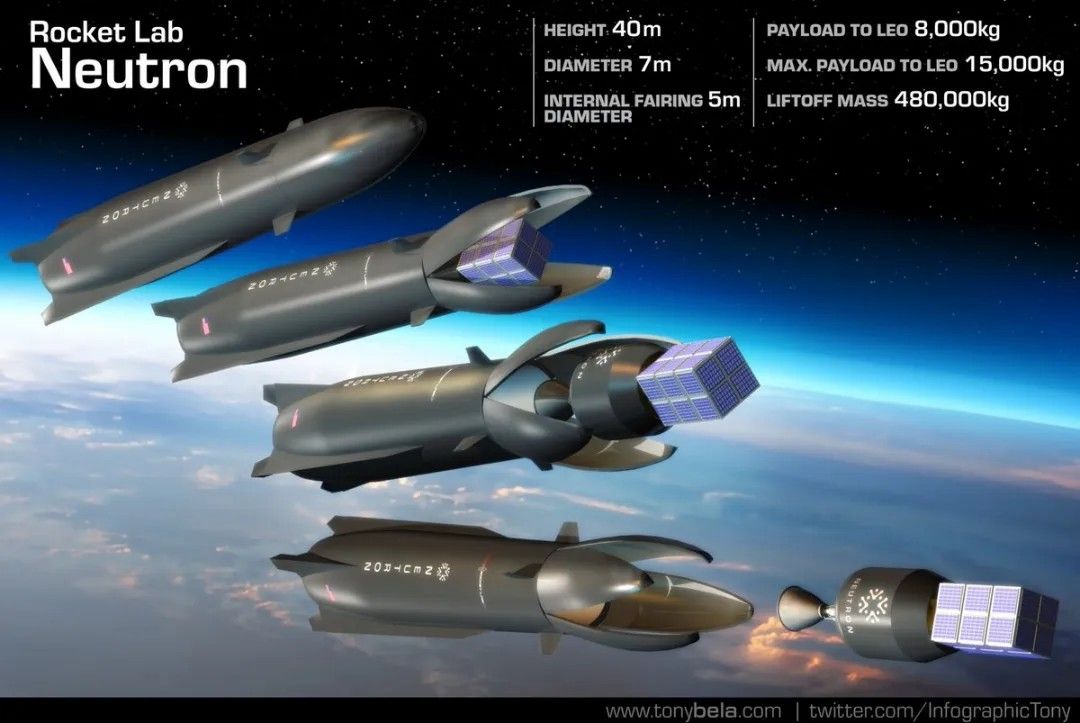
Meanwhile, Rocket Labs suffered a setback which spells the end of their hopes to debut their Neutron rocket in the first quarter of 2026 – and which might delay the vehicle’s maiden flight by as much as a year.

Neutron is intended to be a 2-stage, partially-reusable medium lift launch vehicle (MLLV) in roughly the same class as ULA’s Vulcan-Centaur and SpaceX’s Falcon 9. However, it is of a highly innovative design, the second stage of the vehicle and its payload being carried aloft inside the first stage, within a set of clamshell payload fairings the company calls the “hungry hippo”. These open once the rocket has cleared the Earth’s denser atmosphere so the payload and its motor stage can be released, the core stage then returning to land on a floating platform.

A video showing the 2025 ground testing of Neutron’s aerodynamic fins, which will be used in the core stage’s descent to a landing barge touchdown, and the “Hungry Hippo” payload fairing forming the nose of the stage 

The first Neutron vehicle (sans its upper stage and payload) arrived on the pad at rocket Lab’s launch facilities at the Mid-Atlantic Region Spaceport (MARS) on the Virginia coast earlier in January. On January 21st, the vehicle was undergoing a hydrostatic pressure trial intended to validate structural integrity and safety margins so as to ensure a successful launch.  However, during the test, the vehicle’s main propellant tank buckled and then ruptured, effectively writing off the rocket.

Rocket Lab will now need time to analyse precisely what went wrong, why the propellant tank gave way and whether any significant structural alterations need to be made to it prior to any launch attempt being made.

A rendering of Rocket Lab’s Neutron and how it will work. Credit: Tony Bella

Gazing into the “Eye of Sauron”

Our Sun will one day die. In doing so, its hydrogen depleted, it will swell in size as it struggles to consume progressively heavier elements within itself before it collapses once more, shedding its outer layers into what we call a planetary nebula. It’s not a unique end for a main sequence star such as the Sun, but it can be a beautiful one when viewed from afar and through the eyeglass of time.

One such planetary nebula is that of NGC 7293 / Caldwell 63, commonly referred to as the Helix Nebula. Located some 650 light years away within the constellation of Aquarius as seen from Earth, it is one of the closest bright planetary nebulae to our solar system.

A nine-orbit, true colour image of the Helix Nebula captured by the Hubble Space Telescope (HST) revealing the structure of of nebula. Credit: NASA / ESA / STScl

Formed by an intermediate mass star thought to be similar to the Sun, the Nebula takes its name by the fact that the outer layers  look – from our perspective, at least – like a helix. Some 2.9 light years across its widest axis, the nebula features the stellar core of the star which created it near its centre, a core so energetic as it collapses towards becoming a white dwarf it blew off, it causes the layers of gas and dust to brightly fluoresce.

This combination of shape and fluorescing colours has given the nebula two additional informal names:  The Eye of God, and more latterly and partially in fun in the wake of the Lord of the Rings films, The Eye of Sauron. The nebula was perhaps first made famous by a nine-orbit campaign using the Hubble Space Telescope to capture true-colour images of it in 2004, resulting in a stunning (at the time) composite image of the nebula.

In 2007, the Spitzer Space Telescope captured the Helix Nebula in the infrared wavelengths, revealing much of the complex structure of the nebula’s gas and dust layering, with the core remnants of the star forming it clearly visible and blood red taking to the infrared, giving it the appearance of an eye.

An nfrared false-colour image of the Helix Nebula from the Spitzer Space Telescope. The white dwarf at the heart of the nebula appears red in this image, suggesting a malevolent eye. Image Credit: NASA/JPL

More recently, both the European Southern Observatory’s (ESO) VISTA (Visible and Infrared Survey Telescope for Astronomy) wide-angle telescope located high in the Atacama Desert of Chile, and NASA’s James Webb Space Telescope (JWST) 1.5 million km out in space, have caught the full majesty of the Helix Nebula in comparative detail.

In particular, the JWST images reveal much of the intricate nature of the layers of gas and dust within the nebula. These include clear signs of how the powerful pulses of stellar wind from the dying star are forcing most of the gases and dust in the layers to be pushed away from the core, with globular-like knots and strands of denser material resisting the push, forming what is called cometary knots, due to their resemblance to comets and their tails. However, these “comets” tend to be wider than the planetary core of our solar system!

Left: a true-colour, high-resolution of the Helix Nebula captured by ESO’s VISTA The image of the Helix Nebula on the left is from the ESO’s VISTA telescope in Chile. Right: an image from JWST offering detail on a portion of the Nebula. Credits: ESO/VISTA / NASA / ESA / STScI, J. Emerson (ESO)

JWST’s images also reveal the blue heat of stars beyond the nebula diffracted into beautiful star-like forms by the intervening (and invisible) gas and dust. VISTA, meanwhile helps put the JWST images into perspective within the Nebula as a whole. They also demonstrate how it was likely Helix was result of three different outbursts – or epochs – from the star.

The innermost of these epochs is obviously the youngest and more intact and more exposed to the outflow of stellar winds from the star’s remnants, whilst the outermost is interacting with the interstellar medium, with evidence of shockwaves, ripples, and a general “flattening” of the expanding clouds as it collides with the increasingly denser gas within the interstellar medium. This outermost layer was likely formed about 15,000-20,000 years ago, with the innermost about 10,000-12,000 years old.

A close-up image from JWST showing the “cometary knots”, the majority likely larger than the planetary core of our solar system, formed by dense clusters of gas resisting the outward push of solar winds from the dying star. A star is shown in blue, indicating its heat, the light from it undergoing diffraction by the non-visible dust and gas of the nebula. Credit: NASA / ESA / STScl

In time – around 30-50,000 years from now – the Helix Nebula will vanish as it merges into the interstellar medium and its star collapses into a quiescent white dwarf. But for now it continues to turn its eye upon us, gazing down as an entrancing ring of beauty, visible to professional and amateur astronomers alike.

Space Sunday: Artemis 2 and a Blue Moon lander

An infographic outlining the Artemis 2 mission, during to take place in the first quarter of 2026. Credit: CSA

2026 is set to get off to an impressive start for US-led ambitions for the Moon, with the first three months intended to see the launch and completion of two key missions in the Artemis programme.

In fact, if the principal players in both missions get their way, the missions could be completed before the end of February 2026 and between them signal the opening of the gates that lead directly to the return of US astronauts to the Moon in 2028. Those two missions are the flight of the Blue Origin Pathfinder Mission to the lunar surface, and the first crewed flight to the vicinity of the Moon since the end of the Apollo era: Artemis 2.

Blue Moon Pathfinder

As I’ve previously noted in this column, Blue Moon Pathfinder is intended to fly a prototype of the Blue Moon 1 cargo lander to the Moon’s South Polar Region to demonstrate key elements and capabilities vital to both the Blue Moon Mark 1 and its larger, crew-capable sibling, Blue Moon Mark 2.

These goals include: the firing / re-firing of the BE-7 engine intended for use in both versions of Blue Moon; full use of the planned cryogenic power and propulsion systems; demonstration of the core avionics and automated flight / landing capabilities common to both Blue Moon Mark 1 and Blue Moon Mark 2; evaluate the continuous downlink communications; and  confirm the ability of Blue Moon landers to guide themselves to a targeted landing within 100 metres of a designated lunar touchdown point.

An artist’s rendering of the Blue Moon Mark 1 (foreground) and larger Blue Moon Mark 2 landers on the surface of the Moon. Credit: Blue Origin

Success with the mission could place Blue Origin and Blue Moon in a position where they might take the lead in the provisioning of a human landing system (HLS) to NASA in time for the Artemis 3 mission, currently aiming for a 2028 launch. A similar demonstration flight of Blue Moon Mark 2 is planned for 2027, involving the required Transporter “tug” vehicle needed to get Blue Moon Mark 2 to the Moon. If successful, this could potentially seal the deal for Blue Moon in this regard, given both they and SpaceX must undertake such a demonstration prior to Artemis 3 – and currently, SpaceX has yet to demonstrate the viability of any major component of the HLS design beyond the Super Heavy booster.

Of course, as others have found to their cost in recent years, making an automated landing on the Moon isn’t quite as easy as it may sound, so the above does come with a sizeable “if” hanging over it.

A comparison between the the Apollo Lunar Module, Blue Moon Mark1 and Blue Moon Mark 2. Note that the bulk of the latter comprises the massive Liquid hydrogen (LH2) tank (at the top, with the four large thermal protection / heat dissipation panels needed to help keep the propellant in a liquid form liquid), with the liquid oxygen (LOX) tanks between it and the crew module at the base of the vehicle. Credit: NASA / Blue Origin / David Leonard

The Blue Moon landers are between them intended to provide NASA with a flexible family of landing vehicles, with Blue Moon Mark 1 capable of delivering up to 3 tonnes of materiel to the Moon, and Blue Moon Mark 2 crews of up to four (although 2 will be the initial standard complement) or between 20 tonnes (lander to be re-used) or 30 tonnes (one-way mission) of cargo.

Currently, the Blue Moon Pathfinder flight is scheduled for Q1 2026 – and could potentially take place before the end of January.

Artemis 2: Four People Around the Moon and Back

Artemis 2, meanwhile is targeting a February 5th, 2026 launch. It will see the first crew-carrying Orion Multi-Purpose Crew Vehicle (MPCV) head to cislunar space with three Americans and a Canadian aboard in a 10-11 day mission intended to thoroughly test the vehicle’s crew systems, life support, etc. Despite all the negative (and in part unfair) criticism of the Orion system and its SLS launch vehicle, 21 of the 22 pre-launch milestones have now been met. This leaves only the roll-out of the completed SLS / Orion stack to the launch pad and the full booster propellant tanking testing order for the green light to be given to go ahead with a launch attempt.

An infographic shown by Brad McCain, VP and Programme Manager, Armentum Space Operations Division – a company providing critical support to NASA for SLS ground operations – during a December 15th Webinair on Artemis 2. Note both of the December 2025 items were achieved shortly after the webinair. Credit: Armentum / CDSE

No date has been publicly released for the roll-out, but given the issues experienced with Artemis 1, when helium purge leaks caused problems during the propellant load testing, it is likely that even with the high degree of confidence in the updates made to the propellant loading systems since Artemis 1, NASA will want as much time as possible to carry out the test ahead of the planned launch date.

Whilst Orion did fly to the Moon in 2022, the vehicle being used for Artemis 2 is very different to the one used in Artemis 1. This will be the first time Orion will fly all of the systems required to support a crew of 4 on missions of between 10 and 21 days in space (as is the initial – and possibly only, giving the calls to cancel Orion, despite its inherent flexibility as a crewed vehicle – requirements for the system). As such, Artemis 2 is intended to be a comprehensive test of all of the Orion systems, and particularly the ECLSS – Environmental Control and Life Support System; the vehicle’s Universal Waste Management System (UWMS – or “toilet”, to put it in simpler terms); the food preparation system and the overall crew living space for working, eating, resting and sleeping.

The Artemis 2 crew (l to r: Canadian Space Agency astronaut Jeremy Hansen and NASA astronauts Christina Koch, Victor Glover, and Reid Wiseman) outside the Astronaut Crew Quarters inside the Neil Armstrong Operations and Checkout Building, Kennedy Space Centre, during an integrated ground systems test for the mission, September 20th, 2023. Credit: Kim Shiflett

These tests are part of the reason the mission is set to have a 10-11 day duration compared to the average of 3 days the Apollo missions took to reach, and then return from, the vicinity of the Moon: NASA want to carry out as comprehensive a series of tests as possible on Orion “real” conditions prior to committing to launching the 30-day Artemis 3 mission.

The mission will also be a critical test for Orion’s heat shield. During Artemis 1, the Orion heat shield suffered considerable damage during re-entry into the Earth’s atmosphere, in what was called “char loss” – deep pitting in the heat shield material. Analysis of the damage reviewed the gouges to be the result of “spalling”. In short, in order to shed some of its enormous velocity prior to making a full re-entry into the atmosphere, Orion had been designed to make several “skips” into and out of the atmosphere, allowing it to lose speed without over-stressing the heat shield all at once.

Unfortunately, the method used to manufacture the original heat shields resulted in trace gases being left within the layers of ablative material. When repeatedly exposed to rapid heating as the Artemis 1 Orion vehicle skipped in and out of the upper atmosphere, these gases went through a rapid cycle of expansion, literally blowing out pieces of the heat shield, which were then further exacerbated as the vehicle make its actual re-entry, resulting in the severe char loss.

Two of the official NASA images showing the severe pitting and damage caused to the Orion MPCV heat shield following re-entry into Earth’s atmosphere at 36,000 km/h at the end of the uncrewed Artemis 1 mission, December 11th, 2022. They show the “char loss” pitting caused by “spalling” within the layers of heat shield material. Credit: NASA / NASA OIG

As a result of the Artemis 1 heat shield analysis, those now destined to be used on Artemis 3 onwards will be put through a different layering process to reduce the risk of residual gases becoming trapped in the material. However, because the heat shield for Artemis 2 was already cast, the decision was made to fly it with the mission, but to re-write the Orion’s atmospheric re-entry procedures and software to limit the number of atmospheric skips and the initial thermal stress placed on the heat shield, thus hopefully preventing the spalling.

The Orion vehicle to fly on Artemis 2 is the second fully-completed Orion system – that is, capsule plus European Service Module – and the first vehicle to ne formally named: Integrity. It is functionally identical to the vehicles that will fly on Artemis 3 onwards, with the exception that it is not equipped with the forward docking module the latter vehicles will require to mate with their HLS vehicles and / or the Gateway station.

The SLS booster to be used in the mission is the second in a series of five such boosters being built. Three of these – the vehicle used with Artemis 1 and those for Artemis 2 and 3 are of the initial Block 1 variant, using the Interim Cryogenic Propulsion Stage (ICPS) as their upper stages. This is an evolution of the well-proven – but payload limited – Delta Cryogenic Second Stage (DCSS) developed in the 1990s, and powered by a single RL-10B motor.

Artemis 4 and 5 are intended to be Block 1B versions of SLS, using the purpose-built and more powerful Exploration Upper Stag (EUS), powered by 4 of the uprated RL-10C version of the same engine, enabling them to lift heavier payloads to orbit and the Moon. This means that both Artemis 4 and Artemis 5 will each lift both an Orion MPCV with a crew of 4 and a 10-tonne module intended for the Gateway station intended to be the lunar-orbiting waystation for crews heading to the Moon from Artemis 4 onwards.

A comparison between the SLS ICPS and future EUS. Credit: NASA

However, to return to Artemis 2: as noted, it will be the second SLS rocket to be launched, and like Artemis 1, will fly using the venerable and (up until SLS at least) reusable RS-25 motor developed by Rocketdyne for the US space shuttle vehicles. Sixteen of these engines survived the end of the shuttle programme, and Artemis 2 will see the use of both the most reliable of them ever built. and the only one to be built for the shuttle programme but never used.

Engine 2047 has flown more missions than any other RS-25 – 15 shuttle missions in which it gained a reputation for being the most reliable space shuttle main engine (SSME), consistently out-performing all other motors to come off the original production line. It proved so reliable that not only did it help lift 76 astronauts from the US and around the world into orbit, it was often specifically requested for complex mission such as those involved construction of the International Space Station and servicing the Hubble Space Telescope. By contrast, engine 2062 will be making its first (and last) flight on Artemis 2, being the last of the original RS-25’s off the production line.

The four RS-25 engines to be used on Artemis 2, with 2047 highlighted. Credit: Helen Lewin, RS-25 Launch Support Lead, Aerojet Rocketdyne, via the December 15th, 2025 CDSE webinair

Such is the engineering behind these engines and their control systems that is worth spending a few paragraphs on exactly how they work at launch. While it may seem that all the motors on a multi-engine rocket fire at the same time, this is often not the case because of issues such as the sudden dynamic stress placed on the vehicle’s body and matter of balance, as well as the need to ensure the engines are running correctly.

For the SLS system, for example, engine preparation for launch starts when the propellant tanks are being filled, when some liquid hydrogen is allowed to flow through the engines and vent into the atmosphere in a process called chill down. This cools the critical parts of the engines – notably the high pressure turbopumps – to temperatures where they can handle the full flow of liquid hydrogen or liquid oxygen without suffering potentially damaging thermal shock.

Actual ignition starts at 6.5 seconds prior to lift-off, when the engines fire in sequence – 1, 4, 2, and 3 – a few milliseconds apart (for Artemis 2 engine 2047 is designated flight engine 1 and 2062 flight engine 2, and so these will fire first and second).  Brief though the gap is, it is enough to ensure balance is maintained for the entire vehicle and the four engines can run up to power without creating any damaging harmonics between them.

A diagram of the RS-25 rocket engine used in both the space shuttle system and SLS. Credit: Helen Lewin, RS-25 Launch Support Lead, Aerojet Rocketdyne, via the December 15th, 2025 CDSE webinair

The low and high pressure turbopumps on all four engines then spool up to their operating rates – between 25,000 and 35,000 rpm in the case of the latter – to deliver propellants and oxidiser to the combustion chamber at a pressure of 3,000psi – that’s the equivalent of being some 4 km under the surface of the ocean. During the initial sequence, only sufficient liquid oxygen is delivered to the engines to ignite the flow of liquid hydrogen, causing the exhaust from the engines to burn red. This high pressure exhaust is then directed as thrust through the engine nozzles, meeting the air just beyond the ends of the engine bells.

The counter-pressure of the ambient air pressure is enough to start pushing some of the exhaust gases back up into the engine nozzles, causing what is called a separation layer, visible as a ring of pressure in the exhaust plume. This back pressure, coupled with the thrust of the engines, is enough to start flexing the engine exhaust nozzles, which in turn can cause the exhaust plume on each engine to be deflected by up to 30 centimetres.

Images of a Space Shuttle Main Engine (SSME) ignition sequence showing the formation of the separation rings (arrowed left) and the cleaner-burning half-diamonds (right) as the engines come to full thrust. Credit: NASA

To counter this, the flight control computers initiate a cycle of adjustments throughout each engine, which take place every 20 milliseconds. These adjust the propellant flow rate, turbopump speeds, combustion chamber pressure and the movement of the engines via their gimbal systems in order to ensure all of the engines are firing smoothly and all in a unified direction and pressure, symbolised by a “half diamond” of blue-tinged exhaust (the colour indicating the flow of liquid oxygen) as the separation layer is broken, the thrust of the engines fully overcoming ambient air pressure resistance. All this occurs in less than four seconds, the flight computers able to shut down the engines if anything untoward is monitored. Then, as the countdown reaches zero, the solid rocket boosters (SRBs) ignite and the vehicle launches.

Once underway, Artemis 2 will carry its crew of 4 into Earth orbit for a 24-hour vehicle check-out phase, during which the orbit’s  apogee and perigee are raised. Check-out involves the crew completing a series of tests on the vehicle and its systems, including piloting it, both before and after the ICPS is jettisoned. Completion of this initial check-out phase will conclude with the firing on the ESM’s motor to place Orion on a course for the Moon.

Orion includes the ability for the crew to stow their flight seats flat once in orbit in order to give themselves more room in the capsule. This includes allowing them to rig four shuttle-style sleeping bags in the cabin, each of them positioned in a way that also maximises space for the crew, whilst also positioning them close to the vehicle’s “glass” command and control systems. Credit: NASA

The flight to the Moon will be undertaken using what is called a free return trajectory. That is, a course that will allow the vehicle to loop around the Moon, using its gravity to swing itself back onto a trajectory for Earth without using the main engine to any significant degree. This is to ensure that if the ESM were to suffer a significant issue with its propulsion system, the crew can still be returned to Earth; only the vehicle’s reaction control system (RCS) thrusters will be required for mid-course corrections.

This also means that the mission will only make a single pass around the Moon, not enter orbit. It will pass over the Moon’s far side at a distance of  some 10,300 kilometres and then head back to Earth. On approaching Earth, the Orion capsule will detach from the ESM, perform the revised re-entry flight to hopefully minimise any risk of spalling / char loss, prior to splashing down in the Pacific Ocean off the coast of California.

Orion MPCV 003 Integrity, the vehicle that will carry 4 astronauts on Artemis 2 at Kennedy Space Centre in 2025. The capsule is mated to its ESM, which is in turn mounted on the conical Spacecraft Adapter and awaiting the installation of the three Encapsulated Service Module Panels. Credit: NASA 

I’ll have more on the actual mission and the flight itself as it takes place. In the meantime, my thanks to the Coalition for Deep Space Exploration (CDSE) for hosting a special webinair on Artemis 2 in December 2025, from which portions of this article – particularly some of the graphics – were drawn.