“Stranded” runs the risk of becoming one of the most over-wrought terms used by the by western media in regards to on-orbit human space operations. In recent times it has been used on two occasions, both involving US astronauts, when calling on it was for more about creating sensational headlines than reporting the overall situation.
The first came in 2022/23 when Soyuz MS-22, docked at the ISS, was struck by a small meteor in December 22, severely damaging its lift support cooling systems. Following reviews of the impact, it was agreed that the crew of three – Sergey Prokopyev, Dmitry Petelin, and NASA astronaut Francisco Rubio – would remain on the ISS until the next Soyuz vehicle could be launched uncrewed in February 2023 and then serve as the means to return the three to Earth.
However, this decision did not leave the three men “stranded” in orbit. After extensive testing and computer modelling, Roscosmos determined that should an emergency evacuation of the station be required, Soyuz MS-22 could make a return to Earth carrying Prokopyev and Petelin and without broiling them to death. Arrangements were therefore made for Rubio to b3e able to return to Earth alongside the NASA / SpaceX Crew 5 astronauts should the need arise. Ultimately, these contingencies were not required; the uncrewed Soyuz MS-23 arrived at the ISS ahead of the MS-22 vehicle departing, resolving the issue. MS-22 subsequently made an automated return to Earth during which temperatures within the descent module did not exceed the upper safety limits for flying a 2-man crew home.
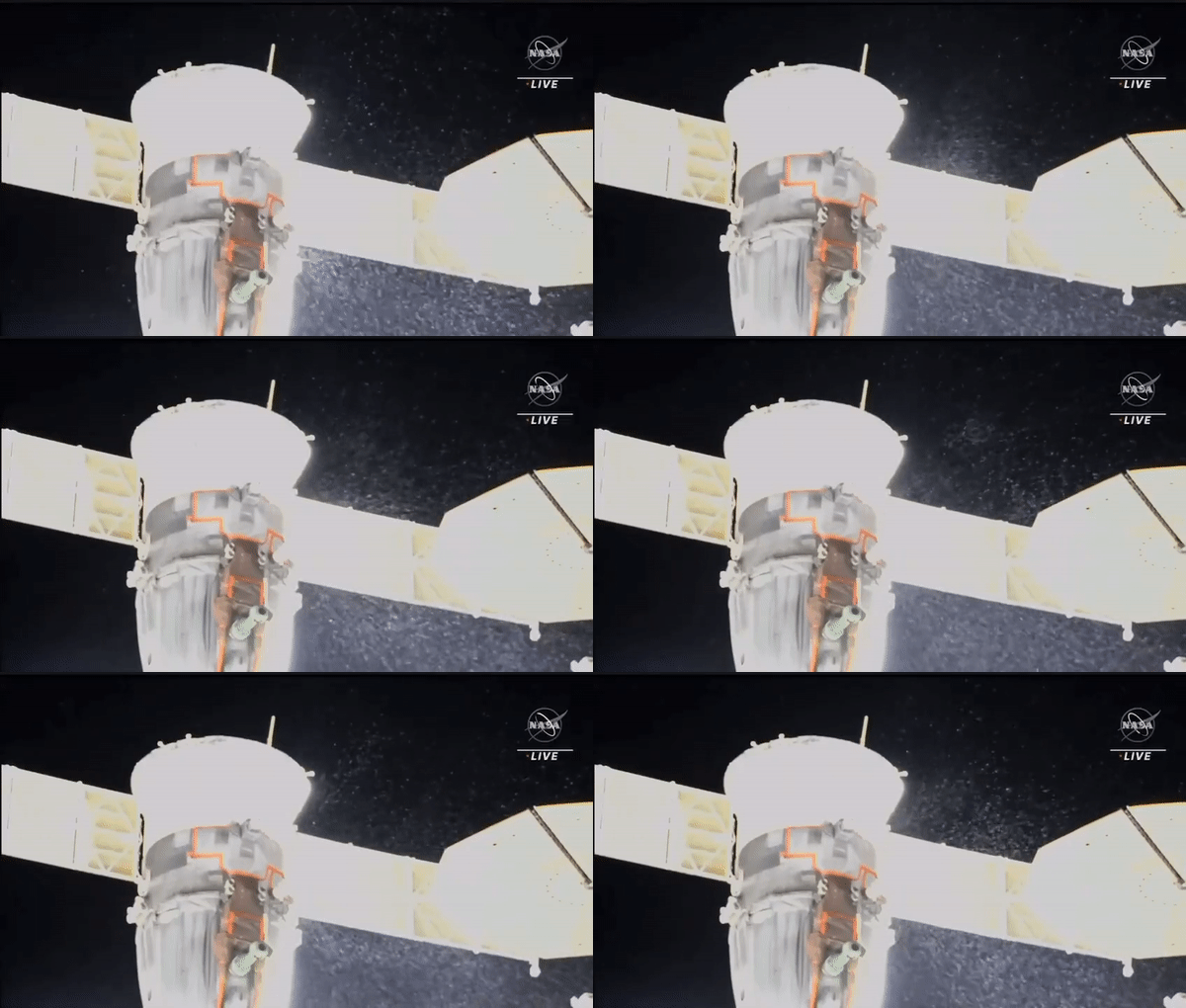
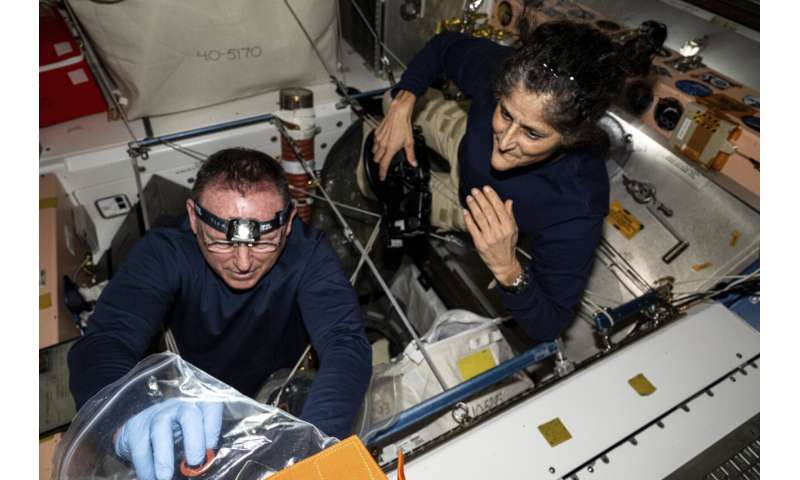
In 2024 much of the news media positively relished the idea that two US astronauts – Barry Wilmore and Sunita Williams – were “stranded” in space when the Boeing CST-100 Starliner they were testing had issues with its thruster systems. Whilst Boeing were confident the issues did not put the astronauts at risk (and indeed, the vehicle made a successful automated return to Earth in September 2024), the decision was made to keep Wilmore and Williams on the station until the next crewed mission to the station – NASA / SpaceX Crew 9 – could be launched, but only with two crew aboard so as to leave the remaining seats free for Williams and Wilmore.
The Crew 9 vehicle eventually launched in September 2024, after the Starliner vehicle had departed the ISS to make room for it. To ensure Wilmore and Williams were not “stranded” in an event of an emergency during the period between the departure of Starliner and the arrival of Crew 9, contingencies were put in place to enable them to return to Earth with the crew of NASA / SpaceX Crew 8. But again, none of this was required. Wilmore and Williams continued to work alongside their colleagues on the ISS, fulfilling the roles vacated by the two Crew 9 astronauts left on the ground, and came home on that vehicle in March 2025, never once having been truly “stranded”.
In the past couple of weeks “stranded” has again been rolled-out by the media, this time in reference to the Chinese Tiangong space station – and this time it does have an underlying cause for concern.
On October 31st, 2025, Shenzhou 21 arrived at the Chinese space station with three crew aboard – mission commander Zhang Lu, Wu Fei and Zhang Hongzhang. They were due to carry out several days of formal hand-over with their comrades Chen Dong, Chen Zhongrui and Wang Jie, who has been aboard the station since April 2025, prior to the latter three boarding their Shenzhou 20 spacecraft and making a return to Earth.
However, at the start of November, 2025, tiny fragments of debris struck Shenzhou 20, and the homecoming crew’s departure would be delayed until the damage to their vehicle had been fully accessed. This assessment revealed the integrity of a viewport on the vehicle’s orbital module had been compromised, and as a result Shenzhou 20 was deemed unsuitable for returning the crew to Earth. Instead, they came home on Shenzhou 21 on November 21st, thus leaving the crew of that mission, Zhang, Wu and Zhang without a means to evacuate the station in an emergency.
And this is where their situation differs to those of the Boeing Starliner crew and Soyuz MS-22: there are no contingencies available except for CMSA to launch an automated Shenzhou vehicle to Tiangong at the earliest opportunity. Fortunately, CMSA work their manned launch vehicles in pairs so that while launches are 6-months apart, at the time of any given launch the vehicle intended to follow it is in a state where it can be readied for launch in a relatively short time should it be required. In this case, CMSA appear to be targeting November 25th, 2025 as a launch date for Shenzhou 22 – although this has not been officially confirmed.

This still leaves the Shenzhou 21 crew in an uncomfortable position, and highlights a growing concern about human space operations in low Earth orbit: it’s getting increasingly crowded with junk and debris, and collisions and impacts are growing increasingly likely. As it is, both the ISS and Tiangong have to make at least 2 significant orbital adjustments a year to avoid debris (with the ISS having to do so five times in 2023), whilst a 2024 European Space Agency study highlighted the fact that there are more than 6,000 items of man-made debris on low Earth orbit of 10 cm or greater in size spanning altitudes of between 375-600 km, marking many of them as potential threats to both the ISS and Tiangong, which orbit between (370-460 km).
Nor does it end there. A study carried out in 2023 revealed that low Earth orbit is seeing debris of 6cm and larger increase at a rate of 2,400 object per year.

As such, the Shenzhou 21 crew situation has given rise to renewed calls for some form of “space rescue” system to be implemented. The problem is – how? There is a degree of commonality in space vehicle design – docking mechanisms for connecting modules to one another and for connecting spacecraft to said modules or, potentially, to one another, are now built to a common standard: the International Docking System Standard (IDSS). However, it’s not entirely clear how closely nations like China adhere to the IDSS. Further, while IDSS may allow rendezvous and docking between craft, it doesn’t specify standards for things like consumable transfers between craft, such as might be required in an emergency (e.g. air, water, propellants).
In addition, the majority of crewed vehicles currently operating aren’t really designed to go pottering around from point-to-point offering assistance. A Soyuz or Crew Dragon from the ISS can’t simply pootle over to Tiangong and offer assistance were its required. The two stations are in very different orbits relative to one another, and the nature of orbital mechanics mean that trying to get from one to the other would likely exhaust a vehicle’s propellant reserves.
This means that in order to be effective, any rescue system need to be both specialised and available on a launch-as-needed basis. But again, this is easier said than done. Who should develop and operate such a system? Who should pay for it? Where should it be based; on the ground, with an entire supporting launch infrastructure with all the complexities that entails, or in orbit – with all the very different complexities that entails? Should the system be crewed, and if so, by whom and on what basis (civilian? military?) or fully automated?
Currently, there are no easy answers – but with commercial activities in Earth orbit about to increase tenfold as companies look towards flying their own orbital research and tourist facilities and their own crew vehicles to link them with Earth, then it is becoming increasingly imperative serious thought is given to try to find answers – and act on them.
Never Tell Me the Odds Comes Home, Blue Origin Reveal Plans
The first stage booster used in Blue Origin’s highly-successful NG-2 mission (see Space Sunday: New Glenn “welds” it on second flight!) has returned to Blue Origin’s facilities at Cape Canaveral Space Force base on November 20th. It will now undergo a examination and refurbishment in readiness for its next flight, which could be as soon as January or February 2026.

The Booster, called Never Tell Me the Odds in a reference to the difficulties involved in bringing a 57.5 metre tall, 7 metre diameter booster back to Earth from the edge of space and landing it smoothly on a vessel 600 km out in the Atlantic – appeared to be in remarkably good condition following its flight as it was delivered to the company’s launch preparation facilities close to Launch Complex 36, from where it had launched on November 13th.
The reason for looking so pristine (particularly in reference to the sooty state of recovered Falcon 9 boosters) is really down to the “clean burn” of the BE-4’s liquid oxygen / liquid methane propellants; it should not be taken as any indication the stage is fit to fly at this point in time. That determination will only come following a complete and careful examination. However, simply seeing it back at CSSF and LC-36 is undeniably a positive further step for Blue Origin.
At around the same time as Never Tell Me the Odds returned to base, Blue Origin revealed its future plans for New Glenn.

In the near-term, the company plan to start operating the vehicle with uprated engines, with the seven BE-4 first stage motors able to generate 4.5 million pound of thrust at lift-off (up from 3.9 million) and the two BE-3U motors of the upper stage increasing their combined thrust from 320,000 pounds to 400,000. Engines of both types capable of handling this increased output have already been tested on the ground, so it might not be too long before they start to be used on New Glenn launches.
In the medium-term, the company also hopes to make the payload fairings recoverable / reusable. Doing so could help support increased flight rates and lower launch costs. However, as SpaceX discovered (albeit by having to go for a complex recovery system of parafoils and high-speed chase boats which looked spectacular but proved impractical), making payload fairings recoverable and actually recovering them in a cost-effective manner might not be that easy.
Most intriguingly and long-term, Blue Origin announced an entirely new variant of New Glenn – the “9×4” – a reference to the fact that it will use 9 BE-4 engines in the first stage (rather than seven) and four in the upper stage (rather than two), whilst maintaining the same overall design and diameter across the two stages (although both will be longer to account for the increased propellant requirements).
This new behemoth is intended to deliver up to 70 tonnes to low Earth orbit, 14 tonnes to geosynchronous orbit and 20 tonnes to the Moon, all with the first stage reusable. In addition the diameter of the payload fairings atop the second stage will be increased from 7 metres to 8.4 metres to handle particularly large payloads (such as space station modules).

It is because of the latter capability – 20 tonnes to the Moon compared to New Glenn’s 7 tonnes – that some are already suggesting the “9×4” should be given a name of its own: the “New Armstrong”, after Neil Armstrong, the first man to set foot on the Moon. Blue Origin has not responded to these calls as yet.
Exactly how commercially viable such a vehicle would be within the commercial sector is hard to say. The SpaceX Falcon Heavy has already demonstrated that launchers with lifting capabilities of 50 tonnes or more really don’t play much of a role in the commercial launch business, instead primarily relying on government contracts. One potential area of use for the New Glenn “9×4” could be in lifting elements of the in-development Orbital Reef commercial space station, a project being led by Blue Origin and Sierra Space – but such work is liable to be niche, rather than a mainstay of revenue generation.
The GEO capability perhaps has more appeal – a 20-tonne capacity could in theory allow the “9×4” to rideshare communications satellites to orbit, reducing the launch costs to customers, with the company’s Blue Ring orbital “tug” positioning them. However, it is in the government sector and lunar operations theatre that the new behemoth would potentially have a role. A 14-20 payload capacity would be very attractive for military launches and to efforts such as Artemis and in launching deep-space science missions into the solar system.

Again, Blue Origin has offered no time frame on when the “9×4” will enter service; however, the degree of commonality it has with New Glenn likely means its development cycle could be relatively brief. In reporting on it, some pundits have suggested the “9×4” could have a maiden launch in 2027, although this does seem a tad ambitious, particularly given Blue Origin’s “soft and gentle” approach. As such, 2030 would seem a more reasonable time frame for “9×4” to start flights.
Some have already suggested that “9×4” could be a viable replacement for NASA’s Space Launch System (SLS) rocket in carrying crews to the Moon. However, and as I’ve noted in these pages, replacing SLS is easier said than done. Whilst New Glenn has been designed from the ground-up to be capable of making crewed launches (something SpaceX’s Starship most definitely is not in its current configuration), there is currently no crewed vehicle it is actually capable of launching. Orion, for example, the only crewed vehicle the US has that is specifically designed to handle carrying crews from Earth to Cislunar space, is currently completely incompatible with New Glenn.

But that said, it is not entirely inconceivable that, given a suitable amount of time (and remember, SLS systems for Artemis 2 through 5 are already well in hand in terms of construction), and with Artemis 5 realistically unlikely to launch before 2031, there is potential for Lockheed Martin and Blue Origin to put their heads together to see if they could develop a means by which Orion could be launched by New Glenn “9×4” to launch Orion. This would still likely require some form on on-orbit propellant resupply – but that would likely only be a single additional launch, so it’s not entirely out of the question (given SpaceX plan to launch around 8-12 Starships for every vehicle it sends to the Moon).
That said, New Glenn being used in crewed lunar missions is not something I’d personally put my money on right now; it just seems so much better suited to rapid cargo delivery to the Moon, again particularly when compared to Starship – even if the latter could in theory carry 5 times more per vehicle to the Moon.