Space Sunday: day of remembrance, seeing Mars and flying over Ceres

This week marked a sombre period in the annals of NASA’s history. In a period of just 7 days – albeit spread across 50 years – America lost 17 astronauts in just three space flight related tragedies. Every year, the US space agency marks this loss of life – the results of the Apollo 1, Challenger and Columbia accidents – with a special Day of Remembrance on the 27th January. This year’s event was particularly poignant in that 2016 marks the 30th anniversary of the Challenger disaster.

It was on January 27th, 1967, that NASA suffered the first of these tragedies when, during a pre-launch rehearsal of what was intended to be the first manned flight of the Apollo Command and Service modules, a fire broke out inside the Command Module as the vehicle sat on the pad of Cape Kennedy Air Force Station Launch Complex 34. A combination of a pure oxygen atmosphere at a high internal PSI, and highly flammable materials used in the vehicle’s interior construction resulted in the deaths of Command Pilot Virgil I. “Gus” Grissom, Senior Pilot Edward H. White II, and Pilot Roger B. Chaffee in just 16 seconds.
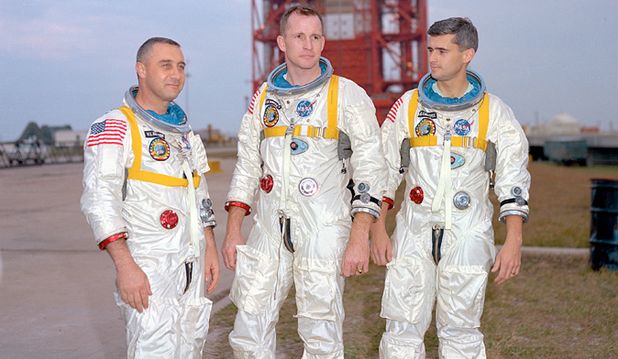
Apollo 1: (l-to-r) Virgil I. "Gus" Grissom, Edward H. White II, and Roger B. Chaffee standing before the Apollo 1 launch vehicle, on January 17th, 1961
Apollo 1: (l-to-r) Virgil I. “Gus” Grissom, Edward H. White II, and Roger B. Chaffee standing before the Apollo 1 launch vehicle, on January 17th, 1961

Nineteen years later, on January 28th, 1986, NASA suffered its largest loss of life in a space mission up until that point in time. It occurred when Space Launch System mission 51L, the 25th flight in the space shuttle programme and the 10th flight of the shuttle orbiter vehicle Challenger – regarded as the veteran of the fleet, having flown more orbital missions than the other three orbiter vehicles at that time – exploded 73 seconds after launch, resulting in the loss of all seven crew.
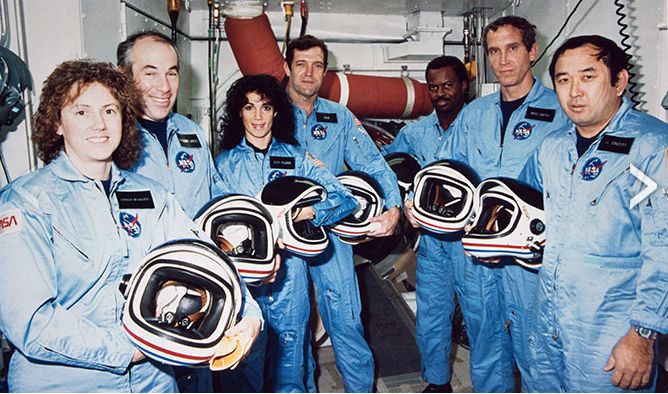
The Challenger 7: (l-to-r) Sharon Christa McAuliffe, Gregory Jarvis, Judith Resnik, Francis "Dick" Scobee, Ronald McNair, Michael Smith and Elison Onizuka, during a countdown training exercise on January 9th, 1986
The Challenger Seven: (l-to-r) Sharon Christa McAuliffe, Gregory Jarvis, Judith Resnik, Francis “Dick” Scobee, Ronald McNair, Michael J. Smith and Ellison Onizuka, during a countdown training exercise on January 9th, 1986

Tragedy struck the space shuttle programme again on February 1st, 2003, when the space shuttle Columbia broke-up following re-entry into the Earth’s atmosphere at the end of mission STS-107, killing all seven crew. On board were Commander Rick Husband, Pilot William McCool, Payload Commander Michael Anderson, Mission Specialists Laurel Blair Salton Clark, Kalpana Chawla, David M. Brown, and Payload Specialist  Ilan Ramon, a colonel in the Israeli Air Force and the first Israeli astronaut.

The official STS-107 crew photo (l-to-r): Brown, Husband, Clark, Chawla, Anderson, McCool, Ramon
The official STS-107 crew photo (l-to-r): David M. Brown, Rick Husband, Laurel Blair Salton Clark, Kalpana Chawla, Michael P Anderson, William C. McCool, and Ilan Ramon

There have of course been other lives lost within the fraternity of astronauts and cosmonauts over the decades. However, these three tragedies perhaps stand larger than others because NASA has always undertaken its missions in the full glare of the public and media spotlight. Apollo 1, for example, was the headline mission for America meeting President Kennedy’s requirement for “landing a man on the Moon and returning him safely to the Earth” before the end of the decade. Similarly, STS-51L, the Challenger mission, had been specifically engineered to be in the public eye, featuring as it did the first teacher in space, Sharon Christa McAuliffe.

McAuliffe had been selected from more than 11,000 applicants to participate in NASA’s Teacher in Space Project, initiated by US Present Ronald Reagan and intended by NASA to rejuvenate public interest in the space programme, which has been declining steadily since the first space shuttle flight in 1981. The gamble paid off and McAuliffe, became a media sensation, attracting world-wide public interest in STS-51L; so much so that it has been estimated that around 17% of Americans watched Challenger’s lift-off live on television as a direct result of McAuliffe’s presence on the mission, and that around 85% heard about the disaster within an hour of it occurring (and if that doesn’t sound unusual, remember 1986 was well before the Internet and media revolution what has placed information and news at our fingertips wherever we are).

It could be argued – particularly with regards to Challenger, and also with Apollo 1, that the disaster could have been avoided. Warnings about the precise type of failure which caused the loss of Challenger date back as far as 1971, which tests carried out in 1977 revealing the risk of what because known as an O-ring failure being inherent in the design of the shuttle’s solid rocket boosters.

Things are less clear in the case of the Columbia tragedy; while it has been suggested that a rescue mission might have been mounted using the shuttle orbiter Atlantis, which was being prepared for a mission due to lift-off at the start of March, 2003. However, in order to get the vehicle flight ready for a launch ahead of the February 15th deadline (the point at which lithium hydroxide, a critical part of the systems used to remove carbon dioxide from the air in a space vehicle, would run out aboard Columbia), was itself fraught with risks.

But whether they could be avoided or not, these three disasters remind us that the cost of becoming a space faring civilisation – something which could be vital to our survival – is not without risk. Which is why I’ll close this part of Space Sunday with the words of Francis R. Scobee, the Commander of STS-51L, written shortly before his death aboard the Challenger:

Continue reading “Space Sunday: day of remembrance, seeing Mars and flying over Ceres”

Space update: seeking planet X, examining comets and sifting sand

CuriosityNASA’s Curiosity rover has been sampling the sands of the “Namib Dune” the vehicle has been studying / circumnavigating for the last few weeks as it studies an extensive dune field which is slowly making its way down the slopes of “Mount Sharp” on Mars at the rate of about a metre per year.

“Mount Sharp”, more formally called Aeolis Mons, is the huge mound of material gathered against the central impact peak of Gale Crater. It forms the rover’s primary mission target in its quest to better understand conditions on Mars down through the ages, and to look for areas which at some point in the planet’s past, may have had all the right conditions – minerals, chemicals, water, heat, shelter, etc., – which might have allows life to arise.

The dune field on the north-east flank of “Mount Sharp” is of considerable interest to scientist, as it is the first genuine dune field to be studied on another world, and obtaining a clearer understanding of how the Martian wind moves sand could lead to a clearer picture of how big a role the wind plays in depositing concentrations of minerals often associated with water across the planet, and by extension, the behaviour and disposition of liquid water across Mars.

Tracks on a sand dune: this image from Curiosity's front Hazard Avoidance Camera (Hazcam) shows the rover's tracks on the same of "Namib Dune" as it starts sample gathering
Tracks on a sand dune: this image from Curiosity’s front Hazard Avoidance Camera (Hazcam) shows the rover’s tracks on the same of “Namib Dune” as it starts sample gathering

On January 12th, the rover reached a target area for sample gathering dubbed “Gobabeb”, and even this presented a challenge. Curiosity had to manoeuvre up onto the dune, and then turn in place in order to start sample gathering operations. This meant a cautious approach to the location, initially “scuffing” the sand to obtain and indication of its depth and composition (loose firm material). After this the rover gently edged onto the sand and deployed the robot arm to use its small scoop in only its second major sample gathering exercise, which took place on January 14th.

The sand gathered by the operations well be sorted within the CHIMRA system inside the robot arm, which uses a series of sieves to divide the sand grains by coarseness. Once sorted, the samples are delivered to the rover on-board chemical and analysis systems  – ChemMin, the Chemical and Mineralogical laboratory and SAM, the Sample Analysis at Mars suite – for examination.

A second sample of sand was gathered on January 19th, and is currently awaiting processing.

CHIMRA
CHIMRA – the Collection and Handling for In-Situ Martian Rock Analysis device attached to the turret at the end of Curiosity’s robotic arm, processes samples acquired from the built-in scoop (red) and the drill, which is not shown but is also part of the turret. CHIMRA also delivers samples to the analytical lab instruments inside the rover. Two paths to get material into CHIMRA are shown (the scoop delivers material to the location marked at the bottom, and the drill deposits material to the sample transfer tube shown at top). Also marked are the location of the vibration mechanism used to shake the turret and cause the sample to move inside CHIMRA, and the portion box (yellow) from which the material processed through a sieve is delivered to the analytical lab instruments.

Europe Joins Dream Chaser

In my last Space Sunday report, I covered the news that Sierra Nevada Corporation (SNC) will be joining SpaceX and Orbital ATK in supporting US work to delivery supplies to, and remove waste from, the International Space Station.

As a part of a new contract which commences in 2019 and runs until 2024, the expected end of ISS operations, SNC will utilise an unmanned cargo version of its Dream Chaser “mini shuttle”, which is based on a lifting body design, to carry up to 5 tonnes of material to the space station. Now Europe has officially joined SNC as a strategic partner.

The Drem Chaser Cargo, bult by SNC, and the International Berth and Docking Mechanism, to be supplied to SNC for Dream Chaser flights by the European Space Agency
The Dream Chaser Cargo, built by SNC, and the International Berth and Docking Mechanism, to be supplied to SNC for Dream Chaser flights by the European Space Agency

SNC and Europe have been looking at options for Dream Chaser development since SNC lost out to SpaceX and Boeing to supply the crewed version of Dream Chaser to NASA for ferrying crews back and forth between the ISS and US soil. Confirmation that NASA will be using Dream Chaser for the resupply flights means that ESA can nor push ahead with developing an International Berthing and Docking Mechanism (IBDM) for Dream Chaser.

Continue reading “Space update: seeking planet X, examining comets and sifting sand”

Space Sunday: cosmic lightsabers, monkeys to Mars and junk in orbit

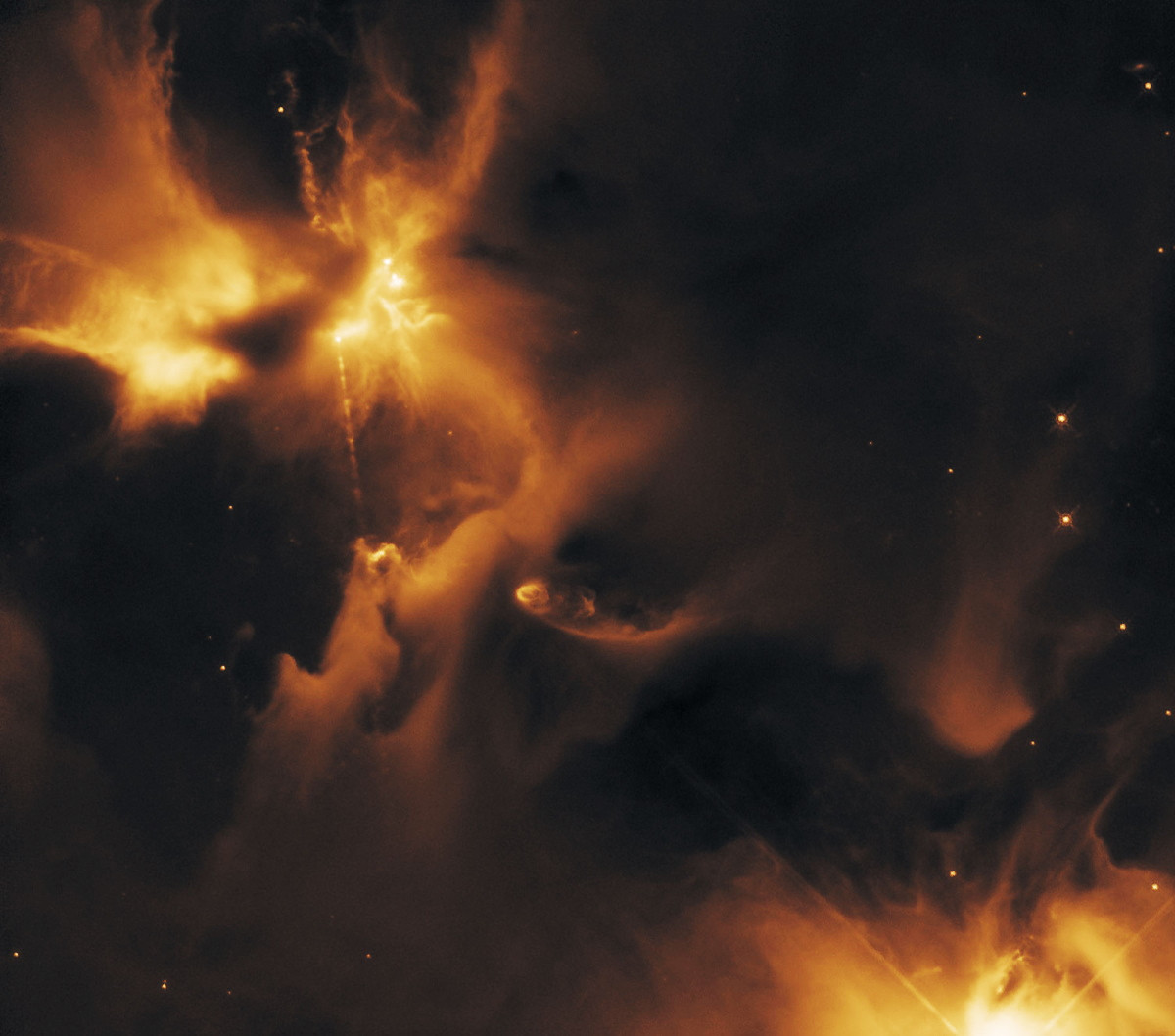
There were many remarkable space images published throughout 2015. However, perhaps one of the most memorable came at the end of the year, and coincided  with the release of Disney’s Star Wars: The Force Awakens. Captured by the Hubble Space Telescope, the image was immediately dubbed by the media as the “cosmic lightsaber” due to the manner in which part of the image resembles the double-sided lightsaber used by Darth Maul in an earlier Star Wars film.

It shows a new-born star laying within a cloud of dust, which is shooting out two beams of light from its poles and which seem to cut through the surrounding material and space.

Two beams of light slice through space from the polar regions of a new-born star. Captured by the Hubble Space Telescope, the image was immediately dubbed "the cosmic lightsaber" (image: ESA / NASA / D. Padgett / T. Megeath / B. Reipurth) - click for full size
Two beams of light slice through space from the polar regions of a new-born star. Captured by the Hubble Space Telescope, the image was immediately dubbed “the cosmic lightsaber” (image: ESA / NASA / D. Padgett / T. Megeath / B. Reipurth) – click for full size

The beams are no optical illusion, but the result of material from the surrounding dust cloud falling into the star, only to erupt into supersonic jets of material ejected up through the star’s poles and into space. As the jets travel outwards, so they encounter other dust and material, and distinctive arced shock waves form within the “beams”, which gradually give rise to knotted clumps of material called Herbig-Haro (HH) objects, and are ubiquitous in star-forming regions, although they are relatively short-lived in astronomical terms.

Given the nature of the HH object seen by Hubble (officially designated HH24), it is thought that the star causing it is very young – just a few thousand years old. It lies in a “stellar nursery” some 1,350 light-years away “in” the constellation of Orion, and which has one of the highest concentrations of HH objects yet found in our galaxy.

Another view of the "stellar nursery" where stars are being formed, captured by Hubble. HH24 can be seen at the top left, with further HH objects just visible in the lower right. Both this image and the one above were captured in infrared, allowing Hubble to "look through" the intervening clouds of dust and "see" the jets
Another view of the “stellar nursery” where stars are being formed, captured by Hubble. HH24 can be seen at the top left, with further HH objects just visible in the lower right. Both this image and the one above were captured in infra-red, allowing Hubble to “look through” the intervening clouds of dust and “see” the jets

Monkeys to Mars?

There is a mounting effort to see humans set foot on Mars some time within the next 25 years; however, Russia is apparently set on getting “crew” to Mars by 2017, in the form of four macaque monkeys.

The simians have been selected on the basis of their cognitive and learning abilities, and have been undergoing 3 hours a day of training for a possible flight to Mars, with news of the proposal first reaching the public domain in October 2015. The training is has been taking place at the Institute of Biomedical Problems in Moscow, and initially comprised training the monkeys to operate a joystick system to “shoot” targets on a screen, as indicated by a cursor.  Successful “hits” saw the monkeys rewarded with a sip of juice.

This has been followed by training the monkeys to solve simple puzzles and mathematical problems. “What we are trying to do,”  Inessa Kozlovskaya, responsible for the team training the monkeys, “is to make them as intelligent as possible so we can use them to explore space beyond our orbit,”

The Russian plan is to send the monkeys on a six-month voyage to Mars, during which their heath and ability to function during a prolonged stay in zero gravity conditions will be assessed, together with their exposure to cosmic radiation. However, Russian officials have refused to indicate whether the mission will include a return trip to Earth.

Rhesus macaques are one of the least endangered, most familiar of the "old world" monkeys, and are known for their intelligence and their social bonds (image: "carcoalfeather", deviant art)
Rhesus macaques are one of the least endangered, most familiar of the “old world” monkeys, and are known for their intelligence and their social bonds (image: “carcoalfeather”, deviant art)

Sending animals into space isn’t new. The very first animal to enter space was in fact a rhesus macaque called Albert. He flew a short-duration ballistic flight atop a US V2  in 1948, but died of suffocation mid-flight. His successors were no less fortunate. Alberts II, and IV were killed on impact when their capsule parachutes failed to deploy, and Albert III died when his V2 exploded on the edge of space.

Continue reading “Space Sunday: cosmic lightsabers, monkeys to Mars and junk in orbit”

Space Update: silica mysteries, Brits in space and tracking Santa

new-horizonNew Horizons is still less than half way through transmitting the data gathered during its fly-past of the Pluto-Charon system in July 2015, but the wealth of information received thus far has already revealed much about Pluto and its “twin”.

Geological evidence has been found for widespread past and present glacial activity, including the formation of networks of eroded valleys, some of which are “hanging valleys,” much like those in Yellowstone National Park, Wyoming. A major part of this activity is occurring in and around “Sputnik Planum”, the left half of Pluto’s “heart”, a 1,000 km (620 mile) wide basin, which is seen as key to understanding much of the current geological activity on Pluto.

Images and data gathered for this region has given rise to new numerical models of thermal convection with “Sputnik Planum”, which is formed by a deep layer of solid nitrogen and other volatile ices. These not only explain the numerous polygonal ice features seen on Sputnik Planum’s surface, but suggest the layer is likely to be a few kilometres in depth.

Evaporation of this nitrogen, together with condensation on higher surrounding terrain is believed causing a glacial flow from the higher lands back down into the basin, where the ice already there is pushed, reshaping the landscape over time.

A ture colour image of Pluto's surface, captures just before the point of closest approach, and created by combining black-and-while images from from the LORRI camera with data gathered by the Ralph instrument suite. The picture show the highlands to one side of "Sputnik Planum with the pockmarked ices of the basin. A combination of evaporation and condensation between the two is giving rise to sustained glaciation on Pluto, showing it to be an active world
A true colour image of Pluto’s surface, captures just before the point of closest approach, and created by combining black-and-while images from from the LORRI camera with data gathered by the Ralph instrument suite. The picture show the highlands to one side of “Sputnik Planum” with the pockmarked ices of the basin. A combination of evaporation and condensation between the two is giving rise to sustained glaciation on Pluto, showing it to be an active world (image: NASA, JHU/APL SwRI)

More data and images have also been received regarding Pluto’s atmosphere, allowing scientists start to probe precisely what processes are at work in generating and renewing the atmosphere, the upper limits of which are subject to erosion by the solar wind, which strike Pluto at some 1.4 million kilometres per hour (900,000 mph).

As well as understanding the processes which are at work renewing the atmosphere, and thus preventing it from being completely blasted away by the solar wind, science teams are hoping to better further why the haze of Pluto’s atmosphere forms a complicated set of layers – some of which are the result of the formation and descent of tholins through the atmosphere – and why it varies spatially around the planet.

The Mars Silica Mystery

In July I covered some of the work going into investigating the mystery of silica on Mars. This is a mineral of particular interest to scientists because high levels of it within rocks could indicate conditions on Mars which may have been conducive to life, or which might preserve any ancient organic material which might be present. In addition.

As I reported back in July, scientists have been particularly interested in the fact that as Curiosity has ascended “Mount Sharp”, so have the amounts of silica present in rocks increased: in some rocks it accounts for nine-tenths of their composition. Trying to work out why this should be, and identifying the nature of some of the silica deposits has given rise to a new set of mysteries.

The first mystery is trying to understand how the silica was deposited – something which could be crucial in understanding how conducive the environment on “Mount Sharp” might have been for life. Water tends to contribute to silica being deposited in rocks in one of two ways. If it is acidic in nature, it tends to leach away other minerals, leaving the silica behind. If it is more neutral or alkaline in nature, then it tends to deposit silica as it filters through rooks.

This May 22, 2015, view from the Mast Camera (Mastcam) in NASA's Curiosity Mars rover shows the "Marias Pass" area where a lower and older geological unit of mudstone -- the pale zone in the center of the image -- lies in contact with an overlying geological unit of sandstone. This view from the Mast Camera (Mastcam) in NASA's Curiosity Mars rover shows the "Marias Pass" area where a lower and older geological unit of mudstone -- the pale zone in the center of the image -- lies in contact with an overlying geological unit of sandstone. Just before Curiosity reached Marias Pass, the rover's laser-firing Chemistry and Camera (ChemCam) instrument examined a rock found to be rich in silica, a mineral-forming chemical. This scene combines several images taken on May 22, 2015, during the 992nd Martian day, or sol, of Curiosity's work on Mars. The scene is presented with a color adjustment that approximates white balancing, to resemble how the rocks and sand would appear under daytime lighting conditions on Earth.
This mosaic of images captures by Curiosity’s Mastcam on May 22nd 2015 (Sol 992), shows the “Marias Pass” region where mudstone (the pale rock in the centre of the image) of the kind the rover had been studying, overlaid by a geological unit of sandstone. rocks in this area should very high concentrations of silica in them, much higher than previously encountered, which the rocks above the area show strong evidence of silica deposition as a result of water action. This image has been white balanced to show the rock under Earth equivalent natural lighting conditions (image: NASA / JPL)

If the water which once flowed down / through “Mount Sharp” was acidic in nature, it would likely mean that the wet environments found on the flanks of the mound were hostile to life having ever arisen there or may have removed any evidence for life having once been present. If evidence that the water was acidic in nature, then it would also possibly point to conditions on “Mount Sharp” may have been somewhat different to those found on the crater floor, where evidence of environments formed with more alkaline water and with all the right building blocks for life to have started, have already been discovered.

The second mystery with the silica is the kind of silica which has been discovered in at least one rock.  Tridymite is a polymorph of silica which on Earth is associated with high temperatures in igneous or metamorphic rocks and volcanic activity. Until Curiosity discovered significantly high concentrations of silica in the “Marias Pass area of “Mount Sharp” some seven months ago – something which led to a four month investigation of the area – tridymite had never been found on Mars.

The region just above "Marias Pass" contained an area referred to as the "Stimson Unit" which showed fracturing rich in silica when compared to the surrounding rocks, suggesting deposition of silica / leaching of other minerals as a result of water action
The region just above “Marias Pass” contained an area referred to as the “Stimson Unit” which showed fracturing rich in silica when compared to the surrounding rocks, suggesting deposition of silica / leaching of other minerals as a result of water action (images: NASA / JPL)

“Marias Pass” and the region directly above it, called the “Stimson Unit” show some of the strongest examples of silica deposition on “Mount Sharp”, and  it was in one of the first rocks, dubbed “Buckskin”, exhibiting evidence of silica deposits in which the tridymite was found.

The question now is: how did it get there? All the evidence for the formation of “Mount Sharp” points to it being sedimentary in nature, rather than volcanic. While Mars was very volcanic early on in its history, the presence of the tridymite on “Mount Sharp” might point to volcanic /  magmatic evolution on Mars continuing for longer than might have been thought, with the mineral being deposited on the slopes of the mound as a result of wind action. Or alternatively, it might point to something else occurring on Mars.

Continue reading “Space Update: silica mysteries, Brits in space and tracking Santa”

Space Sunday: clouds, sand, meteors and launches

Artist's impression of Akatsuki in orbit around Venus
Artist’s impression of Akatsuki in orbit around Venus

In my last Space Sunday update, I was writing at the very time a final effort was being made to see a little Japanese space probe finally achieve an operational orbit around Venus, precisely five years to the date after the first attempt failed as a result of the craft’s primary motor malfunctioning.

At the time of writing that update, it appeared as if little Akatsuki (“Dawn”), designed to probe the Venusian climate and atmosphere had finally arrived in orbit about the planet, but as I noted, final confirmation would take a while.  In the end, it wasn’t until Wednesday, December 9th that the Japan Aerospace eXploration Agency (JAXA) did confirm Akatsuki, less than a metre on a side (excluding its solar panels) was secure in its orbit around Venus and would likely be able to complete its mission.

Following the failure of its main engine on December 7th 2010 during a critical braking manoeuvre, the probe had finished up in a heliocentric orbit, circling the sun and heading away from Venus. However, orbital mechanics being as they are, both the probe and Venus would occupy the same part of space once again in December 2015, presenting final opportunity to push the probe into orbit using its RCS manoeuvring thrusters. This is precisely what happened on the night of December 6th / 7th, 2015. While not designed for this purpose, a set of the probe’s RCS thrusters undertook a 20-minute burn just before midnight UTC on December 6th, and preliminary telemetry received on Earth some 30+ minutes later showed Akatsuki had achieved sufficient braking to enter a very elliptical orbit around Venus.

A simple orbital diagram released as a part of the low-key JAXA press release confirming Akatsuki had arrived in orbit around Venus
A simple orbital diagram released as a part of the low-key JAXA press release confirming Akatsuki had arrived in orbit around Venus (image: JAXA)

Data received since then show that the craft is in an eccentric orbit with an apoasis altitude (the point at which it is furthest from the surface of Venus) of around 440,000km, and a periapsis altitude (the point at which it is closest to the surface of Venus) of around 400km. This is a considerably broader orbit than the mission had originally intended back in 2010, giving the vehicle an orbital period of around 13.5 days, the orbit slightly inclined relative to Venus’ equator.

An ultra-violet image of Venus, returned by Akatsuki shortly after achieving its initial orbit around the planet, and having passed through periapis, already heading away from the planet
An ultra-violet image of Venus, returned by Akatsuki shortly after achieving its initial orbit around the planet, having passed periapsis during the braking manoeuvre, to head away from the planet (image: JAXA)

In order to maximise the science return from the vehicle – which is now operating well in excess of its designed operational life – JAXA plan to use the next few months to gradually ease Akatsuki in an orbit which reduces both the apoasis distance from Venus, and bring down the orbital period to about 9 days.

These manoeuvres will likely be completed by April 2016, allowing the full science mission to finally commence.  This is aimed at learning more about the atmosphere and weather on Venus as well as confirm the presence of active volcanoes and thunder, and also to try to understand exactly why  Earth and Venus developed so differently from each other, despite being seen as sister planets in some regards.

Even so, right from its arrival in its initial orbit, Akatsuki has been flexing its muscles, testing its imaging systems and returning a number of preliminary pictures of Venus to Earth, such as the ultra-violet image shown above right, captured just after the craft finally achieved orbit.

Curiosity reaches Sea of Sand

NASA’s Mars Science Laboratory rover Curiosity has reached the edge of the major “sea” of sand dunes located on the flank of “Mount Sharp”. Dubbed the ““Bagnold Dunes” after British military engineer Ralph Bagnold, who pioneered the study of sand dune formation and motion, doing much to further the understanding of mineral movements and transport by wind action. Such studies are seen as an essential part of understanding how big a role the Marian wind played in depositing concentrations of minerals often associated with water across the planet, and by extension, the behaviour and disposition of liquid water across Mars.

Sand is not a new phenomenon for rovers on Mars to encounter – Curiosity, Opportunity and Spirit have all had dealings with it in the past; in fact Spirit’s mission as a rover came to an end in 2009, after it effectively got stuck in a “sand trap”. However, the “Bagnold Dunes” are very different to the sandy environs previously encountered by rovers; it is a huge “genuine” dune field where the sand hills can reach the height of 2-storey buildings and cover areas equivalent to an American football field.

The rippled surface of the first Martian sand dune ever studied up close. Captured by Curiosity's Mastcam on November 27th, 2015 (Sol 1,176 on Mars), the view is looking up the curved slope of "High Dune", revealing a rippled surface of sand sculpted by the wind. The Bagnold dunes" are "active", in that they are migrating down the slope of "Mount Sharp" at the rate of around one metre (39 inches) a year. The dunes are active, migrating up to about one yard or meter a year.
The rippled surface of the first Martian sand dune ever studied up close. Captured by Curiosity’s Mastcam on November 27th, 2015 (Sol 1,176 on Mars), looking up the curved slope of “High Dune” as it rises above Curiosity. The “Bagnold Dunes” are “active”, in that they are migrating down the slope of “Mount Sharp” at the rate of around one metre (39 inches) a year  (image: NASA / JPL)

So far, Curiosity has only probed the edge of the dune field around a sand hill originally dubbed “Dune 1”, and now called “High Dune”, using both its camera to image the region and its wheels to test the surface material prior to moving deeper into the sands. Wheel slippage is a genuine concern for the rover when moving on loose surfaces, as it can both overtax the motors and put the rover at risk of toppling over. Given this, and while there are no plans to attempt any ascent up the side of a dune, the mission team are taking things cautiously.

Continue reading “Space Sunday: clouds, sand, meteors and launches”

Space Sunday: of rockets, moons, carbon and telescopes

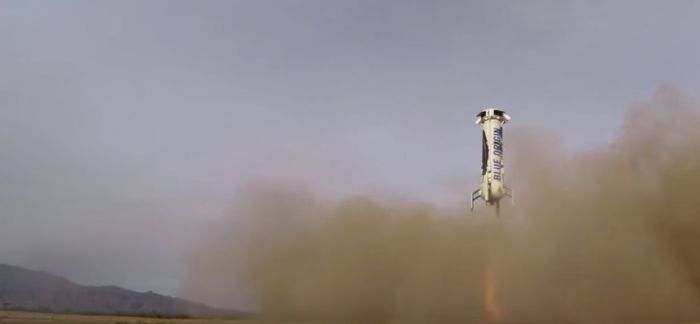
Moments before touchdown: the Blue Origin propulsion module, having lobbed a New Shephard capsule on a sub-orbital flight, powers its way to a historic landing so it can be refurbished and re-used
November 23rd, 2015: moments before touchdown: the Blue Origin propulsion module, having lobbed a New Shephard capsule on a sub-orbital flight, powers its way to a historic landing so it can be refurbished and re-used (image: Blue Origin)

Blue Origin, the private space company founded by Amazon billionaire Jeff Bezos has become the first company to successfully launch a rocket into space – and return all elements of the vehicle to Earth for re-use.

The flight, carried out in West Texas, took place on Monday, November 23rd. It comprised the company’s New Shephard capsule, being flown in an uncrewed mode, and a single stage, recoverable booster is powered by an engine also developed by the company.

Unlike SpaceX, Orbital Sciences, Boeing and Sierra Nevada Space corporation, all of whom are directly pursuing rocket and space vehicle designs capable of orbital flight, Blue Origin is taking a more incremental approach, with efforts focused on the sub-orbital market “space tourism” market. The company is looking to build a cost-effective launch system capable of lifting small groups of paying passengers into space on ballistic “hops” which allow them to experience around 4-5 minutes of zero gravity before returning them to Earth.

The November 23rd flight saw the uncrewed New Shephard vehicle hoisted aloft by the booster system which reached a speed of Mach 3.72, sufficient for it to impart enough velocity to the capsule so that it could, following separation, continue upwards to an altitude of 100.5 kilometres (329,839 feet), before starting its descent back to the ground and parachuting to a safe landing.

April 25th: A camera aboard the propulsion module captures the rear of the New Shephard capsule moments after separation in the first test flight intended to recover both capsule and launcher - although the latter was in fact lost on that flight
April 25th: A camera aboard the propulsion module captures the rear of the New Shephard capsule moments after separation in the first test flight intended to recover both capsule and launcher – although the latter was in fact lost on that flight (image: Blue Origin)

Following capsule separation, however, the booster rocket Also made a control descent back to Earth, rather than being discarded and lost. The design of the booster – which Blue Origin call the “propulsion module” to differentiate to from a “simple” rocket – means it is semi-capable of aerodynamic free-fall, and won’t simply topple over and start tumbling back to Earth. At 6.5 kilometres (4 miles) above the ground, a set of eight drag brakes are deployed to slow the vehicle, with fins along the outside of the module allowing it to be steered. At 1.5 kilometres (just under 1 mile) above the landing pad, the unit’s motor reignites, further slowing it to a safe landing speed and allowing it to precisely manoeuvre itself onto the landing pad.

Highlights of the actual test flight, mixed with computer-generated scenes of the New Shephard capsule carrying a group of tourists on their sub-orbital hop was released by Blue Origin on November 25th.

One of the first to congratulate Blue Origin on their flight was Elon Musk, the man behind SpaceX, which is also pursuing the goal of building a reusable rocket system, but had yet to achieve a successful recovery of the first stage of their Falcon 9 booster. However, as Musk pointed out, there are significant differences and challenges involved in bringing a sub-orbital launch back to Earth and a booster  which has to reach far higher velocities in order to lob a payload into orbit, as SpaceX is already doing.

Not that Blue Origin doesn’t have orbital aspirations; both the “propulsion module” and New Shephard are designed to be integrated into a larger launch vehicle capable of placing the capsule into orbit.  The November 23rd flight itself marks the second attempt to launch and recover both New Shepard and the propulsion module; in April 2015, the first attempt succeeded in recovering the capsule, but a failure in the drag brake hydraulic system on the propulsion module resulted in its loss.

Martian Moon Starting Slow Breakup?

A Mercator map of Phobos showing the compex system of groves and potential lines of fracture across the little moon. Some of these, notably those located close to it, are thought to be the result of the impact which created Stickney crater (left of centre in the map); however most of them seem to be the first indications that Phobos is starting to slowly break-up
A Mercator map of Phobos showing the complex system of groves and potential lines of fracture across the little moon. Some of these, notably those located close to it, are thought to be the result of the impact which created Stickney crater (left of centre in the map); however most of them seem to be the first indications that Phobos is starting to slowly break-up (image: US Geological Survey)

Mars has two natural moons, Deimos and Phobos. Neither are particularly large; Deimos is only 15 × 12.2 × 11 km in size, and orbits Mars once every 30 hours;  Phobos measures just 27 × 22 × 18 km, and orbits the planet once every 7 hours and 39 minutes. Both exhibit interesting properties, in that Deimos is slowly moving away from Mars, and may even break from Mars’ influence in a few hundred million years.

Phobos, however is doing the reverse; it is gradually closing in on Mars at a rate of about 2 metres (6.6 ft) every 100 years. This means that over time, it is being exposed to greater and greater gravitational forces as it approaches its Roche limit.

Continue reading “Space Sunday: of rockets, moons, carbon and telescopes”