Space Sunday: Jupiter’s poles, signals from space, exploding rockets

Captured at a distance of 78,000 km (48,000 mi) from Jupiter by JunoCam, this image reveals the pale bluish region of Jupiter's north polar region, speckled by hurricane-like cloud formations
Captured at a distance of 78,000 km (48,000 mi) from Jupiter by JunoCam, this image reveals the pale bluish region of Jupiter’s north polar region, speckled by hurricane-like cloud formations. Credit: NASA/JPL / SwRI / MSSS

NASA’s Juno spacecraft has continued to return data and images from its second pass around Jupiter on August 27th, 2016. Images in visible and infra-red light have been received as a part of the data – together with the sound of Jupiter’s “voice”.

Of particular interest are the images of Jupiter’s north pole – which has never been seen by human eyes, and is revealed as being vastly different to the rest of the planet, together with detailed images of the planet’s south pole, only previously briefly seen by the Cassini mission in 2008, whilst en route to Saturn.

“First glimpse of Jupiter’s north pole, and it looks like nothing we have seen or imagined before,” said the Juno mission’s principal investigator Scott Bolton on the release of the most recently received images and data on Friday, September 2nd.

An enhanced view of the north polar hurricane-like clouds images by Juno on August 27th, 2016
An enhanced view of the north polar hurricane-like clouds images by Juno on August 27th, 2016, together with the blue tingle of the polar atmosphere. Credit: NASA/JPL / SwRI / MSSS

“It’s bluer in colour up there than other parts of the planet, and there are a lot of storms. There is no sign of the latitudinal bands or zone and belts that we are used to—this image is hardly recognisable as Jupiter. We’re seeing signs that the clouds have shadows, possibly indicating that the clouds are at a higher altitude than other features.”

All of Juno’s science instruments were active during the flyby,gathering some 6 Mb of data, images and sounds, which was transmitted back to Earth over a period of a day and a half once the space vehicle had moved away from Jupiter once more. Among this data were images from the Italian-built Jovian Infra-red Auroral Mapper (JIRAM), which returned the first ever close-up infra-red images of Jupiter’s massive aurora.

A mosaic of three infra-red images of Jupiter's southern aurora taken some 4 hours after the closest point of the flyby. The images were captured by the Jovian Infra-red Auroral Mapper (JIRAM) camera aboard Juno at wavelengths ranging from 3.3 to 3.6 microns -- the wavelengths of light emitted by excited hydrogen ions
A mosaic of three infra-red images of Jupiter’s southern aurora taken some 4 hours after the closest point of the flyby. The images were captured by the Jovian Infra-red Auroral Mapper (JIRAM) camera aboard Juno
at wavelengths ranging from 3.3 to 3.6 microns — the wavelengths of light emitted by excited hydrogen ions. Credit: NASA/JPL / SwRI / IAPS

“JIRAM is getting under Jupiter’s skin, giving us our first infra-red close-ups of the planet,” said Alberto Adriani, JIRAM co-investigator from Istituto di Astrofisica e Planetologia Spaziali, Rome. “These views of Jupiter’s north and south poles are revealing warm and hot spots that have never been seen before.

“No other instruments, both from Earth or space, have been able to see the southern aurora,” he continued. “Now, with JIRAM, we see that it appears to be very bright and well-structured. The high level of detail in the images will tell us more about the aurora’s morphology and dynamics.”

Juno doesn’t only have eyes, it has ears as well. We’ve known for a long time that Jupiter can be quite “vocal”, and the flyby allowed Juno’s Radio/Plasma Wave Experiment (WAVE) to capture the sound of the planet’s aurorae.

“Jupiter is talking to us in a way only gas-giant worlds can,” said Bill Kurth, co-investigator for WAVE. “We detected the signature emissions of the energetic particles that generate the massive auroras which encircle Jupiter’s north pole. These emissions are the strongest in the solar system. Now we are going to try to figure out where the electrons come from that are generating them.”

Juno is now heading back away from Jupiter on the second of its “long” orbits of the planet. On October 19th, the spacecraft will once again skim over Jupiter’s cloud tops, where it will perform a further braking manoeuvre to reduce its orbital period around the planet to just 14 days.

Did ET Call Us? Mostly Likely Not

The end of August saw  various media outlets a-buzz with news about Russian scientists having detected a “strong” radio signal from deep space, with muttering and speculations about aliens, despite cautionary notes from assorted space-related outlets and organisations.

The signal was actually detected in May 2015 by the RATAN-600 radio telescope in Zelenchukskaya, south-western Russia. At the time, the telescope was conducting a survey of astronomical objects in the framework of the SETI (Search for Extraterrestrial Intelligence) programme. It seemed to come from the general direction of the star HD 164595, a star around 95 light years away which is very similar to our own Sun but about 1.5 billion years older, and known to have at least one planet – a gas giant roughly the mass of Neptune – orbiting it.

News about it reached a wider audience in August when a member of the team behind the survey decided to e-mail data on it to colleagues asking for thoughts on what it might be, and suggesting the region of the sky containing HD 164595 should be monitored for further indications of the signal and possible causes.

The RATAN-600 radio telescope. Credit: Russian Academy of Sciences

This request was picked up by science and technology writer Paul Gilster, who blogged about it on his website Centauri Dreams.  While Gilster clearly stated there was no evidence of the signal being the work of an extra-terrestrial civilisation, he did couch his post in terms of the power requirements and possible technological status of such a civilisation were the signal to prove to be artificial in nature.

The information was also received by the SETI Institute in California. Their senior astronomer, Seth Shostak, estimated that if transmitting  in all directions, the signal would require energy on the order of 10^20 watts – or more energy than the Earth receives from the Sun – making the originating species a Type II civilisation on the Kardashev scale. If directed solely towards Earth,  Shostak estimated the energy requirement would “only” be around 10^13 watts – roughly equivalent to all of the energy used by humanity here on Earth, putting the aliens at a Type I civilisation on the Kardashev scale – that is, equal to or slightly more advanced than we are.

Continue reading “Space Sunday: Jupiter’s poles, signals from space, exploding rockets”

Space Sunday: exoplanets, dark matter, rovers and recoveries

An artist's impression of Proxima b with Proxima Centauri low on the horizon. The double star above and to the right of it is Alpha Centauri A and B. Credit: ESO
An artist’s impression of Proxima b with Proxima Centauri low on the horizon. The double star above and to the right of it is Alpha Centauri A and B. Credit: ESO

On August 15th, I wrote about rumours that an “Earth-like” planet has been found orbiting our nearest stellar neighbour, Proxima Centauri, 4.25 light years away from our own Sun. The news was first leaked by the German weekly magazine, Der Spiegel, which indicated the discovery had been made by a team at the European Southern Observatory’s (ESO)  La Silla facility – although ESO refused to comment at the time.

However, during a press conference held on August 24th, ESO did confirm the detection of a rocky planet orbiting Proxima Centauri. Dubbed Proxima b, the planet lies within the so-called “Goldilocks” habitable zone around its parent star – the orbit in which conditions are “just right” for the planet to harbour liquid water and offer the kind of conditions in which life might arise.

Comparing Proxima b with Earth. Credit: Space.com

The ESO data reveals that Proxima b is orbits its parent star at a distance of roughly 7.5 million km (4.7 million miles), at the edge of the habitable zone, and does so every 11.2 terrestrial days and is about 1.3 times as massive as the Earth. The discovery came about by comparing multiple observations of the star over extended periods using two instruments at La Silla to look for signs of the star “wobbling” in its own spin as a result of planetary gravitational influences. Once identified, ESO called on other observatories around the world to carry out similar observations / comparisons to confirm their findings.

Although the planet lies within the “Goldilocks zone”, just how habitable is it likely to be is still open to question. Stars like Proxima Centauri, which is roughly one-seventh the diameter of our Sun, or just 1.5 times bigger than Jupiter, are volatile in nature, all activity within them entirely convective in nature, giving rise to massive stellar flares. As Proxima-B orbits so close to the star, it is entirely possible that over the aeons, such violent outbursts from Proxima Centauri have stripped away the planet’s atmosphere.

Proxima Cantauri compared with other stellar bodies - and Jupiter (Credit: Space.com)
Proxima Cantauri compared with other stellar bodies – and Jupiter. Credit: Space.com

In addition, the preliminary data from ESO suggests the planet is either tidally locked to Proxima Centauri, or may have a 3:2 orbital resonance (i.e. three rotations for every two orbits) – either of which could make it an inhospitable place for life to gain a toe-hold. The first would leave one side in perpetual daylight and the other in perpetual night, while the second would limit any liquid water on the surface to the tropical zones.

Nevertheless, the discovery of another world in one part of our stellar backyard does raise the question of what NASA’s upcoming TESS mission might find when it starts searching the hundreds of nearby stars for evidence of exoplanets in 2018.

Juno’s Second Pass Over Jupiter

NASA’s Juno space craft made a second successful close sweep over the cloud-tops of Jupiter on Saturday, August 27th to complete its first full orbit around the planet. Speeding over the planet at a velocity of 208,000 km/h (130,000 mph) relative to Jupiter, Juno passed just 2,400 km (2,600 miles) above the cloud tops before heading back out into space, where it will again slowly decelerate under the influence of Jupiter’s immense gravity over the next 27 days, before it once again swing back towards the gas giant.

“Early post-flyby telemetry indicates that everything worked as planned and Juno is firing on all cylinders,” said Rick Nybakken, Juno project manager at NASA’s Jet Propulsion Laboratory, as telemetry on the flyby started being received on Earth some 48 mins after the flyby, which occurred at 13:44 UTC.

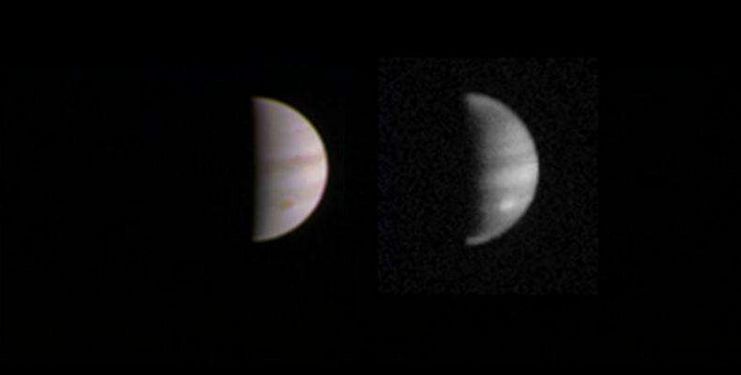
A twin view of Jupiter captured by Juno on August 23rd, when the spacecraft was some 4.4 million km (2.8 million miles) from the gas giant and approaching Jupiter to complete its first full orbit. On the left is a colour image from JunoCam, on the right an infra-red image Credit: NASA/JPL-Caltech/SwRI/MSSS
A twin view of Jupiter captured by Juno on August 23rd, when the spacecraft was some 4.4 million km (2.8 million miles) from the gas giant and approaching Jupiter to complete its first full orbit. On the left is a colour image from JunoCam, on the right an infra-red image. Credit: NASA/JPL / SwRI / MSSS

All of Juno’s science suite was in operation during the passage over Jupiter’s clouds. However, due to speed at which the gathered data can be returned to Earth, and given it cannot all be relayed in one go or necessarily continuously, it will be a week or more before everything has been transmitted back to Earth. Nevertheless the science team are already excited by the flyby.

“We are getting some intriguing early data returns as we speak,” Scott Bolton, principal investigator of Juno from the Southwest Research Institute, stated. Some of that data included initial images of Jupiter captured as Juno swept towards the planet during the run-up to periapsis. “We are in an orbit nobody has ever been in before, and these images give us a whole new perspective on this gas-giant world,” Bolton added.

Continue reading “Space Sunday: exoplanets, dark matter, rovers and recoveries”

Space Sunday: exoplanets, greenhouses and meteors

Sunset on an alien world: an artist's impression of sunset on an Earth-like planet orbits our nearest stellar neighbour, Proxima Centauri (seen closest, left), with Alpha Centauri A and B shining in the distance - story below
Suns over an alien world: an artist’s impression of the view from an “Earth-like” planet orbits our nearest stellar neighbour, Proxima Centauri (seen closest, left), with Alpha Centauri A and B shining in the distance – story below. Credit: ESO/L. Calçada

Last week I reported on the latest issue to strike NASA’s Kepler mission to survey other stars for signs of planets orbiting them. On July 28th, during routine communications with the observatory – which is following the Earth around the Sun roughly 121 million kilometres (75 million miles) “behind” the planet – it was discovered the photometer, the camera-like tool used to detect alien planets, had been turned off.

Power was restored to the unit on August 1st, but engineers were still mystified as to why it had turned off in the first place. Communications with the observatory on Thursday, August 11th, confirmed the photometer was still active and Kepler was gathering data, allowing the engineering team to focus on a possible cause for the unit powering off.

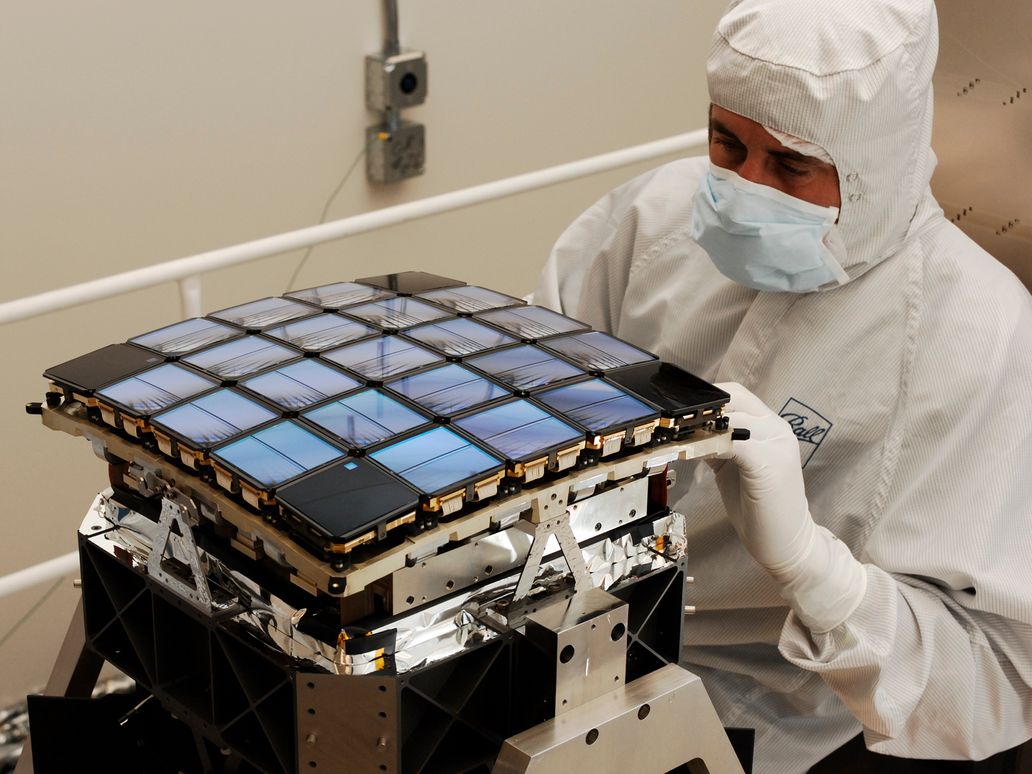
The Photometer includes a curved focal plane of 42 charge-coupled devices (CCDs) arranged within 25 individual modules. One of these modules – Module #7 – suffered a power overload in January 2014, disabling it. Most crucially, the failure prompted the photometer unit to power itself off – just as appeared to have happened shortly before July 28th, 2016, suggesting the most recent issue could also be related to the focal plane.

Kepler's focal plane, showing its array of 25 modules, being assembled at Ball Labs prior to Kepler's launch in 2009
Kepler’s focal plane, showing its array of 25 modules, being assembled at Ball Labs prior to Kepler’s launch in 2009

Analysis of the data received following the restoration of power to the photometer reveals that another module, Module #4,  had failed to warm up to the required operating temperature, strongly suggesting it has also failed, and thus triggered the power-down.

As a result, the science and engineering team responsible for the mission have determined that the targets that were assigned to Module #4 will yield no further science results, but this should not impact Kepler’s overall science campaign, which is expected to continue through until 2019, by which time all no-board fuel reserves will have been depleted, and much of Kepler’s work will have been taken over by the James Webb Space Telescope and NASA’s Transiting Exoplanet Survey Satellite (TESS), examined in my previous Space Sunday column.

An “Earth-Type” World Just 4.2 Light Years Away?

Kepler has detected over 4,000 exoplanet candidates, of which around 216 have been shown to be both roughly terrestrial in size and form, and located within the “Goldilocks Zone” (or more formally the circumstellar habitable zone (CHZ) or habitable zone) around their parent star – the region at which planetary conditions could be “just right” for life to arise. Unfortunately, most of these planets are a very long way away. Kepler 425b, for example, regarded as Earth’s (slightly bigger) “cousin”, and the first exoplanet to be confirmed to be orbiting in its star’s habitable zone, is some 1,400 light years away.

However, Kepler is not alone in the hunt for extra-solar planets. Observatories here on Earth are also engaged in the work, both in support of Kepler by undertaking detailed follow-up examinations of candidate stars, and also as part of their own programmes. A recent article in Germany’s Der Spiegel magazine now claims that one of these, the European Southern Observatory’s (ESO)  La Silla faclity, has found an “Earth-like” planet very much closer to home.

Quoting an alleged member of the ESO team, Der Spiegel states the new planet is orbiting Proxima Centauri, our nearest stellar neighbour, a mere 4.25 light years away, and which can be seen in the southern hemisphere night skies. A red dwarf low-mass star roughly one-seventh the diameter of our Sun, or just 1.5 times bigger than Jupiter, it is thought to be gravitationally bound to the Alpha Centauri binary system of stars, frequently the subject of science-fiction stories down through the decades.

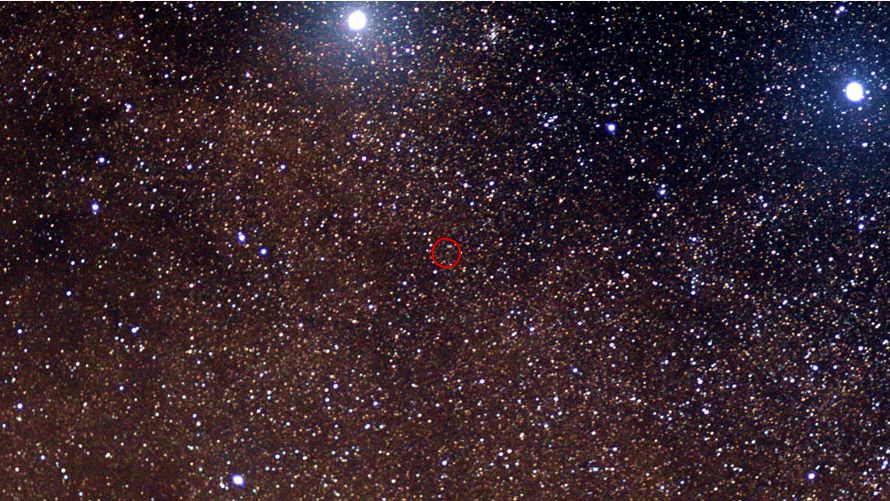
The Alpha Centauri system seen through a modest telescope. At the top, slightly left of centre is the Sun-like Alpha Centauri A, to the upper right is the K1 V Alpha Centauri B. The red circle denotes tiny Proxima Centauri

Given the two primary stars in the Alpha Centauri system are broadly similar to our own Sun  – Alpha Centauri A particularly so – and both are slightly older (around 4.85 billion years), the system has been a frequent subject for study, with the potential for either star to have planetary bodies orbiting it, or given the two stars orbit one another every 79.91 terrestrial years at a distance roughly equivalent to that between the Sun and Uranus, quite possibly around both of them. In fact, two recent papers have suggested two planets orbiting Alpha Centauri B. The first, from 2012, was subsequently dismissed as a spurious data artefact. The  second, from 2015, has yet to be confirmed.

So far, ESO representatives have refused to confirm or deny the Der Spiegel article, or whether an announcement on the matter will be made at the end of August as the magazine claims.  This has been taken by some as tacit confirmation of the discovery, and others that the data – if true – is still being verified. If the latter is the case, some caution at ESO is understandable: the La Silla Observatory was responsible for announcing the 2012 discovery of “Alpha Centauri Bb”, which as noted above, turned out to be a data anomaly.

Some are outright sceptical of the article, pointing out that Proxima Centauri has long been the subject of exoplanet searches by both observatories on Earth and the Hubble Space Telescope, and nary a hint of another other body, large or small, orbiting it has been found.

As a dwarf star – one of the smallest known – Proxima Centauri is also somewhat volatile, with about 88% of the surface active (far more than the Sun’s), and is completely convective, giving rise to massive stellar flares. While this doesn’t out the potential for planets to be orbiting it, the fact that the star’s habitable zone is between 3.5 and 8 million kilometres from its surface, any planet within that zone would be tidally locked to Proxima Centauri, leaving one side in perpetual daylight and the other in perpetual night, with the risk that any atmosphere would be stripped away over the aeons by the stellar flares. So even if the Der Spiegel article is confirmed, it would seem the planet might still be a pretty inhospitable place, even if it is within the Goldilocks zone.

Continue reading “Space Sunday: exoplanets, greenhouses and meteors”

Space Sunday: of Martian and lunar robots, distant worlds and ET

CuriosityAugust 2016 sees NASA’s Mars Science Laboratory rover Curiosity rack up four (terrestrial) years of operations on the surface of Mars.

The rover marked this anniversary rather quietly, by preparing to take further rock samples, this time from a target dubbed “Marimba”. Once gathered, the samples will be subjected to on-board analysis by Curiosity using the compact laboratory systems contained the rover’s body.

The sampling take place as the rover is engaged in a multi-month ascent of a mudstone geological unit as it continues its climb towards higher and progressively younger geological areas on “Mount Sharp” (more correctly, Aeolis Mons), which will include some rock types not yet explored.

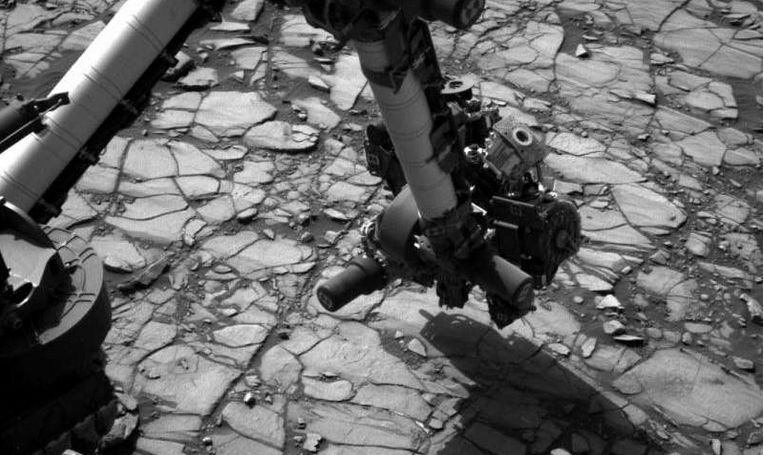
August 2nd, 2016 (Sol 1,418)T: the Navigation Camera (Navcam) on Curiosity's mast images the rover's extended robot arm over a section of the "Marimba" target rock, ready to use the wire brush mounted on the "hand" at the end of the arm in order to scour surface material which otherwise might contaminate and samples gathered from the rock, prior to the rover taking a drilling sample. Credit: NASA/JPL / MSSS
August 2nd, 2016 (Sol 1,418)T: the Navigation Camera (Navcam) on Curiosity’s mast images the rover’s extended robot arm over a section of the “Marimba” target rock, ready to use the wire brush mounted on the “hand” at the end of the arm in order to scour surface material which otherwise might contaminate and samples gathered from the rock, prior to the rover taking a drilling sample. Credit: NASA/JPL / MSSS

In the meantime, examining the samples gathered from “Marimba” will allow a direct comparison with mudstone samples gathered further down the slopes of “Mount Sharp” and from the flatlands of Gale Crater. This will enable scientists to  build a more complete picture of the mineral and chemical  environment the rover is travelling through, and so further understand the general conditions which may have once have existed within the crater.

Goodnight from a Lunar Jade Rabbit

China has finally bid farewell to Yutu (“Jade Rabbit”, named for the companion to the Moon goddess Chang’e), its first lunar robotic explorer, after 31 months of surface operations.

The little solar-powered rover arrived on the lunar surface as part of Chain’s Chang’e 3 lander / rover mission on December 13, 2013, and was deployed from the lander some  7.5 hours after touch-down.

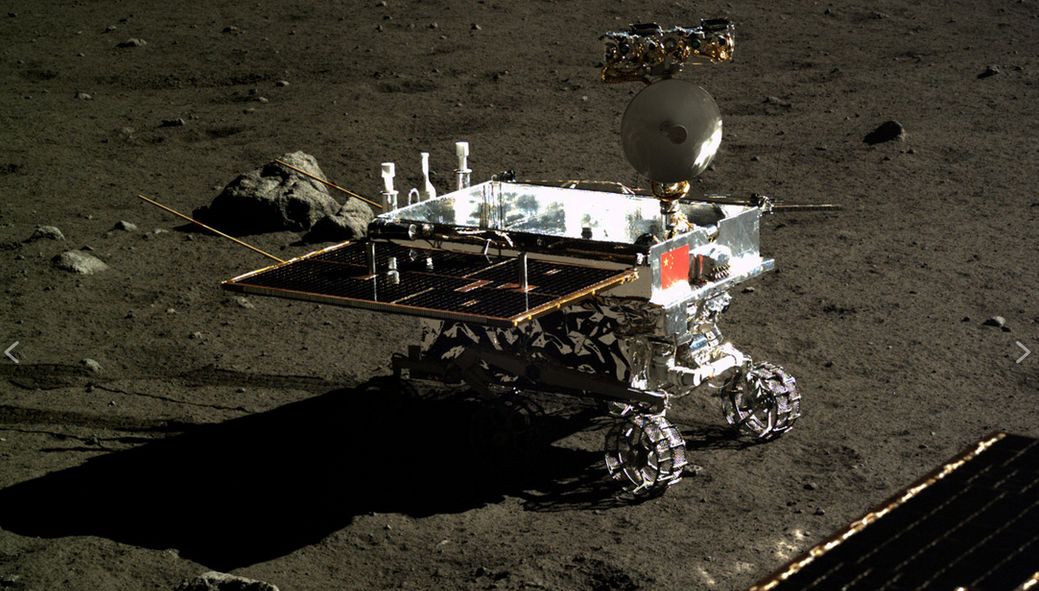
Yutu as imaged from the Chang'e 3 lander (part of the solar pnael from which can be seen in the lower right corner). Credit: National Astronomical Observatories of China
Yutu as imaged from the Chang’e 3 lander (part of the solar panel from which can be seen in the lower right corner). Credit: National Astronomical Observatories of China

However, due to the vast temperature differential experienced between the sunlit and shadowed parts of the rover at the time of the landing, operations didn’t commence until December 21st, when the rover was uniformly lit by the Sun. It’s first activity was to drive part-way around its parent lander and photograph it. After this, the rover travelled some 40 metres (130 ft) from the lander to commence independent science operations studying the lunar surface.

Yutu was designed to operate for just three months and travel up to 10 km (6.2 mi) within an area of 3 square kilometres (1.2 sq mi). Following its expose to the first 14-day long lunar “night”, the rover resumed operations in January 2014. However, as the second lunar night period approached (lasting 14 terrestrial days), the rover suffered a glitch in its drive mechanisms, leaving it susceptible to the harsh cold of the night-time, and on February 12th, following its second Lunar night, the rover was declared lost … only to resume communications with Earth within 24 hours.

Since that time, although immobilised, the little rover has maintained almost regular contact with Earth, but with each night period taking an increasing tolls on its systems. Even so, its continued survival gained it a huge and loyal following on the Chinese micro-blogging site, Weibo, where in a leaf firmly pulled from NASA’s book of social media engagement, Yutu had a first-person account.

It was via that social media account that Yutu’s final demise was announced, as if from the rover itself, on August 2nd 2016:

This time it really is goodnight. There are still many questions I would like answers to, but I’m the rabbit that has seen the most stars. The Moon has prepared a long dream for me, I don’t know what it will be like – will I be a Mars explorer, or be sent back to Earth?

The message gained a huge response from the rover’s 600,000 followers, and the Chinese space agency officially confirmed the rover had “died”, on Wednesday, August 3rd.

Continue reading “Space Sunday: of Martian and lunar robots, distant worlds and ET”

Space Sunday: looking back, looking forward, looking inside

A composite image: The Apollo 11 Saturn V on LC 39A during a countdown demonstration test on July 11th, 1969, and the Apollo 11 crew (l to r): Commander Neil Armstrong; CSM Pilot Michael Collins and LEM Pilot Edwin "Buzz" Aldrin
A composite image: The Apollo 11 Saturn V on LC 39A during a countdown demonstration test on July 11th, 1969, and the Apollo 11 crew (l to r): Commander Neil Armstrong; CSM Pilot Michael Collins and LEM Pilot Edwin “Buzz” Aldrin. Credit: NASA (both)

July 20th marked two anniversaries, the first manned landing on the Moon (July 20th, 1969) by Apollo 11, and the first American automated soft-landing on Mars with Viking Lander 1 (July 20th, 1976). As such, I’m starting this Space Sunday with a short look at both events.

Apollo Lunar Module (LEM) Eagle arrived on the surface of the Moon at 20:18:04 UTC on July 20th, 1969 after being launched atop a Saturn V rocket along with Neil Armstrong, Michael Collins and Edwin “Buzz” Aldrin from the Kennedy Space Centre Launch Complex 39A at 13:32:00 UTC on July 16th, 1969. It was the culmination of John F. Kennedy’s vision to re-assert America’s industrial and technological leadership in the world.

This composite of images from NASA's Lunar Reconnaissance Orbiter (LRO) mission from 2014 highlight elements of the Apollo 11 landing site on the Moon - notably the lower section of the LEM and some of the science equipment
This composite of images from NASA’s Lunar Reconnaissance Orbiter (LRO) mission, released in 2014 highlight elements of the Apollo 11 landing site on the Moon – notably the descent section of the LEM and some of the science equipment – watch the video

The land was dramatic in every sense of the word. On separation from the Command Module, the LEM immediately experienced issues communicating directly with Earth, then there were the infamous 1202 master alarm which triggered the LEM’s landing computer to re-boot itself, followed by a 1201 alarm. Then there was the discovery that, fair from being smooth and flat, the main landing site was boulder strewn, forcing Armstrong to fly the LEM to the limits of its available descent fuel in order to find a suitable landing area.

Armstrong finally set foot on the Moon on July 21st at 02:56:15 UTC, after he and Aldrin (the LEM Pilot)  had been given the opportunity to rest. Aldrin followed Armstrong down the ladder 20 minutes later, and together they spent about 2.5 hours on the surface, collecting 21.5 kg (47.5 lbs) of lunar material for return to Earth. Their total time on the Moon was short – just under 22 hours – but Aldrin and Armstrong between them, seen in fuzzy black-and-white television footage and (later) crisp photos, forever changed humanity’s perception of the Moon and its place in the cosmos.

To Mark the 47th anniversary of the landing, which also saw Collins remain in orbit piloting the Command and Service Module (CSM), The National Air and Space Museum in Washington, DC has produced a 3D tour (with other goodies) of the Apollo Command Module Columbia, as seen from the pilot’s (Collin’s) seat. This can be run in most browsers and offers a first-hand tour of the vehicle.

For those who prefer a visual record, NASA issued a restored film of the entire Apollo 11 EVA on YouTube in 2014. Or you can re-live the entire mission in just 100 seconds, courtesy of Spacecraft Films, which I’ve embedded below.

Apollo 11 was the first of six missions to the Moon (Apollo 13 being famously aborted after a critical failure within the Service Module whilst en route to the Moon), which concluded on December 19th, 1972, when Apollo 17 splashed down in the South Pacific Ocean, the only Apollo mission to fly a fully qualified geologist to the Moon (Harrison Schmitt).

In the 44 years since the end of the Apollo lunar project, human spaceflight has been confined to low-Earth orbit and will not move beyond it until the 2020s (with the uncrewed Exploration Mission 1 serving as the preliminary flight for that move in 2018). As such, it is all too easy to dwell on the political motivations which led to the programme, rather than on the phenomenal achievement Apollo actually was. Today’s plans for moving beyond LEO once more, and for sending Humans to Mars, may seem long overdue but they nevertheless build on the foundations laid down by Apollo.

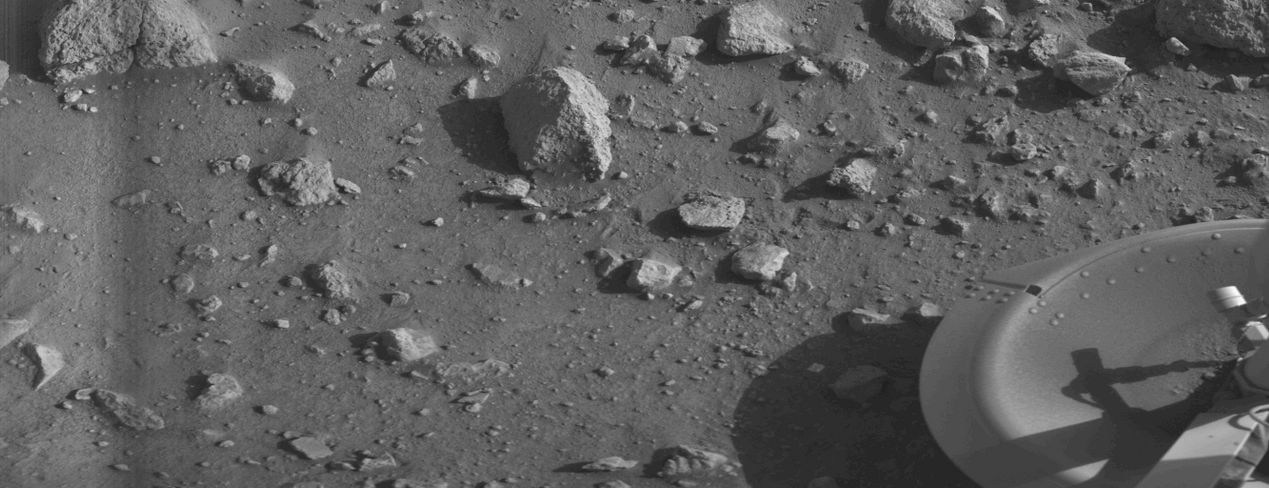
The first "clean" image of the surface of Mars returned by Viking 1 on July 20th, 1976
The first “clean” image of the surface of Mars returned by Viking 1 on July 20th, 1976. Credit: NASA / public domain

Viking Lander 1 arrived on the surface of Mars seven years to the date after Apollo 11 arrived on the Moon – although that hadn’t been the original intent. 1976 saw the United States celebrating its bicentennial, and it had originally been intended that the Lander would touch-down on the Red Planet on July 4th of that year.

However, after arriving in orbit on June 19th, 1976, the Viking orbiter craft used its imagining systems to survey the proposed landing site, which had been “scouted” from orbit  by the Mariner 9 mission  – the first vehicle to orbit Mars – in 1971 / 72. Unfortunately, the Viking orbiter’s much more capable cameras revealed the primary landing site to be far rougher than had been believed, leading to a decision not to land there, but to survey the back-up sites prior to committing to a landing on July 20th, and thus to instead celebrate Apollo 11’s triumph instead of America’s Independence Day.

Given the state of play of planetary exploration at the time, Viking was a massively impressive mission: two orbiter vehicles launched back-to-back, carrying two lander vehicles in turn carrying an impressive set of 5 experiments intended to seek signs of life on Mars. At the time, no-one actually knew the density of the Martian upper atmosphere or the load-bearing strength of the Martian surface or what they might actually find on the surface. There were genuine fears that the latter might be all dust, and the lander could simply dig itself a hole when firing its retro-rockets at the final point of landing and then fall into it, or if it did arrive safely, whether it might sink into the Martian dust; hence why the first image to be returned by the lander following touchdown prominently featured one of its own landing pads (above).

Continue reading “Space Sunday: looking back, looking forward, looking inside”

Space Sunday: minerals, ice, rockets and capsules

CuriosityNASA’s Curiosity rover has resumed its long, slow climb up the slopes of “Mount Sharp”, the 5 km high mound abutting the central impact peak of Gale Crater on Mars.

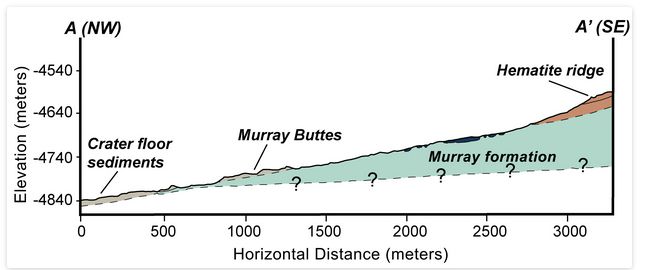
For the last few months, the rover has been easing its way over what is called the “Murray Formation”, a transitional layer marking the separation points between the materials deposited over the aeons to create the gigantic mound, and the material considered to be common to the crater floor. Named in honour of the late co-founder of The Planetary Society, Bruce Murray, the formation comprises a number of different land forms, which the rover has been gradually examining.

On June 4th, 2016, Curiosity collected its latest set of drilling samples – the 11th and 12th it has gathered since arriving on Mars – on the “Naukluft Plateau”, a further region of sandstone within the Murray Formation, similar to the area dubbed the “Stimson Formation”, where the rover collected samples in 2015.

The Murray formation extends about 200 metres (650ft) up the side of "Mount Sharp". Starting at the "Pahrump Hills" below "Murray Buttes" in late 2014, Curiosity is about one fifth of the way across the region, spending extended periods examined various features within the formation. Credit: NASA JPL
The Murray formation extends about 200 metres (650ft) up the side of “Mount Sharp”. Starting at the “Pahrump Hills” below “Murray Buttes” in late 2014, Curiosity is about one fifth of the way across the region, spending extended periods examined various features within the formation. Credit: NASA JPL

The aim is to carry out comparative geology between the two sites to determine whether or not their formation is related. The “Stimson Formation” sandstone strongly suggested it has been laid down by wind after the core slopes of “Mount Sharp” had been laid down by sedimentary processes the result of Gale Crater once being home to s huge lake, but which had then been subjected to fracturing by the passage of water. These bands of fractured sandstone have become more prevalent as the rover has continued up through the “Murray Formation”, so it is hoped that by obtaining samples from “Naukluft Plateau”, the science team will gain further understanding of precisely what part water played in the evolution of the slopes of “Mount Sharp” after the lake waters had receded.

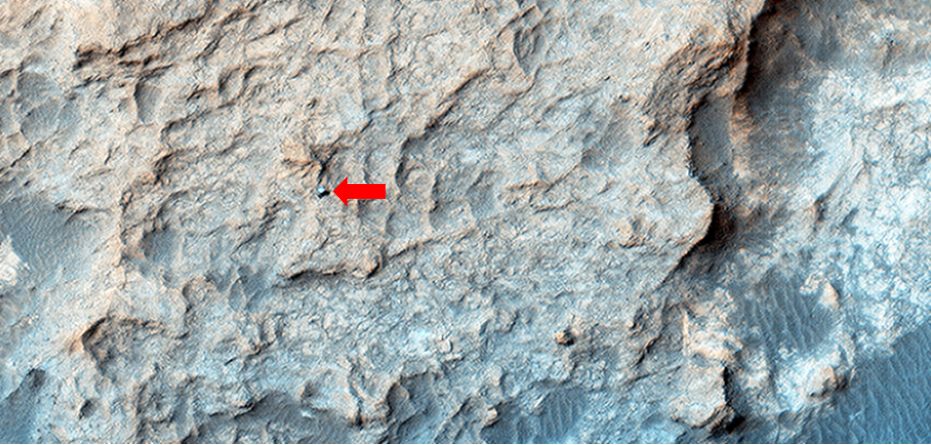
The HiRise imaging system on the Mars Reconnaissance Orbiter (MRO) captured the the Mars Science Laboratory rover Curiosity on the Naukluft Plateau in May 2016 (credit: NASA/JPL / University of Arizona)
The HiRise imaging system on the Mars Reconnaissance Orbiter (MRO) captured the Mars Science Laboratory rover Curiosity on the Naukluft Plateau in May 2016 Credit: NASA/JPL / University of Arizona

Since completing the drilling operations, Curiosity has turned south, and is now climbing the mound “head on”, rather than gradually zig-zagging its way upwards.

The MSL rover has also provided geologists with another surprise. In mid-2015, the rover collected samples from a rock dubbed “Buckskin”. Reviewing the analysis of the minerals in the samples, as discovered by Curiosity’s on-board laboratory suite, scientists have found significant amounts of a silica mineral called tridymite.

“On Earth, tridymite is formed at high temperatures in an explosive process called silicic volcanism. Mount St. Helens, the active volcano in Washington State, and the Satsuma-Iwojima volcano in Japan are examples of such volcanoes,” said Richard Morris, a NASA planetary scientist at Johnson Space Centre. “The tridymite in the Buckskin sample is thought to have been incorporated into “Lake Gale”  mudstone as sediment from erosion of silicic volcanic rocks.”

The find is significant because although volcanism did once take place on Mars, it has never been thought of as being silicic volcanism, which is far more violent that the kind of volcanism associated with the formation of the great shield volcanoes of the Tharsis Bulge and other regions of Mars. So this discovery means geologists may have to re-think the volcanic period of Mars’ early history.

China Launches Long March 7

Saturday, June 25th saw the inaugural launch of China’s Long March 7 booster, a vehicle I wrote about back in April 2016. The launch was also the first from China’s fourth and newest space launch facility, the Wenchang Satellite Launch Centre, located on Hainan Island, the country’s southernmost point.

The Long March 7 is a core component to China’s evolving space ambitions. Classified as a medium lift vehicle, it can carry around 13.5 tonnes to low Earth orbit (LEO), it will operate alongside China’s upcoming heavy lift launcher, the Long March 5. This craft will be capable of lifting around the same payload mass directly to geosynchronous orbit, and around 25 tonnes to LEO. Both vehicles will play a lead role in China’s plans to expand her explorations of the Moon, establish a permanent space station in Earth orbit by 2022, and reach Mars with automated missions.

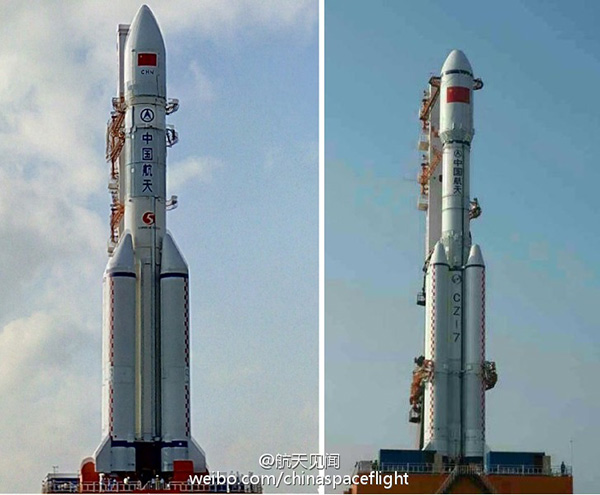
China's Long March 5 (l) and Long March 7 (r) next generation launch vehicles
China’s Long March 7 (right) launched on it inaugural flight on Saturday, June 25th. The bigger Long March 5 (left) is due to launch later in 2016. Credit: China state media

The inaugural launch of the Long March 7 took place at noon GMT on Saturday, June 25th (20:00 local time). It carried a Yuanzheng 1A upper stage and a scale model of China’s next generation crewed orbital vehicle into an orbit of 200 km (120 mi) by 394 km (244 mi) as confirmed by US tracking networks.

Yuanzheng is an automated “space tug” China has used numerous times to deliver payloads to their orbits, and is capable of re-using its engine multiple times. It is most often used to boost China’s communications satellites into higher orbits.

The sub-scale capsule was used to carry out an atmospheric re-entry test to gather data which will be use to further refine and improve the re-entry vehicle which will form a part of China’s replacement for its ageing, Soyuz-inspired Shenzhou crew vehicle. This unit returned to Earth, landing in a desert in Inner Mongolia on Sunday, June 26th, after orbiting the planet 13 times. Also aboard the vehicle was a “cubesat” mission to test a navigation system, and a prototype refuelling system.

Continue reading “Space Sunday: minerals, ice, rockets and capsules”