The Bandit 50/3: outstanding sailing in Second Life

Sailing the Bandit 50/3

The Bandit 50/3 is the latest sailing release by Analyse Dean under her Bandit brand of sailing and power boats. At 99 LI when moored, it is no lightweight – but then, it is packed with features and capabilities, including the latest third generation BOSS dynamic sailing engine, offering one of the most outstanding sailing experiences in Second Life.

Everything about the boat is aimed at giving you a fun and realistic experience, and while being a cruise friendly boat that is accessible for beginners, the Bandit 50/3 is set-up to bring you pure adrenaline when pushed to the limits in high winds with full manual control.

– Analyse Dean, describing the work put into the Bandit 50/3

Bandit 50/3: sailing past Isla Pey

The 50/3 is slightly smaller that the Bandits 55 and 60, but in terms of options, it easily matches and exceeds the pair of them, and builds on the 460AK motor cruiser (which I reviewed in Two Bandits at sea in Second Life) in terms of “hidden” additions. However, the main thing that is liable to make this Bandit a hit is the sailing characteristics.

The 50/3 was set-up with some realism in mind. Where previous boats had some “rubber bumpers” in the code to prevent stuff from happening when people exceed limits. The 50/3 doesn’t have that; go out of range with the spinnaker, broach, sail close to the wind with the genoa, knockdown [When a sailing boat is suddenly pushed onto its side, either by an abrupt wind gust or rouge wave], mess up a tack and it will cost you some time to recover. Heel excessively, and the rudder will loose grip. It is set-up for racing in high winds really, and it will keep the adrenaline flowing when you sail it at the edge.

– Analyse Dean, describing sailing the Bandit 50/3

Bandit 50/3

The package includes the Bandit 50/3, a dock (compatible with the dock supplied with the 406AK) a sailing HUD, and three optional packages: flags, textures, and racing. A comprehensive note card manual is also supplied, providing full coverage of the boat’s features and a set of comprehensive notes on sailing it.

Coming in at just under 15 metres overall length, the Bandit 50/3 is laid out with a stern cockpit with plenty of room for the helmsperson and passengers. Multiple steering poses are provided, depending on the sailing siltation / whether of not the boat is under engine power. A bimini can be raised via chat, as can a more protective tent for bad weather. Note that the dodger is a permanent fixture, but can be hidden by selective editing and making it transparent (although the baked textures on top of the cabin means some re-texturing might be required if you’d prefer to mostly run without the dodger being visible.

Two sleeping berths are provided, one under the cockpit, the other in the bows. Between the two is a comfortable salon with functional galley. There are a lot of poses packed into the cabins – and a lot of clickies, as one would expect from a Bandit: light switched work, the doors to the sleeping berths close / open, the table leaves can be raised / lowered, blinds drawn – and more.

Bandit 50/3: moored at my Linden Houseboat and using the Bandit piers for mooring

I’ve not owned other Bandit boats and am unfamiliar with handling them outside of sailing the demos, so I cannot offer direct comparison between the 50/3 and any of the other boats in the range, but I will say that in the 24 hours I’ve had it, 50/3, I’ve found it to be both a fun and a genuine challenge when sailing.

As the manual notes, the 50/3 includes four sail options: the main, a jib, a genoa and a spinnaker. Which of the latter three you use is down to the prevailing wind conditions (which you can set). Setting the sails can be shared with others sailing with you, if desired (just pass them a copy of of the supplied HUD).

The 50/3 is BOSS 3, just like the Bandit IF. It has multiple animated actions and really comes into its own when you sail with a crew member.

– Analyse Dean, describing sailing the 50/3 with crew

Bandit 50/3: “unfettered and in full career!”

Solo sailing, I have a say that the 50/3 is a handful – at least for the relatively novice, like myself -but also a heck of a lot of fun. When properly trimmed and with a good wind, the boat moves at a fair lick of speed, and the camera system allows you to appreciate this fully. With a crew handling the sails, things really do come into their own and sailing the boat becomes a shared experience that adds a dimension to being on the water.

For those into racing, the race pack includes a HUD-based “iPad” (although it can also be worn by your avatar), is designed to provide a more realistic consistent sailing experience. Also included is a copyable scripted buoy. This can be set out (where you have rezzing rights) along a race course to again provide a consistent wind effect when racing. In taking the boat out on both Blake Sea and around Bellisseria, we made multiple region crossings without issues.

We are also starting a little sailing club for it, off shore, long distance, point to point. Keep an eye out for Blake Off-Shore Rally for Cruisers (BORC) as well, it will be super fun!

– Analyse Dean

Bandit 50/3: in the galley

When moored or anchored, the boat offers a range of single and couples animations, both on the top of and within the cabin. These, and the helm positions, mean that the Bandit 50/3 offers a good selection of poses and animations.

With the Bandit 460AK, analyse introduced a new docking system for her boats, and this is continued with the Bandit 50/3. Rez the pier and when the Bandit 50/3 is close enough, issue the text command “dock”, and the 50/3 will neatly move alongside, deploying its fenders and mooring and electrical power lines appear. What’s more, the pier is fully compatible with the connecting dock supplied with the Bandit 460AK, allowing both to be used together.

The Bandit 50/3 (foreground) with the Bandit 55 and and Bandit 60, The Mesh Shop

As noted at the top of this article, there is a lot to be found in this boat, not all of which is covered here. At L$3,750 it offers a huge amount of value for money. At the time of writing, it is only available in-world at The Mesh Shop, but expect to see it on the Bandit Marketplace store soon; as Analyse noted to me, “It will be there in a week or so. I always wait to see if any bugs surface.”
2019 SL User Groups 19/1: Simulator User Group

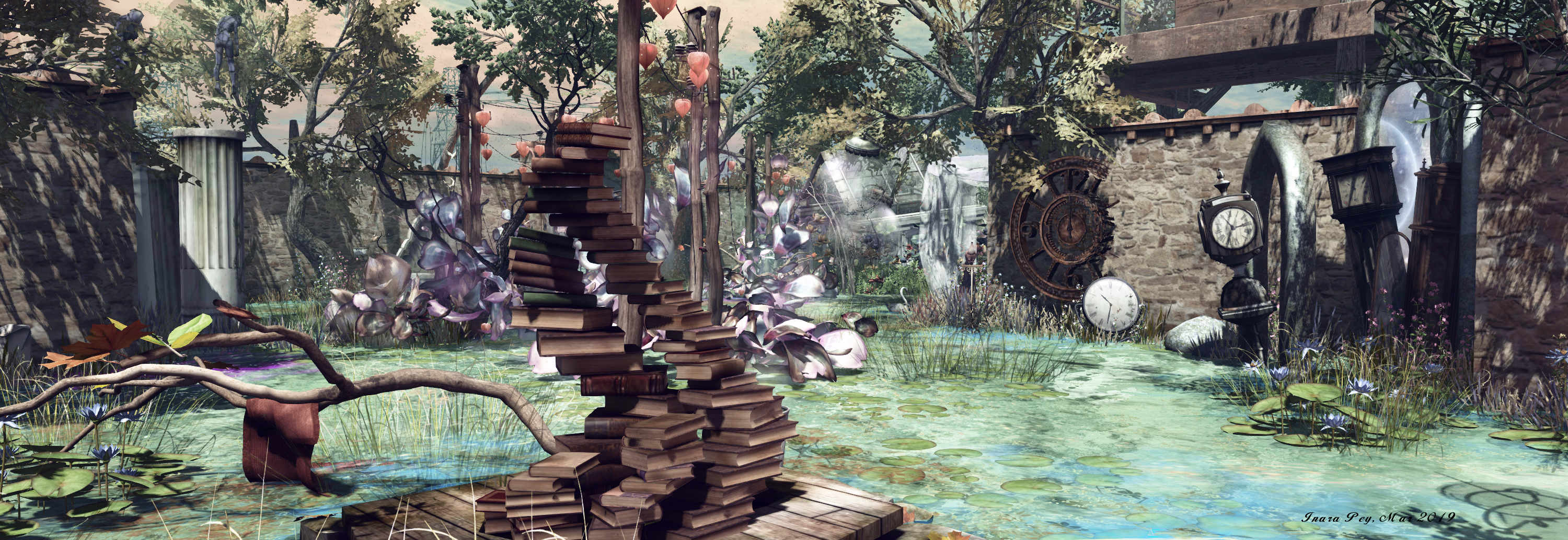
A L T I T U D E; Inara Pey, March 2019, on FlickrA L T I T U D Eblog post

Server Deployments

As always, please refer to the server deployment thread for the latest news.

  • On Tuesday, May 7th, the SLS (Main) channel updated to server maintenance package 19#19.04.25.526669, primarily intended to correct the simulator-side EEP regressions that resulted of the roll-back of Thursday, April 18th. This update also includes a number of other internal fixes.
  • On Wednesday, May 8th, the three RC channels should be updated with server maintenance package #19.05.01.526856, comprising internal fixes.

SL Viewer

The Teranino Maintenance RC viewer updated on Friday May 3rd, to version 6.2.1.526845. This viewer was subsequently promoted to de facto release status on Tuesday, May 7th.

The remaining viewer pipelines remain unchanged:

  • Release channel cohorts:
    • EEP RC viewer version 6.2.0.526104, dated April 11th.
    • Bakes on Mesh RC viewer, version 6.1.1.525409, dated March 26th.
  • Project viewers:
  • Linux Spur viewer, version 5.0.9.329906, dated November 17th, 2017 and promoted to release status 29th November – offered pending a Linux version of the Alex Ivy viewer code.
  • Obsolete platform viewer, version 3.7.28.300847, dated May 8th, 2015 – provided for users on Windows XP and OS X versions below 10.7. This viewer will remain available for as long as reasonable, but will not be updated with new features or bug fixes.

Teleport Disconnects

Following the deployments of server maintenance package 19#19.04.25.526669, it appears that there has been a significant improvement in teleports, with Simon Linden noting that the “TP crash has been mitigated and success rates are back to what they were months ago.”

This doesn’t mean that the Lab is ceasing efforts on trying to improve teleports and region crossings; rather that the priority of the work over that last few weeks has been on easing the problems people have been experiencing the last month.

Script Processing Issues

As reported in my week #18 SUG summary, there have been numerous reports of script run time issues, with some reporting that problems only started occurring following the roll-back on April 18th, 2019. BUG-226851 outlines some of the problems.

There is no specific update on this, other than the Lab’s engineering team has been asked to put together ways for them to look at script run times and performance grid wide.

The magic of images and words in Second Life

The Edge: ViktorSavior and AlenaPit

Currently open at The Edge gallery curated by Ladmilla, is an ensemble exhibition entitled Visual Poems. It features pairings of art and poetry, with some of the artists providing both the words and images, others working in pairs: one producing the images and the other the words.

Pieces are spread between two of the gallery’s exhibition spaces: the castle – notably the upper rooms and the parapet walks around the curtain walls – and in and alongside the cathedral. Those participating in the exhibition are: Mirabelle Sweetwater (images and words); Kapaan (images and words); PatrickofIreland (images and words); Thomascrown11 (images and words) VenicioArmin (images and words) Pearl Grey (images) and Klaus Bereznyak (words); TaraAers (images) and Oleanhorok (words); ViktorSavior (images) and AlenaPit (words); and Ladmilla (images) and Eli Medier (words).

The Edge: TaraAers) and Oleanhorok

This is a fascinating exhibition  – and one that, by virtue of the its scale, may require more than one visit to fully appreciate. The combining of words and images is always an interesting concept (something we have often explored with Seanchai Library with exhibitions at Holly Kai Park), perhaps doubly so when the creator of an image is entrusting their work to the imagination of another to produces the words around it.

Hence, within this exhibition there is an attractiveness to the pairing of artist and poet that can captivate, and without wishing to appear to select favourites, I admit to being particularly drawn to the pieces by Viktor and Alena (two of which form the banner image for this article). There is a minimalist beauty to Viktor’s images that is perfectly balanced by Alena’s 4-line verses. Together they paint a complete story that is deeply evocative.

The Edge: Mirabelle Sweetwater

Alena is a prolific writer, having produced more than 200 poems, and what fascinates me with this particular pairing is the question of which came first: the image or the poem? Or perhaps they have independent origins, with the artists matching words and pictures after the fact.

All my feelings from the heart and soul are reflected in poetry, which makes up most of my life in SL and RL. I write about different things: about romantic relationships, about feelings, about family, about nature, about hope and love. Many people say that my poems are positive and easy. I hope you leave me your opinion about them too. I write poems in Russian, but now I begin to prepare translations into English and arrange visual exhibitions in SL art galleries.

– AlenaPit on her writing

The Edge: Venicio Armin

Alongside the gallery’s cathedral is Venicio Armin’s selection of images for the exhibition, and I must again confess I found these to be completely engrossing. Presented in monochrome the images and words, provide a story of two relationships: the relationship between a man and a woman and the love Argentines have for the Tango. Through six images and short poems bother are beautifully framed and presented in magnificent depth, with Venicio also offering the opportunity to hear the music of the Argentine Tango.

Also on offer at the gallery is an exhibition of art by  anibrm Jung and 3D art by Sempiternel and Mariemadeleine38. These add further depth to an engaging visit – but again, you should allow time to give the exhibitions the attention the deserve.

SLurl Details

Happy Days at NorderNey in Second Life

IMAGO Art Gallery: Happy Days at NorderNey

Currently open at IMAGO Art Gallery, curated by Mareea Farrasco, is an ensemble exhibition celebrating NorderNey (closed to public access at the time of writing), one of Second Life’s more popular photogenic regions (and which I confess to having covered in these pages in 2014, and 2017, although I really should have taken the time to visit it more recently).

Happy Days at NorderNey is a small but enticing exhibition, featuring images by Maxie Daviau, Ninny Dazy, Sorcha Tyles and Mareea herself in a space specially prepared to resemble a part of the region with a sandy beach, the foaming wash of a tide, under an overcast sky.

Each of the artists presents four pieces of art, somewhat split between landscapes of the region and avatar studies that using the region as a backdrop. Together they form – as the title of the exhibition suggests – memories of happy times spent within NorderNey in one of its more recent iterations.

IMAGO Art Gallery: Happy Days at NorderNey – Maxie Daviau

What is particularly interesting in the sixteen images presented is the way that all of the artists have selected more-or-less the same aspects of the region to include in their images: the path to the beach with bicycles leaning on the fence, the sailing boats moored off-shore the scooter sitting at the boundary between tall grass and warm sand for example.

In doing so, each presents unique perspectives on the setting through the use of colour, tone, and post-processing to bring out the clouds, or to offer a feeling of summer warmth or the overcast of an autumn’s day, and so on. Thus, each group of four images may feature some of the same elements as the others, but overall they present different moods and stir different emotional responses.

A small, easy-to view exhibition featuring a group of richly talented Second Life photographers.

IMAGO Art Gallery: Happy Days at NorderNey – Ninna Dazy

SLurl Details

2019 viewer release summaries week #18

Logos representative only and should not be seen as an endorsement / preference / recommendation

Updates for the week ending Sunday, May 5th

This summary is generally published every Monday, and is a list of SL viewer / client releases (official and TPV) made during the previous week. When reading it, please note:

  • It is based on my Current Viewer Releases Page, a list of all Second Life viewers and clients that are in popular use (and of which I am aware), and which are recognised as adhering to the TPV Policy. This page includes comprehensive links to download pages, blog notes, release notes, etc., as well as links to any / all reviews of specific viewers / clients made within this blog.
  • By its nature, this summary presented here will always be in arrears, please refer to the Current Viewer Release Page for more up-to-date information.
  • Note that for purposes of length, TPV test viewers, preview / beta viewers / nightly builds are generally not recorded in these summaries.

Official LL Viewers

  • Current Release version 6.2.0.526190, formerly the Estate Access Management RC viewer, dated April 12, promoted April 17 No change. – see my EAM overview for more information
  • Release channel cohorts:
    • Teranino Maintenance RC viewer updated to version 6.2.1.526845 on May 3rd.
  • Project viewers:
    • No updates.

LL Viewer Resources

Third-party Viewers

V5/V6-style

  • No updates.

V1-style

  • No Updates.

Mobile / Other Clients

  • Lumiya is currently unavailable through Google Play – see my article and update here. However, it remains available to new users (or can be re-purchased if urgent) via SlideMe.
  • MetaChat lists version 1.2.9104 (April 18th) as released; currently only version1.2.9103 is available via iTunes.

Additional TPV Resources

Related Links

Space Sunday: asteroid impacts and private space flights

An artist’s impression of a small (approx 60m) asteroid air burst disintegration over a city. Credit: Igor Zh./Shutterstock

I’ve written about the risk posed by the potential impact of a Near Earth Object on this planet several times within these Space Sunday articles. While they are rare, as we’ve seen with the Tunguska event of 1908, and the more recent  2013 Chelyabinsk air-blast and 2018 LA (ZLAF9B2) in June 2018, objects of a size sufficient enough to survive their initial entry into the Earth’s atmosphere before being ripped apart in a violent explosion can and do exist.

Nor is Earth alone in the threat – as witnessed by those observing the lunar eclipse of January 21st, 2019, the Moon can be hit as well. At 04:41 GMT, during the period of totality during that eclipse, numerous astronomers in North and South America and in Western Europe saw a sudden bright flash lasted less than 1/3 of a second. It was later attributed to an object around 30 to 60 centimetres (1 to 2 ft) across striking the Moon at around 61,000 km/h, producing a new crater somewhere between 10 and 15 metres (32 to 49 ft) across.

While the majority of the 10+ million objects thus far found crossing Earth’s orbit as they go around the Sun pose no real threat to us (in fact, the number of Potentially Hazardous Asteroids, or PHAs, has been put at just 2,000), and the risk of a substantial impact occurring in anyone’s individual lifetime is relatively remote, the fact is that – as Douglas Adams famously noted – space is big really big. Even the solar system is a vast place when compared to the size of Earth, big enough to hide any number of objects that might one day pose a very real threat to all life on Earth or, given humanity’s global distribution the potential to place one of our major cities at risk.

So how might we deal with such an eventuality? Currently, there are really only three practical options available to us – although others have been suggested, and more might be developed in the future. Which of them might be used depends on how much lead time we have in which to take action. To summarise:

  • The gravity tug: if the impact is decades away, a spacecraft with a motor such as an electric ion drive could rendezvous with the asteroid and enter a halo orbit around it. The motor could then be fired along the axis of flight, allowing the gravitational influence of the vehicle to “pull” the asteroid onto a new course. However, this option can really only be used if the inclination of the threatening asteroid is relatively close to that of Earth’s; if the two are very disparate, the time needed to get the spacecraft to the asteroid using gravity assist manoeuvres around the Earth or Venus or even Jupiter, might simply be too long.
The gravity tug explained. Credit: G. Manley / I. Pey
  • The Kinetic intercept: this uses brute force to deflect the asteroid by slamming relatively solid masses into to, their momentum serving to shunt it into a slightly altered orbit around the Sun that is sufficient for it to miss the Earth.
  • Nuclear deflection: similar to the kinetic intercept, but uses the shock waves of nuclear weapons detonated close to the asteroid to again shunt it into an altered orbit so it misses the Earth.

The major problem with the last two is the risk that if the asteroid is too fragile, rather than shunting it aside, they could shatter it, leaving Earth facing not s single object, but a scatter gun of debris, potentially with multiple elements large enough to devastate large areas of the planet’s surface should they enter the atmosphere and explosively disintegrate. This is also the reason why trying to directly blow an asteroid part using a nuclear strike isn’t regarded too favourably. There are other issues with each of these options that could also limit their effectiveness, or raise the need to repeat them, but they provide a general idea of how we might react.

NASA’s planned 2022 DART mission will deliberately smash a vehicle into a small asteroid to test the kinetic impact theory of asteroid deflection. Credit: NASA GSFC

Hence why the International Academy of Astronautics holds a Planetary Defence Conference every two years to discuss the latest findings with NEO and PHAs, and the ways and means to prevent such an impact – or at least the loss of life minimised. Since 2013, the 5-day conference has included a special “war game” type simulation to examine how a threat might be dealt with, and at the 2019 conference, held between April 29th and May 3rd, the simulation with publicly disseminated via social media as it progressed, to encourage grater public understanding about the need to better locate and track NEOs and PHAs (which are currently being discovered at the rate of around 700 a year).

In this simulation, which compressed an 8-year time frame into 5 days, the 200 astronomers, engineers, scientists and politicians at the conference were informed a large (fictional) asteroid around 300 metres across would slam into Colorado in 2027, unless then managed to divert it. Initially, things went well: a joint mission involving the USA, Russia, Europe, China and Japan used kinetic impacts to safely divert the bulk of the asteroid away from Earth. However, a 60m fragment broke away on a course that would see it hit the Earth’s atmosphere at 69,000 km/h (43,000 mph) and explode 15 km (9.3 mi) above Central Park, New York City. The force f the air blast would be sufficient to complete raze Manhattan and parts of New York City for a radius of 15 km (9.4 mi),  with the  effects of the blast felt up to 68 km (42.5 mi) from the epicentre. Plans were drawn up to try to deflect this fragment using a nuclear blast, but these became mired in political wrangling (not for the first time in these simulations)  until it was too late to achieve the desire deflection.

While such exercises might sound like scientists playing games, they do serve a purpose in that they help to underline the massive threat we face if we discover an asteroid is on a collision course with Earth – and the need for us to have better means to detect objects that might pose a threat early enough that we can take action, and also to better understand the processes – technical, scientific and political – that need to followed / overcome in order to prevent a collision.

They also highlight other issues as well. In this case, just how do you handle evacuating a city of 8 million souls? How much time is required (in the simulation, it came down to just 2 months)? What are the logistics required to ensure a (relatively) smooth evacuation? How and when should you tell the public? How do you avoid mass panic? This type of discussion is actually of major import, given current thinking is that if an object due to strike the Earth is 60 metres or less across, the focus should be on evacuating the area directly affected, rather than on trying to deflect it.

Continue reading “Space Sunday: asteroid impacts and private space flights”
