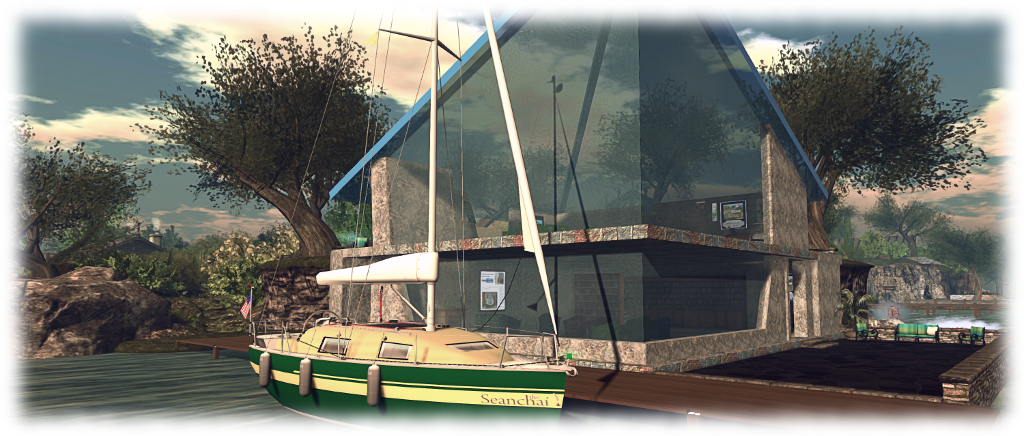
The Mill at Lemon Beach in Second Life

The Mill, Lemon Beach; Inara Pey, May 2019, on FlickrThe Mill, Lemon Beach – click any image for full size

Lemon Beach has seen many designs from various region holders over the years, some of which have been documented in this blog (see here, and here, and here and here, for example). The region is currently under the care of Sylvana Dench, who follows the tradition in offering it for the enjoyment of visitors as The Mill.

This is a wonderfully provincial setting that has hints of France about it, although to me it could perhaps easily be anywhere along the coasts of Belgium, The Netherlands, Denmark or Germany. Low-lying, the region, whilst a island, had an almost headland feel to it; a finger of land tickling the sea, a place where farmlands give way to sands and salt water.

The Mill, Lemon Beach; Inara Pey, May 2019, on FlickrThe Mill, Lemon Beach

The landing point sit off to the north-east, close to the edge of the region. A sign bids a warm welcome, framed by a small lighthouse sitting just off the coast. A further welcome is offered by a little café sitting close by, sitting under a thatched roof – although as we walked by, I couldn’t help but wonder if the smell from the fishmonger across the narrow track of a road might not be a little off-putting to patrons should the breeze be in the wrong direction!

A small cottage sits alongside the fishmonger’s barn, perhaps his home, while a larger house sits on a bend in the road, while the titular mill rises from a small rise in the land just behind the café and its little farm shop. Taken together, and with both sheep grazing on the coastal grass not too far away and the large meadow behind the house where horses frolic, this little grouping of mill, café and house all have the feel of being perhaps owned by the one family.

The Mill, Lemon Beach; Inara Pey, May 2019, on FlickrThe Mill, Lemon Beach

They, and the fishmonger’s house and barn, are not the only buildings here, however. Scattered across the landscape is a walled farmhouse, an old Tuscan-style villa converted to a place of business and another little cottage daintily fronted by walled flowerbeds, all awaiting discovery.

They are all easily reached by following the track that leads southwards away from the landing point. Meanwhile, and further westward, sit a couple of properties that might be holiday homes for those fortunate enough to be able to have a getaway sitting on the coast. One of these sits just off-shore to the south-west, and given it is within its own parcel, it might be intended for private ownership in the future – although at the time of our visit it was open to the public.
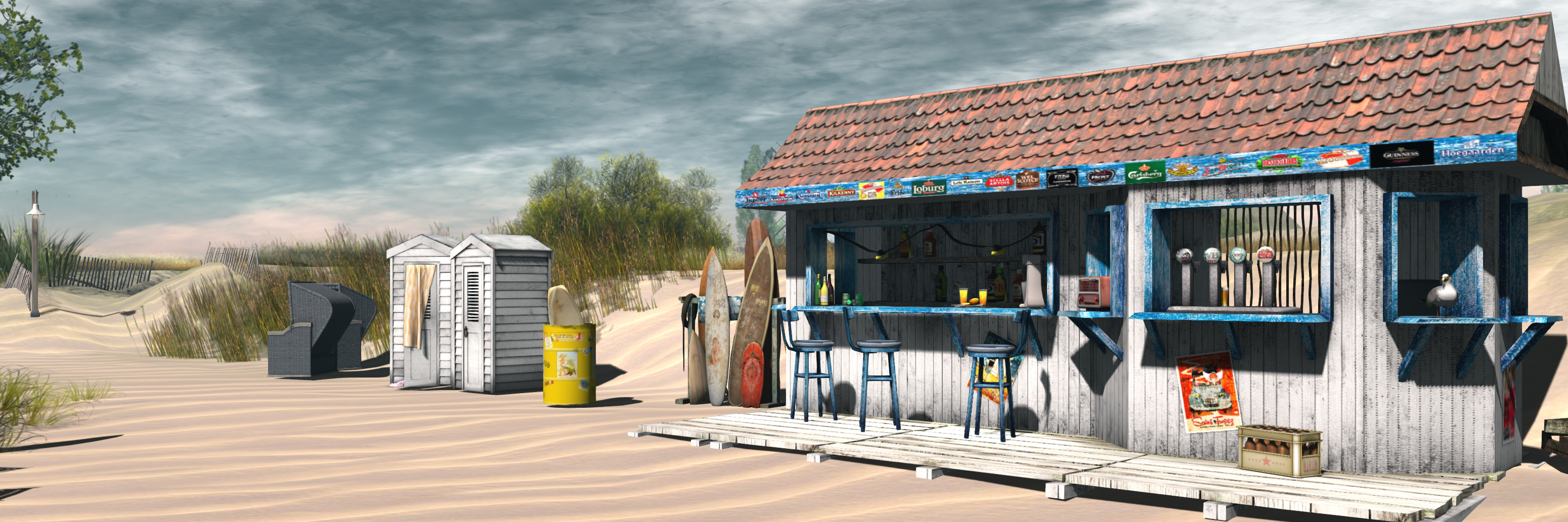
The Mill, Lemon Beach; Inara Pey, May 2019, on FlickrThe Mill, Lemon Beach

The second house sits above the western beach and is clearly set for private occupancy, as demonstrated by the ban lines that become visible should you stray too close. However, it shares a stretch of beach with plenty of room for wandering or sitting, and which also features a bar and what might be a cosy surfer’s shack. Surf boards (traditional and wind) sit on the shore, but aren’t open for public use.

With it sheep and cows grazing peacefully, horses enjoying the freedom of their meadow and with a delightful sound scape, The Mill offers an inviting visit with enough to see and appreciate without it feeling overcrowded or putting undue load on the viewer. Yes, there are a few details that could be tidied a little, notably some of the floating bric-a-brac around the antiques store (or perhaps that’s the influence of the slightly creepy doll sitting on one of the benches outside! 🙂 ), but these are small enough so as not to unduly spoil things.

The Mill, Lemon Beach; Inara Pey, May 2019, on FlickrThe Mill, Lemon Beach

And while the surf boards might not be available for use by visitors, this is an excellent place to for horse riding, if you have a wearable Animesh horse; while those who might be disappointed he surf boards can’t be used might want to keep an eye out for the little boat with an outboard motor, as it can be used for pootling around the coast; just keep an eye out for the odd Orca and bather!

Our thanks to Shawn Shakespeare for the LM!

SLurl Details

  • The Mill (Lemon Beach, rated: Moderate)

Finding Kusama with Cecilia Nansen in Second Life

DiXmiX Gallery: Cecilia Nansen

Finding Kusama is the title of Cecilia Nansen’s latest exhibition, which is currently being hosted by DiXmiX Gallery, curated by Dixmix Source.

I’ve long been an admirer of Cecilia’s photography. She has an evocative, emotive style that offers a rich vein of narrative – but Finding Kusama is something of a departure from Cecilia’s usual approach to her work, as she herself notes.

Kusama came to me with her dots, dots, dots and what I admire so much in art myself; femininity, minimalism, simplicity and clean lines. Meeting her, I knew I had to ‘play with her’ and find my inspiration in her universe. Pop art is not my usual style, but Kusama pulled me in. She made my brain bubble in ideas, like a child with a hundred pastels and a brush.

– Cecilia Nansen on Finding Kusama

DiXmiX Gallery: Cecilia Nansen

The Kusama in question is Yayoi Kusama, the Japanese contemporary artist most noted for her work in sculpture, but is also active in painting, performance, film, fashion, poetry, fiction and other arts. As a conceptual artist, she blends multiple approaches and styles – particularly abstract expressionism – and is regarded as one of the most important and influential artists to emerge from modern Japan.

A particular trademark with Kusama’s work is her use of polka dots, and this is very much reflected within Finding Kusama. Seven of the 12 pieces in this collection offer bright, vibrant pieces rich in the use of polka dots, each with a degree of minimalism Kusama herself would appreciate. There is a wonderful sense of fun about these pieces  – which again, is precisely what Cecilia intends.

The remaining five images in the collection are monochrome, and while continuing the minimalist approach, they are split between those echoing the polka dot theme with its lightness, and some that plumb a deeper, more personal depth for Cecilia, and which reflect a situation she recently passed through.

DiXmiX Gallery: Cecilia Nansen

As both a celebration of Kusama’s art and an exhibition of Cecilia’s own evocative and introspective art, Finding Kusama is not to be missed.

SLurl Details

Saving your Bellisseria house designs for re-use with a rezzing system

A rezzing system / scene rezzer can allow you to save all the décor designs you create for your Linden Home / Houseboat and have them available each time you opt to re-use a particular style of house.

As we’re all now aware, the new Linden Homes are provided via a rezzing system, allowing their owners to live in any one of four styles of home for each type – and to freely swap between house styles whenever they want. This makes the new Linden Homes both flexible and user-friendly: tired of the house you currently have? Then simply clear it out and replace it with another from your parcel’s mailbox or lifebuoy (or swap the house / houseboat style and re-orient your furnishing to suit).

However, if you do like swapping between house / houseboat styles, manually re-doing things each time can be something of a pain. The most obvious way to avoid this is to use a rezzing system or a scene rezzer. Both sound the same – and some systems may well offer both functions, but for the purposes of this article, I’m going to differentiate them as follows:

  • A rezzing system allows you save the furniture and décor (and things like your garden furnishings, any add-ons you’ve purchased / made) for a house / houseboat as a single package, which you can pull from inventory and use to re-rez that particular design / layout whenever you opt to re-use the style of house / houseboat for which it was created. My personal preferences for tools of this type are:
    • Builder’s Buddy, a free system. You can get the raw scripts from the Second Life wiki (just copy / paste the two scripts from the wiki pages into appropriately-named new scripts in your inventory), or via the SL Marketplace.
    • The Rez Faux system by Lex Neva. Primarily intended for creating packages of goods you’ve created and wish to sell, this costs L$600, is available in-world, and works perfectly well with “personal” projects.
    • Note that I am not endorsing these options over other rezzer system products, they are simply the two I personally use.
  • A scene rezzer can allow you to save multiple design / décor layouts for multiple homes, and have them all available through a single in-world device.

Which approach you take is down to you:

  • Use of individual rezzers tends to be quicker and easier than using a scene rezzer, and offers greater flexibility when adding or changing things within an individual design.
  • Using a scene rezzer means you can quickly access all your layouts at the cost of only 1 or 2 LI without having to fiddle around with the correct placement of the individual rezzer. However, updating a saved design is a lot harder, as it can require re-saving the entire design, rather than just adding / swapping individual items.

However, the most important thing to remember is that, in order to work, the items placed within any rezzing system must be both Modify and Copy. You also need to have a basic understanding of editing objects in Second Life. Also note that due to the way the majority of these systems work, if you opt to physically relocate to another parcel in Bellisseria, you will most likely have to create new rezzers for that parcel. Also, note that I’m not referring to “temp rezzers”; these are both against the Bellisseria covenant, and should in general be avoided as they are horrible resource hogs.

The following notes have been written to help you use the above-named systems.

Builder’s Buddy and Rez Faux – Individual Rezzers for House layouts

Creating the Rezzer and Adding Contents

  • Builder’s Buddy: Create a default cube. Drop the Builder’s Buddy Base Script into it. This is now your Base Prim – the rezzer.
  • Rez Faux: rez a copy of the Create A New Package object – this is your rezzer for Rez Faux.
  • Both:
    • Rename your new rezzer according to your needs (e.g. “Winchester House With Party Add-on” or “Barnacle Houseboat Mango Interior” or some such).
    • Position the rezzer object you’re just created towards the centre of your parcel, then copy the X, Y, Z position coordinates from its Object tab and paste them into the Description field of the General tab.
When you use something like Builder’s Buddy or Rez Faux that uses positioning relative to the rezzing item, it is essential the X, Y, Z coordinates of the rezzer are saved (e.g. by using the General tab’s Description field). Note that two Edit floaters are shown in this image for the purposes of illustration only

Continue reading “Saving your Bellisseria house designs for re-use with a rezzing system”

2019 viewer release summaries week #21

Logos representative only and should not be seen as an endorsement / preference / recommendation

Updates for the week ending Sunday, May 26th

This summary is generally published every Monday, and is a list of SL viewer / client releases (official and TPV) made during the previous week. When reading it, please note:

  • It is based on my Current Viewer Releases Page, a list of all Second Life viewers and clients that are in popular use (and of which I am aware), and which are recognised as adhering to the TPV Policy. This page includes comprehensive links to download pages, blog notes, release notes, etc., as well as links to any / all reviews of specific viewers / clients made within this blog.
  • By its nature, this summary presented here will always be in arrears, please refer to the Current Viewer Release Page for more up-to-date information.
  • Note that for purposes of length, TPV test viewers, preview / beta viewers / nightly builds are generally not recorded in these summaries.

Official LL Viewers

  • Current Release version 6.2.2.527338, formerly the Teranino RC viewer, promoted May 22nd – NEW.
  • Release channel cohorts:
    • Bakes on Mesh RC viewer updated to version 6.2.3.527418 on May 23rd.
  • Project viewers:
    • No updates.

LL Viewer Resources

Third-party Viewers

V5/V6-style

V1-style

Mobile / Other Clients

Additional TPV Resources

Related Links

Space Sunday: Venus, Pluto, and a mini round-up

This cylindrical map of Venus reveals the planet’s hostile surface beneath the clouds, a place of volcanoes and vast volcanic plains with few impact craters. The latter demonstrates both how volcanism has played a roll in “smoothing over” the surface of Venus in the past, and how effectively the dense atmosphere acts as a shield in burning-up incoming space debris. Credit: NASA

Once regarded as a planet that may harbour life, Venus – as we know it today – is a hellish place. Cursed with a runaway greenhouse effect, the surface temperatures (averaging 735 Kelvin or 462°C / 863°F) are hot enough to melt lead and mark it was the hottest planetary body in the solar system. The atmosphere is both a toxic cauldron so dense that it exerts a surface pressure 92 times greater than our own – the equivalent of being 900 m (3,000 ft) under water on Earth.

Venus is also unusual in other ways: it has a retrograde rotation (it spins on its axis in the opposite direction to Earth and most of the other planets), and it takes 243 terrestrial days to complete one rotation but only takes 224.7 days to complete an orbit of the Sun, making a “day” on Venus longer than a year.

Despite its hostile conditions, it has long been believed that Venus was at one time in its ancient past a far more hospitable world, potentially warm a wet, and spinning a lot faster on its axis (quite possibly in the same direction as the Earth spins). However, at some point  – so the accepted theories go – Venus experienced a massive impact, one sufficient enough to slow – and even reverse – its rotation and which also left it the broiling, hostile world we know today.

An artist’s impression of how Venus might have appeared some 2.5 – 3 billion years ago, at a time when a globe-spanning ocean might have started to affect the planet’s rotation, slowing it and eventually giving rise to the planet’s runaway greenhouse effect. Credit: NASA

However, a new study involving the University of Bangor, Wales, the University of Washington and NASA, suggests not only did Venus once had a liquid water ocean, but that ocean may have actually been the catalyst that brought about the planet’s dramatic change.

To put it simply, tides act as a brake on a planet’s rotation because of the friction generated between tidal currents and the sea floor. On Earth, this results in the length of a day being shortened by about 20 seconds every million years. Given this. the team responsible for the  study investigated how such interactions might impact Venus. Using a numerical tidal model, the accepted belief that Venus once had a world-girdling ocean, and applying it to planetary rotational periods ranging from 243 to 64 sidereal Earth days, they calculated the tidal dissipation rates and associated tidal torque that would result from each variation in ocean depth and rotational period. Their work revealed that ocean tides on Venus would likely have been enough to slow the planet’s rotation it down by up to 72 terrestrial days every million years.

This might not sound a lot, but of the course of around 10-50 million years, it would have been enough to slow Venus’s rotation and bring it to how we see it today. In turn, this slowing of rotation would have accelerated the evaporation of an ocean waters on the sunward facing side of the planet, both increasing the atmospheric density and trapping more heat within the atmosphere, accelerating the planet’s greenhouse effect, in turn increasing the rate of ocean evaporation in what would have been a closed cycle. Add to that the planet’s known volcanism, and the team estimate that it would have taken around 100-120 million years to turn Venus into the planet we see today.

This work shows how important tides can be to remodel the rotation of a planet, even if that ocean only exists for a few 100 million years, and how key the tides are for making a planet habitable.

– study co-lead Dr. Mattias Green, University of Bangor

The study findings have potentially important implications for the study of extra solar planets, where many “Venus-like” worlds have already been found. From this work, astronomers have a model that could be applied to exoplanets located near the inner edge of their circumstellar habitable zones, helping to determine whether they might have at some point potentially have had liquid water oceans, and how those oceans may have affected their development.

Fly Your Name to Mars

Mid July through August 2020 will see NASA’s next rover mission launched to Mars, and as with a lot of their recent exploratory missions, NASA is giving members of the public the opportunity to have their names flown with the vehicle.

Between now and September 30th, 2019, NASA is inviting one million members of the public to submit their names and postal codes to Send Your Name (Mars 2020). These names will then be laser-etched onto a little chip roughly the size of a penny that will be mounted on the rover and carried to Mars. In return, successful applicants obtain a “boarding pass” similar to the one shown below, indicating their name will be flown on the mission.

My Mars 2020 boarding pass

The Mars 2020 rover is based on the same chassis and power system as used by the Mars Science Laboratory Curiosity rover. It will also use the same type of landing system, featuring a rocket-powered “skycrane” that will hover a few metres above the surface of Mars and then winch the rover down to the surface. However – and for the first time in the history of planetary exploration – Mars 2020 will have the ability to accurately re-target its landing point prior to committing to lower the rover, thus allowing it to avoid last-minute obstructions that might otherwise damage the rover or put it at risk.

Core to this capability is a instrument called the Lander Vision System (LVS), which has been undergoing tests in California’s Death Valley attached to a helicopter. LVS is designed to gather data on the terrain the lander is descending towards, analyse it to identify potential hazards and then feed the information to a guidance system called Terrain-Relative Navigation (TRN), which can then steer the landing system away from hazards, allowing the skycrane to winch the rover to the ground in a (hopefully) a safe location.

The Mars 2020 rover’s LVS under test in Death Valley, California, mounted on the front of a helicopter. Credit: NASA/JPL

Mars 2020 is due to be launched between July 17th and August 5th 2020 to arrive on Mars at Jezero Crater on February 18th, 2021.

Continue reading “Space Sunday: Venus, Pluto, and a mini round-up”

Submarines, invisible cats and podcasts in Second Life

Seanchai Library

It’s time to highlight another week of storytelling in Voice by the staff and volunteers at the Seanchai Library. As always, all times SLT, and events are held at the Library’s home at Holly Kai Park, unless otherwise indicated.

Sunday, May 26th, 13:30: Tea-Time at Baker Street

Tea-time at Baker Street returns and opens the covers of His Last Bow.

A 1917 anthology of previously published Sherlock Holmes stories by Sir Arthur Conan Doyle, the volume originally comprised seven stories published by The Strand Magazine between 1908 and 1917. However, later editions of the book saw an eighth story included, The Adventure of the Cardboard Box, originally published in 1892. This week sees Holmes and Watson engaged upon The Adventure of the Bruce-Partington Plans.

Despite his frequent appearances in various television series depicting the life and times of Sherlock Holmes, Mycroft Holmes only appears, or is mentioned, in just four of Conan Dyole’s tales, this being one of them – actually the one which marked his final appearance in the original canon.

The adventure starts when Mycroft visits Holmes about missing submarine plans and a dead man. The latter is Arthur Cadogan West, formerly a young clerk in a government office at the Woolwich Royal Arsenal, who was found dead next to the London Underground tracks near Aldgate tube station, his head apparently crushed by a passing train. The plans for the Bruce-Partington submarine were found on his body – with three pages missing. Mycroft’s concern is that they’ve been taken by enemies of the Crown.

Not only is there the mystery of the missing pages for the submarine plans, there is much about Arthur Cadogan West’s death which does not add-up; why, for example, was he carrying top-secret plans about his person while apparently due to visit the theatre with his fiancée? Why is there no Underground ticket about his body? Did he manage to travel the service without a ticket, or did someone take it? If the latter, why?

Holmes responds to his brother’s request for help on behalf of the British government – noting to Watson along the way that Mycroft actually is the British government – and thus the adventure begins.

With Da5id Abbot, Elrik Merlin, Kayden Oconnell, and Caledonia Skytower.

Monday, May 27th 19:00: Paper Mage

Gyro Muggins concludes Leah R. Cutter’s 2003 début novel.

Set in the Tang Dynasty of the Middle Kingdom (about the time of Charlemagne in Europe), the novel tells us of the adventures of Xiao Yen, a young woman training to become a paper mage, a sorcerer with the power to endow folded creations with the semblance of life.

Because her gifts are in demand for the protection they can offer, Xiao Yen must leave behind her beloved family and their village home and embark on a dangerous mission when she is hired to protect a caravan. Yet even as she departs, she has no idea that this looming adventure will shape the very woman she is to become.

The story follows two timelines, alternating chapters between the caravan journey, where one of her fellow travellers is a goddess who charges her with a dangerous quest, and the story of her childhood training, when she lay caught between her aunt’s plans and her mother’s plans to have her married off.

Tuesday, May 28th  19:00: Crenshaw

In her first novel after winning the Newbery Medal, Katherine Applegate delivers an unforgettable and magical story about family, friendship, and resilience.

Jackson’s parents are in serious financial trouble; their stressful circumstances are taking a toll on Jackson. Mum and dad remain cheerful and upbeat, putting on a happy face for their kids, but Jackson is not fooled. He knows times are bad and, whether he likes it or not, Crenshaw the giant cat is here to help him through the worst of it.

Crenshaw is not only very large, he’s both outspoken and imaginary. He has come back into Jackson’s life to help him. But is an imaginary feline enough to save Jackson and his family from losing everything?

Author Katherine Applegate proves in unexpected ways that friends matter, whether real or imaginary.

With Caledonia Skytower.

Wednesday, May 29th 19:00: 14 Years of 100-word Stories

Story writer, story-teller, commentator, raconteur – Crap Mariner is all of these, and more. On May 31st, 2005, after being inspired by both a friend and Woody Allen to write 100-word stories  – or “dabbles” – Crap created the 100-word Story podcast, promising to write a story a day until the day he dies.

Fourteen years on, Crap is still writing  – and still reading his stories in what is quite probably the longest-running daily podcast of original material in the world.

Seanchai Library is therefore delighted to host the 14th anniversary of the 100-word story podcast, with Crap reading more of his stories, which will cover a wide range of topics, just like his podcasts. There might even be a George the Pirate story or two 🙂 .

Thursday, May 30th

19:00: Thor The Mighty Adapted by Elizabeth Rudnick

Asgard’s greatest warrior, the mighty Thor, has vowed to protect the mortals of Earth with his legendary hammer Mjolnireven from his trickster brother, Loki!

With Shandon Loring. (Also in Kitely grid.kitely.com:8002:SEANCHAI).

21:00: Seanchai Late Night

Contemporary Sci-Fi Fantasy from such on-line ‘zines as Lightspeed, Escape Pod and Clakesworld. With Finn Zeddmore.