SL16B: Meet the Lindens – when and who

Courtesy of Linden Lab

The 16th anniversary of Second Life’s opening to the public at large – SL16B – is just around the corner (starting June 20th). And, as has been the case with SLB events over the last few years, the celebration will feature a series of Meet the Lindens sessions featuring members of the various teams within the Lab who work on Second Life.

The sessions will run daily through the week of the SL16B celebrations, and will be hosted at the SL16B Auditorium. They offer an opportunity to hear from – and likely ask questions of – Linden Lab staff who work on the platform.

All of the sessions will take place between 14:00 and 15:00 SLT, Monday, June 24th and Thursday, June 27th, with the schedule lining up as follows.

Day (14:00 – 15:00 SLT) Lindens
Monday 24th June Patch Linden, Senior Manager, Product Operations
Tuesday 25th June Oz Linden, Technical Director for Second Life and April Linden, Second Life Operations Manager
Wednesday 26th, June Ebbe Linden (Altberg), Linden Lab CEO
Thursday 27th June Xiola Linden, Lead Community Manager, and Strawberry Linden

Friday, June 28th will see a (currently unadvertised, as awaiting names) session with some of the Moles.

For those who may be unfamiliar with some of the above names and their areas of expertise:

  • Patch Linden oversees the content development teams, the Mainland Land Team, and the Linden Department of Public Works – LDPW, aka The Moles. As such, he oversees things like the development of the new Linden Homes continent, the Lab’s games and experiences such as Linden Realms and Horizons, and so on. He is also responsible for managing the individual Second Life and Sansar support teams, and the account support team.
  • Oz Linden oversees the engineering side of Second Life – this encompasses viewer development, simulator development and a lot of the back-end services required by SL (e.g. the asset service, the appearance and baking services, etc.). This includes managing the development and implementation of SL projects and features such Bento, Animesh, the Environmental Enhancement Project, Bakes on Mesh, etc. On the simulator side of things, His team works closely with the Operations team.
  • April Linden manages the team responsible for keeping all aspects of Second Life’s infrastructure – servers, network, etc., running. This involves more than just the simulator servers, encompassing as it does core systems such as the log-in services, and the back-end services as well.  This is the time that is directly engaged in handling service outages, protecting SL from things like DDoS attacks. When things do go sideways, April also takes responsibility for informing Second Life users on what happened and why (and LL’s efforts to avoid any future repeat) through her excellent post-mortem blog posts (like this one) which are recommended reading for anyone interested in understanding the complexities of Second Life.
  • Ebbe Linden, as the Lab’s CEO since 2014, really needs no introduction. Open and honest, he has always endeavoured to keep SL residents appraised of business at the Lab  – including Sansar – and on the manage perspective on Second Life. Should anyone want a potted biography on him however, I offer the one I pieced together when he officially joined Linden Lab.
  • Xiola Linden oversees the Second Life community team, which includes Strawberry Linden. Like many at the Lab, both Xiola and Strawberry are “former” residents of Second Life (quotes used as both remain active in-world on their personal accounts outside of their official capacity as Lindens).  Part of the Marketing Team, the community team is responsible for community relations, running the Second Life social media accounts, working on marketing projects, etc.

As with previous years, I will hopefully be recording each of the sessions, and will be producing a series of audio reports for each. These will comprise bullet-point summaries of the topics covered (I regret to say that producing full written transcripts of every session is too time-intensive for me to commit to), with accompanying audio, as well as links to the official video of each session.

Again, all these sessions will take place at the SL16B Auditorium – but please note that this SLurl will not work until SL16B officially opens.

Catch the SL16B page in the Destination Guide for more information on events and activities during the celebrations.

2019 viewer release summaries week #24

Logos representative only and should not be seen as an endorsement / preference / recommendation

Updates for the week ending Sunday, June 16th

This summary is generally published every Monday, and is a list of SL viewer / client releases (official and TPV) made during the previous week. When reading it, please note:

  • It is based on my Current Viewer Releases Page, a list of all Second Life viewers and clients that are in popular use (and of which I am aware), and which are recognised as adhering to the TPV Policy. This page includes comprehensive links to download pages, blog notes, release notes, etc., as well as links to any / all reviews of specific viewers / clients made within this blog.
  • By its nature, this summary presented here will always be in arrears, please refer to the Current Viewer Release Page for more up-to-date information.
  • Note that for purposes of length, TPV test viewers, preview / beta viewers / nightly builds are generally not recorded in these summaries.

Official LL Viewers

  • Current Release version 6.2.2.527338, formerly the Teranino RC viewer, promoted May 22nd – No Change.
  • Release channel cohorts:
    • Love Me Render viewer updated to version 6.2.3.527826 on June 10th.
    • Bakes on Mesh RC viewer updated to version 6.3.0.527701 on June 10th.
  • Project viewers:
    • 360 Snapshot project viewer temporarily withdrawn while awaiting a code base update to bring it to parity with the current release viewer.

LL Viewer Resources

Third-party Viewers

V5/V6-style

  • No updates.

V1-style

  • Cool VL viewer Stable branch updated to version 1.26.22.51 and Experimental branch to version 1.26.23.4 on June 15th  (release notes).

Mobile / Other Clients

Additional TPV Resources

Related Links

Cica’s Luna Park in Second Life

Cica Ghost: Luna Park

Update, June 24th: due to low visitor numbers, Cica ha opted to replace Luna Park with a new dynamic installation called Cubes, which you can read about in Cica’s Cubism in Second Life.

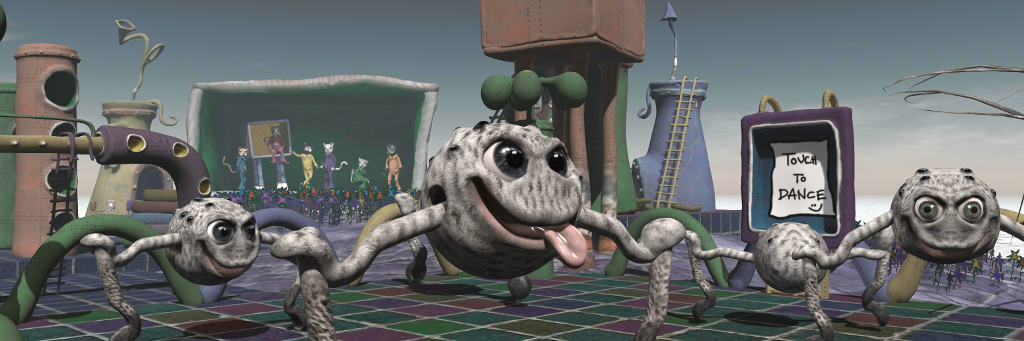
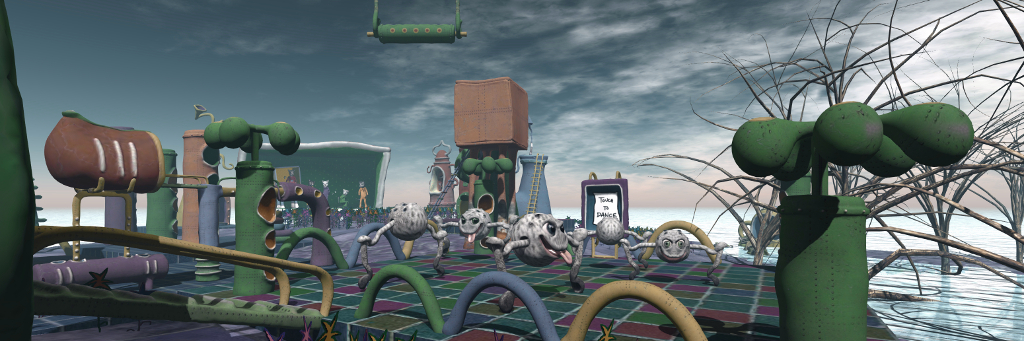
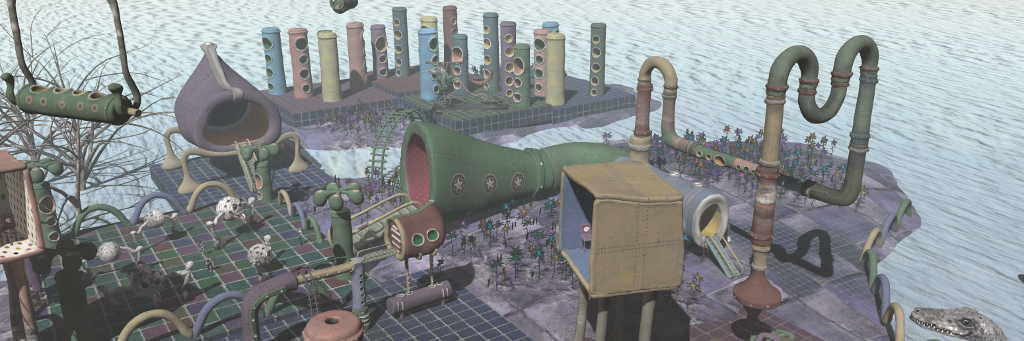
Cica Ghost opened her latest installation on Saturday, June 15th. Called Luna Park, it is once again a whimsical trip into the fantastic.

As usual with her pieces, Cica offers a quote to go with the installation, this one from Walt Disney:

Adults are only kids grown up, anyway. 

Cica Ghost: Luna Park

It’s a part of a wider quote from the famous animator and film producer that reflected his entire philosophy towards films and entertainment – and why so many of us find his animated films so endearing: “You’re dead if you aim only for kids. Adults are only kids grown up, anyway.”

This approach is why Disney films can be touchstone to our childhood, a reminder of a time when we were able to forget the world around us and let our imaginations run wild, even if only for an hour or so.

Cica Ghost: Luna Park

And so it is with Luna Park. It’s an opportunity for us to let go of the adult sensibilities and embrace our inner child; to put aside worries and concerns and simply immerse ourselves in fun, frivolity and lightness. It offers a marvellous landscape filled with curios and strangeness intended to raise a smile.

From a strange horn-like machine  that will dump odd metal shapes on you if you stand at the landing point, to tall funnels and box-like stages and boot / funnel-like structures, this is an interactive theme park where visitors are invited to wander, dance, sit, observe and have fun. There’s a lot to see and do throughout – make sure you take the time to hover the mouse over as much as you can, there are dances and poses throughout; make sure as well, that you climb all the ladders to climb into the boxes and funnels where steps are offered – you might find a few surprises!

Cica Ghost: Luna Park

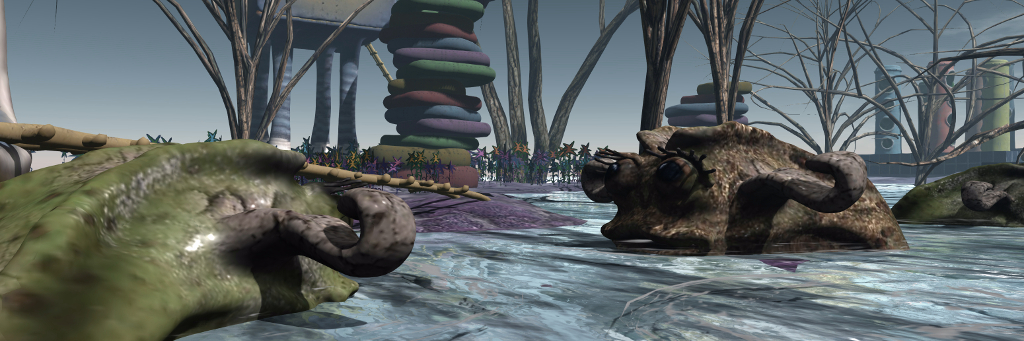
It’s a place with many reminders of Cica’s past builds – such as her Frogs, a new take on her cats, her delightful flowers and stick figures and crow – even some of the structures present echoes of previous works, making Luna Park somewhat evocative as well.

But, when all is said and done, this is an installation that should be experienced, rather than written about, so I urge you to pay a visit and let your inner child out to play. Luna Park will be only be around for a month – and do please consider making a donation towards the cost of the region and Cica’s future art in SL.

SLurl Details

Space Sunday: Europa, a Starshade and ambitions

Arthur C. Clarke’s fictional warning from 2010: Odyssey Two, given with regards to Europa. Now we may have a further reason to send a mission to probe the ocean beneath the moon’s icy crust. Credit: NASA / I. Pey

The words in the image above form part of the conclusion to Arthur C. Clarke’s 2010: Odyssey Two, the sequel to Stanley Kubrick’s collaboration with Clarke, 2001: A Space Odyssey, and itself made into a film by Peter Hyams. They come as the alien force responsible for the strange monoliths that triggered the events of 2001: A Space Odyssey cause the gravitational collapse of Jupiter, generating sufficient compression to start nuclear fusion, turning it into a mini-sun.

The actions were taken due to primitive life being found in the waters under Europa’s crust of ice; life trapped in an evolutionary cul-de-sac unless Europa received greater sunlight to melt the ice, evaporate some of the sea to expose landmasses and allow its burgeoning life the opportunity to grow and evolve. The words were issued to prevent humanity interfering in this process.

While there is no sign of aliens, monoliths, or anything like it around Jupiter, we do know there is a vast salty ocean under Europa’s ice, potentially 100 km (62.5 mi) deep and kept liquid as a result of the gravitational forces of Jupiter and other Galilean moons causing Europa to “flex” and generate heat deep within itself – and that ocean could be the home of life.

Europa’s internal structure, showing the subsurface ocean which could be up to 100 km (62.5 mi) deep. Credit: NASA

It had generally been thought that the salt in Europa’s ocean was likely magnesium chloride. Now a new study indicates that the salt could well be sodium chloride – the same salt present in our own oceans.  This has important implications for the potential existence of life in Europa’s hidden depths.

Scientists believe that hydrothermal circulation within the ocean, mostly likely driven by hydrothermal vents created on the ocean floor as a result of Europa’s “flexing”, might naturally enrich the ocean in sodium chloride. On Earth, hydrothermal vents have been shown to support life around them, which utilises the minerals and heat from the vent. Much the same could be occurring on Europa.

NASA has had many plans for missions to explore Europa’s ocean. Thus far, none have got beyond the the planning phase. Credit: NASA

Identifying the presence of sodium chloride has been a long time coming. Europa is tidily-locked with Jupiter, meaning it always keeps the same side pointed toward the planet. As a result, studies of the moon have been focused on its far side relative to Jupiter, as this side of the moon reveals much of the complex and continuing interaction taking place between Jupiter, Europa, and Jupiter’s innermost moon, Io, which results in sulphur from Io to be deposited on Europa.

Mixed in with these sulphur deposits are traces of magnesium chloride, which led researchers to believe it had been ejected from the moon’s ocean through the cracks and breaks that occur in Europa’s icy shell as a result of the internal “flexing”. However, when reviewing recent data obtained from the Keck Observatory, the team responsible for the new study found something odd. The data – gathered in infra-red – included the “side” of Europa facing along the path of its orbit around Jupiter – a face largely free from sulphur deposits from Io, although it is still stained yellow.

It had been assumed that this discolouration was due to more magnesium chloride being ejected from within Europa. But magnesium chloride is visible in the infra-red – and the Keck data didn’t reveal any such infra-red signature associated with the discolouration. So what might be causing them?

One of the study’s authors, Kevin Hand of NASA’s Jet Propulsion Laboratory, realised that sodium chloride is “invisible” under infra-red – but it can change colour when irradiated. Carrying out tests on ocean salts, he found they did turn yellow under visible light when irradiated. He then analysed the yellow in the salt and the yellow on Europa imaged by Hubble – and found the two exhibited exactly the same absorption line in the visible spectrum.

A pair of composite images of Europa. On the left, as seen in natural light; on the right the same image that has been colour enhanced. They show, on the right, the “far side” of Europa relative to Jupiter, the rust colour the result of sulphur ejected from Jupiter’s inner moon Io being deposited on Europa by Jupiter’s radiation belts, and which show evidence of magnesium chloride. On the left, the yellow staining, originally thought to be the result of further magnesium chloride deposits from within the moon – but which now have been shown to be sodium chloride – the same salt as found in our own oceans. Credit: NASA/JPL / University of Arizona

We’ve had the capacity to do this analysis with the Hubble Space Telescope for the past 20 years. It’s just that nobody thought to look.

Mike Brown, Professor of Planetary Astronomy at Caltech, and study co-author

This is the clearest evidence yet as to the nature of Europa’s ocean and its similarity to our own, life-supporting ocean. However, it’s not absolute proof: the sodium chloride might be indicative of salt deposited in Europa’s icy crust from long ago, rather than evidence of it being contained with the moon’s oceans. However – and despite the fictional warning from Clarke’s novel – the study ups the need for us to send a mission to Europa that is capable of penetrating its icy surface and directly studying the ocean beneath ice, both for signs of possible life, and better understand the processes that might be occurring within its depths.

Starshade: The Quest to See Exoplanets

Over the last few decades, astronomers have discovered over 4,000 exoplanets orbiting other stars, leading to wide-ranging debates as to the suitability of such worlds supporting life. One of the ways we could better make such a determination would be through direct analysis of their atmospheres. The problem here is that given the distances involved, the atmospheres of exoplanets are effectively masked from observation from Earth by the glare of their parent star.

Plans are in hand to achieve this. When the WFIRST telescope is launched in the mid-2020s – assuming it continues to survive attempts by the White House to delay or cancel it – it will carry an instrument called the stellar coronagraph. This will effectively block the light of a star from reaching the telescope’s imaging systems, allowing it to see the atmospheres of planets roughly the size of Saturn or Jupiter or larger. But to see the atmospheres of smaller exoplanets  – the size of the majority so far discovered – an alternative its required. Enter Starshade.

Also called the New World Project, Starshade has been in development since 2005 – although it has yet to gain formal mission status. In essence, it proposes the deployment of a purpose-built space telescope and an “occulter” – a massive deployable, adjustable shade, 26 metres (85 ft) in diameter.

Starshade proposes using a large “occulter” (left) to block the light of distant stars so that a telescope (right) to study the atmospheres of planets orbiting the star. Note this image shows the shade unfurling following its deployment from its carrier vehicle, which also includes the originally-proposed telescope (seen at the right-hand end of the vehicle). once separated, the telescope vehicle would move away from the starshade before turning to align the telescope with it. Credit: NASA, 2014

The idea is that, placed between the telescope and a star with known exoplanets, the shade would block the star’s light – but allow the light from the planets be received by the telescope, allow it to be spectrographically analysed. This would allow scientists to understand the nature and composition of any atmospheres these planets might have, and thus determine their possible suitability for life.

One of the stumbling blocks for the proposal has been cost: developing and launching both a purpose-built telescope and occulter has been put at US $3 billion. However, were Starshade to be used with an already budgeted telescope – say WFIRST – that cost comes down to just US $750 million. Thus, the most recent studies related to the project have been focused on achieving this. In doing so, they’ve raised a significant technical issue: alignment.

Continue reading “Space Sunday: Europa, a Starshade and ambitions”

Shakespeare, boys and badgers, and lunar tourists

Seanchai Library

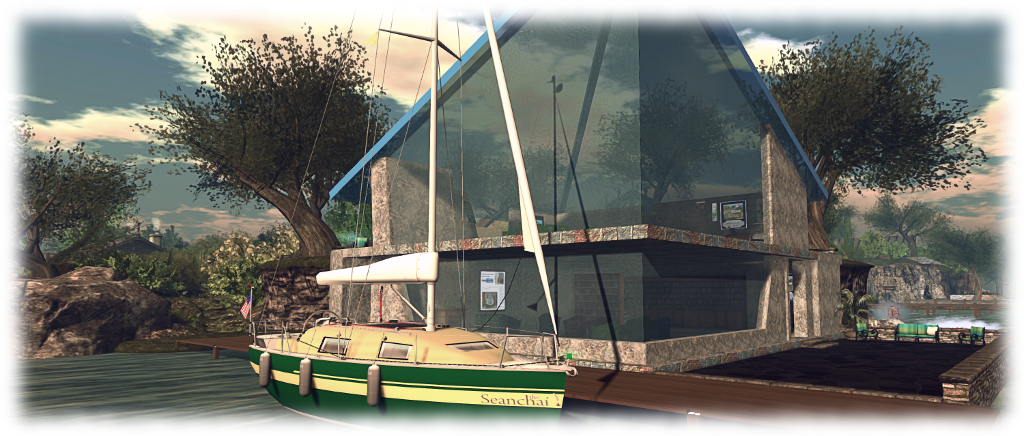
It’s time to highlight another week of storytelling in Voice by the staff and volunteers at the Seanchai Library. As always, all times SLT, and events are held at the Library’s home at Holly Kai Park, unless otherwise indicated.

Sunday, June 16th, 13:00 A Midsummer’s Night Dream

Selected scenes presented live from the current A Midsummer Night’s Dream Project.

One of William Shakespeare’s most popular comedies, A Midsummer Night’s Dream is a four-stranded play set within a forest inhabited by the fairy folk under the rule of Titania and Oberon. There is the over-arching theme of the forthcoming wedding of Duke Theseus of Athens and Hippolyta, the Amazon queen, due to take place within the forest. This is to be in part celebrated by a group of six amateur actors staging a play, and who have also come to the forest to prepare. Then there are the four young Athenians who are to be among the guests at the wedding: Hermia, is in love with Lysander, but has been order by Egeus, her face to wed Demetrius, who is deeply loved by Helena, Hermia’s best friend – but whom he dumped to be free to wed Hermia.

Within the forest, Oberon and Titania are somewhat estranged over Titania’s refusal to accede to Oberon’s demand to hand him her Indian changeling. Angered by her actions, Oberon summon Robin “Puck” Goodfellow, his “shrewd and knavish sprite”, with the intent of putting into motion a plan to shame Titania into doing as he wishes through the use of a magical potion. However, as the plot is put into motion, Oberon witnesses assorted actions: the cruel words of Demetrius to Helena, the assery (a deliberately chosen term in the circumstances 🙂 ) of Nick Bottom, one of the amateur players, and the plot inevitably thickens – helped in no small part by a slight case of mistaken identities, until the fairies are forced to convince those with whom they have interacted have just experienced a dream – and Puck suggests that the dream might even extend to the audience.

A Midsummer’s Night Dream, LEA 2

Hosted by Elrik Merlin and Caledonia Skytower, with performances organised by Kayden Oconnell, the cast comprises Caledonia, Kayden, Da5id Abbot, Fayleen Belois, Ian Quintessa, and Aoife Lorefield, the project’s creator, who will also be interviewed after the performances.

If you cannot attend the event, then why not listen wherever you are, in-world or out, by tuning into fantasy.radioriel.org.

Monday, June 17th 19:00: Incident at Hawk’s Hill

Gyro Muggins reads naturalist and historian Allan W. Eckert’s popular novel.

In 1870, Manitoba became the fifth province of the (then) three-year-old Canadian Confederation. Over the previous 18 months, it had seen strife and rebellion, but for William MacDonald, his wife, Esther, and their family, the lands around what would eventually become the city of Winnipeg, are ideal for farming, and so they have settled and built Hawk’s Hill.

The open spaces are perfect for the MacDonald’s four children – or should have been; while the three elder children thrived, the youngest, six-year-old Ben, became increasingly introverted.

Small for his age, Ben was reserved and prefers being with animals, learning to imitate the sounds of many, and well as copying their movements and actions. In return, the local animals seem to respond well to him – although members of his family and the other locals consider him odd.

But then came the day when Ben, in seeking new animals to mimic, wandered further than was usual, venturing into unfamiliar territory – only to become hopelessly lost. When a storm breaks, he has no option but to hide in a badger hole – an occupied badger hole. And thus begins a relationship spanning several months between young boy and a female badger, to the benefit and comfort of both.

Tuesday, June 18th 19:00: The Penderwicks in Spring

Springtime is finally arriving on Gardam Street, and there are surprises in store for each member of the family. Some surprises are just wonderful, like neighbour Nick Geiger coming home from war. And some are ridiculous, like Batty’s new dog-walking business. Batty is saving up her dog-walking money for an extra-special surprise for her family, which she plans to present on her upcoming birthday. But when some unwelcome surprises make themselves known, the best-laid plans fall apart.

Filled with all the heart, hilarity, and charm that has come to define this beloved clan, The Penderwicks in Spring is about fun and family and friends (and dogs), and what happens when you bring what’s hidden into the bright light of the spring sun.

With Caledonia Skytower.

Wednesday, June 19th 19:00: The Menace from Earth

Young love is often hard on those experiencing it for the first time.

Take 15-year-old Holly, for example. A lunar colonist and aspiring starship designer, who has something of a crush on her closest male friend, Jeff, with whom she shares a particular passion: that of flying.

It’s a popular pastime on the Moon, thanks in part to the 1/6 gravity environment. Taking advantage of this in caverns within the cities where the air pressure can be kept high enough, locals can strap on sets of wings and take to the air. And Holly and Jeff are both fans of the activity.

Another element to life on the Moon is that of tourism: playing host to “groundhogs”, as the locals call them, who like to visit the Moon. One such tourist is Ariel, a glamorous woman to whom Holly is assigned to as a guide.

It all goes well to start with – until Holly introduces Ariel to Jeff. To her dismay, Holly find herself facing The Menace From Earth: Jeff is quite smitten with Ariel. As her jealousy grow, so Holly starts to resent Ariel more and more – but what to do?

Things take a sudden turn when Ariel asks to joins Holly and Jeff flying in the local cavern…

With Derry McMahon, Bear Silvershade, and Caledonia Skytower.

Thursday, June 20th 19:00: Monsters and Myths

Shandon Loring re-opens Bernard Evslin’s work of stories featuring the gods, heroes and monsters of Greek mythology, turning to Evslin’s words on Hecate, variously associated with crossroads, entrance-ways, light, magic, witchcraft, knowledge of herbs and poisonous plants, ghosts, necromancy, and sorcery.

2019 SL User Groups 24/3: TPV Developer Meeting

aZiLe; Inara Pey, May 2019, on FlickraZiLe, May 2019 – blog post

The following notes are taken from the TPV Developer meeting held on Friday, June 14th, 2019. A video of the meeting is embedded below, my thanks as always to North for recording and providing it. The key points of discussion are provided below with time stamps to the relevant points in the video, which will open in a separate tab when clicked.

SL Viewer

[0:23-3:40]

There have been no further LL viewer updates wince the Love Me Render and Bakes On Mesh RC releases on June 10th. This leaves the current LL viewer pipelines as follows:

  • Current Release version 6.2.2.527338, formerly the Teranino RC viewer, promoted May 22 – No Change.
  • Release channel cohorts:
  • Project viewers:
    • Legacy Profiles viewer, version 6.2.3.527749, released on June 5th. Covers the re-integration of Viewer Profiles.
  • Linux Spur viewer, version 5.0.9.329906, dated November 17th, 2017 and promoted to release status 29th November 2017 – offered pending a Linux version of the Alex Ivy viewer code.
  • Obsolete platform viewer, version 3.7.28.300847, May 8th, 2015 – provided for users on Windows XP and OS X versions below 10.7.

BOM Alpha / Universal Wearable Issues

Please also see my week #24 CCUG update for details of issues around alpha handling and the universal wearable channels in the Bakes on Mesh viewer. Vir indicated that the Lab has a handle on this, which will require an Appearance Service update and a “small” viewer-side update that will include a new inventory icon for universal wearables.

Legacy Profile Project Viewer

[3:50-6:10]

  • As per my preview article, the Legacy Profiles project viewer (version 6.2.3.527749 at the time of writing), moves avatar profile in the viewer back into their own floater, rather than using a view of the web profile.
  • This work is in its initial stages, and the overall aim of the work is in flux. This means that the profile panel itself might be subject to further revision, and that even the web feed itself might gain its own floater, rather than being a tab within the new profile floater.

360 Snapshot Viewer

[6:15-7:33] Note that the 360 Snapshot viewer has been temporarily withdrawn, due to  the core viewer code being badly out-of-date. The viewer is currently in the process of being updated – no functionality changes to the 360 snapshot capability, purely an update to bring the core code up-to-date with the current release viewer. It is hoped this will reach the Lab’s QA team soon, and reappear as a project viewer in due course.

Group Chat Performance

[17:01-34:15]

  • A frequent complaint with Group chat is that it can be slow.
  • The Lab’s investigation in issues shows that actual chat messages and group notices account for the minority of traffic seen in the group chat system.
  • By far the largest volume of traffic is purely the on-line / off-line notifications that are being sent.
    • So, for example, in a group of 20,000 members, each time someone logs-in or out of SL, 20,000 messages are generated in the group chat system; for a 50,000 member group, the number is 50,000, and so on.
    • Note that a couple of years ago, to try to improve things, the Lab disabled the ability to see the group members list for groups over 5,000 members – but the actual messages themselves are still circulated.
  • The Lab is therefore seeking feedback on how big an impact it would be if these on-line / off-line messages were turned off on the simulator side, either just for very large groups (upper limit TBD), or simply for all groups, in the hope it will reduce the volume of traffic and help improve overall chat performance.
  • It has been acknowledged that if this is to be done, it would be useful for group members to still be able to see which group owners / moderators are on-line, and for group owners / moderators to see which group members are on-line, so that issues / enquiries can be dealt with. The Lab will investigate whether this can be done.
  • Note that removing these messages would not affect the “last login” date for the group members list.
  • It is likely the Lab may carry out some experiments on a small cohort of groups to see what might be done and check for any measurable performance increase in those groups.
    • Some experimenting has already been done in trying to batch the on-line / off-line update messages, but it’s not clear if this has had any positive impact where it has been done.
  • An alternative suggestion is to break groups into types: e.g. those purely for chat (which may require more information on users’ on-line status) and those just for outwards announcements.
    • This is already done to some degree by group owners setting group rules / members’ capabilities; however, it still means the on-line / off-line messages are still sent.
    • Were the Lab to try to implement a more robust system like this, there would be a major issue is handling existing groups and determining how to define them.
  • [41:00-41:15] More generally with group chat, the Lab have considered adding an ability to add a server-side block (accessible through the viewer) on chat from groups a user does not wish to hear from, chat-wise. This may be implemented “at some point”.

In Brief

  • [36:10-36:35] Avatar Teleport on Region Performance: as we know, avatars arriving in a region can have a significant impact on the region’s performance. The Lab believe that have a partial understanding of the problem, and has some ideas on how the impact might be lessened.
  • [44:20-46:44] BUG-225696 – “All offline inventory offers from scripted objects are lost” –  was believed to have been fixed in the Teranino RC viewer, however it still appears to be occurring. As such BUG-227179 has been raised against the issue, and the Lab will look into it again.
  • [52:16-53:30] Kitty Barnett (Catznip) has been working on trying to clean-up a series of viewer-side events that can cause the viewer to stall after the login.cgi process has completed that can cause region messages (including IMs) to be lost. The Lab is aware of these as well, but would be interested in accepting Kitty’s code contributions if she can get them finished.
  • The Lab is still looking for a Senior Graphics Engineer to work on Second Life (San Francisco based).

Total Aside

In discussing SL groups (and as a point of humour), Oz and Grumpity revealed the first three Jira items filed internally at the Lab:

  • SL-1: Second Life should grow to dominate the entire world, thereby making us the de facto world leaders.
  • SL-2: Build a time machine.
  • SL-3: Build an army of robot cats.

SL-2 was seen as necessary because the Lab knew that it would eventually need to go back and re-engineer some of the decisions made when first defining / building Second Life and its architecture. Sadly, and DeLorean cars notwithstanding, there are still considerable blockers that prevent its implementation!