Calling Out For You is the title of Edie Horngold’s exhibition at DiXmiX gallery. Located on the gallery’s White hall mezzanine and running through until early February 2020, this is an intriguing series of avatar studies, each of which is intended to frame a story, rather than representing an avatar through portrait or action.
Quite what the story might be is entirely down to those who visit – hence the title for the exhibition – as each image in this selection is highly personal in interpretation. All but one of the images deliberately avoid including the full face of their subject (Edie herself), a move that helps to settle those viewing them into a wider consideration of the narrative framed within each image, rather than being focused purely on looks and expression.
A further aspect to the story elements of the pieces comes through the use of colour, with most of the pieces offered as monochrome pieces. Where colour is used, it is generally not only minimalised, it is often offered through softer tones, allowing it to form a part of the overall narrative without distracting from it by causing the eye to unduly focus on individual parts of the image.
DiXmiX Gallery: Edie Horngold
Take Hisssteria, for example. Here the broader monochrome aspect of the piece is “broken” through the reflective sheen afforded the leather suit, while the use of a flesh tone of the arm blends, rather than clashes, with the more alabaster tone to the exposed flesh elsewhere whilst also offering a suggestion of sinuosity in keeping with with the snake (also offered in softer tones), thus helping the eye and mind to focus more on the relationship between figure and reptile.
A contrast to this approach is Hand With Cigarette. Here the use of colour is richer – the green of the dress deliberately contrasting with the paler flesh and the black background. This helps draw the eye to the red nails, the tempting partial exposure of nipples and the languid hand with the cigarette between relaxed fingers. All combine to imply seduction, the dress and poised hand at the side enhancing the potential for story through the suggestion of a femme fatale.
DiXmiX Gallery: Edie Horngold
It is these hints and echoes that make many of the pieces so intriguing. They draw one into each picture, teasing the imagination, presenting both evocative and provocative lines of narrative; mysteries, if you will, in which the solution is unique to each of us.
It’s time to highlight another week of storytelling in Voice by the staff and volunteers at the Seanchai Library. As always, all times SLT, and events are held at the Library’s home unless otherwise indicated. Note that the schedule below may be subject to change during the week, please refer to the Seanchai Library website for the latest information through the week.
Monday, January 6th 19:00 The Integral Trees
Dispatched on a mission of exploration, the Earth ship Discipline, operated by the the all-powerful State, encountered a strange phenomenon: a torus-like ring of gas and dust surrounding a neutron star. Within the torus, the crew discover a thriving ecosystem of plant and animal lifeforms that have evolved to living continually in a state of free-fall.
Despite being overseen by the ship’s AI system, Sharls Davis Kendy, from which they received advice and information, the crew abandoned the Discipline in favour of living among the plants and trees of the torus, which they call the Smoke Ring.
Now, 500 years later, the descends of the original crew have formed a tribal society focused around some of the trees of the system. Adapted to free-fall life, their societal structures are sharply divided, with “wars” common among them, as well as stronger tribes raiding or enslaving weaker tribes, whilst in all of them, artefacts from the original mission are sought-after and venerated.
In the midst of a round of aggression between various tribal factions, one group find themselves aboard an original craft from the Discipline and caught in space beyond the Smoke Ring, where the Discipline and Kendy are still waiting – and Kendy is willing to provide assistance.
Join Gyro Muggins for more.
Tuesday, January 7th 19:00 A Glorious Freedom: Older Women Leading Extraordinary Lives
Selections from Lisa Congdon’s book celebrating extraordinary lives and redefines what it means to gain wisdom and maturity. From the book’s back cover blurb:
In this richly illustrated volume, best-selling author and artist Lisa Congdon explores the power of women over the age of forty who are thriving and living life on their own terms. Profiles, interviews, and essays from women—including Vera Wang, Laura Ingalls Wilder, Julia Child, Cheryl Strayed, and many more—who’ve found creative fulfilment and accomplished great things in the second half of their lives.
Wednesday, January 8th, 19:00:The Starless Sea
Caledonia Skytower reads selections from Erin Morgensterns novel.
Deep beneath the surface of the Earth and upon the shores of the Starless Sea, lies a network of tunnels and rooms filled with stories and tales. The ways into this secret place are many, but hidden, and perhaps set for just one individual to find. They exist where least expected: on the floors of forests, behind doors inside private homes or around alleyway corners or within mountain caves – almost anywhere in which they cannot be anticipated.
Zachary Ezra Rawlins is searching for his door, though he does not know it. He follows a silent siren song, an inexplicable knowledge that he is meant for another place.
When he discovers a mysterious book in the stacks of his campus library he begins to read, entranced by tales of lovelorn prisoners, lost cities, and nameless acolytes. Suddenly a turn of the page brings Zachary to a story from his own childhood impossibly written in this book that is older than he is…
Thursday, January 9th 19:00 Ancient Fires
Shandon Loring delves into the case files of Jules de Grandin, occult detective, as created by Seabury Grandin Quinn for the pulp magazine Weird Tales. He starts with Ancient Fires. Also in Kitely – grid.kitely.com:8002:SEANCHAI).
An artist’s impression of ESA Solar Orbiter over the Sun. Credit: ESA
2020 is promising to be a busy year for space flight and astronomy, so I’m liable to have an even harder time sifting through all that is going on when trying to cover some of the more interesting / unusual events and missions taking place. So for the first Space Sunday of the year, I thought I’d look at some of the more notable events for the year; I can’t promise to cover all of them as the year progresses, but I’m aiming to get to as many as I can!
Spaceflight
Apollo 13
April 1970 marks the 50th anniversary of Apollo 13, probably the second most famous of the Apollo lunar missions on account of what went wrong and the eventual successful return to Earth of the 3-man crew of James Lovell, Jack Swigert and Fred Haise. Apollo 13 was the only Apollo mission to take place in 1970, and I’ll be covering the mission nearer its anniversary.
ISS: 2020 Years of Continuous Human Presence
November 2020 will mark the 20th anniversary of a continuous human presence aboard the International Space Station (ISS).
While there had been five Space Shuttle flights to the ISS between 1998 and 2000, none constituted a continuous human presence at the station. However, on November 2nd 2019, two days after launching from the historic Gagarin Start launch pad (used to launch the first human in space / to orbit the Earth, Yuri Gagarin) at Baikonur Cosmodrome in Kazakhstan, the 3-man crew of Expedition 1, transferred from their Soyuz TM-3 vehicle to the ISS to start a 136-day stay at the station.
The crew that marked the start of a permanent human presence in space aboard the ISS: Expedition 1 crew William Shepherd (c), Flight Engineer Sergei K. Krikalev (l, later commander of Expedition 11), and Soyuz Commander Yuri P. Gidzenko (r)
The crew of NASA astronaut (and mission commander) William Shepherd, and cosmonauts Yuri Gidzenko and Sergei K. Krikalev were not alone during their stay, being joined by the crews of space shuttles Endeavour (STS-97) and Atlantis (STS-98) during missions to further the assembly of the station. The Expedition 1 crew eventually departed the ISS on March 18th, 2001, aboard the shuttle Discovery, which had arrived on March 10th, both as a part of the assembly operations and to deliver the Expedition 2 crew who replaced Shepherd, Gidzenko and Krikalev.
Since then, there have been 61 Expedition crew rotations, with the total number of crew on the ISS at any one time varying from between three and six people (allowing for overlaps between individual Expeditions), with some individual astronauts and cosmonauts participating in more than one rotation.
Commercial Crew Flights
The year should also mark the resumption of crewed flights between US soil and the ISS for the first time since the space shuttle ceased operations in 2011. Crews are due to start flying to the station around mid-2020 using the SpaceX Crew Dragon vehicle (which has already completed a successful uncrewed flight to/from the ISS), and the Boeing CST-100 Starliner (which was unable to rendezvous with the ISS during its first orbital flight).
SpaceX Crew Dragon (l) and the Boeing CST-100 Starliner: crewed lights to the International Space Station in 2020. Credit: SpaceX / Boeing
No formal dates have been given on when Crew Dragon and Starliner will start routine to the ISS, both both are expected to complete one crewed “test flight” in “early” 2020 before transitioning into “operational” flights, with the Boeing test flight possibly lasting a full 6-month crew rotation.
For SpaceX, there is one remaining critical flight test that must be completed prior to any crewed flights. This will be a flight test of the Crew Dragon’s launch abort system, and is due to take place on or just after January 11th, 2020.
NASA Artemis 1
Formerly known as Exploration Mission-1 (EM-1), NASA’s Artemis-1 mission is being targeted for a late 2020 launch as a part of the US space agency’s goal to return humans to the surface of the Moon, possibly by 2024. This mission will be the first flight of NASA’s new super booster, the Space Launch System (SLS), which will be used to send an uncrewed Orion Multi-Purpose Crew Vehicle on an extended 3-week trip to cislunar space, including a week actually orbiting the Moon, before making a return to Earth.
Before the mission can take place, there are a number of critical tests the SLS system must undergo before it can be declared ready for launch, including a major engine firing test for its first stage engines. As such, whether or not Artemis-1 takes place depends on the outcome of these tests.
Space Tourism
It is anticipated that both Virgin Galactic and Blue Origin will commence sub-orbital flights into space for fare-paying tourists before the end of 2020. Neither company have formally committed to dates for their first flights, but Virgin Galactic has already commenced providing training and pre-flight health and diet advice for the first of the estimated 2,500 people who have made at least a significant down payment of their tickets.
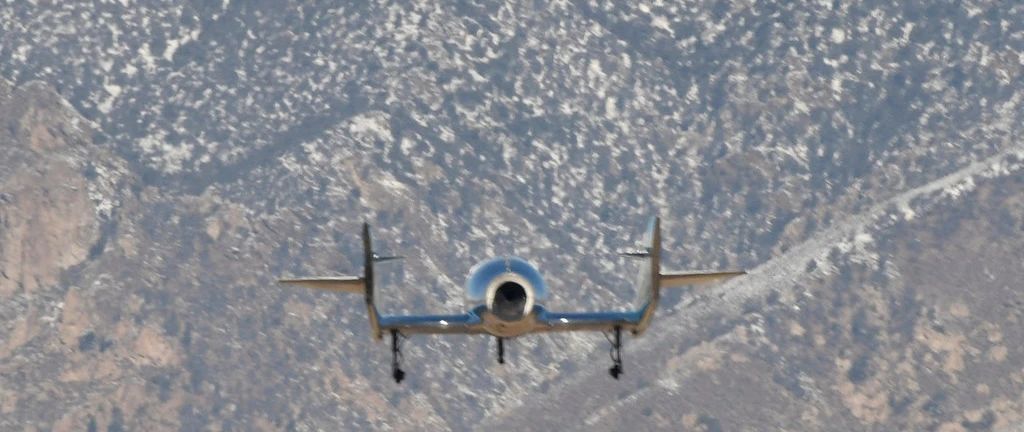
An unusual view of Virgin Galactic’s VSS Unity about to land at the Mojave Air and Space Port in California in February 2019. Credit: Gene Blevins / Reuters
Blue Origin, meanwhile, have been ramping up their New Shephard booster / capsule launches with a series of uncrewed science and test flight in readiness for also flying their own crews and passengers.
Mars Opposition
Mid-2020 will see Mars and Earth make a relatively “close” approach to one another – something that happens every 26 months -, marking it as the most advantageous time to launch missions to the red planet. So the year should see four individual missions launched, involving multiple countries.
NASA Mars 2020: NASA’s latest (and still-to-be-named) Mars rover vehicle is due to be launched on July 17th. Of the same class of large, nuclear-powered rover as Curiosity, Mars 2020 is due to land in Jezero Crater on February 18th, 2021. However, while similar to Curiosity, the Mars 2020 rover has a very different mission – to seek out direct evidence of past life on Mars, and has very different capabilities.
An artist’s impression of the Mars 2020 rover. note the revised instrument package on the rover’s arm. Credit: NASA
In particular, the rover has a completely new instrument system on its robot arm, and will be capable of depositing sealed sample containers on the surface of Mars, which will be collected and returned to Earth by a proposed future mission. In addition, it will carry the first vehicle designed to fly on Mars in the form of a small helicopter drone.
Substance abuse – be it “hard” or “soft” drugs, misuse of prescription drugs or over-indulgence in alcohol, to name but some of its forms – can be a difficult subject to represent. It can come about due to a variety of means and reasons, often with the person or persons caught in the cycle either trying to hide their dependency or deny it. Circumstance often plays a role in misuse, and that circumstance can vary widely.
With her latest installation, Carla, Walk in the Darkness, Terrygold attempts to weave a story of how substance abuse can grow out of the simplest of situations: peer pressure coupled with parental pressure.
Terrygold – Carla: Walk in the Darkness
Though a series of written chapters presented in text, interlinked by a series of 3D vignettes and photographs, the installation traces the story of Carla, a young teenage girl who is apparently content with her lot: school and studying to be a dancer – until she runs into some of her peers into smoking some cannabis.
From this seemingly innocent start, Carla’s life spirals – kicking back and just enjoying the heightened mood associated with cannabis, then skipping dance lessons and rebelling against her family’s concern / pressure that gives her a need to seek “freedom”, which itself is a further opening of the Pandora’s box of needing to recapture the comfort and escape of that first high through every more damaging ways – damaging to both herself and members of her family.
The story is set out in a series of descending rooms, starting from the uppermost, where a general introduction to the installation can be found, together with information on how best to view the installation. Spiralling downwards, each room offers a piece of the story, the physical descent from room to room clearly a metaphor for the descent into the darkness of substance abuse / dependency. Following the path down can be a little difficult in places, – so just cam around if you feel your are stuck; there are clues in places – green triangles on the floor or roses spread across them.
It is ultimately a dark tale that does not end happily – as one might expect – and the ending is made that much starker because after it, we get to see what might have happened if, instead of succumbing to a need to be accepted by peers, Carla had uttered a simple word.
Overall, the story is well told; the words of the story have in places obviously been carefully chosen to have maximum impact, and the individual vignettes (some of which may have interactive elements, so be sure to mouse around them rather than simply passing through) emphasise the key points of the tale. That said, there is a risk some might find the story a little too artificial in structure (long has been the debate around whether medicinal use of some drugs can lead to a need / dependency on them or carry a person into the realm “hard” drug abuse). However, as I’ve noted, this isn’t a subject that is easy to represent or broach; as such some license in the structure and outcome should be allowed.
Terrygold – Carla: Walk in the Darkness
Carla: Walk in the Darkness officially opens at 13:00 SLT on Saturday, January 4th, 2020.
Aradia’s Winter, January 2020 – click any image for full size
Update, January 12th: Aradia has now been re-dressed for spring.
Aradia is a Homestead region designed by LadyOnia that offers a mix of public spaces and rentals for those seeking a home. We first visited in November 2019, not long after the the region had opened, and when it was dressed for autumn. I jumped back with the start of the new year to take a look at it under winter’s blanket.
The landing point sits to the west of the region, above a broad spread of beach – although given the snow and the winds, it might take a very brave soul to take a dip in the waters or attempt any sunbathing on the sands! The rest of this predominantly low-lying region spreads out eastwards, cut by channels of water that serve to break it up such that exploration is a case of findings ways across the water (and even then, once or twice a little wading might be required!).
Aradia’s Winter, January 2020
I say “predominantly low-lying”, because the north-eastern corner of the region is raised slightly above the rest to form a circular table of land on which the rental properties are located. This looks across the region to where the land unmistakable bulks up in a rocky hill to the south-west.
The rentals are clearly separated from the “public” parts of the region, with just a single point of access by foot to their round plateau. Five cottages and a lighthouse form a ring around the outer extent of their rocky table, the centre of which forms an open space marked by ancient stonework built around a water feature.
Aradia’s Winter, January 2020
Rental information on the properties is available at the information board located on the steps that form the access point for the rentals, spaning the channel separating them from the rest of the region. However, I understand from LadyOnia that she is currently using two of the properties, leaving just four with rental options. Wildlife is very much a feature of the region: herons and egrets keep an eye on the waterways, doubtless watching for unwary fish, although they may face some competition for fishy meals from the otters floating on the water or playing nearby.
Away from the waters, peacocks strut around the territories they’ve claimed for themselves, while rabbits and deer take a more relaxed view of things, content to hop through the snow or graze on the grasses poking up through its blanket. Weasels are also to be found as they scurry through the snow, while sheep and goats can be found at various points, with the sheep laying claim to the ring of standing stones to the north-west.
Aradia’s Winter, January 2020
For those fancying a bit of a climb, the south-eastern hill can be reached via log bridges and a rocky arch, the climb made easier by the stone steps winding up its flanks. The hill’s lower shoulder is broad enough to be home to a large frozen pond, a little café raised to one side of it. The latter offers a place to sit and rest and perhaps enjoy a hot cocoa before carrying on up to the peak, while a sign at the edge of the pond will deliver skates for anyone wanting to make use of the ice as a rink.
The central and eastern lowlands offer open spaces and various features of their own – some of which may be changing a the next few weeks as they are decidedly Christmas oriented, and LadyOnia noted to me that she’s looking to introduce a spring setting to the region in the not-too-distant future. Much of these lower areas are marked by trees with trunks bent so they stand as if crouched against an unrelenting wind. Places to sit and cuddle can be found under some of them, with more places of to to be found scattered around, from simple benches to a giant stone-carved hand to winter’s crescent Moon swing.
Aradia’s Winter, January 2020
One of the pleasing aspects of this region – for me, at least – is that the volume of snow didn’t impact my system’s performance as much as it has elsewhere. However, it does combine well with the region’s windlight to add a natural softening to the landscape as one looks across the region, just as now does in the natural world.
This tutorial has been written as a guide to filing SL bug reports and feature requests using the Second Life Jira. It comprises two parts:
Bug Reports:
What is / is not a bug report.
Filing a bug report.
What a Security Exploit is.
Filing a Security Exploit report.
What happens to a report once filed.
Feature Requests (this section):
What a feature request should be.
Filing a feature request.
Using a proposal.
What happens to a feature request once filed.
Both sections are self-contained and can be bookmarked / referenced independently of one another for ease of use. However, to further assist in finding information, the table of contents on the right can be found in both part of the tutorial, and can be used to reference specific sections of either one.
I would like to express my thanks to the following people for their input into this tutorial and for sanity checking the contents: Alexa Linden, Grumpity Linden, Kyle Linden, Soft Linden and Whirly Fizzle.
What is the Jira For?
As noted above, the Jira is primarily for:
Filing reports on bugs that impact Second Life (covering the viewer, the simulator and the web), and which in doing so adversely impact the user experience.
Putting forward suggestions on features and capabilities that might enhance Second Life for users.
The Jira can also be used by third-party viewer (TPV) developers to have their viewer added to the TPV Directory, or for reporting TPVs that may be violating the TPV Policy / Second Life Terms of Service. Both of these options fall outside the scope of either part of this tutorial.
When using the Jira, please keep in mind:
It should not be used to report problems which are specific to you or for general enquiries about things like log-in issues; tier payments; running Second Life on a specific hardware configuration, land issues, and so on.
If you believe the bug presents a security risk (such as allowing griefing or exposing sensitive information), you should use the SEC bug report, details of which can be found in Security Exploits.
When adding comments to a report / feature request (see Commenting on filed requests), these should focus on technical feedback / input pertinent to the issue/ request being made. Personal opinion or general discussions on a bug / feature request can be held through the Second Life forums.
Feature Request Overview
Feature requests are ideas for the technical improvement of Second Life that are submitted to Linden Lab by users. While not all are accepted / actioned, many enhancements have come about as a direct result of submitted feature requests. However, when considering filing a feature request, some basic points need to be considered:
The chances of how and when a feature request being adopted depends on a number of factors, including:
How well the case is written up: the more informed a feature request is, the more likely it is to be considered by Linden Lab. Think of a feature request as a mini project proposal.
Scope: requests that are focused on achieving a single, clearly defined goal are more likely to be viewed positively than requests that call for sweeping (and potentially vague) changes to SL.
It is better to file multiple feature requests on ideas / suggestions than to try to cram multiple ideas into a single request.
Remember, the Lab need to be able to digest your idea(s) and be able to see how they might fit with current work being carried out, or might fit with future work being planned. Keeping to one idea per feature request helps with this.
How the idea fits with the current roadmap of improvements: the Lab is constantly working to improve Second Life, and look at feature requests in terms of what is on their current roadmap of improvements. Requests that match what is planned many be implemented sooner than others.
How well it benefits the entire Second Life community: LL is especially interested in ideas that improve everybody’s experience. It is rare that resources are available for very special case needs.
Offer of code (viewer feature requests only): if a request for a new viewer feature includes code supplied under a contribution agreement, the feature might be adopted ahead of others / alongside of the Lab’s own work in enhancing the viewer, again allowing for the above points.
Use images and attachments.
Providing a mock-up image of how you’d like a new panel in the viewer to appear, or a diagram showing the flow of how a new feature would be used, etc., can be a lot clearer than a wall of text.
If the idea warrants it, don’t be afraid to provide an outline in the Feature Request form and then provide a more comprehensive project proposal as an attachment (see Using a Proposal, below).
Before You File a Feature Request
It is possible that the idea you have may already be the focus of a feature request, so please consider using the Jira search capability to look for similar ideas before submitting a request.
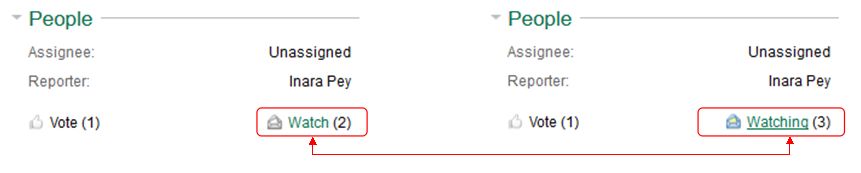
If you find that a feature request already exists for the idea, you can opt to click the Watch option (top tight of a feature request, under People) to receive updates to the Jira via e-mail (you can uncheck Watch should you no longer wish to receive these updates).
You can receive e-mail updates on a Jira by clicking the Start Watching… (l) option (under People in the top right of a displayed Jira). The option will update to Stop Watching… (r), indicating you’re receiving updates. Click the option again to stop receiving updates; the option will revert to Start Watching.
Filing A Feature Request
Setting the Project and Issue Type
Log-in to the Second Life Jira using your Second Life log-in credentials.
Click on the blue Create button in the top menu bar.
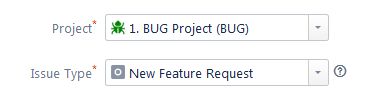
Check the top of the form and make sure:
Project is set to 1. BUG Project (BUG).
Issue Type is set to New Feature Request.
Use the drop-downs to set either, if required.
When filing a feature request, make sure Project is set to 1. BUG Project (BUG), and Issue Type to New Feature Request.
Completing the Form
Summary (required field): provide a concise summary of the feature request (also forms the request title).
If the request is related to a specific project (e.g. EEP), please include the project name at the start of the summary in square braces (e.g. [EEP]).
How Would You Like This Feature To Work (required field): provide an outline of how your proposed feature should work.
Be as clear and concise as possible.
Try to provide a step-by-step guide to how the feature would work.
If the feature is viewer-related and requires a new or updated UI panel, offer image mock-ups of how it should look using the Attachments option, and reference them here.
Why Is This Feature Important To You? How Would It Benefit The Community? (required field): describe why the feature would be useful to you / to Second Life users in general.
Be as clear as possible.
If the request is intended to overcome a specific shortfall in SL, outline what that shortfall is.
If there are a number of potential benefits, list them in turn.
If possible, include a use case on how the featured would be used, if implemented.
Include any relevant images that may help explain things, and reference them here.
Attachment: use this option to add any suitable attachments to the request (e.g. mock-ups of new / updated viewer panels).
Multiple images can be submitted, but ensure each is clearly labelled / annotated and properly referenced in the relevant text fields in the first part of the feature request form.
Keep in mind that individual images can be no larger than 10 Mb in size.
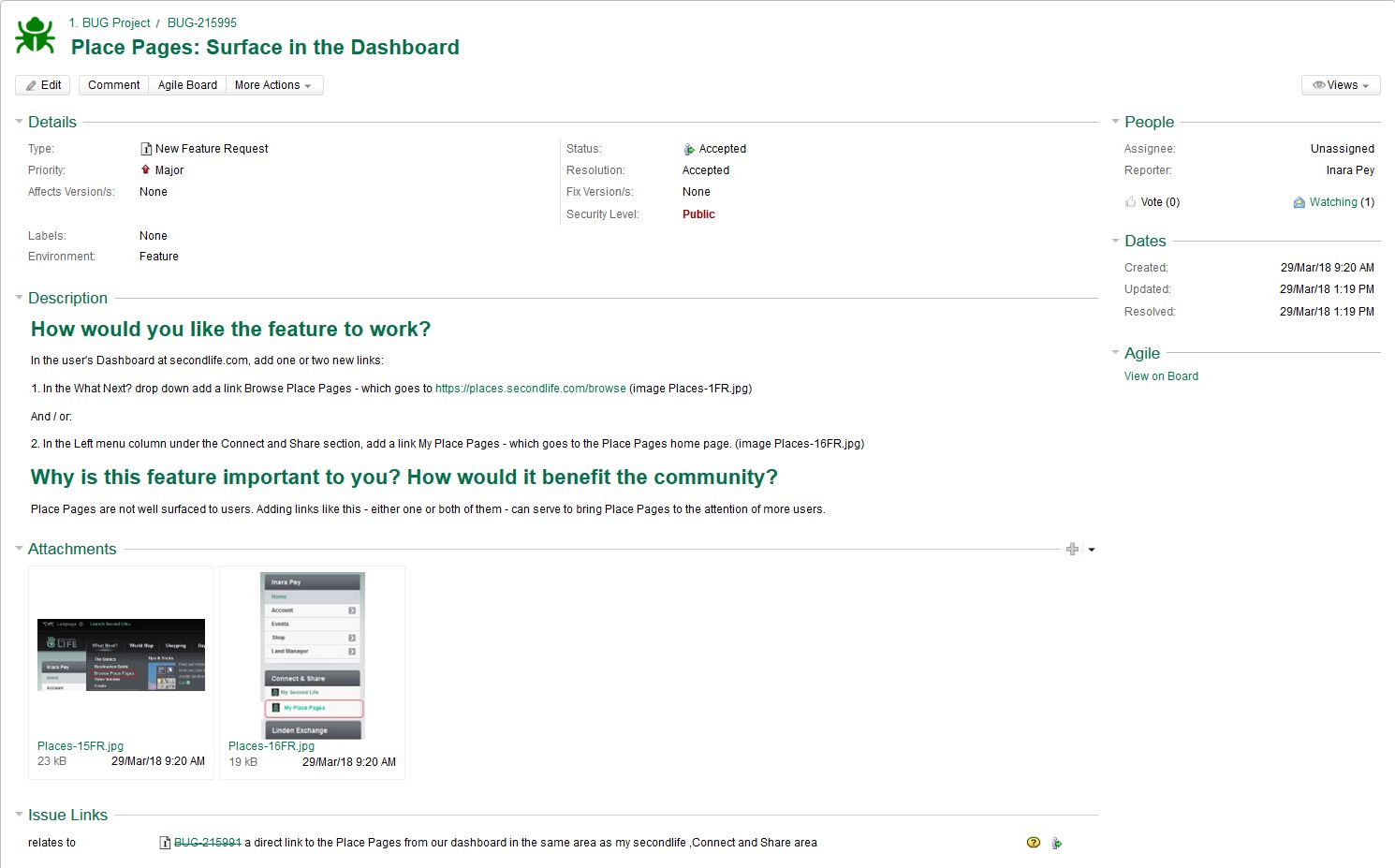
Note that feature requests do not have to be long or complicated. The image below illustrates a simple, straightforward request that has been accepted by the Lab.
Sample feature request, showing that they need not necessarily all be long and complex – click to enlarge, if required
Using a Proposal
If you are offering a significant feature request – such as a new user interface option for users, a new viewer or simulator capability, etc., – consider offering a complete proposal to the Lab, submitted as an attachment to a feature request.
A proposal can:
Let you summarise your idea in the Feature Request form, and then go into greater detail in your proposal.
Allow you to structure your idea clearly, and present it logically and together with related images (UI mock-ups, etc.).
Keep your proposal to a single idea, and don’t forget to explain how it should work and why it would be of benefit. It doesn’t have to be a treatise, just so long as it explains the idea, why you believe it is important and how it would benefit the SL community.
A proposal can be attached to a feature request as a .PDF file or included as a link to a publicly viewable Google Docs file.
When you have confirmed the information is correct and as clear as possible, and any images / files you wish to include are attached, click the Create button at the bottom right of the form to file your bug report.
Refer to What Happens Next?, below, for information on what happens to a filed bug report.
Commenting on Filed Requests
Sometimes after filing a feature request, there may be additional information you wish to add. You can generally do this via the Comment button at the bottom of a feature request page.
Who can comment on a feature request depends on a variety of factors, including general permissions, the security level for the report (Public or Triagers and Reporters), together with the current status of the report (Open, Needs More info, Accepted).
If the Comment button is unavailable, you will need to request permission to make Jira comments. Send an e-mail to letmein-at-lindenlab.com, giving your avatar name and a clear reason for requesting access.
Note that you do not need comment rights in order to file bug reports or feature requests.
What Happens Next?
The Jira Workflow
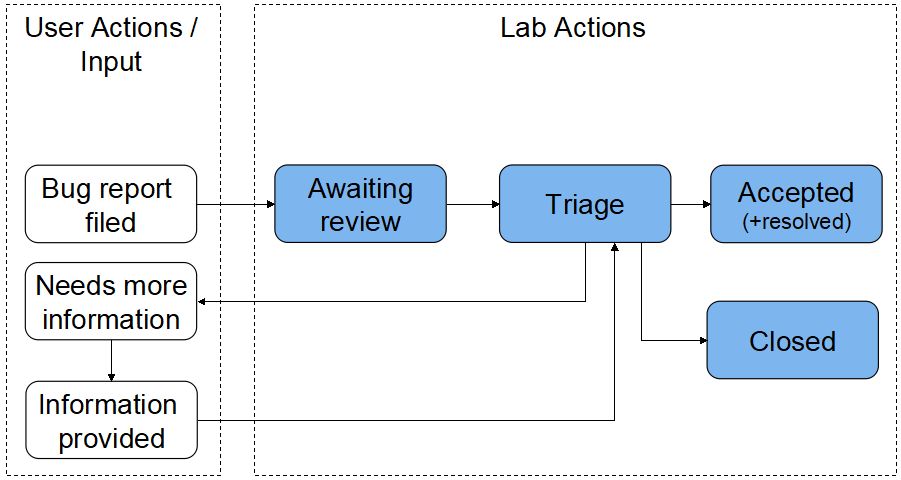
A submitted feature request follows a set workflow, as shown in the diagram below.
The Jira workflow – simplified
Awaiting Review: when you submit a feature request, it enters a queue for review (triage) by the Lab’s QA and Product teams.
Triage: incoming requests are triaged on a weekly basis. The outcome is generally one of the following, as indicated in the status area of the report:
Needs More Information: if the report is vague or not easy to understand or doesn’t contain sufficient information needed to understand the request, it will be flagged by the Lab as requiring more information from the reporter.
This sets the Needs More Info flag on the feature request, and in addition a comment is generally provided by the Lab as to what is required.
The reporter should review the request and any comment(s) recorded by the Lab and attempt to provide the missing information.
Information Provided: when additional information has been added to a request, it is essential the Info Provided button is clicked. This will update the bug report to inform the Lab that the information has been supplied. Note that a failure to click the button could result in a delay in a request being further actioned.
The Needs More Info flag (arrowed) and the Info Provided button
Accepted: the feature request is accepted by the Lab and cloned into their internal JIRA system for tracking.
However, Accepted does not mean a feature request will acted upon immediately. Rather, it may mean the Lab are sufficiently interested in the idea to keep track of it, but implementation may be held until such time as it fits / can be slotted into the SL development road map.
Sometimes, on further reviewing a bug report / feature request, Linden Lab may request even more additional information, and will re-open the original (see Needs More Information, above).
Once an accepted report / feature request has been implemented, the originating Jira will be Closed with a status of Resolved.
Closed: the request is not to be taken any further. Typically, a feature request will be closed and annotated with one of the following reasons:
Duplicate: there’s another feature request covering the same idea.
Unactionable: the described feature has been declined by the Linden Lab feature request review team.
Not Applicable: the reporter has decided to close the issue.








 Inara Pey: Living in a Modemworld