We set a theme and we go our own ways. We take pictures at any sim in the whole of Second Life for about 2 or 3 weeks, and then at the agreed date, we combine our picture at the Café Gallery.
– Lynx Luga and Kit Boyd describing their personal photo challenges
Photo challenges are not new to Second Life, but Kit and Lynx, owners and curators of the Monocle Man gallery spaces and hang-out, use them to good effect to capture images in a thematic manner whilst allowing them to jointly see Second Life in a way that might otherwise be missed or taken for granted.
For their latest joint challenge, now on display at the ground-level Monocle Man Café they offer The Neon Challenge: images of Second Life featuring or focused on the use of neon across the grid.
Monocle Man: The Neon Challenge
Neon is very much a part of Second Life; who hasn’t been to a cyberpunk / Bladerunner / sci-fi themed location, and not encountered neon signs, logos, and lighting? Similarly cityscapes oft have neon signage for stores and locations. As such, its not surprising that some of the images in this selection are from such locations – but they are not, as one might perhaps think, in the majority.
Both Lynx and Kit have cast their nets wide, such that while the sci-fi / Bladerunner, etc., elements are present, they mostly offer unique views and subtle hints (Videophone, Cyberpunk Circles). What’s more they are displayed alongside pieces where neon, whilst present, is not seen as the immediate focus. Instead it sits as a part of the complete picture, forming part of the narrative, rather than being the narrative (Neon Doggy, Trailer Park, Busted, Sexy Legs and Neon Girl).
Monocle Man Gallery: The Neon Challenge
Even what might be regarded as the seedier side of neon’s use in adult theme locations and advertising (Sexy Girls, Sexy Neon and Dancing Girls) is framed to offer a story behind the light. Take Dancing Girls in particular; within it lies the the suggestion of a hidden life of wanting being the colour-backed dance of the silhouettes, one that for me brought to mind the lyrics from Elton John’s In Neon.
An engaging exhibition that I believe will be open through the next month.
The north polar region of Mercury showing the disposition of water ice in permanently-shadowed craters. Credit: NASA / Georgia Tech
Mercury, the closest planet in our solar system to the Sun, is hardly the kind of place where you’d expect to find water ice. With surface temperatures reaching 400º C (750º F) on its sunlit side, the planet is fairly constantly broiled by the Sun. And yet NASA’s MErcury Surface, Space ENvironment, GEochemistry, and Ranging (MESSENGER) mission did actually confirm ice on Mercury in 2012.
As with ice on the Moon, this water ice is located in deep craters around Mercury’s poles where the Sun never shines. What’s more, it appears to be created through a similar process and the lunar water ice; however, and in what may seem to be a counter-intuitive fact, the greater heat Mercury endures means it has far more ice located in its polar craters than the Moon.
It goes like this, electrically charged particles from the Sun’s solar wind interact with the oxygen present in some dust grains on the surface to produce hydroxyl (OH – a single hydrogen atom and a single oxygen atom). This hydroxyl bonds in groups within Mercury’s surface material, just as they do on the Moon.
On both the Moon and Mercury, heat from the Sun both frees these hydroxyl groups and energises them, causing collisions that that produce free hydrogen and water molecules. Some of these water molecules are broken down by sunlight and dissipate. But others descend into deep, dark polar craters that are shielded from the Sun. Here they freeze to become a part of the growing, permanent glacial ice housed in the shadows.
However, because Mercury is so much closer to the Sun, the greater exposure to the solar wind and – more importantly – greater heat means that the production and release of hydroxyl means that the production of hydrogen and water molecules is much greater – and some is the volume of those molecules falling into polar craters. Thus, the production of water ice on Mercury is much more pronounced – so pronounced that it is estimated some 10,000,000,000,000 kg (11,023,110,000 tons) of ice is generated over the course of 3 million years, cumulatively enough to account for around 10% on the total ice found on and under the surface of Mercury – the rest having being delivered via asteroid bombardment in the planet’s early history.
The process of the ice falling into the craters is a little like the song Hotel California. The water molecules can check in to the shadows, but they can never leave.
– Thom Orlando, Georgia Tech, a co-author of a new study into water ice on Mercury
Starliner: 61 Changes Required
On Friday, December 20th, 2019, NASA and Boeing, together with launch partner United Launch Alliance (ULA), attempted to undertake the first flight of the Boeing CST-100 Starliner commercial crew transportation system to the International Space Station (ISS).
The mission – called Orbital Flight Test-1 (OFT-1) should have seen the uncrewed Starliner craft achieve orbit and then rendezvous with the ISS, where it would dock and spend several days there before making a return to Earth and a parachute landing in the Mojave desert.
While, as I reported in Starliner’s first orbital flight, the majority of the mission was a success – the vehicle achieved orbit and was able to carry out as series of orbital tests before returning safely to a soft landing, issues with the craft meant the capsule incorrectly initiated a series of firings of the vehicle’s attitude control system (ACS) when they were not required. By the time the errors were corrected, the vehicle had insufficient fuel reserves left in the ACS system tanks to achieve a safe docking with the station, thus causing the rendezvous to be abandoned.
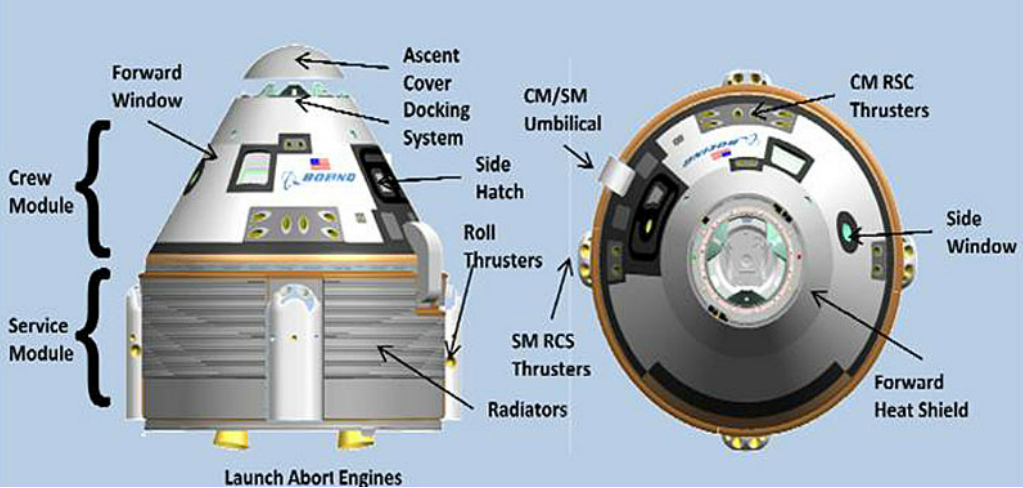
The CST-100 Starliner system. Credit: Boeing
Since then, NASA and Boeing have been investigating the root cause of the ACS timing misfiring. The results of these investigations identified both technical and organisational issues within Boeing’s management of the CST-100 programme. At the same time, a NASA internal review identified several areas where the agency could make improvements with regard to its participation in the production and testing of Orion capsules.
In all, some 61 corrective actions have been identified by NASA that Boeing need to make to both the processing of Orion vehicles and in their flight management organisation. These include gaps in processes that prevented ground-based mission controllers identifying what had gone wrong with OFT-1 in order to initiate corrective action that might have allowed the vehicle to go forward with its rendezvous with the ISS.
Boeing has accepted all 61 recommendations from NASA, and has started to implement them. At the same time, it has indicated it is to overhaul all of its testing, review, and approval processes for CST-100 hardware and software, and institute changes with its engineering board authority. NASA also plans to perform an Organisation Safety Assessment (OSA) of the workplace culture at Boeing prior to any future CST-100 flights.
The OFT-1 Starliner following its successful return to Earth, December 22nd, 2019
While there was no crew aboard the test vehicle, NASA has nevertheless designated the flight a “high visibility close call” in accordance with their own procedural requirements. This means that while it is unlikely they would have threatened a crew had they been aboard (in fact, a crew would likely have been able to immediately respond to the ACS issue and correct it) the anomalies during the flight were simply too big to ignore, and could have led to serious consequences under different circumstances.
No date has yet been confirmed for the second orbital flight for a Starliner vehicle. This is due to deliver a crew of three NASA astronauts (Nicole Mann, Mike Fincke and Christopher Ferguson) to what might yet be an extended stay at the ISS in what is regarded as the final test flight for the CST-100.
The first “operational” flight for Orion will comprise NASA personnel: mission commander Sunita Williams and Josh Cassada, ESA astronaut Thomas Pesquet and cosmonaut Andrei Borisenko. This flight will see the vehicle used in OFT-1 re-used as part of NASA’s plans to fly each CST-100 a number of times. Commander Williams was on hand to witness the vehicle’s return to Earth at the end of OFT-1, and she named the vehicle Calypso.
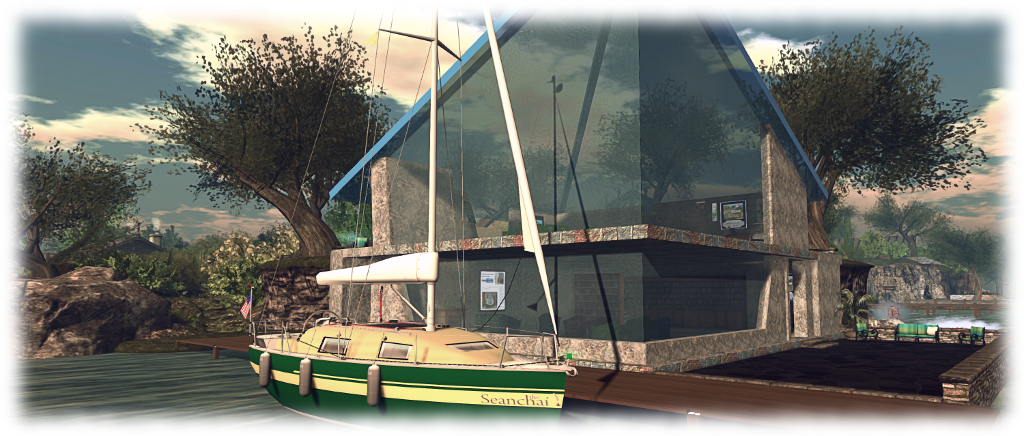
Sunday, March 22nd sees Seanchai Library celebrating 12 continuous years of bringing stories, literature, poems and more to life in Second Life and beyond through the spoken word.
Founded in 2008, Seanchai Library has presented thousands of storytelling events across the grid, and in the process, raised thousands of real US dollars for numerous charities. Starting life as the West of Ireland Library and Cultural Centre, a part of the West of Ireland Charity Estate, the Library has, from the beginning, sought to create a different kind of Library from others found in virtual spaces.
Rather that establish a virtual place where the written word might be read – generally via note card, which has its own limited formatting issues – the Library’s Founder, Derry McMahon decided to offer a presence where stories – original, short or long, novels, poems, great works, classic tales, and fables from all genres could be shared live, in voice; the intimacy of a well told story bringing an added dimension and depth to the listener’s experience, further stirring their imagination.
From the telling of its first story in March 2008, Seanchai has grown to become the foremost voice storytelling group in Second Life. In 2010, the Library joined the Community Virtual Library (CVL) estate in Second Life, where it officially adopted the name Seanchai (pr. Shawn-a-kee – A traditional Irish storyteller/historian) Library. Since then, Seanchai has expanded its programme and virtual presence. Notable points in the Library’s history include:
(2014) Expanded to the OpenSim / Hypergrid enabled Kitely, offering a range of programmes and events to a broad audience of virtual world users.
(2014) presented the first virtual / physical world presentation in what would become their EXPLORE programme to build partnerships with educational and arts institutions to use virtual platforms as tools for audience development, education, exploration, dramaturgy, and more. Explore The Great Gatsby, presented via Kitely and in partnership with the Tacoma Little Theatre (TLT), in Tacoma, Washington state. To date, three such programmes have been produced, with more in the planning stages pending funding.
(2015) In partnership with CVL, Seanchai Library established a presence on (the now defunct) InWorldz grid, which operated for two years prior to both CVL and Seanchai withdrawing from InWorldz.
(2017) Seanchai Library relocated to Holly Kai Park as part of the integrated arts programming at the Park.
Over the years, Seanchai has made numerous immersive storytelling presentations across Second Life, in addition to their Sunday-through-Thursday sessions hosted at their headquarters. These have included presentations of H.G. Wells’ War of the Worlds, an annual trip to Victorian England with The Dickens Project, special events so celebrate St. Patrick’s Day, International Talk Like a Priate Day and more. They have shared their talents with numerous groups and events across Second Life.
Today, Seanchai Library remains as productive as ever, offering anyone in Second Life the opportunity to enjoy the long tradition of spoken-word stories from all genres, as read by their talented staff, volunteers and guests.
Seanchai library celebrates 12 years of storytelling
To mark their 12th anniversary, Seanchai Library is offering a mix of stories and music through the afternoon of Sunday, March 22d, the programme comprising:
From 13:00 SLT – Volume 12:
Shandon Loring reads The Leprechaun’s Gold by Pamela Edwards.
Elrik Merlin an Da5id Abbot with Trouble in the Works by Harold Pinter.
Kayden Oconnell and Caledonia Skytower with The Seller of Dreams by Henry Beston.
Corwyn Allen with Dr. and Mrs. Watson at Home: a Comedy in One Unnatural Act by Loren D. Estleman.
Aoife Lorefield with Selected Poetry.
14:00-15:00 SLT – Radio Riel DJ Challenge #4 – Celtic: music & Dancing in Ceiliuradh Glen as three DJ’s take three different views of the theme, broadcasting from The Glen on Radio Riel:
14:00:Elrik Merlin.
15:00: Ktadhn Vesuvino.
16:00: Gabrielle Riel.
Seanchai in the Coming Week
And why not join Senachai Library during their normal weekly schedule. As always, all times SLT, and events are held at the Library’s home at Holly Kai Park, unless otherwise indicated.
Sunday, March 22nd, 18:30: The Secret Garden
Caledonia Skytower continues this classic of children’s literature by Frances Hodgson Burnett, first published in 1911, at the Golden Horseshoe in Magicland Park.
Orphaned after losing her parents in a cholera epidemic, young Mary Lennox returns to England from India, entering the care of her uncle Archibald Craven, whom she has never met.
Up until this point, Mary’s childhood had not been happy; her parents were selfish and self-seeking, regarding her as a burden over which they were not obliged to hold much responsibility. Not overly healthy herself, she is as a result a temperamental, stubborn and unmistakably rude child – and her arrival at Misselthwaite Manor and the relative gloom of Yorkshire’s weather does little to improve her mein.
Her disposition also isn’t helped by her uncle, who is strict and uncompromising, leading to Mary despising him. But her uncle’s story is itself filled with tragedy, particularly the loss of his wife. As she learns more about her uncle’s past, so Mary also finds out about a walled garden Mrs. Craven once kept, separated from the rest of the grounds and which, since her passing has been kept locked by Mary’s uncle, the door leading to it kept locked, the key to it buried somewhere.
Finding the missing key and the now hidden door, Mary enters the garden, and her passage into it starts her on a journey of friendship and discovery, one that leads her to the thing she never really knew: family.
Monday, March 23rd 19:00: The Ugly Little Boy
Gyro Muggins reads a tale that started life as a short story by Isaac Asimov, and was later expanded into a full length novel by Asimov writing in collaboration with Robert Silverberg.
A 21st century time travel experiment results in a Neanderthal boy being pulled from his time. The intention is to study the boy and understand how his kind lived. However because of the potential for time paradoxes, the boy must be kept in a within a stasis module, a place physically separated from modern time; but he must still be cared for. So the company behind the experiment hires a children’s nurse, Edith Fellowes, to look after him.
Initially horrified by the child, Edith comes to forms a bond with him, discovering he is intelligent and capable of both learning and love. However, to Stasis – the company behind the experiment – the boy is little more than a commodity to be observed and with a story to be sold to the media. As such, he is only of value for as long as there is public interest in his story. When that fades, the company determines the child must be returned to his own time, his place to be taken by a subject from another era. But Edith knows that, thanks to all she has taught him, his own time is no longer a place he is equipped to survive within, and determines she must take action to protect him.
Tuesday, March 24th 19:00: Goblin Lake
During the Thirty Years’ War, a soldier named (of course) Jack is, for a prank, thrown into a lake whose waters are said to change anything they touch. Beneath the surface, Jack finds a whole other world where time passes rather differently, falls in love with the king of the lake’s daughter.
But – what is fiction, and what is reality?
With Willow Moonfire.
Wednesday, March 25th, 19:00: The Phantom Tollbooth
Finn Zeddmore reads Norton Juster’s fantasy adventure for younger readers.
For Milo, everything is a bore and all activities little more than a waste of time. Then one day he arrives home in his usual state of disinterest, only to find a package waiting for him. He has no idea where it has come from or who might have sent it, but is clearly intended for him, given the label. Opening it, he discovers a small tollbooth and a map of “the Lands Beyond,” illustrating the Kingdom of Wisdom.
Reading the limited instructions – that warn him to have a destination from the map in mind – and thinking the package to be some kind of game, he sets the tollbooth up, decides Dictionopolis should be his destination, and propels the accompanying little car through the tollbooth.
Immediately he finds himself driving an actual car through a city that is clearly not his own. Here he discovers he must remain focused, lest his thoughts wander, and his journey wanders as well; a lesson he only discovers when he does daydream and finds himself in the Doldrums.
Also as he travels and meets new friends, so he also realises something else: life is far from boring or dull; it actually offers much to be discovered.
Thursday, March 26th
19:00: Bane and Balm, A Fae Tale of Eire
Shandon Loring reads Jenna Elizabeth’s Johnson’s short story. Also in Kitely! Find teleport from the main Seanchai World grid.kitely.com:8002:SEANCHAI.
21:00 Seanchai Late Night
Contemporary Sci-Fi-Fantasy with Finn Zeddmore featuring stories from sources including Escape Pod, Light Speed, and Clarkesworld on-line magazines.
Lighthouse IMAGINATION, March 2020 – click any image for full size
We were drawn to ARNICAR India’s build of Lighthouse IMAGINATION, located on her Homestead region of Everlong, through another recommendation from Shawn Shakespeare, and it presents a truly marvellous, atmospheric location. Sitting beneath a cloud-marbled evening sky (although I’ve admittedly used an alternate sky setting in the images here), it is a windswept place, largely denuded of trees, rich in detail and the kind of setting that calls on you to stay and immerse yourself in its wild beauty.
The island rises from a slightly troubled sea, waves breaking over offshore groups of rocks, a skirt of gravel coast sitting between waves and the rising rocky face of the island, the undulating back of which is covered in moss-like grass. It’s a place that is home to less than a dozen trees, many of which are wizened with aged, backs bent as if curled against the winds that must surely wail across this lozenge-like landscape when the weather turns. Shrubs fair better than trees here, cliff edges and the rills between rock tops heavy with their greenery even as finger of bushes stretch out across flatter parts of the island’s top.
Lighthouse IMAGINATION, March 2020
This is a place dominated by a single structure: a massive brick-built lighthouse that stands firm upon a great stone foot anchored at the island’s northern end. The multi-faceted eye of this massive industrial-looking place turns unblinkingly, warning away the ships that can be seen to sail slowly by, their outlines softened by off-shore mists, and that might otherwise stray to close to the dangers posed by the rocks lurking beneath the waves.
The Lighthouse is a place that again speaks to the dark moods of nature that can perhaps lash this island: the great stone footings, the heavy brick walls, the use of iron girders and steel plates rather than wooden stairs and platforms to provide ways up to the lighthouse and around its tower to the light. Both metal and steel may be rusted, but they are robustly bolted together and embedded in the walls of the lighthouse, ready to stand firm against whatever Nature might throw at them – although it’s hard not to feel pity for the lighthouse warden who has to travel the exposed, curling path up to the light in times of storm…
Lighthouse IMAGINATION, March 2020
To compensate for such times, the interior of the lighthouse is warmly furnished and equipped. A cast iron stove heats the main living room, a second, wood-burning stove likewise heating the room above and to one side of it while the third offers creature comforts: ale, billiards and a chance to forget what’s outside should the weather turn.
Getting around the top of the island is assisted by an old bridge and lashed trunks of fallen trees, all of which span the rills and cuts that divide the land. However, getting down to the shoreline is a little harder (indeed, getting up and into the lighthouse can be a bit of a challenge); explorers need to find the appropriate points in the island’s flanks where the rocks dip to provide natural trails down to the surrounding ribbon of gravel.
Lighthouse IMAGINATION, March 2020
It’s worth taking the time to find these paths down and exploring the island’s narrow coast, as both will reveal more of its secrets and beautiful detail; places to sit, owls, birds and waterfowl to observe, sheep to wander past, a shoreline photographer to slip but without disturbing – and more.
These delights extend offshore as well, both to the south-east and to the west. At both of these points, paths are marked through the shallows. One of these leads to a wooden birdwatcher’s nest perched on an outcrop of rock and raised above the risk of tidal flooding and the annoyance of waves and spray by stout wooden legs. It is a cosy little place, rich in art and ideal for escaping other island tourists – or for observing them from a distance.
Lighthouse IMAGINATION, March 2020
The second path, marked by two of Cica Ghost’s ducks walking it, points to a tiny offshore setting that is an absolute delight: a partially sunken garden terrace, home to a grand piano sheltered by another aged tree, a chandelier hanging from one of its boughs. This is a totally unexpected setting to come across, utterly serene and offering a further nuanced depth to the region.
Quite marvellously designed, enriched by the local sound scape, offering much to explore whilst keeping a wonderfully desolate beauty, Lighthouse IMAGINATION is a fabulous visit – one bound to set your own imagination free.
The following notes are taken from the TPV Developer meeting held on March 20th, 2020. These meetings are generally held every other week, unless otherwise noted in any given summary. The embedded video is provided to Pantera – my thanks to her for recording and providing it. Time stamps are included with the notes will open the video at the point(s) where a specific topic is discussed.
The Premium RC viewer,version 6.3.8.538264 dated March 12th, updated to de facto release status on Wednesday, March 18th.
The Zirbenz Maintence RC viewer, version 6.3.9.538719, was issued on Thursday, March 19th.
The EEP RC viewer updated to version 6.4.0.538823 on Friday, March 20th.
The rest of the upcoming official viewer remain unchanged as:
Release channel cohorts:
Love Me Render RC viewer, version 6.3.7.536179, February 10.
Camera Presets RC viewer, version 6.3.6.535138, January 24.
Project viewers:
Copy / Paste viewer, version 6.3.5.533365, December 9, 2019.
Project Muscadine (Animesh follow-on) project viewer, version 6.4.0.532999, November 22, 2019.
Legacy Profiles viewer, version 6.3.2.530836, September 17, 2019. Covers the re-integration of Viewer Profiles.
360 Snapshot project viewer, version 6.2.4.529111, July 16, 2019.
General Viewer Notes
Premium Viewer and Future Viewer Blocking
The Premium RC viewer contains new code to specifically handle benefits information related to benefits / limits applied to accounts based on subscription level (Basic, Premium or the upcoming Premium Plus).
Previously, this information can from a variety of sources, with some also hard-coded into the viewer, which made management of benefit changes etc., difficult.
With the future launch of Premium Plus and multiple benefits / limitations and associated values across multiple SL account types, all of this information will be provided directly by the server to the viewer at log-in, to make the on-going maintenance of such benefits and values (including the addition of new benefits / values) as used by the viewer easier to implement and manage.
Until Premium Plus goes live (there is no date at present for when this will happen, other than after Name Changes has been deployed), the changes in this viewer should not impact users. However, TPVs are being asked to adopt the code as soon as they can.
[0:39-0:54] At some point after Premium Plus has been implemented, Linden Lab will be blocking older viewers that do not have this code update, in order to encourage users to switch to viewer that utilise the code.
This step is being taken to ensure the viewer presents accurate information to users about their benefits / fees / limitations, rather than being provided with out-of-date information that is hard-coded into their viewer.
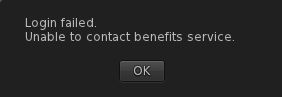
[18:42-20:10] Benefits Service log-in failure messages: some people may have encountered an intermittent log-in failure messages similar to the one shown below over the past couple of weeks (I first encountered the problem on March 7th, 2020, others have been encountering it as recently as March 19th).
Benefits Service log-in failure, March 7th, 2020
The problems have apparently been due to “super brief” outages (and automatic recoveries) with the benefits service, which the Lab is still investigating for a root cause.
This is the type of message people will eventually see when trying to log-in to SL on viewers that do not have the code currently in the Premium RC viewer, once the Premium Plus service is live, and the switch to using the new benefits information service has been made.
Depending on its time in an RC cohort and the nature of any issues found, EEP version 6.3.8.538264 could be the final version of this viewer, and destined for promotion to release status in the next few weeks.
It is unlikely any promotion will occur during week #13 (commencing Monday, March 23rd), because a) the viewer requires time in its cohort to check for issues / crash rates, etc.; and b) the week #12 promotion of the Premium RC viewer.
If the viewer performs well, and no significant issues are found with it or with EEP in general, it would seem likely the view will be promoted some time in the two weeks after week #13.
However, if problems remain with EEP, it is possible the tools update viewer (see below), when available, might be fast-tracked for promotion ahead of EEP.
The previous iteration of the EEP viewer reportedly had one of the lowest crash rates for any LL viewer.
The love Me Render RC viewer is unlikely to be promoted until some time after EEP has reached de facto release status, so as not to have two blocks of rendering changes released one atop the other.
The Camera Presets RC viewer has an update, and should be appearing shortly, once merged with the new release viewer code. This will also not be promoted prior to EEP.
The first public viewer using the updated viewer build tools (VS 2017 and a recent version of Xcode for Mac and which uses the new Github repositories) is going through its “last massive rebuild”, and an RC version is expected to be made available in week #13.
This viewer will be functionality identical to the release viewer; there are no UI or other changes to it, other than bug fixes required by the move to the newer build tools.
This build has yet to address the notarising MAC application issue that results in warnings being issued by OS X “Catalina”. However, LL recognise this issue needs to be addressed , and will be doing so.
Depending on how this viewer fairs in RC compared to the EEP viewer, it might be fast-tracked for promotion to de facto release ahead of EEP.
[10:23-11:04] The Legacy Profiles RC viewer has a bug where under some circumstances it will display the profile web feed information in error, which needs to be addressed before the viewer progresses further (the web feed to the viewer will be turned off from the back-end once the Legacy Profiles viewer is promoted to release status).
In Brief
[17:15-17:36] There are some inventory operations (e.g moving a folder, renaming a folder, etc.) that are under UDP. There is a plan to move all such operations to AIS (HTTP), but this work will likely not be tackled until after the work on the cloud uplift has been completed.
[17:39-18:18] Because of the uplift work, and outside of major projects such as EEP, Name Changes and Premium Plus, the number of server / back-end changes that the Lab make will be “quite constrained” over the course of the next 12 months or so.
[20:15-21:53] The texture caching work in the viewer in on-going, alongside all other viewer-side work, as none of this conflicts with the cloud uplift work.
The first step will be to re-implement the VFS in a “simpler, cleaner way”.
After this, work will extend into revising the texture cache.
Also, “behind” the texture cache work, there is further work on texture fetching via HTTP2.
[22:02-26:25 (inlc. text chat)] BUG-227179 “All offline inventory offers from scripted objects are STILL lost” – LL are still “trying to figure out” the cause of this long-term issue. Firestorm reverted the problem, and requests have been made for LL to do the same, but the Lab would rather “fix” the problem – which doesn’t entirely help those who are victim to inventory loss resulting from it.
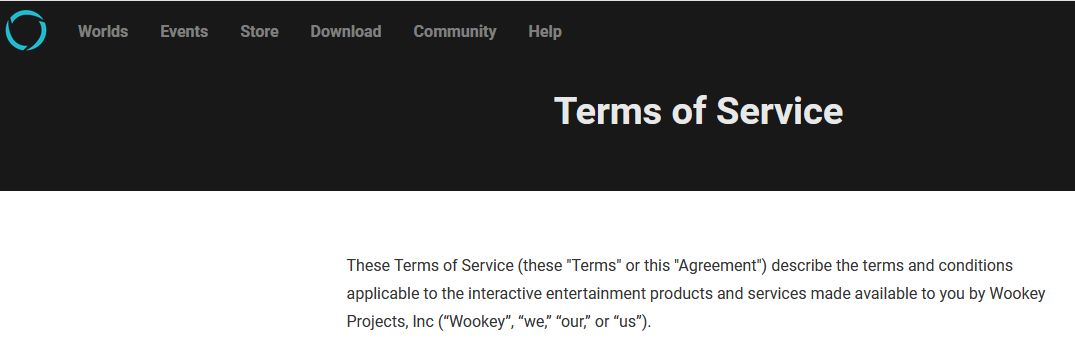
The Sansar Terms of Service and Privacy Policy (which broadly remain the same as previous Terms of Service for the platform, have been revised to reference “Wookey Projects Inc (Wookey)”.
There are some hiccups evident in the change-over: when logging-in to Sansar via the web, users may get a log-in pop-up asking them to agree to the new Terms of Service, but I found the link still points to the Lab’s ToS page for Sansar, resulting in a 503 page error. Doubtless, issues like this will be smoothed out in time.
I first noted the absence of Sansar in the footer areas of Linden Lab related web pages (e.g. the SL Dashboard) earlier in the week of March 16th-20th, which first alerted me to possible changes coming in Sansar’s status
Who Are Wookey Projects Inc?
Information is scarce, but in a couple of hours of digging since seeing the Discord speculation, here’s what I’ve (hopefully correctly!) put together:
The address for Wookey Projects Inc is given as:
Wookey
765 Beach Street
San Francisco, California 9410
This puts it remarkably close to the Lab’s own stomping grounds at Battery Street.
But more particularly, and going by the corporate logo, Wookey Projects Inc., appears to be either and offshoot of, or new operating name for Wookey Search Technologies (strapline “We removed the search bar from search”).
The latter’s place of address is given as 235 Montgomery Street Suite 912, San Francisco, CA 94104, so its not entirely clear if Wookey Technologies and Wookey Projects will operate as separate entities, or whether the latter’s address might signify a physical move on the part of Wookey Technologies. Certainly, both entities appear to share the same web domain of wookey.com.
Wookey Technologies was founded by Mark Gustavson, who serves as the Chief Financial Officer, with Garnet Chaney serving at the Chief Technology Officer, and Steve Moriya as the Senior VP of Marketing. The web page also gives Jonathan Fried as serving as interim CEO.
The Wookey Technologies Management Team: Mark Gustavson (Founder / CFO; Garnet Chaney (CTO) and interim CEO (r) Jonathan Fried.
Peeking behind the curtain of the company’s website, it appears that they are spreading their wings and moving into the VR / AR environment, with the About Us page reading:
Wookey started from our own experience. Just like you, we saw the limitations of flat, one-dimensional internet interaction. With each experience, the frustration grew. It’s evident that algorithms are telling me what it wants, not hearing what I need.
What if we could create on-line experiences that were unbiased and arranged by relevance to us, not by advertisers or bias of company? We realized, with the right team and the right investors, we can.Wookey was born.
We endeavour to create a new generation of on-line AR/VR experiences that allows users the power of collaborative interaction through knowledge immersion.
Interestingly, and despite having been around since approximately 2016, the company describes itself as “approaching the beta stage of development”. Quite what this involves is unclear, but I assume it is in relation to their move to focus VR / AR. In this, and given the changes to the Sansar ToS and PP, it would appear likely they are seeking to keep the platform going in some active form, at least for the time being, possibly as a (further?) means of leveraging themselves into the VR space.
If this is correct – and keeping Sansar alive is certainly what Linden Lab have been hoping to achieve – it will be interesting to see if any of those formerly working on Sansar at the Lab might be involved in the shift of Sansar to Wookey, and whether familiar names might yet be seen to return to the Sansar fold. I speculate on this because, at the time it was confirmed the Lab would no longing be developing Sansar, Lab CEO Ebbe Altberg noted that the company was trying to keep former employees engaged in Sansar involved in discussions in the platforms future:
Yes, there were lay-offs today. A truly wonderful group of people. But as you can see Sansar is up and running. We are still in discussion about next steps. Including with the wonderful group of people. More to come.
In the meantime, we’re still awaiting official word on things from both Linden Lab and Wookey projects Inc. I hope to have more on this as and when something more official is available.











 Inara Pey: Living in a Modemworld